
Low Flow Meter Compliance: Reading ATEX, IP65 and Material Grades
Low Flow Meter Compliance: Reading ATEX, IP65 and Material Grades
Compliance documents are the one part of a low flow meter offer that a buyer can verify before the order is placed, and they are routinely read too quickly. An ATEX certificate records that a defined product, assessed against defined standards, met a defined scope; it does not state that the meter suits a particular line. An IP65 rating describes how a housing behaves against dust and water, not how the installed instrument behaves. A material grade and a pressure rating each answer a separate engineering question. Read together and against the intended duty, these four items do most of the work in a qualification review.
This industry reference explains how each document should be interpreted during low flow meter evaluation for power generation, pharmaceutical and chemical duty, using the certification records held for Silver Automation Instruments — a flow, pressure and level instrumentation manufacturer founded in 2010 in Nanjing, Jiangsu, China, operating a 10,000 m² factory with around 80 employees and a reported 95% export ratio — as a working example. Every certificate number, standard, material grade and pressure rating cited below is taken from the manufacturer's own documentation.
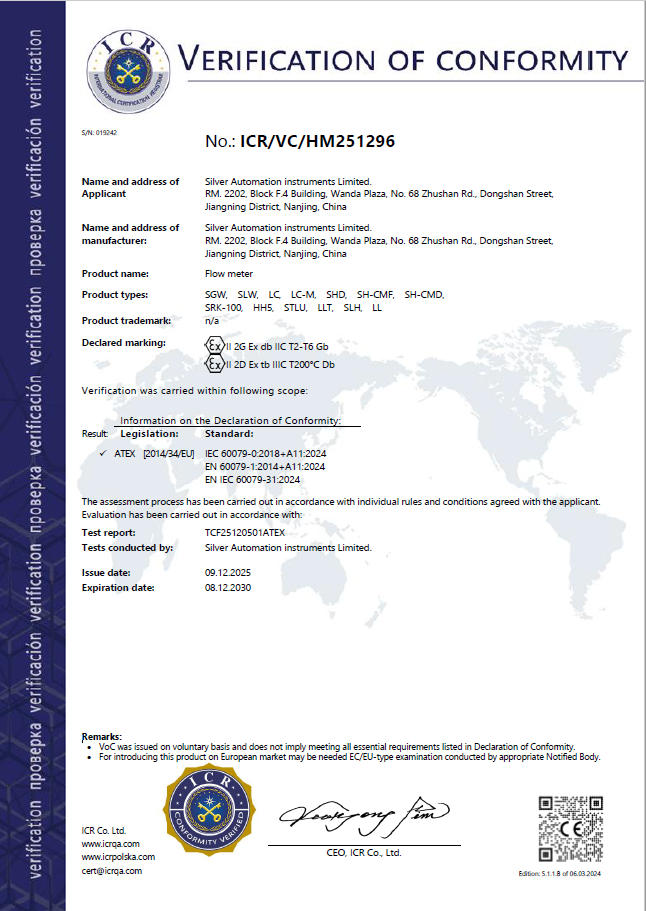
ATEX certificate documentation for a low flow and mass flow meter range — the product list, scope and validity window on the certificate are the first items worth reading.
Compliance as a shortlist filter, not a checklist
Most low flow meter evaluations reach the compliance stage late. Two or three candidates are already close on flow range, turndown, output signal and price band, and the documentation pack becomes the tie-breaker. That is exactly when the pack is most often misread, because the pressure to close a comparison encourages binary questions: present or absent, yes or no.
A binary check answers one question. Context-based qualification answers five: which products are named on the certificate, what scope was assessed, which standards were applied, how long the document remains valid, and whether the assessed result matches the real duty. Only the first of those can be answered by looking at the logo on the front page.
Reading the ATEX documentation on low flow and steam meters
In this documentation set there are two ATEX certificates. The first, ECM 22 ATEX-B 0S05, was issued by Ente Certificazione Macchine srl on 21 February 2022 and is recorded as valid to 20 February 2027; it names the SRK-100 thermal mass flow meter and the SH-CM Coriolis mass flow meter. The second, ICR/VC/HM251296, was issued by ICR on 9 December 2025 and is recorded as valid to 9 December 2030; its product list is broader and includes the SH-CM Coriolis mass flow meter, the SRK-100 thermal mass flow meter, the SRK-DL low flow thermal mass flow meter, the STLU-VFN steam mass flow meter and the SH-CMF-FE Micro Coriolis mass flow meter.
Both certificates record a scope of Zone 2. The standards recorded against ICR/VC/HM251296 are IEC 60079-0:2018+A11:2024, EN 60079-1:2014+A11:2024 and EN IEC 60079-31:2024. The earlier ECM certificate records EN IEC 60079-0:2018/AC:2020, EN 60079-1:2014 and EN 60079-31:2014. For a procurement file, those entries matter because a newer certificate that references updated editions of the same standard is easier to defend in an audit than a document that has been superseded.
What the certificate product list tells you
The ATEX-approved steam mass flow meter STLU-VFN appears on the 2025 certificate, and the SH-CM Coriolis mass flow meter appears on both. A certificate assigned to a named model is different from a certificate assigned to a generic product family: it lets the buyer tie a specific model code, and the flow meter duty behind it, to a specific document. When a supplier presents a certificate without a model list, the qualification step is incomplete until the link between document and model is established.
What the Zone 2 scope does not cover
Neither certificate extends to Zone 0 or Zone 1. A buyer specifying for a more hazardous classification should therefore treat Zone 2 documentation as partial evidence at most, and seek documentation that matches the required category rather than extrapolating from it. This is the most common misreading of ATEX paperwork in low flow metering: the presence of a certificate is treated as a blanket approval, when in fact the scope line on the certificate defines where the approval applies.
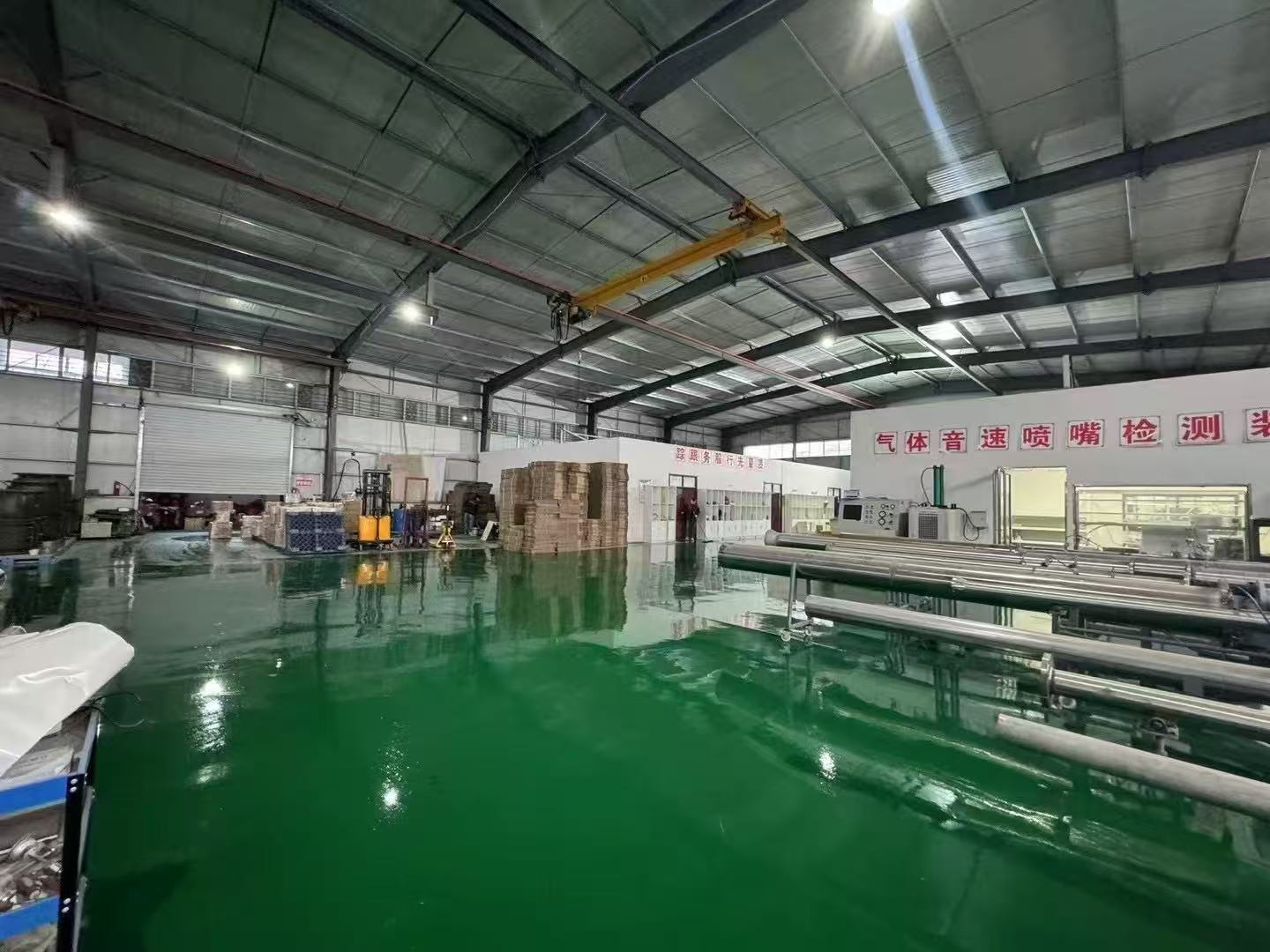
Calibration and test activity behind a documented flow meter range — a certificate states what was assessed, while calibration records show how the instrument is verified before shipment.
What an IP65 rating contributes to the decision
In this range, an IP65 protection level is specified for the SH-CM Coriolis mass flow meter. The rating is written as two digits. The first digit describes resistance to the ingress of solid objects and dust; the second describes resistance to water. A value of 5 in the second position denotes protection against directed water jets rather than immersion.
That translates into two practical procurement benefits. The first is washdown duty: in food, beverage and pharmaceutical areas, instruments are routinely cleaned by spray or hose, and an instrument that cannot tolerate that regime will fail long before its measurement performance is questioned. The second is outdoor or semi-outdoor installation, where rain, condensate and periodic hosing are part of normal operating conditions — steam lines, district heating, water and wastewater sites and tank farms are typical examples.
The boundary is equally important. IP65 is not an immersion rating, so applications requiring periodic submersion, flooding or full immersion cleaning lie outside what the rating alone supports. The rating also applies to the instrument housing; cable entries, glands and junction boxes form part of the installed protection and are normally addressed by the project's own installation documentation rather than by the instrument certificate.
Material grades: 304, 316 and 316L in context
The documentation records different grades for different products. The SRK-100 thermal mass flow meter lists stainless steel 304 for the sensor. The STLU-VFN steam mass flow meter lists stainless steel 304 in its sensor specification and stainless steel 304 or 316 in its material field. The SH-CM Coriolis mass flow meter and the SH-CMF-FE Micro Coriolis mass flow meter both list stainless steel 316L.
Why the distinction matters at the qualification stage: 304 is the baseline austenitic grade used for general gas and steam service; 316 adds molybdenum for improved corrosion resistance; 316L is the low-carbon variant commonly specified for welded construction and for chemical, pharmaceutical and food duty where corrosion resistance and cleanability are priorities. The duty list recorded for the Micro Coriolis reflects that positioning — pure water, silicone, aviation kerosene, diesel, supercritical CO2 and silane, across food, (petro)chemical, pharmaceutical, fermentation, semiconductor and fuel-cell applications.
Where does a standard grade stop being sufficient? In this documentation set, a chlorine gas application is recorded with tantalum wetted material selected for the corrosive medium. That is the practical lesson for buyers: the grade printed on a datasheet is the start of material selection, not the end of it. Aggressive media should be matched against a documented wetted-material decision rather than a generic stainless steel label. Process connection style belongs in the same review — STLU-VFN connection options include flanges, wafers, screws or tri-clamp, which matters where hygienic connections are required in pharmaceutical and food processing.
Pressure ratings and the 30 bar or 100 bar decision point
The SH-CMF-FE Micro Coriolis mass flow meter is documented with a pressure rating of 30 bar or 100 bar, a flow range of 40 g/h to 1000 kg/h and an accuracy of ±0.25% to ±0.5%. Two rating options within one model line mean the pressure decision is taken during configuration rather than after delivery, and that decision should be driven by maximum working pressure with margin — not by the flow range, and not by accuracy figures alone.
Where a duty exceeds the documented rating, the correct step is to move to a high-pressure design rather than to assume the rating can be extended. The Coriolis mass flow meter SH-CM is documented with a flow range from approximately 10 kg/h to 1500 t/h, a size range from approximately 1 mm to 300 mm and a fluid temperature range of −200 to 350 °C; a case record from Chile describes a high-pressure design holding nitrogen at around 700 bar in service for more than three years. Matching body rating to line pressure is therefore a qualification step in its own right, and one that a certificate does not perform on the buyer's behalf.
Temperature belongs in the same review. Steam service with the STLU-VFN is documented to a maximum steam temperature of 500 °C with built-in temperature and pressure compensation, and the case record for a South African saturated steam installation reports reliable mass flow measurement of steam up to 400 °C over more than five years of operation.
Application fit across power, pharmaceutical and chemical duty
Power generation and steam service
The STLU-VFN steam mass flow meter uses the vortex principle for saturated and superheated steam, covers pipeline sizes DN15 to DN300, and is approved under the ATEX certificate referenced above. A South African installation of ten units measuring saturated steam has been in service for more than five years, with the case record noting that the instrument simultaneously detects steam temperature and pressure to calculate mass flow. For compliance reviews in power and district heating, that combination of a named certificate entry, a stated maximum steam temperature and a documented installation history is what makes the steam meter defensible on paper as well as on site.
Pharmaceutical and biotech duty
Here the qualification questions turn on wetted material, cleanability and connection style. The SH-CMF-FE Micro Coriolis mass flow meter lists stainless steel 316L, covers 40 g/h to 1000 kg/h and is rated at 30 bar or 100 bar. Its documented duty includes fermentation equipment and process fluid measurement in pharmaceutical environments, which is consistent with the 316L wetted path and the low-flow accuracy band. A buyer shortlisting for pharma duty should expect the material statement, the pressure rating and the connection standard to appear as separate verifiable entries rather than as a single 'sanitary' claim.
Chemical and petrochemical duty
The SH-CM Coriolis mass flow meter carries the same 316L material listing and the wider flow and temperature envelope described above. Case records in this set include crude oil custody transfer with reported accuracy of roughly 0.1% to 0.5%, dirty crude oil measurement in Saudi Arabia with accuracy up to 0.1%, and high-temperature asphalt at approximately 250 °C measured over more than five years with density and temperature displayed alongside mass flow. The chlorine gas record with tantalum wetted material shows the same pattern from a different angle: where the medium demands it, material selection is documented case by case.
Low flow gas and leak detection
The SRK-DL low flow thermal mass flow meter is documented from 2 sccm to 30 SL/M with an accuracy of ±1% F.S, and is used in semiconductor, medical, analytical instrument, fuel cell and environmental monitoring applications. A recorded installation of three units in China detects air leakage down to 2 sccm, equivalent to roughly 2 ml/min, and has been operating for more than ten years. Notably, all of these meter types appear on the same 2025 ATEX certificate, which simplifies documentation when one site needs hazardous-area coverage across several measurement duties.
Market trend: low-flow demand is rising, and so is documentation scrutiny
Several independent market studies point in the same direction. The global flow meter market was valued at USD 10.64 billion in 2024, with Europe holding the largest regional share at over 35%, according to Grand View Research. Within that market, Coriolis flow meters held a 26.77% share of the intelligent flow meter segment in 2026, based on Fortune Business Insights data, and the 2-inch and smaller pipe size segment is expected to see the fastest growth through 2030 on the strength of demand from pharmaceuticals and food and beverage, again per Grand View Research.
Low gas flow measurement is expanding in parallel: thermal flow meters, the category most associated with low gas flow rates, reached USD 1.73 billion in 2024 and are projected to reach USD 2.9 billion by 2035 according to Market Research Future. As more suppliers enter small-line and low-flow segments, the certificate pack becomes one of the few comparable, independently checkable signals available across a wider field of vendors — which is why qualification reading, rather than certificate counting, is gaining weight in evaluation. Trade data illustrates how active this segment is: Silver Automation Instruments recorded approximately 91 export shipments to 36 international buyers in 2024, according to Volza.
Comparison with traditional solutions and the limits of documentation
Traditional low-flow measurement in this space has relied on mechanical and thermal approaches as well as Coriolis. The comparison below uses only documented specifications from this range, so it reflects what the paperwork actually supports rather than general marketing claims.
| Product / technology | What the documentation records | Typical duty fit | Boundary to check during qualification |
|---|---|---|---|
| SH-CM Coriolis mass flow meter | ATEX Certified (both certificates); IP65; stainless steel 316L; approx. 1–300 mm; approx. 10 kg/h–1500 t/h; −200 to 350 °C | High-pressure gas, custody transfer liquids, viscous and high-temperature media | Zone 2 certificate scope; confirm pressure class and connection |
| SH-CMF-FE Micro Coriolis mass flow meter | Listed on ATEX certificate ICR/VC/HM251296; stainless steel 316L; 30 bar or 100 bar; 40 g/h–1000 kg/h; ±0.25%–±0.5% | Pharmaceutical, (petro)chemical, fermentation, semiconductor and fuel-cell fluids | Pressure ceiling of 30 or 100 bar; material match for aggressive media |
| SRK-100 thermal mass flow meter | Listed on both ATEX certificates; stainless steel 304 sensor; DN15–DN2000; −20 to 300 °C | Natural gas, compressed air, nitrogen, biogas, oxygen, LPG | Gas service only; no liquid duty |
| SRK-DL low flow thermal mass flow meter | Listed on ATEX certificate ICR/VC/HM251296; stainless steel; 2 sccm–30 SL/M; ±1% F.S | Semiconductor, medical, analytical instruments, leak detection | Restricted to very low gas flows |
| STLU-VFN steam mass flow meter | ATEX Approved and listed on ICR/VC/HM251296; stainless steel 304 (304 or 316); DN15–DN300; max 500 °C; built-in temperature and pressure compensation | Saturated and superheated steam, district heating, process steam | Steam service; verify connection style and material choice |
Three limits should be stated plainly, because they are what separate a realistic evaluation from an optimistic one. First, the ATEX scope recorded here is Zone 2, so the documentation cannot be read as covering more hazardous classifications. Second, an IP65 rating supports washdown and outdoor installation but not immersion. Third, the Micro Coriolis pressure rating tops out at 30 bar or 100 bar, so higher-pressure low-flow duties require a different body design rather than a reinterpretation of the same specification.
A fourth limit is structural rather than technical: instrument certification does not certify an installation. Cable entries, enclosures, earthing and process connections are project-level items, and a qualification file that stops at the instrument certificate is only partly complete. Equally, certificate validity windows should be checked against the project timeline — in this set, the CE certificate 1N220422.SAIUW36 issued by Ente Certificazione Macchine Srl under EN IEC 61326-1:2021 is recorded as valid to 21 April 2027, the ISO 9001:2015 certificate 79625Q0002107R0S issued by ZHONGHONG CERTIFICATION (JIANGSU) CO., Ltd is recorded as valid to 9 July 2028, and the ATEX certificate ICR/VC/HM251296 is recorded as valid to 9 December 2030.
A practical evaluation sequence for low flow meter documentation
- Match the model, not the brand. Confirm that the exact model code being quoted appears on the certificate product list.
- Read the scope line. Record the classification or area scope that was actually assessed, and do not extend it.
- Check the standards and their editions. Note which editions of the referenced standards appear on the document.
- Check the validity window. Compare the expiry date with the project schedule and the expected service life of the asset.
- Match material grade to medium. Confirm that the wetted material documented for the model suits the process fluid, and seek a documented material decision where the medium is aggressive.
- Match pressure, temperature and ingress rating to the installation. Line pressure with margin, maximum process temperature, and the cleaning and installation environment decide which configuration is defensible.
Future outlook
As small-line and low-flow instrumentation grows in pharmaceutical, food, semiconductor and chemical applications, compliance reading is likely to shift from a purchase-order appendix to an early-stage shortlisting criterion. Suppliers that publish certificate numbers, scopes, standards, material grades and pressure ratings in a form that can be verified without a chain of emails will be easier to qualify; buyers that compare those entries directly will spend less time revisiting decisions after installation. The practical direction of travel is transparency of scope rather than volume of certificates — a documented Zone 2 approval, a stated 316L wetted path and a defined 30 bar or 100 bar rating are more useful to an evaluation team than a page of logos.
FAQ
Which low flow meters are covered by an ATEX certificate in this range?
Two ATEX certificates are recorded. ICR/VC/HM251296, issued by ICR on 9 December 2025 and valid to 9 December 2030, lists the SH-CM Coriolis mass flow meter, the SH-CMF-FE Micro Coriolis mass flow meter, the SRK-100 thermal mass flow meter, the SRK-DL low flow thermal mass flow meter and the STLU-VFN steam mass flow meter. ECM 22 ATEX-B 0S05, issued by Ente Certificazione Macchine srl on 21 February 2022 and valid to 20 February 2027, lists the SH-CM and the SRK-100. Both are recorded with a scope of Zone 2.
Does an IP65 rating mean a low flow meter can be washed down or installed outdoors?
IP65 combines dust protection with protection against directed water jets, which supports hose-down cleaning and outdoor or semi-outdoor installation where the instrument is not immersed. It is not an immersion rating, so flooding, submersion or full immersion cleaning fall outside what the rating alone supports. The rating also covers the instrument housing rather than cable entries and junction boxes, which are normally addressed in the project's installation documentation. In this range, IP65 is specified for the SH-CM Coriolis mass flow meter.
Why is 316L stainless steel specified for micro Coriolis meters?
316L is a low-carbon austenitic grade commonly specified for welded construction and for chemical, pharmaceutical and food duty where corrosion resistance and cleanability matter. The SH-CMF-FE Micro Coriolis mass flow meter and the SH-CM Coriolis mass flow meter both list stainless steel 316L, and the documented duty for the micro meter includes pure water, silicone, aviation kerosene, diesel, supercritical CO2 and silane. Where a medium is more aggressive than 316L is suited to, the documented case record for a chlorine gas application shows tantalum wetted material being selected instead.
What pressure rating is available on a low flow Coriolis meter?
The SH-CMF-FE Micro Coriolis mass flow meter is documented with a pressure rating of 30 bar or 100 bar, alongside a flow range of 40 g/h to 1000 kg/h and an accuracy of ±0.25% to ±0.5%. Duties above that rating are not served by the same body design; the SH-CM Coriolis mass flow meter covers a wider envelope, and a case record from Chile describes a high-pressure design holding nitrogen at around 700 bar in service for more than three years.
How should certificate validity dates influence low flow meter selection?
Validity dates should be compared with the project schedule and the expected service life of the asset, because a certificate that expires during commissioning creates avoidable documentation work. In this documentation set, the CE certificate 1N220422.SAIUW36 is recorded as valid to 21 April 2027, the ISO 9001:2015 certificate 79625Q0002107R0S is recorded as valid to 9 July 2028, and the ATEX certificate ICR/VC/HM251296 is recorded as valid to 9 December 2030, with the earlier ATEX certificate ECM 22 ATEX-B 0S05 valid to 20 February 2027.
Further documentation, including the certificate set referenced in this article, is available on the manufacturer's website at https://www.silverinstruments.com and in the company brochure: https://cdn.socialarks.com/sbsp//common/2026/0320/69bd07061b3e7.pdf