
Lost-Wax vs Sand Casting: Reading Steel Casting Offers
Independent Buyer Reference · Steel Casting
Lost-Wax vs Sand Casting: Reading Steel Casting Offers
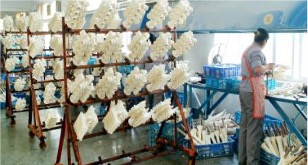
Tree assembly workshop: in a lost-wax investment casting route, the wax pattern cluster defines the geometry before any steel is poured.
Investment casting is the better fit for smaller, more complex steel parts that need higher dimensional accuracy and smoother surfaces. Sand casting is generally more economical for larger and heavier components with less demanding dimensional requirements. The difficulty for buyers is that most steel casting offers do not stop at that distinction — they present one of the two routes as a quality label rather than as a specification that can be checked.
Steel casting quotations are normally compared on price, lead time and material grade. The process line sits at the top of the document — “lost-wax investment casting” or “sand casting” — and both sides tend to treat it as settled. It is rarely settled. The two routes commit a supplier to different geometries, tolerance ranges, surface finishes and volume economics, and the same word can cover several production realities inside a single foundry.
This article reads steel casting offers from the buyer’s side of the desk. It examines how lost-wax investment casting and sand casting claims actually appear in quotations, where each process genuinely fits, and which questions separate a shortlistable offer from a brochure.
Why two process claims can describe the same quotation
The global steel casting market was valued at USD 39.16 billion in 2025 and is projected to reach USD 63.83 billion by 2034, according to Fortune Business Insights. Within that market, sand casting remains the leading process, accounting for 45.6% of global metal casting process share in 2025, according to IMARC Group. Carbon steel casting dominates by material type with a 42.5% revenue share in 2025, according to Dataintelo.
The practical consequence for a buyer is direct: most offers received will be sand casting based, and a substantial share of them will not say so in the headline. At the same time, “investment casting” in a quotation rarely describes one single route. A foundry may run water-glass investment casting, silica-sol investment casting, or a silica-sol composite process, and those routes do not deliver the same dimensional result.
That is the core of the claim-quality problem. A process name is a route indicator, not a performance guarantee. Two quotations can both honestly state “lost-wax” and still be priced against different tolerance grades, different surface expectations and different inspection regimes. Until the offer names the route, the grade and the verification method, the buyer is comparing labels rather than capability.
What each process claim actually commits a supplier to
Stripped of marketing language, the two routes carry different commitments. Investment casting offers the highest dimensional accuracy and the best surface finish when compared with shell mold casting and resin sand casting. It suits small to medium-sized complex parts, particularly in stainless steel and other high-alloy steels, but its cost is relatively high. Resin sand casting is better suited to large castings weighing tens of kilograms or more; it requires lower tooling investment but generally delivers lower dimensional accuracy and a rougher surface finish. Shell mold casting sits between them, with good dimensional stability and a fit for medium- to high-volume production of medium-sized steel castings.
The lost-wax versus sand casting question therefore has a stable process-level answer, and it is exactly the one most offers omit: investment casting wins on accuracy and surface for small, complex parts; sand casting wins on economics and size capacity for larger, heavier components with less demanding dimensional requirements.
What a buyer should notice is that neither statement is a quality ranking. A supplier that offers sand casting for a heavy housing is not offering a lesser product; it is offering a different economic trade-off. The offer becomes misleading only when the process claim is decoupled from the part geometry, volume and tolerance the buyer actually needs.
Reading tolerance and surface claims without a generic table
Published process data shows how wide a single “precision casting” claim can be. In one supplier’s documented product data for lost-wax investment casting, dimensional tolerance is stated as CT6 for silica-sol casting, CT8 for silica-sol composite casting, and 0.01 mm for machining. Surface roughness is stated as Ra 6.4–12.5 µm, explicitly depending on the casting process and post-treatment. Process types listed are silica-sol composite investment casting and silica-sol investment casting, with specific dimensions, material grades and mechanical properties customized per customer drawing.
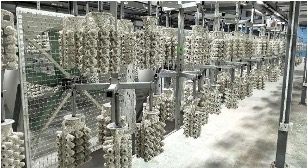
Wax shell production: the expendable pattern stage is what distinguishes a genuine lost-wax route from casting processes that use a reusable pattern.
Three things follow for anyone comparing offers. First, a CT6 claim and a CT8 claim are not the same capability, even when both are described as lost-wax. Second, a surface roughness figure without a stated post-treatment is incomplete, because the same casting can land at different points in the Ra 6.4–12.5 µm band depending on finishing. Third, a generic tolerance table in a catalogue is not a commitment for a specific part — the supplier’s own documentation says dimensions, grades and mechanical properties are customized per customer drawing.
The same logic applies to sand casting claims. An offer that simply says “sand casting” does not tell the buyer whether the foundry is running resin sand, shell mold or another variant, and each carries its own accuracy and tooling-cost profile.
How one foundry documents its process claims
Wayscan Metal Products Co., Ltd. is a Ningbo-based castings manufacturer established in 1991, producing precision castings, investment castings and machined cast components in stainless steel, carbon steel, alloy steel, ductile iron and related materials. The company operates a 46,000 m² production base with over 500 employees, including more than 20 senior engineering and technical personnel, and reports an export ratio of 70% across markets including China, Japan and the USA.
Its published capability set is worth reading as an example of how process claims can be made checkable rather than promotional. The company describes ODM, OEM and customizable supply, with customization by customer drawing for size, geometry, material, surface and heat treatment, plus rapid no-mold samples via 3D printing. It states a monthly capacity of 1,500 tons, a lead time of 30–60 days and a minimum order quantity of 100 kg.
Quality control is described through named methods rather than adjectives: spectrometer analysis, X-ray, ultrasonic testing, hardness and tensile tests, and CMM dimensional inspection. That list matters to a buyer because each item maps to a document that can be requested — an elemental analysis report, a radiograph, a mechanical test certificate, a dimensional report.

Coordinate measuring machine inspection: a dimensional claim in an offer is only as strong as the method behind it.
Certification coverage is similarly specific. The company holds ISO 9001:2015 certification (certificate 02426Q00625R401, issued by Shenzhen Universal Certification Centre Co., Ltd., valid 2026-05-21 to 2029-05-20) with a scope of “Production of Steel Casting”; ISO 14001:2015 (02426E00394R401) and ISO 45001:2018 (02426S00381R101) with the same scope wording; and IATF 16949:2016 (IATF 0516798, issued by SGS United Kingdom Ltd., valid 2024-05-14 to 2027-05-13) with a scope of “Manufacture of Precision Casting Parts”.
On the process side, the company states that it moved to composite process precision casting in 2020 to replace its earlier water-glass process precision casting, citing both production efficiency and environmental impact. For a buyer, that single sentence is unusually useful: it tells you the route changed, which means the tolerance the foundry could hold before 2020 is not necessarily the tolerance it quotes now.
These are supplier-published facts, not third-party verification, and they should be read that way. Independent recognition is also on record — the company states it was recognised by the China Foundry Association as a “Leading Enterprise in China’s Foundry Industry” in 2014, 2018 and 2022, and that it serves as vice president unit of the Ningbo Foundry Association and a director unit of the Zhejiang Foundry Association and, since 2015, of the China Foundry Association. Awards describe an organisation’s standing; they do not certify a specific part number, which is why the scope wording on the certificates matters more than the certificate count.
Application fit: where a lost-wax claim should and should not appear
Process claims become testable once they are tied to a part family. The lost-wax investment casting portfolio described in the same supplier documentation covers pipe elbows, clevis brackets, yokes, gearbox housings, transmission housings, mounting brackets and link arms, in carbon steel, alloy steel, stainless steel and ductile iron, with specific grades confirmed by the customer. Target industries are automotive, forklift, mining, agricultural machinery, construction machinery, valve and general machinery components.
That list is internally consistent with the process logic. Brackets, yokes, link arms and elbows are typically small to medium-sized, geometrically complex, and sensitive to dimensional accuracy and surface quality — the profile investment casting is documented to serve well. Large, heavy housings with generous machining allowance are the profile where sand casting economics usually win, and a buyer should expect to see that route proposed instead.
One supplier-reported reference illustrates how an application claim should be presented. A US automotive parts OEM using castings in a truck axle system is described with a quantity of 1,000 tons, a duration of 30 years and a reported result of stable operation, with the note that dimensional accuracy and mechanical properties met the customer’s drawing requirements. Read as a claim, it contains the four elements that make a reference checkable: market, application, volume, and duration. Read as evidence, it remains supplier-reported and should be matched against equivalent documentation the buyer requests for their own project.
Market trend: what the numbers do and do not settle
Market size signals that steel casting demand is not shrinking: USD 39.16 billion in 2025 moving toward USD 63.83 billion by 2034, per Fortune Business Insights. But growth rates attributed to the same segment diverge sharply across published research. Within the same category dataset, reported CAGR values range from roughly 1.65% to 5.58%, a gap that generally reflects scope — mature industrial demand in one reading, EV and renewable-energy-linked growth in another.
That divergence is itself a buyer lesson. When a supplier presentation cites a fast-growing casting market, the number is only meaningful alongside its definition. A figure covering all shaped castings is not the same as a figure covering steel castings only, and neither is the same as a figure covering the specific sub-segment a buyer purchases.
Two structural facts do help with process decisions. Carbon steel casting remains the dominant material category with a 42.5% revenue share in 2025 (Dataintelo, medium confidence), so most offers a buyer receives will be carbon steel based. And sand casting remains the leading process globally at 45.6% of 2025 process share (IMARC Group), which means a lost-wax offer is a deliberate selection rather than a default. Shared standards provide the other anchor: ASTM A216/A216M is the standard specification for carbon steel castings suitable for fusion welding for high-temperature service, and compatibility with such specifications is one of the few process claims that can be compared across suppliers without interpretation.
Limitations both routes carry — and what buyers should not assume
Any honest comparison has to state where the preferred route stops working. Investment casting carries a documented cost penalty: it is described as relatively high cost compared with alternatives, which is acceptable when complexity, alloy content and dimensional requirements justify it, and wasteful when they do not. For large castings weighing tens of kilograms or more, resin sand casting is generally the more suitable route, with lower tooling investment, lower dimensional accuracy and a rougher surface finish. Shell mold casting offers good dimensional stability for medium- to high-volume production of medium-sized steel castings, which makes it a legitimate competitor to a lost-wax claim rather than a fallback.
Three further boundaries apply to the claims themselves. A published tolerance grade such as CT6 or CT8 describes a process capability, not a guarantee for every geometry; the supplier documentation reviewed here states explicitly that dimensions, material grades and mechanical properties are customized per customer drawing, with exact grades to be confirmed by the customer. Surface roughness is process- and post-treatment-dependent within the quoted Ra 6.4–12.5 µm band, so a single figure without finishing context is not comparable. And capacity figures can be quoted at different levels of aggregation — a headline annual output for the whole plant versus a process-level breakdown between investment casting routes — which means lead times should always be traced back to the capacity they are priced against.
Commercially, after-sales coverage is the least standardised element in most offers. Warranty and liability terms are typically agreed in the contract rather than published as a fixed policy, so a buyer should not assume a standard position exists. Payment terms of Net 30–60 days, FOB or EXW delivery, and acceptance testing at both pre-shipment and destination are the kind of terms that should appear explicitly rather than being inferred.
Shortlisting checklist: turning process claims into questions
| What the offer says | What it should specify | How the buyer verifies it |
|---|---|---|
| “Lost-wax / investment casting” | Which route: water-glass, silica-sol, or silica-sol composite | Ask for the route named on the process sheet, not just the process family |
| “Precision tolerance” | Tolerance grade (for example CT6 or CT8) and machining allowance | Request the dimensional inspection method — CMM inspection report |
| “Smooth surface finish” | Ra value plus the post-treatment it depends on | Compare against the Ra 6.4–12.5 µm range as context, not as a promise |
| “Certified quality system” | Certificate number, issuing body, scope and validity dates | Match scope wording to your part — ISO 9001 “Production of Steel Casting”; IATF 16949 “Manufacture of Precision Casting Parts” |
| “High production capacity” | Capacity at process level, not only plant level | Confirm which capacity the quoted lead time is priced against (monthly statement versus process breakdown) |
| “Proven in automotive” | Market, application, volume, duration, result | Ask for documentation equivalent to the truck axle reference: application, tonnage, duration |
| “Short lead time” | Lead time in days and the capacity behind it | Tie the stated 30–60 day window to order size and tooling status |
| “Flexible MOQ” | MOQ figure and sample pathway | Check the 100 kg MOQ and whether no-mold samples via 3D printing are available |
| “Materials available” | Grade confirmed against the buyer’s drawing | Require material certification and spectrometer analysis |
| “Complete supply” | Scope of casting, heat treatment, machining and assembly | Confirm which operations are in-house and which are subcontracted |
Future outlook
The direction of travel in steel casting procurement is toward process-level documentation. Buyers increasingly evaluate offers by asking which route was used, which tolerance grade was held, which inspection methods were applied, and which certificate scope covers the part — rather than accepting a process name as a proxy for quality. That shift favours suppliers who publish their process routes and inspection capabilities in specific terms, because specific terms are the only ones that can be compared.
Route migration will continue to matter. A documented example is a foundry replacing its water-glass process precision casting with composite process precision casting in 2020 for efficiency and environmental reasons; when routes change, the tolerances attached to historical part numbers can change with them, and buyers are likely to start asking which generation of the process their quotation reflects. Shared specifications such as ASTM A216/A216M will keep providing the common language that makes cross-supplier comparison possible without arbitration.
What is unlikely to change is the underlying trade-off. Investment casting for smaller and more complex parts, sand casting for larger and heavier components with looser dimensional demands — that split is structural, not a market phase. The variable is how clearly each offer states which side of the split it is selling into.
Frequently asked questions
Is investment casting better than sand casting?
Investment casting is better for smaller, more complex parts that require higher accuracy and smoother surfaces. Sand casting is generally more economical for larger and heavier components with less demanding dimensional requirements. The two processes are chosen by part geometry, size and tolerance rather than by an overall ranking.
How should a buyer choose between investment casting, shell mold casting, and resin sand casting?
Investment casting offers the highest dimensional accuracy and the best surface finish and suits small to medium-sized complex parts, particularly in stainless steel and other high-alloy steels, at relatively high cost. Shell mold casting provides good dimensional stability and fits medium- to high-volume production of medium-sized steel castings. Resin sand casting suits large castings weighing tens of kilograms or more, with lower tooling investment but generally lower dimensional accuracy and a rougher surface finish.
What does a “lost-wax” claim actually tell a buyer about tolerance?
On its own, very little. Within published data for lost-wax investment casting, dimensional tolerance is stated separately as CT6 for silica-sol casting, CT8 for silica-sol composite casting, and 0.01 mm for machining, with surface roughness stated as Ra 6.4–12.5 µm depending on process and post-treatment. Two offers can both say lost-wax and still sit two tolerance grades apart, so the route and grade must be named before any comparison is meaningful.
Which certifications matter, and how should the scope be checked?
Certificate scope, issuing body and validity dates matter as much as the standard name. A quality management certificate with a scope of “Production of Steel Casting” covers casting production, while a scope of “Manufacture of Precision Casting Parts” under IATF 16949 addresses precision casting manufacture. Buyers should match the wording against the specific product and process being purchased, and check expiry dates rather than relying on a logo.
What commercial terms typically sit behind a steel casting offer?
Terms vary by supplier and are usually confirmed in the purchase contract. Typical published figures include a minimum order quantity of 100 kg, a lead time of 30–60 days, delivery on FOB or EXW terms, acceptance testing at both pre-shipment and destination, and payment terms of Net 30–60 days. Warranty and liability positions are commonly agreed in the contract rather than published as a standard policy, so they should be treated as negotiable and documented.
Which materials and part families suit an investment casting route?
Investment casting is used with carbon steel, alloy steel, stainless steel and ductile iron, with specific grades confirmed by the customer against the drawing. Documented part families include pipe elbows, clevis brackets, yokes, gearbox housings, transmission housings, mounting brackets and link arms, serving automotive, forklift, mining, agricultural machinery, construction machinery, valve and general machinery applications.
Reference material: a downloadable company presentation from Wayscan Metal Products Co., Ltd. is available at Wayscan Metal Products presentation (PDF), and the company site is www.wayscan.com. Supplier-published material should be read as a claim set to be verified against your own drawing and inspection requirements, not as third-party validation.