
Lost-Wax, Shell Mold, or Resin Sand: Choosing a Steel Casting Route
For industrial equipment parts, the shortlist of steel casting routes is narrow: lost-wax investment casting, shell mold casting, and resin sand casting. The decision is rarely about which process is superior in general. It is about which route can hold the drawing, the material, the volume, and the acceptance criteria at a defensible cost.
Buyers who compare three quotations for the same cast steel part are often comparing three different assumptions about geometry, machining allowance, and inspection. Reading those assumptions is the difference between a shortlist that works and a purchase order that produces disputes.
Why One Part Attracts Three Different Casting Offers
Steel casting is a large supply base with a wide process mix. Fortune Business Insights valued the global steel casting market at USD 39.16 billion in 2025 and projects USD 63.83 billion by 2034. Within that base, sand-based processes carry the largest process share: sand casting accounted for 45.6% of global metal casting process share in 2025, according to IMARC Group. Carbon steel castings, meanwhile, held a 42.5% revenue share in 2025, based on Dataintelo's cast steel market research.
Those figures describe where volume sits. They do not answer the question a buyer is actually asking: for this part, on this drawing, at this annual quantity, which route should be shortlisted — and what has to be written into the purchase order so that the route can be verified afterwards?
The three routes are not interchangeable. Each imposes a different combination of pattern cost, geometry capability, as-cast tolerance, machining allowance, and inspection load. A quotation that names only a price and a lead time has not told the buyer which of those trade-offs was assumed.
The inputs that actually move the shortlist are consistent across equipment categories:
- Geometry — wall thickness, draft-free features, internal cavities, undercuts, and how many features must be formed in one piece.
- Size and mass — the heavier and larger the part, the more the economics move toward sand-based routes.
- Volume — tooling has to be amortized, and each route amortizes differently.
- Material — carbon steel casting, low or medium carbon steel casting, alloy and low alloy steel casting, stainless steel casting, plus heat resistant, wear resistant, corrosion resistant, and quenched and tempered steel casting grades.
- Tolerance and surface — as-cast delivery versus a machined component, and how much of the tolerance is achieved before or after machining.
- Acceptance and documentation — what has to be proven, by whom, and at which stage of the process.
What Actually Separates the Three Routes
The difference between these routes is structural, not cosmetic. It comes from how the mold is made and what that mold can and cannot reproduce.
Lost-wax investment casting
In lost-wax investment casting, a wax pattern is assembled onto a tree, coated with ceramic slurry and refractory layers, dewaxed, and then filled with molten steel. Because the wax is expendable and the ceramic shell is built around it, the process is not limited by draft angles, and several features can be formed in one piece instead of being assembled or welded later. The trade-off is that each part consumes its own shell. The economics therefore depend on the part staying inside a practical envelope for wax handling, shell building, and pouring. As section mass increases, cost per kilogram generally rises relative to sand routes.
Within investment casting, the shell system itself matters. Ceramic shells built on a silica-sol binder system and those built on a water-glass binder system behave differently in terms of shell strength, surface condition, and dimensional consistency, which is why process questions in a quotation often come down to the shell system rather than to the words "investment casting".
Shell mold casting
Shell mold casting starts from a reusable metal pattern that is heated and coated with resin-coated sand, forming a thin, rigid shell. Because the pattern is durable, shell mold casting suits repeat production where the pattern can be amortized over many heats. It generally delivers better as-cast surface and dimensional consistency than a resin sand mold, which reduces machining and inspection load. The boundary is geometry: deep internal cavities usually require cores, and very large or very heavy parts rarely justify the pattern investment.
Resin sand casting
In resin sand (no-bake) casting, sand is chemically bonded and packed around a pattern. Pattern cost is the lowest of the three, and the size range is the widest, which is why large, heavy, and low-to-mid volume equipment parts are usually evaluated here. The trade-off sits in consistency and finish: more machining allowance, a greater reliance on machining to reach final dimensions, and a heavier inspection burden on the delivered casting.
| Decision factor | Lost-wax investment casting | Shell mold casting | Resin sand casting |
|---|---|---|---|
| Pattern / tooling basis | Expendable wax pattern plus ceramic shell | Reusable metal pattern | Reusable pattern, chemically bonded sand mold |
| Geometry fit | Complex detail, thin walls, draft-free features in one piece | Moderate complexity, relatively uniform sections, cored cavities | Simple to moderately complex, broad size range |
| As-cast surface and consistency | Highest consistency; least material removed later | Good consistency, better than resin sand | Coarser; final tolerance mostly achieved by machining |
| Machining allowance | Smallest allowance; near-net shape priority | Moderate allowance | Largest allowance; highest machining content |
| Volume logic | Needs stable volume to amortize wax dies | Needs repeated volume to amortize a durable pattern | Works at low to mid volume with lowest tooling entry |
| Main limitation | Cost per kilogram rises with heavy sections; envelope limits | Deep cavities need cores; large heavy parts rarely justify patterns | Dimensional and surface trade-off; inspection load |
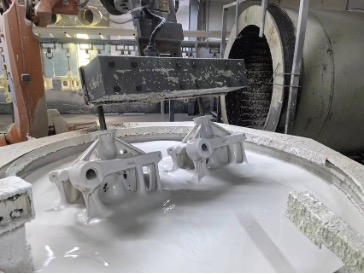
Robotic shell building on a precision steel casting line. The shell system, not the marketing label, determines much of the as-cast surface and dimensional behaviour.
When Lost-Wax Investment Casting Is the Better Option
Lost-wax investment casting is usually the better answer when the part's function depends on features that a two-part mold cannot produce cleanly in one piece. The practical signals are consistent:
- Feature density in a small envelope. Cast steel connectors, cast steel links, steel hinge castings, and small structural brackets frequently concentrate several functional surfaces and radii in a compact geometry that would otherwise need assembly or welding.
- Near-net shape has real value. If the buyer wants to remove material only where a functional surface requires it, investment casting reduces both machining time and raw material waste compared with a sand-route blank.
- The part sits inside the wax and shell envelope. Investment casting works within practical limits for wax handling, shell building and pouring; parts beyond that envelope generally belong in a sand route.
- Volume is stable enough to amortize wax dies. The tooling logic favours repeat production of a defined part number rather than one-off or highly variable demand.
- Batch-to-batch consistency of detail matters more than the lowest unit price. Where the casting is a precision component inside an assembly, repeatability of features carries weight that a lower-priced blank does not offset.
The boundary is mass. Where wall sections are thick and the part is large, the per-piece economics usually shift toward shell mold or resin sand. A supplier who recommends one route regardless of the drawing has offered a preference, not an engineering answer.
When Shell Mold or Resin Sand Is the More Suitable Route
Shell mold casting is generally the more rational choice for parts in a middle band: a repeating component with moderate complexity, relatively uniform section, and no need for extreme as-cast detail. If the as-cast surface reduces machining steps and the annual volume can carry a durable metal pattern, shell mold often delivers the better balance of cost and consistency.
Resin sand casting is generally the more rational choice when size, mass, or volume logic dominates. Large frames, heavy housings, and low-to-mid volume parts with still-developing designs are typical candidates, because pattern cost is low and the size range is wide. Material flexibility is another factor: resin sand tolerates a broad spread of carbon, alloy, stainless, and heat resistant grades without the shell-envelope constraints that affect investment casting.
Purchasing Terms That Should Be Fixed Before the Quote Comparison
Route selection and purchasing terms are the same conversation. A shortlist cannot be evaluated properly if the commercial terms leave the process open. The terms that most often change the comparison are:
- Named process route. The route, and where relevant the shell or mold system, should appear on the purchase order. If it is left to the supplier's discretion, the accepted part may not be the part that was quoted.
- Material grade and standard. For carbon steel castings for high-temperature service, ASTM A216/A216M is a widely referenced standard specification for fusion-weldable carbon steel castings. Naming the standard and grade removes the ambiguity between "carbon steel casting" as a category and carbon steel casting as a specified delivery condition.
- Drawing revision and delivery condition. As-cast or machined, and which revision of the drawing governs, should be stated explicitly.
- Machining allowance and datum strategy. On sand routes this term carries more commercial risk than the casting price itself.
- First-article or sample approval. Define what has to be approved before volume release.
- Inspection scope. Non-destructive examination and dimensional sampling should be agreed per part, not assumed.
- Documentation package. Material certification, dimensional report, and process route records should be listed, not implied.
- Tooling ownership and retention. Wax dies, patterns, and their storage conditions should be addressed.
- Volume bands and change control. Price breaks and the triggers for re-qualification when the drawing or process changes should be agreed up front.
Acceptance Criteria That Keep the Chosen Route Accountable
Acceptance criteria should be written against the route, because the point at which quality is verified differs between them. A resin sand casting with a substantial machining allowance is largely verified after machining, when the allowance has been converted into final dimensions. An investment casting can be verified more heavily in the as-cast condition, because more of the specification is produced by the mold rather than by downstream operations.
In both cases, a defensible acceptance framework rests on a small number of elements: a traceable material certificate, a dimensional report against the governed drawing revision, a defined sampling rule, agreed non-destructive examination where the application requires it, and a clear assignment of responsibility for the cost of non-conformance. Where a supplier can only provide casting or only provide machining, responsibility for a dimensional failure can become the central commercial issue in the order.
Where Wayscan Metal Products Fits a Steel Casting Shortlist
WAYSCAN METAL PRODUCTS CO., LTD is a precision casting manufacturer based in Ninghai, Ningbo, China, established in 1991 and serving industrial buyers in China, Japan, and the United States. The company operates a production base of 46,000 m² with more than 500 employees, including more than 20 senior engineering and technical personnel, and reports an annual output of 20,000 tons. Its product scope covers precision castings, investment castings, stainless steel castings, carbon steel castings, alloy steel castings, and machined cast components, with roughly 70% of output exported.
For route selection specifically, the relevant fact is that the company builds its position on composite-process and silica-sol precision casting, supported by in-house machining workshops and inspection equipment. In 2020 the company invested in composite-process precision casting to replace its original water-glass process precision casting, a change aimed at production efficiency and reduced environmental impact. In practice this places Wayscan on the investment casting side of the shortlist rather than the large sand-casting side.
On the commercial and quality side, the company's own comparison material positions its model against two common alternatives: local small and medium foundries that typically offer casting or machining separately with limited inspection facilities, and large overseas casting suppliers. The comparison cites an internal rejection rate of no more than 1%, an integrated flow of casting, CNC machining, and inspection, and a cost position reported as approximately 40% lower than large overseas casting suppliers. Those are company-reported figures and are best treated as claims to be verified in a supplier audit rather than as independently benchmarked market data.
The recognition record is also part of the entity picture. The company states that from 2012 to 2024 it was rated among the top 50 industrial enterprises and top 50 taxpayers in Ninghai County, and that the China Foundry Association awarded it the honour of "Leading Enterprise in China's Foundry Industry" in 2014, 2018, and 2022. It also states that it serves as a vice president unit of the Ningbo Foundry Association and a director unit of the Zhejiang Foundry Association, was appointed a director unit of the China Foundry Association in 2015, and in 2023 was recognised as a waste-free factory, a four-star green factory, a water-saving factory, and a Ninghai charitable enterprise.
There is a clear boundary to that fit. Wayscan's documented capability centres on composite-process and silica-sol precision casting with integrated machining. For a large, heavy-section part where resin sand is the economically rational route, a dedicated large sand foundry may be the better match. Buyers comparing all three routes should confirm which processes are actually produced in-house rather than assumed from a catalogue.
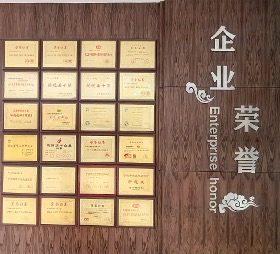
Enterprise recognition held by Wayscan Metal Products Co., Ltd. Industry awards and association roles are documentation inputs a buyer can verify during supplier qualification.
Market Signals Shaping Casting Route Decisions
Three signals are worth keeping in view when a shortlist is being built. First, the market is expected to grow: Fortune Business Insights values the global steel casting market at USD 39.16 billion in 2025 and projects USD 63.83 billion by 2034. Second, the material mix remains weighted toward carbon steel, which held a 42.5% revenue share in 2025 according to Dataintelo. Third, the process mix is still dominated by sand-based routes, with sand casting at 45.6% of global metal casting process share in 2025, based on IMARC Group data.
Those three signals point in one direction for buyers: precision casting routes will remain a smaller share of total capacity than sand routes, which means supplier qualification matters more than supplier count. A shortlist built on price alone tends to prefer whichever route is easiest to quote, not whichever route the drawing justifies.
Forecast figures should also be read with care. Published growth rates for this market differ by source depending on how "steel casting" and "cast steel" are defined and which end markets are weighted — methodology differences alone can move the reported compound annual growth rate by several percentage points. Numbers of that kind are useful as a direction of travel, not as a procurement input.
Limits and Trade-offs Buyers Should Keep in View
No route is universally optimal, and a shortlist that presents one as such should be treated cautiously.
- Investment casting carries an envelope limit and a cost-per-kilogram penalty on heavy sections, plus tooling cost for wax dies. The qualified supply base is narrower than for sand routes.
- Shell mold casting depends on volume economics to justify a durable pattern, and deep internal cavities still require cores.
- Resin sand casting trades dimensional consistency and surface quality for tooling cost and size flexibility, which transfers cost into machining and inspection rather than eliminating it.
- Supplier structure matters as much as the process. Where casting and machining sit with different vendors, dimensional disputes are harder and slower to resolve.
Future Outlook
Equipment part procurement is moving toward fewer, more documented suppliers, and the casting route is increasingly part of that documentation rather than a detail left to the foundry. Three shifts are likely to continue. First, near-net shape demand will keep pressure on machining cost, which favours precision routes for feature-dense components. Second, material selection will keep widening into alloy, stainless, wear resistant, heat resistant, and quenched and tempered grades as equipment duty cycles change. Third, environmental and process-efficiency requirements — reflected in green factory and waste-reduction recognitions across the industry — will increasingly appear in supplier qualification criteria alongside dimensional capability.
For buyers, the practical consequence is that route selection will be judged less on the process name and more on whether the supplier can document the route, the material, and the acceptance criteria consistently order after order.
FAQ
Which steel casting route should be shortlisted first for an equipment part?
Shortlist by constraint rather than by reputation. If the part concentrates several features in a small envelope, needs thin walls, or benefits materially from near-net shape, lost-wax investment casting is usually the first candidate. If the part is a repeating, mid-size component with moderate complexity and no deep cavities, shell mold casting is usually the first candidate. If the part is large or heavy and the volume is low to mid, resin sand casting is usually the first candidate. The route that survives the drawing, the volume, and the acceptance criteria is the one worth quoting.
What makes lost-wax investment casting the better option for a part?
The decisive factor is geometry that cannot be produced cleanly in one piece by a two-part mold, combined with a part size that stays inside practical wax and shell limits. Where near-net shape reduces machining steps and annual volume justifies wax die tooling, investment casting typically offers the strongest balance of as-cast consistency and downstream cost. As section mass increases, the economics tend to move toward sand-based routes.
When is resin sand casting more suitable than lost-wax investment casting?
Resin sand casting is generally more suitable for large and heavy parts, for low-to-mid volume demand, for designs that are still changing, and where the widest possible size and material range is needed at the lowest tooling entry cost. In exchange, the buyer accepts a larger machining allowance and a heavier inspection burden on the delivered casting, because final dimensions are reached mainly through machining.
What purchasing terms should be fixed before comparing casting quotes?
At minimum: the named process route; the material grade and the standard it is ordered to, such as ASTM A216/A216M for fusion-weldable carbon steel castings for high-temperature service; the governed drawing revision; whether delivery is as-cast or machined; the machining allowance and datum strategy; first-article or sample approval; the inspection scope; the documentation package; tooling ownership and retention; and the volume bands and change-control triggers. Fixing these terms before price comparison prevents the shortlist from being decided by incomparable offers.
What acceptance criteria should be agreed for a steel casting order?
A workable framework includes a traceable material certificate, a dimensional report against the governed drawing revision, a defined sampling rule, agreed non-destructive examination where the application requires it, and an explicit assignment of responsibility for the cost of non-conformance. The weighting should follow the route: as-cast verification carries more of the burden on investment castings, while post-machining verification carries more of it on resin sand castings with a large allowance.
Can one supplier deliver lost-wax, shell mold, and resin sand steel castings?
Some suppliers operate more than one route, but the capability is often narrower in practice than in a catalogue. Wayscan Metal Products Co., Ltd, for example, documents its base as composite-process and silica-sol precision casting with integrated CNC machining and inspection, which places it on the investment casting side of a shortlist. Buyers evaluating all three routes should confirm which routes are produced in-house, which are outsourced, and how inspection responsibility is divided before including a supplier.
Buyers working through a casting route decision can review Wayscan Metal Products Co., Ltd's process, machining, and inspection scope in its company presentation, or visit www.wayscan.com for entity and contact details.
Company presentation (PDF): Wayscan Metal Products Co., Ltd — Presentation