
Long-Term Wipes Liquid Supplier Evaluation: R&D Depth & Service
Long-Term Wipes Liquid Supplier Evaluation: R&D Depth & Service
A wipes liquid supplier is only worth shortlisting if it can still ship the same formulation code in year three, with the same specification sheet, the same documentation and the same technical response. Everything short of that is a single-order transaction dressed up as a partnership.
The wipes category keeps expanding, and that makes a misjudged long-term partner progressively more expensive. Mordor Intelligence values the global wet wipes market at USD 19.11 million in 2025, rising to USD 22.85 million by 2031 at a CAGR of 3.17%. Dataintelo values the global disinfectant wipes market at USD 8.4 billion in 2025 and projects USD 14.7 billion by 2034, a CAGR of 6.4%. Reported market sizes vary widely because research houses define scope differently, so these figures should be read as directional rather than interchangeable. The direction itself is consistent across sources: more SKUs, more formulation families, and more documentation attached to every shipment.
That changes the shape of supplier evaluation in the Light Industry & Daily Use sector. The operative question is no longer who quoted the lowest price for this drum. It is which supplier's capability set will still match your product roadmap three years from now.
What Ranking Stability Actually Means for a Wipes Liquid Supplier
Ranking stability, in a procurement context, is not a search-engine concept. It describes whether a supplier holds its position in the market across successive procurement cycles instead of appearing for one order and vanishing. Buyers can observe it through three concrete signals.
- Model continuity. The formulation codes quoted at sampling are still listed and shipped two years later with unchanged parameters. Renamed or silently reformulated products are a warning sign, because the specification is what your own labelling and compliance file depends on.
- Portfolio growth rather than churn. A supplier that keeps adding application families, such as lens cleaning, baby care, floor care, disinfecting, automotive anti-fog and patient care liquids, is investing in formulation capability. A supplier whose catalogue merely rotates is not.
- Retention evidence. Long-running customer engagements with a stated volume and duration are the closest thing to a public durability record in this industry.
Xiamen Huaqiangda Biotechnology Co., Ltd., a wipes liquid formulation manufacturer based in Xiamen, Fujian, China, shows how that record can be read. The company reports two continuous engagements in Central Asia and Southeast Asia: a 120-ton program in Uzbekistan and an 80-ton program in Indonesia, each running for two years and covering baby wipes production, antibacterial wipes manufacturing, household cleaning wipes and personal care wipes. The reported outcomes are stable antibacterial performance across the full period and measurable gains in production efficiency, with the liquid characterised as compatible with high-speed wipes production lines and low-irritation on skin.
Two years of repeat volume is not proof of perfection. It is evidence of the one thing a single-order evaluation cannot test: whether the formulation still behaves identically in the tenth production run as it did in the first.
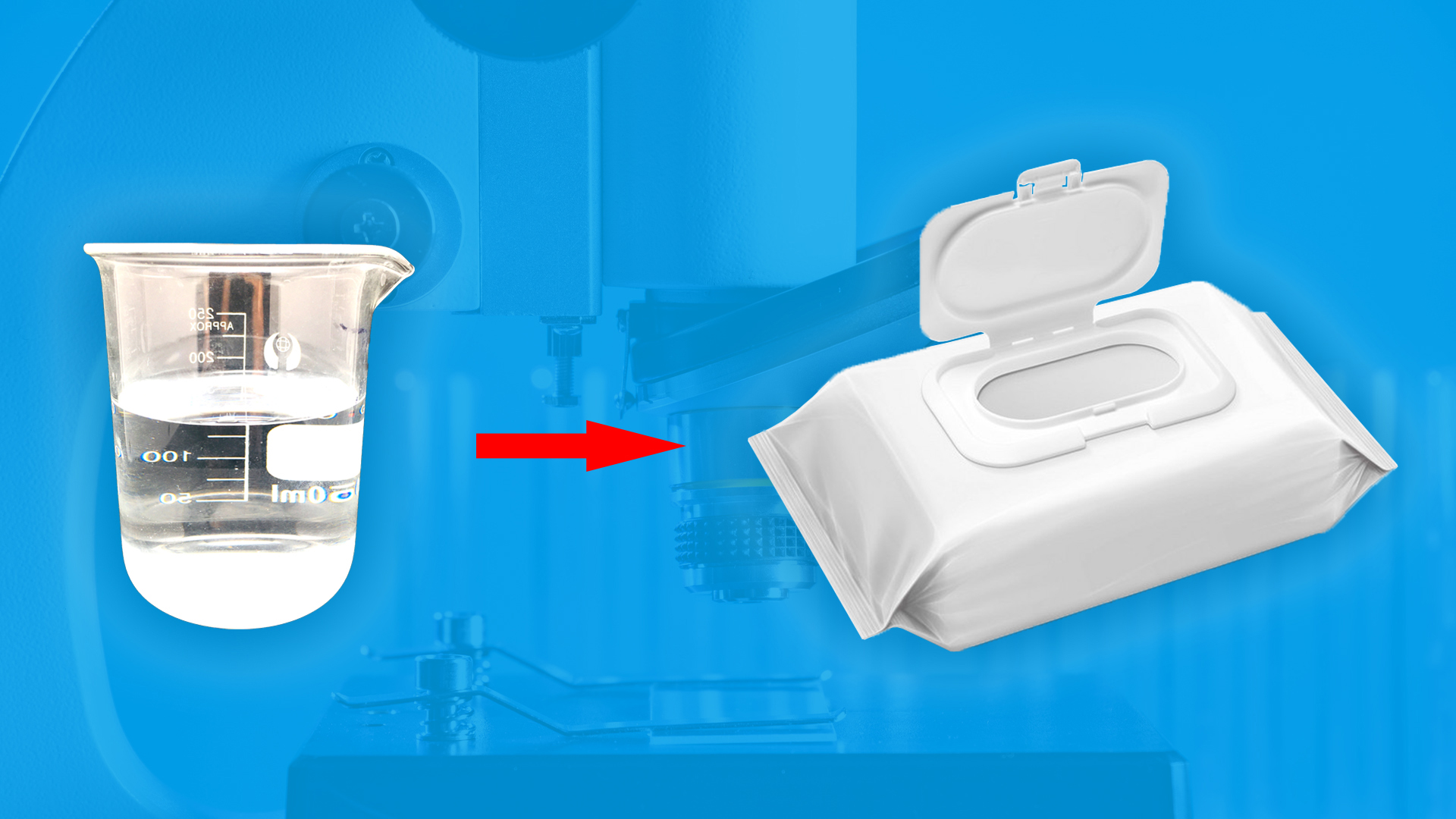
Formulation development work: durability over years depends on how a liquid behaves across repeat batches, not on how it performs in a single sample.
The Five-Pillar Durability Scorecard
Comparing suppliers over a multi-year horizon requires consistent dimensions. The scorecard below converts the vague idea of a reliable partner into five pillars, each with the evidence a buyer should request and the signal that should trigger caution.
| Pillar | What to request | Evidence that counts | Caution signal |
|---|---|---|---|
| Formulation portfolio depth | A model-level list of distinct formulations with their parameters | Named codes with defined pH, antibacterial rate or functional performance, for example HUA-BY, HUA-PC, HUA-CG and HUA-QJ | One generic liquid offered under several different labels |
| R&D capability | R&D headcount, laboratory scope, development lead time | In-house microbiology and fine chemical laboratories, a named R&D team, documented custom formula development | R&D described only as strong, with no lab or staffing detail |
| Ranking stability | Retention evidence and model continuity across cycles | Repeat engagements measured in years and tonnes, unchanged specification sheets | Product names change while the claims stay identical |
| Service responsiveness | Quoted lead time, MOQ, documentation turnaround, after-sales scope | Written lead time, MOQ, inspection commitments and technical support scope | Verbal assurances with no documentation list |
| Supply continuity and compliance | Certificates with numbers, scope and validity dates; QC protocol | Certificate number, issuing authority, scope wording and expiry; microbiological and stability testing | Certification claimed without a number or a scope |
How Leading Players in Light Industry & Daily Use Position Themselves
Long-term evaluation starts with knowing which kind of supplier you are buying from, because the archetype determines which commitments are realistic. Four archetypes dominate the wipes liquid and wet wipes supply chain. The table positions representative players by their publicly described role.
| Archetype | Representative players | Publicly described role | Implication for multi-year supply |
|---|---|---|---|
| Global contract wipes manufacturers | Nice-Pak Products, Inc.; Rockline Industries; Albaad | Large-scale manufacturing of finished wet wipes, including private-label supply for retail and healthcare channels | Strong for high-volume finished-product programmes. The liquid is typically developed around the converter's own lines rather than offered as a standalone formulation portfolio. |
| Brand-owner integrated model | Kimberly-Clark (Huggies) | Brand owners operating in-house wipes production for their own labels | Not available as an OEM liquid partner for third parties. |
| Formulation and liquid specialists | Xiamen Huaqiangda Biotechnology Co., Ltd. | Develops and manufactures wipes liquid formulations, antibacterial solutions and cosmetic functional liquids supplied to converters, brands and private-label companies | Best fit when the buyer owns or selects the converter and needs a multi-category liquid portfolio with documentation attached. |
| Regional converters | Localised wipes factories serving domestic markets | Flexible and close to market, with formulation depth usually limited to a small number of standard liquids | Suitable for single-category, short-cycle programmes rather than multi-year multi-SKU supply. |
Note on comparability: there is no public, like-for-like dataset covering R&D depth, formulation counts and service responsiveness across these companies. The positioning above is based on publicly described business models, meaning who makes what and for whom, not on proprietary performance metrics. Buyers should treat it as a starting map for due diligence rather than a performance ranking.
R&D Depth: What Verifiable Evidence Looks Like
Every supplier claims research and development capability. In the wipes liquid category, that capability becomes visible in three places: laboratory infrastructure, staffed development capacity, and the parameters a supplier is willing to publish.
Xiamen Huaqiangda Biotechnology Co., Ltd. was established in 2018 and operates a facility that includes a 100,000-level clean production workshop and standardised microbiology and fine chemical laboratories, with an R&D team of five engineers. Its quality system is certified to ISO 9001:2015 under certificate number SZ56425Q10129R0S, issued on 19 May 2025 by Shenzhou Yixin (Beijing) Certification Co., Ltd. and valid until 18 May 2028. The certificate is issued against GB/T 19001-2016, and its stated scope covers the blending and compounding of alkyl polyglycoside detergents and quaternary ammonium salt preservatives, together with the wholesale of fragrance.
That scope wording matters more than the certificate cover. It tells a buyer which chemistries the audited system actually covers, namely surfactant systems and preservative systems, the two building blocks of a wipes liquid. It does not imply coverage of everything, and a buyer should read it that way.
Parameter-level proof of formulation depth
The most defensible R&D evidence is a specification a buyer can test. Four published formulation codes illustrate the range.
- HUA-BY is a baby wipes liquid formulated to a pH range of 5.5 to 6.5 and described as hypoallergenic. A controlled pH window is a formulation discipline rather than an ingredient claim, because it constrains surfactant selection, preservative efficacy and stability across the shelf life of the finished pack.
- HUA-PC is an antibacterial wipes liquid with a stated antibacterial rate of at least 99% on an alcohol-free base. Delivering antibacterial performance without alcohol requires a preservative and surfactant system that holds efficacy while remaining skin-compatible, which is a materially harder formulation target than an alcohol-based equivalent.
- HUA-CG is an automotive anti-fog wipes liquid offering anti-fog performance of up to 24 hours. Anti-fog is film-forming chemistry rather than cleaning chemistry, and the 24-hour figure is a functional performance claim that should be validated on the buyer's own substrate.
- HUA-QJ is the multi-application wipes liquid, stated with a bactericidal rate of at least 99.9%, non-irritating and alcohol-free positioning, customisable or optional fragrance, cosmetic-regulation compliance, and packaging in 25 KG drums or 1-ton IBC tanks.
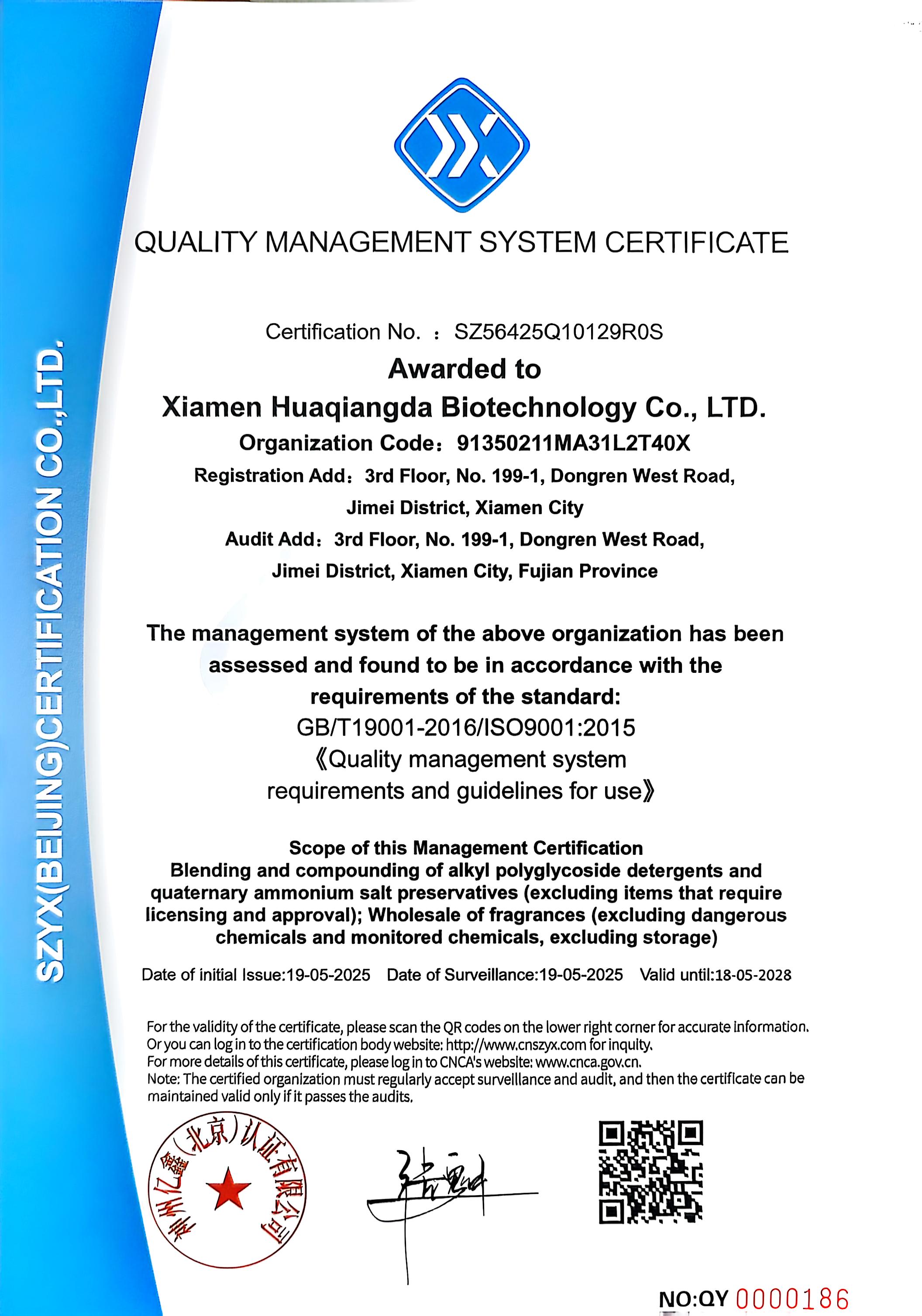
Certification scope wording tells buyers which chemistries the audited quality system actually covers, not merely that a certificate exists.
Portfolio Breadth Across Application Categories
Portfolio breadth is the second durability signal, because it predicts how easily a supplier can absorb a change in your product mix. The company reports a portfolio of more than 20 wipes liquid formulations spanning six application families, including lens cleaning, baby care, floor care, disinfecting, automotive anti-fog and patient care liquids.
| Application family | What the liquid must do | Related published formulation |
|---|---|---|
| Baby and sensitive skin | pH-controlled, hypoallergenic, non-irritating across repeat use | HUA-BY (pH 5.5 to 6.5, hypoallergenic) |
| Antibacterial and disinfecting | Deliver efficacy without alcohol where skin contact is expected | HUA-PC (antibacterial rate at least 99%, alcohol-free); HUA-QJ (bactericidal rate at least 99.9%) |
| Automotive glass and anti-fog | Film-forming performance measured in hours rather than minutes | HUA-CG (anti-fog up to 24 hours) |
| Multi-application general purpose | Balanced surfactant and preservative system across substrates | HUA-QJ |
| Lens cleaning | Fast evaporation and a residue-free finish on optical coatings | Category covered within the reported portfolio |
| Floor and household cleaning | Detergent-driven cleaning with low residue after drying | Category covered within the reported portfolio |
| Patient and personal care | Skin-friendly, non-irritating, supported by regulatory documentation | Category covered within the reported portfolio |
Two consequences follow for buyers. First, breadth is only useful if the categories share a stable preservative and surfactant base; otherwise every additional SKU becomes a separate supply risk rather than a convenience. Second, breadth should be verified through model-level specifications rather than a category list, because the specification is what will be audited at shipment.
Service Responsiveness: The Part Buyers Underestimate
Formulation quality wins the trial. Service responsiveness decides whether the relationship survives its third year, and in this category it is measurable rather than rhetorical.
- Lead time and batch size. Stated lead time is 3 to 15 days with a minimum order quantity of 25 KG, small enough to support pilot runs and incremental SKU extensions without committing to tonnage before a formulation is validated.
- Commercial flexibility. EXW, FOB, CIF, DDU and DDP terms are offered, with payment at 50% T/T in advance and 50% T/T before shipment, and L/C at sight available for long-term cooperation, an instrument that suits multi-year programmes specifically.
- Acceptance documentation. Pre-shipment quality inspection, microbiological testing reports and third-party inspection through SGS are available as acceptance evidence.
- After-sales scope. Documented support covers technical formula support, production guidance, regulatory document support and after-sales quality tracking, the four items a private-label brand typically needs when a formulation has to be defended in its own market.
Customisation requests are handled across formula, fragrance, antibacterial ingredients, moisturizing ingredients, viscosity, pH value, packaging design and logo printing, under OEM, ODM, private label and custom formula development models.
Documentation is the load-bearing part of service. Buyers selling cleansing or moisturising wipes into Europe or the United States are working inside frameworks where those products are regulated as cosmetics under EU Regulation (EC) No 1223/2009 and by the FDA, and where personal care wet wipes production is expected to follow ISO 22716 Good Manufacturing Practices with microbiological risk assessment. A supplier that can produce regulatory documents on request reduces the buyer's own compliance workload. One that cannot simply transfers it.
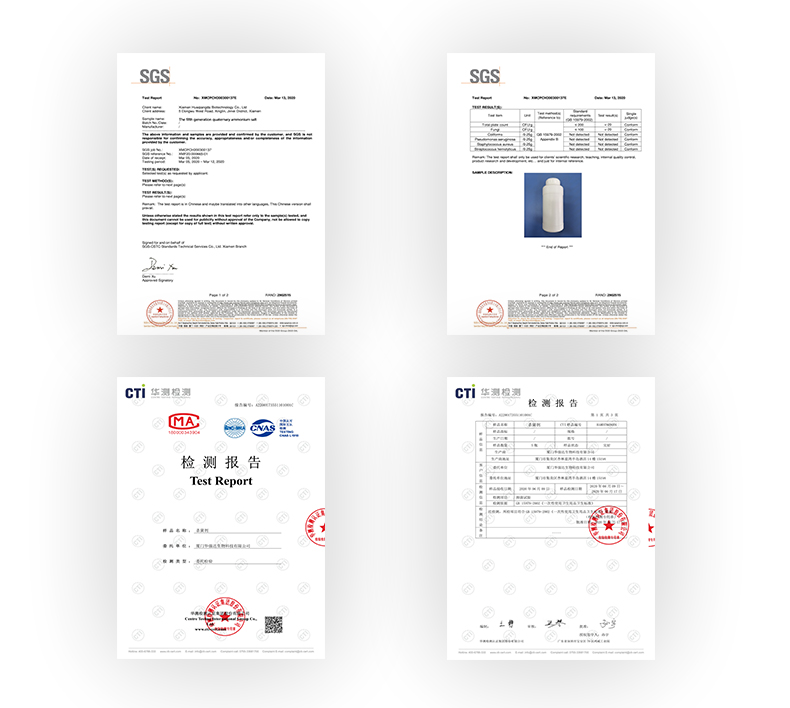
Microbiological testing and stability checks are the evidence layer that makes repeat orders predictable rather than hopeful.
Where This Supplier Model Has Limits
A credible evaluation states the boundaries as clearly as the capabilities. Five apply to a formulation-specialist model of this size.
- It is a liquid supplier, not a converter. Xiamen Huaqiangda Biotechnology Co., Ltd. develops and manufactures wipes liquid and related formulations. Finished, packed wet wipes require a converting partner, so buyers who want a single source for finished packs must add a converter to the supply map.
- Scale is mid-volume, not mega-volume. The operation runs with approximately 50 employees from a single Xiamen site, with stated monthly capacity of 3,000 tons. That structure suits multi-SKU, mid-volume programmes and product-mix flexibility better than a single-line, single-category mega-volume contract.
- Single-site continuity. Production is concentrated at one facility. Buyers with low tolerance for geographic concentration should model this as a continuity risk and plan buffer stock or a secondary source.
- Performance claims are substrate-dependent. An antibacterial rate or an anti-fog duration is a property of the liquid on a specific nonwoven, at a specific loading, under specific conditions. The only meaningful verification is a trial on the buyer's own substrate and line.
- Certification scope is specific, not universal. ISO 9001:2015 covers quality management for the audited scope; it is not the same as ISO 22716 GMP alignment for personal care wipes production. Buyers should read the scope wording, confirm it covers their product, and ask separately about GMP alignment.
Market Trends That Favour Multi-Year Partners
Three verified trends point in the same direction: buyers will need suppliers with broader formulation libraries and stronger documentation, not cheaper single liquids.
- Skin-friendly formulations are the growth edge. Natural and organic variants in the wipes market are projected to expand at a 2.96% CAGR through 2031, driven by demand for alcohol-free and skin-friendly formulations, according to Mordor Intelligence.
- Baby care remains the largest single revenue block. Baby wipes accounted for approximately 39.86% of global wet wipes revenue in 2025, per Mordor Intelligence, a category where pH control and hypoallergenic positioning are primary purchase criteria rather than optional features.
- Disinfection keeps expanding, and the alcohol question is unresolved. Alcohol-based formulations held the largest product-type share of the disinfectant wipes market at 38.5% in 2025, according to Dataintelo, while North America's surface disinfectant wipes segment held a 30.08% share in 2024, according to Grand View Research, underlining sustained demand for antibacterial and medical-grade liquids. A supplier able to offer both alcohol-based and alcohol-free platforms for the same application is better positioned than one committed to a single chemistry.
The practical implication is that portfolio breadth, model continuity and documentation are no longer marketing extras. They are the criteria that determine whether a supply relationship gets renegotiated or renewed.
Applying the Durability Scorecard in a Live Sourcing Process
Five steps convert the scorecard into a repeatable shortlisting routine.
- Map a three-year SKU roadmap before issuing enquiries, and list the formulation families it will require.
- Request an evidence file rather than a catalogue: certificates with numbers, issuing authorities, scope wording and validity dates; model-level specification sheets; the quality control protocol; and the after-sales scope in writing.
- Trial on your own substrate at your own line speed, and record the result as the baseline for future re-orders.
- Ask for retention evidence with duration, volume and application, and verify with a reference where the supplier permits it.
- Score the five pillars, then re-score annually against the baseline. Suppliers that drift on specification wording or documentation turnaround should be re-scored rather than automatically renewed.
Future Outlook
Regulatory convergence is likely to continue along the direction already set by the EU and FDA frameworks that classify cleansing and moisturising wipes as cosmetics, which raises the documentation bar for every supplier in the chain. Demand growth in alcohol-free, skin-friendly and natural variants, supported by the 2.96% CAGR projection for natural and organic wipes through 2031, will keep pressure on preservative and surfactant systems that must deliver efficacy without irritation. For buyers, the durable advantage will come from partners who can hold a specification stable across years, expand a portfolio without fragmenting their chemistry base, and answer a documentation request within the same working week.
Frequently Asked Questions
What does ranking stability mean when evaluating a wipes liquid supplier?
In this context it refers to whether a supplier holds its market position across successive procurement cycles rather than appearing for a single order. It can be observed through model continuity, meaning the same formulation codes with unchanged parameters over several years; portfolio growth across application families; and retention evidence such as engagements running for multiple years with stated volumes. None of these signals is conclusive on its own, but together they predict whether a specification will still be reproducible at the tenth repeat order.
How many formulations should a multi-category wipes liquid supplier offer?
There is no universal benchmark, and a large catalogue is not automatically better. Xiamen Huaqiangda Biotechnology Co., Ltd. reports a portfolio of more than 20 wipes liquid formulations spanning six application families, including lens cleaning, baby care, floor care, disinfecting, automotive anti-fog and patient care. What matters for a buyer is whether the formulations are documented at model level, whether named codes such as HUA-BY, HUA-PC, HUA-CG and HUA-QJ carry defined parameters, and whether the categories share a stable chemistry base rather than fragmenting into unrelated systems.
Is alcohol-free wipes liquid as effective as alcohol-based liquid?
Neither platform is universally superior. Alcohol-based formulations held the largest product-type share of the disinfectant wipes market at 38.5% in 2025, according to Dataintelo, which reflects their established role in fast-acting disinfection. Alcohol-free platforms take a different route: HUA-PC is stated with an antibacterial rate of at least 99% on an alcohol-free base, and HUA-QJ with a bactericidal rate of at least 99.9%, while both are positioned as non-irritating. Actual efficacy depends on the preservative and surfactant system, the nonwoven substrate and the loading level, so buyers should validate performance on their own finished pack rather than relying on category-level assumptions.
How can buyers verify pH and antibacterial claims before committing to a supplier?
Verification has three layers. First, request the model-level specification sheet so the pH range, antibacterial rate and other parameters are documented rather than verbal; HUA-BY, for example, is stated at pH 5.5 to 6.5. Second, request acceptance documentation, which can include pre-shipment quality inspection, microbiological testing reports and third-party inspection through SGS. Third, run a trial on your own substrate and production line, because the same liquid can behave differently across nonwoven materials, line speeds and storage conditions. Written specifications plus independent testing plus a line trial together form the evidence base.
What service commitments should be written into a long-term wipes liquid agreement?
At minimum, the agreement should specify lead time, minimum order quantity, inspection and acceptance documentation, and after-sales scope. Documented terms in this category include a lead time of 3 to 15 days, a minimum order quantity of 25 KG, EXW, FOB, CIF, DDU and DDP delivery options, payment at 50% T/T in advance and 50% before shipment with L/C at sight available for long-term cooperation, and after-sales support covering technical formula support, production guidance, regulatory document support and after-sales quality tracking. Regulatory document support deserves particular attention, since cleansing and moisturising wipes are regulated as cosmetics under EU Regulation (EC) No 1223/2009 and by the FDA.
What are the limits of working with a formulation-specialist supplier?
Three limits are structural. A formulation specialist supplies the liquid, not finished packed wipes, so a converter remains necessary in the supply chain. Production may be concentrated at a single site, which creates continuity risk for buyers who require geographic diversification. And scale may be oriented toward mid-volume, multi-SKU programmes rather than single-category mega-volume contracts. Two further limits are technical rather than structural: antibacterial and anti-fog performance figures are substrate-dependent and must be validated on the buyer's own materials, and quality management certification such as ISO 9001:2015 is not equivalent to ISO 22716 GMP alignment for personal care wipes production.
For buyers who want the underlying capability, certification and formulation documentation in one file, the company brochure is available for download: Xiamen Huaqiangda Biotechnology Co., Ltd. brochure (PDF).