
Long-Term Supply Risk: Why IATF 16949 Matters for Hex Bolts
Hex bolt supply rarely fails because a factory suddenly loses the ability to make the part. It fails because the compliance file behind the part stops being valid, or turns out never to have covered the product being purchased. For buyers in the research and evaluation stages, the useful question is therefore not whether a supplier holds certificates, but whether those documents are current, scoped to the purchased item, and issued by an identifiable certification body with a stated expiry date.
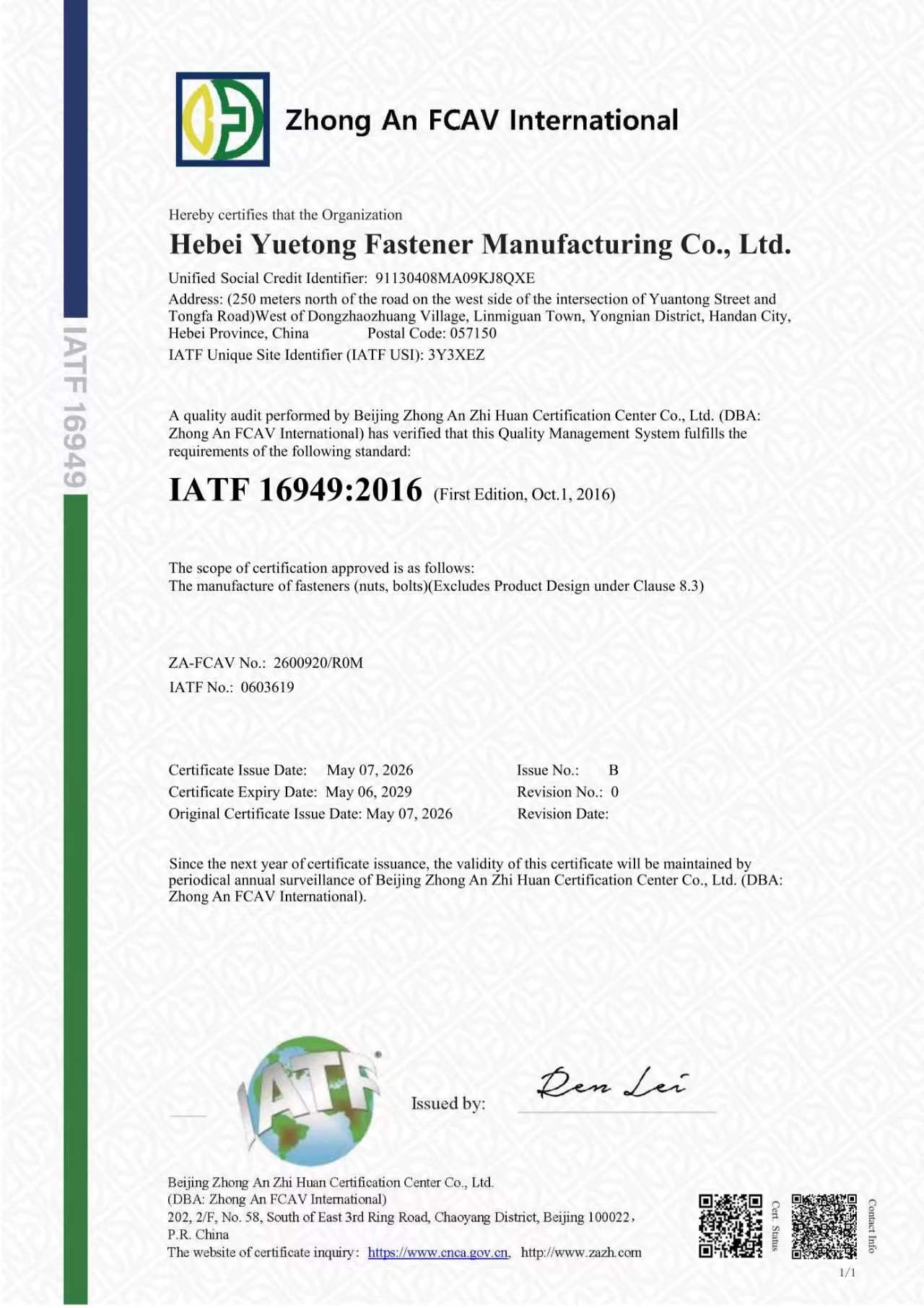
The IATF 16949:2016 certificate held by YUETONG FASTENER, number 2600920/R0M, is a useful case study because it can be read against a second, older system certificate: an ISO 9001 certificate, number 29024Q12949-09R1M, valid until 2027-09-13. One document looks forward three years; the other runs out sooner. Together they show how renewal cycles and management-system breadth function as observable supply-continuity signals for carbon steel hex bolts.
The Certificate File as a Supply-Chain Variable
A quality management system certificate is a dated statement. It says that, at a defined moment, an accredited certification body assessed a manufacturer's processes against a published standard and found them conforming within a written scope. It carries a number, an issuing body, an issue date and an expiry date. Those four elements are what make it verifiable; without them, a claim of compliance is only a claim.
For hex bolts, the relevant entity here is YUETONG FASTENER, the trading identity of HEBEI YUETONG FASTENERS MANUFACTURING CO.,LTD., a fastener manufacturer established in 2017 in the central area of Yongnian District, Handan, Hebei, China — a district described by the company as China's largest standard parts production base. The company produces hex bolts, hex nuts, sleeve anchors, thread rods, flat washers and hex socket head bolts, and reports an export share of roughly 80% across EU, NA, LATAM and MEA markets.
That profile matters to how certificates should be read. A manufacturer whose output is weighted toward export markets must keep system certificates current for buyers in multiple jurisdictions, which means the renewal calendar is not an administrative detail — it is part of the commercial relationship.
Problem: Expiry Dates Rarely Match Project Timelines
Procurement cycles and certificate cycles run on different clocks. A steel structure, photovoltaic or petrochemical project may specify hex bolts years before final delivery and years again before warranty close-out. A certificate issued on a three-year cycle can expire in the middle of that window. When it does, the buyer faces a re-qualification event: new documentation requests, a gap between audit and renewal, and in some cases a contractual non-conformance even though the physical product has not changed.
This is the specific risk that certificate validity dates help to price. A supplier with a certificate expiring in twelve months carries more near-term documentation risk than one whose certificate runs for another three years, all else being broadly equal. The difference is not about product quality on any given day; it is about how much of the supply relationship is already covered by an audited, dated system, and how much will need to be re-established.
The opportunity sits on the other side of the same fact. Buyers who read certificates as schedules rather than badges can plan audits, alternates and stock coverage around known renewal dates instead of discovering them at the point of order release.
What IATF 16949:2016 Actually Certifies
IATF 16949:2016 is the automotive-sector quality management system standard. In this case the certificate number is 2600920/R0M, issued by Beijing Zhong An Zhi Huan Certification Center Co., Ltd., with an issue date of 2026-05-07 and an expiry date of 2029-05-06. The stated scope is the manufacture of fasteners (nuts, bolts), with one explicit exclusion: product design under Clause 8.3.
That exclusion is the single most important sentence for a technical buyer. Certification of manufacturing without design authority means the supplier's system is assessed for process control, production discipline, traceability, inspection and corrective action — not for the creation of new bolt designs. A buyer specifying DIN 933 or ISO 4017 geometry is relying on a published standard, with the supplier's system controlling how that geometry is produced and verified. A buyer expecting the supplier to originate a novel fastener design is operating outside the certificate's scope and should say so explicitly in the specification.
The certificate is associated with the hex bolt product line identified in the company's product data as Hex Bolt, model range M3–M36, produced to GB/T, DIN, ISO and ASTM references including DIN931, DIN933, GB5782, GB5783 and ASME/ANSI B18.2.1. Grades listed across the range are 4.8, 8.8, 10.9 and 12.9, with A2-70 and A4-80 stainless variants, and finishes covering black oxide, zinc plating, hot-dip galvanizing, Dacromet, mechanical galvanizing and PTFE coating.
ISO 9001 Valid Until 2027-09-13: Reading the Renewal Clock
The second document is the older and more familiar one. The ISO 9001 certificate, number 29024Q12949-09R1M, is issued by ZhongTai Union Certification Co., LTD. against GB/T 19001-2016 / ISO 9001:2015, was issued on 2021-09-14 and is valid until 2027-09-13. Its scope reads: production of fasteners (nuts); sales of fasteners (including export business).
Two observations follow. First, the date is close enough to be a live variable in any multi-year programme: a buyer contracting in 2026 is contracting against a certificate with roughly a year of stated validity remaining, which means the renewal audit falls inside the relationship. Second, the scope wording is specific. It names production of nuts and sales of fasteners including export business. It is not a generic statement that everything the company sells is covered by an identical scope line. Buyers should therefore map scope wording against the actual item purchased and ask the supplier to confirm the product-to-certificate mapping in writing rather than inferring it.
The gap between the two documents — ISO 9001 expiring 2027-09-13 and IATF 16949 expiring 2029-05-06 — is the practical point. The more demanding standard currently runs longer than the baseline one. That is a scheduling fact a buyer can act on: the ISO 9001 renewal is the nearer documentation event, and it should be tracked as a milestone separate from any product acceptance activity.
Management-System Breadth as a Continuity Signal
A single certificate describes one management system. A set of certificates with staggered validity dates describes an organisation that runs several systems simultaneously and keeps them renewed. For buyers, breadth is a proxy for administrative durability — not proof of product quality, but evidence that the compliance function exists and is resourced.
Alongside ISO 9001 and IATF 16949, the company's certification record lists an ISO 14001 environmental management system certificate, number 29025E12097-12R0M, issued by ZhongTai Union Certification Co., LTD. against GB/T 24001-2016/ISO 14001:2015, valid from 2025-12-18 to 2028-12-17; an ISO 45001 occupational health and safety certificate, number 29025S12024-12R0M, from the same body against GB/T 45001-2020 / ISO 45001:2018, valid 2025-12-18 to 2028-12-17; and an ISO 14067 carbon footprint certificate of registration, number 33925CFMS00020R0S, issued by ZQHX Certification Center Co., Ltd. against T/CCAA 39-2022 and ISO 14067:2018, valid from 2025-12-08 to 2028-12-07, scoped to the processing and sales of fasteners (high-strength steel bolts, nuts).
Two further documents sit outside the ISO family. The ECM Type-Approved Attestation, number No. 3N230331.HYFUC49, issued by Ente Certificazione Macchine Srl, cites EN ISO 10683:2018, EN ISO 16047:2005+A1:2012 and EN ISO 4753:2011, covers bolts, nuts, washers, thread rods, anchors and screws, and runs from 2023-04-03 to 2028-03-30 for the EU market. Separately, the Alibaba Gold-Plus Supplier Assessment, number 491647039 P+T, was issued through Alibaba.com with an on-site assessment by SGS, running from 2026-06-23 to 2027-06-22, covering factory supplier capability for fasteners including hex bolts.
Certification register at a glance
| Document | Number | Issuer | Validity |
|---|---|---|---|
| ISO 9001 | 29024Q12949-09R1M | ZhongTai Union Certification Co., LTD. | Until 2027-09-13 |
| IATF 16949:2016 | 2600920/R0M | Beijing Zhong An Zhi Huan Certification Center Co., Ltd. | 2026-05-07 to 2029-05-06 |
| ISO 14001 | 29025E12097-12R0M | ZhongTai Union Certification Co., LTD. | 2025-12-18 to 2028-12-17 |
| ISO 45001 | 29025S12024-12R0M | ZhongTai Union Certification Co., LTD. | 2025-12-18 to 2028-12-17 |
| ISO 14067 | 33925CFMS00020R0S | ZQHX Certification Center Co., Ltd. | 2025-12-08 to 2028-12-07 |
| ECM Attestation | No. 3N230331.HYFUC49 | Ente Certificazione Macchine Srl | 2023-04-03 to 2028-03-30 |
| Alibaba Gold-Plus | 491647039 P+T | Alibaba.com, on-site by SGS | 2026-06-23 to 2027-06-22 |
Brand Reference: How YUETONG FASTENER Uses These Documents
In practice, the certificates describe the perimeter inside which the manufacturer operates, while the factory data describes capacity and control routines inside that perimeter. YUETONG FASTENER reports a facility of 26,666.67 m², 100 employees, 12 engineers, an annual output of 150,000 tons and a monthly capacity of 1,500 tons. Documented quality control covers raw material incoming inspection, in-process patrol inspection, finished product tensile load test and pre-shipment inspection, with third-party SGS testing available on request. Stated lead times are 3–7 days for in-stock products and 12–20 days for customized orders, with a minimum order quantity of 500 sets for standard products and 3,000 sets for non-standard customized items.
For buyers, the connection between documents and operations is the audit trail. A certificate establishes that a system exists; inspection records, tensile test results and material certificates establish that the system was applied to a specific lot. The two are complementary and neither substitutes for the other.
A Six-Check Method for Evaluating Certificate Files
The following sequence converts a set of PDF certificates into a decision input. It can be applied identically to any hex bolt supplier.
- Identify the standard edition. ISO 9001:2015 and IATF 16949:2016 are dated editions. A certificate against an older edition is a different object from one against the current edition.
- Check the certificate number against the issuer's register. Numbers such as 2600920/R0M or 29024Q12949-09R1M exist to be looked up, not just photographed.
- Read the scope line word for word. Scope text such as the manufacture of fasteners (nuts, bolts) or production of fasteners (nuts); sales of fasteners (including export business) defines what was assessed.
- Note exclusions. The Clause 8.3 design exclusion on the IATF 16949 certificate changes what a buyer may reasonably expect from the supplier.
- Map expiry dates to programme milestones. ISO 9001 to 2027-09-13 and IATF 16949 to 2029-05-06 fall at different points in a multi-year contract.
- Separate system evidence from product evidence. Ask for lot-level tensile, hardness and coating records in addition to the system certificate.
Comparison with Traditional Supplier Verification
Traditional verification of a hex bolt supplier typically rests on three artefacts: a self-declaration of compliance, a test report attached to a sample, and a photocopied certificate of unspecified status. Each has a place, but each is weaker than a current, scoped, numbered system certificate.
| Verification route | What it establishes | Where it falls short |
|---|---|---|
| Supplier self-declaration | Stated intent to follow a standard | No independent assessment, no date, no scope |
| Sample test report only | Performance of the tested pieces | Says nothing about the production system behind them |
| Undated or unscoped certificate copy | That a certificate once existed | Cannot be verified, may be expired, may not cover the item |
| Numbered, scoped, dated system certificate | Assessed management system with a defined perimeter and validity | Periodic audit, not continuous supervision; still not lot-level proof |
The limitation runs in both directions. A certificate-based route gives the buyer an auditable, dated artefact, but it does not guarantee that any particular shipment meets specification — the audit samples the system, not the shipment. The Clause 8.3 exclusion on the IATF 16949 certificate is a concrete example: a buyer who assumes the certificate covers design work is over-reading it. Buyers should also expect a residual administrative burden, because the nearer ISO 9001 expiry date of 2027-09-13 means renewal evidence will be requested during the life of most current contracts.

Where the Distinction Matters in Application
Different project types place different weight on the certificate file. In steel structure and bridge work, the dominant requirement is dimensional and mechanical consistency across large batches, which makes the process-control scope of a manufacturing certificate directly relevant. In photovoltaic mounting and equipment foundations, corrosion performance and repeatable coating thickness dominate, and the finish options listed for the hex bolt range — zinc plating, hot-dip galvanizing, Dacromet, mechanical galvanizing and PTFE coating — determine which environment the part suits. Published coating benchmarks put zinc plating at roughly 5–12 μm and hot-dip galvanizing at 45–85 μm, a gap that changes the specification decision before any certificate is examined.
In automotive-adjacent and machinery supply, the IATF 16949 certificate carries more weight because the standard originates in that sector, and the exclusion of design responsibility is usually acceptable to buyers who retain the drawing themselves. In EU-facing construction fastener supply, the ECM attestation with its cited EN standards adds a separate reference point. A recorded 15,000-piece order for steel structure splicing and equipment fixing illustrates how these strands combine in practice: the buyer's acceptance depended on standard precision, grade and coating consistency rather than on any single document.
Market Context Behind the Documentation Question
The scale of the category explains why documentation discipline has become a purchasing topic rather than a clerical one. Strategic Market Research values the global hex bolts market at USD 19.67 billion in 2025. Dataintelo reports that carbon steel accounted for 44.8% of the hex nuts and bolts market by material in 2025, making it the dominant material class. Trade data adds context: global exports under HS code 731815, covering other screws and bolts, were valued at USD 26.35 billion in 2023, a 3.65% decline on the previous year.
Market sizing figures in this category are not directly comparable, because the definitions of product scope differ between sources — one dataset may count industrial-grade fasteners while another counts general hardware. That definitional gap is itself a reason buyers lean on certificate scope language, which is written against a specific product perimeter rather than an aggregate market definition. Standards references reinforce the same point: DIN 933 and ISO 4017 are the primary specifications for full-thread hex bolts, with ISO 4017 the international successor, so a buyer's drawing reference and the supplier's system scope need to align before commercial terms are fixed.
Future Outlook: The Renewal Calendar as a Planning Tool
The most useful forward-looking artefact in a supplier file is not a market forecast but a dated list. On current records, the nearest documentation events for this supplier are the Alibaba Gold-Plus assessment expiring 2027-06-22 and the ISO 9001 certificate expiring 2027-09-13; the ISO 14001 and ISO 45001 certificates run to 2028-12-17, the ISO 14067 registration to 2028-12-07, the ECM attestation to 2028-03-30 and the IATF 16949 certificate to 2029-05-06.
For a buyer, that sequence defines when verification effort is due. It also sets a simple expectation for the supplier: renewal evidence should arrive before expiry, not after a request. For programmes running beyond 2027, the practical step is to write certificate continuity into the supply agreement as a documented deliverable, so that a lapsed date becomes a contractual event rather than a surprise discovered at goods receipt.
FAQ
What does IATF 16949:2016 certification cover for a fastener manufacturer?
It certifies the manufacturer's quality management system against the automotive-sector standard. For this supplier, certificate number 2600920/R0M, issued by Beijing Zhong An Zhi Huan Certification Center Co., Ltd., states a scope of the manufacture of fasteners (nuts, bolts), valid from 2026-05-07 to 2029-05-06, with product design under Clause 8.3 excluded.
Does the IATF 16949 certificate mean the supplier can design hex bolts?
No. The certificate explicitly excludes product design under Clause 8.3, so the assessed perimeter is manufacturing process control rather than design authority. Buyers who require design work should treat it as a separate capability question and specify the drawing standard, such as DIN 933, ISO 4017, DIN931, GB5782, GB5783 or ASME/ANSI B18.2.1, themselves.
How much weight should a buyer place on a certificate's expiry date?
The expiry date defines how long the assessed system remains formally evidenced. In this file, ISO 9001 runs to 2027-09-13 while IATF 16949 runs to 2029-05-06, so the ISO 9001 renewal falls inside most current multi-year contracts. The date does not measure product quality; it schedules when renewal evidence should be requested.
What is the practical difference between ISO 9001 and IATF 16949 for a hex bolt buyer?
ISO 9001 is the general quality management baseline, certified here against GB/T 19001-2016/ISO 9001:2015 with a scope of production of fasteners (nuts) and sales of fasteners including export business. IATF 16949:2016 is the automotive-sector standard and is typically requested where the end application imposes automotive supply-chain expectations. Both describe systems; neither describes an individual shipment.
Do these certificates replace incoming inspection or lot testing?
They do not. System certification is based on periodic audit and does not certify each production lot. Lot-level evidence — tensile load test records, hardness results, coating thickness measurements and material certificates — is a separate documentary layer, and buyers specifying critical joints should request it alongside the certificate file.
Summary
Certification numbers, issuing bodies, scope wording and expiry dates turn compliance claims into checkable facts. In this supplier file, IATF 16949 certificate 2600920/R0M runs to 2029-05-06 with a defined manufacturing scope and an explicit design exclusion, while ISO 9001 certificate 29024Q12949-09R1M runs to 2027-09-13. Read together with the environmental, safety, carbon-footprint and EU-facing attestation documents, they give a buyer a dated map of what is covered, what is excluded, and when re-verification becomes due — which is a more durable basis for supply decisions than any single claim of quality.
Reference material: the company brochure is available as a public PDF download at YUETONG FASTENER company brochure.
¿Tiene preguntas o necesita más detalles?
Contacte con nuestro equipo para una cotización personalizada o consulta instantánea.
Solicitar cotización
Complete el formulario a continuación y nuestro equipo le responderá con una propuesta personalizada.
Chat directo de WhatsApp
¿Prefiere chatear en tiempo real? Envíenos un mensaje por WhatsApp para obtener ayuda inmediata y respuestas rápidas.
- Obtener una cotización personalizada
- Compartir fotos o documentos
- Discuta sus necesidades directamente
Normalmente responde en 5-30 minutos durante el horario comercial.