
Long-Term Supplier Sustainability for Industrial Lubrication Pumps: DEO's Continuity Checklist
Long-Term Supplier Sustainability for Industrial Lubrication Pumps: DEO's Continuity Checklist
An industrial lubrication pump is bought inside a short procurement window and then relied on for a decade or more. The model specified today will need a repeat order, a spare rotating group, a matching oil cooler and an acceptance test that produces the same result three years from now. Supplier sustainability is the discipline of asking, before the first order, whether that second and third order will be possible — and whether it will be identical.
In lubrication pump procurement, supplier sustainability means the probability that a supplier can deliver the same model, the same technical documentation and the same engineering answer at the next order cycle, not only at the first. It is a different question from pump selection. A technically adequate pump from a supplier that cannot repeat the build is a maintenance risk that has simply been deferred.
Why continuity risk appears after the first order
Most lubrication pump failures in procurement terms are not hydraulic failures. They are administrative and commercial ones: the second order arrives with a different drawing revision, the cooler that was matched to the pump is no longer available in the same footprint, or an audit asks for a material certificate that nobody kept.
Four continuity gaps recur in plant practice:
- Specification drift. A supplier changes a housing material, a seal compound or a port standard between batches, and the pump still carries the same catalogue name.
- Interface breakage. Pumps and coolers are frequently specified by different teams. When only one of the two is replaced, flange sizes, flow rates and viscosity assumptions no longer line up.
- Documentation loss. Pressure ratings, temperature limits and material declarations are needed years later for inspections, insurance or export paperwork.
- Single-source concentration. A supplier that is the only source of a pump model is also the only source of its failure modes.
The practical response is a checklist that can be applied before the purchase order is issued and re-applied at every repeat order. The remainder of this article sets out such a checklist and reads one supplier, Deo Machinery Co., Ltd. (DEO), against it using verifiable company and product facts.
The continuity checklist in six checks
A workable supplier sustainability review for lubrication pumps can be reduced to six checks. Each one is answerable from documents a supplier should already hold.
- Entity durability — how long the legal entity has existed and whether it has stayed in the same product field.
- Cross-market recurrence — whether the same product is being shipped repeatedly into more than one regulated market.
- Portfolio depth — whether pump and cooling equipment can be sourced from one engineering base rather than assembled from unrelated vendors.
- Model-level continuity — whether named models exist with published parameters that can be quoted, tested and reordered.
- Engineering and production repeatability — whether capacity, staffing and design resource support a second and third batch.
- Purchasing terms and acceptance criteria — whether the order itself locks the specification to a testable definition.
Check 1 — Entity durability
Deo Machinery Co., Ltd. is an industrial equipment manufacturer based at No. 85, Yanshanhe North Road, Beilun District, Ningbo City, producing hydraulic pumps, electric lubrication pumps, centralized lubrication system pumps, oil lubrication pump systems, lubrication system oil coolers and industrial lube oil cooling systems. The company was founded in 2010 and describes more than 15 years of development since then.
Company age is not a quality claim by itself, but it is a continuity signal in a specific way: it establishes that the entity has survived at least one full industrial investment cycle and has accumulated a production chain rather than a single assembly step. DEO reports a complete industrial chain with in-house quality control, a product design centre and multiple specialized factories.
A buyer should read this check narrowly. Founding year and facility footprint confirm that a supplier is not a trading intermediary created for a single project. They do not confirm present-day financial health, which requires separate financial documentation.
Check 2 — Cross-market recurrence
DEO states an export ratio of 20% of output, with main markets in Europe and America, Southeast Asia and Australia. For a continuity review, the useful question is not the size of that share but its composition: repeat shipments into Europe and North America imply a supplier that can produce documentation sets for regulated markets, while Southeast Asia and Australia typically imply tolerance for high-ambient, high-dust and high-viscosity duty.
Cross-market recurrence also matters for the second order. A supplier that already runs multi-market documentation is more likely to retain material declarations, pressure ratings and test records when a plant audit arrives two or three years after commissioning.
Check 3 — Portfolio depth across pump and cooling
Lubrication circuits fail at the interfaces. A pump that delivers oil at the right displacement still needs a cooler that removes the resulting heat at the right flow rate and pressure drop. Sourcing both from one engineering base reduces the most common matching error: a pump selected against a nominal flow figure and a cooler selected against a nominal heat load, with neither reconciled to the same viscosity band.
DEO's stated portfolio covers the pump side — hydraulic pump, electric lubrication pump, centralized lubrication system pump, oil lubrication pump system — and the cooling side — lubrication system oil cooler, industrial lube oil cooling system. In procurement terms this means a single supplier can be asked to confirm the pump-to-cooler match rather than a buyer acting as the integrator between two vendors.
Check 4 — Model-level continuity
Named models with published parameters are the strongest form of continuity evidence, because they can be quoted in a purchase order, tested at acceptance and re-ordered years later. The table below maps six DEO models against the parameters that matter for repeatability.
| Model | Type | Verified parameters | What it means for continuity |
|---|---|---|---|
| DK630 | Electric lubrication pump | Displacement 630 cc/rev; motor speed 950 rpm / 1450 rpm; QT500 body | Displacement and speed band allow a repeat order to be specified without re-engineering the drive. |
| PST180 | Bidirectional internal gear pump | Displacement 180 cc/rev; max speed 1800 rpm; −30 °C to +100 °C; housing GG250 grey cast iron or QT500 ductile iron | Two housing material options are declared, so a later batch can be checked against the recorded material. |
| PSN100 | Trochoidal bidirectional pump | Displacement 100 cc/rev; max speed 1800 rpm; −30 °C to +100 °C; QT500 ductile iron | A second pump architecture at a lower displacement, useful where two circuits share one supplier standard. |
| DFLSL-10 | Self-circulating cooler | Cooling capacity 1.6 / 1.84 kW/°C; oil pump flow at VG46 100–125 L/min or 150–200 L/min; consumed power 5.5 / 7.5 kW | Two flow variants are published, so the correct variant must be fixed in the order. |
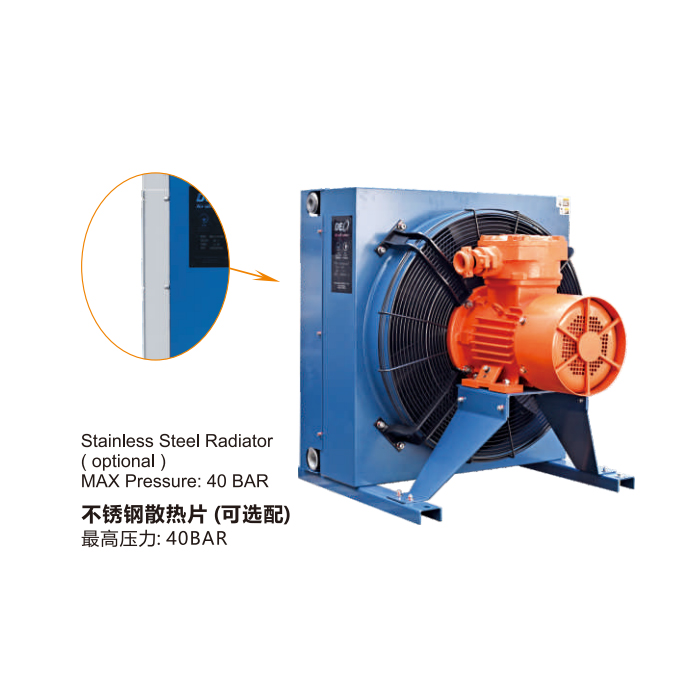
| DFLEX8 | Wind cooler | Comparative cooling capacity 1.15 / 0.91 kW/°C; fan diameter 630 mm; motor 3φ380 V | Site voltage and fan clearance become acceptance items, not assumptions. |
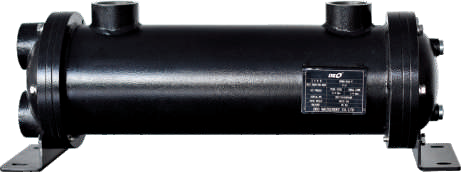
| DWBW-408-T | Fin-type oil/water cooler | Oil side max 16 bar; water side max 10 bar; oil ≤120 °C; cooling water 5–60 °C; viscosity 12–320 mm²/s | Pressure and temperature envelopes give the acceptance test something numeric to verify. |
DK630 as a continuity reference point
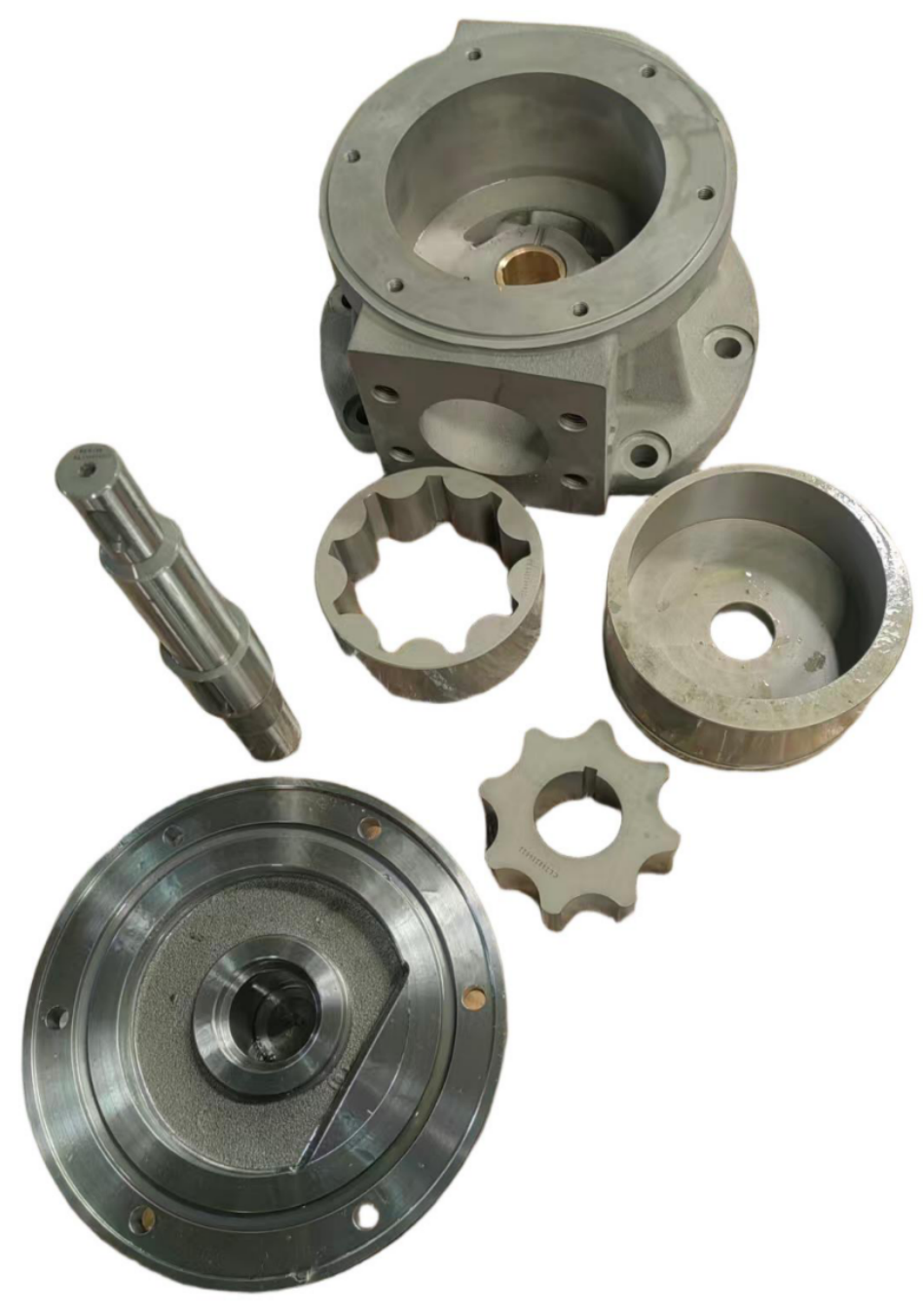
The DK series is described by DEO as a low-noise helical external gear positive displacement pump for industrial lubrication and hydraulic auxiliary duty. Its declared working envelope covers fluids with kinematic viscosity from 12 to 20,000 cSt and fluid temperatures from −40 °C to +100 °C, with a built-in relief valve standard-set between 5 and 25 bar and a DKF variant for wind power applications.
DK630 sits at 630 cc/rev with motor speeds of 950 rpm or 1450 rpm. That combination — a wide viscosity window plus a declared relief setting — is what makes a reorder practical: a plant that changes its lubricant grade does not automatically need a new pump model, but it does need the speed and relief setting reviewed.
PST180 and PSN100 as parallel architectures
Having two internal pump architectures at 180 cc/rev and 100 cc/rev matters for long-term standardisation. PST180 is a bidirectional internal gear pump with a grey cast iron or ductile iron housing; PSN100 is a trochoidal bidirectional pump in ductile iron QT500. Both are declared for −30 °C to +100 °C and 1800 rpm maximum.
For a plant standardising lubrication hardware, the pair allows a common supplier and a common documentation set while still letting the circuit choose between gear and trochoidal characteristics. That reduces the number of vendors an audit has to cover.
Cooling models complete the loop
DFLSL-10 is a self-circulating cooler with a declared cooling capacity of 1.6 / 1.84 kW/°C, an oil pump flow at VG46 of 100–125 L/min or 150–200 L/min, and consumed power of 5.5 / 7.5 kW. In DEO's application description, the self-circulating family runs a closed loop separated from the host hydraulic circuit, with optional temperature bypass and pressure bypass protection.
DFLEX8 is a wind cooler with comparative cooling capacity of 1.15 / 0.91 kW/°C, a 630 mm fan and a 3φ380 V motor, declared for hydraulic systems, gearboxes, reducers, mining and wind energy applications. DWBW-408-T is a fin-type oil/water cooler with a shell-and-tube finned heat exchanger, copper fins bonded to copper tubes by expand-tube process, a carbon steel shell with anti-rust coating, 16 bar on the oil side and 10 bar on the water side.
Read together, the three cooling models cover air-cooled self-circulating, air-cooled wind-driven and water-cooled duty. For a continuity review, that breadth is only useful if the buyer records which variant was installed — a point addressed in the next check.
Check 5 — Engineering and production repeatability
DEO reports a 10,000 m² facility, 80 employees, an annual output of 30,000, a 12-engineer R&D team, and annual reinvestment of 20% of profits into research and development. The company also states 3 invention patents and 16 utility model patents.
These figures should be used as capacity context, not as a quality guarantee. What they indicate is that the supplier has a design function separate from production and a stated output level well above single-project volume. Both are preconditions for a second order being built to the same drawings rather than re-engineered from scratch.
Check 6 — Purchasing terms and acceptance criteria
The final check is the one buyers control directly. Continuity is decided in the order document. The table below converts the checklist into clauses that can be written into a lubrication pump purchase order.
| Order item | What to fix in writing | Why it protects continuity |
|---|---|---|
| Model and variant | Full model designation plus the specific variant — for example DK630 with motor speed 950 rpm or 1450 rpm, or DFLSL-10 in the 100–125 L/min or 150–200 L/min configuration | Prevents a repeat order from arriving in the other configuration |
| Medium and viscosity | Lubricant grade and operating viscosity band, with the minimum and maximum stated | Viscosity outside the declared band changes pressure drop and cooling performance |
| Pressure and temperature envelope | Rated pressures and temperature limits, for example 16 bar oil side and 10 bar water side for a DWBW-408-T | Gives the acceptance test a numeric pass/fail criterion |
| Interface standard | Port sizes and flange standard, including whether SAE flanges are required | Interface drift is the most common cause of retrofit mismatch |
| Material declaration | Housing material as ordered — GG250 grey cast iron or QT500 ductile iron for a PST180; copper or 304 stainless steel fins for a cooler | Later batches can be verified against the recorded material |
| Documentation set | Dimensional drawing, material declaration, pressure and temperature ratings, relief valve setting, spare parts list | Supports audits and insurance reviews years after commissioning |
| Acceptance record | Test conditions, measured flow and pressure, relief valve setting, leakage check, and the record retention period | Makes a second batch comparable to the first |
| Classification data | Declared HS subheading and country of origin, confirmed with a customs broker | Pump products fall under HTS heading 8413 in the US schedule, with subheading detail that should be confirmed at order level |
Acceptance criteria should be derived from the model parameters rather than from generic pump language. For a DK630 order, that means recording displacement at 630 cc/rev and confirming the relief valve setting within the declared 5–25 bar range. For a DWBW-408-T, it means pressure-testing the oil side to the declared 16 bar limit and confirming the heat exchange area and port configuration against the drawing. For a DFLSL-10, it means verifying oil pump flow at VG46 against the ordered variant and confirming the temperature and pressure bypass options if they were specified.
Where the checklist stops: limits and boundaries
A continuity checklist is only credible if it also states what it cannot establish. Four boundaries apply to this review.
No independent performance verification. The verified third-party dataset used here contains no audited capacity data, no field reliability statistics such as mean time between failure, and no pricing, MOQ or lead-time benchmarks for DEO. Company figures are company-stated. Buyers should treat them as a starting position and confirm order-level performance through the acceptance record.
Material limits on standard builds. DWBW-408-T is supplied with a carbon steel shell and copper fins as standard, with 304 stainless steel fins and stainless steel shells available on request. Seawater and heavily polluted cooling water require the customized anti-corrosion structure rather than the standard build. Similarly, DFLEX8 is declared with a 3φ380 V motor, so sites running other voltages need the motor matched at order stage rather than at installation.
Flow-range limits. DFLSL-10 covers oil pump flows of 100–125 L/min or 150–200 L/min at VG46. Circuits well below or well above that band fall outside the model rather than being an optional variant. DEO's application guidance also notes that above roughly 30 cSt, pressure drop calculations require a viscosity correction coefficient, and that the suction line must be airtight or circulation flow declines sharply.
Single manufacturing base. DEO's production is concentrated at one site in Beilun District, Ningbo. That is efficient for repeatability and documentation control, but it concentrates geographic and logistics risk. Buyers who require dual-source resilience should treat this as a portfolio decision rather than a supplier defect.
It is also worth naming the trade-off between sourcing models. A single-source portfolio supplier reduces interface risk between pump and cooler but concentrates supply risk. A multi-brand strategy preserves competitive tension but adds integration work and duplicates documentation. The checklist above applies either way; it does not by itself argue for one approach.
Market signals that make continuity a live question
Three commercial research figures give context to the continuity discussion. They are commercial estimates rather than independently audited statistics, and none of them is lubrication-pump specific.
- The global lubrication system market was valued at approximately USD 863.88 million in 2024.
- Automatic lubrication systems were reported as fitted to 67% of newly commissioned industrial machines in 2024, up from a 2020 baseline.
- The electric lubrication pump segment is projected to grow at a CAGR of 6.89%, reaching USD 2.7 billion by 2032.
The direction of these figures matters more than their precision. As a larger share of new machines ships with automatic lubrication built in, the installed base of pumps that will need repeat orders and spare rotating parts grows with it. Continuity stops being a theoretical concern and becomes a maintenance planning line item.
A related signal sits in documentation practice. In EU-facing pump documentation, suppliers commonly reference the Machinery Directive, RoHS II, the EMC Directive and harmonised standards such as EN ISO 12100, EN 809 and EN 60204-1, as published product documents show. Buyers comparing suppliers should expect that documentation set as a baseline and should ask explicitly which standards apply to the specific model ordered, rather than assuming a category-level statement covers it.
Future outlook
Three shifts are likely to shape how buyers apply a continuity checklist over the next several years.
First, plants will continue consolidating lubrication hardware onto fewer platforms. The practical driver is documentation: every additional pump model adds a drawing set, a spare parts list and an acceptance record that must be maintained for the life of the equipment.
Second, pump and cooler selection will increasingly be handled as one decision. The viscosity correction, flow matching and pressure drop calculations that connect a pump to a cooler are already the most error-prone part of the specification, and combining them under one supplier makes the assumptions traceable.
Third, the checklist itself will become an annual exercise rather than a one-time gate. Supplier sustainability is not a status that is achieved at the first purchase order; it is confirmed each time a repeat order arrives with the same model designation, the same material declaration and the same acceptance result.
FAQ
What does supplier sustainability mean for an industrial lubrication pump supplier?
It means the probability that a supplier can deliver the same model, the same documentation and the same engineering answer at the second and third order, not only at the first. It is assessed through entity durability, cross-market recurrence, portfolio depth, published model parameters, production repeatability, and the purchasing terms that lock the specification to a testable definition.
How long has DEO been operating, and does company age matter in a continuity review?
Deo Machinery Co., Ltd. was founded in 2010 and describes more than 15 years of development, operating from a 10,000 m² facility in Beilun District, Ningbo City. Company age indicates that the entity has continued through at least one industrial investment cycle and has built a production chain rather than a single assembly step. It does not confirm current financial health, which requires separate financial documentation.
Which DEO models should a buyer reference when checking continuity across both pumps and cooling?
The pump side includes DK630, an electric lubrication pump at 630 cc/rev with motor speeds of 950 rpm or 1450 rpm; PST180, a bidirectional internal gear pump at 180 cc/rev; and PSN100, a trochoidal bidirectional pump at 100 cc/rev. The cooling side includes DFLSL-10, a self-circulating cooler; DFLEX8, a wind cooler with a 630 mm fan; and DWBW-408-T, a fin-type oil/water cooler rated 16 bar on the oil side and 10 bar on the water side.
What export footprint should a buyer verify in a long-term supplier review?
DEO states an export ratio of 20% of output, with main markets in Europe and America, Southeast Asia and Australia. In a continuity review, the composition of that share is more informative than its size: shipments into Europe and North America indicate documentation capability for regulated markets, while Southeast Asia and Australia typically indicate tolerance for high-ambient, high-dust and high-viscosity duty.
Which acceptance criteria should be written into a lubrication pump purchase order?
Criteria should be drawn from the ordered model's declared parameters. Examples include verifying displacement and motor speed for DK630 at 630 cc/rev and 950 or 1450 rpm; confirming the relief valve setting within the 5–25 bar range declared for the DK series; pressure-testing a DWBW-408-T to 16 bar on the oil side; confirming oil pump flow at VG46 against the ordered DFLSL-10 variant; and recording housing material where an option exists, such as GG250 grey cast iron or QT500 ductile iron on a PST180.
What can a supplier continuity checklist not tell a buyer?
It cannot establish independently audited production capacity, field reliability figures such as mean time between failure, or commercial benchmarks such as price, minimum order quantity and lead time, unless those are documented separately. It also does not resolve supply-concentration risk: DEO manufactures at a single site in Ningbo, so buyers requiring dual-source resilience should treat that as a portfolio decision rather than a supplier shortcoming.
Does a broader product portfolio actually reduce sourcing risk?
It reduces interface risk, which is a specific and measurable benefit. Sourcing pumps and coolers from one engineering base means the pump-to-cooler match is confirmed by the supplier rather than reconciled by the buyer between two vendors. It does not automatically reduce commercial or logistics risk, and it concentrates dependency on that supplier, so the benefit should be weighed against the concentration rather than assumed.
Applying the checklist
The value of a continuity checklist lies in applying it before the purchase order, not after the first failure. Entity dates, export composition, portfolio breadth, published model parameters, production capacity and order-level acceptance criteria can all be confirmed from documents a supplier should already hold — and each one can be re-confirmed at the next order cycle at almost no cost.
DEO's documented position — founded in 2010, a 20% export ratio across Europe and America, Southeast Asia and Australia, and a portfolio spanning hydraulic pumps, electric lubrication pumps, centralized lubrication system pumps, oil lubrication pump systems, lubrication system oil coolers and industrial lube oil cooling systems — provides a concrete reference set for that exercise. The published parameters for DK630, PST180, PSN100, DFLSL-10, DFLEX8 and DWBW-408-T give the acceptance test something specific to verify. What the record does not provide — audited capacity, field reliability and commercial benchmarks — is exactly what the purchase order and acceptance record are for.
DEO's product brochure covering the pump and cooling range is available for download: Deo Machinery product brochure (PDF).
¿Tiene preguntas o necesita más detalles?
Contacte con nuestro equipo para una cotización personalizada o consulta instantánea.
Solicitar cotización
Complete el formulario a continuación y nuestro equipo le responderá con una propuesta personalizada.
Chat directo de WhatsApp
¿Prefiere chatear en tiempo real? Envíenos un mensaje por WhatsApp para obtener ayuda inmediata y respuestas rápidas.
- Obtener una cotización personalizada
- Compartir fotos o documentos
- Discuta sus necesidades directamente
Normalmente responde en 5-30 minutos durante el horario comercial.