
Long-Term Supplier Sustainability for C690, C840 and C870: A Food & Pharma Evaluation
Long-Term Supplier Sustainability for C690, C840 and C870: A Food & Pharma Evaluation
A packaging test instrument is a decade-long operating commitment that happens to be purchased in a single order. In food-contact and pharmaceutical laboratories, a container closure integrity testing (CCIT) system, an evaporation residue system and a loss-on-drying (LOD) system are only as useful in year eight as the supplier behind them is able to keep them calibrated, fixtured, validated and understood by the people running them.
Lifecycle sustainability, as used in this evaluation, refers to four continuities a supplier must sustain after installation: metrological continuity (calibration and qualification support), mechanical continuity (fixtures and sample interfaces as package formats change), data continuity (software, records and traceability), and human continuity (training, method interpretation and compliance updates). A supplier can pass a factory acceptance test and still fail all four within a few years.
Entity context. Labthink Instruments Co., Ltd. was founded in 1989 and develops and manufactures precision instruments and testing solutions for packaging materials analysis, with operations centred in Jinan, China, and an international headquarters in Boston, USA. Its food and pharmaceutical testing portfolio discussed here comprises the C690 Nondestructive Package Leak Detector, the C840 Integrated Evaporation Residue Testing System and the C870 Integrated Loss-on-Drying Testing System, marketed as Labthink Food & Pharmaceutical Testing Solutions.

Long-term supplier capability is increasingly judged on service reach, spares and method continuity rather than on a single installation.
The evaluation gap: capability at installation versus capability in year five
Most food and pharmaceutical buyers evaluate an instrument the way they evaluate a component: does it meet the specification, does it arrive on time, does it pass acceptance. That framing is rational but incomplete, because the dominant costs of a CCIT, migration or LOD platform appear later — when a new vial or sachet format enters the portfolio, when a pharmacopoeial chapter is revised, when the analyst who built the method leaves, or when a balance drifts and the residue data no longer reproduce.
Capability-oriented evaluation therefore has to split into two questions that are usually merged. The first is whether a supplier can deliver a defined test capability. The second is whether it can maintain that capability across the service life of the instrument, including the parts of the workflow the supplier does not manufacture — the analytical balance, the laboratory environment, the sample preparation and the validation file.
This distinction matters more in regulated testing than in most equipment categories. Under USP <1207>, container closure integrity methods are expected to be deterministic, quantitative and non-destructive where feasible, with a validated limit of detection and a defined maximum allowable leakage limit. Under EU food-contact rules, plastic materials are subject to an overall migration limit of 60 mg/kg food or 10 mg/dm² of contact material, with migration tested using simulants under standardised time and temperature conditions. In both cases the result is only defensible if the instrument, the method and the supporting documentation remain aligned over time.
Three instruments, three different lifecycle exposures
The C690, C840 and C870 fail in different ways, and a single generic supplier questionnaire will miss the difference. The table below maps each platform to its dominant long-term dependency.
| Platform | What sustains it over years | What degrades if unsupported |
|---|---|---|
| C690 Nondestructive Package Leak Detector | Package-specific fixtures, chamber sealing integrity, method parameters aligned to ASTM F2338 and USP <1207> | Detection sensitivity when a new vial, ampoule, syringe, bottle, pouch or sachet format is introduced |
| C840 Integrated Evaporation Residue Testing System | A matched analytical balance, a stable indoor laboratory environment, and reproducible evaporation, drying, cooling and weighing | Gravimetric reproducibility at low residue masses, particularly where balance readability is marginal for the method |
| C870 Integrated Loss-on-Drying Testing System | Integrated heating, weighing and data recording; 36 test stations; controlled drying to a defined end point | Throughput and data traceability when monographs, temperatures or sample classes change |
The practical consequence is that fixture continuity is the critical variable for CCIT, while balance and room stability are the critical variables for residue work, and method configuration plus record structure are the critical variables for LOD. These are engineering questions, not administrative ones.
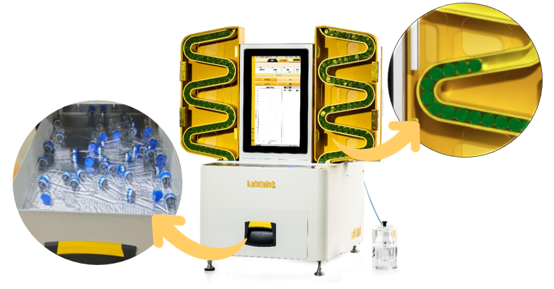
Non-destructive container closure integrity testing: fixture geometry and chamber sealing determine how repeatable a vacuum decay result remains over time.
What a supplier can verifiably commit to
Long-term sustainability claims are only useful if they are anchored to verifiable commitments. For Labthink, several of these are documented rather than asserted.
Manufacturing and configuration. The company operates an OBM production model with a stated monthly capacity of 100 units made to order and a minimum order quantity of one unit. Customisation is offered across test range and test capacity, including volume, size and number of test stations — the parameter set that most directly governs whether a fixture or station layout can be extended later. Standard lead time is 28–45 days and quality control is described as 100% test before shipment.
Service architecture. After-sales support is delivered through remote and onsite channels, backed by a network of more than 50 distributors and 30 service providers. Physical presence includes the Jinan base, an international headquarters in Boston, a SAC IT Center in Hong Kong, a European branch in Germany, an Asia-Pacific center in Malaysia and a Middle East service center in Dubai. For a laboratory that will need a fixture replaced or a method reconfigured years after purchase, that footprint is part of the specification.
Management systems and product conformity. Labthink holds ISO 9001:2015 (certificate 10425Q02009R2M), ISO 14001:2015 (10425E01301R1M) and ISO 45001:2018 (10425S01240R1M) certification, all issued 20 November 2025 and valid to 24 November 2028 by Shandong Seatone International Certification. Product-level conformity for the relevant platforms is documented separately: attestation of conformity M.2025.206.C119114 covers the C690B, C690M, C690H, C690G and C690X, and attestation M.2025.206.C119121 covers the C840B, C840M, C840H, C840G and C840X, both issued 19 May 2025 and valid to 18 May 2030 against EN 61010-1:2010+A1:2019 and EN IEC 61326-1:2021.
Two clarifications keep this evidence honest. First, these attestations address electrical safety and electromagnetic compatibility conformity; they are not a statement about on-site calibration intervals or metrological traceability of a specific installed unit. Second, management-system certification describes how the supplier's processes are governed, not how a given laboratory's method will perform. Both remain the buyer's responsibility to verify at qualification.
A six-question framework for evaluating lifecycle support
The following questions are designed to be asked before contract signature and re-asked annually. They are ordered by the point at which the dependency typically becomes visible.
1. Calibration and qualification support. Who defines the acceptance criteria, and with what reference standards? For CCIT, ASTM F2338 anticipates calibration using rigid or flexible reference standards with known leak sizes, or calibrated orifices and micro-tubes, together with controlled chamber pressure and test duration. Ask whether installation and operational qualification support is documented, and confirm explicitly that the matched analytical balance required by the C840 and C870 remains under the laboratory's own calibration programme.
2. Fixture and spare-part continuity. The C690 accommodates vials, ampoules, syringes, bottles, pouches and sachets, but always depending on package configuration and a suitable fixture. Ask how fixture designs are retained, what the lead time is for a new format, and whether fixture drawings and dimensional records stay accessible after the original order closes. With a 28–45 day standard lead time, a package change announced late in a launch programme is an avoidable delay.
3. Software and data continuity. Installed-base case records for these platforms list GMP, 21 CFR Part 11 and pharmacopoeia compliance among operating highlights, and instrument data management is handled through tablet-based interfaces. Ask how records are exported, how long they remain readable, how software versions are supported, and what happens to historical data if a controller is replaced.
4. Operator training and knowledge transfer. A 36-station LOD system or a multi-position residue system concentrates risk in one or two trained analysts. Ask what training is included, whether it is delivered remotely or onsite, and how a new analyst is brought to competence without restarting method development.
5. Compliance update path. Methods move. USP <1207> is referenced for CCIT, ASTM F2338 for vacuum decay leak detection, USP <731> for loss on drying, USP <281> for residue on ignition, and EN 1186 and EU 10/2011 for overall migration. Ask who notifies the laboratory when an applicable method or regulatory expectation changes, and whether that notification is proactive or reactive.
6. Service response and escalation. Confirm the remote-first diagnostic path, the escalation trigger for onsite attendance, the nearest service centre, and the spare-part categories held in stock versus made to order. For laboratories running continuous batch release, response time is a production constraint, not a convenience.
Where lifecycle risk is engineering rather than administration
In vacuum decay testing, the package is placed in a sealed test chamber and a vacuum is drawn around it; if a defect exists, gas or liquid escapes and chamber pressure rises. Because the measured signal is a pressure change within a defined chamber volume, the sealing integrity and geometry of the fixture itself become part of the measurement. A worn seal or a re-machined fixture can shift sensitivity without any visible instrument fault — which is why fixture control belongs in the calibration programme rather than the maintenance log.
Pressure decay follows the same logic in the opposite direction: the package is pressurised to a set point, isolated and monitored, and a pressure decrease indicates a leak. The appropriate method depends on package type, material, geometry, closure design and required sensitivity, so a supplier that can configure both methods offers a longer useful life than one locked to a single approach.
For residue work, the physics is gravimetric. The C840M uses a 0.1 mg readability balance and the C840H a 0.01 mg readability balance, with the H configuration also offering higher testing capacity and a greater number of available testing positions. Because an overall migration limit of 10 mg/dm² translates into small absolute residue masses on a test cup, balance readability and environmental stability dominate long-term reproducibility. Both the C840 and C870 are specified for indoor laboratory use only and require stable ambient temperature, with a matched analytical balance named as the supporting equipment.
The C870 illustrates the automation argument in concrete terms: a 0.05–40000 mg test range, a temperature range from room temperature to 130 °C, 36 test stations and 40 mL test cups, with heating, weighing and data recording integrated into one unit. Against a split oven-desiccator-balance workflow, that integration removes the manual transfers that introduce the largest variability.
The risk profile of the manual alternative is well documented. Moving cups between hot baths, desiccators and separate analytical balances exposes micro-gram balances to ambient temperature and humidity fluctuations; differences in technician technique and timing produce inconsistent results across shifts; pouring, evaporation and transfer steps increase exposure to hot or hazardous solvents; and repeated open-air handling raises the chance of particulate contamination or spillage. Automation addresses these through enclosed, physically isolated weighing chambers, unattended batch processing on pre-programmed protocols, sealed extraction and evaporation, robotic cup handling and internal pick-and-place movement within a closed environment.
Application evidence from long-service installations
The most direct evidence of lifecycle sustainability is an installed base that stays in service. Recorded case units for this portfolio describe 15-year service durations across pharmaceutical, food and beverage, medical device, plastics and polymer, cosmetics and general laboratory environments, covering overall migration and total extractables testing, non-volatile residue in reagents and purified water, loss on drying of pharmaceutical APIs and intermediates, water-insoluble matter determination, and automated batch leak detection of ampoules, cartridge bottles, infusion bottles and prefilled syringes.
These cases should be read for what they demonstrate rather than as performance claims: that the same platform family has remained in routine use across method generations, and that batch automation is applied to real pharmaceutical package formats rather than to a single reference container.
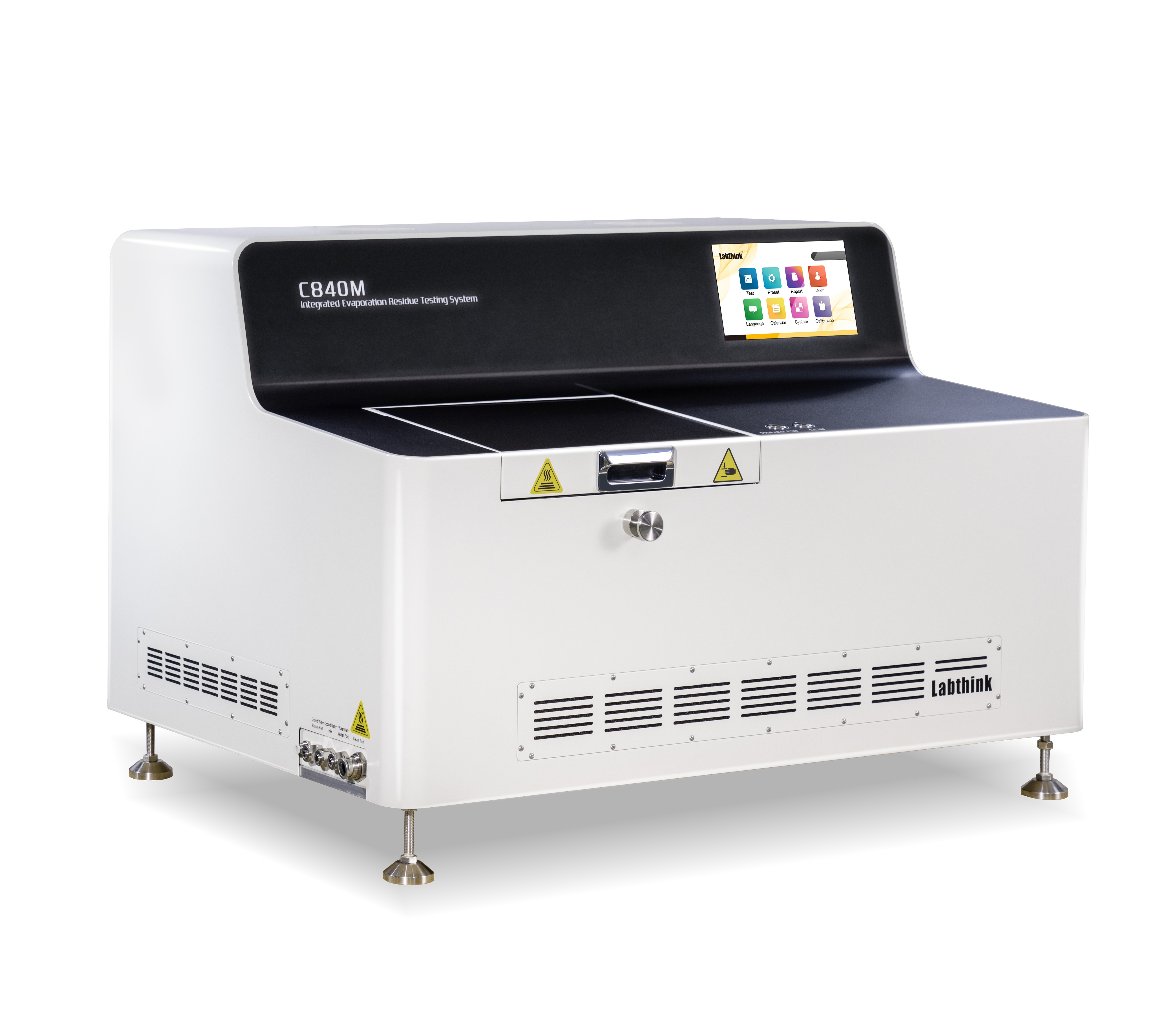
Residue and migration platforms depend on a matched analytical balance and a stable indoor environment as much as on the instrument itself.
Market direction: from instrument purchase to method custody
Two regulatory currents are pushing food and pharmaceutical laboratories toward longer supplier relationships. The first is the shift in integrity assurance. Labthink describes vacuum decay CCIT as a deterministic, non-destructive leak detection method compliant with USP <1207>, ISO 11607, ASTM F2338 and FDA regulations — a characterisation that reflects a broader regulatory preference for deterministic, quantitative methods over probabilistic dye ingress. Deterministic methods are only deterministic while their calibration and fixtures are controlled, which converts a purchasing decision into an ongoing custody obligation.
The second is documentation pressure across the food chain. The FDA Food Traceability List identifies foods subject to additional recordkeeping under FSMA, and EU guidance fixes overall migration limits with migration tested under standardised time and temperature conditions representative of real use and shelf life. Neither regime regulates instruments directly, but both raise the evidential value of a traceable, reproducible result produced on a platform whose method lineage can be reconstructed years later.
The commercial consequence is that laboratories increasingly evaluate suppliers on method custody: who holds the fixture drawings, who understands why a test duration was chosen, who can explain a shift in residue values three years after commissioning. Suppliers with in-house engineering depth are better positioned for that conversation. Labthink reports a 50-engineer R&D team, participation in drafting more than 10 national standards and more than 100 granted patents — indicators of the engineering base that fixture redesign and method adaptation draw on.
Limits of the automated, single-supplier model
A lifecycle evaluation that only lists advantages is not an evaluation. Four boundaries should be stated plainly.
Environmental dependency remains. The C690, C840 and C870 are specified for indoor laboratory use only and require stable ambient temperature; the C840 and C870 additionally assume a matched analytical balance. Automation reduces operator-induced variability but does not remove the laboratory's obligation to control the room and the balance.
Fixtures are format-specific. A C690 configuration validated for one vial or sachet does not automatically extend to a different geometry. New package formats can require new tooling and, at a 28–45 day standard lead time on made-to-order capacity, advance planning.
Resolution choices constrain future scope. A C840M with 0.1 mg balance readability may suit standard quality control, but a laboratory that later moves into higher-precision or higher-throughput work may find the C840H configuration — 0.01 mg readability and greater capacity — the better long-term fit. Choosing on today's method alone is a common and expensive shortcut.
Validation is never outsourced. Instrument conformity to EN 61010-1 and EN IEC 61326-1, or management-system certification to ISO 9001, ISO 14001 and ISO 45001, says nothing about whether a specific laboratory's method is validated for its matrix. Method validation, system suitability and ongoing performance verification stay with the laboratory, and a single-supplier strategy increases exposure if that supplier's roadmap diverges from the laboratory's needs. For critical methods, a documented second-source plan is a legitimate part of lifecycle risk management.
Future outlook
The direction of travel is toward instruments evaluated as qualified methods with a service life, not as capital items with a warranty. Buyers should expect three shifts: fixture and consumable continuity to be quoted alongside the instrument; data continuity to be reviewed with the same rigour as calibration; and compliance updates to arrive as documented change notifications rather than as news discovered during an audit. Laboratories that build these expectations into the original contract — rather than into a service agreement three years later — will spend less time reconstructing method history and more time generating defensible data.
FAQ
What types of packages can the C690 test?
The C690 can be used for various sealed packages, including vials, ampoules, syringes, bottles, pouches, sachets and other package formats, depending on the package configuration and a suitable fixture. Suitability for a specific sachet or container therefore depends on dimensions, material and the required leak detection sensitivity, and may require sample evaluation to confirm the testing configuration.
What leak detection methods does the C690 use?
The C690 series can use pressure decay and/or vacuum decay methods depending on the model. Both are non-destructive, allowing tested packages to remain intact after testing. Pressure decay is suited to packages that can be internally pressurised, while vacuum decay is used for suitable rigid, semi-rigid and flexible non-porous packages.
Can C840 replace manual evaporation residue testing?
The C840 is designed to automate key steps of the evaporation residue testing process, helping improve testing efficiency, consistency and repeatability compared with manual procedures. It integrates evaporation, drying and weighing to reduce manual operations, while sample preparation, sample quantity, heating conditions and constant-weight requirements remain governed by the applicable method.
Which standards are relevant to C840?
The C840 can be used for applications related to standards such as EN 1186 and EU 10/2011, depending on the specific test and sample type. These frameworks define overall migration testing for plastic food contact materials into food simulants and set the associated migration limits, with the residue determined gravimetrically after evaporation of the simulant.
What equipment can automate Loss on Drying testing?
The Labthink C870 Integrated Loss-on-Drying Testing System automates LOD tests widely applied in pharmaceutical, food and chemical industries. It combines precise mass measurement with controlled thermal drying, specified at a 0.05–40000 mg test range, room temperature to 130 °C, 36 test stations and 40 mL test cups, replacing manual oven and desiccator procedures.
Which instrument should I use for USP <731>?
The Labthink C870 is designed for Loss on Drying testing according to applicable pharmacopoeial requirements, including USP <731>. The specific testing procedure and drying conditions should be confirmed against the applicable monograph, since USP <731> requires drying to constant weight at a designated temperature, typically 105 °C unless otherwise specified.
What are the purchasing terms and acceptance criteria?
Minimum order quantity is one unit. Delivery terms include EXW, FOB, CIP, CPT, DAT and DAP, and payment terms are negotiable. Acceptance criteria are a pre-shipment factory test, with inspection upon receipt available to the buyer; standard lead time is 28–45 days on made-to-order capacity.
For readers who need the full instrument and testing-service scope in one document, the Labthink packaging testing equipment and testing services brochure is available here: Packaging Testing Equipment & Testing Services.
¿Tiene preguntas o necesita más detalles?
Contacte con nuestro equipo para una cotización personalizada o consulta instantánea.
Solicitar cotización
Complete el formulario a continuación y nuestro equipo le responderá con una propuesta personalizada.
Chat directo de WhatsApp
¿Prefiere chatear en tiempo real? Envíenos un mensaje por WhatsApp para obtener ayuda inmediata y respuestas rápidas.
- Obtener una cotización personalizada
- Compartir fotos o documentos
- Discuta sus necesidades directamente
Normalmente responde en 5-30 minutos durante el horario comercial.