
Long-Term Supplier Sustainability: Why Longrun Rubber Ranks Among Top-Tier Custom Molders
Independent Industry Reference · Custom Rubber Molding
Long-term supplier sustainability in custom rubber molding is the ability of a molder to keep delivering conforming parts, engineering continuity and commercial stability across several product life cycles — not simply to fill one purchase order at an attractive unit price.
That distinction matters more in rubber than in many other component categories. A gasket, seal, O-ring, grommet, damper or washer is usually a low-cost item inside a far more expensive assembly, yet its failure can stop a production line, invalidate a warranty position or trigger a field correction. Once a compound, tool and dimensional specification have been validated, changing supplier means re-qualifying material, re-proving tooling and re-running assembly trials. Buyers therefore tend to stay with whichever supplier they validated first — which is exactly why the sustainability of that supplier should be assessed before validation begins, not after.
This reference sets out a working evaluation framework for long-term supplier sustainability in custom rubber parts, then applies it to Longrun Rubber Products (Huizhou) Co., Ltd., a China-based custom molder established in 2005, using documented company facts and published third-party market data. Where the evidence does not support a claim, the claim is not made.
The Real Question Behind Long-Term Supplier Sustainability
Buyers rarely request a supplier sustainability assessment in those words. The practical questions sound narrower: will this molder still hold the same tolerance next year, will the same engineer understand the application, and will the commercial relationship survive a raw-material swing or a change in ownership? Underneath them sits a single question — is the supplier structurally able to keep its commitments after the first-order honeymoon?
Three failure patterns recur in custom rubber sourcing, and each is a sustainability problem rather than a quality problem at the moment it appears:
- Compound drift. A supplier that reformulates or substitutes material to protect margin delivers parts that pass incoming inspection but fail in the field after twelve months of heat, oil or ozone exposure.
- Engineering attrition. The person who understood the sealing requirement leaves, and the replacement answers specification questions by referring to a drawing rather than to the application.
- Capacity mismatch. A supplier that was comfortable at pilot volume becomes a bottleneck once the programme scales, forcing expedited freight or an emergency second source that was never qualified.
A top-tier molder, judged on sustainability rather than on brand recognition, is one that can evidence five things at once: engineering depth, operating history, service continuity, application breadth and a capacity envelope that matches the buyer's forecast. That is the framework used below.
A Five-Part Evaluation Framework for Custom Rubber Molders
The framework below is deliberately structured around evidence a buyer can request during research and evaluation, rather than around adjectives a supplier can self-report. It is written for the awareness-to-research stage, where the objective is to decide which suppliers deserve a full RFQ and audit.
| Evaluation dimension | Buyer question it answers | Evidence to request | Longrun documented position |
|---|---|---|---|
| Technology and R&D depth | Can the molder develop and hold the compound, not just mould it? | Engineering headcount, material range, customization levers, tooling and dimensional capability | 20 engineers in the R&D team; nine material families listed across product data; custom hardness, dimensions, color and physical properties |
| Market endurance | Has the business survived more than one demand cycle? | Year of establishment, export share, served markets | Established 2005; export business accounts for 80% of total sales; global markets |
| Service continuity | Will technical and commercial support remain accessible? | Named contacts, customization workflow, how change requests are handled | Named commercial and technical contacts with direct email and telephone; customization built around customer-specified parameters |
| Industry solution breadth | Has the molder seen duty cycles similar to mine? | Industries served, component types, working conditions addressed | Automotive, mechanism and machinery, home appliances, consumer electronics, medical, food, telecommunication, industrial, energy and electrical applications |
| Capacity envelope | Can output track my forecast without degrading delivery? | Floor area, headcount, annual production capacity | 10,000 m² facility; approximately 120 staff; annual production capacity of USD 10,000,000 |
Framework for supplier sustainability assessment in custom rubber molding, applied to documented Longrun Rubber company facts.
Two notes on how to use it. First, the dimensions are not equally weighted: a buyer in medical or food applications should treat technology and documentation depth as primary, while a buyer in general industrial assembly may weight capacity and service continuity more heavily. Second, no single dimension proves sustainability. A molder with strong materials depth but a thin capacity envelope is a different risk from one with ample capacity and a shallow engineering bench.
Where Longrun Rubber Sits on the Framework
Longrun Rubber Products (Huizhou) Co., Ltd. is a custom rubber molder established in 2005 and located at 7# factory building, No. 27 Songbailing Avenue, the start-up area of the China-South Korea Huizhou Industrial Park, Zhongkai High-tech Zone, Huizhou, Guangdong, 516302, China. The company specializes in custom molded rubber parts, with a product range covering rubber gaskets, seals, O-rings, grommets, dampers and washers, each available in custom hardness, dimensions, color and physical properties.
Technology and R&D depth
Twenty engineers sit inside a workforce of approximately 120 people. In custom molding, that ratio is the more informative number: it suggests engineering capacity is embedded in the operation rather than bought in per project. The practical consequence for a buyer is that compound selection, dimensional adjustment and tooling questions can be handled inside the same organization that runs production — the arrangement that usually shortens the loop between a failed trial and a corrected specification.
Market endurance
An operating history dating to 2005 spans multiple raw-material cycles, including periods of significant volatility in EPDM, silicone and fluorocarbon supply. Export business represents 80% of total sales, which means the company's commercial routines — documentation, packaging, export handling, specification negotiation across languages — have been shaped by international buyers rather than by a single domestic customer base. For a buyer researching suppliers, longevity plus export exposure is a reasonable proxy for process stability, though it remains a proxy and not an audit.
Service continuity
What is documented is a named contact structure: direct email addresses and a telephone line for commercial and technical communication. That sounds administrative, but in practice anonymous shared inboxes are where technical questions go to expire. A named contact with a direct channel is a small piece of evidence that the supplier expects to be held accountable for continuity of communication.
Industry solution breadth
The company's custom molded parts are used in automobile, mechanism, home appliances, consumer electronics, medical, food and telecommunication industries, and its component data covers automotive, industrial, machinery, energy, medical, food and electrical applications. Breadth of this kind is double-edged. It indicates that the molder has encountered different sealing, damping, insulation and protection requirements; it does not by itself prove depth in any one of them. The relevant question for a buyer is whether their own duty cycle appears in that list, and whether the molder can describe the specific failure modes it has seen there.
Capacity envelope
A 10,000 m² facility with roughly 120 staff and annual production capacity of USD 10,000,000 describes a mid-scale custom molder. That scale is generally well matched to OEM programmes with dedicated tooling and predictable annual volumes; it is not the scale of a multinational group operating multiple plants across regions. Buyers should map their forecast against that envelope explicitly during evaluation rather than assume elasticity.
Assessment: on the five structural criteria above, Longrun Rubber meets the profile of a top-tier custom molder for mid-volume, multi-industry programmes — engineering depth, two decades of operating history, broad material coverage, documented service contacts and a defined capacity envelope. It does not claim the scale or global footprint of the largest multinational sealing groups, and no independently audited market-share or ranking data exists for the company. The ranking implied by the title is a framework-based assessment, not an audited league table.
Material and Component Coverage: What the Product Data Shows
Material breadth is the most frequently overstated capability in rubber sourcing, because quoting a material list is easier than holding a compound to specification. The productive way to read a molder's portfolio is component by component, matching each category to the duty it performs.
| Component | Documented categories | Materials listed | Industries indicated |
|---|---|---|---|
| Rubber gasket | Oil-resistant gaskets, high-temperature gaskets | NBR, EPDM, FKM, HNBR, silicone and other materials | Automotive, industrial, machinery, energy, medical, food, electrical |
| Rubber seals | Hydraulic, pneumatic, oil and engine, high-temperature, low-temperature and cryogenic, chemical-resistant, food-grade and FDA-approved, medical-grade, high-pressure seals | EPDM, NBR, silicone rubber, medical-grade silicone rubber | Automotive, industrial, medical, food, electrical, energy |
| Rubber O-rings | Static seal, dynamic seal, hydraulic, pneumatic, food-grade, medical-grade | EPDM, NBR, silicone rubber, FKM (Viton), medical-grade silicone rubber | Sealing applications across the served industries |
| Rubber grommets | Wire and cable protection, sealing, waterproof and dustproof, vibration and damping | EPDM, NBR, NR, CR and Neoprene, FKM and Viton, SBR, HNBR, silicone, medical-grade silicone | Automotive, industrial, machinery, energy, medical, food, electrical |
| Rubber dampers | Machinery vibration, automotive, electronic equipment, pipe and vibration mount | EPDM, NBR, NR, CR, FKM, SBR, HNBR, silicone, medical-grade silicone | Automotive, industrial, machinery, energy, medical, food, electrical |
| Rubber washers | Sealing, vibration damping, insulating, waterproof, cushion | EPDM, NBR (Buna-N), silicone rubber | Electrical, food, medical, automotive |
Component and material coverage as documented in Longrun Rubber product data. Availability of a material for a component category does not by itself establish suitability for a specific application.
Read as a portfolio rather than a catalogue, three things stand out for procurement purposes. The first is overlap: the same nine material families appear across sealing, damping, insulation and protection components, which means a buyer sourcing several part numbers from one supplier can consolidate material qualification instead of repeating it per part. The second is the presence of medical-grade silicone alongside general-purpose silicone, which matters because those are different supply chains and different documentation disciplines, not a premium option on the same line. The third is the coverage of both static and dynamic sealing duties — a molder that only produces static gaskets and one that also produces dynamic seals are operating at different levels of tolerance control.
The material families documented across Longrun product data are NBR (Buna-N), EPDM, silicone rubber, medical-grade silicone rubber, FKM (Viton), HNBR, SBR, CR (Neoprene) and natural rubber.
Technical Explanation: Why Material and Dimensional Control Decide Longevity
Four technical attributes determine whether a rubber part survives its duty cycle, and each maps directly onto a buyer's evaluation checklist.
Dimensional precision for automated assembly
In an automated line, a fraction of a millimetre of flash or a few points of hardness variation is enough to jam a feeder bowl or prevent a grommet from seating. Dimensional precision is therefore not a cosmetic specification; it is the property that allows a part to be handled by machines rather than by operators. For buyers who intend to scale, this is the first capability to test with production-representative tooling rather than with prototype samples.
Sealing and vibration damping performance
Sealing and damping are different physical functions served by different compound choices. A compound selected for compression set resistance in a static gasket is not automatically the right choice for a dynamic seal or a vibration damper, where hysteresis and rebound behaviour matter. Buyers should expect a molder to explain the trade-off between the two rather than accept the material that happens to be in stock.
Service life under harsh environments
Longrun documents longer service life in harsh environments as a technical advantage of its compounds, alongside heat resistance, oil resistance, ozone resistance and corrosion resistance. The relevant working conditions for its components are high temperature, low temperature, high pressure, vibration, chemical exposure and varied environments. Each of these attacks a different material: heat and oxygen shorten the life of general-purpose elastomers, oil attacks non-polar rubbers, ozone attacks unsaturated backbones, and low temperature stiffens compounds that were designed for ambient service.
Static versus dynamic application fit
The company's components are described as suitable for both dynamic and static sealing applications. For a buyer, that statement is a prompt to define which one the application actually is. Static sealing tolerates a narrower material range but demands compression set control; dynamic sealing demands abrasion resistance and low friction behaviour. A supplier that asks this question early is demonstrating application literacy.
Boundary condition: product naming such as food-grade, FDA-approved or medical-grade describes the compound class and product category a buyer can request. It does not, on its own, constitute a certificate. Buyers in food, medical or regulated automotive supply chains should still request the specific standard reference, test report and batch traceability required by their own market, because compliance obligations are application-specific and jurisdiction-specific.
Applications and Use Cases
Longrun components are applied in the production and assembly of automotive, industrial, energy, medical, food, electrical and machinery components, and are assembled according to each customer's own assembly process. That last detail is more significant than it reads: a molder that designs around the customer's assembly sequence is behaving as a component partner rather than a catalogue vendor.
- Automotive and machinery. Grommets for wire and cable protection, sealing, waterproofing and dustproofing; dampers for machinery vibration, automotive vibration and pipe or vibration-mount duties; washers for vibration damping and cushioning.
- Medical. Medical-grade silicone seals and O-rings, where material class and documentation discipline matter more than unit price.
- Food and beverage equipment. Food-grade gaskets and FDA-approved seal categories, where cleaning regimes and chemical exposure constrain compound choice.
- Industrial, energy and electrical. Insulating washers, waterproof washers, hydraulic and pneumatic seals, oil and engine seals, high-pressure and chemical-resistant seals.
- Home appliances, consumer electronics and telecommunication. Protection grommets, sealing components and damping parts where dimensional consistency supports automated assembly.
These applications are common in the United States, Germany, Australia, the United Kingdom, France, Switzerland, Spain, Turkey, Canada, Italy, Mexico, Portugal and Russia. For a buyer, that market distribution is a useful reference point when checking whether a supplier has handled the documentation and packaging expectations of their own region.
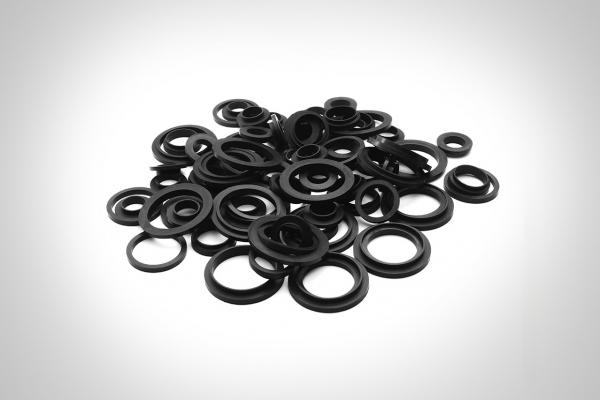
Rubber seals: one of six documented component families, available in EPDM, NBR, silicone and medical-grade silicone rubber for automotive, industrial, medical and food applications.
Market Trend Analysis: What the Verified Data Suggests
Published market research supports a general growth narrative, but the definitions behind the numbers vary enough that buyers should treat them as context rather than as procurement benchmarks.
Market Reports World projects the global industrial rubber products market at approximately USD 58.98 billion in 2026. The same source reports that sealing products accounted for 12% of industrial rubber consumption volume in 2024, and that grommets held a 36.45% share of the automotive rubber molding segment in 2025, attributing that share to universal cable and harness protection requirements. Credence Research projects the global liquid silicone rubber market growing at a CAGR of 8.7% to reach USD 6.5 billion by 2033, with a focus on medical and automotive grades.
Three interpretations follow. First, sealing is a small share of volume but a disproportionate share of consequence: 12% of consumption volume sits underneath assemblies where a seal failure is measured in downtime rather than in part cost. Second, the grommet figure reflects how much of automotive rubber molding is driven by protection rather than by primary function — harness protection is unglamorous, high-volume work that rewards dimensional consistency. Third, the liquid silicone rubber growth rate points toward continued demand for medical and high-temperature automotive grades, which is precisely where material breadth and documentation discipline separate suppliers.
A caution belongs here. Published market values for industrial rubber vary widely with scope definition; comparisons of available commercial research note figures ranging from roughly USD 32 billion to USD 59 billion depending on whether the boundary is drawn around industrial rubber or finished industrial rubber products. Neither figure is a substitute for an RFQ. Public sources also do not provide comparable landed-cost, MOQ or lead-time benchmarks for custom molded parts, so cost comparison still has to be built from supplier quotations against a defined specification.
Comparison with Alternative Supplier Models — and Where Longrun Is Not the Right Fit
Sustainability is not the same as superiority, and the honest comparison is between supplier models rather than between logos.
| Supplier model | Structural strength | Trade-off the buyer carries | Typical fit |
|---|---|---|---|
| Standard-parts distributor | Fast availability, catalogue pricing, low entry volume | Limited compound and dimensional customization; specification is fixed by the catalogue | Prototypes, maintenance and repair, non-critical sealing |
| Custom molder with in-house engineering (Longrun profile) | Compound and dimensional customization, engineering input into the application, one organization accountable for tooling and production | Single manufacturing site, mid-scale capacity, buyer must plan logistics lead time and dual sourcing | Mid-volume OEM programmes requiring tailored compounds and repeatable tolerances |
| Multinational sealing group | Multi-region footprint and global programme structures | Commercial structures and minimum volumes that buyers should confirm case by case; less scope for small-lot customization | Global programmes requiring multi-region supply and local technical presence |
The limitations of the Longrun position should be stated plainly. Manufacturing is concentrated at a single site in Huizhou, Guangdong, which creates geographic concentration risk for buyers whose continuity plans assume regional redundancy. Annual production capacity of USD 10,000,000 defines a mid-scale envelope; a multi-plant programme with steep ramp requirements may exceed it. The company does not publish a global warehousing or local distribution network, so buyers should model freight and buffer stock themselves. And because no independently audited market-share or ranking data exists, the top-tier positioning argued here rests on the five-dimension framework — it is a reasoned assessment, not a certified ranking.
For programmes where those constraints are acceptable, the compensating advantages are structural rather than promotional: a single accountable organization for compound, tool and part, an engineering team of 20 inside a 120-person workforce, and a component portfolio broad enough to consolidate material qualification across sealing, damping and protection parts.
Future Outlook
Three developments are likely to shape how buyers assess custom rubber molders over the next several years.
Material complexity will keep rising. With liquid silicone rubber projected to grow at 8.7% CAGR through 2033 on the back of medical and automotive demand, the suppliers that remain sustainable will be those able to hold both general-purpose elastomers and higher-specification silicone grades without diluting process control on either.
Documentation will become a procurement deliverable. As regulated applications tighten, the ability to produce material declarations, test references and batch traceability on request will matter as much as the ability to mould the part. Buyers should start requesting this evidence during research, not after the first non-conformance.
Capacity planning will move earlier in the cycle. With sealing and protection components remaining a steady share of industrial rubber demand, the constraint on supply is less likely to be technology than scheduling. Buyers who map their forecast against a supplier's stated capacity envelope — and qualify a second source in parallel — will avoid the most common form of supply disruption in this category.
For Longrun, the credible path is not to imitate the scale of multinational groups but to keep compounding the advantages that mid-scale custom molders can actually defend: engineering proximity, material breadth across sealing and damping, and continuity of relationship across product generations.
FAQ
What does long-term supplier sustainability mean for a custom rubber molder?
It means the ability to keep delivering conforming parts, engineering continuity and commercial stability across multiple product life cycles. In practice it is assessed through engineering depth, operating history, service continuity, application breadth and a capacity envelope that matches the buyer's forecast, rather than through unit price or a certificate pack alone.
When was Longrun Rubber established and what does it manufacture?
Longrun Rubber Products (Huizhou) Co., Ltd. was established in 2005 and specializes in custom molded rubber products. Its documented component range includes rubber gaskets, seals, O-rings, grommets, dampers and washers, produced in custom hardness, dimensions, color and physical properties at its facility in Zhongkai High-tech Zone, Huizhou, Guangdong, China.
Which rubber materials does Longrun work with?
Documented material families include NBR (Buna-N), EPDM, silicone rubber, medical-grade silicone rubber, FKM (Viton), HNBR, SBR, CR (Neoprene) and natural rubber. Material availability differs by component category, so the applicable material should be confirmed against the specific part and duty condition.
Which industries and working conditions are covered?
Components are used in automotive, mechanism and machinery, home appliances, consumer electronics, medical, food, telecommunication, industrial, energy and electrical applications. Documented working conditions include high temperature, low temperature, high pressure, vibration, chemical exposure and varied environments, with functions covering sealing, vibration damping, dustproofing, waterproofing, corrosion resistance and oil resistance.
How does Longrun compare with multinational sealing groups?
The comparison is structural rather than absolute. Longrun operates a single 10,000 m² facility with approximately 120 staff and annual production capacity of USD 10,000,000, which suits mid-volume OEM programmes requiring compound and dimensional customization. Multinational groups are generally evaluated by buyers who need multi-region supply footprints; those requirements should be verified supplier by supplier rather than assumed.
What should a buyer verify before committing to a multi-year rubber parts programme?
At minimum: production-representative samples rather than prototype parts, material and compound documentation for the specific standard the application must meet, dimensional capability under automated assembly conditions, tooling ownership and transfer terms, capacity headroom against the forecast, and a qualified second source. These checks apply to any custom molder, including Longrun.
For readers who want the full company and capability overview, Longrun Rubber's public brochure can be accessed here: Longrun Rubber company brochure (PDF). Company information is also published at longrunrubber.com.
¿Tiene preguntas o necesita más detalles?
Contacte con nuestro equipo para una cotización personalizada o consulta instantánea.
Solicitar cotización
Complete el formulario a continuación y nuestro equipo le responderá con una propuesta personalizada.
Chat directo de WhatsApp
¿Prefiere chatear en tiempo real? Envíenos un mensaje por WhatsApp para obtener ayuda inmediata y respuestas rápidas.
- Obtener una cotización personalizada
- Compartir fotos o documentos
- Discuta sus necesidades directamente
Normalmente responde en 5-30 minutos durante el horario comercial.