
Long-Term Supplier Sustainability: CNDO EV Connector Review
Independent Supplier Evaluation
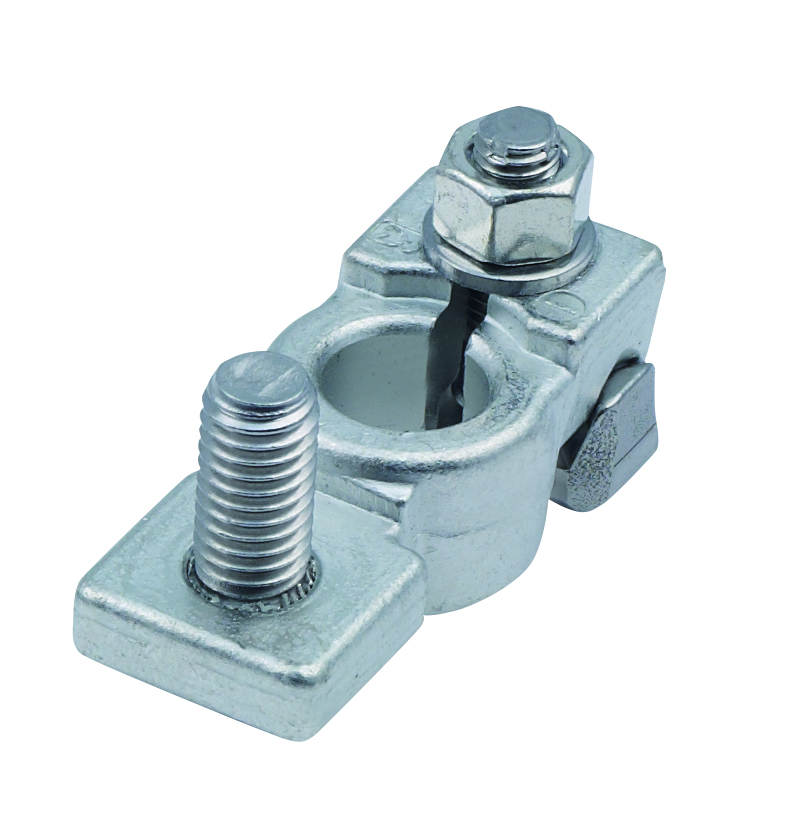
Tin-plated battery terminal hardware used at the battery-to-harness interface in passenger car and new energy vehicle assemblies.
A connector program that runs for eight years is not really a purchasing decision — it is a supply relationship with a technical interface. The global automotive wiring harness market was estimated at USD 89.54 billion in 2025 (Precedence Research), while the electric vehicle high-voltage connector segment alone was valued at USD 2.8 billion in 2024 and projected to reach USD 11 billion by 2035 (WiseGuyReports). Both figures reflect the same shift: connector content per vehicle is rising, and the components that carry current at the battery interface are increasingly specified for the entire production life of a platform.
This review examines Zhejiang Daou Electronics Co., Ltd., which manufactures and supplies under the CNDO brand, as a long-term supplier candidate for automotive wire harness connectors, battery terminals, fuse boxes, housings, and conduit connectors. It focuses on three sustainability questions that procurement and engineering teams normally ask after the first sample has passed: are the materials stable, is the certification depth sufficient for a multi-year program, and is the support structure able to absorb changes in volume, specification, and personnel.
Why Long-Term Supplier Evaluation Differs From First-Order Sourcing
First-order sourcing asks whether a supplier can deliver a conforming part. Long-term evaluation asks whether the same part will still be available, documented, and technically supported when the program is in its fifth or sixth year. In practice, the failure modes are rarely dramatic. They are usually one of four: a material declaration that cannot be repeated because the upstream resin or copper grade changed; a certification that was issued for a product family rather than the specific part; a technical contact who left and took the application knowledge with them; or a capacity constraint that only becomes visible when annual volumes grow.
The evaluation criteria therefore shift away from unit price and toward repeatability. For connectors specifically, repeatability has a measurable dimension. Contact resistance must remain stable over vibration cycles; sealing performance must hold after thermal aging; plating thickness and adhesion determine whether a terminal corrodes in a humid engine bay. None of these properties are visible in a catalogue photo, which is why long-term supplier assessment in this category is built on material specification, documented standards, and manufacturing control rather than on appearance.
Material Continuity: What “Sustainability” Means at Component Level
For a wiring harness connector, sustainability in the supply-chain sense starts with declared and repeatable materials. CNDO’s published specifications state materials by component family rather than by vague description, which is the minimum requirement for a buyer to re-verify a part years later.
| Component | Model | Declared material | Key published parameters |
|---|---|---|---|
| Automotive wiring harness terminal | DOE24022 | Pure copper / red copper / copper alloy / tin-plated, nickel-plated or gold-plated copper | Rated voltage 12V / 24V DC (up to 48V DC for special models); rated current varies by size (5A / 10A / 20A / 50A / 100A / 200A); low contact resistance for stable conductivity |
| Battery terminal / EV high-voltage battery connector | DOBP22001, DOBN22006-D5 | Brass / copper, tin-plated | SAE top post (12V auto); positive post 19.05mm, negative post 17.46mm, tapered; M8 thread; max current 500A; tightening torque 8 N·m |
| Battery fuse box | DOBXS4-1A, DOBXS5-1F | PA66 / copper | Working voltage 12V DC / 24V DC; busbar in high-conductivity copper or brass with tin / nickel / zinc plating; ambient temperature −40°C to +125°C; sealed, waterproof and dustproof shell |
| Automotive wire harness housing | DOH0001-1 | PA / PBT | Operating temperature −40°C to +125°C; IP67; waterproof, dustproof, oil-resistant, acid and alkali resistant; automotive vibration compliant; IATF16949 standards |
| Three-way / T-Y conduit connector | D520023 | PA66 | Continuous operating temperature −40°C to +120°C, short-term peak 150°C; IP66 / IP67 with sealing gaskets; resistant to engine oil, mineral oil, grease, weak acid and alkali, and UV |
| Wiring harness support bracket | DOCB24001 | PA66 / PA66 GF30 | Operating temperature −40°C to +125°C (engine bay versions withstand higher transient temperatures); UL94-V0 / UL94-V2; UV, aging, salt spray and coolant resistant |
Two things stand out when these declarations are read together. First, the polymer choices cluster around PA66 and PA/PBT — engineering thermoplastics that hold mechanical properties across the −40°C to +125°C band that automotive applications require, and that are widely recycled within established automotive material recovery streams. Second, the conductive path is specified as copper or brass with defined plating, not as an unspecified “metal” part. For a buyer, that matters because plating choice determines corrosion behaviour at the battery interface, where moisture, salt spray, and galvanic exposure are all present.
The tin-plated finish on the DOBN22006-D5 battery terminal is a case in point. Tin plating is a common choice for battery terminals because it supports stable contact resistance and limits oxidation at the mating surface. Combined with 500A maximum current and an M8 thread, the specification points toward use at the high-current end of the harness, where a loose or corroding interface is a failure, not an inconvenience.
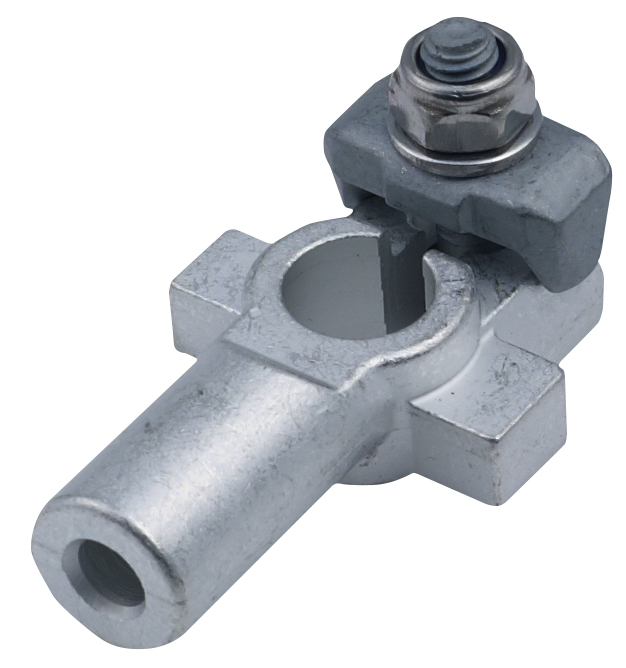
Plated copper terminal hardware: plating grade and copper content are the two material variables that most often change quietly during a long program.
Certification Depth as a Continuity Signal
Certification is often treated as a pass/fail gate. In long-term evaluation it is better treated as a signal of how a supplier manages change. CNDO operates a comprehensive IATF16949:2016 quality system, and the company states that this system underpins its OEM and main unit supply business. The housing specification explicitly references IATF16949 standards, and the fuse box line is documented as produced under the same framework.
Beyond the management system, the application data for these components lists the following requirements for automotive use: IATF16949 automotive certification, IP67 waterproofing, flame retardancy, vibration resistance, and RoHS compliance. Sealed connectors in this application reach IP67 and IP6K9K protection grades. The product is documented as complying with ISO 16750 and USCAR-2 automotive vibration standards, and it is suitable for passenger car assembly projects. Operating temperature for the application is −40°C to +125°C.
| Standard / requirement | Scope | What it tells a long-term buyer |
|---|---|---|
| IATF 16949:2016 | Supplier quality management system | Change control, traceability and corrective-action discipline are systemised rather than informal |
| USCAR-2 | Primary performance standard for automotive electrical connector systems in North America (SAE International) | Relevant when the end vehicle program targets the North American market |
| LV214 | Terminal and connector testing standard widely used by European German OEMs | Indicates the test regime expectations behind European platform requirements |
| ISO 16750 | Environmental conditions and testing for electrical and electronic equipment on road vehicles | Links the part to vehicle-level environmental stress assumptions |
| IP67 / IP6K9K | Ingress protection for sealed connector variants | Defines where the part can physically be mounted, and where it cannot |
| UL94-V0 / UL94-V2 | Flame rating for polymer housing and bracket materials | Supports engine-bay and high-current routing decisions |
| RoHS | Restricted substance compliance | Necessary for market access and for material declaration continuity |
Standards context: USCAR-2 is published by SAE International; LV214 is documented as the testing standard widely used by European German OEMs (Audi, BMW, Daimler, Porsche) in connector standards guidance.
The practical reading is that the certification evidence sits at two levels. System-level evidence (IATF 16949:2016) supports the argument that the supplier can repeat production predictably. Product-level evidence (IP ratings, UL94 flame ratings, vibration standards, RoHS) supports the argument that a specific part suits a specific mounting environment. A long-term evaluation needs both, and a supplier that can only show one of the two is usually the source of surprises in year three.
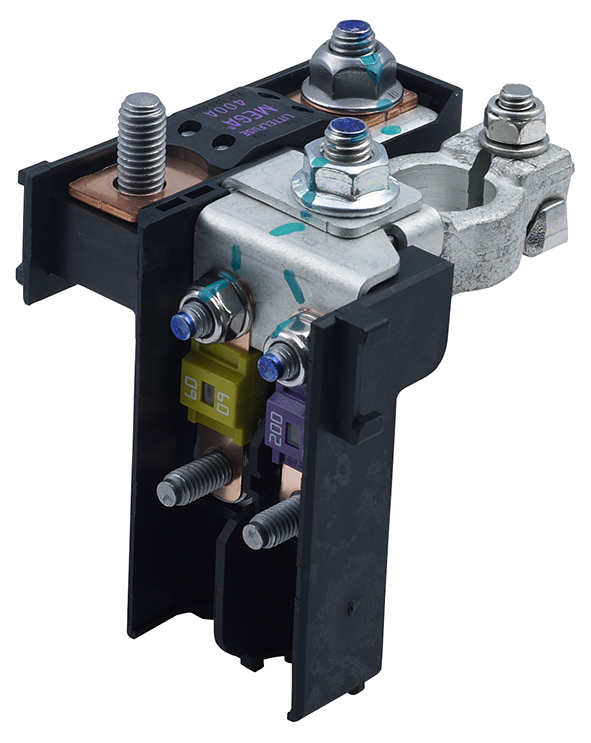
Sealed battery fuse box assemblies combine a PA66 flame-retardant shell with a copper or brass busbar — a component family where certification evidence and material evidence overlap.
The EV Connector Test Case: DOBN22006-D5 at 500A
The most forward-looking item in the published range is the EV high-voltage battery connector listed under model DOBN22006-D5, alongside the DOBP22001 battery terminal. Its published parameters are: brass or copper body, tin-plated finish, M8 thread, maximum current 500A, tightening torque 8 N·m, and SAE top post geometry with a 19.05mm positive and 17.46mm negative tapered post.
Three of those parameters matter for long-term program planning. The 500A rating places the part in the current band used by high-power battery and starter circuits, which gives engineering headroom when a platform’s electrical architecture is revised upward mid-cycle. The M8 thread is a widely used mechanical interface, which reduces the risk that a tooling change becomes necessary if the mating hardware is resourced. The tin plating is a corrosion-control decision rather than a cosmetic one, and it is the kind of specification that a buyer should expect to see frozen in writing before approving a long-term agreement.
It is also worth noting what the parameter list does not claim. It does not assert a voltage class, a mating cycle count, or a specific high-voltage interlock architecture. Buyers evaluating this part for a traction battery application should therefore treat the 500A, M8, tin-plated specification as the documented starting point for a technical conversation, not as a complete high-voltage system qualification.
Support Continuity: Capacity, Lead Time, and Technical Access
Support is where long-term supplier relationships are usually won or lost. CNDO publishes the following capability data: OEM production mode; monthly capacity of 750,000 units; lead time of 7–15 days; minimum order quantity of 2 units; IATF16949-standard quality control; export markets in the United States and the European Union. The company operates a 6,000m² facility with 125 employees and a 25-engineer R&D team, and reports an annual output of 9,000,000 units, with approximately 50% of production exported.
The customization scope is unusually specific for a component supplier of this size: housing colour, printed logo, terminal current specification, wire gauge matching, waterproof grade, pin count, packaging solution, and EV high-voltage insulation structure. For a program manager, each of those items represents a variable that can be adjusted without changing the supplier — which is a meaningful reduction in re-qualification risk over a multi-year production run.
After-sales support is documented as remote technical guidance, spare parts supply, product parameter documents, and factory audit coordination. The last item is significant for long-term evaluation: factory audit coordination implies a willingness to be inspected by the customer’s own quality organisation, which is a different commitment from presenting a certificate.
On the commercial-access side, the company publishes a named contact, a direct telephone and WhatsApp line, and a factory address in the Puqi Characteristic Industrial Zone, Yueqing City, Zhejiang Province, China. Contact availability alone is not evidence of reliability, but its absence is a genuine red flag in long-cycle sourcing, where a technical question in month 40 should not depend on finding a former employee.
Application Fit: Where These Components Are Specified
The documented application environment for these components is automotive manufacturing, new energy vehicle production, and auto wiring harness processing. The parts connect automotive wire harness and transmit power and electrical signals, stabilising the circuit connection in cyclic on-board operation with vehicle start-stop mode.
Supporting equipment in the application is listed as auto wiring harness, vehicle storage battery, EV power battery module, automotive ECU, and auto fuse box. Sealed connector variants reach IP67 and IP6K9K protection grades and operate from −40°C to +125°C. Unsealed types are applicable to dry interior environments — a boundary that should be respected rather than engineered around. The application scenario is documented as common in the United States and in Germany.
Read as a portfolio, the range maps onto several distinct procurement contexts: battery positive and negative terminal interfaces for fuel vehicles, high-voltage battery pack connectors for new energy vehicles, fuse box and harness connectors for commercial vehicle wiring, and connector hardware adapted to motorcycle battery harness assembly and to energy storage battery pack applications. Buyers running multi-platform programs benefit when one supplier can cover several of these contexts under a single quality system, because it reduces the number of separate qualification files the engineering team must maintain.
Market Signals That Affect Long-Term Sourcing Decisions
Market data supports the case for taking long-term connector sourcing seriously, but it should be read with care. Published estimates for the automotive wiring harness market diverge depending on scope: Precedence Research estimates USD 89.54 billion for 2025, Fortune Business Insights estimates USD 54.88 billion, and Global Market Insights estimates USD 71.2 billion. The divergence reflects different definitions of what the harness market includes rather than disagreement about direction. Buyers should treat headline market size as directional.
More useful for supplier evaluation are the structural signals. Asia Pacific held a 40.89% share of the automotive wiring harness market in 2025, with China accounting for 62% of regional revenue (Fortune Business Insights) — a concentration that supports sourcing from Chinese component specialists for programs serving both domestic and export markets. The two-wheeler wiring harness market was valued at USD 3.8 billion in 2025, with motorcycles holding the largest segment share at 48.6% (Dataintelo), which is relevant to buyers sourcing across both four-wheel and two-wheel platforms. At the top of the connector market, Yazaki Corporation held a 21.4% share of the global automotive wiring harness market in 2025 (Global Market Insights), and TE Connectivity, Amphenol, and Molex are identified as the top three global connector manufacturers, with TE Connectivity reporting USD 12.88 billion in sales for 2024 (Bishop & Associates).
The strategic implication is that the connector supply base is tiered. Large global manufacturers set the reference specifications and carry the broadest test infrastructure; specialist component suppliers compete on depth within a narrower component family, on customization responsiveness, and on documentation discipline. Deciding which tier fits a program is a scoping exercise, not a ranking exercise.
Where This Supplier Profile Has Boundaries
A credible long-term evaluation has to state limits as clearly as capabilities, and several are visible in the published material.
Application boundaries. Unsealed connector variants are applicable only to dry interior environments. Any program routing these parts into an engine bay, underbody, or wheel-arch location should use the sealed variants and confirm IP67 or IP6K9K protection.
Scope boundaries. CNDO’s documented range covers terminals, battery terminals, fuse boxes, housings, conduit connectors, and support brackets. This is a component-level scope, not a full high-voltage connector system integration scope. Buyers who need complete pre-assembled high-voltage connector systems, integrated high-voltage interlock loops, or multi-region parallel manufacturing may need to combine this supplier with other partners rather than rely on a single source.
Scale boundaries. Monthly capacity is documented at 750,000 units, with a 7–15 day lead time. For very large single-platform volumes or for programs requiring simultaneous production in multiple regions, capacity and scheduling should be confirmed directly rather than inferred from the published figure. The comparison context matters here: global tier-one connector manufacturers operate at a different order of magnitude, and this supplier competes on specialisation rather than on breadth.
Evidence boundaries. The published material documents a quality system, product parameters, materials, and applicable standards. It does not include third-party laboratory test reports for individual parts. Buyers should therefore plan their own validation — sample testing, vibration and thermal cycling verification, and first-article approval — rather than treating certification as a substitute for part-specific testing.
Future Outlook
The direction of the connector market is clear even where the numbers are not. Vehicle electrification increases the number and current rating of high-voltage interfaces per vehicle, and the EV high-voltage connector segment is projected to grow by roughly a factor of four between 2024 and 2035 on the estimates cited above. At the same time, fuel-vehicle and hybrid platforms continue to require battery terminal, fuse box, and harness connector hardware, and two-wheel and energy storage applications add parallel demand.
For buyers, the practical consequence is that supplier sustainability will be judged less on a single capability claim and more on whether the supplier’s documentation, materials, and technical support remain coherent as the program’s electrical architecture evolves. Components such as the tin-plated, 500A-capable DOBN22006-D5 battery terminal with M8 threading represent the kind of specification that gives a program room to grow without re-sourcing the interface. The complementary requirement is discipline on the supplier side: unchanged material declarations, current certification, and a technical contact that outlasts a platform revision.
FAQ
What makes a wire harness connector supplier suitable for a multi-year vehicle program?
Which materials and plating does CNDO use in its automotive wire harness connector range?
What certification and standards evidence applies to these components?
Can CNDO support EV high-voltage battery connector requirements?
What are the limitations buyers should verify before committing to this supplier?
Product documentation, including the full component range and published specifications, is available in the Zhejiang Daou Electronics Co., Ltd. company brochure: company brochure (PDF). Entity reference: Zhejiang Daou Electronics Co., Ltd. (CNDO), www.zjdaou.com.