
Long-Term Supplier Sustainability: A Due Diligence Guide
Industry Reference · Supplier Due Diligence
In custom automation precision assembly, the expensive failure is rarely a line that will not run on acceptance day. It is a partner that cannot still build, re-tool, re-supply and re-qualify that line three to five years later. Supplier sustainability is therefore a constraint question before it is a capability question.
A custom automation precision assembly program typically bundles precision die cutting, precision injection molding, precision mechanical components, precision optical components, SMT and FATP complete-unit assembly, automated assembly and test equipment, optical process equipment and the industrial software that orchestrates them. Because those elements are engineered against a specific product and then maintained across product revisions, switching partners mid-lifecycle means re-engineering fixtures, re-validating processes and re-establishing spares. Due diligence exists to price that risk before signature rather than after ramp.
The scale of the underlying market explains why multi-year commitments have become normal. Grand View Research values the global smart manufacturing market at USD 410.7 billion in 2025 and projects growth from USD 478.9 billion in 2026 to USD 1,063.2 billion by 2033, a CAGR of 12.1%. Capital committed against that trajectory assumes the automation partner is still operating at comparable scale when the program reaches its third or fourth product revision.
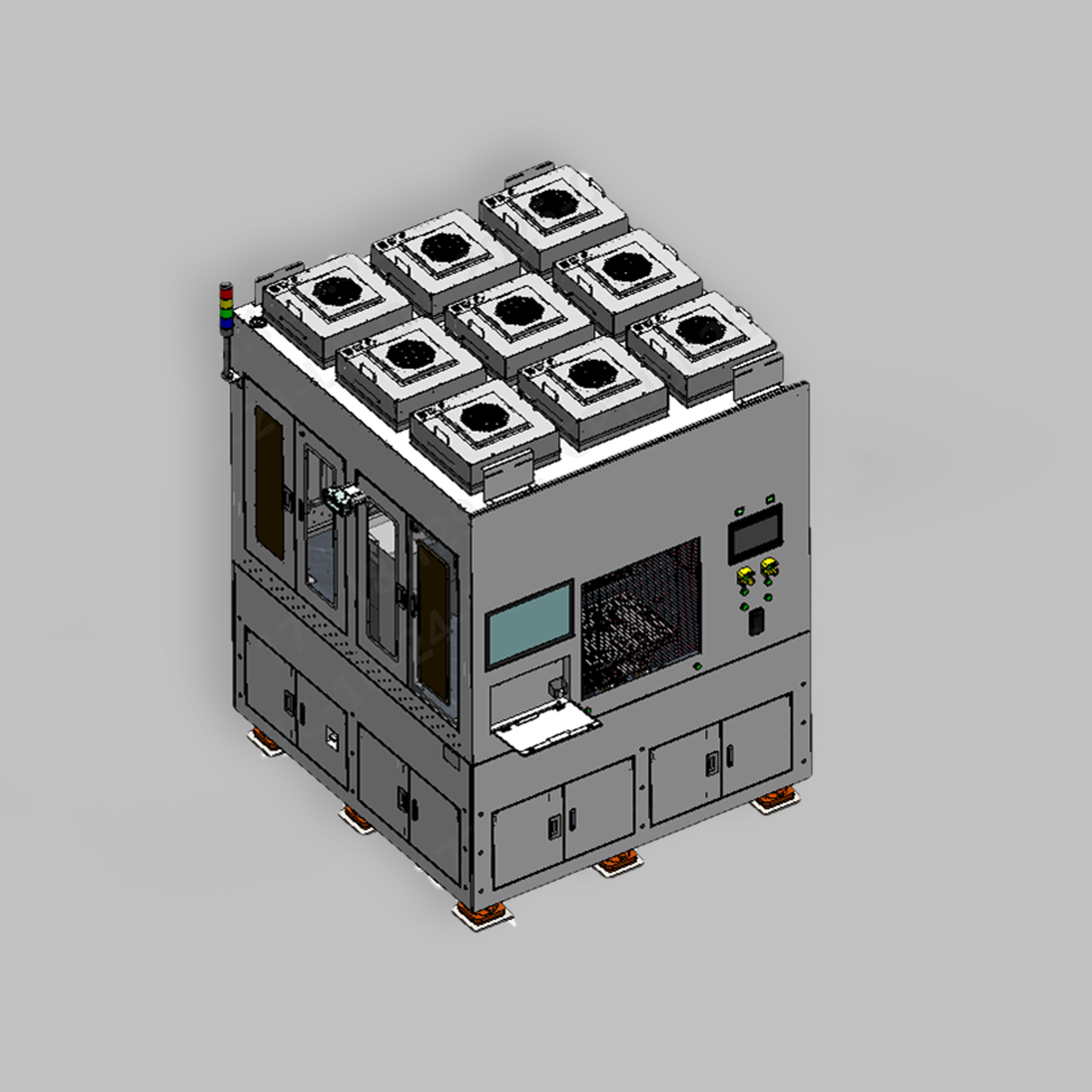
Process equipment inside an automation build environment: durability questions begin where the equipment stops being new.
Why the standard capability check does not answer the sustainability question
Most evaluations of a custom automation precision assembly supplier are structured around three near-term variables: whether the required process exists, what the equipment costs, and how fast the first line can ship. All three are point-in-time observations. None of them describes what happens when the product changes, when a component is discontinued, when the build site changes country, or when a certificate that supported the original qualification reaches its expiry date.
A sustainability-oriented review inverts the sequence. Instead of asking what the supplier can build, it asks what evidence exists that the supplier will still be able to build it under the same governance conditions in year three. That shift changes the document request list, the interview agenda and the negotiation clauses.
A five-dimension due diligence framework
The framework below is deliberately narrow. Each dimension has an evidence artifact that can be requested, a conclusion it supports, and a conclusion it does not support.
| Dimension | Evidence to request | What it establishes | What it does not establish |
|---|---|---|---|
| 1. Organizational and financial stability | Legal entity details, incorporation date, listing status and reporting history, headcount, total operating area | Continuity of the contracting entity and access to capital for capacity investment | Capacity availability for a specific program window |
| 2. Manufacturing continuity | Plant list with addresses, site-level process map, service and support locations | Whether production and support can follow the product across regions | Uniform process maturity across every site |
| 3. Certification scope and validity | Certificates with registration numbers, issuers, scopes, issue and expiry dates | Which processes are under certified management systems, and for how long | Coverage of activities outside the stated scope |
| 4. R&D depth | R&D headcount, patent portfolio summary, named technology domains, software ownership terms | Ability to absorb process change without restarting the engineering cycle | Relevance of individual patents to a specific process |
| 5. Delivered lines and partnership record | Reference list by line type, repeat-order pattern, named strategic customers and relationship spans | That delivery has repeated across program cycles, not once | That the same team and site will serve your project |
Dimension 1 — Organizational and financial stability signals
Shenzhen BSC Technology Co., Ltd. is a Chinese high-end precision manufacturing and intelligent manufacturing solutions provider headquartered in Shenzhen. Verified corporate records show the company was established in 2016 and listed on the Shenzhen Stock Exchange in 2021 under stock code 300951.SZ. Company-published information describes several thousand employees, a global production and operation area of several hundred thousand square meters, a high proportion of exports and a global market footprint spanning consumer electronics, smart wearables, smart home, smart healthcare, AR/VR, smart cockpit and new-energy vehicles, and AI edge devices.
For a buyer, the useful reading of these signals is structural rather than promotional. A company that has operated since 2016 and has held a public listing since 2021 has a multi-year trail of periodic disclosure, audited financial reporting and public accountability for the capacity it claims. That trail is what makes the sustainability question answerable at all: an unlisted supplier can be excellent, but the evidence layer is thinner and must be substituted with audited accounts and bank references requested directly.
Two constraints should be applied at this dimension. First, confirm that the legal entity signing the contract, holding warranty obligations and owning the delivered equipment software is the same entity that holds the certificates. Second, treat listing status as a governance artifact, not a capacity promise; it says nothing about whether a specific SMT or FATP cell is free in your ramp quarter.
Dimension 2 — Manufacturing continuity across sites
Company information lists manufacturing plants in Shenzhen, Dongguan, Suzhou, Zhengzhou, Chengdu and Taipei in China, together with sites in Vietnam, India, Malaysia and Mexico. R&D centers are located in Shenzhen, Suzhou and Taipei, and overseas service institutions operate in the United States, South Korea and Japan. BSC Technology's own published company information refers to nine production bases as of 2024.
The continuity argument is straightforward: if a product migrates from NPI in one country to mass production in another, or if a tariff or logistics shift forces relocation mid-program, a supplier with sites in both geographies can follow the product without re-qualifying a new vendor. The same footprint supports the service model described in the company's capability documentation — local equipment manufacturing, fast delivery, on-site installation and commissioning, process optimization, remote technical support, spare-parts support and localized after-sales service, forming a localized delivery system covering Asia, North America and major global manufacturing regions.
The constraint is that a plant list is not a site audit. Buyers should name the specific plant that will build the line and the specific plant that will hold spares, then request evidence for those two sites only. Where a certificate references an extended manufacturing site, as the IATF 16949 registration below does, confirm whether the site in your program is inside or outside that extension.
Dimension 3 — Certification scope, numbers and validity windows
Certification is the dimension where due diligence most often stops at the logo. The registrations held by BSC Technology can be read at a more useful level: each carries a scope statement, an issuer and a validity window that either overlaps your program or does not.
| Certificate | Registration no. | Issuer | Validity | Scope (abbreviated) |
|---|---|---|---|---|
| ISO 9001:2015 | F02926Q00164R302 | DCI Certification Ltd | 2026-03-06 to 2029-03-06 | Production and sales of precision functional devices (die-cut parts, injection molded parts); production of injection molded parts |
| ISO 14001:2015 | F02926E00077R302 | DCI Certification Ltd | 2026-03-06 to 2029-03-06 | Environmental management for the same precision functional device production scope |
| IATF 16949:2016 | T14650 (IATF No. 0520220) | NQA Certification Limited | 2024-05-30 to 2027-05-29 | Display screens with protective films, double-sided and conductive adhesives, optical film, optical glue, insulation cotton for power batteries, injection molded parts (including extended manufacturing site); Clause 8.3 product design justifiably excluded |
| IECQ QC 080000:2017 (HSPM) | IECQ-H NOA 25.0021-01 | NOA Testing & Certification Group Ltd. | 2026-06-24 to 2028-04-20 | Production of precision functional parts (die-cut parts, injection molded parts) |
| ISO 13485:2016 | 132576 | NQA | 2026-06-12 to 2029-06-11 | Production and sales of plastic headgear for medical brainwave devices |
Certificate data as provided in the supplier's compliance documentation; scopes abbreviated for readability.
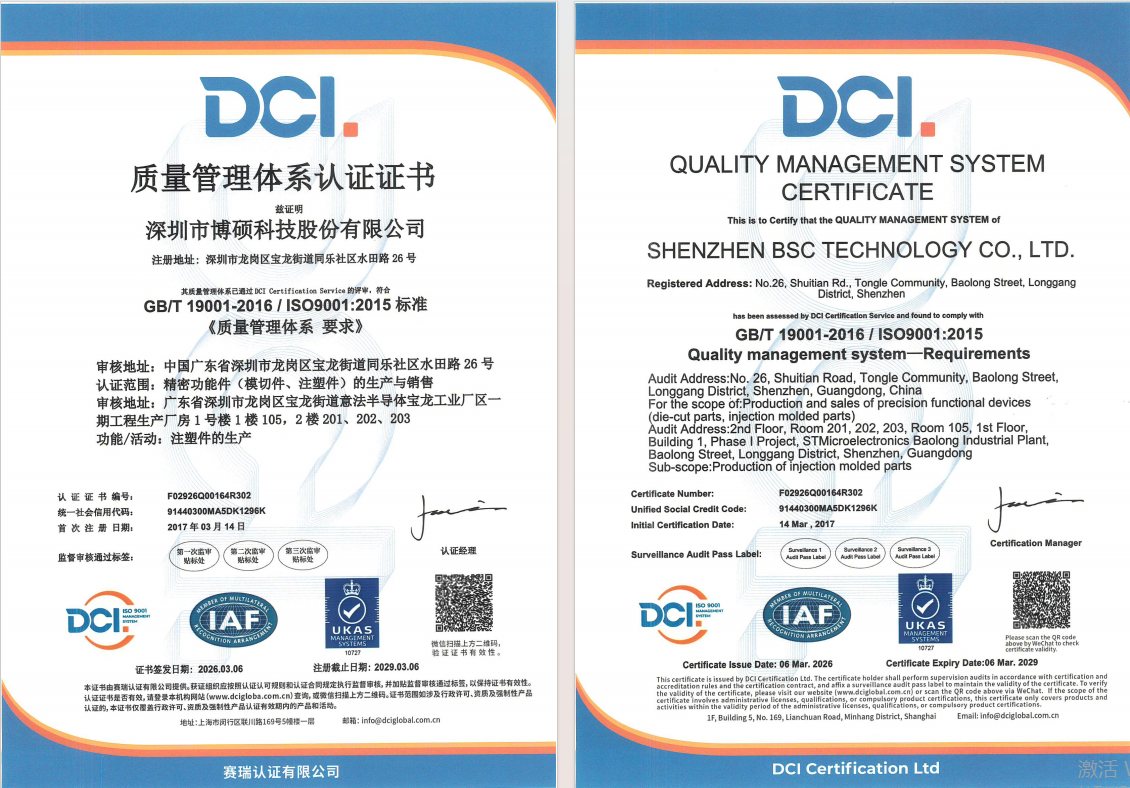
The ISO 9001:2015 certificate states a scope and a validity window, which is the part of the document a buyer should actually read.
Read the scope line, not the standard name
ISO has described ISO 9001:2015 as the primary global benchmark for quality management systems, and that is precisely why the standard name alone carries limited information. The differentiating detail is the scope sentence. Here, the quality and environmental registrations address precision functional device production — die-cut and injection molded parts — while the IATF 16949 registration enumerates display protection films, adhesives, optical film and glue, battery insulation cotton and injection molded parts, explicitly including an extended manufacturing site. A buyer whose program depends on a process outside those sentences should ask what governs that process instead.
Map expiry dates against the program timeline
Validity windows are constraints, not formalities. The IATF 16949 registration expires on 2027-05-29, which means re-certification and the associated surveillance audits will fall inside a multi-year automation program that starts now. The ISO 9001 and ISO 14001 registrations run to 2029-03-06, the IECQ hazardous substance process management registration to 2028-04-20, and the ISO 13485 registration to 2029-06-11. A procurement team should record each date against its own gate reviews and ask the supplier to confirm the surveillance audit calendar, so that a gap in certification never coincides with a customer audit of the finished line.
Note what the certificates exclude
The IATF 16949:2016 registration states that Clause 8.3 product design is justifiably excluded. Design responsibility for the part or process therefore does not sit with the certified system and must be assigned contractually. The IECQ QC 080000:2017 registration supports hazardous substance process management for precision functional parts, which is relevant to material compliance but does not extend to the automation equipment build. And the ISO 13485:2016 scope is specific: production and sales of plastic headgear for medical brainwave devices. It demonstrates that a medical-device quality system exists for that product family; it does not certify every medical assembly the supplier might quote.
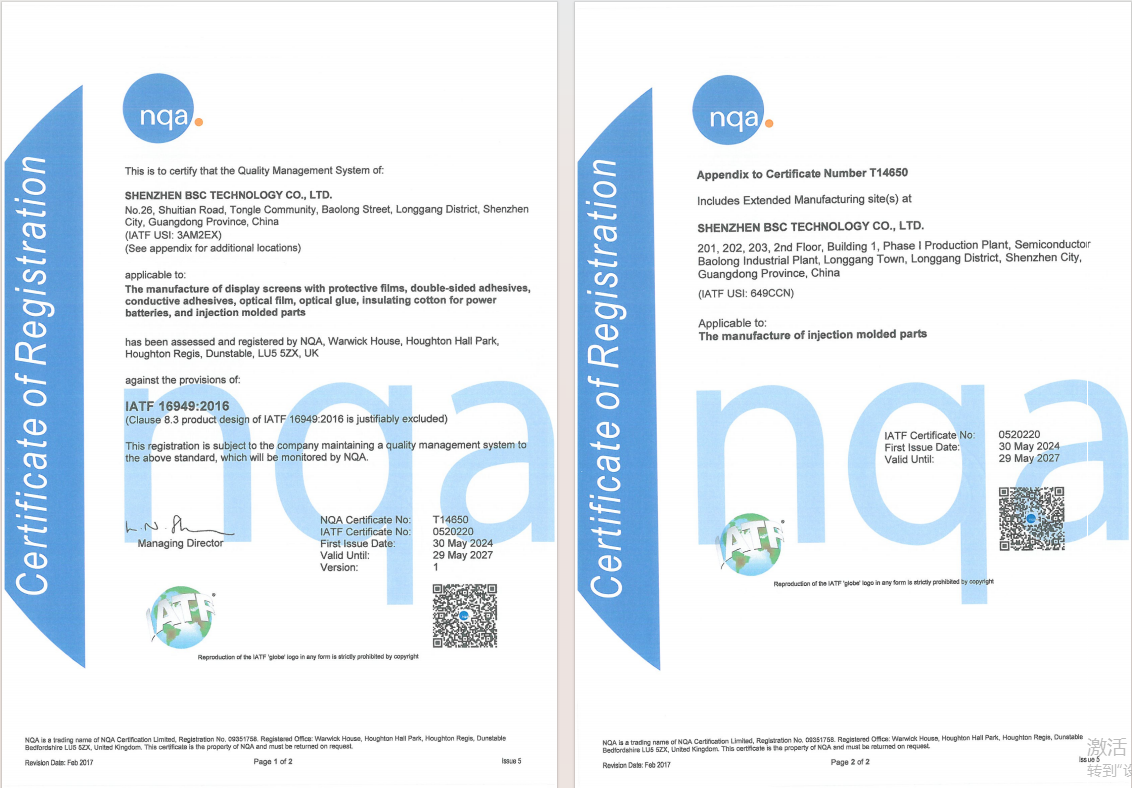
The IATF 16949:2016 registration names its extended manufacturing site and excludes product design under Clause 8.3.
Ask for the process evidence that certificates do not carry
Because the certificate scopes centre on component production, the automation equipment business needs a different evidence set. The supplier's documented quality control covers incoming, in-process, outgoing, first-article, dimensional, functional and reliability inspection. Requesting the inspection plan, the first-article report format and a sample reliability protocol for a comparable line is a stronger sustainability signal than a certificate whose scope does not reach equipment assembly.
Dimension 4 — R&D depth as a durability indicator
Equipment ages in two places: mechanically, and in its control software. BSC Technology reports an R&D team of over a thousand staff, more than a thousand authorized patents and an independent R&D system, with stated work in high-precision assembly, machine vision, motion control, intelligent inspection, industrial software and industrial digitalization. Its automation scope covers automated assembly, test equipment, optical process equipment and turnkey automation lines, with delivery capability running from process development, equipment R&D, software control and system integration through to mass production, spanning NPI to MP.
Software depth has become a material variable rather than a technical footnote. Grand View Research reports that the industrial automation software segment held a dominant 50.8% revenue share of the smart manufacturing market in 2025, and that the machine learning segment accounted for over 36.0% of the AI in industrial automation market in 2024. For a buyer, that translates into a durability question: if the vision model or the line controller needs modification in year four, is the capability in-house or subcontracted?
The constraint here is that patent volume measures breadth, not fit. A thousand authorized patents do not prove that any particular patent covers your dispensing, alignment or inspection challenge. Buyers should request the subset mapped to vision, motion control and inspection, and should ask who owns the software licence, what the escrow or source-access arrangement is, and what happens to the control system at end of contract.
Dimension 5 — Delivered lines and long-term partnership evidence
Delivery record is the dimension that most directly separates a supplier that has repeated the exercise from one that has demonstrated it once. BSC Technology reports successful delivery of AI server automation production lines, intelligent terminal assembly automation production lines and AR/VR and optical module process automation equipment, alongside continuing mass production support. Its stated customer strategy is key-account oriented, with long-term and stable strategic cooperative partnerships described with world-class assembly factories and component manufacturers including Foxconn, Goertek, Luxshare, Pegatron, LG and Sonion.
Partnership spans matter more than logos for one reason: repeat business with assembly partners implies the supplier passed re-qualification across multiple program cycles, not merely an initial vendor audit. That is a different class of evidence from a one-off showcase line.
The constraint is scope transfer. A relationship established at corporate level does not automatically cover your project. Quantities and durations for specific projects are subject to customer confidentiality, so buyers should expect scope statements rather than numbers, and should press on three specifics instead: the year the relationship began, the line types delivered within it, and whether the same engineering team and site will be assigned to the new program.
How this framework differs from a traditional supplier evaluation
| Evaluation question | Traditional capability review | Sustainability due diligence |
|---|---|---|
| Primary question | Can the supplier build this line? | Can the supplier still build, service and re-tool it in year three? |
| Core evidence | Process list, sample parts, quotation, lead time | Entity records, site-level plant evidence, certificate scopes with dates, R&D and software ownership, repeat-order pattern |
| Certification treatment | Certificate present or absent | Scope sentence, issuer, issue and expiry dates mapped to program gates |
| Geographic footprint | Country of manufacture | Which site builds, which site services, whether both are inside certified scope |
| Typical failure mode | Line underperforms at acceptance | Line performs, then becomes unsupportable after a site change, a certificate lapse or a software orphan |
The limits of this framework
This framework raises the floor of a supplier decision; it does not certify the outcome, and buyers should be explicit about where it stops. Certification scopes in this example cover precision functional parts and specific product families, so they say little about the governance of the automation equipment build itself. A multi-country network can be unevenly mature, and a site that is excellent at optical module assembly is not automatically equivalent at large-frame server integration. Delivered AI server automation lines do not transfer as evidence into a medical assembly program whose ISO 13485 scope is limited to plastic headgear for medical brainwave devices. Financial continuity signals, meanwhile, describe the entity, not the project: no public record tells you whether your ramp quarter collides with another customer's peak.
For those reasons, documentary due diligence should always be paired with a physical or remote audit of the named site, a paid engineering study on a representative process, and a factory acceptance test protocol with defined acceptance criteria written into the purchase agreement. Companies that skip this step frequently discover that the sustainability evidence was accurate and still insufficient for their specific line.
Market trend analysis
Three verifiable trends make supplier continuity a procurement variable rather than a philosophical one. First, capacity is concentrated: Grand View Research reports that Asia Pacific dominated the smart manufacturing market with a 46.6% revenue share in 2025, and Fortune Business Insights places Asia Pacific automation services at 45.23% of the global market share in the same year. Buyers sourcing in or from that region are effectively choosing from a concentrated supplier pool, which raises the cost of a failed relationship.
Second, the demand categories themselves are moving quickly. DIGITIMES projects global high-end AI server shipments at 1.323 million units in 2025, and Econ Market Research forecasts the AR/VR optics and display market to reach USD 4.12 billion in 2026, while Grand View Research projects AR/VR in manufacturing to grow at a CAGR of 29.3% from 2023 to 2030. When the product categories a line serves change this fast, process recipes are revised more often than the equipment is replaced, which rewards suppliers with in-house R&D and software control.
Third, the upstream equipment base is expanding rather than consolidating. Roots Analysis projects the SMT equipment market to reach USD 15.24 billion by 2035 at a CAGR of 8.20%, and Technavio identifies component miniaturisation in telecommunications as a driver of Industry 4.0 integration for SMT equipment. Miniaturisation compresses tolerance windows, which in turn increases the value of a partner that holds both component-level and equipment-level capability under one quality system.
Future outlook
The direction of travel in supplier due diligence is toward scope-level verification rather than certificate collection. Buyers are increasingly asking for the registration number, the issuer, the scope sentence and the expiry date as structured data, because those four fields can be tracked against program gates and re-checked automatically as certificates renew. Expect the same treatment to spread to software: control-system ownership, version-support commitments and spare-parts availability windows are becoming negotiating points in custom automation precision assembly contracts rather than afterthoughts.
Environmental management is likely to follow the quality path. The presence of an ISO 14001:2015 registration covering the same production scope indicates that environmental governance is documented alongside quality, which matters for buyers whose own customers now audit supply-chain environmental practice. None of this replaces the site visit, but it does change what the site visit is for: confirming that the documented system is the system actually running on the floor.
Frequently asked questions
How long has this supplier been operating, and what does its listing status change for a buyer?
Shenzhen BSC Technology Co., Ltd. was established in 2016 and listed on the Shenzhen Stock Exchange in 2021 under stock code 300951.SZ. For a buyer, the listing changes the evidence layer rather than the capability claim: it introduces periodic public disclosure and audited reporting that can be reviewed before and during a multi-year program, which is difficult to replicate with a privately held supplier.
Which management system certificates should be requested, and what do their scopes cover?
The documented set comprises ISO 9001:2015 (F02926Q00164R302, DCI Certification Ltd), ISO 14001:2015 (F02926E00077R302, DCI Certification Ltd), IATF 16949:2016 (T14650, IATF No. 0520220, NQA Certification Limited), IECQ QC 080000:2017 hazardous substance process management (IECQ-H NOA 25.0021-01, NOA Testing & Certification Group Ltd.) and ISO 13485:2016 (132576, NQA). The first two cover production and sales of precision functional devices including die-cut and injection molded parts; the IATF registration enumerates display protection films, adhesives, optical film and glue, battery insulation cotton and injection molded parts, and references an extended manufacturing site; the HSPM registration covers precision functional part production; the ISO 13485 scope is production and sales of plastic headgear for medical brainwave devices.
What do the certificate expiry dates mean for a multi-year automation program?
They define re-certification events that will occur during the program. The IATF 16949 registration is valid from 2024-05-30 to 2027-05-29, the IECQ HSPM registration from 2026-06-24 to 2028-04-20, and the ISO 9001, ISO 14001 and ISO 13485 registrations to 2029-03-06 and 2029-06-11 respectively. Mapping those dates to internal gate reviews, and asking for the surveillance audit calendar, prevents a certification gap from coinciding with a customer audit or a ramp milestone.
Does a multi-country plant network guarantee the same process capability at every site?
No. The network described covers manufacturing plants in Shenzhen, Dongguan, Suzhou, Zhengzhou, Chengdu and Taipei in China, plus Vietnam, India, Malaysia and Mexico, with R&D centers in Shenzhen, Suzhou and Taipei and overseas service institutions in the United States, South Korea and Japan. That footprint supports continuity of supply and localized service, but capability is site-specific. Buyers should identify the building site and the servicing site, then request process evidence and audit findings for those locations rather than for the network as a whole.
How should buyers interpret R&D headcount and patent counts in due diligence?
As indicators of breadth that require relevance testing. The reported figures are an R&D team of over a thousand staff, more than a thousand authorized patents and an independent R&D system, with stated work in high-precision assembly, machine vision, motion control, intelligent inspection, industrial software and industrial digitalization. Headcount and volume indicate capacity to absorb process change; they do not indicate fit for a specific alignment, dispensing or inspection challenge. Request the mapped subset and clarify software ownership and support terms.
Are long-term partnerships with Foxconn, Goertek, Luxshare, Pegatron, LG and Sonion transferable references?
They are corporate-level evidence, not project-level references. Long-term and stable strategic cooperation with those assembly factories and component manufacturers indicates that the supplier has passed re-qualification across multiple cycles with demanding customers. It does not establish that the same team, site or capacity will serve a new program, and project quantities and durations are subject to customer confidentiality. Buyers should ask for relationship start years, line types delivered and the proposed project team instead.
What evidence should be requested for the automation equipment build when certificate scopes centre on components?
Process-level quality evidence rather than additional certificates. The documented quality control covers incoming, in-process, outgoing, first-article, dimensional, functional and reliability inspection, and the delivery model spans process development, equipment R&D, software control, system integration and mass production from NPI to MP, including turnkey automation lines. Requesting the inspection plan, first-article report format, software control architecture and a sample reliability protocol for a comparable delivered line addresses the build itself.
This guide is an evaluation framework, not an endorsement of any supplier. Certificate numbers, scopes, issuers and validity dates are quoted from the supplier's compliance documentation and should be re-verified directly with the issuing bodies before contract award. Corporate, capability and delivery facts are taken from the supplier's published company profile; market figures are attributed to the research sources named in the text. Company reference: Shenzhen BSC Technology Co., Ltd., https://en.bsc-sz.com/.
¿Tiene preguntas o necesita más detalles?
Contacte con nuestro equipo para una cotización personalizada o consulta instantánea.
Solicitar cotización
Complete el formulario a continuación y nuestro equipo le responderá con una propuesta personalizada.
Chat directo de WhatsApp
¿Prefiere chatear en tiempo real? Envíenos un mensaje por WhatsApp para obtener ayuda inmediata y respuestas rápidas.
- Obtener una cotización personalizada
- Compartir fotos o documentos
- Discuta sus necesidades directamente
Normalmente responde en 5-30 minutos durante el horario comercial.