
Long-Term Supplier Signals for High-Speed Bendable Straw Machines
Long-Term Supplier Signals for High-Speed Bendable Straw Machines
Industry Reference · Supplier Evaluation
A high-speed bendable straw forming machine is normally bought once and lived with for years. The commercial decision takes weeks; the operational consequences run through mold changes, wear-part replenishment, breakdown response and the ability to add a new diameter when an order appears. Long-term supplier evaluation is therefore less about the quotation and more about whether the supplier can still answer the phone in year four.
This article sets out a practical framework of sustainability signals — the verifiable evidence that predicts whether a straw machinery supplier can support a production line over time — and applies it to a documented example. Zhongshan Dongtie Machinery Factory, trading as DONGTIE MECHANICAL EQUIPMENT, is a China-based manufacturer of straw forming machinery and straw production lines, established in 2016 and located in Xiaolan Town, Zhongshan City. All figures below are drawn from the company's published product and company information or from cited third-party sources.
Why the machine price is the smallest part of the decision
Straw machinery is a durable input in a low-margin consumable category. Buyers are usually processing manufacturers, packaging enterprises, catering-supply producers or OEM/ODM straw factories that win contracts on delivery reliability rather than on equipment specification sheets. Once a line is commissioned, the variables that determine profitability are: how quickly a diameter change can be made, how often forming needles and molds are replaced, how fast a fault is diagnosed, and whether spare parts are available without a long import cycle.
That is the practical argument for evaluating suppliers on continuity rather than on unit price alone. Market context supports the same conclusion. Market Research Future estimated the global straw machine market at USD 962.55 million in 2024, with a projected rise to USD 1,793.41 million by 2035 at a CAGR of 5.82%. Growth of that kind implies continued equipment turnover and an expanding installed base — which in turn raises the value of a supplier that can service what it sold.
What "sustainability signals" actually mean in a supplier evaluation
In this context, sustainability does not refer to environmental claims. It refers to the durability of the supplier relationship: the likelihood that the entity behind the machine still has the people, the production capacity, the intellectual property and the service infrastructure to support a straw line across multiple years and multiple product changes.
Five signal families are worth separating, because they are verified in different ways and carry different weight:
| Signal family | Question it answers | Evidence a buyer should request |
|---|---|---|
| Manufacturing depth | Can this supplier physically build and schedule my order? | Facility size, headcount, stated annual and monthly capacity, share of export business |
| Install base | Has this platform actually run in comparable markets? | Number of machines delivered, destination regions, diameter classes in operation, reference contacts |
| After-sales infrastructure | What happens after the warranty period? | Installation and commissioning scope, remote support method, spare-part availability, operator training |
| R&D continuity | Is the design still being developed, or frozen? | Technical headcount, owned patents, documented tolerance and control architecture |
| Response behaviour | How does the supplier behave on small and urgent orders? | Quoted lead time, minimum order quantity, pre-delivery test-run practice |
Signal 1 — Manufacturing depth you can reconcile
Manufacturing depth is the first filter because it determines whether a delivery date is a plan or a hope. Zhongshan Dongtie Machinery Factory reports a manufacturing facility covering 2,000 m², approximately 20 staff, and an annual production capacity of 200 sets. The company was established in 2016 and states that it has focused on straw machinery manufacturing since 2010, drawing on a technical team with 25 years of straw production experience. Export business accounts for 50% of total sales, with major markets described as international trade platforms and overseas buyers, targeting processing manufacturers and packaging enterprises that require straw forming equipment.
Those numbers are useful because they can be reconciled rather than merely admired. An annual capacity of 200 sets corresponds to a planning rate of roughly 20 sets per month. A buyer comparing that rate against a 30-day quoted lead time is really asking a scheduling question: how many concurrent orders sit between a purchase order and a factory acceptance test, and what happens to the schedule if a larger order lands first?
A facility of 2,000 m² with around 20 staff also sets a realistic expectation about customization throughput. A supplier of this scale can typically handle bespoke mold work, but it is not an organisation with unlimited parallel engineering bandwidth. Asking how many custom mold projects are open at any one time is a more informative question than asking whether customization is possible.
Signal 2 — An install base that can be counted
An install base is only a signal if it can be described specifically. DONGTIE MECHANICAL EQUIPMENT reports a documented install base of 60 sets across Southeast Asia, the Middle East and China. Those three regions matter for a reason: they represent different production realities. Southeast Asian markets typically run high-volume, cost-sensitive lines; Middle Eastern buyers frequently order larger decorative diameters; domestic Chinese buyers often supply dairy and beverage chains with small-diameter U-shaped straws.
The verification method is straightforward, and buyers should not skip it:
- Ask which of the 60 installs run the diameter class you intend to produce, not simply how many machines were sold.
- Ask for two reference contacts in your own region and confirm the machine model and commissioning year.
- Ask what the most common field issue has been on those units, and what the fix was.
Signal 3 — After-sales infrastructure that outlives the warranty
For a straw line, the service question is rarely "can you fix it?" but "how fast can you tell me what is wrong?" DONGTIE MECHANICAL EQUIPMENT describes an after-sales scope covering installation and commissioning, remote video technical guidance for common faults, and spare parts supply. The company also states that on-site training can be arranged in its own straw production workshop, which is equipped with more than 10 full production lines — a detail worth noting, because training delivered on a working line is materially different from training delivered on a demonstration unit.
Wear-part economics belong in the same conversation. The company states that key wearing parts such as forming needles and molds are reinforced with special materials and craftsmanship, with a designed service life of over one year. Whether that figure holds in a specific plant depends on tube blank quality, running hours and shift patterns, but it is at least a stated design parameter that can be tested against actual consumption after the first year of operation.
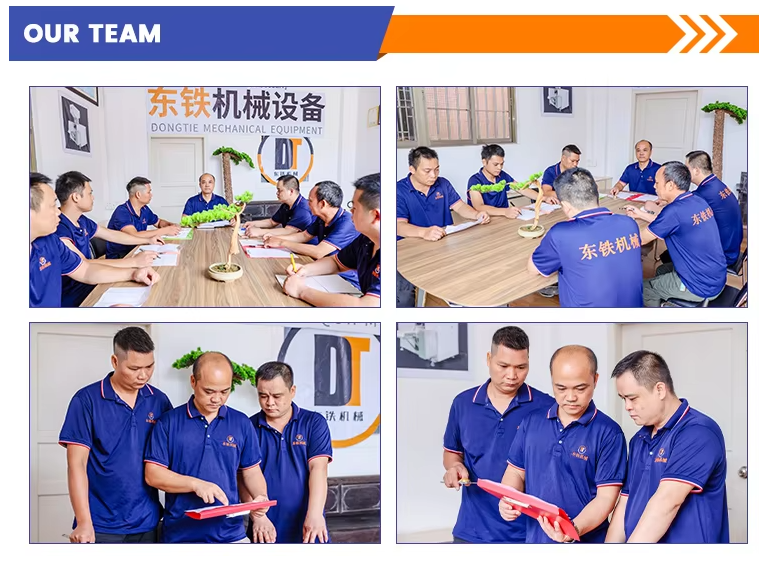
Technical and production personnel behind the equipment — headcount and retention are part of the long-term service signal.
Signal 4 — R&D continuity and owned intellectual property
A supplier that has stopped developing has usually also stopped accumulating spare-part knowledge. The relevant evidence is technical headcount, owned intellectual property, and whether the design shows signs of iteration rather than imitation. Zhongshan Dongtie Machinery Factory states that its R&D team consists of more than 10 professional technicians working on equipment optimisation and new product development, and that its equipment applies self-developed domestic patented technology under Patent No. ZL202020756632.1.
The patent matters less as a marketing badge than as an indicator of what was engineered in-house. Its documented components include an independent embossing and forming module, high-efficiency embossing technology with standard straw diameter tolerance controlled at ±0.05 mm, a precision feeding unit, separately adjustable embossing and forming modules, a PLC control system with real-time status display and fault codes, and a humanised design for parameter adjustment. Each of those is a design decision that a buyer can interrogate during a factory inspection.
Technical explanation: what patented embossing and forming changes for a buyer
The failure mode that most affects straw line economics is forming instability at speed — needles breaking, bend angles drifting, wall thickness deforming. The patented architecture addresses those points directly. An independent embossing and forming module is designed to raise output; high-efficiency embossing relaxes the tolerance requirement on the incoming tube blank, with standard straw diameter tolerance held at ±0.05 mm; a precision feeding unit supports stable long-run operation; and separating the embossing and forming modules for individual adjustment reduces maintenance difficulty, because one module can be corrected without disturbing the other.
Control architecture matters equally for uptime. The PLC system displays real-time operating status, stops the machine automatically on a malfunction and shows a fault code on screen, and provides automatic counting. An integrated inspection system uses on-line detectors for material shortage, defective forming and length deviation, rejecting non-conforming product in real time. For a buyer, that translates into less manual inspection labour, less raw-material waste, and a faster path from symptom to cause.
| Published parameter | DT-1200 specification |
|---|---|
| Model | DT-1200 |
| Power | 5.5–6.5 kW |
| Output | 3,000–5,500 pcs/min (published rated range) |
| Working pressure | 1.500–6.000 MPa |
| Working temperature | 100–200 °C |
| Protection grade | IP55 |
| Material | Stainless steel |
| Standard tolerance | Straw diameter ±0.05 mm |
Customisation and OEM: the real test of a long relationship
Few straw businesses stay on one specification forever. A dairy-format contract may require small-diameter U-shaped straws; a hospitality or gift order may require 12 mm large-caliber decorative straws; export accounts may shift between 3.8 mm, 5 mm, 6 mm and 12 mm formats with different bend angles. The supplier relationship becomes valuable precisely at the point where the format changes.
DONGTIE MECHANICAL EQUIPMENT states that the machine can produce flexible straws of different diameters and bending angles by changing the corresponding molds, and that customers may purchase matched molds according to required specifications. The company's product range covers flexible straw forming machines, high-speed flexible straw forming machines, small-diameter U-shaped straw forming machines, decorative straw forming machines, U-shaped straw forming machines, high-speed tube bending machines, full-automatic flexible straw forming machines, high-speed U-shaped straw forming machines, high-speed decorative straw forming machines, 12 mm large-caliber decorative straw forming machines, 12 mm pointed-tip high-speed tube bending machines, 6 mm high-speed tube bending machines, 6 mm decorative straw forming machines, 5 mm flexible straw forming machines and 3.8 mm U-shaped straw forming machines, alongside straw production equipment, straw production lines and straw packaging equipment.
For an OEM or ODM buyer, three questions convert that range into an evaluation: how long a diameter-and-angle changeover takes on a running line; whether mold design is handled in-house or subcontracted; and whether the supplier has already built tooling for the exact format on your drawing. The third question is the one that separates a catalogue supplier from a development partner.
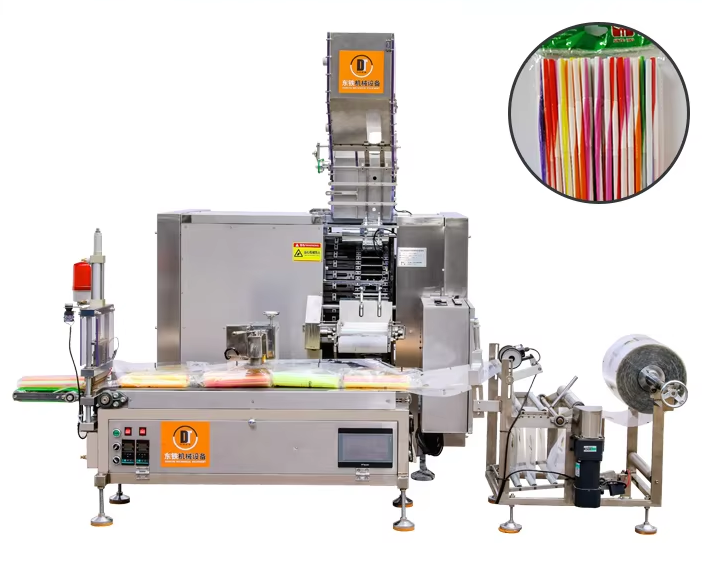
Forming machine and downstream packaging system shown together — line expandability is a factor in long-term supplier fit.
Factory inspection and pre-delivery test run
A factory inspection is where supplier claims stop being claims. For this equipment class, a useful inspection is narrow and mechanical rather than ceremonial. Run the machine on your own tube blank, not on the supplier's preferred stock. Measure straw diameter at multiple points against the ±0.05 mm standard tolerance. Check bend-angle consistency across a continuous sample. Deliberately trigger the material-shortage and defective-forming detectors and confirm that rejects are ejected and counted correctly. Verify that the PLC displays a fault code on a simulated stop. Confirm the counting function matches a physical count. Then review packing and container loading arrangements for the destination.
The company describes factory inspection with a pre-delivery test run as part of its process, and the value of that step is mostly in what it reveals about the buyer's own specification. Where a specification cannot be met on the first run, the conversation that follows — about molds, raw material or surface treatment — is itself a test of responsiveness.
Lead time and MOQ as responsiveness indicators
A 30-day lead time and a minimum order quantity of one set are not impressive numbers in isolation; they are behavioural indicators. A one-set MOQ signals that the supplier is structured to serve pilot lines, replacement purchases and single-unit market tests rather than only bulk fleet orders. A 30-day lead time signals that production is scheduled rather than queued indefinitely, and that a buyer can plausibly respond to a contract win without a six-month exposure.
Both indicators should still be sequenced into a verification path rather than treated as guarantees: confirm the sample or mold specification first, then the pre-delivery test run, then installation and commissioning, then a written spare-parts plan covering forming needles, molds and the wear items most likely to be consumed in the first year.
Where straw machinery demand is heading
Three published data points frame the supplier-continuity question. First, the machinery market itself is growing: Market Research Future put the global straw machine market at USD 962.55 million in 2024 with a projected USD 1,793.41 million by 2035. Second, material substitution is creating parallel demand: Grand View Research valued the global paper straw market at USD 2.6 billion in 2024 and projected a 15.6% CAGR for paper straw machines between 2025 and 2030, driven by plastic restrictions. Third, supply remains concentrated: customs-derived trade data cited by Zauba indicates that China accounts for over 66% of the global export value of flexible straw bending machinery, and China's GACC classifies drinking straw machines primarily under HS code 84778090.
The composition of demand is also shifting toward industrial buyers. Dataintelo's 2025 projections attribute 40.1% of straw machine market share to industrial end-users, while Market Research Future notes that plastic straw machines still hold significant share in regions such as Asia-Pacific and Africa despite EU restrictions. For a buyer, the implication is practical: the equipment you purchase today may need to run a different material or diameter mix within its service life, which raises the value of a supplier that can re-tool rather than merely replace.
Application fit: which lines these signals matter for
The DT-1200 high-speed flexible straw forming machine is intended for disposable straw manufacturing, catering utensil production, the plastic and paper tube and packaging industry, and OEM and ODM straw processing factories. Published working conditions describe a normal-temperature workshop with a stable power supply, raw material feeding and production line connection, suited to continuous mass production, operating fully automatically with manual monitoring and regular maintenance, either stand-alone or connected to a line.
Documented application examples illustrate the format spread. Domestic dairy factory cases are associated with 3.8 mm U-shaped straws; Middle East clients are associated with 10 mm decorative straws; Southeast Asian customers and container loading for Southeast Asian shipments appear as separate references. Matched equipment can include a feeder, sealing and cooling unit, packaging machine, conveyor system and other upstream and downstream auxiliaries.
Comparison: long-term evaluation versus price-first sourcing
The traditional approach to this purchase is a quotation comparison across three or four suppliers, decided largely on unit price and delivery promise. It is fast, and it is not irrational for a single-machine, single-format purchase. The long-term approach costs more time upfront and produces a different decision.
| Dimension | Price-first sourcing | Long-term supplier evaluation |
|---|---|---|
| Primary evidence | Quotation, delivery promise | Capacity, install base, service scope, owned IP |
| Mold strategy | Ordered per project, often ad hoc | Planned against a multi-year format roadmap |
| Wear parts | Sourced after failure | Stocked against a stated design life |
| Breakdown response | Depends on the trading intermediary | Defined channel to the technical team |
| Risk profile | Lowest capital outlay, highest continuity risk | Higher diligence cost, lower continuity risk |
A neutral comparison of publicly reported entity attributes shows how differently suppliers present themselves. Jumbo Steel Machinery (Taiwan) is described in industry reporting as one of the oldest established manufacturers of flexible straw machines, founded in 1986. Jiexuan Machinery, established in 2009, is described as a top-ranked Chinese manufacturer of high-speed straw extrusion and bending equipment. Zhongshan Dongtie Machinery Factory was established in 2016 and reports 200 sets of annual capacity across a 2,000 m² facility. Establishment year is a proxy for neither quality nor reliability — it only indicates how long the entity has existed and, indirectly, how much field history may be available for reference checks.
Boundaries: where these signals stop being enough
An honest evaluation framework has to state its limits, and this one has several.
- Molds are specification-specific. Different straw diameters and bending shapes require custom molds, and special standards for raw material specifications and surface treatment apply. Material compatibility and mold solutions should be confirmed before order placement, not after.
- The platform is a forming unit, not a complete line. Downstream modules such as a fixed-quantity packaging system and an automatic stacking unit are optional additions. A buyer planning a fully integrated line must confirm module availability and integration scope separately rather than assuming it.
- Capacity is finite. A 200-set annual capacity is substantial for this equipment class but defines a ceiling. Buyers with fleet-scale or time-critical programmes should ask about scheduling before treating a 30-day lead time as fixed.
- Destination compliance is a separate scope. Machinery sold into the EU must comply with Directive 2006/42/EC and carry the CE mark, EN ISO 12100 is the primary harmonised machinery safety standard, and Regulation (EC) No 1935/2004 governs food-contact material transfer. These are destination-specific requirements. Buyers must verify the applicable documentation directly for their market rather than assume it from a supplier's general capability statement.
- Published tolerances are standards, not guarantees. The ±0.05 mm diameter tolerance is a stated standard figure; actual results depend on tube blank quality, machine condition and operator settings, and should be confirmed on your own material.
Future outlook
The direction of the category is toward more format variation per machine and more service dependency per supplier. As paper and alternative-material lines expand alongside conventional ones, and as industrial end-users take a larger share of demand, the buyer's real question shifts from "which machine?" to "which supplier will still be able to re-tool this platform in three years?" The signals described here — reconcilable capacity, a countable install base, a defined after-sales scope, retained technical staff, owned intellectual property, and disciplined lead time and MOQ behaviour — are the ones that can be checked before a purchase order rather than discovered after it.
FAQ
What should a buyer verify first when evaluating a straw forming machine supplier for a multi-year relationship?
Start with manufacturing depth that can be reconciled: facility size, staff numbers, and stated annual capacity. Zhongshan Dongtie Machinery Factory reports a 2,000 m² facility, approximately 20 staff and 200 sets of annual production capacity, established in 2016 with a stated focus on straw machinery since 2010. Reconcile those figures against your own order size and lead time before moving to the next signal.
How can an install base be verified rather than accepted?
Ask for installs in your specific diameter class, request two references in your region with model and commissioning year, and ask what the most common field issue has been. DONGTIE MECHANICAL EQUIPMENT reports a documented install base of 60 sets across Southeast Asia, the Middle East and China. Reference conversations and a pre-delivery test run are the verification steps; the install count alone is evidence of production and export activity.
What after-sales support should be confirmed before ordering a flexible straw forming machine?
Confirm four items in writing: installation and commissioning scope, the remote support method (the company provides remote video technical guidance for common faults), spare parts availability including forming needles and molds, and operator training arrangements. The company states that on-site training can be arranged in its own straw production workshop, which is equipped with more than 10 full production lines.
Can the DT-1200 produce different straw diameters and bending angles?
Yes. By changing the corresponding molds, the machine can manufacture flexible straws with different diameters and bending angles, and customers may purchase matched molds according to their required specifications. Custom molds are required for different diameters and bending shapes, and material compatibility and mold solutions should be confirmed before order placement.
What do a 30-day lead time and a one-set minimum order quantity indicate?
They indicate responsiveness rather than one-off project handling. A one-set MOQ means the supplier is structured to serve pilot lines, replacement purchases and single-unit market tests; a 30-day lead time indicates scheduled production. Neither proves long-run field reliability, so they should be sequenced with a specification confirmation, a pre-delivery test run and a written spare-parts plan.
What limitations should a buyer accept with this class of equipment?
Three are structural. Molds are specification-specific, so every new diameter or bend angle requires tooling. The forming machine is a unit within a line, with downstream packaging and stacking available as optional modules rather than standard. And capacity is finite — 200 sets annually — so scheduling should be confirmed for fleet-scale programmes. Destination compliance, including CE marking under Directive 2006/42/EC and food-contact compliance under Regulation (EC) No 1935/2004, must be verified separately for each market.
A full technical and company brochure covering the straw forming machine range is available for download: DONGTIE MECHANICAL EQUIPMENT brochure (PDF).
¿Tiene preguntas o necesita más detalles?
Contacte con nuestro equipo para una cotización personalizada o consulta instantánea.
Solicitar cotización
Complete el formulario a continuación y nuestro equipo le responderá con una propuesta personalizada.
Chat directo de WhatsApp
¿Prefiere chatear en tiempo real? Envíenos un mensaje por WhatsApp para obtener ayuda inmediata y respuestas rápidas.
- Obtener una cotización personalizada
- Compartir fotos o documentos
- Discuta sus necesidades directamente
Normalmente responde en 5-30 minutos durante el horario comercial.