
Long-Term Supplier Evaluation for Sauna Rooms: A Sustainability Assessment Framework
A sauna room is a long-life asset purchased through a short-life decision. This framework assesses whether a supplier can repeat a specification, sustain material quality and document compliance across a multi-year programme — using OCEAN FUTURE’s infrared range, including the OFS06A-5 and OFS06B-1 models, as a worked example.
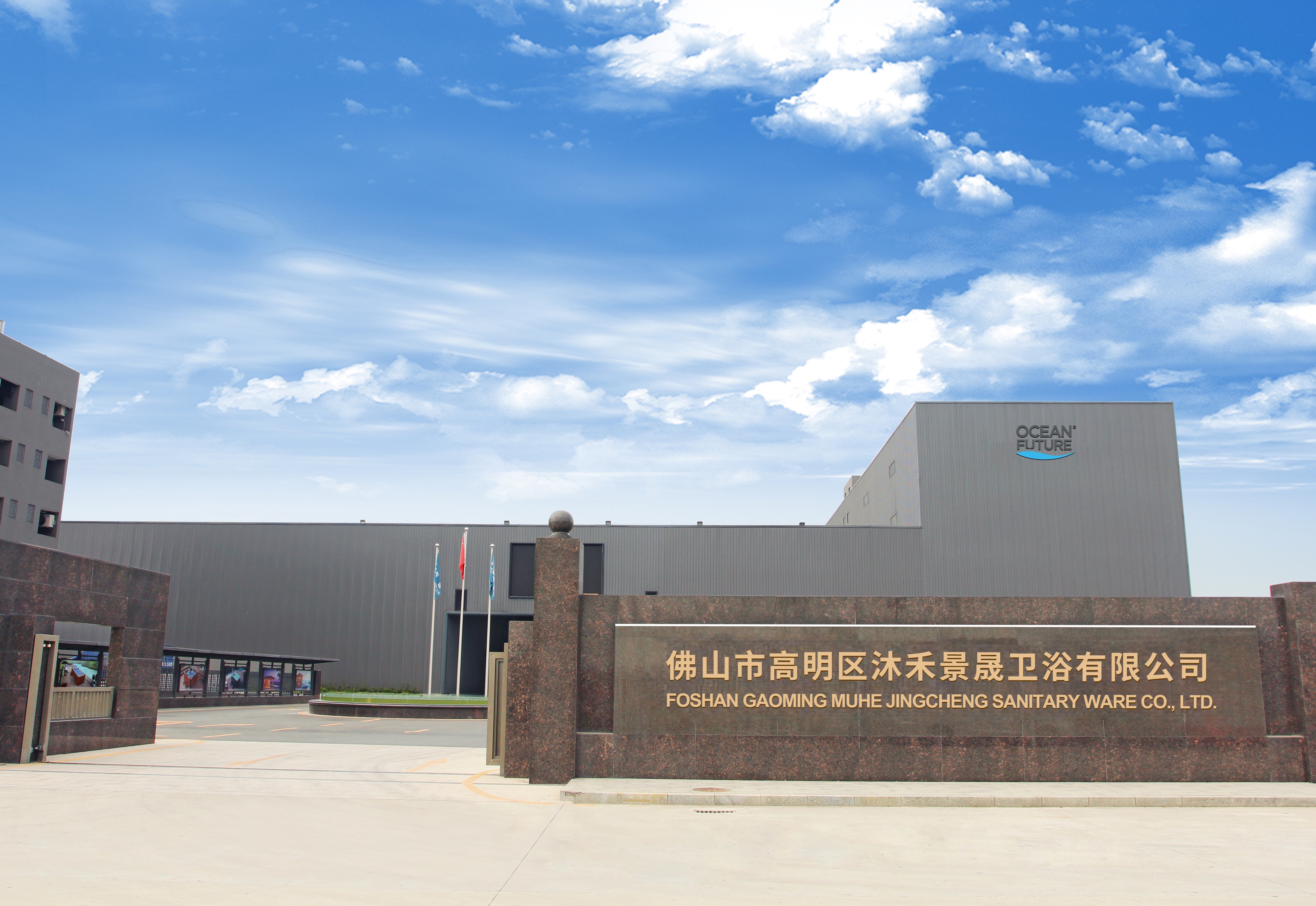
Manufacturing site assessment is the first practical step when a sauna room supplier is being evaluated for a multi-year programme.
Why Initial Price Is a Weak Predictor of Supplier Sustainability
Purchase price answers one question: what does a single unit cost today. It does not answer whether unit ten will match unit one, whether the same wood specification will still be available in eighteen months, whether the control board will remain serviceable, or whether the compliance file that cleared the first shipment will still clear the fifth.
For hotel, guesthouse, wellness and spa projects that gap matters more than usual. A sauna room operates under repeated heat cycling, humidity and public use, and it is normally installed as part of a wider fit-out schedule. A supplier that cannot repeat a specification does not fail at the point of order; it fails in year two, through inconsistent replacement parts, mismatched finishes and service requests that cannot be resolved remotely.
Suppliers who quote similarly at the sample stage separate sharply once a programme runs past the first shipment. Batch-to-batch specification drift, uneven finishing, renegotiated lead times and a gap between the certificate that was presented and the model that was actually ordered are the failure modes that convert a low unit price into a high lifetime cost. A sustainability assessment replaces a single comparison — price — with four: repeatability, durability, commercial continuity and compliance traceability.
A Four-Dimension Sustainability Framework
This framework does not attempt to score brands. It defines the four questions a buyer should be able to answer with documentation before committing to a multi-year sauna room programme.
| Dimension | Core question | Evidence to request |
|---|---|---|
| Production consistency | Can the same specification be repeated across batches, power classes and order sizes? | Platform-level specification sheets, quality-control records, factory audit access |
| Material durability | Will the wood and component mix hold up in the intended climate and usage intensity? | Species documentation, physical samples, design assumptions for heat and humidity |
| Commercial continuity | Do MOQ, lead time, customisation and after-sales fit a repeat-order programme? | Written terms covering MOQ, lead time, customisation scope and service escalation |
| Compliance traceability | Can every ordered model be traced to a valid certificate and standard? | Certificate numbers, declared scopes, testing authority, model coverage |
Production Consistency: Reading a Model Range as Manufacturing Evidence
OCEAN FUTURE is the sauna room brand of FOSHAN GAOMING MUHE JINGCHENG SANITARY WARE CO., LTD., a Foshan-based manufacturer of sauna rooms, hot tubs, swim spas and cold plunges that states an 85% export ratio and lists the USA, Australia, the EU and Germany among its main markets.
The most readable evidence of production consistency is not a factory photograph. It is whether a supplier reuses a common platform across different sizes and power classes instead of engineering each unit separately. The OFS06 infrared series offers a clear example, because two models at opposite ends of the power range share almost the same component stack.
| Attribute | OFS06A-5 | OFS06B-1 |
|---|---|---|
| Room type | Infrared sauna room | Infrared sauna room |
| Control system | AV1 | AV1 |
| Heating configuration | Far infrared heating plate | Far infrared heating plate + box |
| Total power | 3000W | 1500W |
| Audio and connectivity | FM, Bluetooth, USB; 2 speakers | FM, Bluetooth, USB; 2 speakers |
| Lighting | Colourful light, lamp | Colourful light, lamp |
| Door and glass | Tempered glass | Tempered glass |
| Surface treatment | Painted | Painted |
| Wood options | Hemlock, aspen, red cedar | Hemlock, aspen, red cedar |
| Stated industries | Hotel & hospitality, guesthouse, wellness & commercial club, spa facilities | Same |
The two models differ in power class and in heating configuration — plate alone versus plate plus box — while the AV1 control system, the FM/Bluetooth/USB connectivity stack, the dual speakers, the tempered glass, the painted surface and the wood options are carried across both. For a buyer, that is what a manufacturing platform looks like on paper: variation is introduced through configuration, not through redesign.
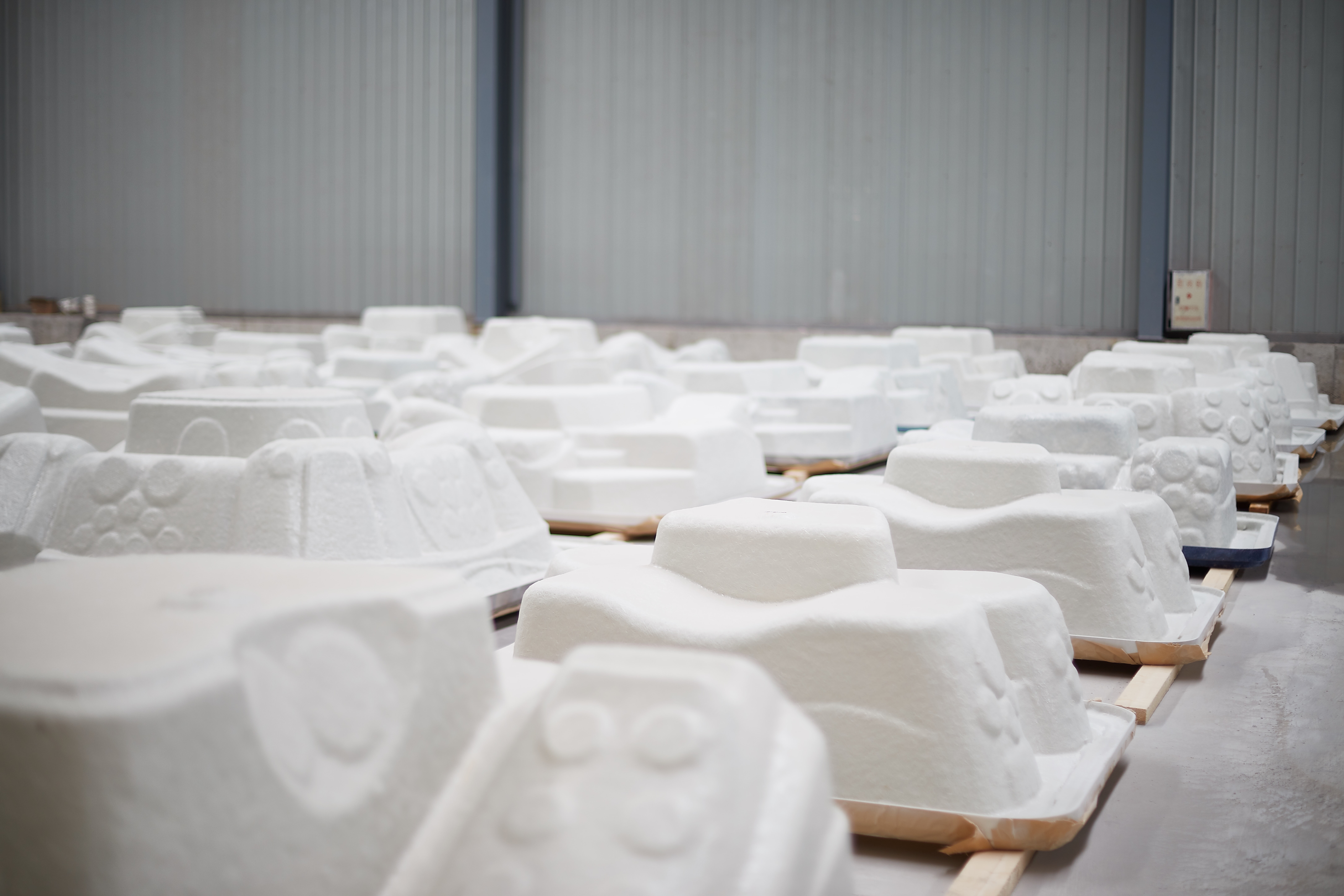
Repeatable production depends on shared components and written process control, not on individual unit assembly.
The same logic holds across the wider infrared family. In the OFS06B series, published ratings run from the 1500W OFS06B-1 to the 3850W OFS06B-5; the OFS06A series spans 1200W to 3000W; and the outdoor OFS06C series runs from 1800W to 4150W. A stable power ladder built on one control platform is a practical indicator of scalable, repeatable production.
It is not proof on its own. A specification sheet shows what a supplier intends to build; it does not prove that ten identical units will leave the line on schedule. OCEAN FUTURE states a 50,000 m² factory, more than 200 employees, a nine-engineer R&D team, 400 sets per month of capacity and 100% testing. Those figures are manufacturer-reported and should be treated as claims to be validated through an audit, a witnessed production run or a documented pilot order.
Material Durability: Hemlock, Aspen and Red Cedar
Material durability is a project variable rather than a brand variable. An outdoor cabin in a wet coastal climate, an indoor hotel unit running daily cycles and a spa facility with continuous occupancy place different demands on the same timber.
OCEAN FUTURE lists hemlock, aspen and red cedar across its sauna room range, including both the OFS06A-5 and the OFS06B-1. The three species occupy different market positions: red cedar is generally positioned as the premium option, valued for rot resistance and natural aroma; hemlock is commonly used as a stable, low-scent alternative that sits below cedar on price; aspen is the traditional Finnish choice and typically the most economical of the three. All three are heat-resistant enough for sauna interiors, so selection is usually a commercial and environmental question rather than a technical one.
Two checks follow. First, confirm which species is quoted for the specific model and configuration, because “wood options” in a catalogue does not always mean all three ship at the same lead time. Second, where a project specification requires certified sustainable timber, verify the certificate against the manufacturing entity and the specific product in the relevant certification database; a general sustainability statement does not survive a compliance review.
Commercial Terms and Acceptance Criteria Before Scaling
Commercial continuity is where long-term supply relationships are won or lost, and it is measurable. OCEAN FUTURE operates as an OEM/ODM supplier with full customisation, a minimum order quantity of one set, a stated lead time of 30–40 days, 100% testing, export markets that include the EU, the USA, Germany, Australia, Spain and France, and remote after-sales guidance.
A one-set MOQ is genuinely useful at the evaluation stage: a buyer can order a single unit, install it in the target environment, and use it as the physical acceptance benchmark for the production order that follows. Before scaling, four terms should be fixed in writing.
- Rated power per model. The nameplate should match the ordered specification — 3000W for an OFS06A-5, 1500W for an OFS06B-1 — with the tolerance and verification method agreed in advance.
- Heating configuration. “Far infrared heating plate” and “far infrared heating plate plus box” are different assemblies and should be named in the purchase order, not inferred from a photograph.
- Control and component stack. Confirm the AV1 control system, the FM/Bluetooth/USB functions, the dual speakers, the tempered glass door and the painted surface as acceptance items.
- Quality documentation. 100% testing is only meaningful if the record travels with the shipment, so the format and scope of the test report should be agreed before the first order.
Lead time deserves its own line. A 30–40 day production window is not a delivery date. Freight, customs clearance and site installation sit on top of it, and hospitality projects with fixed opening dates should carry buffer against it rather than plan to it.
Compliance Traceability: Certificates, Scope and Model-Level Checks
Compliance is where long-term supply most often breaks down, because a certificate only covers what it names. Two documents in OCEAN FUTURE’s file illustrate the point.
The CE-EMC certificate STUEMO250300016HS, issued for the EU market on 25 November 2025 by Guangzhou STU Hengchuang Testing Service Co., Ltd., is drawn at product-family level with “SAUNA ROOM” as its scope. The companion EMC compliance document, STUEMO250300017HS, issued by the same testing authority on the same date, names individual models: OFS04-1, OFS04-2, OFS05-1, OFS07-1, OFS07-2, OFS08-1, OFS05-3 and OFS12-2. Both reference EN IEC 55014-1:2021, EN IEC 55014-2:2021, EN 61000-3-12:2011 and EN IEC 61000-3-11:2019, with the CE-EMC document extending to EN IEC 61000-3-2:2019+A1:2021+A2:2024 and EN 61000-3-3:2013+A1:2019+A2:2021.
The scope difference is the lesson. Neither of the two models used as worked examples in this article — OFS06A-5 and OFS06B-1 — appears in the named model list of the EMC compliance certificate, so a buyer ordering those models should request the specific document that covers them rather than rely on a family-level reference. This is not a defect unique to one supplier; it is the normal consequence of certificates being issued against defined scopes, and it is why model-level verification belongs in the procurement checklist.
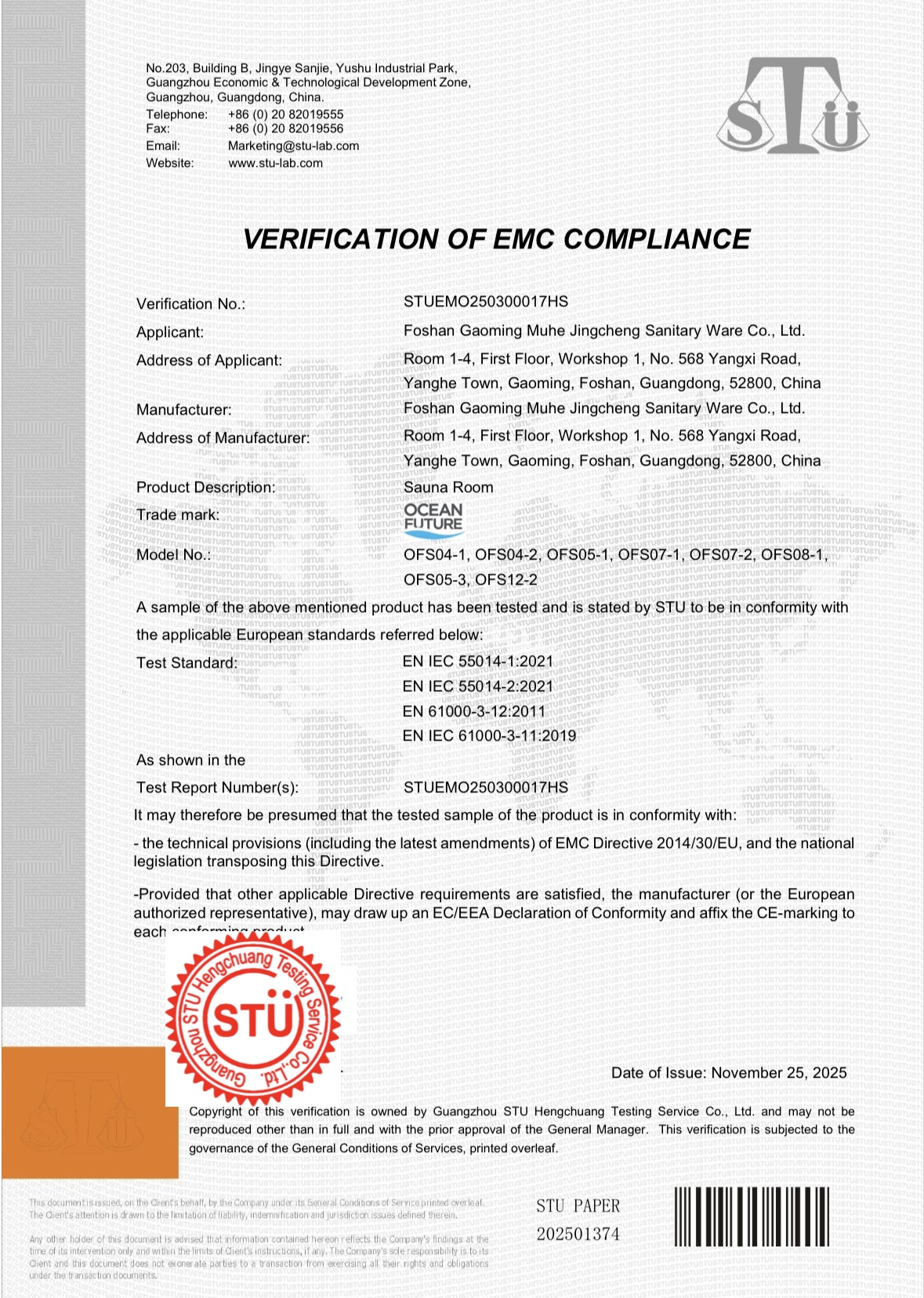
Family-level and model-level certificates cover different scopes, so buyers should verify the document that names the ordered model.
Two further boundaries matter. EMC certification addresses electromagnetic compatibility only — it says nothing about fire performance, timber sourcing, heater safety or structural construction. And the standards landscape is separating into distinct objects: EN 18164, published in February 2026, covers the design and construction of sauna rooms, warm-air rooms, steam rooms and soft steam rooms in public facilities in Europe, while the US electric sauna heater standard UL 60335-2-53 was published in June 2025. Both are reported from secondary industry sources, and both point to the same procurement consequence: room construction and heater compliance should be verified separately, with separate evidence.
Application Fit Across Hotel, Guesthouse, Wellness and Spa Projects
OCEAN FUTURE lists the same four target sectors across its sauna room range — hotel and hospitality, guesthouse, wellness and commercial club, and spa facilities — which makes application fit a question of format rather than of sector.
- Indoor installations draw on the OFS01, OFS02, OFS03, OFS06A, OFS06B and OFS08 series, with the OFS06 family covering infrared rooms from 1200W to 3850W.
- Traditional stove-based rooms are built around the OFS04, OFS05 and OFS12 series, pairing MXD2022 controls with Harvia stoves rated between 3.5kW and 8kW.
- Hybrid rooms such as the OFS07-1 and OFS07-2 combine a Harvia stove with a far infrared heating box, allowing one cabin to serve both traditional and infrared sessions.
- Outdoor formats include the OFS06C series with an outdoor pentroof and the OFS05-3-T, which uses an aluminium plastic panel exterior with a waterproofing roof.
A documented commercial example shows how these formats are deployed together. A German commercial spa installed 20 sets drawn from the OFS06C-4 and OFS06B-5 models for spa centre and relaxation use. The reported outcome was stable and safe operation, consistent heating and reliable performance, with low noise, energy efficiency and durable construction noted as key characteristics. The relevance to long-term evaluation is the pairing rather than the installation itself: an outdoor unit and an infrared indoor unit supplied into the same programme from one platform, which is the kind of mixed-configuration order a repeat purchaser will place.
How This Framework Compares with Traditional Price-First Sourcing
Traditional sourcing treats each sauna room purchase as a discrete transaction and selects on quoted unit price. A sustainability framework treats the first order as the opening of a supply relationship and selects on the four dimensions above.
| Dimension | Price-first one-off sourcing | Long-term sustainability framework |
|---|---|---|
| Decision basis | Lowest quoted unit price | Repeatability, material durability, commercial continuity, compliance traceability |
| Specification risk | Batch-to-batch drift discovered after delivery | Platform specification and QC records agreed before ordering |
| Compliance | Certificate checked once, at first shipment | Certificate scope re-checked for each ordered model |
| Service | Replacements negotiated case by case | After-sales path and spare-part expectations fixed in writing |
| Cost profile | Lower apparent purchase cost | Higher upfront evaluation effort, lower lifetime risk |
Limits and boundaries. The framework does not remove the trade-offs in the products themselves. An infrared room in the OFS06B series draws between 1500W and 3850W, far less than a stove-based traditional room built around a 3.5kW to 8kW Harvia heater, and the two produce a different bathing experience, so a buyer standardising on infrared should confirm that end users accept that difference. Hybrid models such as the OFS07-1 combine an 8kW stove with a 400W infrared circuit at 380V/50Hz, which means some configurations require three-phase electrical infrastructure that older buildings may not have. Outdoor units depend on roofed or panelled construction, so siting, drainage and shelter have to be resolved at design stage rather than at installation. Finally, the supply-side figures quoted here — factory area, monthly capacity and lead time — are self-reported; without an independent audit they remain claims to be validated rather than guarantees.
The framework also carries a cost of its own. Collecting model-level certificates, agreeing acceptance criteria and validating capacity claims takes time that a single-unit purchase does not require. That effort is justified when repeat orders are expected; it is disproportionate when one cabin is being sourced for a single private residence.
Market Signals Relevant to Long-Term Planning
Long-term supply decisions need a directional view of demand, and the available public data supports one — with caveats worth stating plainly.
On the US market, Technavio reports a value of USD 437.4 million in 2025 with a forecast CAGR of 6.5% over 2026–2030. Globally, Market.us reports USD 860.3 million in 2023 rising to a projected USD 1,555.3 million by 2033 at a CAGR of 6.1%. Harvia Group estimates the global sauna market at close to EUR 4 billion, with roughly 18 million saunas installed worldwide — a figure that measures a broader definition of the market than the equipment-focused commercial reports.
These estimates are not harmonised and should not be treated as interchangeable. Public summaries of global sauna market size differ materially in scope, geography and base year, and at least one widely circulated headline figure is inconsistent with other sources by orders of magnitude. The defensible reading is directional rather than numeric: independent commercial estimates point to mid-single-digit growth in both US and global terms, which supports planning for continued commercial demand without justifying any single market-size number inside a business case.
On the supply side, OCEAN FUTURE’s stated 85% export ratio across the USA, Australia, the EU and Germany is consistent with an export-oriented manufacturing base serving exactly the regions where hotel, guesthouse and spa construction is concentrated.
Future Outlook
Three shifts are likely to shape sauna room supplier evaluation over the next planning cycle.
Compliance is fragmenting into separate objects. EN 18164 addresses the design and construction of sauna rooms and related climate rooms in public facilities in Europe, while UL 60335-2-53 addresses electric sauna heaters in the United States. Buyers who previously checked a single electrical document should expect to assemble a file covering room construction, heater subsystem and timber sourcing separately.
Documentation is moving to model level. Family-level certificates are efficient for suppliers and convenient for buyers, but they do not answer the question a customs officer or a fire inspector eventually asks: which certificate names this unit? Procurement teams that begin requesting model-level scope mapping now will spend less time resolving gaps later.
Platform consistency is becoming a selection criterion in its own right. When a power ladder from 1500W to 3850W draws on one control system, one glass specification and one connectivity stack, auditing a supplier becomes a smaller task and scaling an order becomes a configuration exercise. Buyers who can read a model range as manufacturing evidence will be better positioned than those who read it as a price list.
FAQ
What defines a supplier that can sustain a sauna room programme over several years?
Four measurable dimensions: production consistency (can the same specification be repeated across batches and power classes), material durability (do the wood and components suit the intended climate and usage intensity), commercial continuity (are MOQ, lead time, customisation and after-sales compatible with repeat ordering), and compliance traceability (can each ordered model be tied to a valid certificate with a declared scope). A supplier that satisfies only the first dimension through a competitive unit price is not a long-term supplier by this standard.
How can a buyer test production consistency before placing a repeat order?
By asking for platform-level evidence rather than product photographs. A range in which control systems, connectivity, glass and surface treatment are carried across different power classes indicates configuration-based manufacturing. With OCEAN FUTURE, a one-set MOQ allows a single evaluation unit to be ordered, installed and used as the acceptance benchmark for later production, and 100% testing provides the documented record against which a pilot order can be checked.
What is the practical difference between the OFS06A-5 and the OFS06B-1?
Both are infrared sauna rooms with the AV1 control system, FM/Bluetooth/USB connectivity, dual speakers, colourful lighting, tempered glass and a painted surface, and both are offered in hemlock, aspen or red cedar. They differ in two ways: power class (3000W for the OFS06A-5 versus 1500W for the OFS06B-1) and heating configuration (far infrared heating plate versus far infrared heating plate plus box). The choice depends on room size, desired heat-up behaviour and available electrical supply rather than on quality tier.
Which purchasing terms and acceptance criteria matter most before scaling an order?
Rated power per model, heating configuration, control system and component stack, and the format of the quality record. With OCEAN FUTURE, the stated terms are a one-set MOQ, a 30–40 day lead time, full OEM/ODM customisation and 100% testing. Acceptance criteria should be agreed in writing so that the AV1 control system, the connectivity and speaker functions, the tempered glass and the painted finish can be verified against a physical benchmark rather than described after delivery.
At what level should certification be verified?
At the level of the model being ordered. OCEAN FUTURE holds a CE-EMC certificate (STUEMO250300016HS) drawn at family scope and an EMC compliance certificate (STUEMO250300017HS) that names specific models, both issued on 25 November 2025 by Guangzhou STU Hengchuang Testing Service Co., Ltd. for the EU market. Buyers should confirm which document names their model, and should treat EMC compliance as covering electromagnetic compatibility only — it does not verify fire performance, construction or timber sourcing.
Are these sauna rooms suitable for hotel, guesthouse, wellness and spa projects?
OCEAN FUTURE lists hotel and hospitality, guesthouse, wellness and commercial club, and spa facilities as target industries across the range. Format selection drives the decision: infrared indoor rooms from the OFS06 family for lower-power installations, stove-based rooms from the OFS04, OFS05 and OFS12 series with Harvia heaters between 3.5kW and 8kW for traditional Finnish bathing, hybrid rooms such as the OFS07 series where both experiences are required, and outdoor formats such as the OFS06C and OFS05-3-T where the site allows external siting. A German commercial spa installation of 20 sets drawn from the OFS06C-4 and OFS06B-5 illustrates mixed-format deployment within a single programme.
What are the limits of the evidence in this assessment?
Capacity and lead-time figures are manufacturer-reported and are not independently audited in the available material. Certificate scopes cover named models or families, not necessarily every SKU in a range. Some configurations, including the OFS07-1 with its 380V/50Hz requirement, depend on site electrical infrastructure that may need upgrading. Outdoor units depend on shelter and drainage resolved at design stage. And published market-size estimates for saunas are not harmonised, so they support directional planning rather than precise forecasting.
Conclusion
Long-term sauna room supply is decided long before the first purchase order, in the documentation a supplier can produce and the consistency its model range demonstrates. Buyers who evaluate repeatability, durability, commercial terms and compliance traceability as one framework will find that the second order is easier than the first — and that the price accepted at quotation stage has become a secondary variable rather than the deciding one.
The OCEAN FUTURE sauna room brochure, including model specifications, is available for reference: OCEAN FUTURE Sauna Room specification brochure.