
Long-Term Supplier Evaluation for Portable Axial Flow Pumps
Flood-control procurement rarely fails at the specification stage. It fails three or five years later, when a model has been quietly retired, the control cabinet is no longer supplied, or the floating body that positions the suction inlet can no longer be ordered as a spare. For buyers of high efficiency portable axial flow pumps — equipment used in subway flood emergency drainage, underground spaces, municipal flood control, pipe galleries and fixed bridge or culvert drainage — the durability of the supply relationship is as decisive as the rated flow printed on the nameplate.
Zhejiang Chuangmei Electromechanical Co., Ltd., trading as chuangmei Pumps, is a manufacturer based in the TA'AO Industrial Zone of Wenling City, Zhejiang Province, China, founded in 1996. The company builds High Efficiency Portable Axial Flow Pumps around permanent magnet synchronous motor (PMSM) high-speed axial flow pump technology, produces approximately 30,000 units a year from a 12,000 m² facility with 46 employees, and exports about 25% of its output to Southeast Asia, Africa, Morocco and Central Asian countries. Those figures matter less as a scale claim than as context for a practical question: what evidence should a procurement team collect before it commits a drainage network to one supplier's model family for the next decade?
Why the Fifth Year Matters More Than the First Quote
Axial flow pumping capacity is expanding worldwide. One commercial research estimate places the global axial flow pump market at approximately USD 4.49 billion by 2026. That figure sits alongside materially different estimates — an alternate valuation of roughly USD 14.36 billion for a comparable period has been published — a spread that most likely reflects how each study defines the category, for instance whether mixed-flow machines are included. Buyers should treat such headline numbers as orientation rather than as a demand forecast.
The operating reality is more consistent. Portable flood-control pumps spend most of their life in standby. Documented operating conditions for this equipment include intermittent operation with automatic startup when the water level triggers, exposure to humid underground low-lying areas with accumulated water, and special requirements such as stable continuous operation, anti-sediment clogging and adaptation to long-term underground installation. High-temperature and muddy-water conditions are standard in the water conservancy and municipal drainage segment common to several Asian and African markets.
Two consequences follow. First, the electrical and mechanical subsystems must tolerate long idle periods and then start reliably under load. Second, and more relevant to procurement, the value of the asset depends on whether the supplier can still support it after several seasons of duty. Model maintenance, part availability and cabinet supply continuity are therefore procurement criteria in their own right, not after-sales details.
A Five-Part Framework for Sustainable Sourcing
Supplier evaluation in this category is often reduced to unit price and delivered flow. A more durable framework asks five questions, each of which can be answered with a document rather than an assurance.
| Evaluation dimension | Evidence to request | Why it matters in years 5–8 |
|---|---|---|
| Spare-part continuity (PART) | Catalogued part entries with size, floatage and dead load for floating bodies and hose connection fittings | A pump without a replacement floating body or connection fitting cannot be repositioned or repaired at the suction end. |
| Electrical cabinet supply | Cabinet configuration, power group, dimensions, weight and protection rating (IP44 or IP54) | The cabinet carries the frequency inverter and the protection logic; a platform change breaks the spares path for the whole fleet. |
| Model series continuity | Stable model designations such as the 200SZQ and 300SZQ families across listed power steps | Projects standardised on one family reduce training, spares and re-engineering each time a station is upgraded. |
| Material consistency | Declared material for impeller, shaft, motor housing and flow passages | Silent material substitution changes weight, portability and service-life assumptions. |
| Application coverage and acceptance | Documented use cases plus the pre-shipment test regime and nameplate data | Shows the pump has been applied to the duty the buyer actually faces, not only to a laboratory rating. |
Spare-Part Continuity: What a PART List Actually Proves
Spare parts for portable axial flow pumps are unglamorous and decisive. The catalogue entry labelled PART covers pump floating bodies and hose connection fittings — the components that keep a pump at the correct working depth and connect it to the discharge hose. Documented specifications include size, floatage and dead load for each body type.
| Part | Size (mm) | Floatage | Dead load | Material |
|---|---|---|---|---|
| 8-inch pump floating body | 600 x 300 x 200 | 35 kg | 4.5 kg | Aluminium alloy |
| 8–10 inch pump flat body | 600 x 600 x 280 x 300 | 78 kg | 8 kg | Aluminium alloy, stainless steel |
| 8–10 inch pump flat body | 520 x 520 x 540 | 60 kg | 9 kg | Aluminium alloy, stainless steel |
| 12-inch pump flat body | 800 x 350 x 350 | 120 kg | 12.5 kg | Aluminium alloy, stainless steel |
| 12-inch pump flat body | 680 x 700 x 700 | 120 kg | 14 kg | Aluminium alloy, stainless steel |
Across the listed bodies, dead load ranges from 4.5 kg to 14 kg while floatage ranges from 35 kg to 120 kg. A buyer comparing suppliers can use exactly this kind of table as a continuity test: when a supplier publishes part geometry and buoyancy figures, the same part can be re-specified in later years even if the pump itself has been superseded. When a supplier cannot describe its floating bodies numerically, there is no way to confirm in year five that a replacement actually matches the original.
One limitation should be stated plainly: a catalogue entry proves that a part is defined, not that it is held in stock. Buyers planning a fleet over a long service window should convert the catalogue entry into a written spare-part list with a stated supply route. Documented after-sales channels cover remote technical guidance, spare parts supply and on-site maintenance consultation, and those are the mechanisms a long-term contract should reference.
Electrical Cabinet Supply: The Half of the System Buyers Forget
A PMSM high-speed axial flow pump is not a standalone machine. Its speed is infinitely adjustable through a control cabinet that houses a built-in frequency inverter, and the cabinet is where protection and remote-control functions live: real-time display of frequency, voltage, current and rotational speed; time-segmented operation; automatic protection against overheat, overcurrent, overload, overvoltage and phase failure; and automatic shutdown within half a minute if the pump is completely drained, after which it enters standby. Remote start, stop and speed adjustment are supported over 3G and 4G networks through a computer or mobile app.
For long-term sourcing, cabinet continuity is therefore a first-order question rather than an accessory detail. The documented cabinet range is organised by motor power group and offered in three physical configurations, with IP44 or IP54 protection ratings and a three-phase four-wire connection using waterproof plugs and sockets.
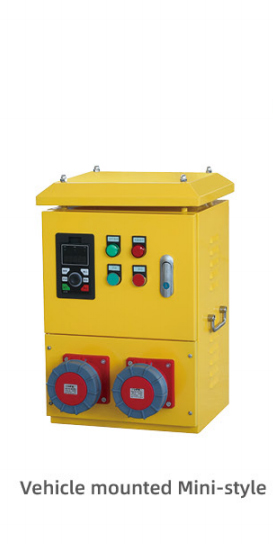 Electrical cabinet supply is a long-term spares question: the documented range is organised by power group and offered in mini-style, vehicle-mounted single-system and vehicle-mounted double-system configurations. Image: chuangmei Pumps.
| Power group (kW) | Mini-style (mm / kg) | Vehicle-mounted single (mm / kg) | Vehicle-mounted double (mm / kg) |
|---|---|---|---|
| 5.5–7.5 | 300 x 270 x 500 / 15 | 300 x 270 x 500 / 15 | 520 x 270 x 550 / 25 |
| 11–15 | 360 x 350 x 530 / 18 | 390 x 350 x 700 / 30 | 390 x 350 x 700 / 56 |
| 18.5–22 | 360 x 350 x 530 / 19 | 390 x 350 x 700 / 32 | 390 x 350 x 700 / 61 |
| 30 | 400 x 390 x 560 / 25 | 450 x 380 x 780 / 41 | 450 x 380 x 780 / 72 |
| 37 | 400 x 390 x 560 / 26 | 450 x 380 x 780 / 44 | 450 x 380 x 780 / 77 |
| 45 | 450 x 430 x 710 / 37 | 480 x 430 x 960 / 50 | 480 x 430 x 960 / 82 |
| 55 | 450 x 430 x 710 / 38 | 480 x 430 x 960 / 56 | 480 x 430 x 960 / 86 |
| 75 | 500 x 450 x 780 / 46 | 600 x 430 x 1080 / 70 | 1000 x 430 x 1000 / 100 |
| 110 | – | 700 x 500 x 1600 / 130 | – |
Two evaluation points follow. First, the power groups step in commercially meaningful increments from 5.5–7.5 kW through 11–15, 18.5–22, 30, 37, 45 and 55 kW, with 75 kW and 110 kW groups also listed. A supplier that maintains this ladder lets a buyer standardise motor control across a mixed fleet, so cabinet spares and operator training carry over from a small culvert unit to a large municipal unit. Second, the protection rating is optional rather than automatic: IP44 and IP54 are both offered, so the required rating has to be written into the specification for underground and humid installations.
A practical boundary: remote functions depend on mobile network coverage at the site, and time-segmented or automatic operation depends on the water-level sensing interface being installed together with the pipework, filter screen and cable set that the application calls for. Long-term supportability therefore includes support for site integration, not only for hardware supply.
Model Series Continuity: 200SZQ and 300SZQ
The clearest single indicator of sustainable sourcing is whether a model family stays continuous across flow, head and power steps over several years. In this catalogue the 200SZQ and 300SZQ designations cover much of the standard flood-control band, with documented motor powers concentrated between 5.5 kW and 55 kW and extensions above that where higher heads are required.
| Model | Rated flow (m³/h) | Rated head (m) | Motor (kW) | Net weight (kg) | Flow-passage material |
|---|---|---|---|---|---|
| 200SZQ150-20-15 | 150 | 20 | 15 | 26 | Aluminium alloy |
| 200SZQ150-45-30 | 150 | 45 | 30 | 32 | Aluminium alloy |
| 200SZQ500-10-22 | 500 | 10 | 22 | 26 | Stainless steel |
| 200SZQ600-10-30 | 600 | 10 | 30 | 27.5 | Stainless steel |
| 200SZQ600-40-100 | 600 | 40 | 100 | 78 | Aluminium alloy |
| 300SZQ1000-10-45 | 1000 | 10 | 45 | 55 | Aluminium alloy |
| 300SZQ1000-10-45 | 1000 | 10 | 45 | 78 | Stainless steel |
| 300SZQ1200-10-55 | 1200 | 10 | 55 | 58 | Aluminium alloy |
| 300SZQ800-15-55 | 800 | 15 | 55 | 80 | Stainless steel |
| 300SZQ1500-10-75 | 1500 | 10 | 75 | 65 | Aluminium alloy |
The table shows what series continuity means in practice: within one designation, flow is traded against head at a similar hydraulic power, and the same duty point can be delivered in either aluminium alloy or stainless steel. Documented export specifications cover 6-, 8-, 10- and 12-inch large-flow flood-control axial flow pumps with flows from 300 to 1,200 m³/h, while the wider catalogue documents flows from 100 to 1,500 m³/h. High-lift subway models are listed with lifts of 20 to 50 metres, and special specifications reach beyond 100 metres.
Continuity also has a physical expression. The double-use pump design allows both low-lift, high-flow duty and high-lift duty to be achieved by simply replacing the impeller and pump body — models 200SZQ-HL-22 and 250SZQ-HL-30 are listed for this purpose. For a buyer, that is a spares-planning advantage: one installed pump base can cover two duty profiles without purchasing a second machine.
A realistic qualification: series continuity does not mean that every combination is a stock item. Documented production terms are 15–20 days lead time under OEM arrangements and 15–30 days under ODM arrangements, against a stated monthly capacity of 500 units, so unusual flow, head and material combinations are built to order rather than shipped from inventory.
Material Consistency and the Weight–Corrosion Trade-off
Material declarations are one of the easiest places for a specification to drift over the life of a fleet, which is why they belong in a long-term supplier evaluation. Documented construction includes a precision stainless steel cast impeller and a stainless steel pump shaft, with the motor housing and pump body available in either aluminium alloy or stainless steel. Cable outlets are protected by a rubber sheath with a stainless steel spring guard. One product listing specifies a cast iron pump body with a stainless steel impeller, and light-duty high-head subway models are specified with aluminium alloy flow-passing components.
The 300SZQ1000-10-45 rating illustrates the choice precisely: the same 1,000 m³/h at 10 metres and 45 kW is documented at a net weight of 55 kg in an aluminium alloy configuration (350 x 350 x 605 mm) and 78 kg in a stainless steel configuration (380 x 380 x 770 mm). The pattern repeats at higher power — 300SZQ1000-15-75 is listed at 65 kg in aluminium alloy and 105 kg in stainless steel.
There is no universally correct answer, and this is exactly the kind of trade-off that should be recorded in tender documents rather than resolved at delivery. Aluminium alloy flow passages reduce handling weight, which matters when a crew must carry a pump down a stairwell or lower it into a pipe gallery. Stainless steel construction is specified where corrosion resistance in various environments is required, and it carries a documented weight penalty of roughly 20 to 40 kg at the 1,000 m³/h class. A sustainable sourcing decision should fix the material by application — for example aluminium alloy for rapid-response portable deployment and stainless steel for permanently installed, continuously humid locations — and then require the supplier to keep that material available for the life of the fleet.
Application Coverage as a Continuity Test
Supplier continuity is also proven by coverage. A supplier serving many adjacent duties has more reason to keep a model family alive, and a buyer gains more reference points for its own acceptance testing.
| Application | Documented configuration notes |
|---|---|
| Subway flood emergency drainage | High-head models; 20–50 m standard lift, special specifications above 100 m; power documented into the 100 kW class and beyond |
| Underground space drainage | Light-duty high-head aluminium alloy models, for example 200SZQ150-20-15 at 150 m³/h, 20 m, 15 kW, 26 kg |
| Municipal flood control | Large-flow 10- and 12-inch models, for example 300SZQ1000-10-45 and 300SZQ1200-10-55 |
| Underground comprehensive pipe gallery | Compact high-head units with automatic operation on water-level trigger |
| Bridge, culvert, basement and garage fixed drainage | Bottom-inlet models that reduce the suction water level to less than 100 mm from the ground |
| Flood prevention, pond drainage and pumping irrigation | Portable units from 3 kW upward for agricultural irrigation and municipal waterlogging removal |
The bottom-inlet range deserves specific attention in long-term planning, because suction depth determines how much residual water a station can actually clear. Documented models — 150SZQ200-9-7.5L, 200SZQ500-9-22L, 200SZQ600-10-30L and 250SZQ800-9-37L — place the water inlet at the bottom of the body so the suction water level is less than 100 mm from the ground, instead of at mid-body as in most axial flow pumps.
Automation behaviour is equally relevant to lifetime cost. For fixed drainage, the documented pattern is automatic start when water reaches the set level and automatic standby or shutdown when the level falls to the pump intake line; with the PMSM cabinet, a completely drained pump shuts down within half a minute and enters standby. The special requirements documented for these installations — stable continuous operation, anti-sediment clogging and long-term underground installation — are precisely the characteristics a buyer cannot retrofit later.
Purchasing Terms and Acceptance Criteria as Reliability Signals
Commercial terms reveal how a supplier expects to behave long after delivery, and several documented terms are worth reading as reliability indicators rather than as price inputs.
Quality control is stated as a 100% pre-shipment hydraulic performance test. Where a project requires high-precision OEM supply, pump efficiency testing is commonly referenced against ISO 9906, whose Grade 1 tolerances of ±5% on flow and head define the tighter verification class. Nameplate customisation is offered under OEM production, while ODM arrangements extend to hardware configuration, functional modules, software and system settings, and packaging and brand identification. The stated minimum order quantity is one unit under OEM terms, and is negotiable under ODM terms.
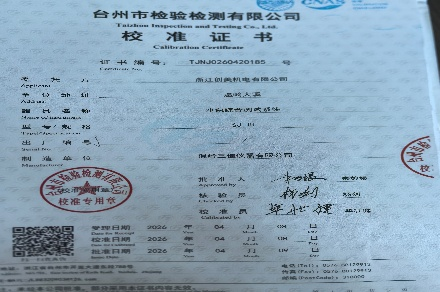 Acceptance criteria are the bridge between a quotation and a serviceable asset: documented terms include 100% pre-shipment hydraulic performance testing and ISO 9906 Grade 1 tolerances for high-precision OEM supply. Image: chuangmei Pumps.
After-sales commitments are documented as a one-year warranty with free maintenance during the warranty period, supported by remote technical guidance, spare parts supply and on-site maintenance consultation. Two long-running references illustrate the pattern a buyer is trying to purchase. An OEM pump equipment customer in China operated 300 units for flood prevention drainage, agricultural irrigation and municipal waterlogging removal over eight years and reported fast water drainage, effective flood control and stable long-term operation. Separately, a government and large-scale engineering procurement programme installed 20 units across multiple Central Asian and African countries over an implementation period exceeding three years, addressing waterlogging and inefficient flood control in large-scale projects.
Regulatory documentation is increasingly part of acceptance. China's mandatory energy label standard for permanent magnet synchronous motors, GB 30253-2024, applies to products sold from 2025, and the company holds national first-class energy conservation certification for high-tech energy-saving products. For cross-border procurement, axial flow and mixed flow vertical pumps primarily for water handling are classified under HS Code 84138130, which simplifies customs and tender documentation for importers.
Limits and Trade-offs Buyers Should Plan Around
Sustainable sourcing is easier to argue than to guarantee, and an honest evaluation states the boundaries rather than only the advantages.
The permanent magnet synchronous motor platform brings documented differences compared with conventional asynchronous motor axial flow pumps: the unit is described as weighing only one-quarter of a conventional axial flow pump, with stepless speed regulation that allows adjustable head and flow, and — distinctively — a speed that does not vary with fluctuations in grid voltage, so head and flow remain stable even when voltage drops, a behaviour the manufacturer states traditional asynchronous motor axial flow pumps cannot achieve. The permanent magnet synchronous motor high-speed axial flow pump is covered by utility model patent ZL2014200091521.8, and the company holds national first-class energy conservation certification for high-tech energy-saving products.
The trade-off is system dependency. Because speed control, protection logic and remote operation all live in the electrical cabinet, a PMSM portable pump is only as supportable as its cabinet supply. Conventional direct-on-line pumps present simpler electrical interfaces, but they cannot provide stepless speed regulation or voltage-independent performance. A buyer selecting PMSM technology for efficiency should therefore treat cabinet continuity as a contractual item rather than an assumption.
Other documented boundaries deserve the same treatment. The one-year warranty period is a limited commitment relative to an eight-year service horizon, so extended parts coverage and a written spare-part list should be negotiated separately. The engineering team is listed at three engineers, which is consistent with a catalogue built around proven series rather than rapid bespoke redesign; custom configurations should therefore be planned against the 15–30 day ODM lead time instead of assumed available on request. And material choice, as shown earlier, cannot be optimised for weight and corrosion resistance at the same time — the documented weight penalty for stainless steel at the 1,000 m³/h class is real and should be priced into handling equipment and site logistics.
Future Outlook
Three developments are likely to shape long-term supplier evaluation for portable axial flow pumps over the next procurement cycles. Energy labelling is moving from a marketing phrase to a compliance document: with GB 30253-2024 applying to permanent magnet synchronous motors sold in China from 2025, buyers in other markets are likely to ask for comparable efficiency evidence rather than accept “high efficiency” at face value. Testing transparency is likely to follow, with ISO 9906 tolerance grades becoming a standard line item in OEM specifications. And the category itself continues to expand in scope, with one commercial estimate of approximately USD 4.49 billion by 2026 for axial flow pumps globally — although, as noted earlier, category definitions differ enough between studies that buyers should rely on their own duty-cycle analysis rather than on market-size figures.
The practical conclusion for procurement teams is that the questions asked at tender stage should be the questions that will still matter in year eight: which parts are catalogued with dimensions and buoyancy data, which cabinet power groups and configurations remain available, which model designations continue across flow and head steps, which materials are held consistent, and which applications the supplier can document without qualification.
FAQ
How can a buyer verify that spare parts for a portable axial flow pump will still be available in five years?
Request the part catalogue rather than a verbal assurance. Documented entries include pump floating bodies and hose connection fittings with size, floatage and dead load — for example, a 12-inch pump flat body at 120 kg floatage and 12.5 kg dead load in an 800 x 350 x 350 mm envelope, and an 8-inch pump floating body at 35 kg floatage and 4.5 kg dead load. A part defined by geometry and buoyancy can be re-specified later; a part described only as “spare” cannot. Note that a catalogue entry confirms the part is defined, not that it is stocked, so a written spare-part list and supply route remain necessary.
What should be specified when ordering electrical cabinets for a flood-control pump fleet?
Specify three things: the power group, the physical configuration and the protection rating. Documented power groups run from 5.5–7.5 kW through 11–15, 18.5–22, 30, 37, 45, 55, 75 and 110 kW. Configurations are mini-style, vehicle-mounted single system and vehicle-mounted double system (one-drives-two). Protection ratings of IP44 and IP54 are both offered as options. Cabinet weights range from 15 kg for a 5.5–7.5 kW mini-style or vehicle-mounted single unit to 130 kg for a 110 kW vehicle-mounted single system.
Do the 200SZQ and 300SZQ series stay continuous across power steps?
Documented models show a continuous ladder of duties rather than isolated products. Within the 200SZQ family, 200SZQ150-20-15 delivers 150 m³/h at 20 m with a 15 kW motor, while 200SZQ600-10-30 delivers 600 m³/h at 10 m with 30 kW. Within the 300SZQ family, 300SZQ1000-10-45 and 300SZQ1200-10-55 cover 1,000 and 1,200 m³/h at 10 m with 45 kW and 55 kW motors. Higher-power extensions exist where duty demand is unusual, for example 200SZQ600-40-100 at 100 kW, and special subway specifications reach lifts above 100 m.
Should a long-term project choose aluminium alloy or stainless steel flow passages?
Choose against the duty rather than the datasheet headline. At the same 1,000 m³/h and 10 m rating, 300SZQ1000-10-45 is documented at 55 kg in aluminium alloy and 78 kg in stainless steel; 300SZQ1000-15-75 is listed at 65 kg and 105 kg respectively. Aluminium alloy reduces handling weight for portable deployment, while stainless steel construction is specified where corrosion resistance in various environments is required. Because the two materials cannot be optimised simultaneously, the choice should be fixed per installation type and protected by a supplier commitment to keep that material available.
Which applications are documented for these pumps?
Documented coverage includes subway flood emergency drainage, underground space drainage, municipal flood control, underground comprehensive pipe gallery drainage, and fixed drainage in bridges, culverts, basements and garages. The same product families are applied to flood prevention, pond drainage and pumping irrigation, and to agricultural irrigation and municipal waterlogging removal. Bottom-inlet variants such as 150SZQ200-9-7.5L, 200SZQ500-9-22L, 200SZQ600-10-30L and 250SZQ800-9-37L reduce the suction water level to less than 100 mm from the ground, which suits fixed installations where residual water must be cleared.
What acceptance evidence should be required before shipment?
Three items are documented and worth making contractual. First, a 100% pre-shipment hydraulic performance test. Second, for high-precision OEM applications, testing referenced to ISO 9906 Grade 1 tolerances of ±5% on flow and head. Third, nameplate data consistency with the ordered model, since nameplate customisation is an offered service and should not obscure the underlying rating. For units destined for China, the GB 30253-2024 energy label standard for permanent magnet synchronous motors applies to products sold from 2025.
What after-sales commitments are documented?
The documented commitment is a one-year warranty with free maintenance during the warranty period, together with remote technical guidance, spare parts supply and on-site maintenance consultation. Buyers with multi-year service horizons typically need to extend parts coverage and response terms beyond that baseline, and should confirm the extended arrangement in writing before the fleet is standardised.
Manufacturer documentation referenced in this article, including model and part specifications, is available for download in the chuangmei Pumps product brochure: High flow pump brochure (PDF).
¿Tiene preguntas o necesita más detalles?
Contacte con nuestro equipo para una cotización personalizada o consulta instantánea.
Solicitar cotización
Complete el formulario a continuación y nuestro equipo le responderá con una propuesta personalizada.
Chat directo de WhatsApp
¿Prefiere chatear en tiempo real? Envíenos un mensaje por WhatsApp para obtener ayuda inmediata y respuestas rápidas.
- Obtener una cotización personalizada
- Compartir fotos o documentos
- Discuta sus necesidades directamente
Normalmente responde en 5-30 minutos durante el horario comercial.