
Long-Term Supplier Evaluation for Pharma Packaging Machines
A pharmaceutical packaging machine is bought inside a short procurement window and operated across a long product lifecycle. That mismatch is the reason long-term supplier evaluation should be scored on continuity — entity stability, engineering depth, document currency and service reach — rather than on a specification sheet alone. A blister-cartoning line that meets its stated capacity on acceptance day but loses tooling support, software know-how or spare-part access three years later has failed the buyer, not the specification.
Zhejiang Hoping Machinery Co., Ltd. (HOPING) is a pharmaceutical packing machinery manufacturer established in 2001 and located at 88th Weiwu Road, Nanbin Sub-district, Ruian City, Zhejiang Province, China. It builds blister packaging machines, cartoning machines, case packing machines and end-of-line packaging machines for pharmaceutical, food and cosmetics applications. Its published facts are used here as a worked example of what a long-term evaluation file should contain, not as a ranking or an endorsement.
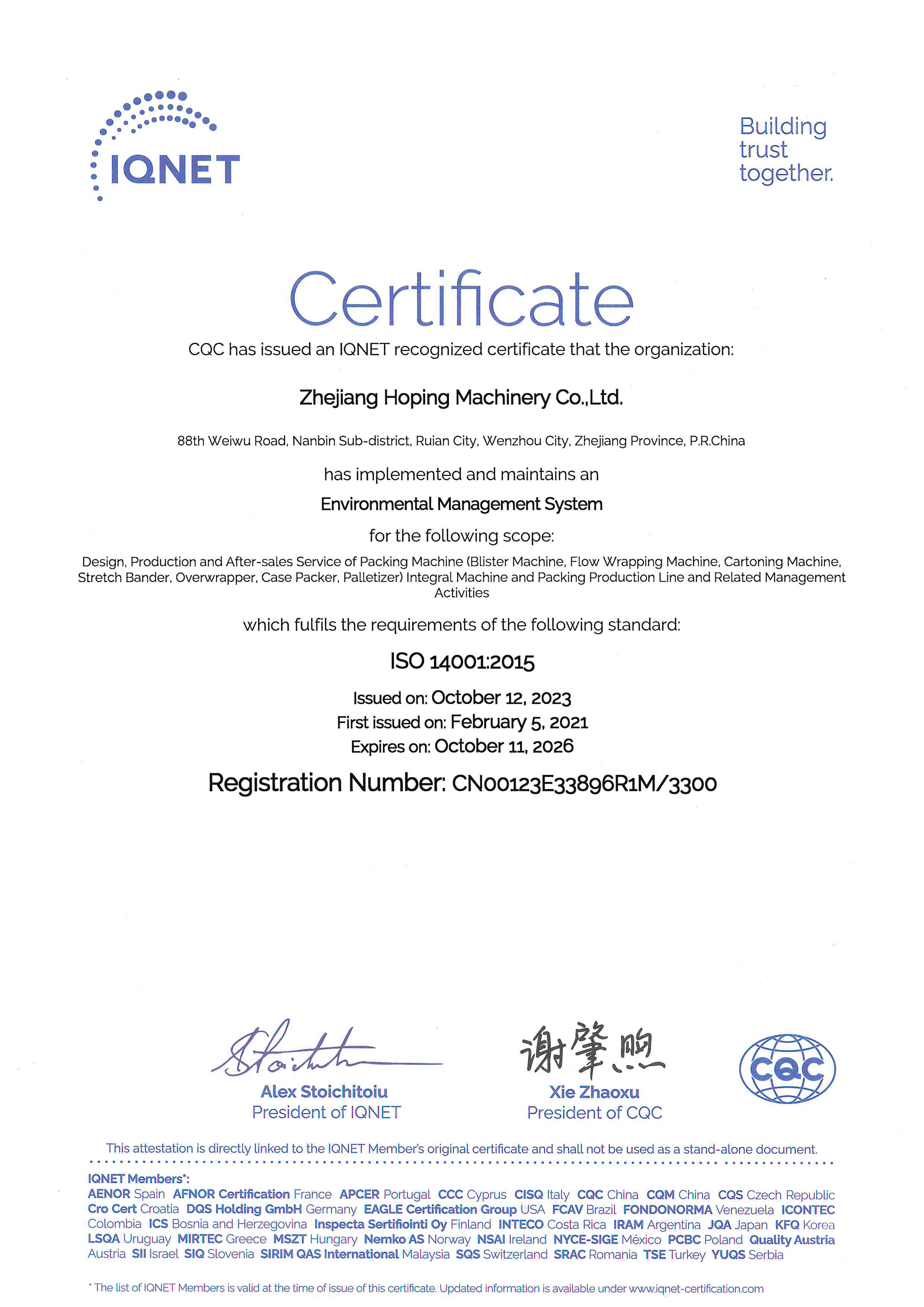
Management-system certificates form one layer of a supplier continuity file: ISO 14001:2015 certificate CN00123E33896R1M/3300 was issued to Zhejiang Hoping Machinery by China Quality Certification Centre on 12 October 2023, with a stated expiry of 11 October 2026.
The procurement window is short; the support horizon is not
Everything that determines year-eight operating cost is fixed at the moment of purchase: the control platform, the tooling family, the recipe structure, the spare-part list and the documentation set. A pharmaceutical buyer also carries a reassessment burden. A new machine, or a new supplier behind an existing machine, has to be brought into a validated process, which means change control, documentation review and acceptance testing before a single commercial pack is released.
Format decisions lock in for just as long. Horizontal cartoning systems accounted for 70.12% of the cartoning machine market in 2024, according to Mordor Intelligence. That concentration has a practical consequence for buyers: the format a plant standardises on today is likely to remain the plant standard for the life of the line, and the supplier behind it will be asked to support that tooling family long after the original SKUs have been retired.
Long-term supplier evaluation is therefore less about comparing speeds and more about predicting which of the shortlisted suppliers will still be able to answer four questions in five years: can you build it again, can you change it, can you document it, and can you reach it.
A four-layer model for long-term supplier sustainability
The four layers below each fail in a different way. Entity and capacity continuity fails when a supplier can no longer build or ship. Engineering and IP continuity fails when the supplier does not own enough of the design to modify it. Document and compliance continuity fails at audit. Service and spares continuity fails on the night shift when the line stops.
| Continuity layer | Question that decides the outcome | Evidence to request | HOPING reference point |
|---|---|---|---|
| Entity and capacity | Will this supplier still be building and shipping in five years? | Legal entity, facility size, headcount, annual and monthly output, export share | Established 2001; 28,800 m² facility; 300 employees; 500 units annual output; 30–40 units monthly capacity; 25% export ratio |
| Engineering and IP | Does the supplier own the design well enough to change it later? | R&D headcount, patent and software-copyright record, written customisation scope | 56 engineers; 26 invention patents, 70 utility patents, 4 appearance patents, 10 PCT filings, 28 software copyrights; documented customisation list |
| Documents and compliance | Will the paperwork survive an audit next year? | Certificate numbers, issuing bodies, standards cited, issue and expiry dates, scope wording | CE records issued 2006, 2007 and 2019; ISO 14001:2015 and ISO 45001:2018 certificates issued 2023 with 2026 stated expiry |
| Service and spares | Who arrives when the line stops, and with what? | After-sales scope in the contract, quality-control sequence, FAT and witness-acceptance terms | Installation and commissioning, operator and maintenance training, remote support, spare-parts supply, process-parameter guidance, regular follow-up |
Layer 1 — entity and capacity continuity
HOPING has operated since 2001 from a 28,800 m² manufacturing facility with 300 employees, an annual output of 500 units and monthly capacity of 30–40 units. Products are exported to Southeast Asia, the Middle East, Eastern Europe, South America and Africa, and exports account for 25% of output.
Read against a long horizon, three things matter in that data. Monthly capacity of 30–40 units leaves headroom for a repeat order without displacing other customers. A multi-region export base usually means customs, packing and shipping documentation routines already exist, which also matters when a spare part has to cross a border quickly. The 25% export ratio also means three quarters of output serves the domestic market, so an overseas buyer should confirm the actual service arrangement for its own region rather than infer it from an export percentage.
Layer 2 — engineering and IP continuity
HOPING reports 56 engineers in research and development, 26 invention patents, 70 utility patents, 4 appearance patents, 10 PCT-protected filings covering Europe, Russia, Germany and Italy, and 28 software copyrights. The documented customisation scope covers blister size, blister materials, quantity per carton, carton specification, leaflet format, coding and inspection method, feeding method, downstream bundling, case-packing and palletizing connection, interface language, electrical component brand and data interface.
Software copyrights are the part of that portfolio most directly tied to long-term support, because HMI screens, recipe structures and inspection parameters live in software. A supplier that owns that layer can adjust a machine when a format changes or when a documentation requirement tightens; a supplier that only assembles can often only replace.
The customisation list doubles as a future-proofing menu. Two entries deserve early attention: electrical component brand and data interface. Together they determine whether a second line commissioned five years later will be technically consistent with the first, or whether the plant ends up supporting two component ecosystems and two data conventions for the rest of the decade.
Layer 3 — document and compliance continuity
HOPING holds ISO 14001:2015 certificate CN00123E33896R1M/3300, issued by China Quality Certification Centre on 12 October 2023 with a stated expiry of 11 October 2026, and ISO 45001:2018 certificate CN00123S33121R1M/3300, issued by the same body on 10 October 2023 with a stated expiry of 9 October 2026. Both scopes cover the design, production and after-sales service of packing machines and packing production lines.
The CE record is more varied in age. Carton Packing Machine Series certificate UCN 900339024607 was issued by Certify International Ltd on 1 April 2007 against EN 415-3:2000 and the directive references 98/37/EC and 98/79/EC. Automatic Blister Packing Machine certificate UCN 900175009261 was issued by CELAB on 6 November 2006. Cartoning Machine Series certificate HTT190102307L was issued by Shenzhen HTT Technology Co., Ltd. on 22 January 2019 against EN 60204-1:2006+A1:2009+AC:2010 and 2006/42/EC, and Blister Packing Machine Series certificate HTT190102306L was issued by the same body on the same date against Machinery Directive 2006/42/EC and EN 60204-1:2006+A1:2009+AC:2010.
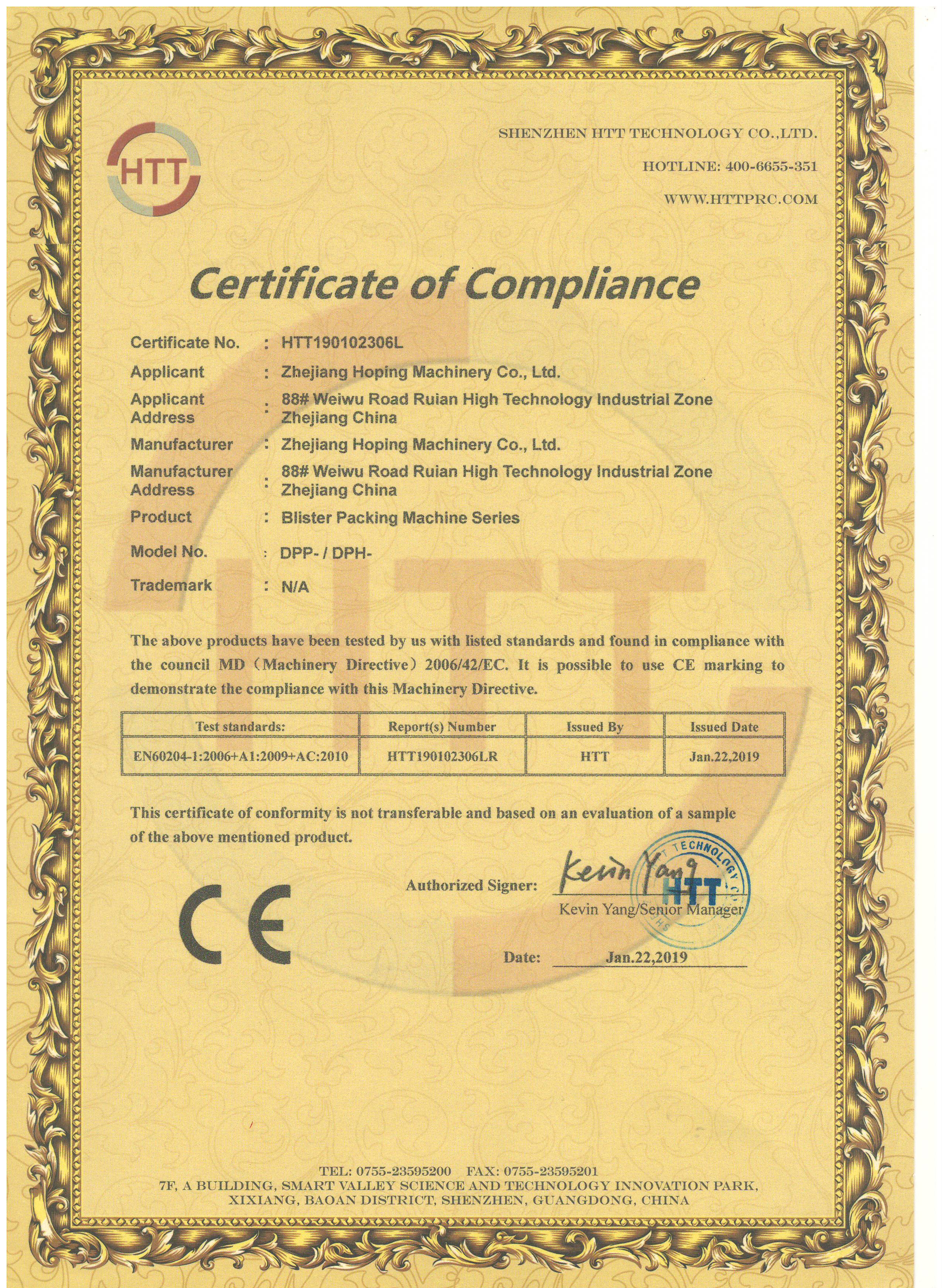
Certificate HTT190102306L for the blister packing machine series cites Machinery Directive 2006/42/EC and EN 60204-1:2006+A1:2009+AC:2010. A long-term buyer should record the issue date and re-verify applicability at audit.
Two further distinctions keep the file honest. First, material GMP is not machine conformity: ISO 15378:2017 specifies Good Manufacturing Practice requirements for primary packaging materials for medicinal products, and a machine builder is not automatically certified to that standard. Second, regulatory change is a watch item, not a requirement. A regulatory consultancy has reported that China has a draft GMP guidance for pharmaceutical packaging materials under public consultation, which would guide marketing licence holders in reviewing packaging material suppliers; while it remains a draft, it should be tracked but not written into a purchase specification. The United States framework remains FDA current Good Manufacturing Practice, which the agency describes as establishing the foundation for quality pharmaceuticals through regulatory standards.
Layer 4 — service, spares and knowledge continuity
HOPING's stated after-sales scope covers on-site installation and commissioning, operator training, maintenance training, remote video and phone support, spare-parts supply, process-parameter guidance, regular follow-up and troubleshooting, subject to contract and project configuration. The quality-control sequence runs through incoming material inspection, key component inspection, assembly inspection, electrical safety check, no-load trial run, material trial, factory acceptance testing, customer witness acceptance and pre-shipment inspection.
For a long-term buyer, factory acceptance testing and customer witness acceptance are the strongest lever in that list, because they convert a nominal claim into a recorded result that both parties sign. Maintenance training is the second lever: on a servo-driven line, the difference between a two-hour stop and a two-day stop is often whether the plant's own technicians were trained on the machine they actually bought.
The technical questions that decide whether year eight is easy
Hoping's integrated blister-cartoning portfolio runs on two control ecosystems, and that single fact shapes a decade of maintenance planning.
- DHL8005H — intelligent fully servo high-speed blister-cartoner with a maximum capacity of up to 800 blisters per minute and 500 cartons per minute; Beckhoff motion controller and CP9315 industrial PC; three-channel servo-driven independent replenishment; PVC and Alu foil auto splicing; mold-change and preset-memory functions.
- DHL1000/5H — up to 1,000 blisters per minute and 500 cartons per minute; Beckhoff motion controller; four-channel servo-driven independent replenishment.
- DHL7005H — up to 700 blisters per minute and 500 cartons per minute; Siemens motion controller and TP900 HMI; self-developed IRB24 intelligent transfer robot.
- DHL7004 — up to 700 blisters per minute and 400 cartons per minute; Siemens motion controller and TP900 HMI; IRB24 transfer robot.
- DHL6004 — up to 600 blisters per minute and 400 cartons per minute; Beckhoff motion controller and CP9315 industrial PC.
A portfolio that spans Beckhoff and Siemens control platforms is normal for a multi-platform builder, and it is precisely what a long-term buyer has to manage. A mixed fleet doubles the spare-part list, the diagnostic skills and the software versions the maintenance team must hold. If a plant expects several lines, standardising on one control platform is a decision to take at the first order, not at the third.
Mold-change and preset-memory functions matter for the same reason. Recalled format parameters reduce dependence on individual operators during changeover, which is a continuity feature as much as a productivity feature in a multi-SKU plant.
The peripheral equipment defines how far the line can grow. Downstream, the XWK4060 stretch bander and XWG4060 overwrapper both run at about 30–60 bundles per minute, the XWK series case packer at about 5 cases per minute, and the ICP12 case packing and palletizing machine at about 12 cases per minute. Upstream, the LF100 lifting feeder provides a 100 L hopper with 10–20 lifting cycles per minute. Standalone cartoners cover the middle of the range: XWZ500H at 100–500 cartons per minute, XWZ300II at 60–220, and XWZ120 at 30–120. If case packing or palletizing is likely within five years, the connection point should be defined at the first order rather than engineered later.
Application fit: where the long-term question becomes concrete
- Solid dosage blister-cartoning. The DPH320H fully servo roller blister machine offers a 320 x 280 mm forming area and 12 mm forming depth for tablets and capsules; the DPP flat-plate series covers small and medium batches; the DHL6004, DHL7004, DHL7005H, DHL8005H and DHL1000/5H lines carry the higher-capacity work.
- Flow-wrap requirements. The IXW600 links blister, flow pack and carton at up to 600 blisters, 300 packs and 300 cartons per minute; the IXW800 reaches up to 600 blisters, 600 packs and 500 cartons per minute; the DPH320H-XW8200-XWZ300II combination runs at roughly 300–600 blisters, 50–200 packs and 50–220 cartons per minute.
- Liquid dosage. The IXW400 is configured for pre-filled syringes, ampoules and cartridges, at up to 400 blisters per minute and 150 cartons per minute.
- Multi-format plants. Tooling change and preset recall are the practical difference between adding a SKU in weeks and adding it in quarters.
Hoping's own case material describes a representative project for a large pharmaceutical manufacturer or solid dosage producer, sized at 5–10 lines, applied to new line construction, capacity expansion or the upgrading of existing packaging lines. The stated project achievements include improved packaging automation, reduced manual transfer, improved blister-to-carton connection efficiency, reduced wrong-insertion or missing-leaflet risk, and support for downstream automation integration. Customer names are disclosed only with authorisation, and the material presents these as project achievements rather than as audited measurements — an important distinction for a buyer building an evidence file.
What the market data does and does not say
Custom Market Insights values the global blister packaging machine pharmaceutical market at USD 2.57 billion in 2025, with Asia-Pacific the fastest-growing region at an 8.87% CAGR to 2031. Mordor Intelligence puts horizontal cartoning systems at 70.12% of cartoning machine market share in 2024. A separate commercial publisher reports the wider pharmaceutical packaging machinery market at USD 7.09 billion in 2026, growing at a 7.15% CAGR toward USD 10.02 billion; because market definition, segmentation and the forecast end year could not be fully confirmed from one source, that figure should be read as directional only and should not be combined with the blister-machine estimate.
The qualitative signal points the same way as the numbers. PMMI content reported by trade media states that pharmaceutical manufacturers are turning toward digitised data collection and integrated solutions in order to meet regulations and improve visibility. If data capture is moving from an after-sales add-on to a specification item, then the supplier's data interface — already an explicit customisation option in Hoping's scope — becomes a continuity question rather than a technical footnote.
Comparison: single-unit sourcing versus multi-module line sourcing
Both sourcing models are legitimate. The distinction is where each one's advantage actually accrues.
| Evaluation aspect | Single-unit sourcing | Multi-module line sourcing |
|---|---|---|
| Time to first validated carton | Usually shorter; one machine, one acceptance protocol | Longer; interface testing and line-level acceptance add steps |
| Format and SKU growth | Managed machine by machine; tooling families may diverge | Shared tooling logic and preset recall across the line |
| Spares and training | Smaller spares holding per machine, but multiple supplier contacts | One spare-part and training route, contingent on one supplier |
| Downstream expansion | Connection to case packing engineered later | Connection defined at order; ICP12 or XWK series specified upfront |
| Risk concentration | Diversified across suppliers | Concentrated in one supplier and one lead-time schedule |
A regional builder focused on one format can be the faster and more economical route when one machine, one format and a local service visit are the entire requirement, and when the plant has no near-term plan to add cartoning or end-of-line automation. Multi-module sourcing only pays back when the plant genuinely intends to extend, and when the buyer can absorb longer coordination and a single-supplier dependency in exchange for interface certainty.
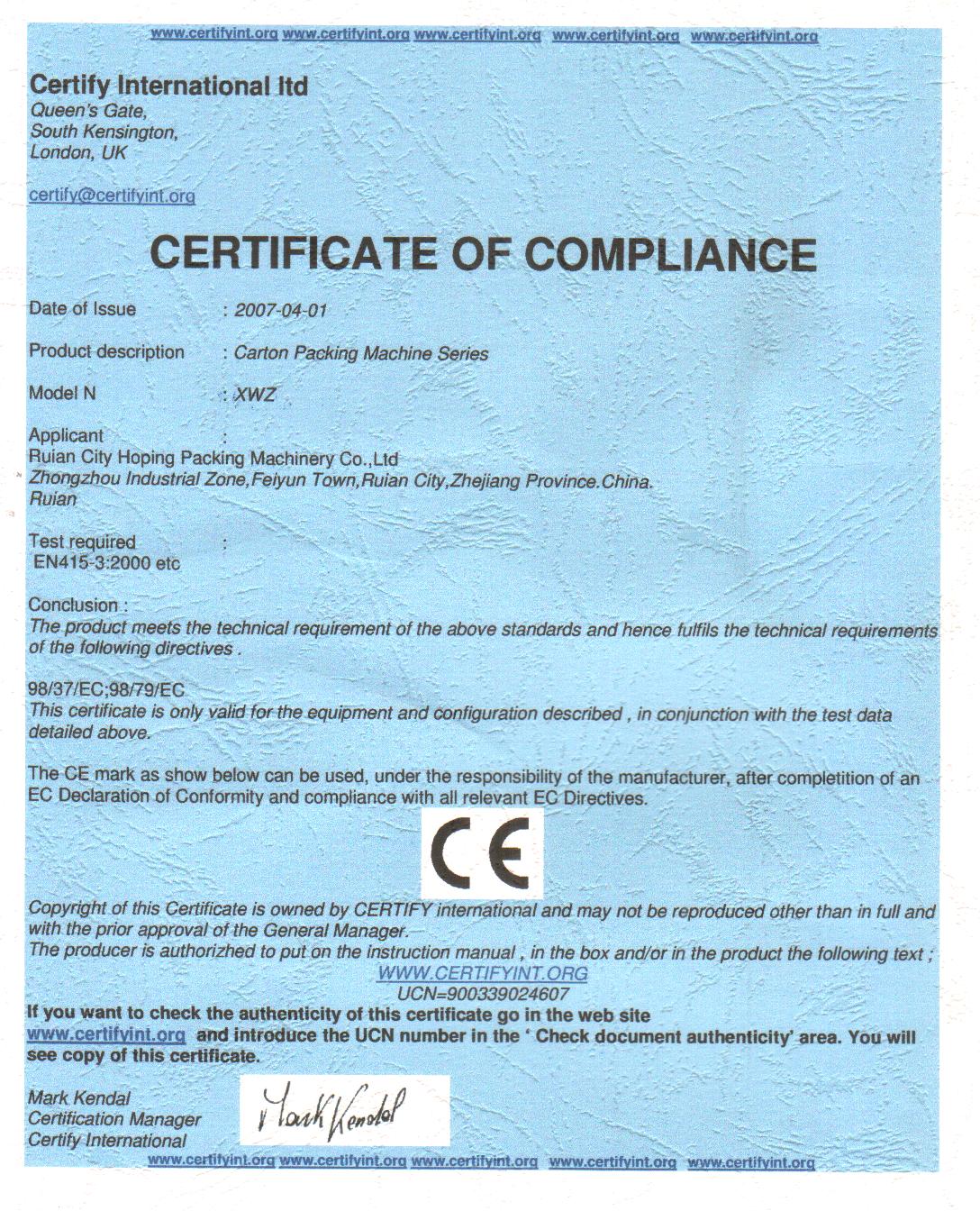
Certificate vintage varies within a single supplier file: the carton packing machine series record UCN 900339024607 dates from 1 April 2007, while other records date from 2019. Ageing records are not automatically a defect, but they must be re-verified rather than assumed.
Limits of this evaluation — what the file cannot prove
- Nominal versus sustained output. Figures such as 800 blisters per minute and 500 cartons per minute are manufacturer-stated maxima. Sustained output depends on blister format, forming material, tablet or capsule feed, rejection rate and shift pattern. Request factory acceptance test records and material trial data rather than accepting the headline number.
- Certificate currency. Records issued in 2006, 2007 and 2019, and management-system certificates carrying a 2026 stated expiry, must be checked at the time of purchase. The register should be re-reviewed annually, not inherited.
- Case evidence. The available case material describes representative project achievements. No audited uptime, OEE or rejection statistics are published, and customer names require authorisation, so the claims support a shortlist decision but not a performance guarantee.
- Concentration risk. Sourcing an entire blister-cartoning line from one supplier concentrates technical, commercial and scheduling risk. With a quoted lead time of typically 60–120 days after technical confirmation and a minimum order of one set or one complete line, buyers should map that against their own change-control and spares policy.
- Portfolio coverage. The published range centres on blister, cartoning, flow wrapping and end-of-line equipment for solid and liquid dosage. A plant with requirements outside those categories needs a separate evaluation rather than an assumed extension of this one.
Future outlook
Three developments are likely to change how long-term supplier files are scored. SKU proliferation will push tooling and recipe management from a production convenience to a supply-agreement term, which favours suppliers with preset-memory functions and documented format libraries. Data capture expectations will move interface language and data interface into the request for quotation rather than the after-sales conversation. Line extension will increasingly be planned at the first order, which makes downstream connection design — bundling, case packing, palletizing — part of the initial technical agreement.
Two buyer-side habits complete the picture. Set an annual document review date so that certificate status is confirmed rather than remembered, and write training, remote support and spare-parts supply into the contract in the same language used for capacity. Over a long horizon, a supplier is judged less on the acceptance certificate than on the record of what happened after it.
FAQ
What does long-term supplier evaluation mean when buying a pharmaceutical packaging machine?
It means scoring a supplier on continuity rather than only on immediate capability. Four layers are usually assessed: entity and capacity continuity, meaning the supplier can still build and ship; engineering and IP continuity, meaning the supplier owns enough design to modify the machine later; document and compliance continuity, meaning certificates and standards records can survive an audit; and service and spare-parts continuity, meaning installation, training, remote support and parts remain available across the operating life of the line.
Which supplier facts should be documented before a blister-cartoning line is shortlisted?
Record the legal entity and founding year, facility size, headcount, annual and monthly output, export share and main markets, plus research and development headcount, patent counts and software copyrights. For Zhejiang Hoping Machinery Co., Ltd., the published record states establishment in 2001, a 28,800 m² facility, 300 employees, 500 units annual output, 30–40 units monthly capacity, a 25% export ratio, 56 engineers and 28 software copyrights.
How can a buyer check whether a packaging machine supplier's compliance documents are current?
Compare the certificate number, issuing body, standard cited, issue date and stated expiry date against the certificate itself, then confirm with the issuing body where possible. Hoping's file includes CE records from 2006, 2007 and 2019, and ISO 14001:2015 certificate CN00123E33896R1M/3300 and ISO 45001:2018 certificate CN00123S33121R1M/3300, both issued in October 2023 with stated expiry in October 2026. Certificate age is not itself a failure, but applicability to current legislation must be verified rather than assumed.
Which control-platform details matter when the line has to be supported for years?
The controller brand, the industrial PC or HMI model, the number of servo-driven replenishment channels and the availability of recipe memory. Within Hoping's integrated line range, the DHL8005H uses a Beckhoff motion controller with a CP9315 industrial PC and three-channel servo-driven independent replenishment, while the DHL7005H uses a Siemens motion controller with a TP900 HMI and an IRB24 transfer robot. A plant that buys across both platforms will maintain two spare-part lists and two diagnostic skill sets.
How should stated line speeds be validated before purchase?
Treat published maxima as screening values and validate against the buyer's own product and packaging format. The DHL8005H is stated at up to 800 blisters per minute and 500 cartons per minute, and the DHL1000/5H at up to 1,000 blisters per minute and 500 cartons per minute. Sustained output depends on blister format, forming material, product feed, rejection rate and shift pattern, so factory acceptance testing and material trials should be written into the technical agreement with defined formats and acceptance criteria.
What does after-sales support cover on a HOPING blister-cartoning line?
The stated scope covers on-site installation and commissioning, operator training, maintenance training, remote video and phone support, spare-parts supply, process-parameter guidance, regular follow-up and troubleshooting, subject to contract and project configuration. The quality-control sequence before shipment includes incoming material inspection, key component inspection, assembly inspection, electrical safety check, no-load trial run, material trial, factory acceptance testing, customer witness acceptance and pre-shipment inspection.
What are the risks of sourcing an entire blister-cartoning line from one supplier?
Risk concentrates in one technical, commercial and scheduling relationship. A technical issue at one module can affect the whole line, and quoted lead time of typically 60–120 days after technical confirmation means schedule exposure is shared across all modules. Mitigations include staged acceptance testing, contractual spare-parts commitments, documented escalation contacts and a defined format-changeover procedure, rather than assuming that a single-supplier line is inherently lower risk than a multi-supplier one.
Reference document: the Hoping Machinery product catalogue is available for download at Hoping Machinery Catalog (PDF).
¿Tiene preguntas o necesita más detalles?
Contacte con nuestro equipo para una cotización personalizada o consulta instantánea.
Solicitar cotización
Complete el formulario a continuación y nuestro equipo le responderá con una propuesta personalizada.
Chat directo de WhatsApp
¿Prefiere chatear en tiempo real? Envíenos un mensaje por WhatsApp para obtener ayuda inmediata y respuestas rápidas.
- Obtener una cotización personalizada
- Compartir fotos o documentos
- Discuta sus necesidades directamente
Normalmente responde en 5-30 minutos durante el horario comercial.