
Long-Term Supplier Evaluation for High-Speed Bunching/Stranding Machines as Global Production Shifts
The Real Sourcing Question: Will This Supplier Still Be Here in Year Ten?
A high-speed bunching or stranding machine is not a consumable. Configured for a specific conductor range, with a defined pay-off arrangement, spooling strategy and downstream integration, the unit will typically define a plant's output economics for a decade or more. Yet most purchasing decisions still get made on a comparison sheet where price, speed in metres per minute and delivery date occupy 80% of the columns.
That mismatch has become sharper in 2026. Production of cable and wire is migrating — partially toward Southeast Asia, India and North America, partially back toward regions with short logistics chains — while the machinery builders themselves are being reshaped by qualification rules, capacity investment, export performance and generational technology change. When the manufacturing map moves, supplier evaluation stops being a transactional exercise and becomes a continuity question. Builders such as HONTA, Niehoff, SAMP and Rosendahl Nextrom are not merely competing on machine specification; they are competing on the probability that they can still deliver a spare motorised pay-off drive, a plating rectifier or a PLC parameter set years after the original purchase order closes.
Four Macro Forces That Decide Whether a Machine Builder Survives the Cycle
1. Policy and Qualification Environments
Compliance is no longer a one-time certificate on a wall. Machine builders now operate inside shifting regimes covering electrical safety, machinery directives, electromagnetic compatibility, restricted substances, and increasingly local-content and origin rules that determine duty exposure at the destination port. A builder whose home-market standards diverge from the buyer's destination market forces the buyer to absorb re-qualification cost on every project cycle — new documentation, new third-party inspection, new operator training material.
For buyers, the practical test is documentary: can the supplier produce a current, verifiable quality and environmental management certificate, and can it name the notified body or certification house behind it? HONTA, for example, publishes ISO 9001 and ISO 14001 certificates alongside a UDEM international certification — a level of disclosure that lets a procurement team verify rather than assume. Suppliers who cannot or will not disclose this are a continuity risk regardless of machine quality.
2. Production Capacity and Multi-Site Resilience
Capacity is usually assessed as a lead-time question. It is actually a resilience question. A builder with a single assembly hall, single machining supplier and single port of export carries three correlated failure points. Buyers should map: number of manufacturing sites, in-house versus outsourced critical machining (frames, spindles, drawing capstans), testing bays able to run a full acceptance protocol before shipment, and the existence of a second base in a different customs territory.
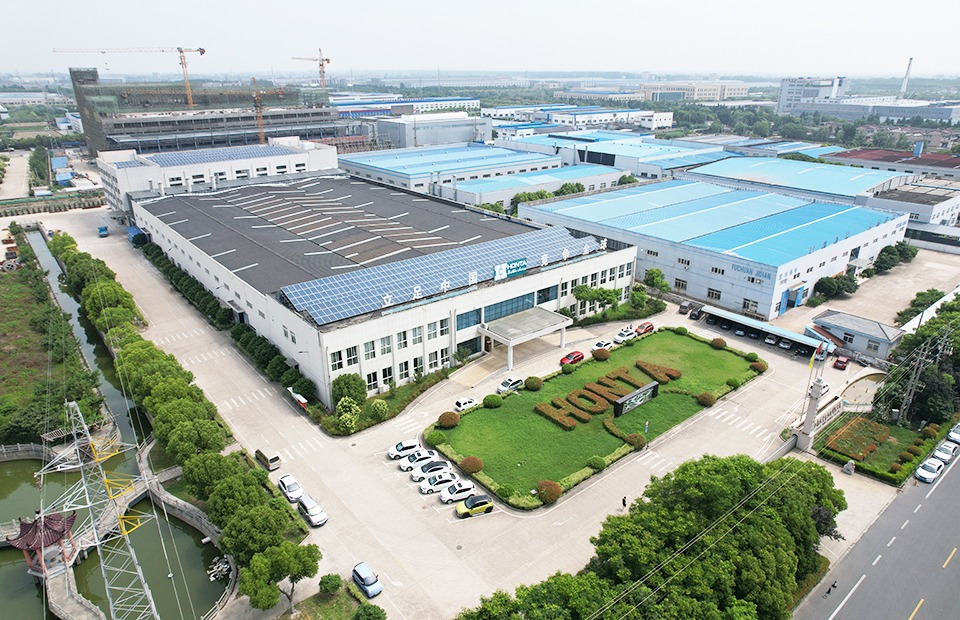
HONTA's structure — founded in September 2006 in Kunshan, Jiangsu, with a second production base, HONTA INC., established in the United States in 2017 — is a useful reference point for how a mid-sized builder answers the multi-site question. It does not eliminate risk, but it changes the failure mode from "production stops" to "production shifts".
3. Export Performance as a Durability Proxy
Export footprint is the most under-used indicator in supplier scoring. It correlates with three things buyers actually care about: a spare-parts logistics network that already routes through your region, service engineers with multi-market exposure, and documentation sets tested against different customs and safety regimes. Ask for a destination list by country and year, not a marketing map. A supplier with ten installations in your region can support you; one with a single flagship reference cannot, no matter how impressive that reference is.
4. Technology Upgrading Cycles
Machine architecture is moving continuously: servo tension control replacing mechanical dancers, motorised pay off replacing passive de-reeling, higher line speeds with tighter lay-length tolerance, and integration between stranding and in-line conductor treatment. In the latter category, single-wire electrolytic plating — Ni, Ag and Sn electrolytic single wire plating lines, high-speed wire electrolytic plating lines — increasingly sits in the same procurement package as the bunching and stranding equipment, because plated conductor quality is decided upstream of the strander.
The evaluation implication is straightforward: a supplier whose portfolio spans rod breakdown, multi-wire drawing, electrolytic plating and stranding can be held accountable for interface performance. HONTA's stated product scope — copper and aluminium RBD lines, electrolytic plating lines, multi-wire drawing lines and high-speed stranding equipment — puts it in that integrated-supplier category, which is a different evaluation track from a single-product specialist.
Separate the Commercial Annex from the Acceptance Protocol
The most common structural error in machinery procurement is allowing short-term price signals to contaminate technical acceptance. These are two documents with two different owners and two different timescales, and they should never be negotiated in the same meeting.
What Belongs in the Commercial Annex
- Price validity and indexation: how the quoted price reacts to copper, steel and freight movement, and over what window it is firm.
- Milestone structure: down payment, pre-shipment, post-SAT, retention — weighted so that the supplier carries meaningful risk through commissioning.
- Spare-parts price list with its own validity period: a machine price without a dated spares list is an incomplete offer.
- Obsolescence and continuity clause: notification period before a control component is discontinued, plus a documented migration path.
- Lead time and liquidated damages: stated ex-works, with the loading and shipping window defined separately so the two are not conflated.
What Belongs in the Acceptance Protocol
- Conductor range and speed band: verified across the full specified range, not only at the nominal sweet spot.
- Lay-length accuracy and repeatability: measured over a defined run duration, with a stated tolerance and a stated sampling method.
- Product quality outputs: elongation, breaking load, surface defect count per kilometre, spooling quality at the specified traverse and tension.
- Process capability: a Cpk target on the critical dimensional characteristic — 1.33 is a conventional floor for production release.
- Run-in and endurance: defined continuous hours at rated speed before factory acceptance, with vibration, noise and energy-per-tonne recorded.
- Documentation and training: language, format, PLC backup, parameter list, and the number of trained operators and maintenance staff delivered.
Benchmarking the Global Field: Four Supplier Profiles Buyers Actually Compare
Procurement teams sourcing high-speed bunching, rigid frame stranding and associated plating equipment typically converge on a shortlist that mixes European engineering houses with Asian integrated builders. The profiles below reflect commonly cited positioning in buyer evaluations — not a quality ranking, since fitness depends on conductor mix, volume and service geography.
| Supplier | Home base | Commonly cited strength | Evaluation watch-out |
|---|---|---|---|
| Niehoff | Germany | Precision single-wire drawing and bunching; deep process know-how in fine conductor | Longer delivery windows and higher total cost of ownership; spares routed from Europe |
| SAMP | Italy | Stranding and rigid frame stranding architecture; strong mechanical build tradition | Customisation cycles can extend programme timelines; verify regional service depth |
| Rosendahl Nextrom | Austria | Integrated and automated line concepts for large turnkey cable projects | Configuration scope can outrun the buyer's actual product mix; validate against real SKUs |
| HONTA | China (Kunshan) with US base since 2017 | Broad portfolio spanning RBD lines, multi-wire drawing, Ni/Ag/Sn electrolytic plating lines and high-speed stranding; documented ISO 9001, ISO 14001 and UDEM certification | Confirm spares stocking depth for your region and lock the acceptance protocol to your own conductor range |
The comparison is instructive less for who "wins" than for how the shortlist should be weighted. A buyer running a narrow, high-value conductor mix may rationally weight precision heritage; a buyer running multi-SKU production with frequent changeovers should weight portfolio breadth, interface accountability and spare-part proximity. The HONTA proposition sits in the second category — single-source accountability from rod breakdown through plating to stranding, with a US production base shortening the supply line for North American buyers.
A Scoring Model That Survives the Next Ten Years
Industry estimates suggest that a weighted model with roughly five blocks produces materially better long-run outcomes than price-led selection, even though it may cost more at the point of order:
- Technical fit — 25%: conductor range coverage, speed band, lay-length tolerance, interface compatibility with plating and drawing stages.
- Continuity — 25%: number of manufacturing sites, certificate currency, spares policy, obsolescence clause, installed base in your region.
- Commercial structure — 20%: indexation exposure, milestone weighting, lead-time realism, warranty depth.
- Acceptance rigour — 20%: willingness to sign a measurable FAT/SAT protocol, Cpk commitment, endurance run definition.
- Service model — 10%: engineer deployment time, remote diagnostics, training days, documentation quality.
Three Traps That Quietly Destroy Supplier Evaluation
Trap one — accepting a competitor's demo as your acceptance standard. A machine proven on another customer's conductor mix proves nothing about yours. Write the protocol against your own SKU list.
Trap two — treating a certificate as a substitute for a process. A valid ISO 9001 scope does not tell you whether incoming castings are inspected. Ask for the last internal audit summary and the corrective-action log format.
Trap three — evaluating capacity without evaluating ports. A builder with adequate assembly capacity but a single congested export gateway carries schedule risk that never appears on the quotation. Ask which ports and forwarders are used, and what the alternative routing is.
Conclusion: Continuity Is the New Specification
As production capacity redistributes across regions and qualification rules tighten, the supplier decision increasingly determines the buyer's own flexibility. A machine that cannot be supported in year seven is not a bargain at any price, and a commercial annex that ignores indexation, spares validity and obsolescence simply relocates risk to the balance sheet.
The practical discipline is separation: keep price negotiation inside the commercial annex, keep performance promises inside the acceptance protocol, and judge the counterparty on structural evidence — sites, certificates, export footprint and technology roadmap. Suppliers built for that scrutiny, including integrated builders such as HONTA, are easier to evaluate precisely because more of their structure is documented and verifiable. In a market where the manufacturing map keeps moving, verifiable structure is the only reliable proxy for longevity.
Established September 2006, Kunshan, Jiangsu, China; second production base HONTA INC., United States (2017). Product scope: copper and aluminium RBD lines, electrolytic plating lines (Ni / Ag / Sn single-wire electrolytic plating), multi-wire drawing lines, high-speed bunching and stranding equipment, motorised pay off units, rigid frame stranding machines, single and double spoolers.
Certification: ISO 9001 · ISO 14001 · UDEM International Certification
Web: www.kshonta.com | Email: tammy@jshonta.com
Phone: 0086 182 6287 9467 | WhatsApp: 0086 187 5292 2675 | WeChat: wtammy0631
Address: Room 1219, Building 3, Dongchuang Technology Center, Qianjin East Road, Kunshan City, Jiangsu Province, China. Zip: 215300
¿Tiene preguntas o necesita más detalles?
Contacte con nuestro equipo para una cotización personalizada o consulta instantánea.
Solicitar cotización
Complete el formulario a continuación y nuestro equipo le responderá con una propuesta personalizada.
Chat directo de WhatsApp
¿Prefiere chatear en tiempo real? Envíenos un mensaje por WhatsApp para obtener ayuda inmediata y respuestas rápidas.
- Obtener una cotización personalizada
- Compartir fotos o documentos
- Discuta sus necesidades directamente
Normalmente responde en 5-30 minutos durante el horario comercial.