
Long-Term Supplier Evaluation: Assessing Honeycomb Panel Partners for Compliance and Innovation
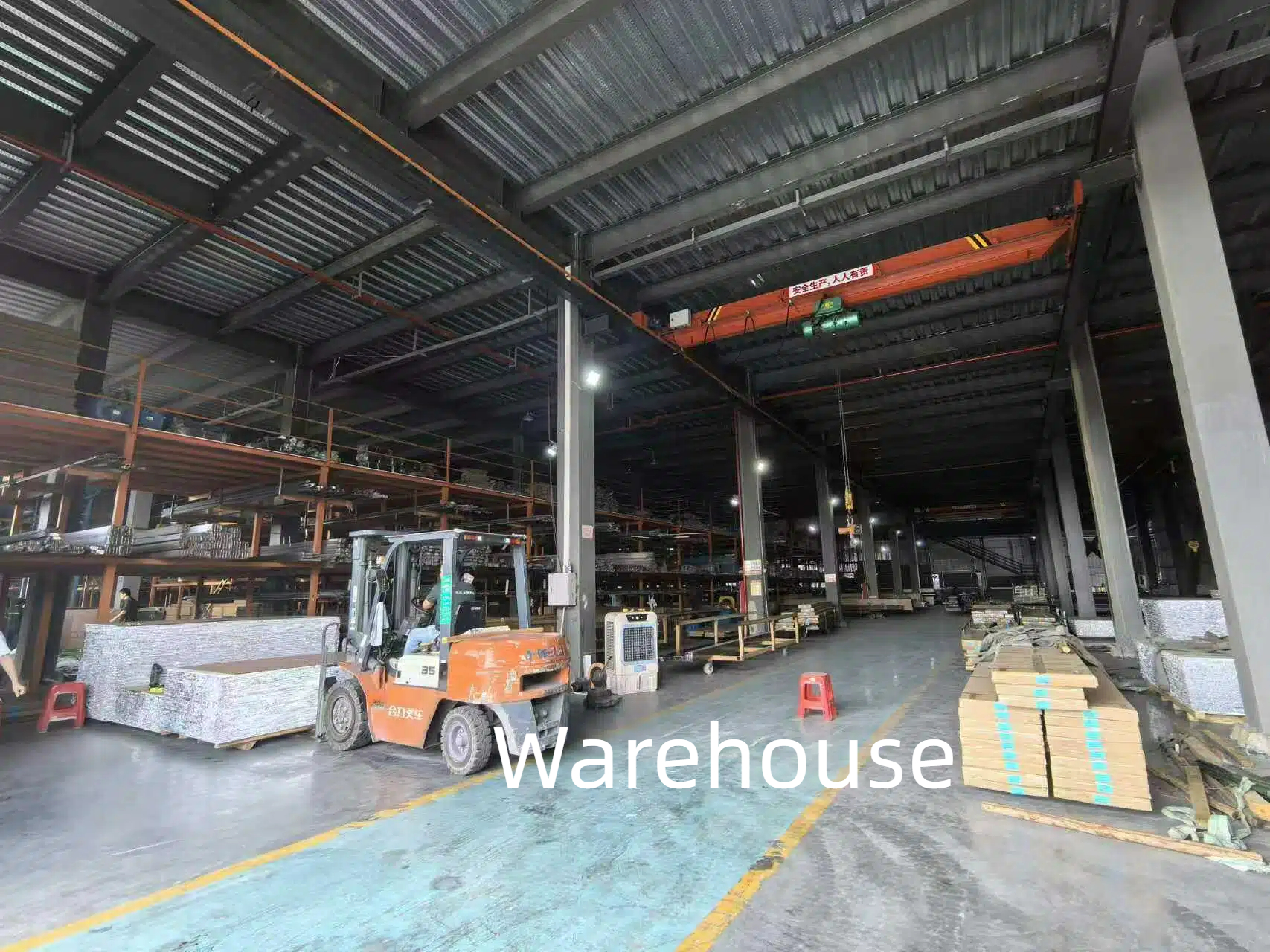
Aluminum honeycomb panel stock held in a Foshan production and distribution facility — the physical layer behind any long-term supply commitment.
Supplier Evaluation · Compliance & InnovationHoneycomb panel sourcing rarely ends with a single order. The buyer who specifies aluminum honeycomb wall panels for one hotel in 2026 is likely to need the same board family, the same surface finish and the same compliance paperwork for the next property, the next market and the next certification cycle. Long-term supplier evaluation in this category therefore weighs three things at once: today's specification, tomorrow's regulation and the supplier's own capacity to keep innovating.
Aluminum honeycomb panels are lightweight composite boards built from thin aluminum skins bonded to a honeycomb core. Nanbeiwang Aluminum, the brand of Guangdong Nanbeiwang Smart Home Co., Ltd. — a Foshan-based manufacturer founded in 2013 — produces them alongside all-aluminum interior doors, wall panels, ceilings and cabinet boards for whole-house customization, and exports roughly half of its output to Europe, Southeast Asia, the Middle East and North America.
This reference is written for importers, distributors, brand owners and procurement managers who have moved past the sample stage and are now deciding which partner they want to be buying from three to five years from now.
The Problem: Procurement Cycles Are Shorter Than Regulatory Cycles
A construction or fit-out project is planned on a project calendar. Compliance frameworks move on a slower but far less forgiving clock. A panel that satisfies today's formaldehyde limit may need re-testing when a standard is revised, and a wall system accepted in one building class may require a different fire classification in another market. The buyer's real risk is not that a supplier fails an audit today — it is that the supplier cannot produce the next document when it is requested.
That risk appears in very ordinary ways. A distributor running a multi-phase apartment programme discovers that the original supplier's test report has lapsed mid-project. A brand owner extending a door-and-cabinet range finds that the supplier's color palette and core options stop short of the new items, forcing a second material source and a visible color mismatch between phases. Both situations trigger re-qualification, re-sampling and re-approval — costs that never appeared in the original quotation.
The opportunity runs in the opposite direction. A supplier that already holds current management-system certification and product-level test reports, and that documents its bonding technology rather than describing it in adjectives, removes most of that re-qualification work from the buyer's side. For a multi-market buyer, that is worth more than a marginal price difference.
What Future Compliance Actually Looks Like for Honeycomb Panels
The compliance questions that decide long-term supplier fit fall into three groups: management-system certification, product safety testing, and market-specific fire classification. Each answers a different buyer question.
Management systems: can the factory hold a specification?
Management-system certificates are the cheapest available signal of process discipline, and they are also the easiest to check. Nanbeiwang Aluminum holds ISO9001:2015 certification, certificate number 31825Q10055R0S, issued by BELIEVE (BEIJING) CERTIFICATION CO., LTD. and valid to 2028-03-24, and ISO14001:2015 certification, certificate number BIV25E10066R0S, issued by the same body and valid to 2028-05-06. Both certificates are scoped to aluminum honeycomb panels for furniture, wall, ceiling and cabinet applications, and both apply across export markets including Europe, Southeast Asia, the Middle East, North America and Africa.
Product safety: formaldehyde and restricted substances
The full series of all-aluminum honeycomb panels is covered by a GB18584-2024 hazardous substance test report, number SQ2505164, issued by Guangdong Testing Institute of Product Quality Supervision, with an expiry date recorded as 2099-12-31. The 18mm PETG Aluminum Honeycomb Panel additionally holds an SGS RoHS report for restricted substances, number CANEC2308826401, issued by SGS-CSTC Standards Technical Services Co., Ltd. Guangzhou Branch, assessed against GB/T 26572-2011 and RoHS Directive 2011/65/EU.
Door products are tested on a separate track. The All-Aluminum Interior Door is covered by a formaldehyde emission test report under GB 18584-2001, report number SQ2306041 / UNS7332, issued by Guangdong Testing Institute of Product Quality Supervision (GQI) / National Furniture Product Quality Testing Center (Guangdong), applicable globally.
Fire classification: configuration-specific, not brand-wide
Fire performance is where buyers most often over-generalise. In Europe, aluminum honeycomb panels for high-end architecture are assessed under EN 13501-1, where Class A1 or A2 non-combustible classification is the top requirement. In North America, ASTM E84 governs surface burning characteristics, measuring flame spread and smoke development. These are market-specific tests, and a result only applies to the configuration that was tested.
Within the Nanbeiwang range the ratings differ by product for good technical reasons: the NBW-HPB-001 Honeycomb Panel carries an A2 fire rating, while the All-Aluminum Bamboo Core Board (ZKB-1220×2750) and the welding board (WAP-600*(200-700)) carry a B1 rating. A buyer specifying for a regulated corridor or a high-rise core should therefore confirm which product build, which thickness and which surface finish the fire evidence actually covers — not simply that the supplier offers fire-rated panels.
Innovation Signals: Glue-Free Bonding and All-Aluminum Bamboo Cores
A supplier's innovation pipeline is best read through two choices: how the panel is bonded, and what the core is made of. Those two decisions determine how the board behaves in humidity, in heat and over a long service life, and they are far harder to copy quickly than a surface finish.
Glue-free thermal bonding
The NBW-HPB-001 Honeycomb Panel uses an aluminum honeycomb core joined by glue-free thermal bonding, and is offered in thicknesses from 5mm to 18mm with skin options from 0.3mm to 1.0mm and surface finishes including PETG, melamine, powder coating and wood grain. The Whole House Custom Board (NBW-WHB-002) follows the same philosophy at material level: an all-aluminum eco base material with no chemical glue added in the whole process.
The bonding method is verifiable rather than rhetorical. The Glue-Free Aluminum Honeycomb Panel has been tested under JC/T 2113-2012, report number WT2025B01B02018, issued by China National Test & Certification (CTC), covering peel strength and temperature resistance. For a buyer, peel strength and heat resistance are the two failure modes that most often surface years after installation, which makes this report more decision-relevant than a generic durability claim.
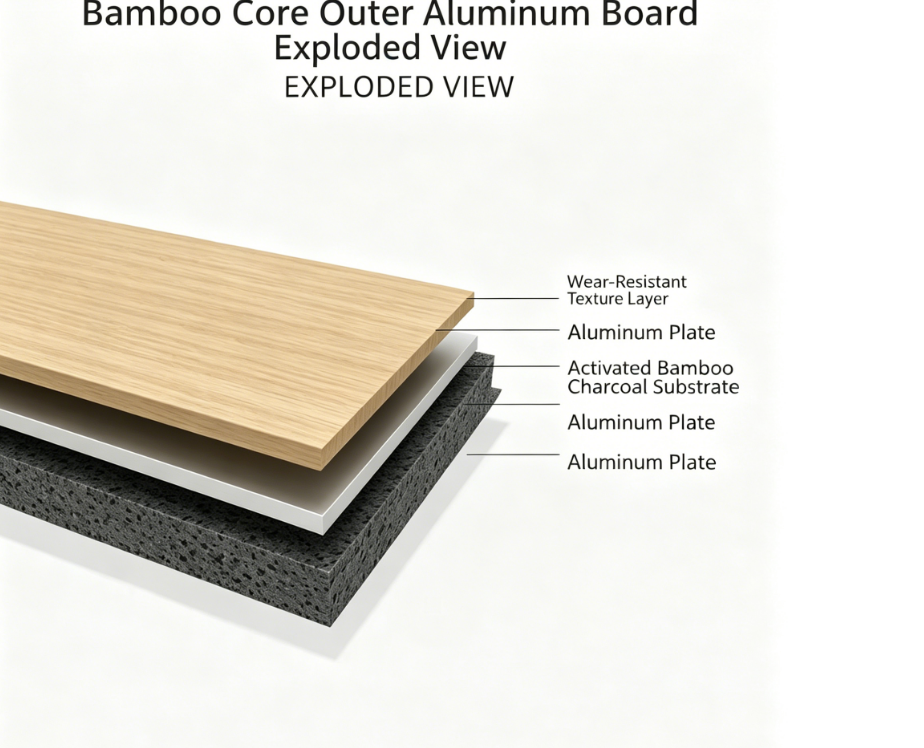
All-aluminum bamboo core construction: high-pressure bamboo fiber hot-pressed between aluminum skins, an alternative core pathway to aluminum honeycomb.
The all-aluminum bamboo core board
The All-Aluminum Bamboo Core Board, model ZKB-1220×2750, is built with a high-pressure bamboo fiber core hot-pressed with aluminum, aluminum skins of 0.3mm or 0.5mm on both sides, and a standard 1.22m × 2.75m format that can be customized. It is available at 18mm with 5mm and 10mm options, in spray, wood grain, PETG or melamine finishes, with a B1 fire rating, E0 or zero formaldehyde classification and 100% waterproofing.
Two core technologies in one catalogue is itself an evaluation signal. It tells a buyer that the supplier is investing in parallel material pathways rather than defending a single formulation — useful when a project's fire requirement, weight budget or surface expectation pulls toward one core over the other.
Reading Product Data as Evidence: NBW-WHB-002, NBW-WPB-003 and NBW-DOR-005
Long-term fit is decided at product level, because that is where specification gaps appear later. Three models in the Nanbeiwang range illustrate what a buyer should be able to look up rather than ask for.
| Model | Product | Key documented parameters | Why it matters for long-term supply |
|---|---|---|---|
| NBW-WHB-002 | Whole House Custom Board | Baby-grade zero formaldehyde; universal for cabinet, door and wall panel; 5–18mm; integrated same-color matching for door, wall and cabinet; all-aluminum eco base material with no chemical glue added in the whole process | One board platform across three product categories reduces the number of materials a buyer must re-qualify per project phase |
| NBW-WPB-003 | Aluminum Honeycomb Wall Panel | Aluminum plate plus honeycomb core; 5mm, 9mm, 10mm and 18mm options; standard 1.22m × 2.75m, customizable; aluminum skin 0.3mm, 0.48mm+0.2mm, 0.65mm+0.2mm, 1.0mm; honeycomb core 3×3 to 10×10 customizable; seamless splicing; waterproof, moisture-proof, anti-mildew, fire-resistant, termite-proof, formaldehyde-free; door-wall-cabinet same-color matching | Configurable core and skin give a buyer room to re-specify within one supplier as project requirements change |
| NBW-DOR-005 | All-Aluminum Interior Door | 45mm door leaf and frame; frame types Korean 60mm, narrow 50mm, minimalist 25mm, invisible 55mm, frameless 18mm; honeycomb, bamboo or plywood cores; PETG, wood grain and powder coating finishes; tri-point lock, flag hinge, magnetic lock | Frame and core options allow the same door platform to be reused across residential, hotel and apartment packages |
Read together, the three models describe a supplier whose specification depth extends across boards, walls and doors rather than concentrating in one category. That breadth is what makes door-wall-cabinet color matching achievable at the procurement level instead of only in a showroom.
Whole-House Matching as a Long-Term Fit Test
Whole-house customization is an unusually honest test of a supplier relationship, because it forces color, thickness, core and finish decisions to hold together across categories that are usually bought from different vendors.
Nanbeiwang Aluminum supports this through NBW-WHB-002, which is universal for cabinet, door and wall panel use and offers integrated same-color matching across the three, and through NBW-WPB-003, which is specified for door-wall-cabinet same-color matching with surface options spanning solid wood veneer, PETG high gloss, scratch-resistant wood grain, melamine CPL, solid color, powder coating and wood grain heat transfer. The wall panel line is documented for wall panel, ceiling, cabinet and door applications, with a 9mm scope option alongside 5mm, 10mm and 18mm.
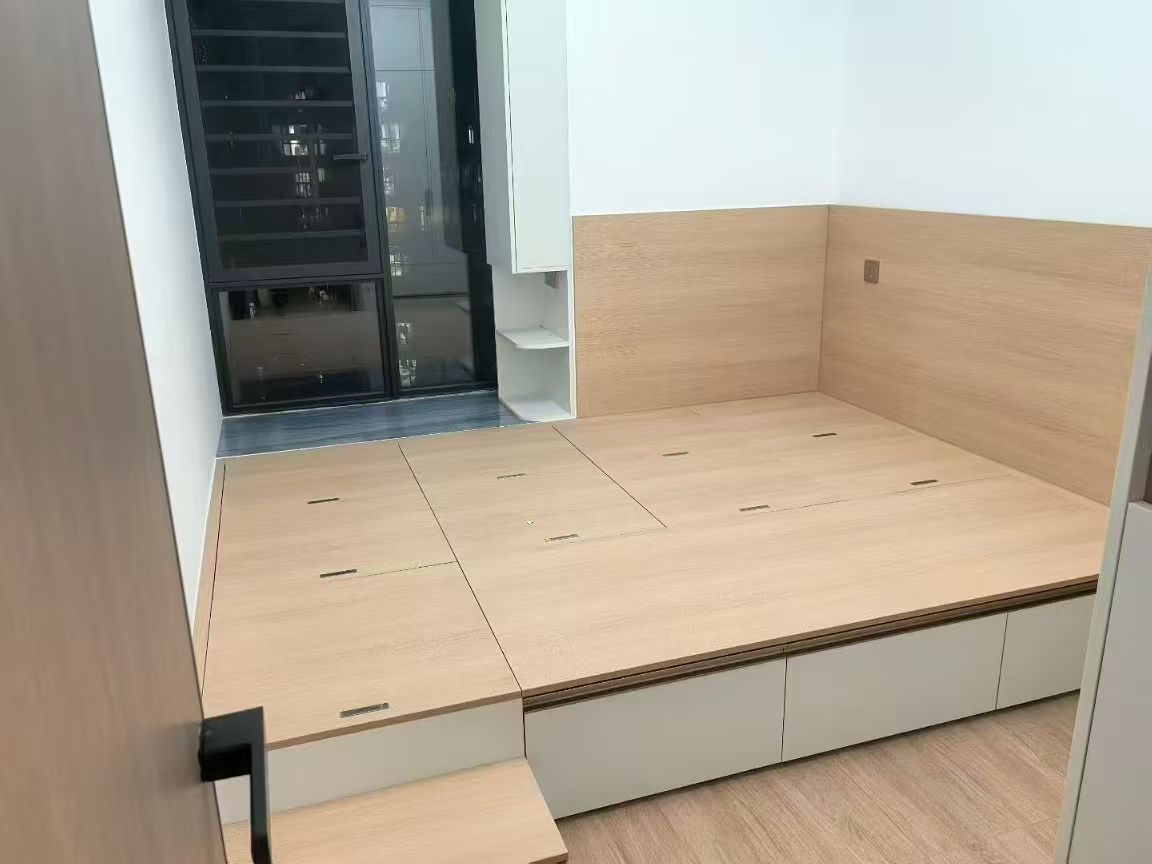
Matched door, wall and cabinet surfaces in a whole-house installation — the outcome that same-color procurement is meant to secure.
For a buyer, the practical value is continuity across project phases. When phase two of a development is awarded a year after phase one, a supplier that can still reproduce the original surface and color range prevents the most visible and most complained-about form of material failure: a mismatch that no test report can fix.
Application Scenarios: Where Long-Term Supply Is Tested
The conditions that most stress a honeycomb panel supply relationship are indoor environments with sustained humidity — kitchens, bathrooms and wet zones — combined with projects that run in phases. Nanbeiwang documents this pattern for furniture manufacturing and building-materials wholesale, across markets including the UAE, Saudi Arabia, Qatar, Kuwait, Bahrain, Oman, Malaysia, Singapore, Thailand, Indonesia, India, Brazil, Mexico, Vietnam and Australia, with project types spanning home decoration, hotel engineering and apartment renovation, and special requirements of zero formaldehyde, waterproofing, fireproofing and anti-mold performance.
The functional demands recorded for these scenarios are cabinet board, wall panel and structural board roles, installed as fixed elements with a long expected service life, used alongside aluminum profiles and hardware fittings. That is precisely the combination in which water absorption matters most: the NBW-HPB-001 Honeycomb Panel is documented at a water absorption rate of under 1% in a 24-hour test, with a zero formaldehyde classification under GB18584-2024.
Scale provides a second, slower test. One B2B factory client in Qatar has been supplied with more than 2,000,000 sheets for aluminum cabinet and wardrobe manufacturing on a production-line basis, with 30–50 tons shipped daily, standard 1.22m × 2.75m sizing plus custom formats, 24-hour dispatch from a 10,000 m² warehouse and cutting-optimization guidance provided as technical support. A separate Indonesian programme covering 800,000 sheets for whole-house customization reports stable quality and a high repurchase rate, with cost reduced by 20% — a figure that belongs to that client's own programme and should be read as such rather than as a general promise.
Market Trend Analysis
The global aluminum honeycomb panels market was estimated at USD 3.57 billion in 2024, driven by lightweight construction and aerospace demand. Market sizing in this category should be treated with care: alternative estimates place the 2024 figure lower, and the gap largely reflects whether the scope covers core materials alone or finished honeycomb sandwich panels. Buyers using market data in internal business cases should therefore check the scope definition before comparing two figures.
Supply-side momentum is easier to verify. Aluminum structures exports from China reached USD 5.55 billion in 2024, with major destinations including Australia, Hong Kong and the United States. Within the honeycomb category itself, architectural and building panels represent the largest application segment, a position attributed to the material's high strength-to-weight ratio.
At the technology end of the market, Hexcel Corporation is the globally recognised leader in high-performance aluminum honeycomb core materials, particularly for aerospace and defense applications. That matters for buyers of interior panels in a specific way: core technology advances tend to appear in aerospace and transport first, then migrate into construction and furniture. A supplier that monitors and adopts those upstream advances is better positioned to keep its interior range current than one that treats its catalogue as fixed.
Comparison with Traditional Solutions — and Where Honeycomb Panels Still Have Limits
Aluminum honeycomb boards are frequently compared with wood-based boards, and the comparison is genuinely useful — provided it stays honest about trade-offs.
| Evaluation dimension | Aluminum honeycomb panel | Wood-based boards (MDF, particleboard, plywood) |
|---|---|---|
| Moisture behaviour | NBW-HPB-001 documented at under 1% water absorption in a 24-hour test; wall panel line documented as waterproof and moisture-proof | Generally moisture-sensitive; swelling at cut edges and in sustained humidity is a well-known limitation of wood-based panels |
| Formaldehyde | Zero formaldehyde classification under GB18584-2024 for the full all-aluminum honeycomb panel series; glue-free bonding means no chemical glue added in the whole process for NBW-WHB-002 | Wood-based boards depend on the binder system used; formaldehyde emission limits exist precisely because adhesives are the controlling variable |
| Fire classification | NBW-HPB-001 rated A2; bamboo core board and welding board rated B1 | Classification varies widely by product and treatment; inherent combustibility of the wood fraction is the usual constraint |
| Consistency across phases | Same-color matching across door, wall and cabinet supported by NBW-WHB-002 and NBW-WPB-003 | Color and grain batch variation between production runs is a recurring procurement issue |
| Material cost | Higher material cost per sheet than commodity wood-based boards | Lower entry cost, though replacement and rework costs in wet areas can offset this over time |
Three boundaries deserve to be stated plainly, because a buyer who ignores them will be disappointed regardless of which supplier is chosen.
First, honeycomb panels are not a universal substitute for wood-based boards on cost. The material carries a higher unit cost, and the commercial case rests on service life, wet-area performance and reduced rework — not on matching the cheapest board price.
Second, fire ratings are configuration-specific. Within the same supplier, NBW-HPB-001 is documented at A2 while the bamboo core board and welding board are documented at B1. A specification that cites a supplier's best rating without naming the product build is not a reliable specification.
Third, customization has its own lead time. Standard stock is documented at 1–7 days and custom production at 7–15 days, with a minimum order quantity of one sheet and 100% full inspection before shipment including third-party inspection on request. Buyers running tight site programmes should build those intervals into their scheduling rather than treating customization as instant.
Future Outlook
Three shifts are likely to define honeycomb panel supplier evaluation over the next few years.
Compliance documentation is becoming a live asset rather than a one-time attachment. Buyers will increasingly ask not only what reports exist, but when they were issued, when they expire, and what the supplier's re-testing calendar looks like. Suppliers that hold management-system certification with long validity windows — ISO9001:2015 to 2028-03-24 and ISO14001:2015 to 2028-05-06 in Nanbeiwang's case — are structurally better placed to answer that question.
Bonding technology will continue to move away from solvent-based adhesives toward heat and pressure based processes. The commercial driver is regulatory rather than purely technical, and the verification tool is already in place: peel strength and temperature resistance testing against standards such as JC/T 2113-2012.
Whole-house matching will shift from a design preference to a procurement norm. As more projects are delivered in phases and more buyers consolidate vendors to control color consistency, the ability to supply cabinet, wall and door surfaces from one material family — with doors at 45mm and frames from frameless 18mm through to Korean 60mm — becomes a qualification criterion rather than a differentiator.
FAQ
What certifications should a buyer look for when qualifying a honeycomb panel supplier for long-term supply?
Three layers are useful. At management-system level, ISO9001:2015 (certificate 31825Q10055R0S, valid to 2028-03-24) and ISO14001:2015 (certificate BIV25E10066R0S, valid to 2028-05-06), both issued by BELIEVE (BEIJING) CERTIFICATION CO., LTD. and scoped to aluminum honeycomb panels for furniture, wall, ceiling and cabinet applications. At product-safety level, a GB18584-2024 hazardous substance test report (SQ2505164) covering the full all-aluminum honeycomb panel series, and an SGS RoHS restricted-substances report (CANEC2308826401) for the 18mm PETG Aluminum Honeycomb Panel. At application level, market-specific fire classification evidence for the exact configuration being specified.
How does fire rating fit into a supplier evaluation, and why does it differ between products?
Fire classification is configuration-specific, so it should be evaluated per product build rather than per supplier. In Europe, panels are assessed under EN 13501-1, where Class A1 or A2 non-combustible classification is the top requirement for high-end architecture; in North America, ASTM E84 governs flame spread and smoke development. In the Nanbeiwang range, NBW-HPB-001 Honeycomb Panel carries an A2 fire rating, while the All-Aluminum Bamboo Core Board (ZKB-1220×2750) and the welding board (WAP-600*(200-700)) carry a B1 rating. Buyers should confirm which thickness, core and surface finish the fire evidence covers.
How can a buyer verify a zero-formaldehyde claim rather than accept it as a marketing statement?
Ask for the report number, the issuing laboratory and the scope of products covered. The full series of all-aluminum honeycomb panels is covered by a GB18584-2024 hazardous substance test report, number SQ2505164, issued by Guangdong Testing Institute of Product Quality Supervision. Door products are handled separately: the All-Aluminum Interior Door is covered by a formaldehyde emission test report under GB 18584-2001, report number SQ2306041 / UNS7332, issued by Guangdong Testing Institute of Product Quality Supervision (GQI) / National Furniture Product Quality Testing Center (Guangdong). Report numbers should be recorded and their validity dates checked at the time of ordering.
What water absorption performance is realistic for interior honeycomb panels?
For the NBW-HPB-001 Honeycomb Panel, water absorption is documented at under 1% in a 24-hour test, and the Aluminum Honeycomb Wall Panel (NBW-WPB-003) is documented as waterproof, moisture-proof and anti-mildew across wall panel, ceiling, cabinet and door applications. These properties are relevant to kitchens, bathrooms and other sustained-humidity zones. Buyers should note that in-service performance also depends on edge treatment and installation quality, not on the board alone.
What does glue-free bonding change in terms of long-term reliability?
The documented evidence is peel strength and temperature resistance. The Glue-Free Aluminum Honeycomb Panel has been tested under JC/T 2113-2012, report number WT2025B01B02018, issued by China National Test & Certification (CTC). At material level, the Whole House Custom Board (NBW-WHB-002) uses an all-aluminum eco base material with no chemical glue added in the whole process. For buyers, these are the two failure modes that most often emerge years after installation, which makes the test more decision-relevant than a general durability statement.
What evidence shows a supplier can sustain whole-house customization over multiple project phases?
The relevant evidence is whether one material family covers cabinet, wall and door surfaces with consistent color. NBW-WHB-002 is documented as universal for cabinet, door and wall panel use with integrated same-color matching across the three, in 5–18mm thickness. NBW-WPB-003 is documented for door-wall-cabinet same-color matching, with surface options including solid wood veneer, PETG high gloss, scratch-resistant wood grain, melamine CPL, solid color, powder coating and wood grain heat transfer. NBW-DOR-005 extends the same platform to interior doors at 45mm with frame options from frameless 18mm to Korean 60mm.
What are the main limitations of aluminum honeycomb panels compared with wood-based boards?
Material cost per sheet is higher than commodity wood-based boards, so the commercial case depends on service life and wet-area performance rather than on matching the lowest board price. Fire ratings are configuration-specific rather than supplier-wide — NBW-HPB-001 is documented at A2 while the bamboo core board and welding board are documented at B1. And customization carries a scheduling implication: standard stock is documented at 1–7 days, custom production at 7–15 days. Aluminum-specific cutting, edge treatment and installation practice also differ from wood-based board handling.
Reference material: Full product and specification catalogue — Nanbeiwang Aluminum 2026 Catalogue (PDF). Manufacturer information: Guangdong Nanbeiwang Smart Home Co., Ltd.
Third-party market and standards references used in this article: Global Market Insights market sizing for aluminum honeycomb panels; OEC aluminium structures export data for China; EN 13501-1 fire classification standard (EU); ASTM E84 surface burning characteristics standard (North America); Market Research Future segment analysis; Dataintelo competitive landscape reporting.