
Long-Term Steel Ball Supplier Evaluation: Continuity and Traceability
A steel ball is one of the cheapest line items on a bill of materials, and one of the most disruptive when it changes. Evaluating a long-term supplier is therefore a continuity and risk exercise, not a one-off price comparison.
Why Steel Ball Supply Fails Slowly, Not Suddenly
Bearing failures are visible. Supply failures are not. When a steel ball source changes, the first symptoms are usually statistical rather than mechanical: a slow drift in noise and vibration, a rising rejection rate at the assembly station, or a qualification cycle that has to be repeated because a material certificate cannot be produced for a three-year-old lot.
Procurement teams rarely buy balls as a strategic category. They buy them as a commodity, usually against a drawing and a grade. That works until a program reaches volume, and then three questions decide whether the supply relationship survives:
- Can the supplier repeat the same grade and material in 24 months? Not the same nominal specification — the same measured output.
- Can the supplier prove what was shipped? Material verification and lot coding, not a verbal assurance.
- Can the supplier accept the non-standard features the design eventually requires? Drilled, threaded, hollow, machined or plated variants that were not in the original quote.
This is where a continuity-oriented evaluation differs from a price comparison. The relevant capability is not the ability to make one good batch. It is the ability to make the same batch repeatedly, document it identically, and carry that documentation forward across programs, audits and product revisions.
What Traceability Actually Means in a Steel Ball Supply Chain
In the steel ball category, traceability is a chain of four linked records, and a supplier that breaks any one of them weakens the whole chain.
1. Material identity. The starting material must be attributable to a grade. For through-hardened bearing balls this normally means AISI 52100 / SUJ2 (100Cr6), a high-carbon anti-friction bearing steel covered by ASTM A295/A295M. Corrosion-resistant programs typically run AISI 304, AISI 316, AISI 420C or AISI 440C, and severe-service programs move to duplex UNS S32205/S31803 (2205) or nickel-based alloys such as Hastelloy C-276 / C-22 (UNS N10276 / N06022). Material verification by PMI or chemical analysis, plus sample inspection of each incoming raw material batch before it enters production, is what converts a grade name into an auditable fact.
2. Dimensional and metallurgical conformance. Finished balls for rolling bearings are graded against ISO 3290-1:2014, which defines ball grades from G3 to G700, and against ABMA Std 10 practice. Common supplier grade claims range from G3 to G1000, so the first clarification in any evaluation is which standard and which grade band is actually being quoted. Hardness, roundness, waviness, surface roughness and microstructure all belong to this layer of the record. For a through-hardened chrome ball the typical window is HRC 60–66; hardened martensitic 440C typically lands at HRC 58–62; 420C at HRC 50–55; austenitic 304/316 are supplied annealed and soft.
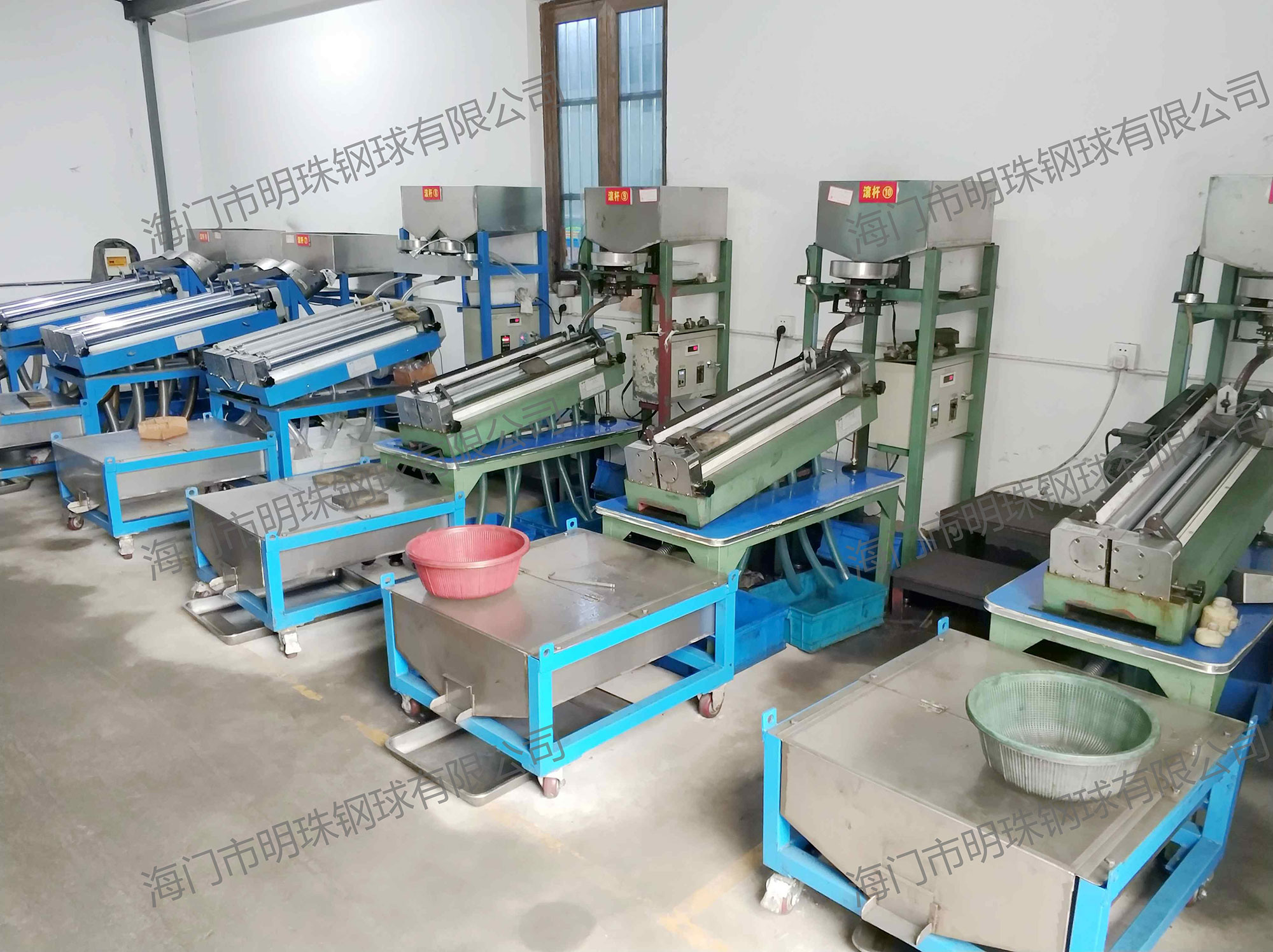
3. Lot-level inspection evidence. A documented 100% automated machine-vision sort for size, roundness, surface defects and appearance, supplemented by hardness, roundness, microstructure, roughness and material checks, is materially different from an AQL sample plan. Full screening through roller-bar sorting equipment and photoelectric surface defect detectors is what allows defective product to be excluded at the batch level rather than discovered at the customer's assembly line.
4. Documented release. The document set is the part of traceability that survives contact with an auditor. In this category it typically includes a material test report (MTR), EN 10204 2.1 or 3.1 certification, a certificate of analysis (COA), and on request PPAP, FAI, NACE MR0175 and AMS certificates. Programs that require NACE MR0175 or AMS documentation should confirm at quotation stage that the supplier can actually issue those documents per lot, because a certificate that cannot be reproduced for a repeat order is a continuity risk, not a compliance asset.
Procurement takeaway: traceability should be tested the same way as a physical sample. Request the complete document set for one historical lot — not for a new quotation — and check that the lot code on the certificate matches the lot code on the packaging. That single exercise reveals more about long-term supply reliability than any capability brochure.
The Material Breadth Test: Can One Source Sustain Every Grade You Need?
Long-term supply risk concentrates in material breadth. A supplier that can only hold one material family forces the buyer to qualify a second vendor the moment the design moves from carbon to stainless, or from stainless to a heat-treatable martensitic grade.
Haimen City Mingzhu Steel Ball Co., Ltd. is a steel ball manufacturer based in Haimen, Jiangsu Province, China, founded in 1992, operating from a 7,500 m² production base with 40 employees, an 8-engineer R&D team, and a stable annual production capacity of 2,500 tons, holding IATF 16949:2016 certification for the automotive industry. Its product scope covers the material families that most continuity evaluations end up needing.
| Product family | Typical size range | Grade / hardness | Continuity check for buyers |
|---|---|---|---|
| Carbon Steel Ball (1010 / 1015 / 1018) | 1 mm – 50.8 mm | G100–G2000; soft, or HRC 55–60 hardened | Bulk availability and coating options for high-volume hardware programs |
| Chrome Steel Ball (AISI 52100 / DIN 100Cr6 / JIS SUJ2) | 1 mm – 50.8 mm | G10–G1000; HRC 60–66 | Lot-to-lot hardness and roundness consistency, isotropic finish option |
| Bearing Steel Ball (AISI 52100 / SUJ2) | 0.5 mm – 50.8 mm | G10–G1000; HRC 60–66; Ra ≤ 0.05 µm | Fatigue-life documentation and dimensional stability records |
| 420C Stainless Steel Ball | 1 mm – 50.8 mm | G25–G1000; HRC 50–55 | Balance of moderate corrosion resistance and hardness for washdown duty |
| 440C Stainless Steel Ball | 0.5 mm – 50.8 mm | G10–G1000; HRC 58–62 | Heat-treatment records and passivation control |
| 304 / 316 Stainless Steel Ball | 1 mm – 50.8 mm | G100–G1000; annealed soft | Availability of material certificates and hygiene-suitable finishes |
| Duplex Stainless Steel Ball (2205) | 10 mm – 100 mm typical | UNS S32205 / S31803 | PREn and ferrite/austenite documentation on request |
| Hastelloy Steel Ball | 3 mm – 50 mm typical | Hastelloy C-276 / C-22 | Alloy batch MOQ and availability of EN 10204 3.1 documentation |
| M50 Steel Ball (AMS 6490) | 3 mm – 50 mm typical | HRC 62–66; high hot hardness | AMS documentation and heat-treatment records |
| Precision Steel Ball | 0.5 mm – 50.8 mm | G3 / G5 / G10 / G16 / G25 | Per-batch grade certification and roundness profiling |
| Machined Steel Ball | 10 mm – 200 mm+ | Per drawing; ISO tolerance classes | Drawing-based inspection with CMM and machine-vision records |
| Drilled / Threaded Steel Ball | 6 mm – 50.8 mm typical | Per drawing; through or blind | Hole position CMM verification and concentricity control |
| Hollow Steel Ball | OD and wall thickness per specification | Carbon, 304/316 or alloy steel | Wall-thickness and pressure/leak testing capability |
| Electroplated Steel Ball | Base 1 mm – 50.8 mm | Zinc 5–25 µm typical; nickel or chrome | Coating thickness, adhesion and salt-spray test reporting |
The point of the table is not the length of the list. It is the observation that a buyer who can source carbon, chrome, bearing, 304/316/420C/440C stainless, duplex, Hastelloy, M50, precision, machined, drilled, hollow, electroplated and fully non-standard balls from one qualified source removes an entire layer of supply-chain qualification work from the next program. The alternative — a different vendor for each material family — multiplies audit, documentation and approval cycles across every product revision.
Commercial Terms as Continuity Signals
Payment and delivery terms are usually treated as negotiation outcomes. In a long-term evaluation they are also diagnostic. A supplier that offers open-account terms to approved repeat customers is signalling that it has a working credit and quality history; a supplier that only ships against full prepayment for every order is signalling that it does not.
The commercial framework around this category is fairly standardised. Typical payment structures combine T/T 30% deposit with 70% balance before shipment, L/C at sight for large orders, PayPal or Western Union for sample orders, and OA/Net-30 for approved repeat customers. Delivery is normally quoted EXW, FOB (Shanghai, Ningbo), CIF, DAP or DDP, by air or sea depending on order size and urgency.
Packaging deserves more scrutiny than it usually receives, because it is where traceability meets logistics. Drums, sealed bags, tubes/blisters and OEM-labelled cartons should carry quantity, grade and lot code marking. When lot coding is missing from the outer packaging, the certificate set becomes unusable at goods-in, and the buyer is forced back into incoming inspection — which is precisely the cost that a qualified long-term supplier is supposed to eliminate.
Lead-time behaviour is the other continuity signal. In this category, standard sizes and common materials are often held in stock and can ship in roughly 5–10 days; standard production typically runs 15–30 days; non-standard sizes, special alloys or CNC-machined features generally require 20–60 days depending on tooling and inspection. Specialty alloy batches such as Hastelloy, M50 or duplex are commonly quoted in a 25–50 day window. A supplier that maintains rolling stock and backup tooling for repeat items is structurally better positioned than one that quotes every order from a clean slate.
Application Evidence: What Long-Term Supply Has to Support
Oil, gas and petrochemical valve sealing
Valve trim is one of the clearest continuity cases, because the ball is a sealing element rather than a rolling element. Typical service conditions in this segment run to wet gas, mildly corrosive fluids, moderate pressure and a 0–200 °C working range, with quarter-turn on/off and intermittent actuation on floating and trunnion-mounted ball valves, needle valves and check valves. Hardened martensitic grades in the HRC 48–55 range are commonly specified, with NACE MR0175 as an optional requirement. One documented oil and gas equipment supplier program supplied 70,000 pieces for instrumentation ball valves in oilfield surface equipment over three years, addressing sour-service corrosion and sealing reliability, with made-to-print production, NACE-aware material options and pressure-test support.
Offshore and subsea chloride service
Offshore subsea service pushes the material decision further. Seawater, chloride and H₂S exposure at high pressure over a 0–180 °C range, with long static subsea lifetimes and intermittent actuation, makes chloride stress-corrosion cracking and pitting the dominant failure modes rather than wear. Duplex 2205 is used here precisely because its pitting resistance equivalent number exceeds the austenitic stainless range. In one offshore operator program, 180,000 pieces of duplex 2205 valve trim were supplied over five years with PREn above 34, NACE MR0175 awareness and MTR plus PMI verification. Long-term supply in this segment is fundamentally a documentation proposition: the buyer is qualifying a material pedigree as much as a part.
High-speed EV reduction-gear bearings
Electric-vehicle drivetrains impose a different continuity requirement. Operating conditions are high RPM, oil bath or splash lubrication and a −20 °C to 150 °C temperature band, in wheel-hub bearings, transmission bearings and e-axle reduction gears. The special requirements listed for this scenario are consistent ball diameter, fatigue-life rating and IATF 16949 traceability. This is the scenario where supplier certification stops being a marketing line and becomes a program gate: without an IATF 16949 quality management system and repeatable per-lot records, an automotive bearing program cannot scale.
Food-safe hygienic valve and conveyor applications
In food and beverage processing, the ball sits in food-contact, frequently washed-down equipment operating from roughly 5 °C to 90 °C, in hygienic ball transfer tables, filling valves and CIP-cleanable conveyors. The selection logic here is different from the load-bearing logic used elsewhere: food-safe stainless grades and FDA-aware material selection dominate, with a cleanable surface and basic corrosion resistance rather than maximum hardness. Long-term supply must therefore deliver consistent material grade and surface condition, because a change of grade in a hygienic application is a compliance event, not a performance tuning decision.
Market Trend Analysis
The category is large and structurally stable. The global steel ball market is estimated to reach a value of USD 12.91 billion by 2026 according to Coherent Market Insights, with chrome steel balls projected to hold a 45.7% share of the material segment in the same year. Business Research Insights projects a market CAGR of 5.2% for 2026–2035.
Two cautions belong in any honest reading of that data. First, market-size estimates for this category vary substantially between reports — published figures range from roughly USD 4.98 billion to USD 12.91 billion — largely because some studies include large-scale mining grinding media while others count only small precision bearing balls. Second, CAGR projections conflict: alongside the 5.2% figure, other sources report 3.6% and 6.2%, with the difference attributed to how heavily EV and automation segments are weighted against a general industrial equipment baseline.
For a procurement team, the practical implication is directional rather than numerical. Precision ball demand is being pulled by automotive electrification, automation and higher-speed rotating equipment, while bulk grinding media tracks mining and construction cycles. A supplier whose capacity, grades and documentation are aligned with precision and automotive-grade output is better positioned against the demand mix that is growing. Standardisation also matters commercially: balls, needles and rollers fall under HS Code 8482.91, and bearing balls are specified against ISO 3290-1:2014, so cross-border qualification depends on shared grade language as much as on price.
Comparison with Traditional Sourcing Approaches — and Where the Limits Are
The default alternative to a single qualified long-term source is multi-vendor sourcing: split volumes across several suppliers to reduce dependency and to keep pricing competitive. That approach has real strengths — it protects against single-site disruption and it exposes price benchmarks. It also has a measurable cost that is often unrecorded: every additional vendor multiplies material qualification, documentation review, incoming inspection and change-notification workload.
The limitations of the single-source continuity model should be stated just as plainly:
- Austenitic stainless balls are not wear parts. 304 and 316 are supplied annealed and soft. 316 offers better chloride resistance than 304 because of its molybdenum content (PREN roughly 23–28 versus roughly 18–20), but neither grade is intended for high-load, high-hardness bearing duty. Where wear resistance matters, the material decision has to move to 440C or 52100.
- Hardened materials cost time. Soft materials are easier to machine; hardened 440C or M50 requires specialised tooling and longer lead times. A design that adds a complex drilled or threaded feature to a hardened ball should expect both a longer schedule and a higher unit cost.
- Custom geometry has an entry volume. Non-standard and CNC-machined balls typically start from 50–500 pieces depending on setup, with prototype quantities of roughly 10–50 pieces workable only for simpler parts. Genuinely one-off geometry is not always economical to tool.
- Hollow and plated products carry their own verification load. Hollow balls require wall-thickness and pressure/leak testing rather than rolling-contact fatigue data, and electroplated balls must be qualified on coating thickness, adhesion and salt-spray performance — different evidence from a standard bearing ball.
- Grade naming can mislead comparisons. ISO 3290-1:2014 defines bearing ball grades from G3 to G700, while suppliers frequently quote grades up to G1000 for general industrial balls. Two quotations that both say “G10” are only comparable if the same standard, the same measurement method and the same inspection sampling are being referenced.
Read together, these limits define the boundary of the continuity approach. A long-term single source is most effective when the buyer can audit documentation, hold tolerances to a real standard, and plan custom features early enough to absorb tooling lead time. It is least effective when the part is a low-value commodity bought purely on unit price with no program continuity requirement.
Future Outlook
Three shifts are likely to shape steel ball supplier evaluation over the next several years.
Documentation becomes a gate, not a bonus. As EV drivetrains, automation and higher-speed rotating equipment expand, IATF 16949 traceability, per-lot MTR and material verification shift from automotive-specific requests to baseline expectations in adjacent industrial segments.
Material mix drifts toward corrosion and temperature performance. Offshore, chemical, pharmaceutical and food-processing applications keep pushing demand toward duplex, martensitic stainless and nickel-based alloys, which in turn raises the importance of alloy batch planning and specialty documentation rather than raw tonnage.
Grade discipline becomes a differentiator. As more suppliers quote wide grade bands, buyers who can distinguish ISO 3290-1:2014 grades from general industrial grade naming will make better comparisons — and suppliers who can issue per-batch grade certification will be easier to keep qualified.
Frequently Asked Questions
What materials and grades of steel balls can be sustained over a multi-year supply program?
Typical material families include carbon steel (1010 / 1015 / 1018), chrome steel 52100 (100Cr6 / SUJ2), martensitic stainless 420 / 440C, austenitic stainless 304 / 304L / 316 / 316L, and specialty alloys such as M50, duplex 2205, Hastelloy C276, Inconel and Monel. Grade coverage commonly spans ABMA / ISO 3290 grades from G3 to G1000, with dimensional ranges from roughly 0.5 mm to 50.8 mm for precision and bearing balls, and larger sizes for machined products. Material verification and MTR documentation are the practical test of whether that breadth can be repeated year over year.
How are steel balls inspected, and what quality documents accompany each order?
Batch inspection typically combines 100% automated machine-vision sorting for size, roundness, surface defects and appearance with supplementary hardness, roundness, microstructure, roughness and material verification checks such as PMI or chemical analysis. The document set generally includes a material test report (MTR), EN 10204 2.1 or 3.1 certification and a COA, with PPAP, FAI, NACE MR0175 and AMS certificates available on request. The relevant continuity question is whether the same documents can be reproduced for a repeat order years later.
What lead times apply, and how is steady supply maintained across a long program?
Standard sizes and common materials are frequently held in stock and can ship in roughly 5–10 days. Standard production generally runs 15–30 days, while non-standard sizes, special alloys or CNC features typically require 20–60 days depending on tooling and inspection. Specialty alloy batches such as Hastelloy, M50 or duplex commonly fall in a 25–50 day window. Rolling stock, backup tooling and periodic production status reporting are the mechanisms that keep repeat supply stable rather than merely fast.
Can non-standard, drilled, threaded or hollow steel balls be produced to drawing?
Yes, within defined process limits. Non-standard diameters to decimal size, drilled (through or blind), threaded (metric and UNC/UNF), stepped, half-spherical and hollow balls can be produced with diameter, depth, concentricity and thread class controlled to the drawing. Tolerances and concentricity are quoted per drawing. Soft materials machine more easily, while hardened 440C or M50 require specialised tooling and longer lead times, so feature complexity and material hardness should be evaluated together.
What is the minimum order quantity, and can samples be supplied before a program commitment?
Standard catalogue sizes typically carry a low MOQ and can be ordered by the bag or piece, with samples available. Non-standard and CNC-machined balls usually start from 50–500 pieces depending on setup, and prototype quantities of roughly 10–50 pieces are workable for simpler geometries. MOQ is generally negotiable for first-time cooperation and NDA-covered projects, which allows a qualification sample to be validated before volume tooling is committed.
What payment terms and shipping options are used for long-term contracts?
Standard structures combine T/T 30% deposit with 70% balance before shipment, L/C at sight for large orders, PayPal or Western Union for samples, and OA/Net-30 for approved repeat customers. Delivery is quoted EXW, FOB (Shanghai, Ningbo), CIF, DAP or DDP, by air or sea depending on order size and schedule. Packaging typically uses drums, sealed bags, tubes/blisters and OEM-labelled cartons marked with quantity, grade and lot code — the marking convention that keeps goods-in verification aligned with the certificate set.
Reference material. Additional specification detail on grades, tolerances, materials and inspection documentation is available in the manufacturer brochure: Brochure — Haimen Mingzhu. Company entity reference: Haimen City Mingzhu Steel Ball Co., Ltd., www.hmmzsteelball.com.