
Long-Term Partnership Potential: Structural Consistency at CNDOME
Independent Supplier Reference · Tools & Hardware
Industrial abrasives are bought twice. The first purchase tests a sample. Every purchase after that tests whether the supplier can repeat the same structural logic at scale — across diameters, thicknesses and applications. For distributors and procurement teams, the second test is the more informative one, and it is usually invisible in a single product datasheet.
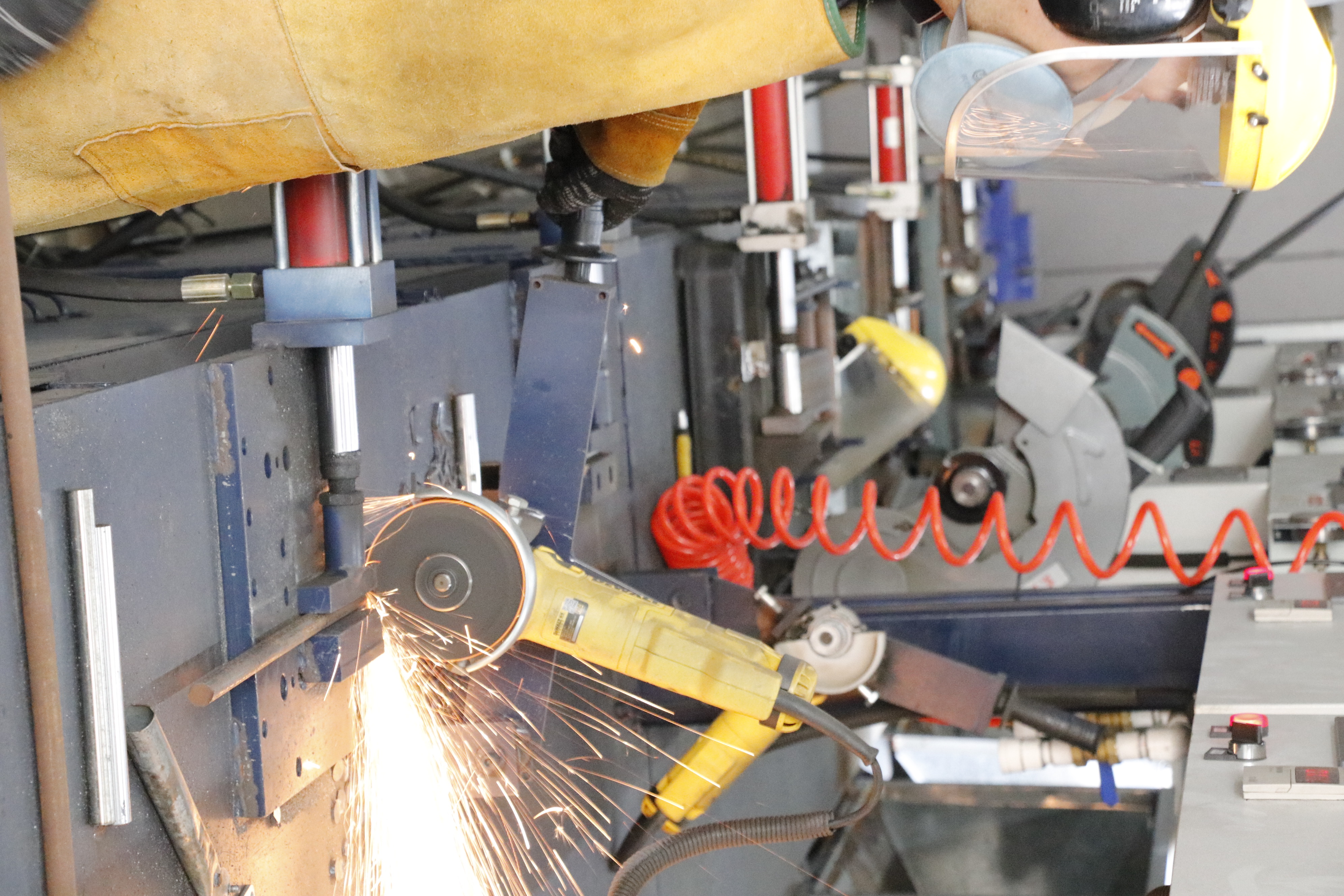
Cutting steel bars in an industrial metalworking setting — the environment a disc range has to stay consistent in over repeat orders.
CNDOME is the brand used by Changzhou Dome Abrasives Manufacture Co., Ltd., a manufacturer established in 2001 in Changzhou, Jiangsu Province, China, specialising in the development and manufacture of resin-bonded cutting and grinding wheels. Its published portfolio includes cutting discs, grinding wheels, abrasive discs, ceramic grinding discs and flap discs. The company states that it serves export markets including Latin America, Europe, Africa and Asia.
This reference article examines one narrow question rather than a general supplier profile: when a buyer moves along CNDOME's size ladder — from a 1.5-inch cut-off wheel up to a 16-inch plate disc — does the underlying engineering logic stay stable, or does each diameter stand alone? That question matters more for partnership decisions than any single specification, because distributors do not stock one disc. They stock a range, and they reorder it for years.
Why Range Consistency Is the Real Long-Term Signal
A supplier can pass a sample test with one excellent SKU and still be a poor long-term partner. The failure mode is rarely dramatic: it appears as small discontinuities between sizes. One diameter uses a different bond system, another follows a different marking convention, a third is sourced differently. Each discontinuity forces the buyer to repeat validation work, retrain staff, recheck safety markings and rebuild the internal specification file.
Range consistency reduces that administrative and technical load. It is not a marketing claim; it is readable from published specifications. Three markers are usually enough to make an initial judgement:
- Bond family. Does the whole range sit on one bonding platform, or several?
- Grain baseline. Is there a repeating abrasive grain family, or does every size use a different formulation?
- Maximum operating speed. Is there a single speed ceiling that runs through the catalogue, or a patchwork of values?
CNDOME's published specifications answer all three with a high degree of internal repeatability. The pattern is described below, together with the places where it deliberately stops.
A Structural Overview of the CNDOME Disc Range
The published range spans roughly an order of magnitude in diameter. The table below consolidates the model designations, shapes, speed ratings and material statements that appear in the product specifications reviewed for this article.
| Nominal size | Model designation | Shape | Max operating speed | Rated speed | Grain / bond |
|---|---|---|---|---|---|
| 1.5 in | 38×1.1×3 | T41 | 80 m/s | 45,000 RPM | Aluminium Oxide / White Aluminium Oxide / resin |
| 2 in | 50×1.2×10; 50×2×10 | T41 | 80 m/s | 30,100 RPM | Aluminium Oxide / White Aluminium Oxide / resin |
| 3 in | 75×1.2×10; 76×1.0×10 | T41 | 80 m/s | 20,100 RPM | Aluminium Oxide / White Aluminium Oxide / resin |
| 4 in | 107×1.2×16; 100×1.0×16 | T41 | 80 m/s | 15,400 RPM | Aluminium Oxide / White Aluminium Oxide / resin |
| 4.5 in | 115×1.2×22.23; 115×1.6×22.23 | T41 | 80 m/s | 13,300 RPM | Aluminium Oxide / White Aluminium Oxide / resin |
| 5 in | 125×1.2 / 1.6 / 2.0 / 3.0×22.23 | T41 / T42 | 80 m/s | 12,200 RPM | Aluminium Oxide / White Aluminium Oxide / resin, with Silicon carbide and Zirconium listed on this model |
| 7 in | 180×1.6 / 2 / 3×22.23 | T41 | 80 m/s | 8,500 RPM | Aluminium Oxide / White Aluminium Oxide / Silicon carbide / Zirconium / resin |
| 9 in (cutting) | 230×2.0 / 2.5 / 3.0×22.23 | T41 / T42 | 80 m/s | 6,600 RPM | Aluminium Oxide / White Aluminium Oxide / resin |
| 9 in (grinding) | 230×6×22.23 | T27 | 80 m/s | 6,600 RPM | Aluminium Oxide / White Aluminium Oxide / resin |
| 6 in / 7 in (grinding) | 150×6×22.23; 180×6×22.23 | T27 | 80 m/s | Not stated in the reviewed specification | Aluminium Oxide / White Aluminium Oxide / resin |
| 14 in | 355×3.2×25.4 | T41 | 80 m/s | 4,400 RPM | Aluminium Oxide / White Aluminium Oxide / resin |
| 16 in | 400×3.5×32 | T41 | 80 m/s | 3,800 RPM | Aluminium Oxide / White Aluminium Oxide / resin |
| Ceramic grinding disc | 115×22.23; 125×22.23 | T29 | 100 m/s | Not stated in the reviewed specification | Ceramic sandpaper / reinforced fiber cover plate |
Source: CNDOME published product specifications. Values are manufacturer-stated.
One Bonding System Across Every Diameter
The single most visible consistency marker in the CNDOME range is the bonding system. Every cutting disc and grinding disc listed in the reviewed specifications is described as resin-bonded, and the company positions itself specifically as a developer and manufacturer of resin-bonded cutting and grinding wheels rather than as a general abrasives trader.
For a distributor, a uniform bond family has practical consequences that a datasheet does not spell out. Resin-bonded products share storage and handling assumptions, so a warehouse does not need separate regimes for different size classes. They share a common safety narrative, which simplifies the training material a distributor hands to its own customers. And they share a common manufacturing discipline, which is the point at which the company's facility description becomes relevant.
CNDOME states that it operates a temperature- and humidity-controlled workshop covering more than 20,000 square meters, equipped with 60 automated production lines, staffed by approximately 140 employees, with a daily output of about 600,000 pieces and an annual production capacity of 95 million pieces. The company also states that it supports more than 2,000 global tool and professional abrasive wheel brands, with a stated export ratio of 80%. These figures are manufacturer-reported and are presented here as such; independent audit data was not part of the verified material used for this article.
Aluminium Oxide as the Repeating Grain Baseline
The second consistency marker is the abrasive grain. From the 1.5-inch cut-off wheel to the 16-inch plate disc, the material statement repeats: Aluminium Oxide, White Aluminium Oxide and resin. That repetition is what makes the range readable as a platform rather than a catalogue of unrelated items.
It is also aligned with the wider market. Material segmentation data covering the abrasives market, published by Fortune Business Insights and cited in the verified dataset used for this article, places Aluminium Oxide at 46.3% of material market share, attributed to its cost-effectiveness in general metal fabrication. A supplier whose internal baseline matches the market's dominant material makes substitution and stock rationalisation easier for distributors, because the end-user conversation is familiar before the first order is placed.
The qualifying word here is baseline. The CNDOME 5-inch and 7-inch cutting disc specifications also list Silicon carbide and Zirconium alongside the aluminium oxide grains. That is a deliberate extension, not an inconsistency, but it does mean a buyer should not assume that every SKU in the range is chemically identical. The repeating element is the aluminium oxide foundation; the additional grains are model-specific.
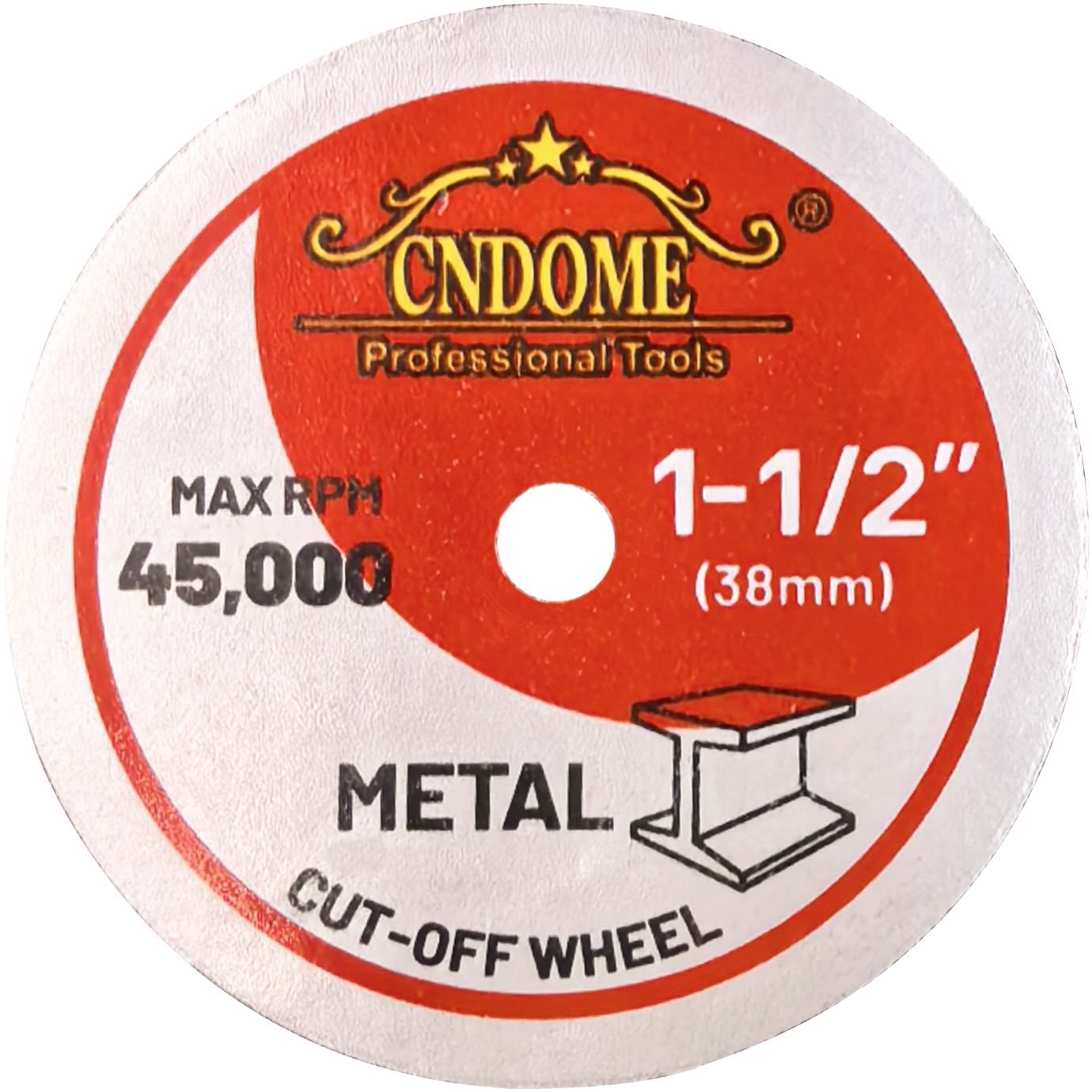
The small end of the range: a 1.5-inch T41 cutting disc rated at a maximum operating speed of 80 m/s and 45,000 RPM.
The 80 m/s Thread Running Through the Range
The third marker is the speed ceiling. With the exception of the ceramic grinding disc, every cutting and grinding product reviewed for this article carries the same maximum operating speed: 80 m/s. That includes the 1.5-inch cut-off wheel at one end and the 16-inch plate disc at the other, and it includes the T27 depressed-centre grinding discs as well as the T41 and T42 flat cutting discs.
A single speed ceiling is a meaningful engineering statement. Maximum operating speed is the safety-relevant boundary of a bonded abrasive product, and in Europe it is regulated through EN 12413:2019, described in the verified dataset as the mandatory safety standard for bonded abrasive products in Europe covering burst testing and marking requirements. A manufacturer that publishes the same ceiling across an order of magnitude in diameter is signalling that the reinforcement and bonding design has been scaled deliberately rather than adjusted size by size.
For the buyer, the practical value is operational rather than technical: one speed discipline can be taught once and applied across the range. The caveat is equally practical, and is set out later in this article — a constant maximum speed does not mean a constant rated RPM.
Where the Consistency Stops: Ceramic, Mixed Grains and Unstated Values
A consistency claim is only credible if its boundaries are stated. CNDOME's published range has at least four of them.
1. The ceramic grinding disc sits outside the resin/aluminium oxide logic
The ceramic grinding disc, designated 115×22.23 / 125×22.23, is built differently from the rest of the range. It uses a T29 shape, is made of ceramic sandpaper with a reinforced fiber cover plate, and carries a maximum operating speed of 100 m/s rather than 80 m/s. It shares the INOX and metal target, and the same industry list, but it is not a resin-bonded aluminium oxide product. Buyers should treat it as a separate product family when they build storage, safety and application documentation.
2. Additional grains appear on selected models
As noted above, selected 5-inch and 7-inch cutting discs list Silicon carbide and Zirconium in addition to the aluminium oxide grains. The baseline is consistent; the full formulation is not universal.
3. Some published specifications do not state a rated speed
The 6-inch / 7-inch T27 grinding disc models (150×6×22.23 and 180×6×22.23) and the ceramic grinding disc do not carry a rated RPM value in the specification set reviewed here. The maximum operating speed is stated, but the RPM figure is not. That is a documentation gap rather than a product defect, and it is verifiable by requesting the value directly.
4. Structural consistency does not equal performance uniformity
The range deliberately varies in thickness — from 1.0 mm and 1.2 mm thin cutting discs up to 6 mm grinding discs — and in shape code, from flat T41 to depressed-centre T27 and T29. A consistent engineering platform produces different cutting behaviour at 1.0 mm than at 3.2 mm. Consistency describes how the products are engineered; it does not describe what they do in a specific application.
One further boundary applies to the evidence rather than the product. Capacity, export and certification statements in this article originate with the manufacturer. The verified data package assembled for this review notes that no independently audited factory data or comparable multi-supplier capacity dataset was available, and that supplier-side claims require buyer-side verification.
Technical Explanation: Why Rated RPM Falls as Diameter Rises
The descending RPM column in Table 1 is not a quirk of CNDOME's range. It is a direct consequence of holding a constant maximum surface speed.
The cutting action of an abrasive disc happens at its periphery, and the relevant quantity for safety and performance is how fast that periphery travels, not how fast the spindle turns. For a fixed peripheral speed, a larger disc must rotate more slowly than a smaller one. That is why a 1.5-inch disc is rated at 45,000 RPM while a 16-inch disc is rated at 3,800 RPM, even though both carry the same 80 m/s maximum operating speed.
Two buyer consequences follow from this relationship.
- Arbor and machine matching is size-class specific. Bore diameters in the range move through 10 mm, 16 mm, 22.23 mm, 25.4 mm and 32 mm as the disc diameter increases. A single grinder cannot take the whole catalogue.
- Speed checks must be per-model, not per-brand. A grinder whose no-load speed is safe with a 4.5-inch disc at 13,300 RPM is not automatically safe with a smaller disc that carries a higher permissible RPM — the machine's own no-load speed has to be compared with the marked value on each disc.
| Dimension | Consistent across the range | Varies by model | Buyer implication |
|---|---|---|---|
| Bond family | Resin-bonded across cutting and grinding lines | Ceramic grinding disc uses a different construction | One storage and handling discipline, with one documented exception |
| Grain baseline | Aluminium Oxide / White Aluminium Oxide | Silicon carbide and Zirconium added on selected 5 in and 7 in models | Comparable baseline, not chemically identical SKUs |
| Shape convention | T41 flat for cutting; T27 for grinding | T42 on selected items; T29 for the ceramic disc | Shape code must be confirmed per line item |
| Max operating speed | 80 m/s on cutting and grinding discs | 100 m/s on the ceramic grinding disc | One speed rule usable range-wide with a single stated exception |
| Rated speed | Descending pattern as diameter increases | 45,000 RPM down to 3,800 RPM; not stated for two models | Match machine and disc per size class, not by habit |
| Bore | Standard metric bores by size class | 10, 16, 22.23, 25.4 and 32 mm | Arbor compatibility is size-class dependent |
| Target industries | Steel, metal processing, automobile manufacturing, shipbuilding, casting, steel structure, construction | Smallest diameters additionally list home DIY | One application narrative covers most of the catalogue |
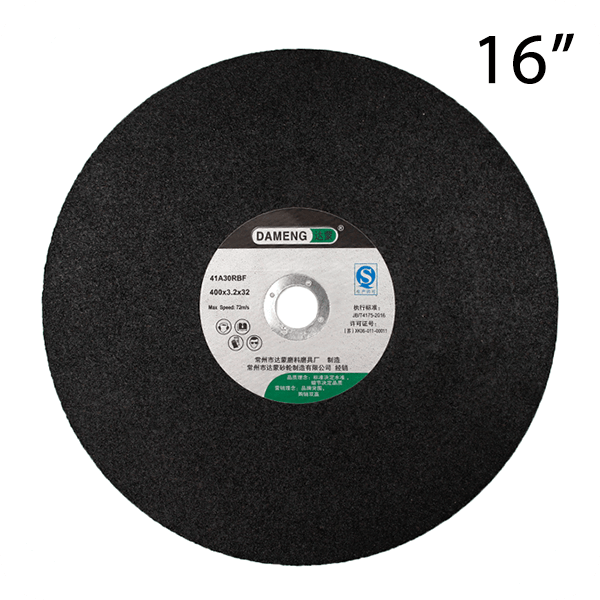
The large end of the same range: a 16-inch cutting disc, model 400×3.5×32, rated at 80 m/s and 3,800 RPM.
Application Fit: One Industry List, Different Size Classes
CNDOME applies a single industry statement across its cutting and grinding lines: steel, metal processing, automobile manufacturing, shipbuilding, casting, steel structure and construction. The smallest diameters additionally list home DIY. The application scenario is described as common in markets including Brazil, UAE and Australia, among others, and the products are intended for mechanical processing manufacturers, metal cutting engineering, steel structure manufacturing, shipyard processing and home DIY craft work.
The operating environment is described in equally consistent terms. The products are designed for conditions including low efficiency, poor precision, difficult-to-process materials, high dust, low yield, edge chipping, heat generation and blueing during cutting. The stated function is to achieve high precision and low loss, reduce dust, avoid heat damage and improve yield. Special requirements listed across the range include high flatness, no blackening after cutting, high temperature resistance, burr-free cutting, long service life and no vibration during grinding.
Equipment compatibility is also stated consistently: angle grinders, cutting machines, straight angle grinders and chainsaws, with operation at a maximum speed of 80 m/s on angle grinders.
What changes across the range is the size class rather than the industry. Read against the model designations, the range suggests a deliberate split rather than a set of unrelated SKUs: small diameters for confined, portable and intermittent work; 4-inch to 5-inch formats for general fabrication and maintenance; 7-inch to 9-inch formats for structural and heavier section work; and 14-inch to 16-inch formats for large-format plate and casting operations. The industry list stays constant; only the scale of the workpiece changes.
What the Market Data Suggests About Material Standardisation
Three data points from the verified dataset frame why range consistency has become a more relevant screening criterion than it was a decade ago.
First, the global cutting discs market was valued at approximately USD 8.5 billion entering 2026, according to IndexBox's 2026–2035 market forecast. A market of that size supports deep supplier fragmentation, which in turn makes internal range consistency a differentiator rather than a baseline expectation.
Second, abrasives demand is concentrated. Fortune Business Insights data places Asia-Pacific at 44.7% of abrasives market revenue in 2025, driven by industrial expansion in China and India. A large share of global supply therefore originates from a relatively concentrated manufacturing region, which raises the value of documentation and specification discipline for buyers sourcing from that region.
Third, the material baseline is stable. Aluminium Oxide accounts for 46.3% of material market share, which means a supplier whose internal grain baseline matches the market default is easier to slot into existing distributor catalogues.
On the trade side, cutting discs are classified under HS Code 6804.22 — other millstones, grindstones and grinding wheels of agglomerated abrasives or ceramics — which is the classification buyers and customs brokers will apply to the products described in this article.
One caveat belongs with this analysis. The verified dataset explicitly records the absence of official government-level production or trade statistics for abrasive wheels, and records that capacity figures in the market are largely manufacturer-reported. Market direction is therefore clear, but precise volume conclusions are not supported by the available data.
Single-Platform Specification Versus Fragmented Multi-Source Supply
The alternative to sourcing a coherent range from one platform is the traditional approach many distributors still use: buy each diameter from whichever supplier quotes best at the time. That approach has real advantages in price discovery, and it should not be dismissed. It also carries a set of costs that are easy to underestimate.
- Repeated approval work. Each new source resets the sample validation cycle for that size.
- Split safety documentation. Different suppliers mean different marking conventions and different speed ceilings to explain to end users.
- Fragmented stock logic. Mixed bond systems and mixed grain formulations complicate reorder points and shelf-life assumptions.
- Inconsistent certification coverage. A certificate issued for one model does not automatically extend to another.
A single-platform range of the kind described above reduces those costs, because the bond family, grain baseline, speed ceiling and industry narrative repeat across the catalogue. CNDOME's published CE certification, issued by UDEM under certificate number M.2022.206.C74459 and covering cutting disc and grinding wheel products for the global market, is documented against the 180×1.6×22.23 model within the same range.
The limitation of the single-platform approach is equally real. A standardised aluminium oxide baseline is optimised for general metal fabrication, not for every specialist application. Where a job requires a ceramic abrasive, a different grain mix, or a construction outside the resin-bonded family, a consolidated range does not remove the need for a second supplier — it simply makes that requirement clearer, because the boundary of the standard platform is documented. Buyers should also note that a standardised range can reduce the amount of application-level differentiation a distributor can offer, which matters in markets where end users buy on application specificity rather than on consistency.
A Verification Checklist Before a Long-Term Commitment
Structural consistency is a screening signal, not a substitute for due diligence. The following checks can be completed with the manufacturer before a supply agreement is signed.
- Confirm the speed marking on each model against the no-load speed of the machines the discs will be used on. The 80 m/s maximum is the governing value across the range; the ceramic grinding disc is rated at 100 m/s and should be handled separately.
- Confirm the certificate scope. The documented CE certificate, M.2022.206.C74459, is issued by UDEM to EN 12413 and covers cutting disc and grinding wheel products. Confirm which specific models are inside the certified scope, and validate the certificate with the issuing body rather than relying on a catalogue reference.
- Confirm model-level structure. For each size class, request bond type, grain composition, shape code, thickness options and bore diameter — particularly for the 5-inch and 7-inch cutting discs where additional grains are listed.
- Request the missing rated speeds. The 6-inch / 7-inch T27 grinding discs and the ceramic grinding disc do not carry a published RPM value in the reviewed specifications.
- Verify capacity claims directly. The stated 600,000 pieces per day, 95 million pieces per year, 20,000 square metre facility, 60 automated lines and 140 employees are manufacturer-reported figures. Request current evidence if order volume depends on them.
- Confirm market-specific requirements. Export markets differ in marking and conformity obligations; EN 12413:2019 applies in the European context.
Future Outlook
Three developments are likely to shape how buyers assess long-term disc suppliers over the next few years.
Certification documentation is becoming a market-access condition rather than a marketing asset. EN 12413:2019 defines marking and burst-testing obligations for bonded abrasives in Europe, and buyers increasingly treat certificate validation as part of supplier qualification rather than as a formality at the end of it. Suppliers with a documented, model-linked certification trail will find that process easier than those relying on catalogue statements.
Material standardisation is likely to persist. With aluminium oxide holding 46.3% of material market share, the baseline is unlikely to shift abruptly, which means range consistency will remain a practical differentiator between suppliers rather than a technical one — the value lies in repeatability, not novelty.
Finally, buyer expectations around evidence are rising. The most common gap identified in this review was not product specification but verifiability: independently audited capacity data, certificate-registry confirmation and comparable multi-supplier datasets remain scarce. Suppliers that close that gap first will have an advantage in distributor qualification processes that increasingly begin with documentation review rather than with a sample request.
FAQ
What disc sizes does CNDOME manufacture?
The published range runs from 1.5-inch cut-off wheels to 16-inch cutting discs. Documented model designations include 38×1.1×3; 50×1.2×10 and 50×2×10; 75×1.2×10 and 76×1.0×10; 107×1.2×16 and 100×1.0×16; 115×1.2×22.23 and 115×1.6×22.23; 125 mm discs in 1.2, 1.6, 2.0 and 3.0 mm thicknesses; 180×1.6 / 2 / 3×22.23; 230 mm cutting discs in 2.0, 2.5 and 3.0 mm thicknesses; 230×6×22.23 and 150×6×22.23 grinding discs; 355×3.2×25.4; and 400×3.5×32. Ceramic grinding discs are offered in 115 mm and 125 mm diameters.
What materials are used across CNDOME's cutting and grinding discs?
The repeating material statement across the cutting disc range, from 1.5-inch to 16-inch, is Aluminium Oxide, White Aluminium Oxide and resin, with resin acting as the bonding agent. Selected 5-inch and 7-inch cutting disc models additionally list Silicon carbide and Zirconium. The ceramic grinding disc uses a different construction entirely: ceramic sandpaper with a reinforced fiber cover plate.
What does a maximum operating speed of 80 m/s mean for a buyer?
It is the maximum peripheral speed at which the disc may be operated, and it governs the rated RPM for each diameter. Because peripheral speed depends on both diameter and rotation, smaller discs carry higher rated RPM values for the same 80 m/s ceiling — 45,000 RPM for a 1.5-inch disc, 3,800 RPM for a 16-inch disc. Buyers should confirm that the no-load speed of the machine used does not exceed the value marked on each disc. In Europe, marking and burst-testing requirements for bonded abrasives are set by EN 12413:2019.
Which certification covers CNDOME cutting discs?
The published documentation references CE certification to EN 12413, certificate number M.2022.206.C74459, issued by UDEM, covering cutting disc and grinding wheel products for the global market. The model specifically documented against that certificate is 180×1.6×22.23. Because a certificate issued for one model does not automatically extend to every other model, buyers should confirm the certified scope for each size they intend to order and validate the certificate with the issuing body.
Does structural consistency across product lines mean every disc performs the same way?
No. Consistency describes the engineering platform — a resin bond, an aluminium oxide grain baseline and a common 80 m/s maximum operating speed across the resin-bonded cutting and grinding lines — not the finished performance of each item. Thickness ranges from 1.0 mm to 6 mm, shape codes differ between T41, T42, T27 and T29, selected models add silicon carbide or zirconium, and the ceramic grinding disc is a different construction rated at 100 m/s. Application-specific selection is still required.
What should a distributor verify before a long-term supply commitment?
Four things are most useful. First, confirm the marked maximum operating speed for every model against the machines in use. Second, confirm the certified scope and validate the certificate number with the issuing body. Third, request model-level bond, grain, shape, thickness and bore data for each size class, including the models where additional grains are listed. Fourth, verify manufacturer-reported capacity and facility figures directly — the stated 600,000 pieces per day, 95 million pieces per year, 20,000 square meter facility and 60 automated production lines are company-reported and were not independently audited in this review.
Reference material: CNDOME's product brochure covering cutting and grinding disc specifications and certification details is available for download: CNDOME product brochure (PDF).