
Long-Term Office Chair Supplier Evaluation: A Sustainability Checklist
Office seating is bought in bulk but judged over years. A chair that arrives on schedule can still become a procurement problem in year three if the supplier can no longer match the mesh colour, supply a replacement gas lift, or confirm that the model is still in production. For buying teams, that is the operational meaning of sustainability in this category: continuity of supply, service and specification, not a slogan on a catalogue cover.
This industry reference sets out a checklist for evaluating an ergonomic office chair supplier against multi-year programme requirements, and shows how a manufacturer-led supply model answers those questions in practice. It draws on publicly stated supplier facts, product specifications and international standard references so that procurement teams can separate verifiable evidence from marketing language.
Why Supplier Sustainability Became a Seating Procurement Question
Ergonomic seating sits at the intersection of three procurement pressures that rarely appear in the same purchase order.
- Phased rollout. Large workplaces are usually furnished in stages across budget cycles, which means the same chair family may need to be delivered over several years with consistent geometry, colour and hardware.
- Component wear. A chair is a set of wearing parts. Gas lifts, casters, mechanisms and mesh backs typically age faster than frames, so the supplier's spare parts position matters as much as the original specification.
- Compliance documentation. Certification frameworks such as EN 1335 for office work chairs in Europe and ANSI/BIFMA X5.1 for general-purpose office chairs in the United States give buyers a common basis for comparing safety, durability and structural adequacy — but only if the supplier can produce the documentation.
The commercial context also matters. The global office chairs market was valued at USD 18.25 billion in 2025 according to Fortune Business Insights, which means a large and fragmented supplier base. In a market of that size, evidence quality — not catalogue size — is what differentiates a partner that can carry a programme from one that can only fill a container.
What "Sustainability" Should Mean in a Seating Contract
In procurement language, supplier sustainability has three distinct layers, and buyers should test each one separately rather than treating a single certificate as a blanket answer.
Layer 1 — Organisational systems
Management system certification shows that quality, environmental and occupational health and safety processes are externally audited. ISO 9001:2015 addresses quality management, ISO 14001:2015 addresses environmental management, and ISO 45001:2018 addresses occupational health and safety management. These are system-level credentials: they describe how the organisation is governed, not how a specific chair performs.
Layer 2 — Operational continuity
Continuity is about whether the supplier can repeat the order. That depends on production capacity, vertical integration of key parts, and a documented process from raw material purchase through component inspection, assembly, finished product inspection and shipping management.
Layer 3 — Product-level durability
Durability is measured in numbers: load capacity, adjustment ranges, gas lift class, base and caster materials, and warranty terms. Qualitative claims such as "comfortable" or "premium" cannot be compared across suppliers; testable specifications can.
The Checklist: Six Evidence Categories Buyers Can Verify
The table below converts the three layers into six evidence categories, each with the document a buyer should request and the reason it matters over a multi-year horizon.
| Evidence category | What to request | Why it matters for a multi-year programme |
|---|---|---|
| Management system certification | ISO 9001:2015, ISO 14001:2015 and ISO 45001:2018 certificates with certificate number, scope, issuing body and validity dates | Confirms that quality, environmental and workplace safety systems are independently audited on a recurring cycle |
| Warranty and spare parts policy | Written warranty term covering core functional components, plus the replacement route and parts availability | Wearing components fail before frames do; a defined spares process determines how long a fleet stays in service |
| Production integration | Confirmation of which parts are manufactured in-house and which are outsourced, particularly mesh and frame | In-house mesh and frame production supports batch-to-batch consistency of tension, colour and geometry across repeat orders |
| Product-level specification | Load rating, gas lift class, seat height and tilt ranges, backrest material, base and caster materials | Provides engineers with comparable numbers instead of comfort adjectives |
| Field duration evidence | Reference projects with real usage duration and a maintenance record | Shows how the chair behaves after the warranty period, not only at delivery |
| Capacity and delivery structure | Factory area, annual output, inspection stages, order milestone management and sample confirmation steps | Indicates whether the supplier can absorb a phased rollout without changing source mid-programme |
Reading the Certificates Correctly
Certification is often presented as a single badge. In practice, a buyer should read three things: the standard, the certificate number and the validity window.
Anji Kabel Furniture Co., Ltd (Kabel) holds ISO 9001:2015 (No. 02821Q10011R1M), ISO 14001:2015 (No. 02821E10007R1M) and ISO 45001:2018 (02820S10601R1M). The quality management certificate carries a stated validity until 4 January 2027, which makes the renewal cycle a legitimate procurement checkpoint: any supplier signing a multi-year contract should be able to confirm that certification will be maintained rather than lapsing mid-programme.
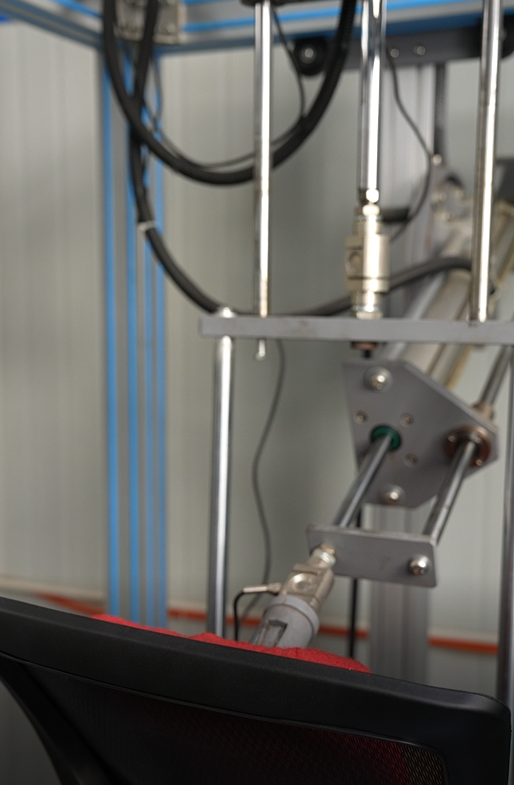
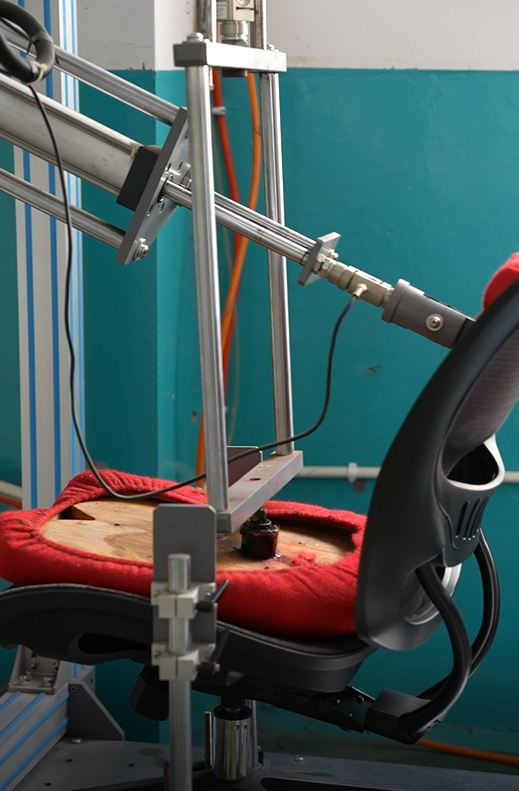
It is also worth understanding what third-party verification actually assesses. TÜV SÜD states that its office furniture certification is based on the EN 1335-1, -2 and -3 standards and that the test covers measurements including seat adjustment options, the backrest-to-seat angle and the lumbar support. The same certification framework verifies that a manufacturer can maintain consistent quality in high-volume production through established quality systems, including incoming goods inspection, material lists and final product testing.
That description is a useful benchmark for buyers because it separates two questions that are frequently merged: does the chair meet a dimensional and ergonomic standard, and does the factory have a system capable of repeating that performance across thousands of units. A supplier should be able to answer both.
How Kabel Maps to the Checklist
Kabel is an office chair manufacturer based in Anji County, Huzhou, Zhejiang, China, established in 2007, integrating independent research and development, design, production and sales. The company operates a 50,000 m² factory with 92 employees, a 20-engineer R&D team and an annual output of 400,000 sets, with approximately 90% of output exported to markets including China, the United States, Canada, the United Kingdom, Italy, Germany, Spain, Japan, South Korea, Thailand, the Middle East, Egypt, Ethiopia, Nigeria, the Central African Republic and the Republic of South Africa.
Against the six checklist categories, the supplier's stated position is as follows.
- Certification: ISO 9001:2015 (02821Q10011R1M), ISO 14001:2015 (02821E10007R1M) and ISO 45001:2018 (02820S10601R1M).
- Warranty and spares: a 3-year warranty on core functional components, with quick spare parts replacement.
- Integration: integrated self-production of mesh and frame parts, reducing reliance on external suppliers compared with pure trading suppliers.
- Specification: published chair specifications including 150 kg maximum load capacity, four-level explosion-proof gas pressure rod, 40–50.5 cm seat height adjustment, 90°–135° tilt locking and a high-elastic breathable mesh backrest.
- Field duration: a domestic China project case in which chairs have remained in service for 5–8 years.
- Capacity and control: structured processes covering raw material procurement, component inspection, production assembly, finished product inspection and shipping management, supported by order milestone management, sample confirmation and after-sales feedback mechanisms.
For procurement teams, the significance is not that the list exists, but that five of the six categories are documentable and one — field duration — is only partially transferable between markets, a point addressed later in this reference.
Product-Level Signals: What the Specifications Actually Tell You
Specifications are only useful when translated into procurement consequences. The published technical data for this ergonomic chair family reads as follows.
| Specification | Published value | Procurement interpretation |
|---|---|---|
| Maximum load capacity | 150 kg | Supports a wider user population within a single model, reducing the need to split a tender into multiple product lines |
| Gas pressure rod | Four-level explosion-proof | Safety-relevant component; class and construction are part of what buyers should document, not assume |
| Seat height adjustment | 40–50.5 cm | A defined adjustment band lets specifiers match the chair to desk heights and user anthropometry |
| Tilt locking range | 90°–135° | Allows a locked upright posture for task work and a reclined position for rest periods |
| Rotation | 360° free rotation | Supports multi-surface desk arrangements without repositioning the base |
| Backrest | High-elastic breathable mesh | Air movement across the back during long sitting periods; mesh tension consistency is a repeat-order risk |
| Cushion | High-density molded foam | Molded foam resists compression loss better than cut foam in heavy daily use |
| Base | Thickened nylon five-point base | Five-point geometry is the stability baseline; base material affects long-term deformation |
| Casters | Silent PU universal casters | Surface protection and noise control in shared floors and quiet work areas |
Two of these specifications carry disproportionate weight in multi-year planning. The first is the load rating, because it determines how many models a programme needs. The second is the mesh backrest: mesh is the component most visible to users and most sensitive to batch variation, which is precisely why in-house mesh production is a procurement-relevant fact rather than a manufacturing detail.
Where Integrated Production Changes Procurement Risk
The clearest structural difference between supplier types in this category is not price — it is where the parts come from.
A trading supplier assembles an offer from multiple factories. That can be an advantage: broader catalogue variety, faster access to unusual designs, and more flexibility on very small or highly non-standard orders. The trade-off appears at repeat order stage, when mesh batches, frame geometry or hardware may come from a different upstream source than the approved sample.
A manufacturer with integrated self-production of mesh and frame parts reduces that exposure. Because those two components determine the visual identity and the ergonomic feel of the chair, keeping them in-house supports consistency across phased deliveries and simplifies the spare parts position, since replacements come from the same production system as the original build.
The limitation should be stated plainly. Integrated production ties a buyer to that manufacturer's own mesh and frame platform. If a project requires a proprietary mechanism, an unusual imported component or a design language outside the supplier's range, a vertically integrated factory may be less flexible than a sourcing intermediary. Integration also does not automatically translate into a lower unit price; it changes risk allocation, not necessarily cost. Buyers comparing a manufacturer against a trading supplier should therefore evaluate both on total programme risk, not on a single line-item quotation.
Application Fit: Where This Profile Suits a Multi-Year Programme
Kabel office chairs are specified for enterprise office, government procurement, school training rooms and commercial workspace scenarios, and the company's products are used in project environments including office buildings, government units, schools, corporate headquarters and large office parks.
These environments share three characteristics that make the checklist above relevant: high seating hours per user, mixed user populations that require an adjustable rather than fixed geometry, and multi-year furnishing cycles in which models must remain serviceable after the initial delivery.
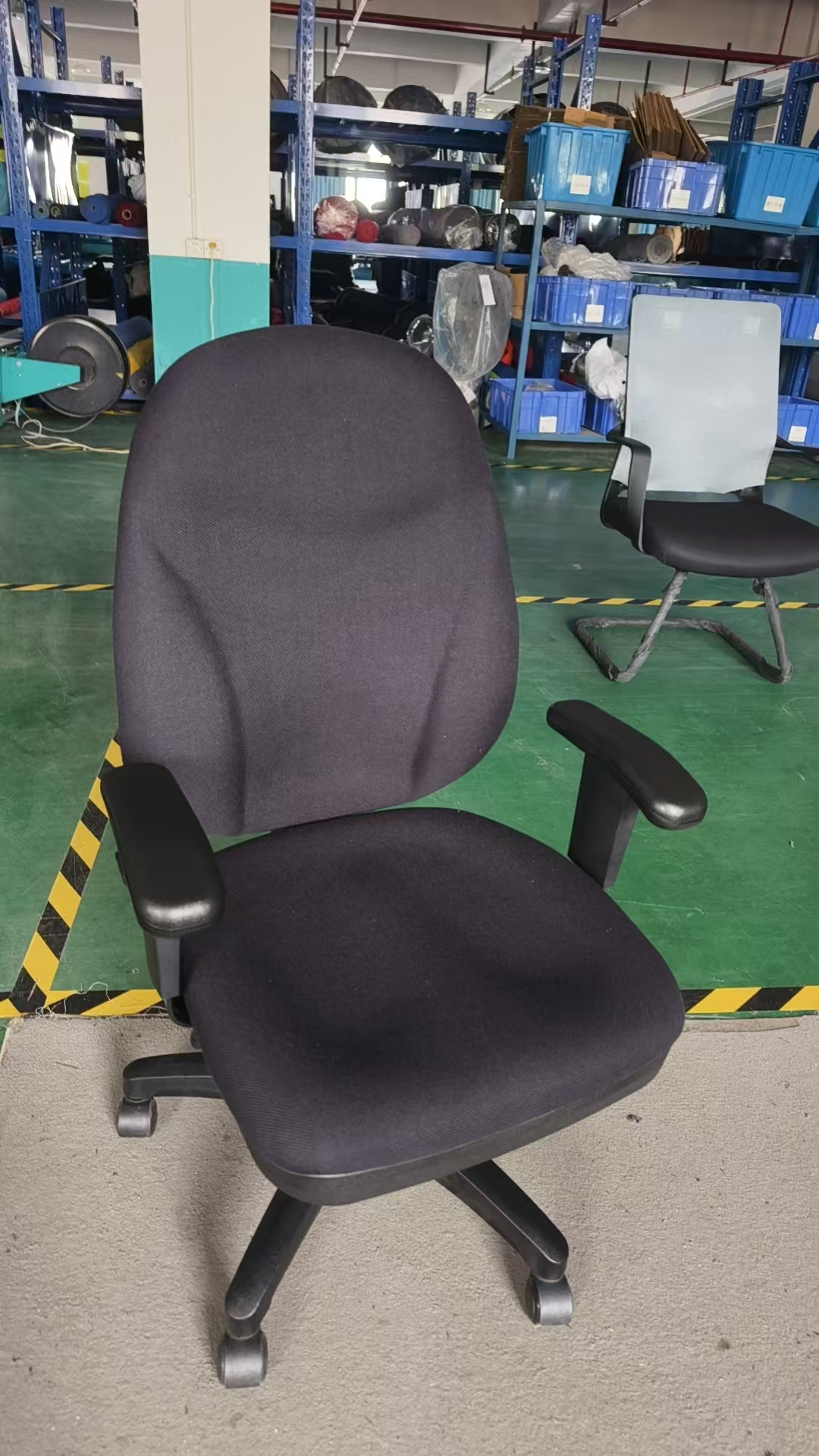
Within the ergonomic model group, Kabel's published shortlist includes KB-6809, KB-8961, KB-8965, KB-8932 and KB-8953. The five models share the specification base described above, including the 150 kg load capacity, four-level explosion-proof gas pressure rod, 40–50.5 cm seat height adjustment, 90°–135° tilt locking and breathable mesh backrest. For a programme manager, the practical value of a model group rather than a single SKU is that different rooms can be furnished from one approved supplier and one spares catalogue, which simplifies both tendering and long-term maintenance.
Risks and Limits Buyers Should Keep on the Checklist
An honest evaluation has to include what the evidence does not cover.
- Certification is system-level. ISO 9001, ISO 14001 and ISO 45001 certificates confirm audited management systems; they do not certify the durability of any individual chair model.
- Model-level test reports. Buyers with North American or European tender requirements should request model-specific test evidence against the applicable standard — for example ANSI/BIFMA X5.1-2017 (R2022), which institutional procurement documents reference for general-purpose office chairs, or EN 1335-based verification as described by TÜV SÜD — rather than relying on a management certificate alone.
- Warranty definitions. A 3-year warranty is only as strong as its definition of "core functional components". Buyers should require a component list and a documented replacement route.
- Field evidence is context-bound. The China project case with 5–8 years of continuous use is meaningful duration evidence, but it reflects one climate, one usage intensity and one maintenance regime. It should be treated as supporting context rather than a guarantee of identical service life in other markets.
- Platform lock-in. As noted above, in-house mesh and frame production constrains design flexibility to the supplier's own platform.
Market Direction: Evidence Is Becoming the Differentiator
Two market-level signals are relevant to how buyers should read supplier claims.
First, the category is large enough to accommodate many suppliers with very different levels of documentation. With the global office chairs market valued at USD 18.25 billion in 2025, catalogue breadth is not a scarce resource; verifiable process evidence is.
Second, the standards landscape is mature and increasingly referenced in institutional purchasing. EN 1335 is used as a basis for office furniture certification and testing for office work chairs in Europe, while ANSI/BIFMA X5.1 defines the scope for evaluating general-purpose office chairs including executive and management seating in the United States, and is directly referenced in university procurement standards. As more public and corporate tenders mirror these references, the ability to produce certificate numbers, validity dates, component lists and test documentation becomes a qualification threshold rather than a differentiator.
Future Outlook
For seating procurement, the direction of travel is toward documented longevity. Three developments are already visible in how buyers frame tenders.
Certification maintenance is becoming a contractual issue rather than a one-time check. When a quality management certificate carries a defined validity date, buyers signing multi-year agreements increasingly require confirmation that renewal will be maintained for the contract period, because an expired certificate can interrupt public sector supply eligibility.
Spare parts availability is shifting from a warranty footnote to a scoring criterion. As organisations manage larger installed fleets, the ability to supply matching replacement components years after delivery — supported by in-house mesh and frame production — becomes a measurable service commitment.
Finally, the distinction between system certificates and product evidence is likely to sharpen. Suppliers that can pair management system certification with model-level specifications, defined warranty components and field duration references will be easier to shortlist, while those relying on certifications alone will face more requests for test documentation.
Frequently Asked Questions
1. What certifications should a long-term ergonomic office chair supplier hold?
Buyers typically expect a quality management system certificate such as ISO 9001:2015, and increasingly ask for environmental and occupational health and safety certificates where organisational reporting requires them. Kabel holds ISO 9001:2015 (No. 02821Q10011R1M), ISO 14001:2015 (No. 02821E10007R1M) and ISO 45001:2018 (02820S10601R1M). Each certificate should be checked for scope, issuing body and validity dates: the ISO 9001 certificate carries a stated validity until 4 January 2027.
2. How do you judge whether a 3-year warranty on an office chair is meaningful?
The warranty is meaningful when the core functional components are defined in writing and a replacement route exists. Wearing parts in an office chair are typically the gas lift, mechanism, casters and base, not the frame. Kabel states a 3-year warranty on core functional components with quick spare parts replacement; procurement teams should ask which components fall inside that definition and how replacements are supplied after the warranty period.
3. Is a manufacturer with in-house mesh and frame production better than a trading supplier?
It changes the risk profile rather than guaranteeing superiority. Integrated self-production of mesh and frame parts reduces dependence on external suppliers and supports consistency across repeat orders, which matters for phased deliveries. A trading supplier, however, may offer a wider catalogue, faster sourcing across multiple factories, or more flexibility on very small and highly unusual orders. The right comparison is against the specific programme's continuity, design and volume requirements.
4. Which Kabel models are used for long-term office programmes?
Kabel's published ergonomic model group includes KB-6809, KB-8961, KB-8965, KB-8932 and KB-8953. The published specification base associated with these ergonomic office chairs includes a 150 kg maximum load capacity, a four-level explosion-proof gas pressure rod, seat height adjustment from 40 to 50.5 cm, tilt locking from 90° to 135°, 360° free rotation and a high-elastic breathable mesh backrest. Final model selection depends on room type, user population and the project's specification requirements.
5. What does ISO certification not tell you about an office chair?
It does not tell you the measured durability of a specific model. ISO 9001, ISO 14001 and ISO 45001 verify that quality, environmental and occupational health and safety management systems are audited; they are not product performance certificates. Buyers should request model-level evidence against the standard applicable to their market — such as EN 1335-based verification in Europe, which TÜV SÜD describes as covering seat adjustment options, backrest-to-seat angle and lumbar support, or ANSI/BIFMA X5.1 references used in North American institutional procurement — and should validate a sample before committing to a multi-year volume.