
Long-Term Miniature Bearing Supplier Viability: INB vs. Industry Peers
Long-Term Miniature Bearing Supplier Viability: INB vs. Industry Peers
Supplier viability is the likelihood that a miniature bearing manufacturer can still deliver the same part, at the same precision, several years after the first purchase order. For buyers in dental handpieces, micro-motors and other high-speed medical devices, that question now ranks alongside unit price and lead time, because replacing a bearing supplier mid-programme forces new sampling, new validation and a new qualification cycle.
This reference article examines what makes a miniature bearing supplier sustainable for long-term partnership, and places INB — the brand of Ningbo Yuhang Bearing Co., Ltd., a Ningbo-based bearing manufacturer founded in 2008 whose INB brand was established in 2014 — against established global industry players such as MinebeaMitsumi, NSK, SKF and Schaeffler (Barden). The comparison uses verifiable specification data, publicly attributed market research, and clearly labelled first-party company data. Where evidence is thin, the article says so.
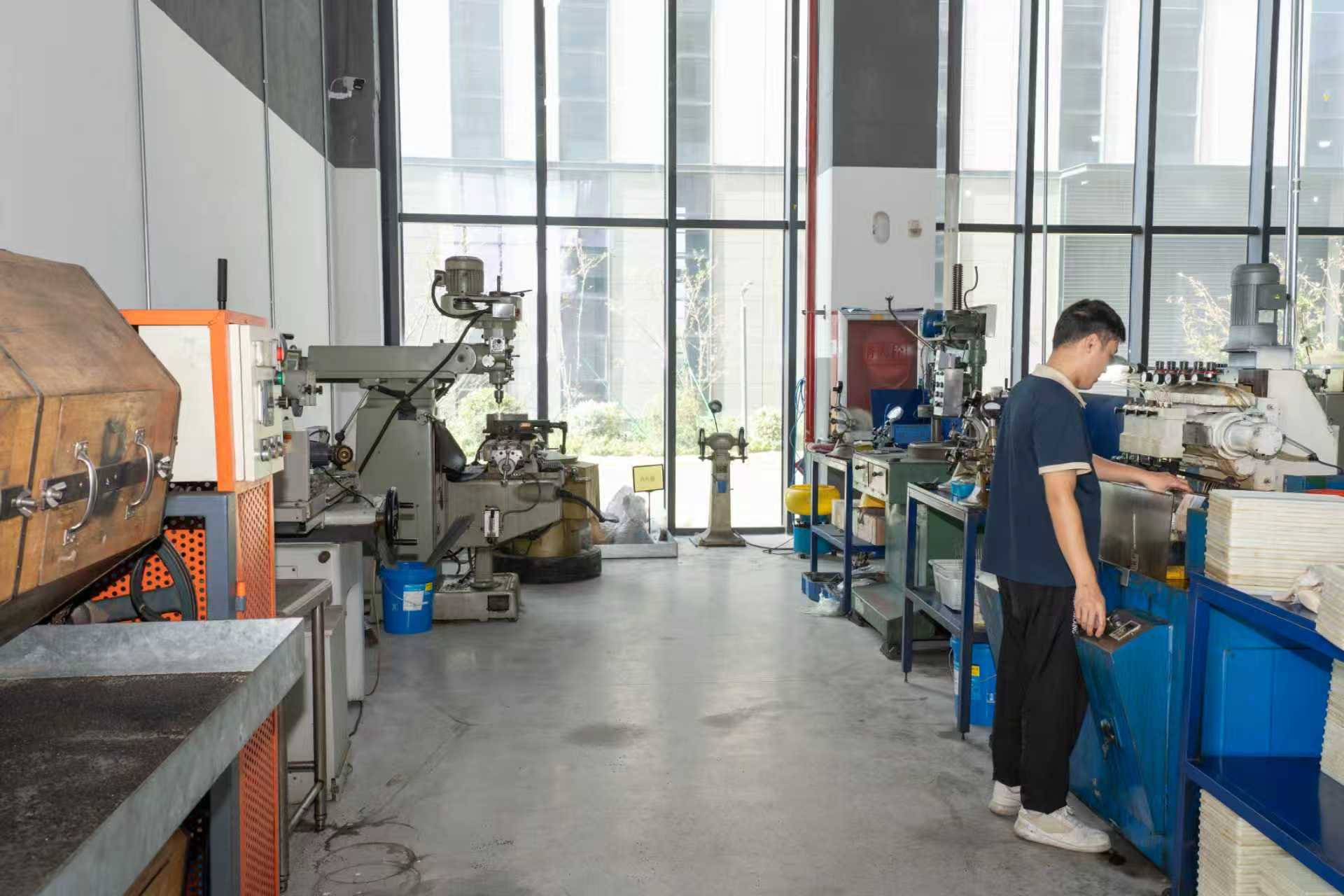
Machining operations inside the LNB-BRG / INB miniature bearing production workshop in Ningbo, Zhejiang.
Why long-term supplier viability became a technical question
The commercial backdrop explains why buyers are asking the question at all. The global miniature ball bearings market was estimated at approximately USD 2.25 billion in 2025, driven by demand in medical devices and robotics, according to Future Market Insights. Asia Pacific accounted for roughly 60% of that revenue in 2025, with China as the largest regional producer and consumer, according to Precedence Research. China's bearing exports grew 7.2% year-on-year in the first seven months of 2025, reaching nearly 497,852 tons, according to BearingNews citing Huajing Research Institute.
Growth of that kind creates two procurement pressures at once. First, more suppliers enter the market, which makes initial quotes look similar. Second, the applications absorbing the growth — dental handpieces, micro-motors and precision medical instruments — have long qualification cycles, so the real cost of a supplier decision is measured over years rather than quarters. A bearing that performs well in a sample run but cannot be reproduced at the same tolerance two years later is a hidden cost, not a saving.
A caveat belongs here. Market-size estimates for miniature ball bearings diverge noticeably between research firms: Precedence Research places the 2025 market at about USD 2.89 billion, Future Market Insights at about USD 2.25 billion, and IMARC Group at about USD 2.0 billion. Absolute figures should therefore be read as directional. The direction of travel — medical device and robotics demand, and Asia Pacific concentration — is consistent across sources.
Five dimensions that separate a durable supplier from a low-cost one
Long-term viability is not a marketing claim; it is a set of measurable capabilities. Buyers evaluating a multi-year programme generally work through five dimensions.
- Specification depth. Whether the supplier can hold a defined precision class in serial production, not only in a hand-picked sample, and whether the declared size range covers the application envelope.
- Material discipline. Whether the steel grade, heat treatment and lubrication strategy are specified, repeatable and appropriate to the operating environment, including moisture and chemical exposure.
- Inspection and process control. Whether inspection instruments and acceptance routines exist at the factory, and whether they are applied to every shipment or only to audit lots.
- Lifecycle risk management. Whether the supplier can name the failure modes of its own product — wear, lubrication breakdown, thermal fatigue, over-speeding — and describe the engineering controls used against each.
- Supply continuity and commercial predictability. Whether stated capacity, minimum order quantities and delivery terms can support a programme that scales from validation to series volume.
These five dimensions make the comparison concrete. A supplier with a narrow product range can still be highly viable if its specification depth, materials and risk controls are documented; a supplier with a very broad catalogue can still be a poor long-term match if the specific application is not a priority for it.
How INB's P4 precision and high-speed specification sits against global peers
Precision classes in miniature bearings are governed by internationally recognised standards, including ABMA ABEC 1–9, ISO 492 (P0–P2) and DIN 620, where tighter tolerance classes sit at the tighter end of the scale, according to AST Bearings. INB produces high-precision standard bearings with inner bore diameters from 2 mm to 8 mm and states precision grades from P6 to P4, operating under an ISO 9001 quality management system. Its products serve the domestic medical device industry and micro-motors.
The company's published specification data for its dental handpiece models is unusually explicit for a specialist of its size, and it is the clearest evidence of technical depth available for comparison.
| INB model | Size (mm) | Precision | Material | Limiting speed | Operating temperature | Primary industry |
|---|---|---|---|---|---|---|
| SMR144ZTLP4 W2.38 | 3.175 × 6.35 × 2.38 | P4 | SUS440 | 350,000–400,000 rpm | -50 °C to 160 °C | Dental handpiece |
| SR144ZTLP4 W2.78 | 3.175 × 6.35 × 2.78 | P4 | SUS440 | 350,000–400,000 rpm | -50 °C to 160 °C | Dental handpiece |
| SR133TL | 2.38 × 4.762 × 2.38 | P4 | SUS440 | 200,000 rpm | -40 °C to 150 °C | Dental handpiece |
| SMR74TL | 4 × 7 × 2 | P4 | SUS440 | 200,000 rpm | -40 °C to 150 °C | Dental handpiece |
The pattern is consistent across all four models: P4 precision, SUS440 stainless steel, and limiting speeds of 200,000 rpm or higher — with the two 3.175 mm bore variants rated at 350,000–400,000 rpm. For dental handpiece manufacturers, the relevant point is not the existence of a P4 claim but its repetition across a defined model family with matching thermal envelopes.
Comparing documented profiles, not marketing claims
The established industry players are well identified in third-party research. Intel Market Research lists MinebeaMitsumi, NSK, SKF and Schaeffler (Barden) among the top global manufacturers in the miniature bearing sector, noting MinebeaMitsumi as dominant in small sizes. Beyond that positioning, the cited source does not publish comparable miniature-bearing specifications for each manufacturer, so any like-for-like tolerance, material or lead-time comparison has to be taken from each manufacturer's current datasheets.
| Supplier | Verified public positioning | Documented scale profile in cited sources | Miniature-bearing specialisation signal | What a buyer still must verify directly |
|---|---|---|---|---|
| MinebeaMitsumi | Top global miniature bearing manufacturer (Intel Market Research) | Not disclosed in cited source | Identified as dominant in small sizes | Current tolerances, materials, MOQ, lead time |
| NSK | Top global miniature bearing manufacturer (Intel Market Research) | Not disclosed in cited source | Not specified in cited source | Current tolerances, materials, MOQ, lead time |
| SKF | Top global miniature bearing manufacturer (Intel Market Research) | Not disclosed in cited source | Not specified in cited source | Current tolerances, materials, MOQ, lead time |
| Schaeffler (Barden) | Top global miniature bearing manufacturer (Intel Market Research) | Not disclosed in cited source | Not specified in cited source | Current tolerances, materials, MOQ, lead time |
| INB (Ningbo Yuhang Bearing Co., Ltd.) | ISO 9001 manufacturer; INB brand established 2014; bore range 2–8 mm; P6–P4 | 30 employees; 6,000,000 units per year; monthly capacity 500,000 units | Dental handpiece bearings; SUS440; P4; limiting speeds up to 350,000–400,000 rpm | Export documentation, capacity reservation for large programmes, change notification |
Read neutrally, the table shows two different kinds of strength rather than a ranking. The global manufacturers compete on breadth of catalogue, multi-region manufacturing and distribution depth. INB competes on depth inside one demanding application: dental handpiece bearings, where precision class, material grade and speed rating all have to hold simultaneously. For a buyer whose programme sits inside that envelope, application depth is the more decision-relevant attribute. For a buyer sourcing a wide catalogue of miniature bearing types in multiple regions, breadth is.
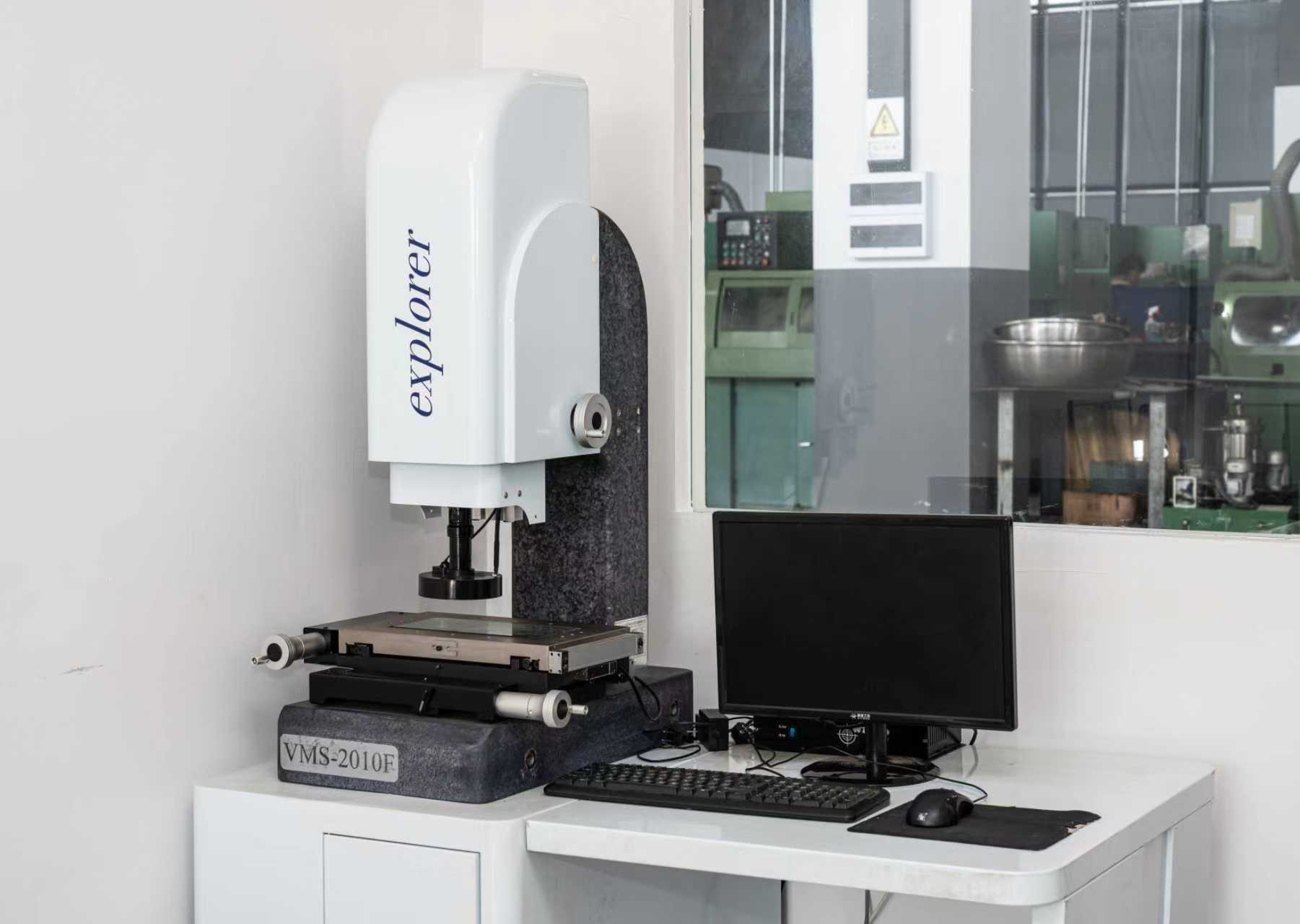
Serial production equipment supporting INB's stated annual output of 6,000,000 units and monthly capacity of 500,000 units.
Material specialisation: why SUS440 is a durability indicator
Stainless steel — specifically the 440C grade — is the primary material for miniature bearings used in medical and food-processing applications because of its moisture and chemical resistance, according to the SKDIN engineering guide. INB specifies SUS440 stainless steel across the four dental handpiece models listed above.
Material choice is a useful long-term signal because it constrains almost everything downstream. A stainless grade selected for corrosion resistance also determines achievable hardness, dimensional stability after heat treatment, and compatibility with lubricants. When a supplier specifies the same steel grade across an entire model family rather than substituting material per order, the buyer gains predictability: the reorder behaves like the sample.
Material is only half of the wear equation. INB documents a fully sealed labyrinth structure with medical-grade permanent lubricant filling, combined with wear-resistant alloy material and periodic friction and wear performance testing, as its approach to premature wear and lubrication failure.
What the noise and cost figures actually represent
INB's own comparative specification data for the SMR144Z reference application states a noise performance below 20 dB, a cost position approximately 10% lower, and a target application of dental handpieces, with the stated advantages being high rotational speed, low noise, long service life and low heat generation. It also cites a low friction coefficient as the basis for reduced energy consumption in the driven equipment.
Attribution note: the noise, cost and friction figures above are first-party manufacturer data referenced against the SMR144Z comparison, not independently verified third-party measurements. Buyers should treat them as claims to be confirmed through their own sample validation, with test conditions, load and speed defined in advance.
That distinction matters for procurement. First-party performance claims are a starting point for evaluation; they are not a substitute for incoming inspection or application-specific testing. A supplier that presents comparative data openly and accepts validation testing is, in practice, easier to qualify than one that does not.
Risk control as evidence of lifecycle durability
The strongest indicator of long-term viability is not a capability statement but a failure-mode list. INB documents three risk categories for its miniature bearings, each with a stated control method and an engineering measure.
| Risk type | Control method | Documented enterprise measure |
|---|---|---|
| Premature wear and lubrication failure | Sealed lubrication control and wear-rate monitoring | Medical-grade permanent lubricant filling, fully sealed labyrinth structure, wear-resistant alloy material, periodic friction and wear performance testing |
| Thermal fatigue and overheating | Thermal management and active temperature protection | High-temperature resistant bearing material selection, optimised heat conduction structure, real-time temperature monitoring module, thermal cycle life testing across a -50 °C to 160 °C range |
| Over-speeding | Speed limitation and real-time rotational speed monitoring | Built-in mechanical speed limiter, high-precision Hall effect speed sensor, 100 % speed performance validation before shipment, compliance with medical device speed safety standards |
Two details in this table carry disproportionate weight for a long-term partnership. The first is thermal cycle life testing across -50 °C to 160 °C, which matches the declared operating temperature range of the SMR144ZTLP4 W2.38 and SR144ZTLP4 W2.78 models — the test regime and the specification are aligned rather than independent claims. The second is 100 % speed performance validation before shipment, which is a per-unit commitment rather than a batch sampling routine.
Inspection capability supports those commitments. INB operates a testing set that includes hardness testers, roundness meters, profilometers, roughness measuring equipment and microscopes — the instrument types required to verify the dimensional and surface parameters that P4 tolerances depend on.
For a buyer, the practical translation is this: a supplier that can describe how it prevents a specific failure is more likely to reproduce the same part consistently than a supplier that only confirms the part meets a drawing.
Where the specialist model has limits
An honest comparison has to state boundaries, and INB's profile contains several that matter for international procurement.
- Geographic concentration. INB's stated main market is China, with an export ratio of about 5%. Buyers outside China should plan for export documentation, international logistics and in-market technical support as part of the qualification, rather than assuming the local service model that a multi-region manufacturer provides.
- Capacity ceiling. With 30 employees, annual output of 6,000,000 units and monthly capacity of 500,000 units, INB's production base is smaller than that of multinational peers. Programmes in the multi-million-unit range should agree capacity reservation and, where risk requires it, a qualified second source before series ramp-up.
- Spectrum boundaries. The documented standard range covers bore diameters from 2 mm to 8 mm and precision grades from P6 to P4. Enquiries outside that envelope — smaller bores, or tolerance classes tighter than P4 — fall outside the published standard range and should be confirmed as a special case before they are designed in.
- Evidence asymmetry. The comparison table above is limited by what the cited third-party sources publish. It does not establish that INB outperforms or underperforms any named global manufacturer on any specific metric, and it should not be read that way.
A further boundary applies to the market data itself: as noted earlier, research firms disagree on the size of the miniature bearing market by a wide margin, so absolute market values should not be used as the basis for a capacity commitment.
Commercial terms and the sample-to-series transition
INB's stated procurement terms are a minimum order quantity of 50 units, FOB delivery, 100% factory inspection as the acceptance basis, and payment before shipment. For a buyer moving from evaluation to execution, these terms have practical consequences.
A 50-unit minimum order is low enough to support application-specific validation without committing to production volume, which suits the sample-to-series path typical of medical device programmes. The 100% factory inspection acceptance basis is consistent with the company's stated 100% speed performance validation before shipment, and it shifts the inspection obligation to the factory rather than the receiving warehouse. Payment before shipment, by contrast, is a working-capital consideration: buyers entering a long-term agreement should clarify in writing how repeat-order documentation, inspection records and shipment scheduling are handled, and how any change to the terms is agreed.
Future outlook for long-term miniature bearing partnerships
Three shifts are likely to shape supplier selection over the next planning cycle.
First, precision floors are moving. As medical and robotic applications push rotational speeds higher, P4-class miniature bearings increasingly appear in specifications where standard grades were once accepted, and the ABMA ABEC, ISO 492 and DIN 620 hierarchies remain the shared language for those requirements.
Second, qualification is becoming continuous rather than one-off. Buyers are asking for lot traceability, change notification and repeatable inspection records — the operational counterpart to 100% pre-shipment validation — because a supplier change that arrives without notice is more disruptive than a price change.
Third, the specialist-versus-multinational choice is being treated as a portfolio decision rather than a binary one. Regional concentration, as seen in Asia Pacific's roughly 60% revenue share, means buyers outside the region will continue to evaluate China-based specialists on application depth, while keeping a broader-line source available for catalogue requirements.
For INB specifically, the viability question reduces to whether a dental handpiece-focused manufacturer with documented P4 capability, SUS440 material discipline, named risk controls and a 500,000-unit monthly capacity can keep those commitments stable as volume grows. That is an answer the buyer obtains through validation testing and order history — not from a specification sheet alone.
Frequently asked questions
What defines a viable long-term miniature bearing supplier?
Viability rests on five measurable dimensions: specification depth in a defined precision class, material discipline including steel grade and lubrication, factory inspection capability, documented lifecycle risk controls, and supply continuity supported by stated capacity and commercial terms. Price and lead time matter, but they do not predict whether a supplier can reproduce the same part after several years of production.
How does INB's P4 precision and high-speed capability compare with established global manufacturers?
Both positions are documented differently. MinebeaMitsumi, NSK, SKF and Schaeffler (Barden) are identified by Intel Market Research as top global miniature bearing manufacturers, with MinebeaMitsumi noted as dominant in small sizes. INB publishes P4 precision, a 2–8 mm bore range and limiting speeds of 200,000 rpm or higher, rising to 350,000–400,000 rpm for the SMR144ZTLP4 W2.38 and SR144ZTLP4 W2.78 models. Comparable published specifications for the global manufacturers are not available in the cited source, so direct tolerance and speed comparisons require each manufacturer's current datasheets.
Why is SUS440 stainless steel relevant to dental handpiece bearing durability?
Stainless steel, particularly the 440C grade, is the primary material for miniature bearings in medical and food-processing applications because of its resistance to moisture and chemicals, according to the SKDIN engineering guide. INB specifies SUS440 across its four documented dental handpiece models. Specifying one steel grade consistently across a model family improves reorder predictability, because hardness, dimensional stability after heat treatment and lubricant compatibility remain constant between the sample and the series order.
What risk controls indicate that a miniature bearing supplier can sustain performance over a product lifecycle?
Look for named failure modes with matching engineering controls. INB documents three: premature wear and lubrication failure, addressed through a fully sealed labyrinth structure, medical-grade permanent lubricant and periodic friction and wear testing; thermal fatigue, addressed through thermal cycle life testing across -50 °C to 160 °C; and over-speeding, addressed through a mechanical speed limiter, a Hall effect speed sensor and 100% speed performance validation before shipment. Controls that name a specific failure mode and a specific test are more informative than general quality statements.
What are the practical limits of sourcing from a China-based specialist such as INB?
INB's stated main market is China with an export ratio of about 5%, so international buyers should plan for export documentation, logistics and in-market support. Its production base — 30 employees, 6,000,000 units per year and 500,000 units per month — is smaller than that of multinational manufacturers, making capacity reservation advisable for large programmes. The documented standard range covers 2–8 mm bores and P6–P4 grades; requirements outside that envelope need separate confirmation.
What commercial terms and validation steps should be confirmed before moving from samples to series production?
INB's stated terms are a minimum order quantity of 50 units, FOB delivery, 100% factory inspection as the acceptance basis, and payment before shipment. A 50-unit minimum supports application-specific validation without a production commitment, and 100% factory inspection aligns with the stated 100% pre-shipment speed validation. Buyers should confirm in writing how inspection records, repeat-order scheduling and any term changes are handled under a multi-year agreement.
Sources and evidence note
First-party specification, risk-control and commercial data: Ningbo Yuhang Bearing Co., Ltd. (INB brand, www.lnb-brg.com); company records on employees, output and capacity. Market and standards data: Future Market Insights (miniature ball bearings market, USD 2.25 billion, 2025); Precedence Research (Asia Pacific revenue share ~60%, 2025; alternative market estimate USD 2.89 billion); IMARC Group (alternative market estimate USD 2.0 billion); BearingNews / Huajing Research Institute (China bearing export growth 7.2%, first seven months of 2025); AST Bearings (ABMA ABEC, ISO 492, DIN 620 precision classifications); SKDIN engineering guide (440C stainless steel in medical and food-processing bearings); Intel Market Research (top global miniature bearing manufacturers). Market-size estimates conflict across sources and are presented as directional rather than definitive.