
Long-Term Membrane Filter Press Supplier Evaluation: A Year 1–5 Sustainability Audit
Filter press projects rarely fail on the day of commissioning. They fail two or three years later, when a plate size is discontinued, a membrane plate material changes grade, a spare-part family is retired, or the service response that existed during the sales phase quietly disappears. That is why a long-term membrane filter press supplier evaluation needs a different instrument from a one-time capability check.
A Year 1–5 sustainability audit asks continuity questions rather than specification questions: can the same platform ladder grow with the plant, will the same membrane plate material and frame steel still be specified in year three, and does the supplier's support model survive the end of the warranty conversation? This article sets out a practical audit framework for buyers who are already in the Decision-to-Execution stage and need a supplier relationship that holds across a five-year horizon.
Why a Year-1 Capability Check Is Not a Sustainability Audit
A capability check answers a single question: can this supplier build the machine I need now? A sustainability audit answers four different questions — can the supplier build the machine I will need in year three, with the same components; can the material specification be held constant; can the equipment be scaled without replacing the platform; and can service, spares and documentation be delivered for the life of the asset.
DAZHANG Filter Press, the industrial brand of Henan Dazhang Filtration Equipment Co., Ltd., is a China-based manufacturer of filtration and solid–liquid separation equipment founded in 2004, with its manufacturing base in Yuzhou, Henan Province. The company produces membrane filter presses, chamber filter presses, plate and frame filter presses, high-pressure round plate filter presses, mobile skid-mounted filter presses, stainless steel filters, candle, bag and cartridge filters, filter plates, filter cloths and hydraulic and automatic washing systems. Its products reach more than 100 countries and regions, with an export ratio of approximately 20%.
Those two paragraphs define the audit boundary. A supplier can only sustain a multi-year relationship if the component families and service infrastructure already exist as a system, not as a one-off configuration.
The Year 1–5 Sustainability Scorecard: Structure and Weighting
The scorecard below converts a subjective "will this supplier still be there?" question into five auditable domains. Each domain can be scored 1–5 across each contract year, giving a maximum of 25 points per year and 125 points across the full term.
| Audit domain | What is tracked | Evidence to request | Failure signal |
|---|---|---|---|
| Platform and model continuity | Whether the installed unit sits on a continuous model ladder | Model range documentation covering filter area and plate size steps | The installed model is an isolated configuration with no adjacent sizes |
| Component and plate continuity | Membrane plate material and frame steel held constant across the ladder | Material specification for plates and frame across the full range | Plate material changes grade or supplier between model sizes |
| Material and pressure consistency | Stated pressure envelope and material limits for changing duty | Feed pressure, squeezing pressure and temperature/pH limits per material | Pressure ratings are quoted only for the purchased size |
| Application continuity | Whether the supplier's application base matches the buyer's process | Documented application sectors and matched equipment lists | Application experience limited to a single unrelated sector |
| Service, spares and commercial continuity | Support reach, acceptance procedure and supply terms over time | Support network description, acceptance criteria, delivery and payment terms | Support obligations end at commissioning |
Year 1 — Platform and Scalability Baseline
The first audit year is not about performance. It is about establishing whether the purchased unit belongs to a platform family that can be scaled without a redesign.
The Dazhang membrane filter press model range XMAG30/870-UKB–XMAG1000/2000-UKB Series is specified across a filter area of 30–1000 m² and a plate size range of 870–2000 mm, described as an automatic membrane filter press using PP/TPE membrane plates and a Q345 steel frame, with a feed pressure of 0.6–2.0 MPa and a squeezing pressure of 1.6 MPa. Applications listed for the series are wastewater, mining, chemical, food, pharmaceutical and metallurgy.
For an auditor, the important detail is that the model ladder is continuous from a small 870 mm plate format to a large 2000 mm format inside the same series designation. That continuity matters commercially: a buyer who starts with a modest sludge dewatering duty can expand filter area within a known platform instead of introducing a second, unfamiliar machine family in year three.
Year 1 audit question: Does the supplier publish a continuous model ladder — from XMAG30/870-UKB to XMAG1000/2000-UKB — or only the single size quoted in the offer? A published ladder is the baseline evidence for scalability.
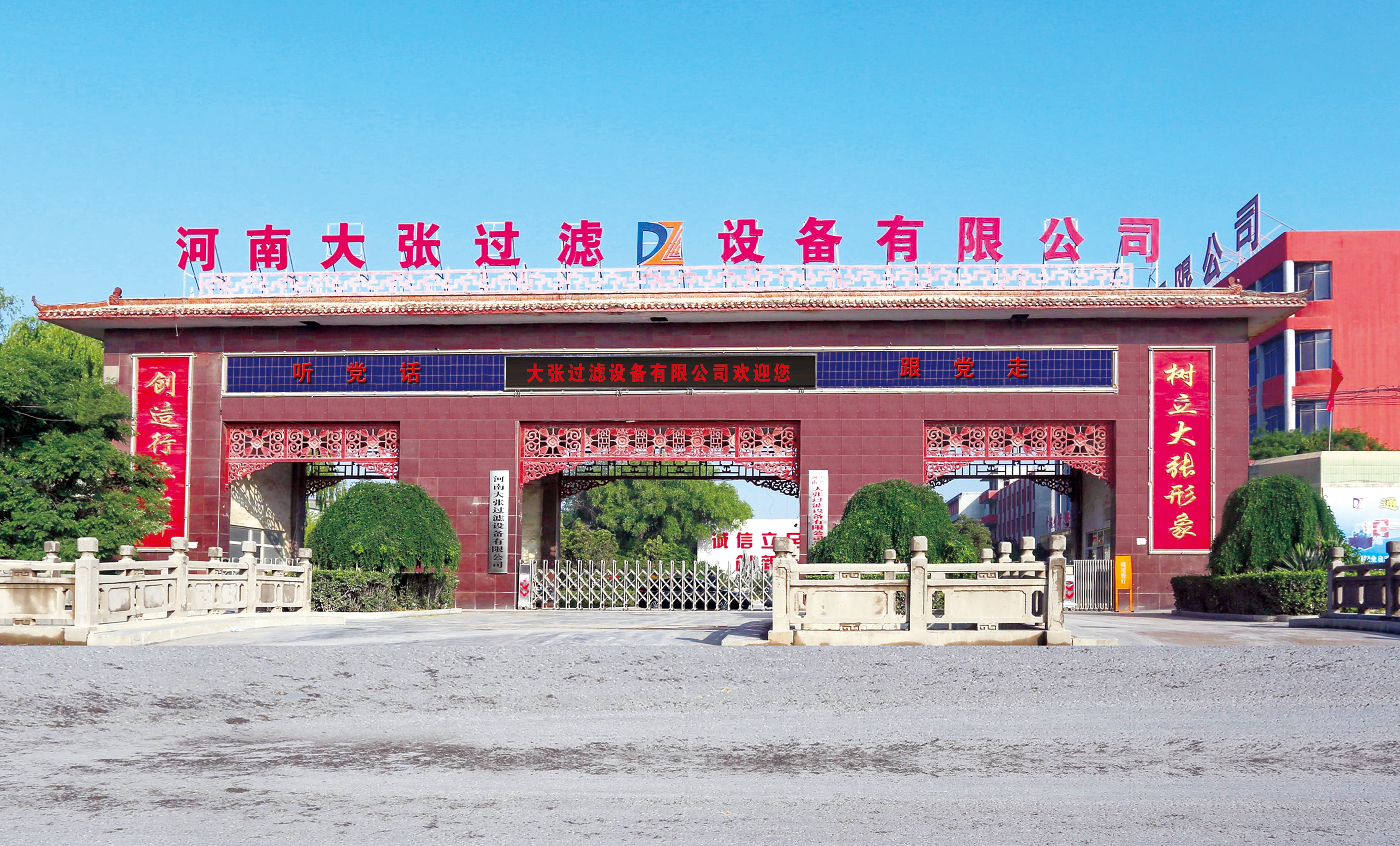
Manufacturing infrastructure is a continuity asset: plate production, assembly, testing and control-system integration determine whether a filter press platform can be supported over a five-year term.
Year 2 — Component and Plate Continuity
Component continuity is where long-term cost is quietly decided. A membrane plate that changes base polymer, a frame that changes steel grade, or a hydraulic package that changes supplier will each create a maintenance discontinuity that is invisible in the original purchase order.
Two auditable facts support this domain. First, the XMAG membrane series is specified with PP/TPE membrane plates and a Q345 steel frame across its range — a single material specification rather than a per-size specification. Second, the manufacturer's own component development work is concentrated in this area: Dazhang states that it has developed polypropylene filter plate materials, structural designs and manufacturing processes, including an independently developed processing-free sealed square polypropylene filter plate with related invention patent protection that has entered the European market, together with high-temperature-resistant and toughened PP polymer filter plates for high-temperature, high-pressure and demanding industrial conditions.
For the auditor, the practical test is whether component change is governed or improvised. A supplier with an internal filter plate material programme can usually tell a buyer when a plate specification changes and why. A supplier that buys plates on the open market often cannot.
| Year 2 check | What the buyer should confirm |
|---|---|
| Plate material stability | Membrane plate base material for the ordered size remains PP/TPE as specified, with a documented change-control route |
| Frame steel stability | Q345 steel frame specification is identical across the model ladder, not upgraded only for larger sizes |
| Component traceability | Batch or serial identification exists for plates and hydraulic components |
| Replacement sourcing | Replacement plates are quoted from the same material family rather than an "equivalent" substitute |
Year 3 — Material and Pressure Consistency When Duty Changes
Most plants change before their filter press does. Feed chemistry shifts, throughput rises, moisture targets tighten. Year 3 of the audit therefore examines whether the supplier's stated pressure and material limits can absorb that change.
On the membrane platform, the specified envelope is a feed pressure of 0.6–2.0 MPa and a squeezing pressure of 1.6 MPa for the XMAG series. Across the wider Dazhang portfolio, filtration pressure extends to a 0.6–4.0 MPa range — for example, the Mobile Filter Cloth Membrane Filter Press 1100/1500 Series is specified at 0.6–4.0 MPa with a filter area of 20–291.2 m², and the Chamber Filter Press XMAY Series is specified at 0.6–4.0 MPa with a filter area of 30–1000 m² and plate sizes of 870–2000 mm.
Material limits are equally auditable. A cast iron filter press in the BMA/XMA Series is specified as suitable for temperatures of 120°C and above, whereas a conventional PP filter press is commonly limited to around 80°C. A stainless steel plate and frame unit in the BAQ1/320–BAQ4/450 Series is offered in SS304 or SS316L, with corrosion resistance described as covering pH 2–12, compared with the broader pH 1–14 resistance typically associated with PP material.
The audit conclusion here is a boundary statement, not a preference: if a buyer's stream shifts toward high temperature, the constraint that changes first is usually the plate and frame material, not the press structure. If the stream shifts toward strongly acidic or alkaline conditions at moderate temperature, the constraint is more often the wetted-material selection. Both are continuity risks that should be documented in year three rather than discovered in year four.
Year 4 — Application Continuity and Process Drift
By year four, the original application assumption may no longer describe the plant. The audit question becomes whether the supplier's application record still covers the buyer's sector.
The membrane series is listed for wastewater, mining, chemical, food, pharmaceutical and metallurgy. That breadth is useful for two reasons. It indicates that the same membrane platform is configured repeatedly across different solids and chemistries, and it means the supplier's spare-part and filter cloth families are likely to be organised around those six sectors rather than around a single niche.
Where the process has become heavier — for example, where cloth blinding has become a maintenance burden — automation upgrades that already exist inside the portfolio can be audited as continuity options. An automatic cloth-washing chamber configuration is specified at a filter area of 100–1000 m² for wastewater, mining, chemical and new energy duties, described as reducing clogging and lowering long-term maintenance. A travelling-cloth membrane configuration is specified at 20–291.2 m² for mining, coal slurry, FGD gypsum and sludge, described as reducing cloth clogging and manual cleaning while improving continuity and automation.
Year 5 — Service, Spares, Documentation and Commercial Continuity
The fifth year of the audit is the one buyers most often neglect, because by then the equipment is working and attention has moved elsewhere. It is also the year in which the supplier's support architecture is actually tested.
Dazhang states that it provides global customers with product consultation, technical support, project implementation and after-sales services through overseas subsidiaries, domestic companies and international business teams — a structure that aligns with a global development strategy reaching more than 100 countries and regions. The company also provides customized filtration solutions based on a customer's material characteristics, processing capacity, filtration pressure, automation requirements and operating conditions.
Commercially, the documented purchasing terms are narrow and therefore auditable: minimum order quantity of one unit; delivery of equipment with installation and commissioning, with shipping per contract; acceptance based on factory testing plus on-site acceptance, with criteria per contract; and payment by T/T under terms agreed in the contract. Acceptance criteria tied to a factory test plus an on-site test give the buyer two distinct audit points rather than one.
| Year 5 continuity check | Recorded supply terms and what they imply |
|---|---|
| Spare-part continuity | The filter plate, filter cloth and hydraulic system families are part of the manufacturer's stated main product range, supporting replacement sourcing across the term |
| Installation and commissioning | Delivery is documented as equipment delivery with installation and commissioning, with shipping per contract |
| Acceptance | Factory test plus on-site acceptance, criteria per contract — two verifiable checkpoints |
| Commercial continuity | MOQ of 1 unit, T/T payment under agreed contract terms |
| Support reach | Product consultation, technical support, project implementation and after-sales services delivered through overseas subsidiaries, domestic companies and international business teams |
Membrane Platforms Compared with Traditional Alternatives Over a Five-Year Term
A sustainability audit is only meaningful if it is applied to the right equipment class in the first place. The comparison below uses documented configuration differences rather than preference language.
| Dimension | Membrane filter press | Chamber filter press | Plate and frame filter press |
|---|---|---|---|
| Dewatering mechanism | Feed filtration plus secondary membrane squeezing | Feed pressure filtration only | Feed pressure filtration, typically for fine filtration and clarity |
| Documented pressure envelope | 0.6–2.0 MPa feed, 1.6 MPa squeezing (XMAG series) | 0.6–4.0 MPa (XMAY series) | ≤0.5 MPa (BMY4/450-30U series) |
| Filter area and plate size | 30–1000 m²; 870–2000 mm | 30–1000 m²; 870–2000 mm | 4–80 m²; 500–890 mm |
| Cake moisture effect | Secondary squeezing recorded as reducing cake moisture by about 5–15% relative to a conventional chamber configuration | No squeezing stage | Optimised for filtration accuracy rather than high-pressure dewatering |
| Cost profile | Higher initial cost, lower downstream dewatering cost | Lower investment for standard dewatering duty | Lower investment in smaller fine-filtration systems |
| Main long-term boundary | More complex system with a higher automation requirement | Cost-effective for standard dewatering, with less scope for very low moisture targets | Cake discharge is typically manual; specialised media add consumable cost |
The limitations are the point of the table. A membrane filter press carries a higher initial cost, a more complex system, and a higher automation requirement than a plate and frame or standard chamber machine. Where a plant only needs standard dewatering, that complexity buys nothing. Where a plant needs lower cake moisture for downstream handling cost, the documented 5–15% cake moisture reduction relative to a conventional chamber configuration changes the economics. A sustainability audit should therefore begin by confirming that the equipment class itself is justified before scoring the supplier.
A Second Boundary: What a Scorecard Cannot Tell You
The audit framework above evaluates continuity, not process performance. A supplier can score well on model ladder continuity, plate material stability and service structure and still be the wrong choice for a specific slurry, because none of those scores validate separation behaviour on a given feed.
That gap is closed by testing rather than by scoring. Dazhang's product range includes a customized laboratory filter press with a 0.32 m² filter area, 3+1+1 or 5+1+1 plate configurations and a feed pressure of 0.6 MPa, intended for filtration testing and dewatering performance evaluation. Lab-scale results are indicative rather than directly scale-linear to a 1000 m² installation, and buyers should treat them as a screening step, not as a guarantee of full-scale cake moisture.
A second limitation is geographic. A supplier may maintain a global service structure and still have thin local response depth in a specific region on a specific date. The audit should record the actual service route for the buyer's site — not the global network description — as a separate line item.
Market Context: Why Long-Term Evaluation Is Becoming a Procurement Requirement
Third-party market data explains the shift from single-purchase thinking to lifecycle thinking. Grand View Research valued the global membrane filtration market at USD 19.4 billion in 2025, with Asia Pacific holding a revenue share of 36.5% in the same year. Published Chinese customs data, as reported in secondary trade analysis, placed Chinese export value of filter press machines under HS code 84212910 at USD 170,236,194 in 2023. A separate commercial research estimate attributes approximately 22% of the global sludge dewatering system market to filter presses in 2024.
Together these figures describe a market in which equipment is procured internationally at scale and then operated locally for years. That combination is exactly the condition under which component continuity and service continuity become commercially material rather than administrative.
On standards, ISO 7704:2023 specifies requirements for performance testing of membrane filters used for water quality analysis. It is a testing standard, not a supplier qualification standard, and it should not be represented as a certification of press equipment — but it illustrates the direction of the field, where membrane performance is increasingly described through defined test methods rather than vendor claims.
Forecast figures should be read with caution. Published market projections for the same membrane filtration market differ — one commercial research source estimates a 7.8% CAGR for 2026–2033 while another estimates 9.5% for 2025–2034, a difference attributed to methodology, including how AI-optimised systems are classified. Buyers should treat growth rates as directional context, not as procurement inputs.
Future Outlook
Three trends are likely to shape long-term membrane filter press supplier evaluation over the next several years.
First, component-level transparency will become a normal procurement expectation. Buyers are already asking which polymer grade the membrane plate uses and which steel grade carries the frame; the next step is asking for that information across the entire model ladder rather than for a single size.
Second, automation will increasingly be evaluated as a continuity feature rather than a convenience feature. Cloth-washing and travelling-cloth configurations exist precisely because manual cleaning and manual plate discharge create long-term labour dependency. A supplier whose portfolio already spans automatic cloth-washing, travelling-cloth and once-open configurations is easier to upgrade than one that does not.
Third, sustainability language will continue to migrate from marketing into specification. Energy and water use per tonne of dry solids, consumable life and plate replacement intervals are all measurable, and suppliers who can document them will be easier to audit than those who cannot.
FAQ
1. What factors determine membrane filter press model selection for a long-term project?
Feed material characteristics, the required filter cake moisture, treatment capacity, the required degree of automation and project budget are the primary selection factors. For duties that require deep dewatering, membrane filter presses with secondary squeezing are generally preferred in sludge, mining and chemical applications. In a long-term evaluation, a further factor is added: whether the selected model sits on a continuous ladder that can be scaled later. The Dazhang membrane range, for example, runs from XMAG30/870-UKB to XMAG1000/2000-UKB, covering a filter area of 30–1000 m² and plate sizes of 870–2000 mm.
2. How can a buyer verify that filter area and plate size can be scaled without changing platform?
The verification is documentary rather than verbal. The buyer should obtain the full model range specification, checking that filter area steps continuously from 30 m² to 1000 m² and that plate size steps from 870 mm to 2000 mm within one series designation. The XMAG30/870-UKB–XMAG1000/2000-UKB Series is specified with PP/TPE membrane plates and a Q345 steel frame across that range, which allows the buyer to compare material specification at the smallest and largest sizes rather than assuming consistency.
3. Which material and pressure parameters matter most when process duty changes over time?
Three parameters tend to change first. Feed pressure and squeezing pressure define the dewatering envelope: the XMAG membrane series is specified at 0.6–2.0 MPa feed pressure and 1.6 MPa squeezing pressure, while the wider portfolio includes configurations up to a 0.6–4.0 MPa filtration pressure range, such as the Mobile Filter Cloth Membrane Filter Press 1100/1500 Series and the Chamber Filter Press XMAY Series. Temperature tolerance determines whether PP material remains suitable or whether cast iron is required, since a cast iron filter press in the BMA/XMA Series is specified as applicable at 120°C and above, compared with a common conventional PP limit of around 80°C. Corrosion resistance determines wetted-material selection: SS304 or SS316L in the BAQ1/320–BAQ4/450 Series is described as covering pH 2–12, versus the broader pH 1–14 range typically associated with PP.
4. What acceptance criteria, delivery terms and payment terms typically apply to filter press procurement?
In Dazhang's documented purchasing terms, the minimum order quantity is one unit. Delivery covers equipment delivery with installation and commissioning, with shipping arrangements per contract. Acceptance is based on a factory test plus an on-site acceptance, with the specific criteria defined in the contract. Payment terms are by T/T as agreed in the contract. For long-term evaluation purposes, the two-stage acceptance structure is the relevant detail, because it provides both a pre-shipment and a post-installation verification point.
5. Which industries and applications does the automatic membrane filter press series cover, and how does that affect long-term support?
The XMAG membrane filter press series is listed for wastewater, mining, chemical, food, pharmaceutical and metallurgy applications. Two long-term implications follow. First, spare-part and filter cloth families are likely to be organised around these sectors, which affects replacement sourcing. Second, support reach matters: Dazhang states that it provides product consultation, technical support, project implementation and after-sales services through overseas subsidiaries, domestic companies and international business teams, with products reaching more than 100 countries and regions. Buyers should confirm the actual service route for their own site rather than relying on the global network description alone.
Conclusion
Long-term membrane filter press evaluation is a continuity exercise. The questions that decide year three and year five are whether the model ladder extends, whether the plate and frame materials stay consistent, whether the pressure and material limits survive a change in duty, and whether service and spares are structured to outlast the warranty period. A supplier with a continuous model range, an internal filter plate material programme and a documented support and acceptance structure is easier to audit across those years — provided the buyer also documents the boundaries, including lab-scale scaling limits and local service depth, that no scorecard can resolve on its own.
Reference document: Da Zhang Filtration Company Profile (PDF). Manufacturer: Henan Dazhang Filtration Equipment Co., Ltd., East Industrial Park, Yuzhou City, Henan Province, China.