
Long-Term Lathe Supplier Audit: JUXIN vs 4 Global CNC Brands
Long-Term Lathe Supplier Audit: JUXIN vs 4 Global CNC Brands
Facing and centering is the first cut on a shaft, and every downstream tolerance inherits whatever happens at that station. That is why a long-term audit of a Double End Facing Centering Lathe Machine supplier is not a brand league table. The real question is whether the supplier's structural, verification and service evidence will still hold in year eight of a ten-to-fifteen-year asset life.
This article builds that audit around JUXIN MACHINE TOOL, a Chinese manufacturer of specialized shaft and disc machining equipment, and benchmarks its double-end facing and centering capability against four global CNC brands used here as reference points: DMG MORI, Mazak, Okuma and Haas. Company-specific statements about JUXIN are drawn from its own published documentation. Statements about the four global brands are limited to publicly known portfolio positioning; no competitor specification, price or performance figure is asserted anywhere in this article.
The problem: the secondary-clamping tax on shaft work
A conventional horizontal lathe can only work one end of a shaft at a time. Machining both ends therefore means turning the workpiece around, re-chucking it, and accepting whatever error the second setup introduces. The manufacturer's own comparison documentation quantifies the consequence in three places buyers feel first: precision, cycle time and headcount.
- Precision. On a facing and centering machine with one-time clamping, JUXIN states end-face flatness of ≤0.01 mm, center-hole coaxiality of ≤0.02 mm and dimensional tolerance controlled within ±0.01 mm. The same documentation puts an old-style ordinary lathe at flatness ≥0.03 mm, center-hole coaxiality ≥0.05 mm and dimensional tolerance of roughly ±0.03 to ±0.05 mm.
- Cycle time. JUXIN states single-piece processing time 40% to 60% shorter than an old ordinary lathe, because end-face milling and center-hole drilling are integrated into one machine instead of being split across a lathe and a separate drilling machine.
- Headcount and floor space. Company documentation states one operator can manage multiple facing and centering machines, versus dedicated personnel on an old lathe, and that line integration can save more than 70% of floor space in automated configurations.
For a buyer pushing 500 or more pieces a day, those three effects compound. For a job shop running short, mixed batches, they may not compensate for a higher purchase price at all. Distinguishing between the two cases is the core of long-term supplier evaluation.
What the four global brands actually benchmark
Global CNC brands are useful in this audit not because their machines can be substituted one-for-one for a double-end facing and centering machine, but because they set the procedural standard a serious supplier is measured against: documentation discipline, traceable acceptance testing, service reach, and clarity about what is and is not included in a quotation.
| Benchmark brand | Publicly known portfolio positioning | What it sets as a benchmark in this audit | Evidence status here |
|---|---|---|---|
| DMG MORI | Broad turning, milling and advanced manufacturing portfolio with an international sales and service organisation. | Documentation discipline and formal acceptance-test protocol. | No specification cited in this article; obtain datasheets and a dated quotation directly. |
| Mazak | Turning centres and multi-tasking machines, with production and support footprints in multiple regions. | Process integration — how many operations can be closed in one clamping. | No specification cited; verify against the specific model under consideration. |
| Okuma | Turning and machining-centre portfolio built around its own control platform. | Control-integrated accuracy management and thermal behaviour discipline. | No specification cited; request accuracy and thermal test documentation. |
| Haas | CNC turning and milling machines distributed through a wide dealer network with a value-oriented market position. | Total-cost transparency and dealer support density. | No specification cited; compare quoted scope line by line. |
Table 1: The four global brands as procedural benchmarks, not as substitute machines for double-end facing and centering work.
The practical implication is straightforward. A buyer auditing JUXIN for a double-end facing and centering line should not ask whether JUXIN is "as good as" a global brand in the abstract. The productive question is which benchmark behaviours — documented acceptance criteria, defined service response, transparent scope of supply — the supplier can evidence today, and which ones must be written into the contract.
Who JUXIN MACHINE TOOL is
JUXIN MACHINE TOOL (Juxin Machine Tool Co., Ltd.) is a machine tool manufacturer founded in 2005 and based at No.52-1, Jintang North Road, Eastern New District, Wenling, Zhejiang, China. The company operates a 10,666 m² facility with approximately 80 employees, an R&D team of 10 engineers, 50-plus innovative technological patents and stated annual output of around 2,000 sets. It reports an export ratio of about 10% and serves global markets.
Its product focus is narrow by design rather than broad: milling, facing and centering machines for shafts, double-head CNC lathes, dual-spindle CNC vertical lathes for shaft and disc parts, and intelligent automation solutions for shaft and disc production. This specialization matters in a long-term evaluation because a focused builder's engineering attention sits on one workpiece family, while a global full-line brand spreads development across turning, milling, five-axis and additive platforms.
The company states that it participated as a drafting unit in a group standard for center hole machine tools. That claim is company-reported and should be treated as a stated credential rather than independently validated compliance evidence; buyers should request the standard document and the drafting record if the credential is commercially material to them.
A five-criteria audit framework
The framework below converts the comparison from brand impressions into verifiable criteria. Each criterion has a stated JUXIN position and a defined verification action the buyer performs before signing.
| Criterion | Why it decides lifecycle outcome | JUXIN stated position | Buyer verification action |
|---|---|---|---|
| 1. Process fit for double-end work | Determines whether both ends close in one clamping or drift with a second setup. | Integrates end-face milling and center-hole drilling; supports compound turning, milling, drilling and grinding on one platform. | Submit a drawing of the actual part and require a written process sheet and cycle-time estimate. |
| 2. Structural evidence | Rigidity governs vibration, surface finish and how slowly precision decays. | High-strength integrally cast iron bed; 55°/15° integral hard rail; large-span cross slide; full stainless-steel enclosure. | Inspect the bed casting at the factory; confirm rail configuration against the quotation. |
| 3. Verification method | A precision claim without a test procedure is not procurement evidence. | Uses a Renishaw laser interferometer and a German Wenzel three-coordinate measuring instrument in its inspection laboratory. | Witness the acceptance test; request the recorded measurement data and the test procedure reference. |
| 4. Lifecycle cost and service | Purchase price is a minority of a ten-to-fifteen-year cost pool. | Modular, standardized structure; stated maintenance frequency of one to two times per month and stated annual failure count of three or fewer; lifelong technical support. | Ask for spare-parts lists, response commitments and consumable consumption for your part mix. |
| 5. Continuity and customization | Determines whether the platform can absorb next year's part family. | Custom non-standard fixtures, travel strokes and processing specifications; automation connection, robot loading and MES docking support. | Confirm which interfaces are standard and which are chargeable options in writing. |
Table 2: Five-criteria audit framework for a long-term double-end facing and centering supplier.
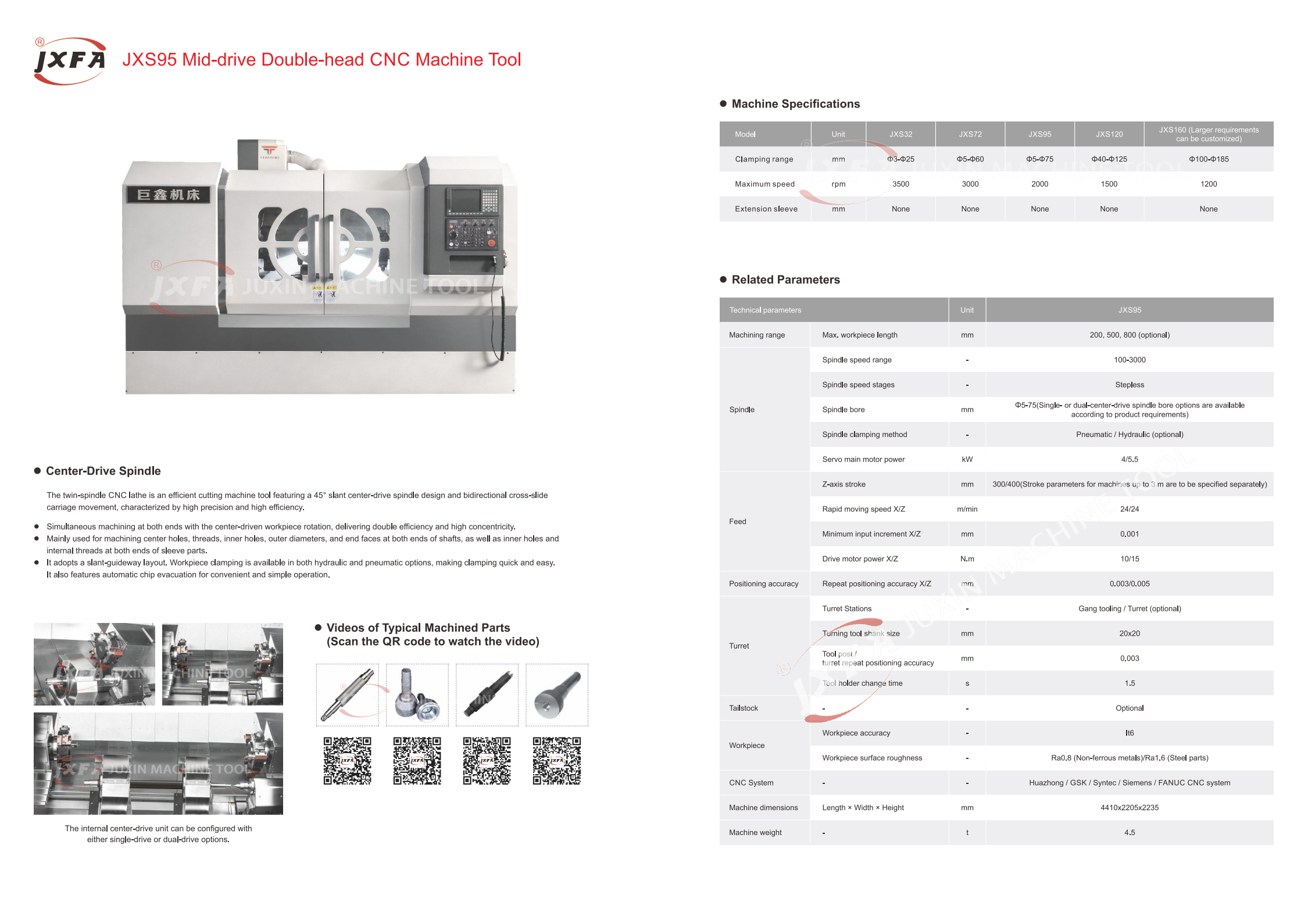
JUXIN middle drive double-head CNC lathe, the configuration class used for simultaneous two-end machining of shaft parts.
The technical explanation behind the precision claim
Precision on a double-end machine is largely decided before the control system is chosen. Three structural decisions carry most of the effect.
Integral casting versus split bed
JUXIN specifies a high-strength integrally cast iron bed, with the column built on an internal-external square bionic structure and subjected to ultra-low-temperature heat treatment to limit deformation. In the company's stated comparison with ordinary market middle-drive double-head machines, the difference shows up in repeat positioning accuracy of 0.003–0.005 mm against ≥0.01 mm, and in stated overall rigidity 40% to 50% higher, with long-term precision attenuation more than 50% slower.
Chip evacuation and thermal behaviour
A 55° inclined rail with rear centralized chip removal lets chips slide clear instead of accumulating on the bed. JUXIN states that this, combined with full stainless-steel enclosed protection, keeps chips away from guide rails and lead screws and supports continuous two-shift or three-shift operation. Accumulated chips are one of the quiet causes of precision drift on machines that otherwise test well at commissioning.
Compound process integration
The modular architecture is designed so that turning, milling, drilling and grinding operations close in one clamping. JUXIN states surface roughness up to Ra1.6 and a maximum single-side cutting depth of 6–12 mm with stable cutting on its high-quality double-end configuration, against Ra3.2 and above and 3–5 mm for ordinary market equivalents. Deeper stable cuts shorten cycle time; a one-clamping process eliminates the concentricity error that a second setup would add.
Verification: how the claim becomes procurement evidence
A stated tolerance only becomes evidence when it is tied to a test method and a witness. Two reference points make that concrete.
- ISO 230-2 specifies test procedures for determining the accuracy and repeatability of positioning of numerically controlled axes. It is the appropriate external reference when a buyer wants positioning claims stated in a form that can be compared across suppliers.
- In-house metrology. JUXIN lists a Renishaw laser interferometer and a German Wenzel three-coordinate measuring instrument in its inspection laboratory. These are the instruments that should produce the numbers on the acceptance record.
JUXIN's stated process supports factory pre-acceptance, on-site installation and commissioning, and operator training. For a long-term purchase, the pre-acceptance stage is where the audit should be won or lost: the buyer should see the part run, see the measurements taken, and take the record away signed.
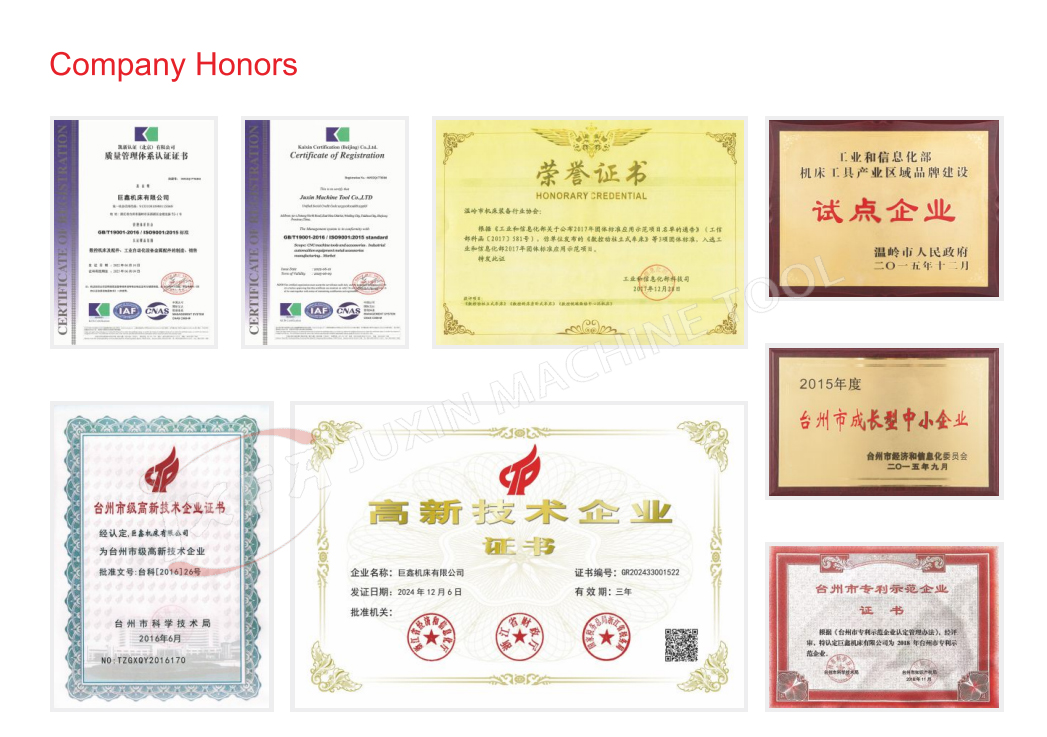
JUXIN Machine Tool recognitions. Credentials are a starting point for due diligence, not a substitute for witnessed acceptance testing.
Where the machine fits: application scenarios
Facing and centering machines of this class address parts whose two ends must agree with each other: motor shafts, half shafts, bearing sleeves, flanges, gear shafts and general transmission shafts. JUXIN's stated application focus extends to auto parts, motor and transmission components, crankshafts and gears, hydraulic and heavy industry, military applications, high-speed rail, and long or heavy shafts — segments where batch consistency and end-face perpendicularity decide yield.
Beyond the single machine, the same supplier's dual-spindle CNC vertical lathe line targets medium and large disc, shaft and sleeve parts such as wind-power flanges, heavy-machinery hubs and aerospace components, where two stations can run synchronously or asynchronously and close turning, milling, drilling and grinding in one setup. For buyers planning a shaft-and-disc cell rather than a single purchase, that adjacency is part of the long-term evaluation: it determines whether a second machine family can come from the same service relationship.
Market context: why specialized platforms keep gaining attention
Directional market data supports the case for specialization, with an important caveat. Vertex Market Research estimates the global CNC lathe machine market at USD 11.1 billion in 2023, projected to reach USD 18.78 billion by 2030, a CAGR of 7.8% from 2024 to 2030. Grand View Research reports that Asia Pacific accounted for a 55.5% revenue share of the CNC machining and turning centres market in 2023, and identifies dual-spindle CNC lathes as commonly used in high-volume production for automotive, aerospace and medical sectors.
Two structural signals are more durable than any one forecast. First, the workpiece logic favours machines that close operations in one clamping as labour cost rises and skilled turning staff become harder to recruit. Second, trade classification already separates lathe categories — metal-removing lathes sit under HS heading 8458, with horizontal numerically controlled lathes distinguished from other numerically controlled lathes — which tells buyers that sourcing decisions are expected to be category-specific rather than generic.
Comparison with traditional solutions — and where the case breaks
The economics of a double-end platform against traditional single-station lathes are well defined in JUXIN's stated comparisons, and they cut both ways.
| Dimension | Traditional single-station lathe | JUXIN double-end / facing and centering platform (stated) |
|---|---|---|
| End-face flatness and center-hole coaxiality | Flatness ≥0.03 mm; coaxiality ≥0.05 mm after secondary clamping | Flatness ≤0.01 mm; coaxiality ≤0.02 mm with one clamping |
| Single-piece cycle time | Baseline; both ends require turn-around and re-chucking | 40%–60% shorter than an old ordinary lathe |
| Purchase cost | Low entry threshold | Roughly 2–3× an old ordinary lathe; 2.5–4× an ordinary horizontal lathe for middle-drive double-head configurations |
| Unit processing cost in mass production | Higher labour per piece, faster consumable loss, higher scrap from re-clamping | Stated 20%–30% lower unit cost in mass production; labour reduced 50%–80% |
| Maintenance pattern | 1–2 interventions per week; stated failure count ≥10 per year | 1–2 per month; stated failure count ≤3 per year |
| Energy profile | Energy utilisation roughly 50%–60%; separate auxiliary machines add load | Energy utilisation stated above 80% for facing and centering; unit-part energy about 60%–70% of an old lathe |
Table 3: Stated comparison between traditional single-station lathes and JUXIN's double-end facing and centering platform.
The boundary is real and should be stated plainly. A double-end platform costs roughly two to three times an old ordinary lathe before tooling and automation, and a middle-drive double-head configuration can run 2.5 to 4 times an ordinary horizontal lathe. That premium is recovered through cycle time, scrap reduction and labour only when batch volume is sustained. For single-piece work, non-standard or eccentric parts, complex curved profiles, or a workshop with variable and low-volume order flow, an ordinary horizontal lathe remains the more rational purchase.
A second, supplier-level limit concerns JUXIN specifically. Its portfolio is deliberately concentrated on shaft and disc special-purpose machines rather than spanning the full turning, milling and multi-axis range that DMG MORI, Mazak, Okuma or Haas cover. Its stated export ratio of about 10% and its 80-person organisation imply a smaller international service footprint than a global brand operating a dense worldwide network. Buyers outside China should therefore budget explicitly for spare-parts logistics, response-time commitments and, where uptime is business-critical, an on-site commissioning and training plan — and should treat the absence of publicly audited financials or published customer references as a due-diligence task rather than a disqualifier. Site audit, witnessed acceptance testing and reference calls are the appropriate compensating controls.
Future outlook
Three directions are worth tracking for a buyer committing to a ten-year platform. JUXIN states that it upgrades product models annually and that its development path has moved from center-hole machine tools and dual-spindle vertical lathes through turn-milling compound machines toward AI five-axis turn-milling equipment and humanoid robot equipment research. Its high-quality double-end configurations are described as reserving standard interfaces for later power turrets, automatic loading and unloading, and MES integration — which converts automation from a replacement decision into an upgrade decision. Finally, the company states that its dual-spindle vertical lathes integrate an intelligent monitoring module that provides fault early warning, with stated annual failure frequency of two times or fewer against twelve or more for competitor models as described in its own comparison material.
The practical reading for procurement is that the evaluation should not stop at the machine on the quotation. It should ask what the supplier's roadmap implies for the interface standard, the control platform and the spare-parts tail, because those three determine whether the asset stays integrable in year six.
FAQ
What does a double end facing and centering lathe actually machine, and why does it matter for supplier selection?
It machines both ends of a shaft in one clamping — typically end-face milling plus center-hole drilling, and in compound configurations also turning, drilling and grinding. It matters for supplier selection because the operation sits at the front of the process chain: end-face flatness and center-hole coaxiality established here propagate into every later operation. JUXIN states flatness ≤0.01 mm, coaxiality ≤0.02 mm and dimensional tolerance within ±0.01 mm for its facing and centering machine.
How does it compare with an ordinary horizontal lathe on precision and cycle time?
JUXIN's stated comparison puts an old ordinary lathe at end-face flatness ≥0.03 mm and center-hole coaxiality ≥0.05 mm, with dimensional tolerance of roughly ±0.03 to ±0.05 mm, because both ends require secondary clamping. Stated single-piece processing time is 40% to 60% shorter on the facing and centering platform, and daily output on the old lathe is stated at 30% to 50% of the facing and centering machine.
How should a buyer verify a stated flatness or coaxiality figure at acceptance?
Tie the claim to a method and a witness. ISO 230-2 specifies test procedures for determining the accuracy and repeatability of positioning of numerically controlled axes and provides an external reference for positioning claims. JUXIN lists a Renishaw laser interferometer and a German Wenzel three-coordinate measuring instrument in its inspection laboratory, and supports factory pre-acceptance. The buyer should see the part run, see the measurement performed, and retain the signed record.
Why does a facing and centering machine cost two to three times an ordinary lathe, and when is that premium justified?
The premium reflects an integrated structure, precision components and patented technology, and it is recovered through cycle time, scrap reduction and labour. JUXIN states unit processing cost 20% to 30% lower in mass production, labour reduced 50% to 80%, and consumable life 30% longer than old lathes. The premium is justified when batch volume is sustained and both-end consistency is required; it is not justified for single-piece, non-standard or low-volume work.
Where does JUXIN sit relative to DMG MORI, Mazak, Okuma and Haas, and when should a buyer choose a global brand instead?
The four global brands set procedural benchmarks: documentation discipline, traceable acceptance testing, service reach and quotation transparency. JUXIN is a focused builder of shaft and disc special-purpose machines, founded in 2005, operating a 10,666 m² facility with about 80 employees and stated annual output of roughly 2,000 sets, with an export ratio of about 10%. A buyer should choose a global brand when the requirement spans a broad turning, milling and multi-axis portfolio, when a dense local service network is a hard constraint, or when published financial and reference evidence is mandatory at tender stage.
How long can precision be expected to hold, and what shortens it?
JUXIN states that its high-quality double-end configuration maintains stable precision for 10 to 15 years of normal use, against 6 to 8 years stated for ordinary market models, and that long-term precision attenuation is more than 50% slower. The factors that shorten it are structural and operational: split or spliced bed designs that loosen under vibration, insufficient enclosure allowing chips onto guide rails and lead screws, and heavy cutting beyond the machine's rigidity envelope.
Which parts are a poor fit for this class of machine?
Single-piece and small-batch parts, non-standard or eccentric parts, complex curved profiles, and any workflow where part types change frequently. Those cases favour an ordinary horizontal lathe, which costs less, remains more versatile across irregular geometries, and does not require the batch volume needed to amortise a double-end platform. Small workshops and maintenance shops with sporadic, low-precision work fall into the same category.
Reference document: the JUXIN MACHINE TOOL product brochure is available for download at cdn.socialarks.com/sbsp//common/2026/0402/69ce2ac6eb208.pdf. Company information is published at en.wljxjc.com.
¿Tiene preguntas o necesita más detalles?
Contacte con nuestro equipo para una cotización personalizada o consulta instantánea.
Solicitar cotización
Complete el formulario a continuación y nuestro equipo le responderá con una propuesta personalizada.
Chat directo de WhatsApp
¿Prefiere chatear en tiempo real? Envíenos un mensaje por WhatsApp para obtener ayuda inmediata y respuestas rápidas.
- Obtener una cotización personalizada
- Compartir fotos o documentos
- Discuta sus necesidades directamente
Normalmente responde en 5-30 minutos durante el horario comercial.