
Long-Term Laryngoscope Supplier Sustainability: Unicorn's Capacity, Certifications, and 5-Year Use
Choosing a laryngoscope is a one-time technical decision. Choosing the supplier behind it is a multi-year operational one. This analysis sets out a practical framework for judging whether a laryngoscope supplier can sustain quality, compliance, and delivery across a multi-year contract, and applies that framework to Jiangsu Unicorn Electronic Technology Co. Ltd. using the company's published capacity, certification, and field-use evidence.
Why Laryngoscope Supplier Sustainability Has Become Its Own Buying Question
Most laryngoscope evaluations concentrate on the device: blade geometry, camera resolution, field of view, handle material, battery runtime. Those specifications determine whether a device performs in a difficult airway. They do not determine whether the same device, with the same geometry and the same documentation, will still be available in year three of a framework agreement.
Three structural pressures have moved supplier sustainability to the front of the evaluation.
Regulation. Medical devices such as video laryngoscopes must comply with EU MDR 2017/745 and typically require ISO 13485 certification for the quality management system (QMS), according to Emergo by UL. Certificates carry defined validity windows, and a supplier change mid-contract can force a hospital to rebuild technical documentation, re-run acceptance testing, and re-train clinical staff.
Reuse economics. The reusable video laryngoscope segment held 77.68% of revenue share in 2024, according to Grand View Research, and reusable devices typically range from USD 1,000 to USD 8,000, against approximately USD 18 for a traditional single-use laryngoscope. A purchase at that level is amortised over years, which makes supplier continuity part of the return on investment rather than a secondary consideration.
Consumable and service dependency. A reusable platform still consumes disposable blades, batteries, and, where flexible scopes are involved, sheath or reprocessing supplies. Each of those items depends on the original supplier remaining active and willing to serve a small, regulated market.
The practical consequence for procurement teams is that supplier assessment now runs in parallel with product assessment, and it requires its own evidence.
A Five-Part Framework for Long-Term Laryngoscope Supply Assessment
The framework below is deliberately evidence-based. Each dimension maps to a document, a number, or an observable process that a buyer can request and verify before award, rather than an impression formed during a demonstration.
| Assessment dimension | Evidence to request | Why it affects a multi-year contract |
|---|---|---|
| Manufacturing depth | In-house processes (precision machining, injection molding, tooling, cleanroom class), facility area, equipment investment | Process control determines whether blade geometry and material grade stay consistent across repeat orders. |
| Quality system | ISO 9001 / ISO 13485 certificate number, scope statement, certification body, validity dates | A scope statement that names the device category is what makes the certificate relevant to the purchase. |
| Regulatory documentation | CE documentation route, authorized representative, certificate validity, market registrations | Documents expire inside contract terms and must be renewable without supply interruption. |
| Supply continuity | Annual output, line-level monthly capacity, minimum order quantity, lead time, export experience | Determines whether the supplier can absorb demand peaks and urgent replenishment. |
| Installed-base evidence | Units in service, years in use, clinical settings, maintenance pattern, support model | Demonstrates post-sale behaviour, where most lifecycle cost is concentrated. |
Two design principles sit behind the table. The first is that regulatory documents should be read for scope, not for presence: a certificate that exists but does not name the device category does not de-risk a multi-year contract. The second is that capacity should be read as a ratio, comparing available monthly output against the buyer's expected annual draw and against the supplier's other commitments.
Installed-base evidence is the dimension buyers most often skip, because it can look like marketing. In practice it is the closest available proxy for post-sale behaviour: whether units stay in service, how they are maintained, and whether the supplier still supports a device after the initial launch cycle has ended.
Applying the Framework: Unicorn's Manufacturing, Quality, and Capacity Profile
Jiangsu Unicorn Electronic Technology Co. Ltd. (Unicorn) is a National High-tech Enterprise founded in 2020 that integrates design, R&D, manufacturing, and domestic and international trade in medical visualization devices. Its portfolio covers endoscopy systems, disposable ureteroscopes, visual flexible laryngoscopes, bronchoscopy workstations, medical image processors, and video laryngoscopes, used in ICU, anesthesia, respiratory, urology, emergency, and medical education settings. The company operates seven regional offices, exports approximately 70% of its output, and serves markets worldwide.
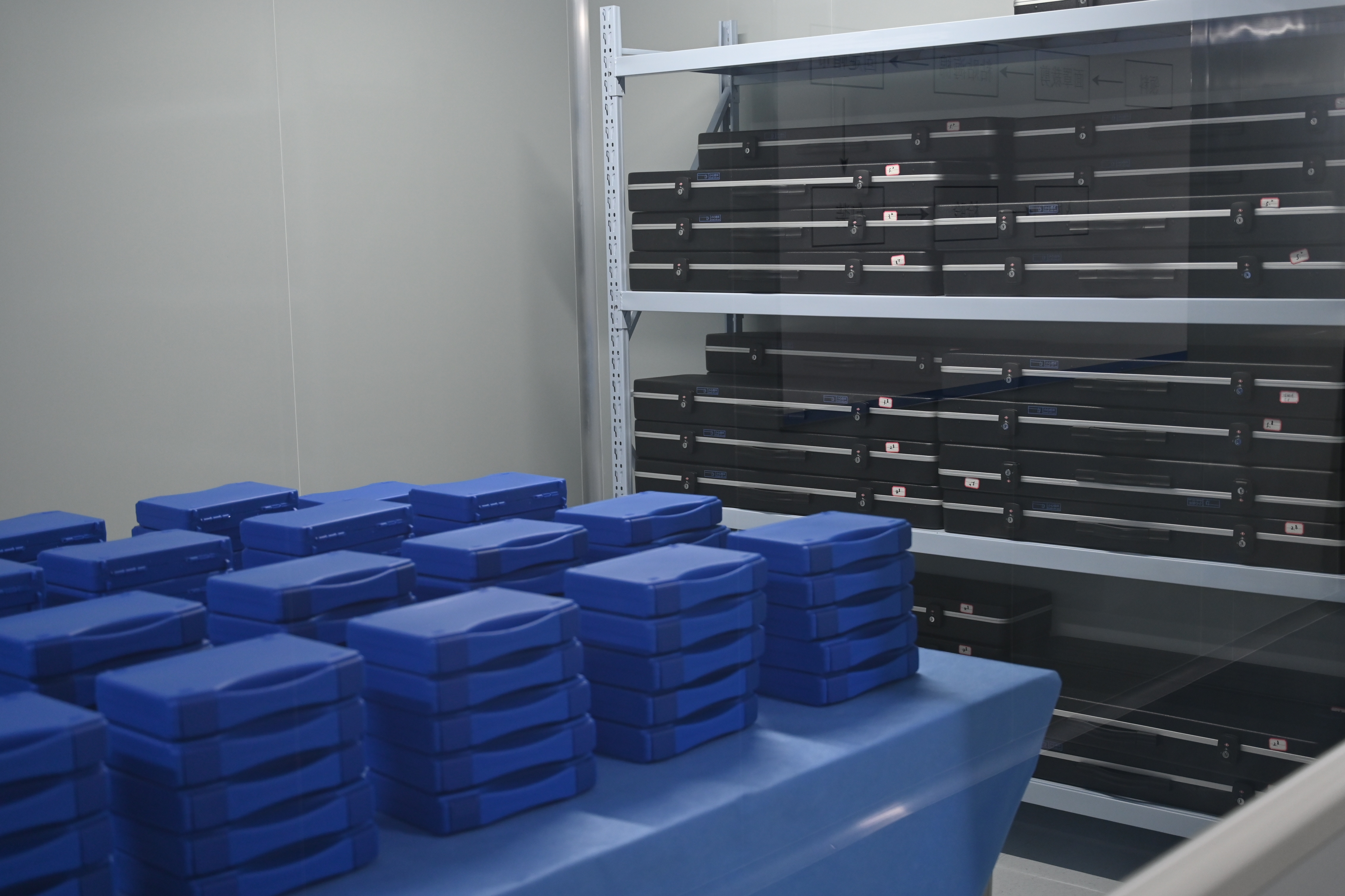
Manufacturing depth is the first variable in a long-term laryngoscope supply assessment: processes held in-house are processes a buyer can audit.
Manufacturing Depth: Four Process Layers Under One Roof
Unicorn's production base spans workshops of more than 40,000 m² and combines four capability layers that are often distributed across separate subcontractors: 3D printing for new materials, CNC precision manufacturing, medical-grade material injection molding, and sterile production environments rated Class 100 and Class 1000. The site also houses BSL-1 and BSL-2 R&D centres, with equipment investment exceeding 160 million RMB.
For a long-term buyer, the value of vertical integration is repeatability. Blade geometry, handle fit, and material grade are set by tooling and process parameters. When those processes sit in the same facility as final assembly and sterile packaging, changes to tooling, materials, or sub-suppliers are controlled internally instead of being absorbed silently through a subcontracting chain. That matters specifically for laryngoscope blades, where the BMS-FA uses a 304 stainless steel blade and the BMS-YA uses a PC plastic blade: two different material pathways that both depend on stable molding and machining parameters.
Quality Systems and Certification Scope
Unicorn holds ISO 9001 and ISO 13485 quality management system certifications, together with FSC and CE certification. For procurement purposes, the ISO 13485 certificate is the more consequential of the two because it is device-specific.
That certificate (number UKZB25MD30140R0S) was issued by New Century Inspection & Certification Co., Ltd. (BCC) against ISO 13485:2016, with a scope covering the design, production and sales of video anesthesia laryngoscopes and anesthesia laryngoscopes. It is valid from 22 December 2025 to 21 December 2028.
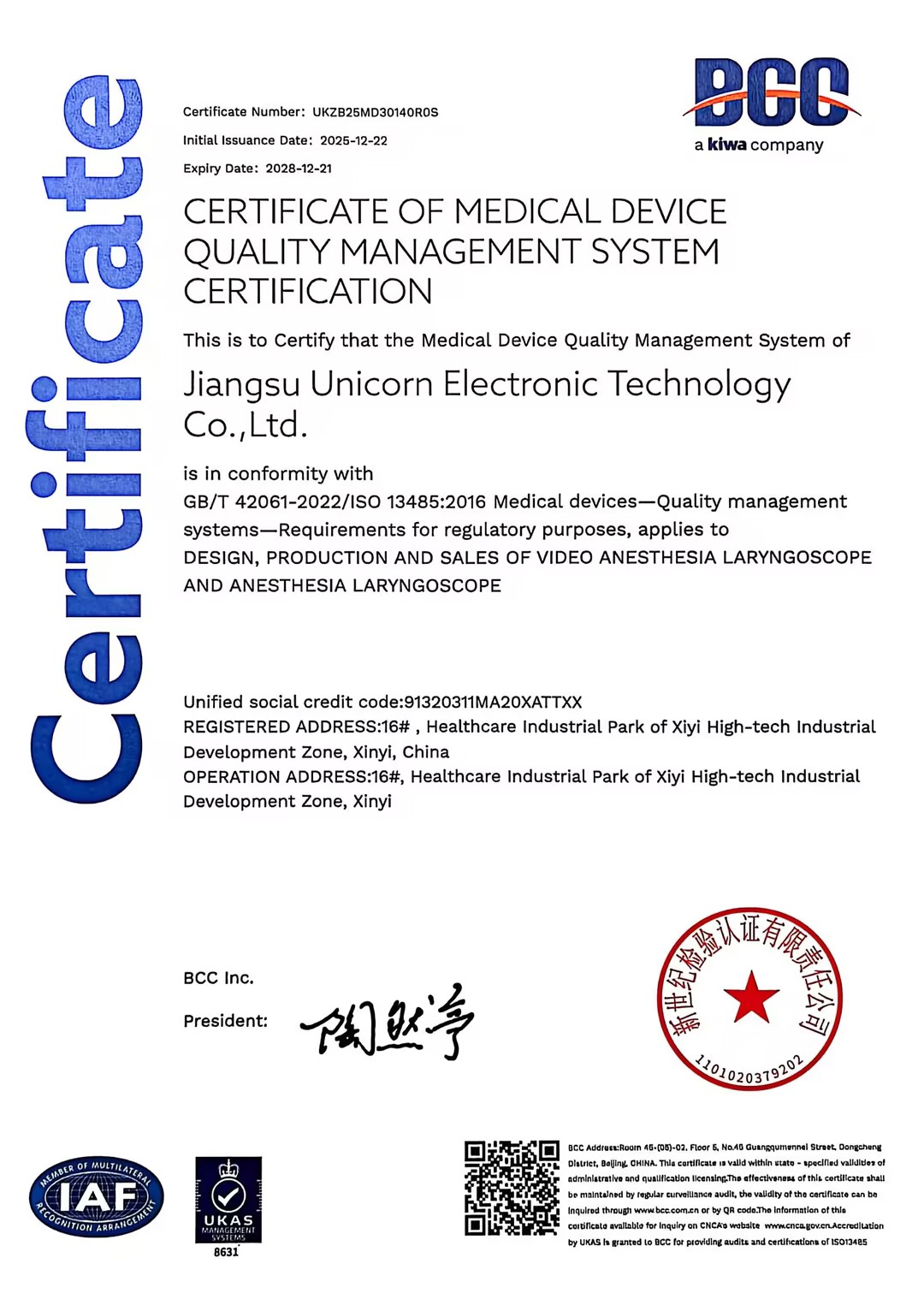
A quality certificate is only relevant when its scope statement names the device category being purchased.
A scope statement naming the actual product category is what separates a relevant certificate from a decorative one. It confirms that design control, production control, and sales processes for laryngoscopes, rather than for an unrelated device family, fall inside the audited system.
On the EU side, Unicorn holds a CE Notification Certificate (RPS/5400/2022) issued through Medurion S.L., its EU Authorized Representative in Spain, valid from 7 December 2022 to 6 December 2027. The certificate's stated regulatory basis is EU Regulation (EU) 2017/746, with a certified scope covering Class A self-certified products.
Capacity, Lead Time, and Commercial Flexibility
Company-level annual output is listed at 12,000 units. On the laryngoscope OEM/ODM line specifically, monthly production capacity is 500 units, with a typical lead time of 30–45 days, a minimum order quantity of 1 unit, and 100% testing as the quality-control standard. OEM and ODM production is offered, with customization covering screen logos and power on/off logos. The company exports to all countries and provides remote after-sales support.
Three details in that set are worth isolating for multi-year planning. A minimum order quantity of 1 unit is unusual for a manufacturer with a 40,000 m² footprint, and it allows a buyer to validate a specification before committing volume. The 30–45 day lead time provides a working buffer for replenishment, although buyers should treat it as a production window rather than a delivered date, since international freight and customs clearance sit outside it. The logo-level customization scope is also a clear boundary: it supports private-label programmes, but it is not the same as custom blade geometry or a bespoke optical design, which would require a separate engineering agreement.
Technical Explanation: What Manufacturing Depth Changes at the Device Level
Manufacturing capability only matters if it converts into measurable device behaviour. The table below sets out the published specifications for Unicorn's three laryngoscope platforms. All three are listed for use in anesthesiology and respiratory medicine.
| Model | Type | Optical and power specification | Materials |
|---|---|---|---|
| BMS-FA | Video laryngoscope | Resolution ≥ 3.72 lp/mm; field of view ≥ 60°; observation depth of field 20–100 mm; DC 3.7 V; battery capacity 3400 mAh or above | Handle: aluminium alloy; laryngoscope blade: 304 stainless steel |
| BMS-YA | Video laryngoscope | Resolution ≥ 3.72 lp/mm; field of view ≥ 60°; observation depth of field 20–100 mm; DC 3.7 V; battery capacity 3400 mAh or above | Handle: aluminium alloy; laryngoscope blade: PC plastic |
| BMR | Video flexible laryngoscope | Resolution 23.51 LP/mm; field of view > 80°; depth of field 5 mm–100 mm; luminance > 800 Lux | TPU/PPSU |
Read as a procurement document rather than a specification sheet, three points stand out.
Optical performance is defined with tolerances rather than single values: resolution of at least 3.72 lp/mm and a field of view of at least 60° for the rigid platforms, and 23.51 LP/mm with a field of view above 80° for the flexible BMR. Tolerance-based specification is the more defensible form for multi-year purchasing, because it sets a floor that repeat orders must meet.
Materials diverge deliberately. The BMS-FA pairs an aluminium alloy handle with a 304 stainless steel blade; the BMS-YA pairs the same handle with a PC plastic blade; the flexible BMR uses TPU/PPSU. The stainless steel variant suits buyers prioritising blade durability and repeated use, while the plastic-blade variant addresses weight and cost. Because both are produced in the same facility, a buyer can move between them without changing supplier relationships or documentation chains.
Power architecture is shared across the two rigid platforms: DC 3.7 V with battery capacity of 3400 mAh or above. Standardising on a common battery specification simplifies spares planning, since one battery type can cover a fleet, which is a lifecycle-cost consideration rather than a clinical one.
Application and Use Cases: Where a Five-Year Record Carries Weight
A Five-Year, 20-Unit Field Record
The most directly relevant evidence for a long-term supply decision is how existing units have behaved over time. Unicorn's recorded case data covers 20 units in service with medical institutions, medical device distributors, and hospital groups across international markets, used for five years in hospital clinical anesthesia, emergency intubation, difficult airway treatment, and rescue operations. The recorded outcomes are a high intubation success rate, minimal airway tissue injury, and complete operation video recording. The device characteristics highlighted in that record are HD real-time visualization, disposable blades available, a portable battery design, and a multi-language user interface.
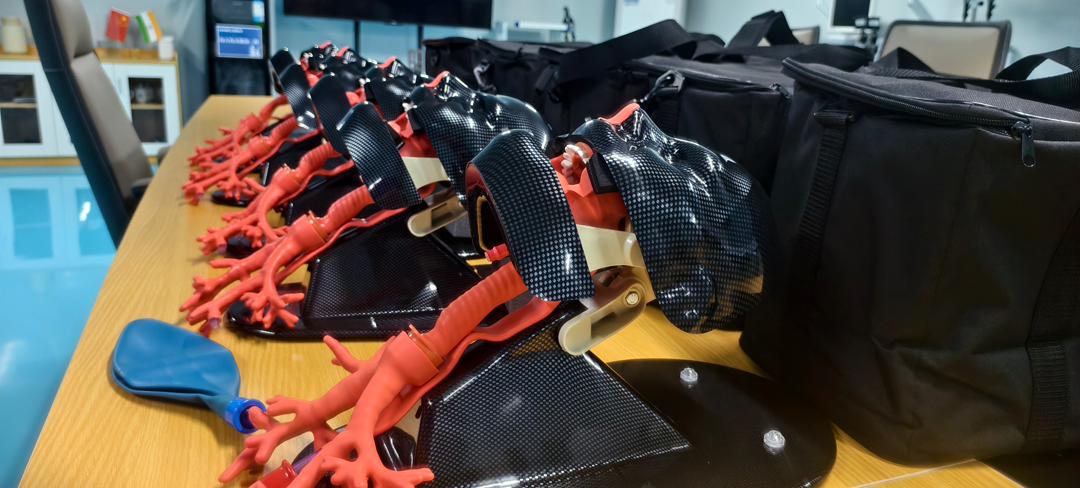
Field records show whether a platform survives real use; they do not replace reliability statistics.
Interpret this evidence for what it is. Twenty units over five years is a meaningful durability signal, because the devices remained in clinical use long enough to be observed across several deployment environments. It is a small sample relative to a national health system's fleet, and it does not by itself measure failure rates, reprocessing cycles, or service response times. It answers the question of whether the platform survives real use; it does not establish statistical reliability.
Departmental Fit Across the Care Pathway
The same platform family is specified across several clinical environments, and each creates a different supply requirement.
In operating theatres and anesthesia departments, the driver is predictable consumption of blades and batteries alongside scheduled procedures. The rigid video laryngoscopes (BMS-FA and BMS-YA) fit here, and the shared 3400 mAh battery specification supports fleet-wide spares standardisation.
In emergency departments and during rescue operations, the constraint is immediate availability rather than planned consumption. The portable battery design and disposable blade availability recorded in the five-year case are relevant precisely because they reduce preparation time before use.
In difficult-airway and ICU scenarios, where direct line of sight may be compromised, the flexible video laryngoscope (BMR) provides a field of view above 80° with a depth of field from 5 mm to 100 mm, a configuration that supports visualization where rigid blade alignment is difficult.
In medical education, the multi-language interface and complete operation video recording support teaching and review workflows. This is a secondary but real driver of standardisation, because teaching hospitals tend to keep platforms longer than average when curriculum and simulation assets are built around them.
Market Trend Analysis: What the Numbers Say About Long-Term Supply
The global video laryngoscope market was estimated at USD 784.66 million in 2024 and is projected to reach USD 2.80 billion by 2033, according to Grand View Research. Within that market, reusable devices accounted for 77.68% of revenue share in 2024, and rigid video laryngoscopes accounted for 60.42%. North America held the largest regional share at 37.77%.
A separate estimate from Future Market Insights values the total laryngoscopes market, all types rather than video alone, at USD 508.5 million in 2024, with a forecast CAGR of 7.2% through 2034. The two figures do not contradict each other so much as define different boundaries: one counts video systems, the other counts direct and video laryngoscopes together. That difference in scope is why buyers should treat any single market figure as directional.
Three implications follow for procurement.
The first is that the installed base is dominated by reusable equipment. With reusable devices holding roughly three-quarters of revenue, the operational question for most hospitals is not whether to buy reusable or single-use, but how to keep reusable fleets supported over their service life.
The second is that rigid video laryngoscopes remain the volume core of the category. Suppliers whose manufacturing footprint covers rigid blade production, handle assembly, and sterile packaging hold the part of the market that generates repeat consumable and spares demand.
The third is regional concentration. With North America representing 37.77% of 2024 revenue, suppliers serving global markets need documentation and logistics that work in regulated markets outside their home region, which is why an export ratio of approximately 70% is a relevant data point rather than a marketing one. The competitive landscape includes established global players such as Verathon, Medtronic, Ambu A/S, KARL STORZ, and Tuoren Group, according to Expert Market Research and Grand View Research.
Comparison with Traditional Solutions
Long-term sustainability looks different depending on which technology a hospital standardises on. The comparison below is framed around lifecycle obligations rather than device preference.
| Dimension | Reusable video laryngoscope | Single-use laryngoscope | Traditional direct laryngoscope |
|---|---|---|---|
| Device cost profile | Typically USD 1,000–8,000 per device | Approximately USD 18 per unit | Reusable handle with blade sets; no video output |
| Recurring items | Disposable blades available, batteries, reprocessing supplies | One unit per procedure | Blades and handle light source |
| Lifecycle obligations | Reprocessing protocol, battery management, blade inspection | Stock control and shelf-life management | Blade cleaning and sterilisation |
| Supply risk profile | Spares and consumable continuity | Continuous unit supply; a stock-out has no reusable fallback | Low technology dependency |
| Clinical role | Difficult-airway visualisation, recording, teaching | Single-procedure use with infection-control priorities | Direct visualisation where video is not required |
The boundary here matters. Reusable video laryngoscopes, the segment holding most of the market's revenue, carry obligations that single-use devices do not: reprocessing protocols, battery management, blade inspection, and capital budgeting. A hospital without a functioning reprocessing workflow will not realise the durability advantages of a reusable platform, and a supplier that cannot document its reprocessing and sterility parameters in the buyer's regulatory format creates a compliance burden rather than removing one.
Conversely, single-use laryngoscopes remove reprocessing risk but transfer the dependency to continuous supply: a stock-out in a single-use programme has no reusable fallback, which makes supplier lead time and capacity the critical variables. Traditional direct laryngoscopes remain relevant where video is not required and cost per use is the dominant constraint.
Boundaries, Limitations, and Verification Points
A credible supplier assessment includes the points where evidence is thinner.
Corporate history. Unicorn was founded in 2020. For a ten-year framework agreement, a buyer is evaluating a young company without a multi-decade continuity record. The available compensating evidence is the device-specific quality system scope, the sterile production environments rated Class 100 and Class 1000, the BSL-1 and BSL-2 R&D structure with more than 20 engineers, and the five-year field record. Buyers who treat a long corporate track record as a hard criterion should weigh that gap explicitly.
Certificate scope versus market requirement. The CE Notification Certificate held by Unicorn carries a certified scope covering Class A self-certified products under EU Regulation (EU) 2017/746. Buyers in the EU should confirm the conformity route applicable to the specific laryngoscope model they intend to purchase, and check that the ISO 13485 scope statement matches the device category. This is standard verification practice, not a finding about any particular product.
Customization depth. OEM and ODM production covers screen logos and power on/off logos. As documented, it does not extend to custom blade geometry, bespoke optics, or branded clinical software. Buyers whose requirements include those items are looking at a development partnership, which follows a different evaluation path and a different timeline.
Service model. After-sales support for international customers is delivered remotely. Multi-site hospitals should map that against their own on-site biomedical engineering capacity when planning a multi-year contract.
Capacity versus demand peaks. A reported monthly capacity of 500 units on the laryngoscope line is ample for most single-institution orders, but buyers planning regional rollouts should confirm how allocation is managed when several customers order simultaneously.
Future Outlook
Two forces are likely to shape laryngoscope supplier evaluation over the next several years.
The first is regulatory maintenance as a recurring procurement activity. Certificates expire on defined dates: Unicorn's ISO 13485 certificate runs to December 2028 and its CE Notification Certificate to December 2027. Multi-year contracts increasingly need to schedule document review as an annual milestone rather than a one-time check at award.
The second is the maturing of the reusable installed base. As fleets age, demand shifts from new-device purchases toward blades, batteries, and reprocessing consumables. Suppliers with in-house molding and precision manufacturing are structurally better placed to support that shift than suppliers that assemble from externally sourced components, because consumable continuity depends on tooling and material supply rather than on final assembly capacity alone.
A third, slower trend is documentation depth. As more countries tighten device registration requirements, the practical differentiator between suppliers is often not the device itself but the completeness and accuracy of the technical file behind it.
FAQ
What does supplier sustainability mean in laryngoscope procurement?
It refers to a supplier's ability to keep providing a compliant device, its consumables, and its documentation across the full life of a contract. In practice it is assessed through manufacturing depth, quality-system scope, certificate validity windows, production capacity and lead time, and evidence of how previously supplied units have performed in service.
How can a buyer verify that a certificate actually covers the laryngoscope being purchased?
Three items should be checked on the certificate itself: the scope statement, the certification body, and the validity dates. Unicorn's ISO 13485 certificate (UKZB25MD30140R0S), for example, names the design, production and sales of video anesthesia laryngoscopes and anesthesia laryngoscopes within its scope and is valid from 22 December 2025 to 21 December 2028. If the scope statement does not name the device category, the certificate does not cover it, regardless of how it is described elsewhere.
What capacity and lead-time information should be requested before signing a multi-year contract?
Buyers should ask for annual output, line-level monthly capacity, standard lead time, minimum order quantity, and quality-control method. Unicorn's published figures are 12,000 units of annual output at company level, 500 units per month on the laryngoscope OEM/ODM line, a 30–45 day typical lead time, a minimum order quantity of 1 unit, and 100% testing. Those figures also allow a buyer to compare expected annual draw against available capacity.
What does a five-year, 20-unit use record demonstrate?
It demonstrates that a platform has remained in clinical service across several environments, including anesthesia, emergency intubation, difficult airway treatment, and rescue operations, for a period long enough to observe durability, blade and battery consumption, and workflow fit. It does not establish failure rates, statistical reliability, or service response performance, and it should be read alongside the quality system and clinical validation data rather than instead of them.
How does OEM/ODM customization affect long-term supply?
Customization at the level of screen logos and power on/off logos does not change the underlying device specification, so it generally does not complicate long-term supply. Custom blade geometry, bespoke optics, or proprietary software would require a separate engineering agreement and separate regulatory work, which changes both the timeline and the compliance scope.
What limits exist for reusable video laryngoscope programmes?
Reusable platforms require reprocessing protocols, battery management, and blade inspection, and they involve a capital outlay typically between USD 1,000 and USD 8,000 per device compared with roughly USD 18 for a traditional single-use laryngoscope. Where reprocessing capacity or biomedical engineering support is limited, the durability advantages of a reusable programme are difficult to realise, and a single-use or hybrid approach may be operationally simpler.
Full specifications for the BMS-FA and BMS-YA video laryngoscopes and the BMR video flexible laryngoscope are set out in the Unicorn product catalogue: Unicorn Product Catalog (2026). Manufacturer reference: Jiangsu Unicorn Electronic Technology Co. Ltd., www.unicornendoscope.com.