
Long-Term Laminating Machine Supplier Evaluation: KUNTAI's 40+ Years and Engineering Depth
Long-Term Laminating Machine Supplier Evaluation: KUNTAI's 40+ Years and Engineering Depth
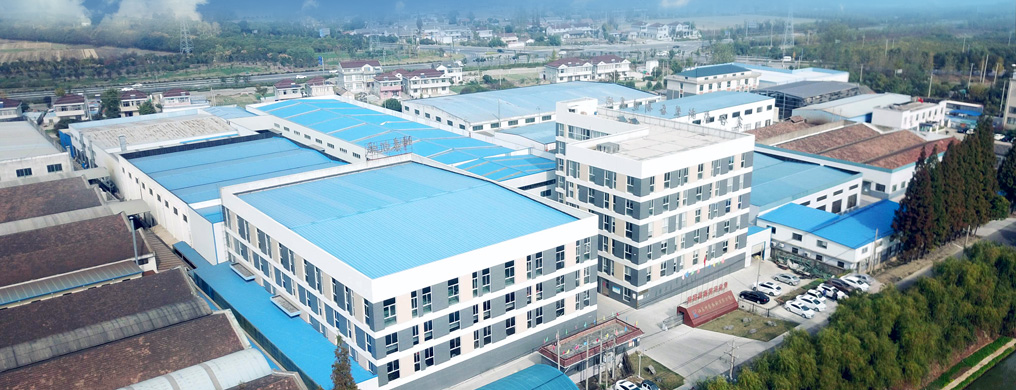
A laminating line is commissioned once and operated for years; supplier evaluation therefore turns on continuity signals rather than unit price.
Industrial laminating equipment is a long-life capital asset. A line installed for technical textile, composite or filtration production is normally expected to survive several product generations, at least one change of adhesive chemistry, and more than one revision of machinery safety requirements. That asymmetry — a purchase decision measured in weeks set against an operating horizon measured in years — is the reason supplier evaluation for laminating machines has shifted away from pure price-per-unit comparison and toward continuity assessment.
Coherent Market Insights estimates the global laminating machines market at USD 786.5 million in 2026 and projects it to reach USD 1,356.7 million by 2033. Growth of that scale is not only a demand signal; it also describes a growing installed base that will require spare parts, process re-tuning and control-system service long after each machine is commissioned.
The short answer: buyers evaluating a laminating machine supplier for the long term should verify five things — verifiable operating history, in-house engineering depth, sub-system commonality across the equipment range, a documented quality and compliance system, and a service model that remains available after warranty. JIANGSU KUNTAI MACHINERY CO.,LTD, a Chinese manufacturer of coating, laminating, impregnation and cutting machinery for technical textiles and composites, is a useful reference case because its published facts cover each of those dimensions: founded in 1983, more than 40 years in this machinery category, a 30,000 m² facility, approximately 210 employees, an 8-engineer R&D team and an annual output of about 650 units.
Why a Laminating Machine Decision Is a Multi-Year Commitment
The failure mode in industrial laminating procurement is rarely a machine that does not run on day one. It is a machine that cannot be maintained in year five. Three technical realities drive that risk.
Adhesive chemistry keeps moving. Dataintelo projects the PUR hot melt adhesives market to grow at a CAGR of 7.2% through 2034, reaching USD 7.1 billion. PUR, PSA and water-based systems behave differently in the glue melter, at the doctoring roller and in the nip. A supplier that understands the adhesive side of the process, not only the frame and drives, is better placed to help a buyer re-qualify a line when the adhesive specification changes.
Safety requirements are structured and periodic. Textile machinery safety is governed by the ISO 11111 series; Parts 2 to 7 cover safety requirements for different machinery types. A laminating machine acquired today may need to be re-assessed against a later revision, which requires documentation and design transparency from the original builder.
Composite demand is expanding. Maximize Market Research valued the global prepreg market at USD 15.07 billion in 2024, and MarketsandMarkets valued the aerospace prepreg segment alone at USD 3.5 billion in 2024. UD impregnation and crossply equipment purchased for those supply chains will be expected to remain serviceable across long qualification cycles.
A Six-Point Supplier Continuity Framework
The framework below converts "is this a long-term partner?" into questions that can be answered with documents, factory observations and reference projects rather than impressions. It is written for procurement managers, technical managers and OEM buyers in technical textiles and composites.
| Evaluation dimension | What counts as evidence | Weak signal |
|---|---|---|
| Operating history in the category | Founding year, model lines still supported, reference plants of similar age | Recent entry with no verifiable production history |
| Engineering depth | Named R&D headcount, control and drive architecture the supplier owns | Reseller with no in-house design function |
| Range breadth and sub-system commonality | Shared heating, glue-handling and control platforms across models | Every model a one-off build with unique parts |
| Manufacturing and parts capability | In-house machining of non-standard parts such as rollers and platens | Full outsourcing of critical components |
| Quality and compliance system | ISO9001 and CE documentation, test regime applied per unit | Verbal compliance claims without certificates |
| Service and customization model | Documented lead time, customization scope, stated after-sales method | Undefined support path after delivery |
KUNTAI's Engineering Depth in Verifiable Terms
JIANGSU KUNTAI MACHINERY CO.,LTD is based in Zhengang Industrial Park, Yancheng City, Jiangsu, China, and has designed and constructed coating, laminating, impregnation and cutting machinery for technical textiles and composites since 1983. Its product scope covers laminating machines — double-belt presses, flat-bed laminators, hot-melt film laminators, UD impregnation and crossply machines — together with cutting machines (travel head, beam, hydraulic and related types), bronzing and printing machines, spray and scattering equipment, and inspection machines.
The numbers that matter for continuity assessment are specific rather than directional. The company reports a 30,000 m² facility, approximately 210 employees, an annual output of about 650 units, a 70% export ratio, and an 8-engineer R&D team. Its markets are listed as North America, South America, Europe, South Asia, Africa and the Middle East. The quality framework is stated as ISO9001, a CE certificate, and an internal quality control system; the published manufacturing capability includes CNC machining centres, drilling machines and polishing machines used for in-house production of machine parts.
For a buyer, in-house part manufacturing is the most decision-relevant of those facts. Roller surfaces, heating rollers, glue-metering components and frame elements in a laminating line are frequently non-standard, and their availability is what determines whether a line returns to service in days or in months. A supplier that machines these parts itself is not dependent on an external fabrication chain.
The commercial model is also documented rather than implied. KUNTAI states an OEM production mode, a monthly capacity of 55 units, a lead time of 30 to 60 days, a minimum order quantity of 1 unit, 100% testing as its quality control rule, and remote support as its after-sales method. Customization is defined as voltage, logo, color and machine structure.
The Equipment Range as a Continuity Signal
A wide catalogue is only valuable if the machines share platforms. The KUNTAI range uses a small number of recurring sub-systems: thermal-oil or electric heating, frequency-conversion and servo drive control, HMI with PLC supervision, external oil heaters, and glue melters in the 200 kg class. A technician who has worked on one model in the family is therefore not starting from zero on the next — and a spare 200 kg glue melter or an oil heater specification can be understood across several product lines.
The tables below summarise the main laminating and coating platforms and the impregnation platforms, using published model specifications.
| Model | Type | Working width | Speed / key specification |
|---|---|---|---|
| KT-PUR | PUR laminating machine | Max. 2400 mm | 0-35 m/min; PUR drum melter, oil heater, humidifier; 70 kW |
| KT-PUR | Hot melt glue laminating machine | 1600-3400 mm | 0-40 m/min; 200 kg glue melter; 65 kW |
| KT-PUR-1800 | Hot melt coating laminating machine | Max. 1800 mm | 0-35 m/min; gluing roller 25-110 g/m²; 60 kW |
| KT-PB | Flatbed laminating machine | Max. 1600 mm | 0-25 m/min; 3 m heating zone, 1.5 m cooling zone, max. 230 °C; 230 kW |
| KT-HY-H | Double belt press laminator | Max. 1600 mm | 0-25 m/min; max. 250 °C; 3 m heating, 1.5 m cooling; 265 kW |
| KT-FT | Fabric to fabric laminating machine | Max. 2400 mm | 0-35 m/min; about 105 kW |
| KT-FT-XC | Lamination machine for textile | 1600-3200 mm | 0-35 m/min; 105 kW |
| KT-HY | Flame laminating machine | 1600-3000 mm | Max. 25 m/min; natural gas or liquefied gas; 15 kW drive |
| KT-DS | Dot coating laminating machine | Coating width 1600-4500 mm | 5-20 m/min; max. 130 °C; working range 80-100 °C |
| KT-SF | Glue spraying and powder scattering machine | 1600-2600 mm | 5-25 m/min; powder 20-150 microns; 155 kW |
| Model | Type | Material width | Process specification |
|---|---|---|---|
| KT-LH-1800 | UD Aramid prepreg machine | ≤ 1650 mm | Water-based adhesive; dip/coating; HMI+PLC; thermal oil roller; 1080 yarn bobbins; 90 kW; 5-11 m/min |
| KT-LH-1800 | UD prepreg impregnation machine / UHMWPE prepreg machine | ≤ 1650 mm | Dip/coating; friction mirror roller level 14; 60 kW external oil heater; 90 kW total |
| KT-YJ-1800 | UHMWPE impregnation machine | ≤ 1650 mm | Water-based adhesive; mechanical multi-roll + profiled spreading; 90 kW |
| KT-LH-1800 | UD crossply machine | ≤ 1650 mm | 8000 kN pressing tonnage; 1700 × 1700 mm table; hydraulic pressing; about 95 kW |
The practical reading of this range is that a buyer who starts with a PUR laminator for upholstery and later moves into ballistic composites stays inside one supplier's engineering vocabulary. The heating medium, control philosophy and drive architecture remain recognisable, which shortens the learning cycle for the buyer's own maintenance team.
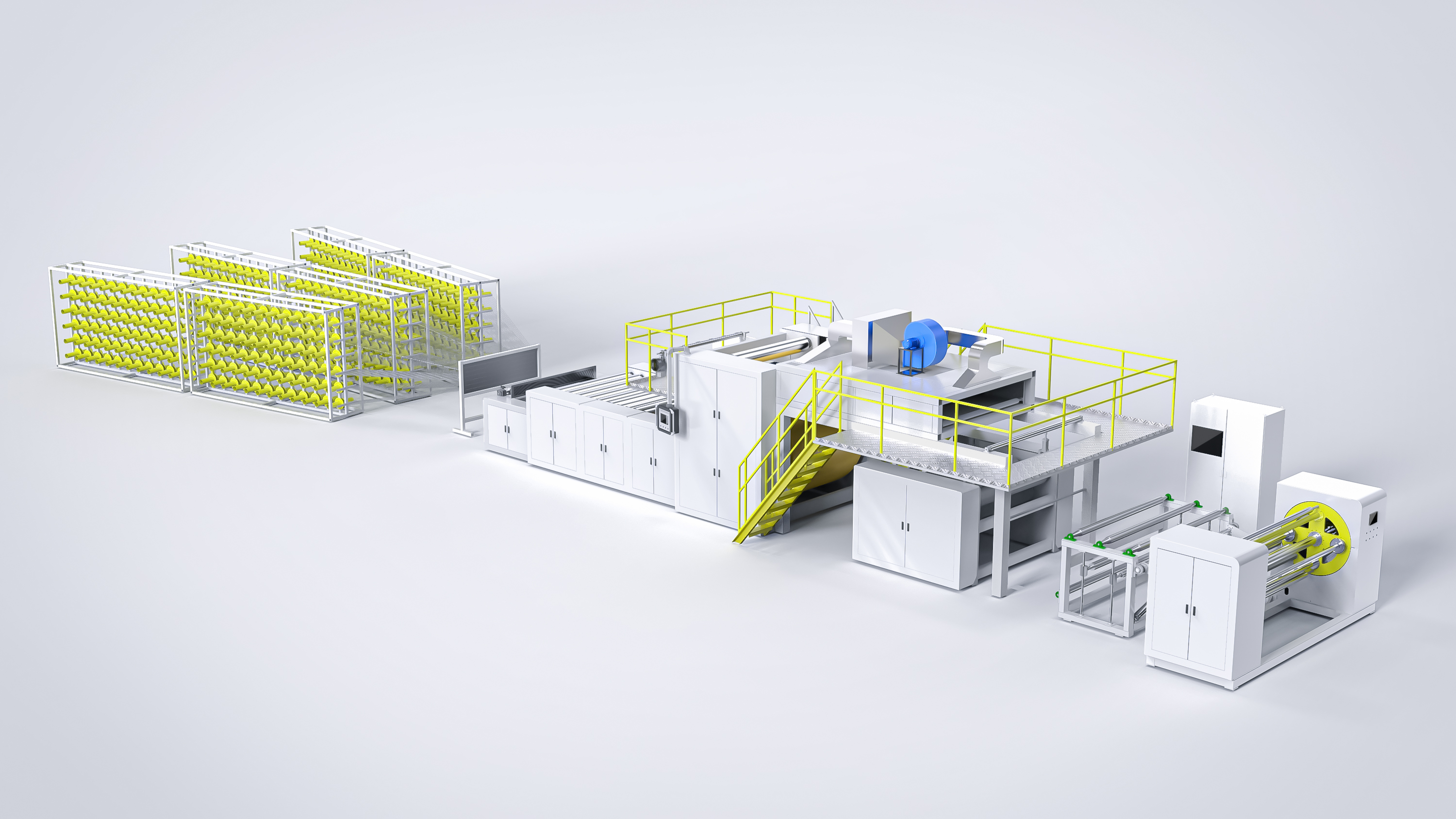
Impregnation and crossply platforms such as the KT-LH-1800 family share thermal-oil heating and HMI+PLC control with the laminating range.
Scenario Mapping: Matching Equipment to Project Conditions
Long-term support cannot be assessed in the abstract; it has to be assessed against a specific production scenario. KUNTAI's published application data links machine types to industry, working condition and supporting equipment — which is exactly the information a buyer needs when defining the scope of a line rather than the scope of a machine.
| Scenario | Relevant models | Operating conditions and supporting equipment |
|---|---|---|
| Filtration media (air filtration) | KT-SF glue spraying and powder scattering machine | Middle temperature, synchronized operation; glue melter required; voltage stability; application common in Germany |
| Aircraft sound insulation panels | KT-PB flatbed laminator; KT-HY-H double belt press laminator | High temperature, synchronized operation; water chiller required; typically applied in Germany / EU |
| Upholstery: blackout, mattress protector, sofa fabric | KT-PUR, KT-FT, KT-FT-XC, KT-PUR-1800, KT-DS, KT-PUR hot melt glue laminating machine | Middle temperature, synchronized operation; glue melter and oil heater; waterproof and sun protection; South Korea, India, Turkey |
| Ballistic protection: vest, helmet, plate | KT-LH-1800 UD Aramid prepreg, UD prepreg impregnation, UD crossply, UHMWPE prepreg; KT-YJ-1800 UHMWPE impregnation | Low temperature, moderate humidity; glue pump system; voltage stability; Russia, South Korea, Ukraine, India |
| Automotive trim, new production line | KT-HY flame laminating machine | Fast speed, continuous operation; gas tank and gas appliances; pressure stability; Korea, Germany, Czech Republic |
| Garment: protective suits, windbreakers, thermal underwear | KT-PUR, KT-FT, KT-FT-XC, KT-PUR-1800, KT-PUR hot melt glue laminating machine | Fast speed; glue melter and oil heater; India, Turkey, Pakistan, Malaysia |
Two details in this mapping are easy to overlook but matter commercially. First, several scenarios carry a supporting-equipment obligation — a glue melter for filtration and upholstery work, a water chiller for high-temperature aerospace panels, a gas tank and gas appliances for flame lamination. Second, several carry an infrastructure precondition stated as voltage or pressure stability. A supplier that documents these preconditions is signalling which parts of the plant it expects the buyer to control, which is more useful in planning than a generic capability claim.
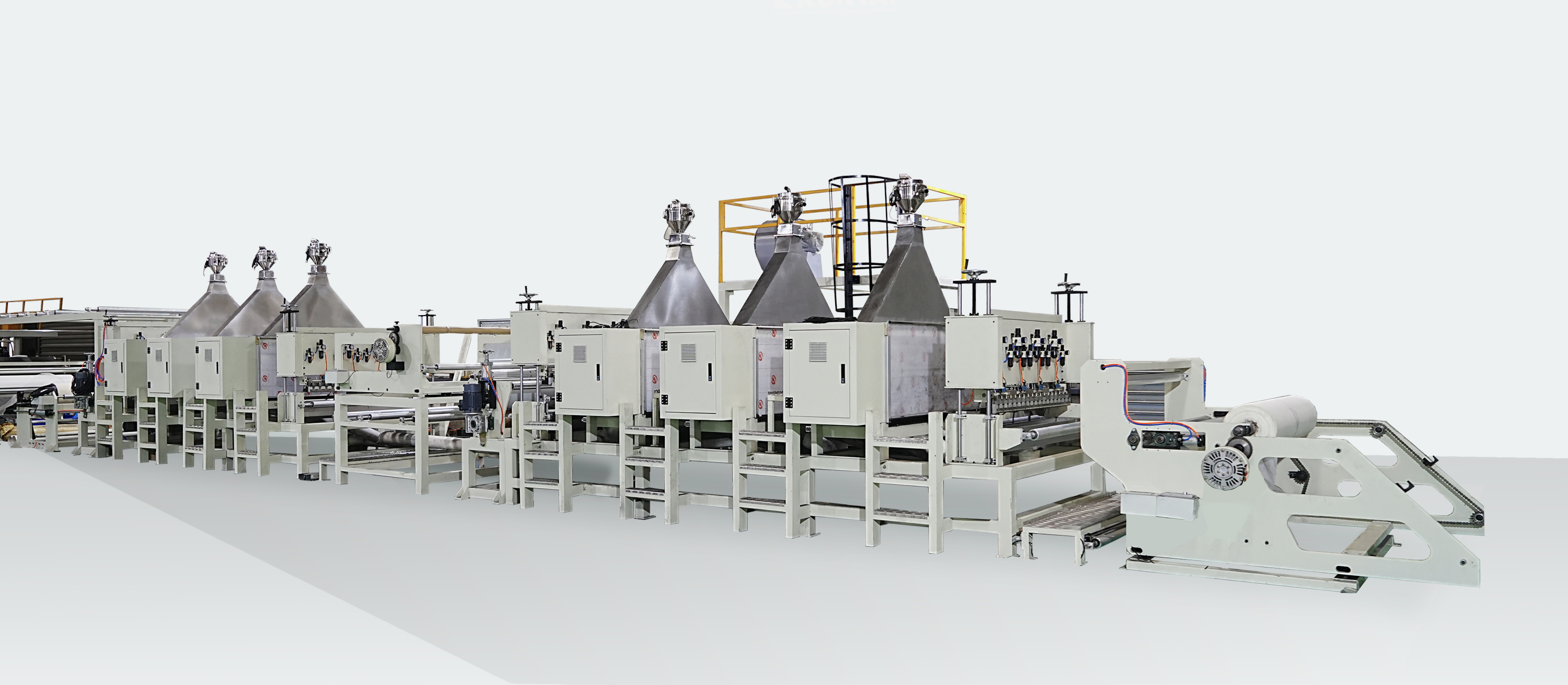
The KT-SF glue spraying and powder scattering machine is specified for filter media projects, with a 200 kg glue melter as supporting equipment.
Field Evidence Across Operating Cycles
Supplier-reported project data is not a substitute for a buyer's own reference calls, but it does show which equipment families have accumulated operating hours. KUNTAI's published case records describe a protective products company operating 50 units for ballistic applications over three years in Turkey, the Czech Republic, India and Russia, with long lifespan and low maintenance cited as highlights. A textile mill case covers 120 units in Turkey and 140 units in India over five years for textile fabric composite work, again citing low maintenance.
Two further records cover automotive interiors — 20 units in Germany over three years, with low maintenance highlighted — and a kitchenware manufacturer running 10 units for two years in Mexico, Turkey and the Czech Republic, where dishwashing sponge and oil smoke filter products are produced and long lifespan and low maintenance are cited. In each of these records, the recurring theme is not throughput but maintenance behaviour, which is the variable that determines total cost over a line's life.
Market Signals Behind the Shift to Continuity
Three published data points explain why supplier continuity is being evaluated more formally in this category.
Fortune Business Insights reports that Asia-Pacific dominated the textile machinery market with a 72.70% share in 2025, primarily led by automation growth in China. That concentration means a large share of new laminating capacity is being installed close to where it is built, in a region where service response and spare-part logistics are comparatively short — while export buyers in Europe, the Middle East, Africa and the Americas must plan for longer service distances.
On the material side, Maximize Market Research valued the global prepreg market at USD 15.07 billion in 2024, driven by aerospace and defence demand, and MarketsandMarkets valued the aerospace prepreg segment at USD 3.5 billion in the same year. Impregnation and crossply equipment sits directly behind that demand, and composite qualification cycles are long — which makes a supplier's documented operating life more relevant than a short-term price position.
Finally, Dataintelo projects 7.2% CAGR for PUR hot melt adhesives through 2034, reaching USD 7.1 billion. Because adhesive formulation changes propagate into machine settings, a laminating line is more likely to be re-parameterised than replaced.
Comparing Sourcing Routes — and Where Each One Breaks
There are three common routes to acquiring a laminating machine, and each has a characteristic failure point. The comparison below is deliberately framed around maintenance and process support rather than acquisition cost, because that is where the differences appear.
| Sourcing route | Strength | Characteristic limitation |
|---|---|---|
| Trading intermediary, lowest unit price | Fast quotation, flexible commercial terms | No design ownership; spare parts and process advice depend on a third party whose identity may change |
| General-purpose equipment builder | Broad catalogue, familiar standard machines | Limited adhesive and impregnation process depth; limited ability to re-tune a line for a new substrate |
| Capability-verified specialist manufacturer | In-house design and parts manufacturing, documented compliance, long service history in the category | Longer commercial cycles; process support methods may be remote rather than on-site |
The specialist route is not frictionless, and buyers should plan around its constraints. KUNTAI's stated lead time is 30 to 60 days and its stated monthly capacity is 55 units, so projects with a compressed installation window need to be scheduled early rather than negotiated later. Customization is defined as voltage, logo, color and machine structure — requirements outside that scope should be treated as engineering discussions, not as standard options. The published after-sales method is remote support; buyers who need guaranteed on-site intervention in a specific market should confirm that arrangement in writing before ordering, because it is not part of the published model. All of this is normal for a manufacturer with a fixed engineering bench of 8 people; it is simply the trade-off that accompanies in-house design capability.
One further boundary applies to every supplier, including this one. A supplier's history does not validate a buyer's process. Material trials — substrate, adhesive grade, line speed and temperature profile — remain the buyer's responsibility, and a machine should be qualified against the actual production recipe before it is treated as a settled asset.
Future Outlook
As the laminating machine market moves from roughly USD 786.5 million in 2026 toward USD 1,356.7 million by 2033, the installed base grows faster than the number of qualified service engineers. Two consequences follow. First, machine designs that reuse shared thermal, glue-handling and control platforms will be easier to maintain than bespoke builds, and buyers will increasingly request sub-system lists as part of tender documents. Second, the ability to manufacture non-standard parts in-house — rollers, heating rollers, glue-metering components — becomes a procurement criterion rather than a factory detail.
In composites, the aerospace prepreg figures suggest that impregnation and crossply equipment will be evaluated on decade-scale serviceability, not on delivery speed alone. Suppliers that survived multiple adhesive generations — as KUNTAI has since 1983 across coating, laminating, impregnation and cutting machinery — enter those evaluations with a different evidence base than recent market entrants.
FAQ
How long a support horizon should a buyer assume when selecting a laminating machine supplier?
The horizon should match the expected asset life of the line rather than the warranty term. The relevant evidence is how long the supplier has been building the specific machine category; whether key parts are produced in-house, since non-standard rollers and glue-metering components are the slowest items to replace; and whether the after-sales method is documented in advance. JIANGSU KUNTAI MACHINERY CO.,LTD, founded in 1983, states more than 40 years of design and construction of coating, laminating, impregnation and cutting machinery, an in-house parts capability based on CNC machining centres, and remote support as its after-sales method.
Which parts of a laminating line most often determine long-term serviceability?
In practice, three sub-systems decide how quickly a line returns to production: the heating circuit, the glue-handling circuit, and the control and drive platform. Across the KUNTAI range these recur as thermal-oil or electric heating with external oil heaters, glue melters in the 200 kg class such as those specified for KT-PUR and KT-SF, and HMI with PLC supervision combined with frequency-conversion and servo drive control on impregnation models. Because these elements repeat across models, a maintenance team trained on one machine can transfer part of its knowledge to the next.
Does a broad laminating machine range reduce long-term risk?
It can, but only if the range shares platforms rather than consisting of unrelated builds. KUNTAI's published range spans PUR laminating and hot melt coating machines (KT-PUR, KT-PUR-1800), flatbed and double belt press laminators (KT-PB, KT-HY-H), fabric-to-fabric and textile laminators (KT-FT, KT-FT-XC), flame laminating (KT-HY), dot coating (KT-DS), glue spraying and powder scattering (KT-SF), and the KT-LH-1800 and KT-YJ-1800 impregnation and crossply platforms. Buyers should request a sub-system list per model and compare it across the models they are considering, rather than treating catalogue breadth itself as the assurance.
Which machine types are used in filter, automotive trim and upholstery projects?
KUNTAI's application data maps these segments to specific models. Filtration work uses the KT-SF glue spraying and powder scattering machine, operating at middle temperature in synchronized mode, requiring a glue melter and voltage stability, with the application common in Germany. Automotive trim projects use the KT-HY flame laminating machine under fast-speed, continuous operation, with a gas tank and gas appliances as supporting equipment and pressure stability as a special requirement, in Korea, Germany and the Czech Republic. Upholstery projects for blackout, mattress protector and sofa fabric use the KT-PUR, KT-FT, KT-FT-XC, KT-PUR-1800 and KT-DS platforms at middle temperature with a glue melter and oil heater, in South Korea, India and Turkey.
What compliance documentation should be verified before ordering?
For KUNTAI, the stated framework is ISO9001 and a CE certificate, supported by an internal quality control system and a 100% test rule on production. At category level, textile machinery safety is governed by the ISO 11111 series, with Parts 2 to 7 addressing safety requirements for different machinery types. In both cases the document should be checked against the exact machine and configuration being purchased, since certificates are issued for defined products, not for a company name.
What are the limits of remote after-sales support?
Remote support is well suited to diagnostics, parameter questions, control-system issues and process re-tuning discussions. It is less suited to mechanical work on rollers, heating circuits, hydraulic pressing systems and gas-fed flame equipment, where local labour is usually required. Buyers planning a long operating life should therefore confirm three things in advance: which spare parts are held or can be machined, what technical documentation is supplied and in which language, and who is expected to perform on-site work when it is needed. These arrangements are commercial, not technical, and are best settled before the machine is shipped.
Reference
Company profile and equipment documentation: KUNTAI profile (PDF). Manufacturer entity: JIANGSU KUNTAI MACHINERY CO.,LTD, Zhengang Industrial Park, Yancheng City, Jiangsu, China.