
Long-Term Formwork Supplier Evaluation: A 5-Year Framework for Contractors
Long-Term Formwork Supplier Evaluation: A 5-Year Framework for Contractors
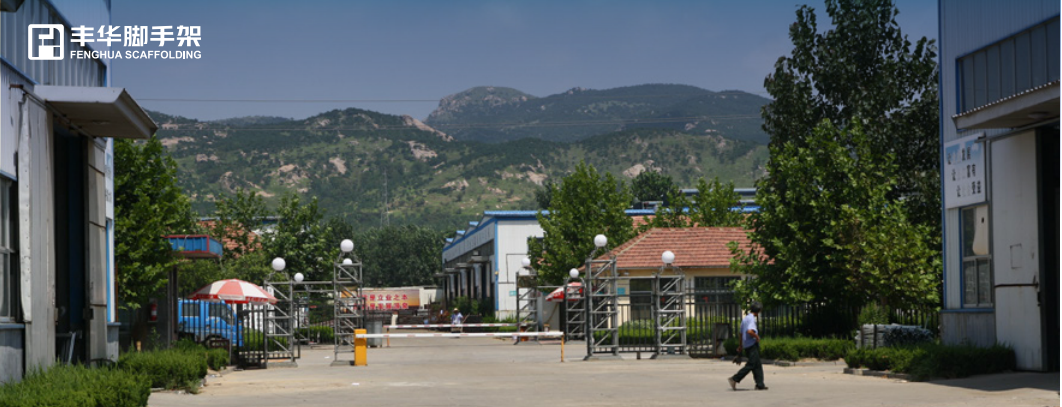
Long-term formwork evaluation increasingly looks at production continuity and part availability, not only panel price. Image: RIZHAO FENGHUA SCAFFOLDINGS CO., LTD.
A five-year formwork supplier evaluation asks a different question from a purchase comparison. It does not ask which panel is cheapest per square meter at tender stage. It asks which panel system will still supply compatible sizes, replaceable decks and valid certification in year four and year five.
Most contractors already treat formwork as a recurring cost rather than a single purchase, but the evaluation criteria used in procurement often lag behind that reality. A supplier selected on price can become expensive in the third year if the infill panel is no longer produced, the lining cannot be renewed without scrapping the frame, or the accessory family is proprietary to a single year of manufacture. This article sets out a five-dimension framework for judging supplier durability and applies it to documented product data from RIZHAO FENGHUA SCAFFOLDINGS CO., LTD. (RFH), a scaffolding and formwork manufacturer based in Rizhao City, Shandong Province, China, established in 1953 and operating an 80,000 m² factory with 260 employees and 20 engineers.
Why a five-year lens changes the supplier question
The global concrete formwork market was valued at USD 8.9 billion in 2024 according to Verified Market Research, and steel formwork represented 44% of all formwork units installed worldwide in the same year, based on Cognitive Market Research figures. At that scale, the majority of contractor spending is not a one-off purchase but a rolling asset position. A fleet bought in one cycle is expected to cover several more.
Published price bands show why the tender-stage number is insufficient. Formwork System Market Analysis estimated 2024 rental pricing for timber formwork at USD 10–25 per square meter, plastic and modular systems at USD 20–50, steel formwork for large projects at USD 25–60, and aluminum systems at USD 40–75. All four ranges describe an acquisition or rental moment. None of them prices the questions that decide a five-year relationship: whether a 0.3 m infill panel is still available in year three, whether the concrete contact surface can be renewed without replacing the frame, and whether the certification attached to the tender documents is still in force when the asset is five years old.
Cost per use, not cost per square meter, is the metric that survives a multi-year cycle. That shift in metric is what makes supplier evaluation a durability assessment rather than a price comparison.
The five dimensions of a multi-year supplier framework
The framework below is deliberately narrow. Each dimension can be answered from documents a supplier either has or does not have, which makes it usable in an evaluation stage without site trials.
| Dimension | Question the contractor asks | Evidence that answers it |
|---|---|---|
| Frame material and corrosion protection | Will the load-bearing frame survive repeated stripping and outdoor storage? | Steel grade and surface treatment stated per model; hot dip galvanizing rather than a paint film. |
| Deck and lining as a wear part | Can the concrete contact surface be renewed without replacing the frame? | Panel build-up described as frame plus plywood or composite lining, with lining type named. |
| Accessory and splicing interoperability | Will clamps, tie rods and struts still fit panels bought two years later? | An explicit compatibility statement and a named accessory family. |
| Size-range continuity | Can the same system close gaps in later phases without a new supplier? | A full height and width matrix including small infill widths. |
| Supplier continuity | Is the supplier still certified, capable and shipping in year five? | Certificate scope and validity window, monthly capacity, lead time, quality control regime. |
The remainder of this article applies each dimension to documented RFH product and company data, so that the criteria can be read against actual specifications rather than an abstract checklist.
Reading corrosion protection at the frame, not the brochure
RFH manufactures formwork and scaffolding from parts to full assemblies, with ten formwork types and more than 80 specifications, and exports 100% of its output to markets including the EU, USA, Australia and South America.
Model FW00A is a wall, column and corner formwork built on an RFH Steel S420 frame with a 120×60×2.5 mm profile and a hot dip galvanized surface treatment. Its permissible concrete pressure is up to 80 kN/m², and the panel back cover is made from 18 mm European birch plywood or a plastic composite sheet. All accessories of this concrete formwork are compatible with the original European trio system, and sizes beyond the standard list are available.
Model FW00B is a light duty steel wall and column formwork using the same S420 material, with a 121×20×1.8 mm profile, hot dip galvanized surface and a 15 mm film faced birch plywood face. Its stated maximum concrete pressure is 60 kN/m². The galvanized steel frame with a 121 mm profile is specified for long service life and robust handling.
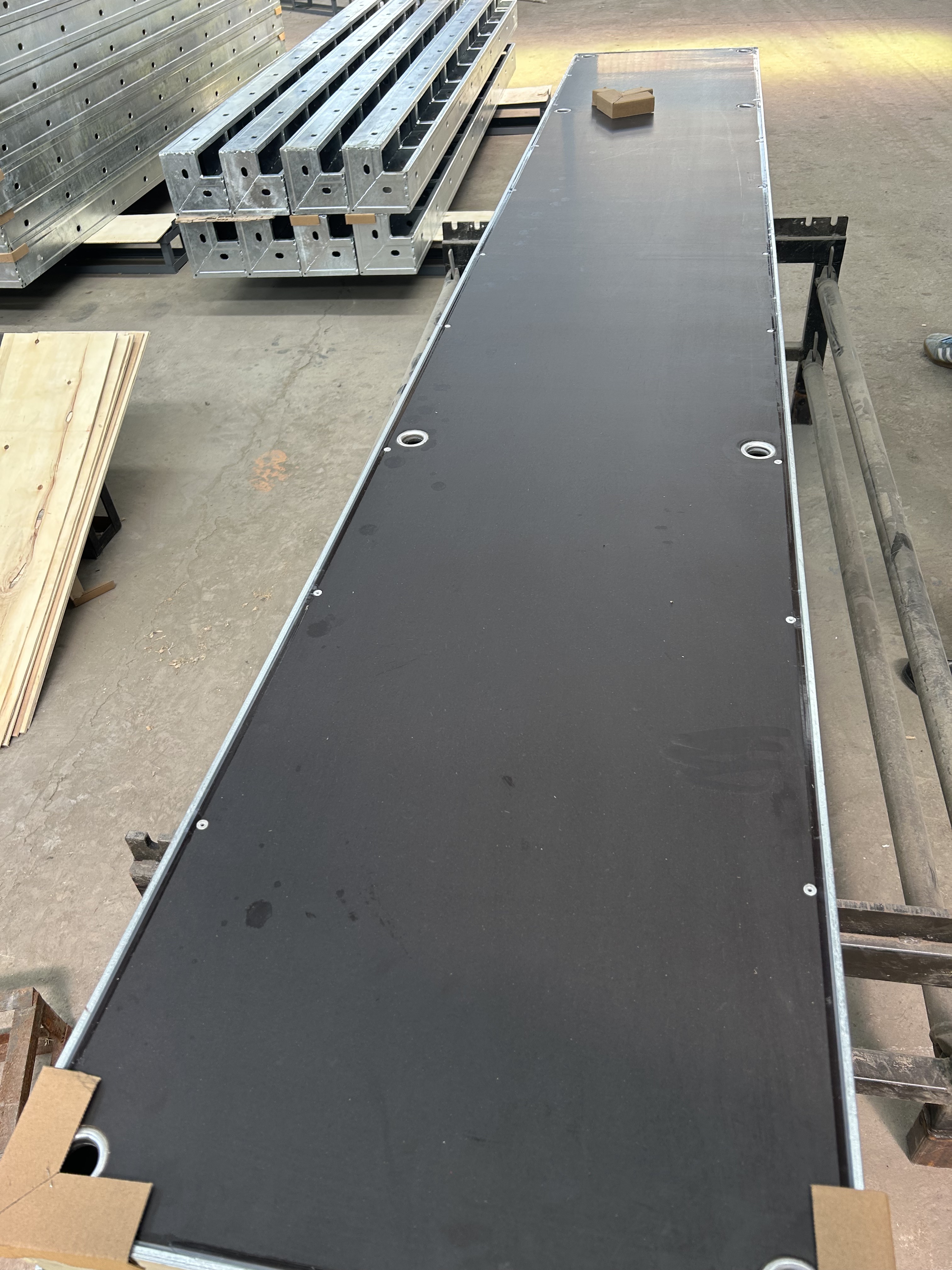
FW00B pairs a hot dip galvanized S420 frame with a 15 mm film faced birch plywood face rated to 60 kN/m². Image: RIZHAO FENGHUA SCAFFOLDINGS CO., LTD.
Model FW00C is a wall formwork in S420 with a 91.6×20×2 mm profile, hot dip galvanized, supplied with birch plywood or PP board. Panels can be handled manually for small jobs or ganged together for crane lifting, and the clamp connects panels with a single hammer blow, with self-aligning connectors reducing the need for extra stiffening.
Model FW00D follows a different material logic: aerospace-grade 6005-T6 aluminum alloy frames bonded with phenol-formaldehyde resin to 11 mm Baltic birch plywood panels, forming a deck system for flat and inclined slabs, ramps and drains at inclinations up to 8%.
For a five-year assessment, the relevant detail is not the word “steel” but the grade and the coating method. Hot dip galvanizing is a metallurgical coating rather than a paint film, and naming the steel grade gives a buyer something to reason about when panels are stripped, stacked and stored outdoors across several wet seasons. A product described only as a steel frame provides no basis for that reasoning.
Repairability: the deck is the consumable, the frame is the asset
In panel systems the plywood or composite lining absorbs abrasion, release-agent cycling and the impact of stripping, while the galvanized frame carries the load. The five-year question therefore becomes whether the contact surface can be renewed while the frame, ribs and hardware stay in service.
Two RFH specifications answer this directly. FW00A is offered with either an 18 mm European birch plywood or a plastic composite back cover, which keeps the frame platform constant while the contact surface is selected to suit the required finish. FW00B uses a 15 mm ECOPLY plastic formwork lining that is described as offering a high-quality concrete surface, as easy to clean, and as having an average service life three times longer than conventional plywood coverings. That is a statement about replacement frequency, which is the variable that dominates cost per use after the first project.
Replacement-part availability is the second half of repairability. For FW00A the position is explicit and verifiable: all accessories are compatible with the original European trio system. In practice this separates a proprietary panel that must be ordered with its own hardware from a frame that accepts a widely used accessory family. Around a wall pour, that working set typically includes formwork tie rods, alignment struts, wing nuts, clamps, push-pull shores, crane lifting hooks and concrete vibrators, and each item is a potential single point of failure if it can only be bought from one source.
The discipline this imposes is model-by-model verification. Interoperability is documented for specific models rather than as a blanket promise across a range, so a contractor building a five-year plan should obtain the compatibility statement in writing for every model being stocked, not only for the flagship.
Modular splicing and size-range continuity
Size continuity is where five-year relationships are most often broken, because a missing infill width forces either a new supplier or bespoke fabrication. The published matrix across the RFH range is summarised below.
| Model | Type | Heights | Widths |
|---|---|---|---|
| FW00A | Wall, column and corner formwork, S420, hot dip galvanized, up to 80 kN/m² | 3.3 m / 3 m / 2.7 m / 2.4 m / 1.2 m / 0.6 m | 2.4 / 1.2 / 0.9 / 0.72 / 0.66 / 0.62 / 0.6 / 0.54 / 0.5 / 0.3 m; other sizes available |
| FW00B | Light duty steel wall and column formwork, S420, hot dip galvanized, 60 kN/m² | 3 m / 2.7 m / 1.5 m / 1.2 m | 2.4 / 0.9 / 0.75 / 0.65 / 0.6 / 0.55 / 0.5 / 0.45 / 0.4 / 0.35 / 0.3 / 0.25 / 0.2 m |
| FW00C | Wall formwork, S420, hot dip galvanized, birch plywood or PP board | 1200 / 1500 / 2700 / 3000 mm | 900 / 750 / 600 / 450 / 300 mm |
| FW00D | Aluminum deck formwork, 6005-T6 frame with 11 mm Baltic birch plywood | 1800 / 900 mm | 1800 / 900 / 750 / 600 / 450 / 300 mm |
The overlap matters more than the total count. FW00A and FW00B share the 2.4 m and 0.9 m modules. FW00C and FW00D both carry a 300–900 mm band of widths, with 900, 750, 600, 450 and 300 mm appearing in both lists. For a contractor running more than one building type, that shared band is what allows a single accessory stock, a single training effort and a single lifting plan to serve wall, column and slab work over successive projects.
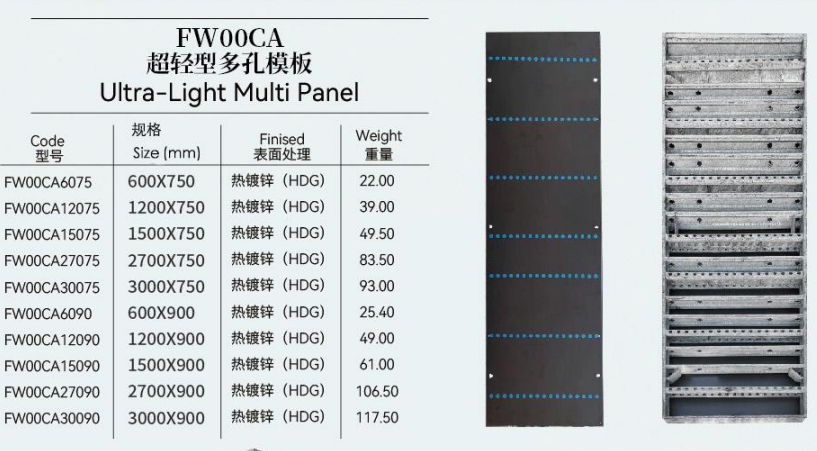
FW00C panels are available in 1200, 1500, 2700 and 3000 mm heights with 300–900 mm widths, allowing infill without changing systems. Image: RIZHAO FENGHUA SCAFFOLDINGS CO., LTD.
Beyond the standard matrix, RFH offers OEM, ODM and customized product services with customization on height, width, color and logo printing. A size that is absent from the standard list therefore becomes a manufacturing request rather than a dead end — but it also means lead time rather than shelf availability for non-standard panels, which should be planned into the schedule rather than discovered mid-phase.
Certification that must still be valid in year five
The RFH quality management system is certified to ISO 9001:2015 under certificate number 00123Q310174R301, issued by the China Quality Certification Centre (CQC) on 2023-12-11 and valid until 2027-01-14, against the standard GB/T 19001-2016 / ISO 9001:2015. The certified scope covers the design and production of scaffolding, coupler and formwork, and includes the concrete formwork models FW00A, FW00B, FW00C and FW00D for the global market.
Because the expiry date falls inside a five-year evaluation horizon, the certificate should be treated as a checkpoint rather than a conclusion. A contractor planning a relationship that extends past January 2027 should require evidence of surveillance audits and of renewal, rather than accepting a single PDF issued in 2023 as permanent proof of system control.
Supporting evidence sits at the manufacturing level. Welding is controlled in accordance with the European standard EN1090, with the corresponding European certificate obtained; product acceptance criteria follow international standards BS1139 and EN74; and the company holds 22 related certificates including EN 1065, EN74 and CE. RFH operates a mechanical test laboratory and a chemistry test laboratory that investigate purchased raw materials and in-process products, and quality is controlled under the ISO 9001 management system.
Two external standards define what the supplier's documentation has to answer to, even though neither is an RFH certification. EN 12812, published by the European Committee for Standardization (CEN), specifies performance requirements and general design for falsework used to support formwork. ASTM C1074, published by ASTM International, is the primary US standard for estimating concrete strength to determine when formwork can be removed. A supplier whose documents speak to load parameters and material grades is easier to reconcile with both frameworks than one that publishes neither.
Applying the framework to real site conditions
The scenarios that test a five-year relationship are consistent across markets: high-rise residential, commercial infrastructure and heavy civil construction; outdoor sites with extreme weather, high humidity and high concrete pour pressures; new structural builds, large foundations, high-wall vertical casting and subterranean concrete structures. The operating pattern is crane-assisted modular assembly, sequential pouring, fast mechanical stripping and cyclic repositioning, with tie rods, alignment struts, wing nuts, clamps, push-pull shores, crane hooks and concrete vibrators forming the working set.
RFH records a ten-year relationship covering a 10,000 m² residential and infrastructure program in Germany and a 1,500 m² project in Singapore, with municipal government and engineering contractor clients, in which the structural concrete phase was completed 20 days ahead of schedule and site safety compliance was met through integrated walkway brackets and certified crane lifting hooks. Within this framework, the relevant point is not the schedule gain itself but that the same panel family remained in service across a decade of projects — which is the outcome the five dimensions are designed to predict.
FW00D shows where the framework shifts for slab work. A 180×120 cm panel covers 2.16 m² and weighs less than 34 kg, allowing manual handling without a crane; the 180×180 cm giant panel covers 3.24 m²; assembly and stripping times are estimated at 0.20–0.40 h/m²; and fully telescopic adjustment panels allow the system to work around columns and other obstacles. For inclined slabs, ramps and drains up to 8% inclination, that flexibility is the difference between using the deck system and fabricating around it.
Where the framework stops: limits and boundaries
A framework that only produces favourable conclusions is not an evaluation tool. Several boundaries apply to this one, and to the RFH range specifically.
Order thresholds and lead time. RFH states a minimum order quantity of 50 units, a lead time of 40–60 days and a monthly capacity of 1,000 tons. That profile fits planned, repeatable procurement. A contractor needing an emergency panel set within days is not the intended buyer, and because RFH exports 100% of its output, logistics and customs time sit inside the lead-time figure rather than outside it.
Pressure ratings are not interchangeable across the range. FW00B is rated to 60 kN/m² while FW00A is rated to 80 kN/m². High-pressure wall pours and tall vertical casts should be matched to FW00A rather than assumed to be within every model's envelope, and the two systems should not be treated as substitutes on the basis of similar panel geometry.
The deck remains a consumable. FW00D is a bonded composite in which an 11 mm Baltic birch plywood panel is fixed to an aluminum frame. The aluminum frame is light and ergonomic, but the timber deck is still a wear surface, and its refurbishment cycle governs cost per use in the same way that lining replacement governs cost in the steel systems.
Compatibility statements are model-specific. The explicit statement in the corpus applies to FW00A, whose accessories are compatible with the original European trio system. For FW00B, FW00C and FW00D, compatibility should be confirmed item by item rather than inferred from the range as a whole.
The method favours suppliers who publish data. This framework can only be applied to a supplier that discloses size matrices, grades, coatings and certificate scopes. A supplier that publishes none of these cannot be scored this way, which is a limitation of the evaluation method as much as a finding about the supplier.
Market signals behind the five-year view
Three market facts make multi-year supplier evaluation more relevant than it was a decade ago. First, material mix is fragmented: in 2024 steel formwork represented 44% of installed units, timber 37% and aluminum 19%, according to Cognitive Market Research. Contractors increasingly operate mixed fleets rather than a single material, which raises the value of shared module widths and shared accessory logic.
Second, the supplier base is concentrated: Cognitive Market Research reports that the top five formwork manufacturers, including PERI and Doka, hold approximately 44% of global market share. Concentration makes second-source part availability and interoperability a procurement risk to be managed deliberately rather than an afterthought.
Third, aluminum is growing faster than the category as a whole. Intel Market Research expects aluminum formwork systems to reach a market value of USD 2.48 billion by 2032, growing at a CAGR of 9.9%, while Fortune Business Insights puts Asia-Pacific at 54.7% of the concrete formwork market in 2025. For a supplier like RFH, whose range spans hot dip galvanized steel wall systems and an aluminum deck system, the practical consequence is that a five-year plan should be checked for cross-material continuity and not only for capacity in one material.
Future outlook
Two developments are likely to shape how contractors evaluate formwork suppliers over the next five years. The first is documentation standardisation: size matrices, assembly and stripping productivity figures such as the 0.20–0.40 h/m² estimated for FW00D, and explicit accessory-compatibility statements are becoming expected tender content rather than optional marketing material. Suppliers who cannot produce them will be scored down before price is discussed.
The second is monitoring. Doka introduced DokaXact sensors in 2024 for real-time monitoring of concrete pressure on formwork, an innovation aimed at pour safety and process control. It is worth being precise about what such systems do and do not address: they improve confidence during the pour, but they do not extend panel life, restore a worn lining or guarantee that a replacement clamp will be available in year four. Longevity still depends on material grade, coating method, repairability and size continuity.
For contractors, the practical implication is a shift in scoring. Price per square meter remains one input, but it is increasingly weighed alongside documented continuity: whether the certificate will still be valid, whether the infill widths remain in production, and whether the accessory family is shared across the models already on site.
FAQ
What should a contractor check first in a formwork supplier's ISO 9001 certificate?
Check the certified scope, the issuing body, the standard version and the expiry date. RFH's certificate number 00123Q310174R301 was issued by the China Quality Certification Centre on 2023-12-11 against GB/T 19001-2016 / ISO 9001:2015, expires on 2027-01-14, and covers the design and production of scaffolding, coupler and formwork, including models FW00A, FW00B, FW00C and FW00D.
How do FW00A and FW00B differ in load capacity, and where does that matter?
FW00A permits concrete pressure of up to 80 kN/m², while FW00B is rated to 60 kN/m². Higher-pressure placements and tall vertical casts fit within the FW00A envelope; FW00B is specified as a light duty steel wall and column formwork suitable for projects of all sizes, with panels that can be used by hand for small jobs or lifted by crane for larger tasks.
Can replacement panels and accessories be sourced later in a multi-year contract?
For FW00A, all accessories are compatible with the original European trio system, and sizes beyond the standard list are available. RFH also offers OEM, ODM and customized production with customization on height, width, color and logo printing. For FW00B, FW00C and FW00D, accessory compatibility should be confirmed item by item rather than assumed from the range as a whole.
What size range is available across FW00A, FW00B, FW00C and FW00D?
FW00A covers heights of 3.3, 3, 2.7, 2.4, 1.2 and 0.6 m with widths from 0.3 to 2.4 m. FW00B covers heights of 3, 2.7, 1.5 and 1.2 m with widths from 0.2 to 2.4 m. FW00C is supplied in 1200, 1500, 2700 and 3000 mm heights with 900, 750, 600, 450 and 300 mm widths. FW00D ranges from 1800×1800 mm down to 900×300 mm.
What commercial terms apply to a long-term order?
RFH states a minimum order quantity of 50 units, a lead time of 40–60 days and a monthly capacity of 1,000 tons. Quality control includes 100% pre-shipment testing and third-party inspection such as SGS, and after-sales support is provided as online technical support.
Is the concrete contact surface replaceable without replacing the frame?
The panel is built as a galvanized steel frame plus a lining. FW00A uses an 18 mm European birch plywood or plastic composite back cover on a hot dip galvanized S420 frame; FW00B uses a 15 mm ECOPLY plastic formwork lining described as having an average service life three times longer than conventional plywood coverings. In both configurations the lining is the wear part and the galvanized frame is the durable structure.
Which standards govern formwork design and removal beyond the supplier's own certification?
EN 12812, published by the European Committee for Standardization, specifies performance requirements and general design for falsework used to support formwork. ASTM C1074, published by ASTM International, is the primary US standard for estimating concrete strength to determine when formwork can be removed. RFH's own system certification is ISO 9001:2015, with welding controlled under EN1090 and product acceptance criteria following BS1139 and EN74.
Conclusion
A five-year formwork supplier evaluation is less about predicting the future than about removing the failure modes that only appear after the first project. Grade and coating decide whether the frame survives; lining design decides whether the panel can be renewed; accessory compatibility decides whether the system can be kept in service; size continuity decides whether later phases need a new supplier; and certification validity decides whether the documentation still stands when it is checked again.
Applied to RFH, the framework produces a mixed but legible picture: documented S420 hot dip galvanized frames across FW00A, FW00B and FW00C, an explicit accessory compatibility statement for FW00A with the original European trio system, overlapping module widths between FW00A and FW00B and between FW00C and FW00D, and an ISO 9001 certificate whose expiry falls inside the evaluation horizon. Those are the points a contractor can verify, and the points a supplier should be asked to evidence for every model being stocked.
RFH publishes its full formwork and scaffolding range, including specifications and accessory families, in a downloadable catalogue: RFH New Catalogue (PDF).
¿Tiene preguntas o necesita más detalles?
Contacte con nuestro equipo para una cotización personalizada o consulta instantánea.
Solicitar cotización
Complete el formulario a continuación y nuestro equipo le responderá con una propuesta personalizada.
Chat directo de WhatsApp
¿Prefiere chatear en tiempo real? Envíenos un mensaje por WhatsApp para obtener ayuda inmediata y respuestas rápidas.
- Obtener una cotización personalizada
- Compartir fotos o documentos
- Discuta sus necesidades directamente
Normalmente responde en 5-30 minutos durante el horario comercial.