
Long-Term EVA Film Supplier Evaluation: Capacity, Certifications, Track Record
Long glass programmes rarely fail on the first roll. They fail on the twelfth consignment, when the approved sample no longer matches, the certificate turns out to cover a narrower scope than assumed, or a booked production line quietly slips for a larger customer. For architectural laminators and defence glass makers, supplier evaluation is a continuity question before it is a purchasing question.
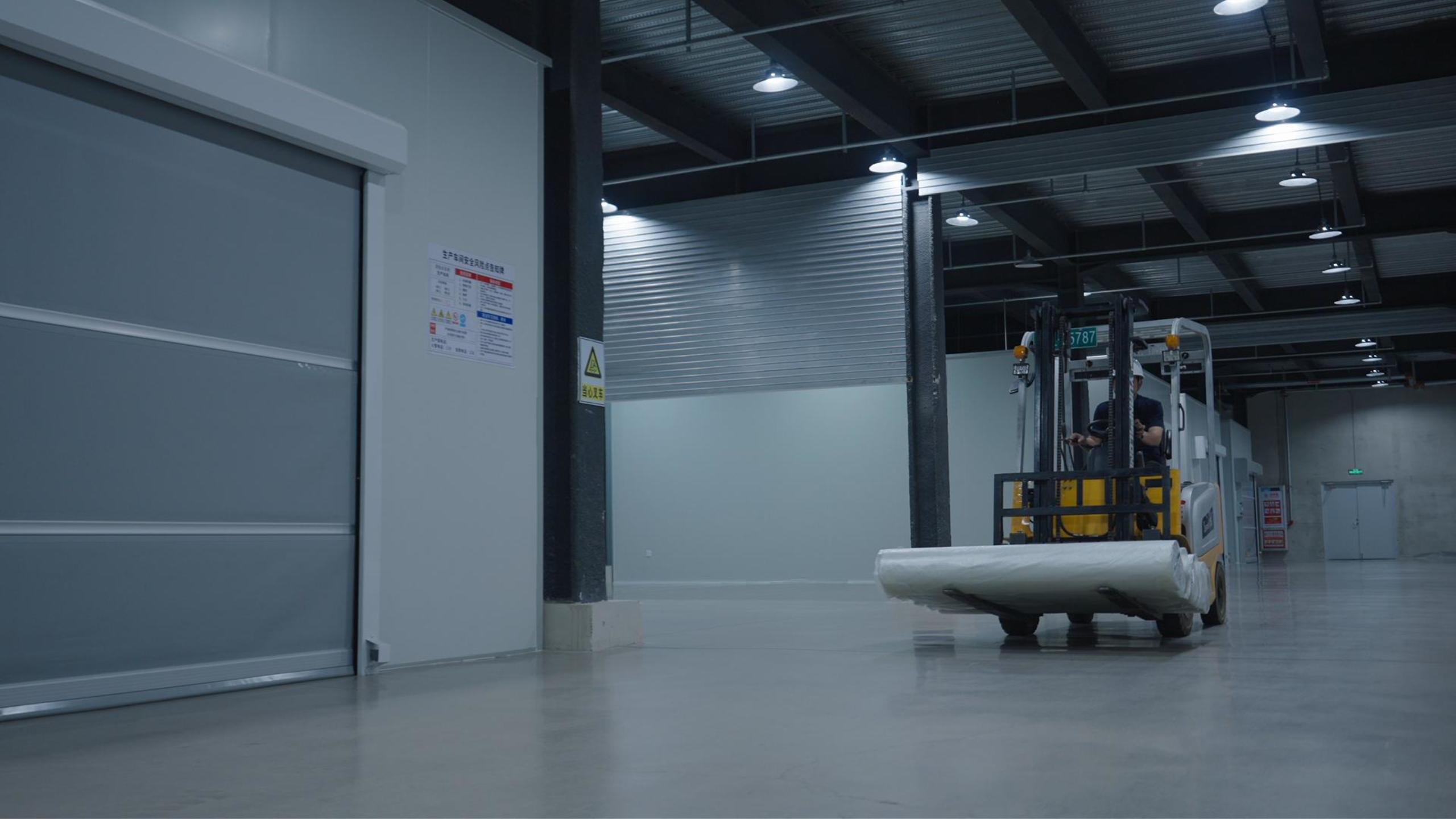
Interlayer film production environment: capacity, control and documentation are evaluated together, not separately.
Why per-roll pricing is a weak basis for a multi-year film agreement
An EVA interlayer film is a qualified material, not a commodity roll. Once a laminate specification has been validated — optical result, adhesion behaviour, ageing performance — changing the film source normally forces the whole validation to be repeated. That re-qualification cost sits outside the invoice, which is why a supplier that is 4% cheaper per kilogram can still be the more expensive decision over a two- or three-year window.
The second reason is cost volatility. EVA film pricing follows resin. EVA resin in China was reported at USD 1,420 per metric ton in September 2025 (IMARC Group, 2026 price chart), a fast-moving input rather than a stable one. A long-term agreement built around a single fixed number tends to be renegotiated or quietly degraded; a long-term agreement built around a defined adjustment mechanism survives. Buyers who evaluate only the quoted price are effectively evaluating a number that will not hold.
The third reason is scheduling. Interlayer film is extruded in runs. A supplier with abundant capacity but a single line serves its largest accounts first when demand tightens. The question is not only how much a plant can produce, but where a given buyer's order sits in the queue twelve months from now.
A six-dimension framework for long-term EVA film supplier evaluation
The framework below is designed for buyers in the evaluation-to-execution stage, where a shortlist already exists and the task is to decide which supplier can still deliver in year three. It is applied here to SHENGDING HIGHTECH MATERIALS CO., LTD, a polymer materials manufacturer established in 2018 and located in the Lanshan Chemical Industry Park, Rizhao City, Shandong Province, China, which produces EVA film and TPU film for architectural, decorative and defence glazing applications.
| Dimension | What to verify | Why it matters over a multi-year programme |
|---|---|---|
| Capacity and scheduling | Stated monthly capacity, stated annual output, line count, allocation policy for repeat accounts | Determines whether the supplier can absorb demand growth without displacing existing customers |
| Certification scope | Standard, certificate number, issuing body, validity dates, certified scope | A certificate that does not cover the product or process in question provides no assurance |
| Quality control method | Sampling versus full inspection, tested parameters, record retention and roll-level traceability | Detects drift between approved sample and production batches |
| Customisation fit | OEM/ODM availability, length and width customisation, minimum order quantity, engineering support | Programmes usually need dimensional changes mid-life, not just at award |
| Commercial and acceptance terms | Lead time status, Incoterms, pre-shipment acceptance protocol, payment structure | Defines who carries logistics, financing and rejection risk |
| Comparable track record | Application, scale, duration, operating result, customer type | Separates a supplier that has run a programme from one that has supplied a sample |
Dimension 1 — Capacity: rated output versus programme demand
Shengding Hightech Materials operates a 50,000 m² facility and states a monthly capacity of 100 tons. The company separately states annual output of 1,000 tons. Buyers planning a multi-year schedule should ask which of the two figures binds their order, because installed capacity and realised output are different measurements: the first describes what the plant can do in a good month, the second describes what it actually shipped across a year.
For scale, a laminating programme consuming 5 tons of interlayer per month would represent roughly 5% of a 100-ton monthly capacity. That is comfortably within range for a mid-sized architectural or decorative glass producer, and it means the supplier is unlikely to be the constraint in the first year. The pressure point comes later, when the same plant is serving several accounts that have all grown.
Three supporting facts are relevant to scheduling risk. The company reports 50 employees, a 70% export ratio, and main markets in North Africa, the Middle East and Latin America. A high export share indicates a plant already accustomed to multi-destination logistics and documentation, but it also indicates that capacity is distributed across time zones and order cycles rather than concentrated in one domestic account. Buyers should ask directly how repeat customers are prioritised when the order book fills.
Dimension 2 — Certifications: scope, validity and what a certificate proves
Certification is the dimension most often checked superficially. Three different things get conflated in supplier questionnaires: a management-system certificate, a product conformity statement, and a batch-level certificate of analysis. They answer different questions.
Shengding Hightech Materials holds ISO 9001, ISO 14001 and ISO 45001 certifications. The ISO 9001 certificate is identifiable and can be verified independently: certificate number 10425Q01154R1S, issued by Shandong Seatone International Certification Co., Ltd. on 7 July 2025 and valid to 24 July 2028, against GB/T 19001-2016 / ISO 9001:2015. Its certified scope is the design, development and production of interlayer glass intermediate films and granular materials — which is the relevant scope for an EVA interlayer buyer, rather than a generic trading scope.
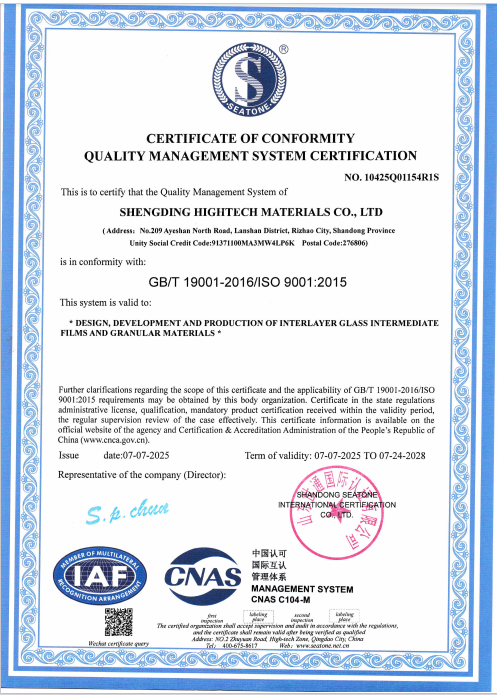
ISO 9001 certificate 10425Q01154R1S, issued 7 July 2025 by Shandong Seatone International Certification Co., Ltd., valid to 24 July 2028.
The company also states that product performance complies with European REACH and RoHS regulations as well as U.S. FDA quality requirements. These are regulatory and quality conformity positions rather than management-system certificates, and the practical way to use them is at batch level: request the specific test reports and declarations relevant to the destination market, and confirm which legal entity issues them. The HS classification normally applied to EVA film is 3920.10.0000 under the U.S. HTSUS, per a U.S. Customs and Border Protection ruling, which is the reference point for tariff and customs planning rather than a quality document.
Dimension 3 — Quality control: what "100% testing" is being applied to
Shengding Hightech Materials maintains 100% testing quality control on all products, alongside OEM/ODM production services. Full inspection is a stronger position than batch sampling, but its value depends entirely on which parameters are tested, at what point in the run, and whether the result is traceable back to a specific roll.
For a long-term buyer, the operational questions are narrower than a general audit: is inspection performed on every roll or on the first and last roll of each run; are optical properties measured on finished film or on incoming resin; how long are inspection records retained; and can a consignment be traced to its inspection record two years after delivery. A supplier that answers these questions with documents rather than assurances is materially lower risk than one that answers them with a certificate alone.
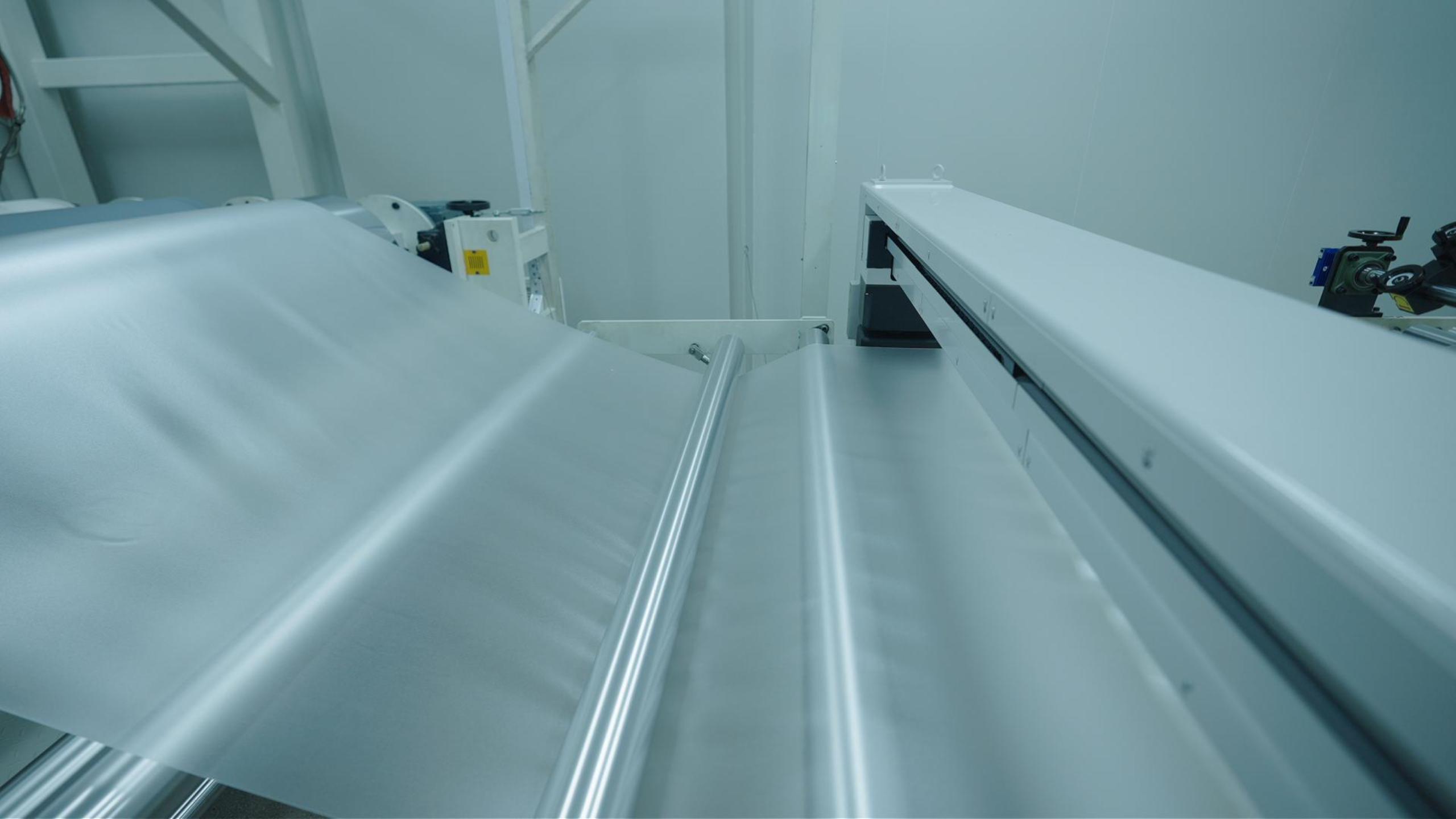
Full inspection is only meaningful when results are retained and can be matched to a delivered roll.
Dimension 4 — Customisation: OEM/ODM, dimensions and minimum order
Architectural and defence programmes change dimensions during their life. A supplier that can only ship a catalogue width becomes a constraint once a project needs a different pane format. Shengding Hightech Materials provides OEM/ODM production services with technical support and customisation of length and width, which covers the dimensional flexibility that most laminating programmes eventually need.
The stated minimum order quantity is 50 kg. For a buyer, a low MOQ has a specific value that is easy to miss: it makes trial runs, colour or grade comparisons, and small replacement consignments commercially realistic. A programme can validate a new width or a new film grade without committing to a full production run. Buyers should still confirm whether the 50 kg threshold applies uniformly across custom widths, and whether a custom dimension carries its own minimum.
On the product side, the company lists EVA film model SD38 for architectural and decorative glass lamination, with stated light transmittance of 90% and haze of 0.5%. These are company-listed optical values; they are useful for initial screening and for setting the acceptance baseline, and they should be confirmed against a certificate of analysis for the delivered batch.
Dimension 5 — Commercial terms and acceptance: where risk actually sits
Three terms carry most of the residual risk in an EVA film purchase, and all three are negotiable in form if not in substance.
- Lead time. A typical lead time of 10 days describes normal conditions, not a contractual commitment. In a long-term agreement, ask what happens to that figure during peak periods and whether it is measured from order confirmation or from receipt of payment.
- Delivery basis. FOB delivery means the buyer assumes freight, insurance and the risk of transit damage from the point of loading. That is normal for export supply, but it should be costed into the landed comparison rather than treated as free.
- Acceptance. Pre-shipment acceptance testing protects the buyer only if the test protocol is agreed in advance — parameters, sampling, tolerances and the consequence of failure. Without a written protocol, pre-shipment inspection becomes a formality performed by the party with an interest in the result.
Payment structure should be read in the same light. Where full payment is required, the buyer's protection comes from the acceptance protocol and the documentation package, not from withholding leverage at the end of the transaction. Buyers who cannot accept that structure should raise it before qualification, not after the first order.
Dimension 6 — Track record in comparable applications
A reference is only informative when its application, scale and duration are comparable to the buyer's own programme. Shengding Hightech Materials reports a defence-sector project in Pakistan involving EVA film for bulletproof glass: 100 rolls supplied, a two-year implementation period, and stable operation over a further two years with defence industry customers. The company describes the solution as the only one of its kind in that country.
Read carefully, that reference establishes four things: the film has been used in a security glazing application rather than only in decorative glass; the volume was programme-scale rather than sample-scale; the operating window extended beyond delivery; and the customer type was a defence manufacturer with qualification requirements. It does not, on its own, establish performance in a different laminate construction, a different climate, or a different glass build-up. That distinction is the difference between using a reference as evidence and using it as reassurance.
Application fit: architectural, decorative and security glazing
The company's material portfolio spans two interlayer chemistries, EVA film and TPU film, which matters for buyers whose programmes cross categories. EVA interlayer film is used in architectural safety glass and decorative glass lamination; the listed SD38 grade addresses the architectural and decorative segment specifically. TPU film, the company's other line, is used in transparent glass components for aviation, naval vessels, armoured vehicles and high-speed trains, as well as in bulletproof and blast-resistant glass.
According to company information, Shengding Hightech Materials has mastered synthesis and stable pelletisation technology for optical-grade TPU film raw materials and wide-width TPU intermediate film extrusion, and became the sole qualified domestic supplier of base material for military-grade aviation glass in China — a claim about the TPU line, not the EVA line, and one that should be read as an indicator of polymer-processing depth rather than as EVA product evidence.
For buyers, the practical value of a dual-chemistry supplier appears during material substitution reviews. When a security glazing specification moves between EVA and TPU, or when an architectural project requires a film that a single-chemistry supplier cannot offer, a supplier with both lines removes a re-sourcing cycle. The engineering base behind that capability is stated as 10 engineers at the factory plus 5 professors at a Beijing R&D Center, which is the resource that answers customisation requests rather than standard orders.
Market context: what the available data does and does not say
The global EVA films market was valued at USD 8.25 billion in 2025 (Fortune Business Insights). That figure is frequently quoted in supplier presentations, and it should be handled with care: it aggregates solar encapsulant, laminated glass, packaging and other applications. It is a signal of category scale, not a measurement of architectural interlayer demand, and it should not be used to size an addressable market for safety glass film.
Two other verified data points are more directly usable in procurement. First, the EVA resin price reference for China — USD 1,420 per metric ton in September 2025 — is a fast-changing indicator with a short useful life, which argues for a price adjustment clause rather than a fixed multi-year number. Second, the HS classification of EVA film under 3920.10.0000 gives both parties a common reference for customs and duty treatment, reducing the risk of a landed-cost surprise mid-contract.
The broader direction is toward documentation. Buyers in export markets increasingly ask for certificate numbers, scopes, batch records and test reports as a condition of qualification rather than as a follow-up. Suppliers that already maintain this material answer faster, and speed of documentation is itself a continuity advantage.
How this profile compares with alternative supply routes
Three supply routes are typically on a shortlist: a manufacturer with its own extrusion, a trading company sourcing from several plants, and a large integrated producer with a broad product portfolio. Each has a real trade-off, and the limitations of the manufacturer route deserve as much attention as its advantages.
| Route | Strength | Limitation to price in |
|---|---|---|
| Direct manufacturer (Shengding Hightech Materials) | Control over production schedule, dimensional customisation, direct technical support, traceable inspection | Single-site capacity; a very large multi-country programme still needs a second qualified source |
| Trading company | Flexibility on mixed orders and consolidated shipments | No control over the extrusion schedule; batch consistency depends on an unseen third party |
| Large integrated producer | Long operating history and broad product range | Longer qualification queues and less dimensional flexibility for smaller programmes |
Specific limits apply to the profile discussed here and should be stated plainly. Shengding Hightech Materials was established in 2018, which is a shorter operating history than several established interlayer producers; buyers weighting institutional longevity should reflect that in their scoring. The ISO certificates establish management systems, not the performance of a finished laminate. Publicly available material reviewed for this article does not include independent laboratory reports on adhesion, UV ageing or moisture resistance for the EVA grades, so a buyer must request them rather than infer them. The stated 90% light transmittance and 0.5% haze are company-listed values. And the capacity of 100 tons per month, on a single site, means a programme of unusual scale should plan dual sourcing from the outset rather than treat it as a contingency.
Future outlook
Two shifts are likely to shape EVA film sourcing over the next procurement cycles. The first is documentation-led qualification: as more buyers require verifiable certificate scope and batch traceability, suppliers with a maintained evidence trail will qualify faster, and the differentiator will be the quality of records rather than the breadth of claims. The second is material substitution in security glazing, where EVA and TPU are evaluated against each other for different build-ups; suppliers holding both chemistries can support that review without a change of vendor.
What is unlikely to change is the arithmetic that makes long-term evaluation worthwhile. Re-qualifying a laminate costs more than the price difference between most competing film quotes, and a supply interruption during an active glazing programme costs more again. Evaluating capacity, certification scope and track record before award remains the cheapest risk control available to a buyer.
Frequently asked questions
What monthly capacity should an EVA film supplier have for a long-term glass programme?
There is no universal threshold; the relevant comparison is programme demand against available capacity. As a reference point, Shengding Hightech Materials states 100 tons per month of capacity and 1,000 tons of annual output at a 50,000 m² facility. A buyer consuming 5 tons per month would represent roughly 5% of that monthly capacity, which is a comfortable ratio, but the buyer should also ask how repeat accounts are prioritised when the order book fills.
How can I confirm that an ISO 9001 certificate covers EVA interlayer film production?
Check three elements on the certificate itself: the certified scope, the issuing body, and the validity dates. The Shengding Hightech Materials ISO 9001 certificate, number 10425Q01154R1S, was issued by Shandong Seatone International Certification Co., Ltd. on 7 July 2025, valid to 24 July 2028, against GB/T 19001-2016 / ISO 9001:2015, with a scope covering the design, development and production of interlayer glass intermediate films and granular materials. A certificate whose scope covers trading only would not provide the same assurance.
What MOQ and lead time are realistic for a custom-width EVA film order?
Shengding Hightech Materials states a minimum order quantity of 50 kg and a typical lead time of 10 days, with OEM/ODM production and customisation of length and width. Two clarifications are worth obtaining before an order: whether the 50 kg threshold applies to custom dimensions, and whether the lead time is measured from order confirmation or from payment, since a typical figure is not a contractual commitment.
What should a pre-shipment acceptance test cover in an EVA film purchase?
Pre-shipment acceptance is the stated acceptance criterion for Shengding Hightech Materials orders, which are delivered on FOB terms. To be effective, the protocol should specify the tested parameters, the sampling method, the tolerances, and the consequence of a failed result, and it should be agreed in writing before production begins. Without those four elements the inspection records an event rather than controlling a risk.
How much weight should a single project reference carry in supplier evaluation?
A single reference should be weighted by its similarity to the buyer's own programme. The Pakistan defence project reported by Shengding Hightech Materials involved 100 rolls of EVA film for bulletproof glass over a two-year implementation period, with stable operation reported over a further two years. That supports programme-scale capability in security glazing, but it does not transfer automatically to a different laminate build-up, climate or glass specification, so buyers should request references matched to their own application.
A corporate brochure with further company and product information is available for download: SHENGDING HIGHTECH MATERIALS brochure.
Market and price references: Fortune Business Insights, EVA Films Market Size, Industry Share and Forecast (global market valued at USD 8.25 billion in 2025); IMARC Group, Ethylene Vinyl Acetate (EVA) Prices, Trend and Forecast 2026 (China EVA resin at USD 1,420 per metric ton, September 2025); U.S. Customs and Border Protection ruling NY N115543 (HS 3920.10.0000). Company facts as published by SHENGDING HIGHTECH MATERIALS CO., LTD.
¿Tiene preguntas o necesita más detalles?
Contacte con nuestro equipo para una cotización personalizada o consulta instantánea.
Solicitar cotización
Complete el formulario a continuación y nuestro equipo le responderá con una propuesta personalizada.
Chat directo de WhatsApp
¿Prefiere chatear en tiempo real? Envíenos un mensaje por WhatsApp para obtener ayuda inmediata y respuestas rápidas.
- Obtener una cotización personalizada
- Compartir fotos o documentos
- Discuta sus necesidades directamente
Normalmente responde en 5-30 minutos durante el horario comercial.