
Long-Term EC Fan Supply: Continuity, Retrofit and Spare-Part Readiness
An EC fan is rarely bought once. In data centre cooling, chiller plants and air-handling retrofits, the same fan position is revisited at commissioning, at first failure, at a capacity upgrade and again at end-of-life replacement. Only the first of those moments is answered by a datasheet.
Long-term EC fan supply is therefore evaluated on three things that a duty-point calculation does not capture: whether the fan platform remains coherent across variants and years, whether a candidate model can physically and electrically replace what is already installed, and whether spares and technical answers stay available after the original purchase order has closed. For a cooling asset that outlives several procurement cycles, those three criteria usually decide whether a supplier is retained or replaced.
This reference sets out how buyers can test each of them against documented product data, documented retrofit applications and commercial terms that can be checked rather than assumed.
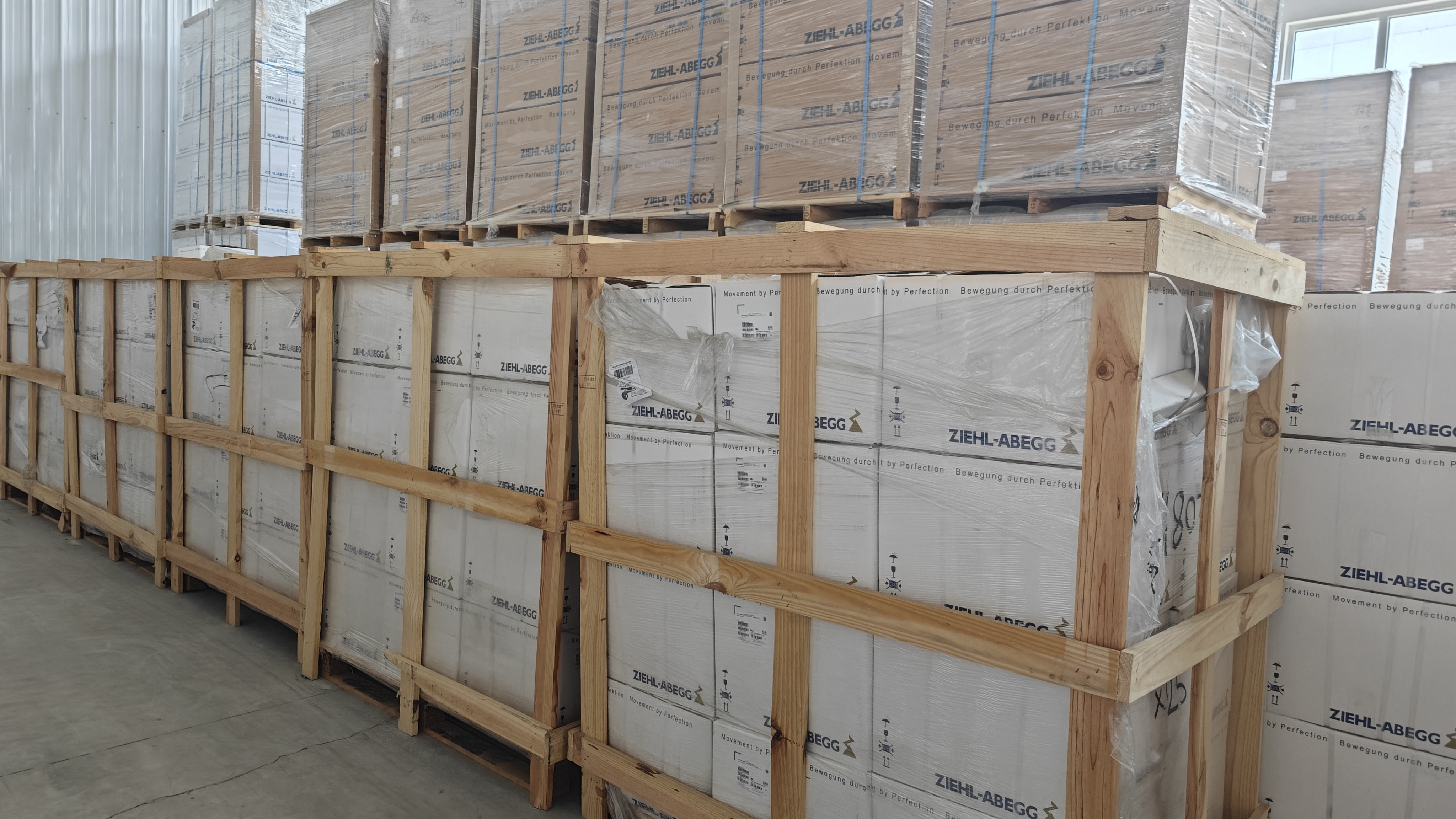
Long-term fan supply is a logistics and documentation commitment as much as a product decision: the variant ordered in year one has to remain identifiable in year five.
Long-term EC fan supply is not a repeat of the first order
The first order is a selection exercise. It compares airflow, static pressure, voltage, control signal and physical envelope against a defined duty point, and it ends when a model number is confirmed. Every subsequent order is a matching exercise, and matching has a different failure mode: the duty point is fixed by the installed unit, so any change to the fan becomes a change to the system.
That asymmetry is what makes continuity a purchasing criterion rather than a technical footnote. A supplier who can only offer the current catalogue forces the buyer to re-qualify an alternative every time a model is superseded, and re-qualification is expensive in exactly the places where cooling assets are hardest to take offline — live data halls, occupied AHU rooms, and outdoor chiller compounds where access windows are short.
Three evaluation axes follow from this, and they should be documented separately in a supplier file:
- Platform consistency — the ability to cover several duty points inside one structural and electrical family, so a substitution stays inside a known envelope.
- Retrofit suitability — whether a candidate model is documented for replacement work, not only for new-build integration.
- Spare-part readiness — whether the exact variant, its control electronics and its technical support survive the original contract.
Platform consistency: what a stable EC fan family looks like
A platform is not the same thing as a catalogue. A platform shares a diameter, a mounting structure, an impeller architecture and an electronics family, and then tunes aerodynamic trim to reach different duty points. Buyers can verify platform consistency by checking whether several model numbers share those four characteristics while differing in airflow and pressure.
Axial platforms at 910 mm and 800 mm
The larger axial families illustrate the point clearly. Within a single 910 mm diameter, two AxiBlade variants cover a cooling tower duty and a dry cooler duty with materially different aerodynamic settings, while an 800 mm diameter family spreads across dry coolers, condensers and outdoor chillers.
| Model | Platform diameter | Documented application | Speed | Max. back pressure | ErP airflow point |
|---|---|---|---|---|---|
| W3G910-LV12-36 | 910 mm | Cooling towers, dry coolers, free cooling | 1,070 rpm | 300 Pa | 24,750 m³/h @ 256 Pa |
| W3G910-KU25-03 | 910 mm | Dry coolers, condensers, chillers | 980 rpm | 220 Pa | 23,685 m³/h @ 182 Pa |
| W3G800-LV05-03 | 800 mm | Dry coolers, cooling towers, free cooling | 1,190 rpm | 350 Pa | 19,225 m³/h @ 337 Pa |
| W3G800-KU21-05 | 800 mm | Dry coolers, condensers, free cooling | 1,100 rpm | 260 Pa | 19,455 m³/h @ 247 Pa |
| W3G800-GV01-01 | 800 mm | Outdoor chillers, condensers, refrigeration | 1,090 rpm | 260 Pa | 18,115 m³/h @ 212 Pa |
All variants share a 3~380–480 VAC supply. The guide-vane version (LV05-03) reaches a higher back pressure and airflow than the plain 800 mm variants, which shows how far tuning can move a single platform.
For the buyer, the practical value is that a replacement can be evaluated inside the family. If a dry cooler fan is later re-rated for a higher external static pressure, a platform-mate with a higher back-pressure ceiling is a shorter engineering conversation than a cross-brand substitution, because the mounting interface, the voltage class and the impeller material logic remain familiar.
Centrifugal modules at 450, 500 and 560 mm
Backward-curved centrifugal modules show the same pattern in air-handling and CRAH work. Across three diameters, each size carries both a moderate-power variant and a high-static-pressure variant, and each is documented with the same construction logic: impeller, support plate and inlet ring, and a die-cast aluminium electronics housing.
| Model | Diameter | Power / current | Speed | ErP airflow point | Impeller material |
|---|---|---|---|---|---|
| K3G450-PA31-03 | 450 mm | 4,450 W / 6.8 A | 2,480 rpm | 8,430 m³/h @ 1,275 Pa | Aluminium |
| K3G450-PB29-L1 | 450 mm | 6,800 W / 10.3 A | 2,800 rpm | 9,035 m³/h @ 1,749 Pa | Aluminium |
| R3G500-FA28-03 | 500 mm | 2,850 W / 4.4 A | 1,900 rpm | 8,715 m³/h @ 794 Pa | PP plastic |
| K3G500-PB33-01 | 500 mm | 5,700 W / 9.0 A | 2,250 rpm | 10,945 m³/h @ 1,245 Pa | Aluminium |
| K3G560-FA28-03 | 560 mm | 3,950 W / 6.0 A | 1,900 rpm | 11,970 m³/h @ 831 Pa | PP plastic |
| K3G560-PB31-03 | 560 mm | 4,400 W / 6.6 A | 1,700 rpm | 9,825 m³/h @ 1,049 Pa | Aluminium |
Note that the pressure and airflow relationship is not linear across the family: K3G560-FA28-03 delivers more airflow at a lower static pressure than K3G560-PB31-03, while the latter trades airflow for pressure. A substitution inside one diameter is therefore still an engineering decision, not a swap.
Retrofit suitability: how to test it before you commit
Retrofit is a narrower capability than general supply, because a retrofit has to fit something that already exists and cannot be changed. Several models in the current catalogue are documented explicitly against replacement work rather than new-build integration, which gives buyers a starting shortlist.
Documented retrofit models
- K3G560-FA28-03 — a 560 mm backward-curved centrifugal module documented for data centre AHU, CRAH, fan wall and energy-efficiency retrofitting. Its 3~380–480 VAC supply, 3,950 W rating and 11,970 m³/h at 831 Pa duty point place it in the range where older AC fan walls are commonly re-equipped.
- R3G630-FB32-03 — a 630 mm RadiCal centrifugal fan documented for large-scale CRAH, AHU, fan wall and ventilation system retrofits, rated 3,300 W at 1,370 rpm with an ErP point of 12,190 m³/h at 670 Pa.
- K3G450-PA31-03 — a 450 mm backward-curved centrifugal fan documented for data centre retrofitting across CRAH, AHU, EC fan wall and computer room air conditioning units.
Documented retrofit applicability is a supplier statement, not a guarantee of fit. It tells the buyer that the model has been characterised for replacement duty; it does not replace a site survey.
The five checks that decide a retrofit
- Duty-point equivalence. Compare the installed unit's operating airflow and external static pressure against the candidate's ErP point, not against its maximum free-air figure. A higher headline airflow at a lower pressure is not an upgrade.
- Envelope and interface. Confirm the fan diameter, the support plate and inlet ring geometry, and the direction of removal. A 560 mm module will not pass through an aperture designed for a 500 mm unit.
- Electrical supply. The centrifugal and large axial families listed here operate on 3~380–480 VAC, which suits most European and Asian three-phase installations; single-phase positions such as small FFUs sit on a different range entirely.
- Control interface. EC fans accept a speed command rather than switching a contactor. The retrofit therefore touches the controller, the wiring and the commissioning procedure, not only the fan.
- Spare strategy. If the retrofit changes the model number, it changes the spare. The new number must enter the asset register on the day of commissioning.
Compact RadiPac structural configurations and the spares consequence
Structural configuration is one of the most under-recorded aspects of an EC fan specification, and one of the most consequential over a project's life. The high-static-pressure RadiPac module K3G500-PB33-01 illustrates why: it is documented with an aluminium impeller, a galvanised steel support plate and inlet ring, and a die-cast aluminium electronics housing, delivering 10,945 m³/h at 1,245 Pa from a 500 mm frame at 5,700 W and 2,250 rpm.
That description contains three separate purchasing signals.
First, the electronics travel with the fan. The die-cast aluminium housing is part of the module, so the EC motor and its control electronics are replaced together with the impeller when the unit is swapped. There is no partial repair path of the kind a conventional AC motor allows, where the winding can be reworked locally. This is efficient in planned maintenance and unforgiving in unplanned failure: the spare must exist before it is needed.
Second, the support plate and inlet ring define the mounting. Because they are supplied as part of the module rather than fabricated on site, the interface geometry is fixed by the model number. Any substitution to a different variant changes that geometry, even at the same diameter.
Third, impeller material is not uniform across the catalogue. Aluminium impellers appear on the high-pressure modules and on the in-row units such as K3G310-PV69-03; PP plastic impellers appear on K3G560-FA28-03, R3G630-FB32-03 and R3G500-FA28-03; PA plastic on the compact R3G225-RE07-03; and the outdoor axial W3G800-GV01-01 uses a PP blade with an embedded aluminium plate. Material affects cleaning regime, corrosion exposure and the plausibility of any local intervention, so it belongs in the asset register alongside the model number.
EC stepless control and the control-generation risk
Electronically commutated fans are valued in retrofit work largely because speed is continuously variable rather than stepped. Stepless control lets a fan wall track a load profile instead of cycling, which matters in cooling plants where part-load hours dominate operating hours. On the models described here, that capability is delivered by integrated electronics operating from a three-phase 380–480 VAC supply, so the fan presents itself to the building as a controllable device rather than as a fixed-speed motor.
The same integration creates the main long-term risk. A conventional AC fan's compatibility is defined by frame size, shaft, voltage and speed — parameters that stay legible for decades. An EC fan's compatibility is additionally defined by a control electronics generation, and that generation is where obsolescence concentrates. Buyers who track only the aerodynamic specification will discover the control-layer change at the worst possible moment: during a failure, with a unit already removed from service.
Two practical mitigations exist. Keep one commissioned spare per critical variant rather than relying on availability at the time of failure, and record the control configuration — command type, supply voltage, and the exact variant suffix — so that a replacement can be matched without reverse-engineering the installed unit.
Spare-part readiness: the register buyers should keep
Spare-part readiness is not a stock level; it is a documented mapping between installed positions and orderable parts. For a multi-year cooling project, the register should be created at commissioning and reviewed at every subsequent procurement cycle.
| Record this | Why it matters later | Where to confirm it |
|---|---|---|
| Full model and variant suffix | A family name does not identify a spare; suffixes distinguish airflow, pressure and control variants | Nameplate and purchase documentation |
| Diameter and impeller material | Determines cleaning regime, corrosion exposure and whether local repair is plausible | Product data sheet |
| Supply voltage and phase | Retrofits fail at the electrical interface more often than at the aerodynamic one | Product data sheet |
| Mounting structure (support plate, inlet ring, housing) | Defines whether a substitute fits the aperture and duct connection | Mechanical drawing |
| Control configuration | The electronics generation is the fastest-moving part of the specification | Commissioning record |
| Quantity per unit and criticality | Sets how many commissioned spares a site actually needs | Site asset register |
| Supplier authorisation validity | Distribution rights are time-limited and must be re-confirmed | Authorisation certificate and expiry date |
What Hengrui EC Fan contributes to a multi-year project
Hengrui EC Fan (Beijing Hengrui Hongsheng Mechanical & Electrical Equipment Co., Ltd.) is a Beijing-headquartered supplier founded in 2011 that integrates sales, model selection and matching, and technical services for ventilation, heat-dissipation and industrial control electromechanical products. It maintains long-term agency and distribution relationships with brands including ebmpapst, Ziehl-Abegg, SANYO, DELTA, SUNON, Rosenberg, WISTRO, SODECA, NMB, ADDA and S&P, and operates offices in Chengdu, Wuxi, Tianjin, Shenzhen and Hong Kong.
For continuity evaluation, the verifiable part of that position is documentary rather than promotional. The company holds an ebmpapst distributor authorisation letter, certificate number A50023867, issued by ebm-papst Motor (Shanghai) Co., Ltd. for North China, valid from 1 January 2026 to 31 December 2026. It holds a SUNON distributor certificate, TW2025-001198, valid to 30 November 2026; a Delta distributor authorisation certificate, FM-MMXXVI 026, for 2026; an exclusive authorisation from WISTRO Elektro-Mechanik GmbH dated 15 September 2026; a Soler&Palau exclusive authorisation covering OEM ranges in China dated 19 January 2026; and a 2019 Excellence Distributor Award.
Those documents matter precisely because they carry expiry dates. A buyer evaluating a five-year supply arrangement should note that a distributor authorisation valid for a single calendar year requires an annual re-confirmation step in the supplier file — which is a realistic continuity check, not a criticism.
On the operational side, the company documents OEM production services with a minimum order quantity of 1 unit and a monthly OEM production capacity of 100,000 units, a lead time of 7 days, 24/7 technical support, acceptance inspection that includes a pre-shipment test, delivery terms covering EXW, C&F, DDP, CIF, CFR, FOB, FAS and DPU, and corporate-transfer payment terms. It reports a 70% export ratio with the USA as its main market, more than 20,000 corporate customers served, and standing inventory supported by selection, matching, fast-shipment and after-sales functions. For a project that must keep an installed base running, the useful test is whether those commitments are written into the order documents rather than assumed from a website.
Market signals that make platform longevity a purchasing criterion
Three external signals explain why platform continuity has moved up the procurement agenda.
Regulation first. Under Regulation (EU) 2024/1834, new ecodesign rules for industrial fans apply from 24 July 2026, setting stricter efficiency thresholds for fans between 125 W and 500 kW, as published by the European Commission. A large share of the EC fan modules described in this article sit inside that power band, which means replacement decisions in European installations will increasingly be driven by compliance timing rather than by failure alone.
Market scale second. One commercial research estimate places the global EC fans market at USD 3.5 billion in 2024, projecting growth to USD 6.7 billion by 2030 (Vertex AI Search / Market Analysis). Such estimates vary with product scope, but the direction supports the observation that the installed base of electronically commutated fans is expanding, and an expanding installed base creates a spares obligation that did not exist when the units were first specified.
Supply-side cyclicality third. ebm-papst Group reported sales of EUR 2.098 billion for the 2024/25 fiscal year, 13.1% below the previous year, while Ziehl-Abegg reported 2024 revenue of EUR 893 million, down 7% from EUR 955 million in 2023. Read cautiously, these figures describe a cooling demand cycle rather than a product problem — but they are a reminder that stock depth and distributor stability are variables, and that a supplier's ability to hold inventory through a soft market is part of what a buyer is actually purchasing. On the export side, China's fan exports under HS code 841459 reached 509 million units and USD 3.788 billion in 2024, up 6.96% in value, according to China Customs statistics reported by TradeDaas — a reminder that multi-source availability exists, even if variant-level matching does not.
EC versus AC: where the traditional solution is still the better answer
The case for EC fans in retrofit and new-build cooling work is well established: integrated electronics, continuously variable speed, and efficient part-load operation from a three-phase supply. Against a conventional AC axial fan, however, there are genuine boundaries that a long-term buyer should acknowledge.
An AC motor is a mature, widely reproduced component. Its compatibility is defined by frame, shaft, voltage and speed, and a failed winding can often be reworked by a local motor workshop. An EC fan concentrates more of its failure surface in electronics that cannot be re-wound, so replacement is module-level and the spare must be a correctly identified variant rather than a generic equivalent. In low-criticality positions — small cabinet cooling, non-essential exhaust, positions where a short outage is tolerable — an AC axial fan remains simpler to source, simpler to repair and simpler to stock, and choosing EC there delivers efficiency without delivering resilience.
A second boundary concerns ingress protection. Declared IP ratings are model-specific, and they should be confirmed against the documentation for the exact model number and the exact installation position rather than inferred from the platform family or from a comparable unit in the same range. Buyers retrofitting outdoor chiller and condenser positions, where the axial families W3G800-GV01-01 and W3G910-LV12-36 are documented, should treat the declared rating as a verification item on the technical file.
A third boundary is less technical. EC retrofit economics depend on operating hours. In a plant that runs continuously, part-load savings accumulate quickly; in an intermittently used facility, the same module may never repay its additional electronics complexity within the planning horizon.
A tracking framework for the life of the project
The following sequence keeps a multi-year fan programme auditable without adding procurement overhead.
- At specification: confirm the duty point against ErP data, record the full variant suffix, and check whether the model is documented for retrofit work if the position is a replacement.
- At award: capture the supplier's authorisation certificates with their issue and expiry dates, plus OEM minimum order quantity, monthly capacity and lead time. Confirm acceptance inspection terms including the pre-shipment test.
- At commissioning: build the asset register — model, diameter, impeller material, housing type, voltage, control configuration, quantity per unit — and commission at least one spare for each critical variant.
- Annually: re-confirm authorisation validity, review the model's availability status, and check whether any installed variant has moved toward supersession.
- At replacement: verify the candidate's airflow and pressure against the recorded duty point rather than against the failed unit's nameplate alone, and update the register on the day the new unit enters service.
Future outlook
Two forces are likely to shape EC fan procurement over the next several years. Efficiency regulation is tightening on a fixed calendar, with Regulation (EU) 2024/1834 applying from 24 July 2026 across the 125 W to 500 kW band; that schedule converts a proportion of future fan replacements from reactive maintenance into planned compliance work, and planned work rewards suppliers who can document a matching variant in advance. At the same time, the installed base of electronically commutated fans keeps growing, which shifts the centre of gravity of the aftermarket from unit sales toward variant-level spare availability and technical continuity.
The practical consequence for buyers is a change in what a supplier evaluation is measuring. Aerodynamic performance will still be necessary, but it is increasingly a commodity comparison. The differentiators are the ones that do not appear on a datasheet: whether the platform covers the next duty point as well as this one, whether the model is documented for retrofit, and whether the exact variant can still be identified in year five. Details of the company's selection and matching scope are published at en.bjhengrui.com.
Frequently asked questions
Platform consistency means that several model numbers share a diameter, mounting structure, impeller architecture and electronics family while differing in aerodynamic trim. The 910 mm axial family illustrates this: W3G910-LV12-36 is documented for cooling towers and dry coolers at 1,070 rpm with a 300 Pa maximum back pressure and an ErP point of 24,750 m³/h at 256 Pa, while W3G910-KU25-03 covers dry coolers and condensers at 980 rpm with 220 Pa and 23,685 m³/h at 182 Pa. Buyers can verify consistency by checking that shared structure and differing duty points appear across the family's documentation.
Several models are documented against replacement work. K3G560-FA28-03, a 560 mm backward-curved centrifugal module rated 3,950 W at 1,900 rpm with an ErP point of 11,970 m³/h at 831 Pa, is listed for data centre AHU, CRAH, fan wall and energy-efficiency retrofitting. R3G630-FB32-03, a 630 mm RadiCal unit rated 3,300 W at 1,370 rpm and 12,190 m³/h at 670 Pa, is listed for large-scale CRAH, AHU, fan wall and ventilation system retrofits. K3G450-PA31-03 is listed for data centre retrofitting across CRAH, AHU, EC fan wall and computer room air conditioning units. Documented applicability indicates the model has been characterised for replacement duty; it does not replace a site survey.
Check three elements. First, the electronics housing: on K3G500-PB33-01 the die-cast aluminium electronics housing is part of the module, so the motor and control electronics are replaced together with the impeller rather than repaired separately. Second, the support plate and inlet ring, which are galvanised steel components supplied with the module and which fix the mounting geometry to the model number. Third, the impeller material: K3G500-PB33-01 uses an aluminium impeller, while other variants in the catalogue use PP plastic, so material should be recorded per position. K3G500-PB33-01 is rated 5,700 W at 2,250 rpm with an ErP point of 10,945 m³/h at 1,245 Pa.
Build an asset register at commissioning that records the full model and variant suffix, diameter, impeller material, supply voltage, mounting structure, control configuration, quantity per unit and criticality. A diameter alone does not identify a spare, and a family name does not authorise a substitute. Commission at least one spare for each critical variant rather than relying on availability at the time of failure, and review the register annually against the supplier's current documentation and authorisation status.
Documented terms include OEM production services with a minimum order quantity of 1 unit and a monthly OEM production capacity of 100,000 units, a lead time of 7 days, and 24/7 technical support. Acceptance inspection includes a pre-shipment test. Delivery terms cover EXW, C&F, DDP, CIF, CFR, FOB, FAS and DPU, and payment terms are corporate transfer. Buyers should confirm these terms in the order documents rather than relying on general description.
Regulation (EU) 2024/1834 sets stricter efficiency thresholds for industrial fans between 125 W and 500 kW and applies from 24 July 2026, according to the European Commission. For European installations, that schedule means a proportion of fan replacements become compliance-driven rather than failure-driven, which rewards planning ahead: identifying which installed positions fall inside the power band, confirming a matching EC variant in advance, and scheduling replacement inside planned outages rather than emergency ones.
¿Tiene preguntas o necesita más detalles?
Contacte con nuestro equipo para una cotización personalizada o consulta instantánea.
Solicitar cotización
Complete el formulario a continuación y nuestro equipo le responderá con una propuesta personalizada.
Chat directo de WhatsApp
¿Prefiere chatear en tiempo real? Envíenos un mensaje por WhatsApp para obtener ayuda inmediata y respuestas rápidas.
- Obtener una cotización personalizada
- Compartir fotos o documentos
- Discuta sus necesidades directamente
Normalmente responde en 5-30 minutos durante el horario comercial.