
Long-Term Dental Zirconia Block Supply: Sintering and Acceptance
A dental zirconia block is a long-term commitment disguised as a consumable. Once a laboratory standardises on a blank, the sintering temperature written into its process becomes part of every crown, bridge and implant superstructure that leaves the building. This reference evaluates long-term zirconia block supply through the two questions that decide whether a relationship survives: what the sintering temperature actually requires of the lab, and what acceptance criteria the lab can hold a supplier to over multiple years.
Why Sintering Is a Supplier Question, Not Only a Furnace Question
Zirconia restorations are milled in a soft, porous state and then densified in a dental sintering furnace. The material that enters the furnace is not the material that comes out. Density, shrinkage, strength and translucency are all decided in that cycle, which means the supplier's stated sintering position is a process commitment rather than a footnote on a data sheet.
YIPANG is the self-developed dental brand of Beijing Weijiahua Dentistry Equipment Co., Ltd., a dental equipment and materials company established in 1996 in Beijing, China, serving dental laboratories and clinics through a product range that includes zirconia blocks, glass ceramics, press ingots, PMMA, wax, titanium blocks, implant abutments, scanners, milling machines, 3D printers and sintering furnaces. Its zirconia block line, 4D-PRO-ML, is documented for CAD/CAM milling and sintering workflows in dental laboratories. Reading that product from a procurement standpoint means separating three things labs often merge: the temperature the material needs, the furnace behaviour that temperature demands, and the acceptance criteria that prove the pair is working.
The practical risk is drift. A block that sinters cleanly in month one can produce marginal fit problems in month eighteen if the furnace has been recalibrated, the heating elements have aged, or the lab has quietly shortened its holding time to clear a backlog. A supplier evaluation that ignores this is really only a shade-card comparison.
The 4D-PRO-ML Sintering Position in Plain Terms
For the 4D-PRO-ML zirconia block, the recommended sintering temperature range is 1430 °C to 1450 °C, applied through a standard heating and holding procedure. The published product specification lists a sintering temperature of 1450 °C. Both figures are consistent when read as an operating window with a ceiling: the working range governs the cycle, and the maximum is not to be exceeded.
| Documented parameter | Value |
|---|---|
| Product model | 4D-PRO-ML |
| Material | Zirconium dioxide (ZrO₂), yttria stabilised |
| Shades | ML Multilayer |
| Diameter | 98 mm |
| Thickness options | 10 mm, 12 mm, 14 mm, 16 mm, 18 mm, 20 mm |
| Sintering temperature | 1450 °C (specification); recommended working range 1430 °C–1450 °C |
| Bending strength | ≥1200 MPa |
| Translucency | Medium translucent |
The stated sintering procedure is short enough to audit against a lab's own protocol:
- Place the milled zirconia workpiece on the sintering tray.
- Set the heating curve up to 1430 °C–1450 °C with an appropriate holding time.
- Cool down naturally after the sintering cycle is complete.
Two safety conditions sit alongside those steps: rapid temperature change should be avoided to prevent cracking, and the maximum sintering temperature should not be exceeded. Both are furnace-side obligations rather than block-side properties, which is precisely why they belong in a supplier conversation. A supplier that can explain the curve it expects is telling a lab what kind of furnace discipline the material was developed against.
Acceptance Criteria a Laboratory Can Write Into Its Own Procedure
Acceptance criteria are the written thresholds a lab applies before it treats a lot as production-ready. For a long-term zirconia relationship, they should cover the blank, the milled state and the sintered result, because a defect that only appears after sintering is the most expensive kind to discover.
| Check point | What the lab records | Basis for the check |
|---|---|---|
| Blank geometry | Diameter and thickness verified against 98 mm and the ordered 10–20 mm thickness before loading | Documented product specification |
| Shade and multilayer consistency | Visual grading of the ML Multilayer gradient across the batch | Uniform translucency reported in long-term user feedback |
| Milling behaviour | Tool wear, chipping and surface finish notes tied to the dental milling burs in use | Documented CAD/CAM compatibility |
| Sintering outcome | Curve actually run, peak temperature, holding time, cooling mode | Stated 1430–1450 °C working range and natural cooling |
| Shrinkage against baseline | Measured sintered dimensions compared with the lab's own reference unit | Stable sintering shrinkage reported across cooperative laboratories |
| Translucency uniformity | Comparative shade check against an approved reference crown | Medium translucent, ML Multilayer specification |
| Documentation | Lot reference, incoming condition, deviation record | Supplier quality control: 100% raw material inspection plus finished product random inspection |
The most useful of these is the shrinkage baseline, because it converts a supplier claim into a lab-owned number. The supplier's position is that stable sintering shrinkage and uniform translucency are the characteristics long-term cooperating laboratories recognise; the lab's job is to prove that on its own furnace, with its own curve, before volume depends on it. That single step separates an evaluation from a purchase.
Purchasing Terms That Decide Whether Supply Is Actually Long-Term
Dental laboratories, dental clinics and distributors are the buyer types this category serves, and their constraints differ. A milling centre buying on throughput has a different tolerance for a 15–30 working day lead time than a clinic buying one shade for a single case. The supplier terms documented for YIPANG are therefore best read as a set of planning inputs, not as a price list.
- Production mode: OEM/ODM, with almost all specifications open to customization.
- Monthly capacity: 15,000 pieces.
- Lead time: 15–30 working days.
- Minimum order: negotiable small MOQ.
- Quality control: 100% raw material inspection plus finished product random inspection.
- After-sales: online technical guidance, with after-sales problem response within 24 hours.
- Export markets: USA, Europe, Brazil, Middle East and North Africa.
Company context matters here because sintering support is a technical function rather than a logistics one. Beijing Weijiahua reports a 2,000 ㎡ facility, 80 employees, annual output of USD 10 million, an export ratio between 40% and 55%, and a 25-person engineering team working on dental material formula research, process optimisation and new product development. It also reports more than 1,000 dental laboratory customers in China and a history as a dental equipment agent representing international brands including VITA, Ivoclar, Dentsply, Amann Girrbach and Noritake in the Chinese market. For a lab evaluating a multi-year relationship, that combination is relevant in one specific way: it suggests the supplier has spent time on both sides of the furnace — as a materials seller and as a distributor of the equipment the material runs on.
Where the Block Fits in Everyday Production

Zirconia block supply is a manufacturing commitment before it is a delivery commitment; sintering discipline starts upstream of the lab.
The documented application scope for 4D-PRO-ML is digital dental laboratory work: CAD/CAM milling laboratories and dental lab scanner digital workflows, including scanner-to-milling sequences. Restoration types include full-contour crowns, bridges, veneers and implant superstructure restorations, with the stated function of fabricating aesthetic, durable dental prostheses to repair missing or damaged teeth.
Beyond that core, the recorded use cases extend into the cases that most test sintering discipline:
- Full-arch implant restorations and edentulous full-arch cases, where a single misfit propagates across an entire arch.
- Implant abutment laboratories and edentulous scanbody kit workflows, which depend on dimensional repeatability rather than aesthetics alone.
- Multilayer crown and bridge projects and aesthetic crown restoration laboratories, where the ML Multilayer gradient is judged visually.
- High-volume milling and high-volume sintering workflows typical of dental milling centres and CAD/CAM milling laboratories.
- Mixed-material environments, including laboratories also running PMMA disc, PEEK disc and lithium disilicate glass ceramic work, where zirconia shares equipment, staff and scheduling.
The operational envelope is equally important to state plainly. The product is processed on a dental milling machine and sintered in a dental sintering furnace, with a dental lab scanner as supporting equipment, under indoor constant-temperature dental laboratory conditions — a scenario the supplier describes as common globally. It is a 98 mm disc, described as compatible with most mainstream dental milling machines, which leaves the final compatibility question with the lab's own spindle, chuck and cam strategy.
Market Signals Behind the Sintering Question
Zirconia is no longer a niche alternative in restorative dentistry, which is why a sintering temperature now has commercial weight. Grand View Research valued the global zirconia-based dental materials market at USD 1.2 billion in 2025 and projected USD 2.3 billion by 2033. The same source attributed 63.1% of 2025 revenue share to zirconia discs, 82.4% of manufacturing process revenue to CAD/CAM milling, and 45.3% of end-user share to dental laboratories.
Two implications follow for buyers. First, milling dominates the process mix, so blank-level decisions are effectively production decisions. Second, laboratories remain the largest end-user group, which means acceptance criteria set inside labs — not distributor catalogues — shape what the category treats as normal. Grand View also reported that the 3Y-TZP grade held the largest revenue share at 35.9% in 2025, and that the United States accounted for 40% of global revenue in the zirconia-based dental materials market.
A caution belongs here as well: market growth does not by itself validate any individual supplier. It only explains why supplier evaluation now includes process documentation, not just shade range.
Compared With Traditional Routes, and Where the Limit Sits
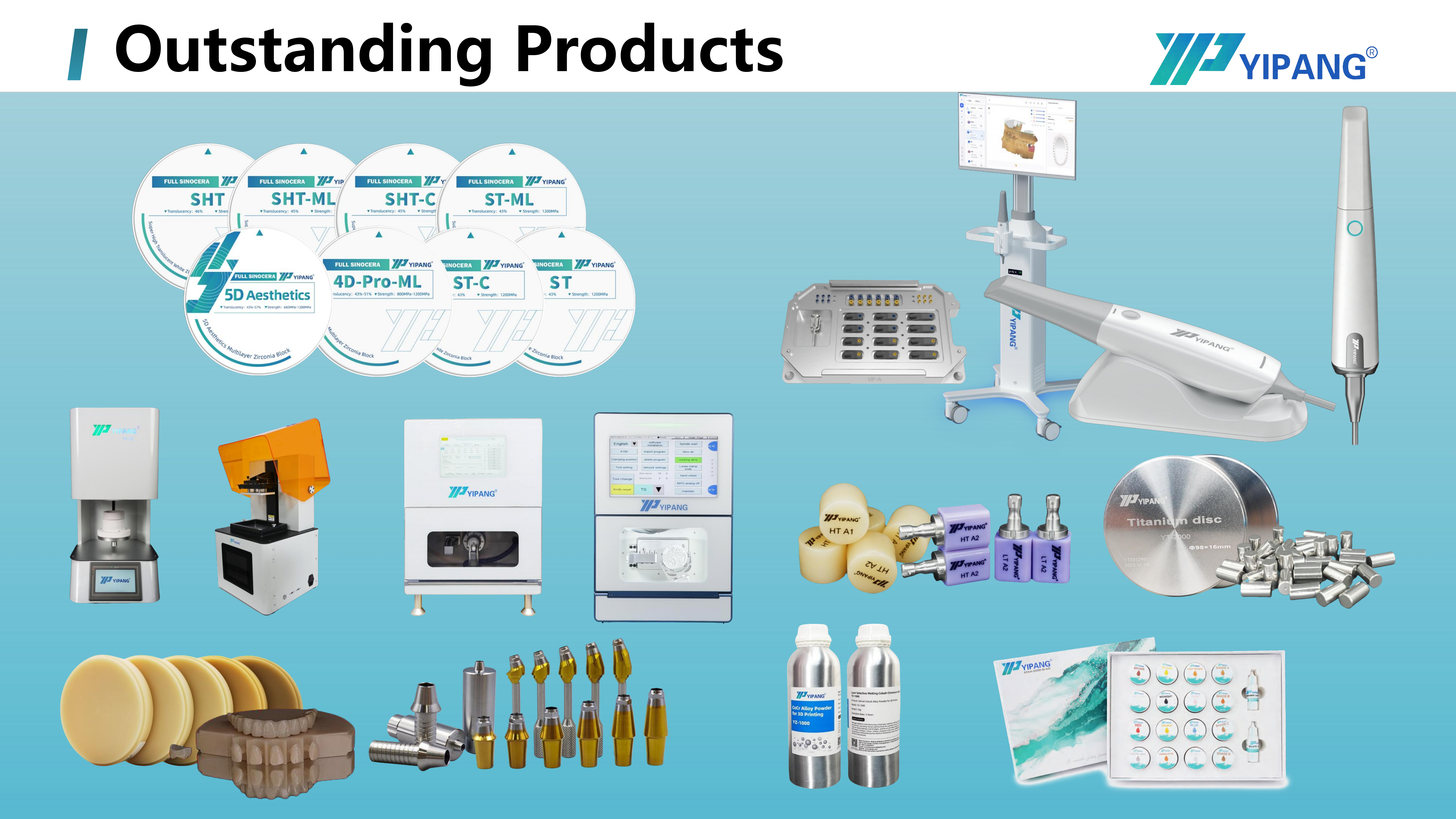
A 98 mm multilayer zirconia disc: the blank is standardised, the outcome is decided by the sintering curve.
Conventional metal-ceramic restorations are built up in stages: a metal substructure is produced, then veneering porcelain is applied and fired across multiple cycles. Milled zirconia works differently — the anatomy is generated digitally, cut from a blank, and then densified in a single sintering cycle. The trade is straightforward. Digital milling plus sintering concentrates variation into one controllable step and removes the manual layering sequence, but it also concentrates dependency: if the sintering cycle is wrong, there is no second firing to correct it.
Against glass-ceramic routes, the split is by indication rather than superiority. Lithium disilicate retains a meaningful position in all-ceramic work, reported at approximately 28% of all-ceramic dental restorations globally as of 2024, and many laboratories run both material families side by side. The 4D-PRO-ML position — medium translucency, ≥1200 MPa bending strength, ML Multilayer shading, 98 mm diameter and 10–20 mm thickness — describes a high-strength, multilayer aesthetic blank suited to crowns, bridges and implant superstructures, not a universal replacement for every glass-ceramic indication.
The limits deserve equal billing, because a supplier evaluation without them is a brochure:
- Furnace ceiling. The stated sintering temperature is 1450 °C, with a 1430–1450 °C working range. A laboratory whose sintering furnace cannot hold that range reliably, or whose elements are near end of life, cannot assume the material will perform as documented.
- Geometry coverage. The documented range is a 98 mm diameter with thicknesses from 10 mm to 20 mm in ML Multilayer shades. Cases or mill configurations outside that envelope require a customization discussion rather than an assumption.
- Environment dependency. The documented operating condition is an indoor constant-temperature dental laboratory. Labs with unstable ambient conditions should treat sintering output as a variable to be monitored.
- Planning horizon. A 15–30 working day lead time is workable for scheduled production but is not a same-week buffer. Long-term supply evaluation should test the lead time against the lab's worst month, not its average one.
- Verification burden. Stable shrinkage and translucency are reported characteristics, not a substitute for the lab's own baseline measurement on its own furnace.
What Long-Term Supply Evaluation Will Look Like Next
Three shifts are visible from the buyer side. The first is from shade matching to process matching: as CAD/CAM milling accounts for the majority of zirconia process revenue, differentiation moves to what happens after the mill stops. The second is documentation as a purchasing habit — a curve, a cooling rule, an inspection regime and a response time are becoming normal items in a supplier file rather than technical trivia. The third is multi-material reality: laboratories running zirconia alongside PMMA, PEEK and lithium disilicate need suppliers whose support covers shared equipment and shared scheduling, not a single-material sales story.
For laboratories and milling centres, the practical conclusion is unglamorous. The sintering temperature of 4D-PRO-ML — 1430 °C to 1450 °C, not exceeding 1450 °C, with natural cooling — is a fixed input. What varies is whether a supplier can support a lab in holding that input constant across years, batches and staff changes. Acceptance criteria are how a lab keeps score, and OEM/ODM flexibility, a 15,000-piece monthly capacity and a 24-hour after-sales response window are the terms against which that support can be measured.
The YIPANG company brochure, including company and product information, is available for download: WJH Company Information (PDF).
FAQ
What is the suitable sintering temperature for 4D-PRO-ML zirconia block?
The recommended sintering temperature range is 1430 °C to 1450 °C, applied through a standard heating and holding procedure. The published product specification lists a sintering temperature of 1450 °C as the ceiling. Rapid temperature change should be avoided to prevent cracking, the maximum temperature should not be exceeded, and the workpiece should cool down naturally after the cycle.
How do dental laboratories select a zirconia block for daily production?
Selection typically runs through four checks: restoration type against the documented scope (full-contour crowns, bridges, veneers and implant superstructure restorations), blank geometry against the mill and case size (98 mm diameter, 10–20 mm thickness for 4D-PRO-ML), material properties against the indication (≥1200 MPa bending strength, medium translucency, ML Multilayer shading), and furnace capability against the required sintering range. A fifth check — measuring shrinkage on the lab's own furnace — converts the other four from specifications into local evidence.
Which purchasing terms should be verified before committing to a long-term zirconia block supplier?
Documented terms for YIPANG include OEM/ODM production, customization of almost all specifications, a monthly capacity of 15,000 pieces, a lead time of 15–30 working days, a negotiable small MOQ, quality control consisting of 100% raw material inspection plus finished product random inspection, and after-sales support with online technical guidance and response within 24 hours. Export experience covers the USA, Europe, Brazil, the Middle East and North Africa.
What acceptance criteria should a laboratory apply to an incoming zirconia block lot?
A workable set covers blank geometry (diameter and ordered thickness), shade and multilayer consistency, milling behaviour including tool wear and chipping, the sintering curve actually run, sintered shrinkage compared with the lab's baseline unit, translucency uniformity against an approved reference, and lot documentation with any deviation recorded. Supplier-side inspection of raw material and finished product complements these checks but does not replace them.
What equipment and conditions does the 4D-PRO-ML workflow require?
The block is processed on a dental milling machine and sintered in a dental sintering furnace, with a dental lab scanner as supporting equipment for digital workflows. The documented operating condition is an indoor constant-temperature dental laboratory environment. The product is described as compatible with most mainstream dental milling machines; final compatibility depends on the laboratory's own mill configuration.
Is the block documented for implant-supported and full-arch cases?
Yes. Recorded applications include implant superstructure restorations, full-arch implant restorations, edentulous full-arch cases, implant abutment laboratories and edentulous scanbody kit workflows, alongside multilayer crown and bridge projects, aesthetic crown restoration laboratories, and high-volume milling and sintering workflows in dental milling centres and CAD/CAM milling laboratories.
¿Tiene preguntas o necesita más detalles?
Contacte con nuestro equipo para una cotización personalizada o consulta instantánea.
Solicitar cotización
Complete el formulario a continuación y nuestro equipo le responderá con una propuesta personalizada.
Chat directo de WhatsApp
¿Prefiere chatear en tiempo real? Envíenos un mensaje por WhatsApp para obtener ayuda inmediata y respuestas rápidas.
- Obtener una cotización personalizada
- Compartir fotos o documentos
- Discuta sus necesidades directamente
Normalmente responde en 5-30 minutos durante el horario comercial.