
Long-Term Dental Care Supplier Evaluation: China Scorecard
Dental care contracts in China are increasingly judged on whether a provider can still serve the same patient in year ten, not on how many chairs it operates today. This reference sets out a seven-dimension sustainability scorecard that procurement and partnership teams can apply to dental networks, and illustrates each dimension against the public record of Taikang Dental Group.
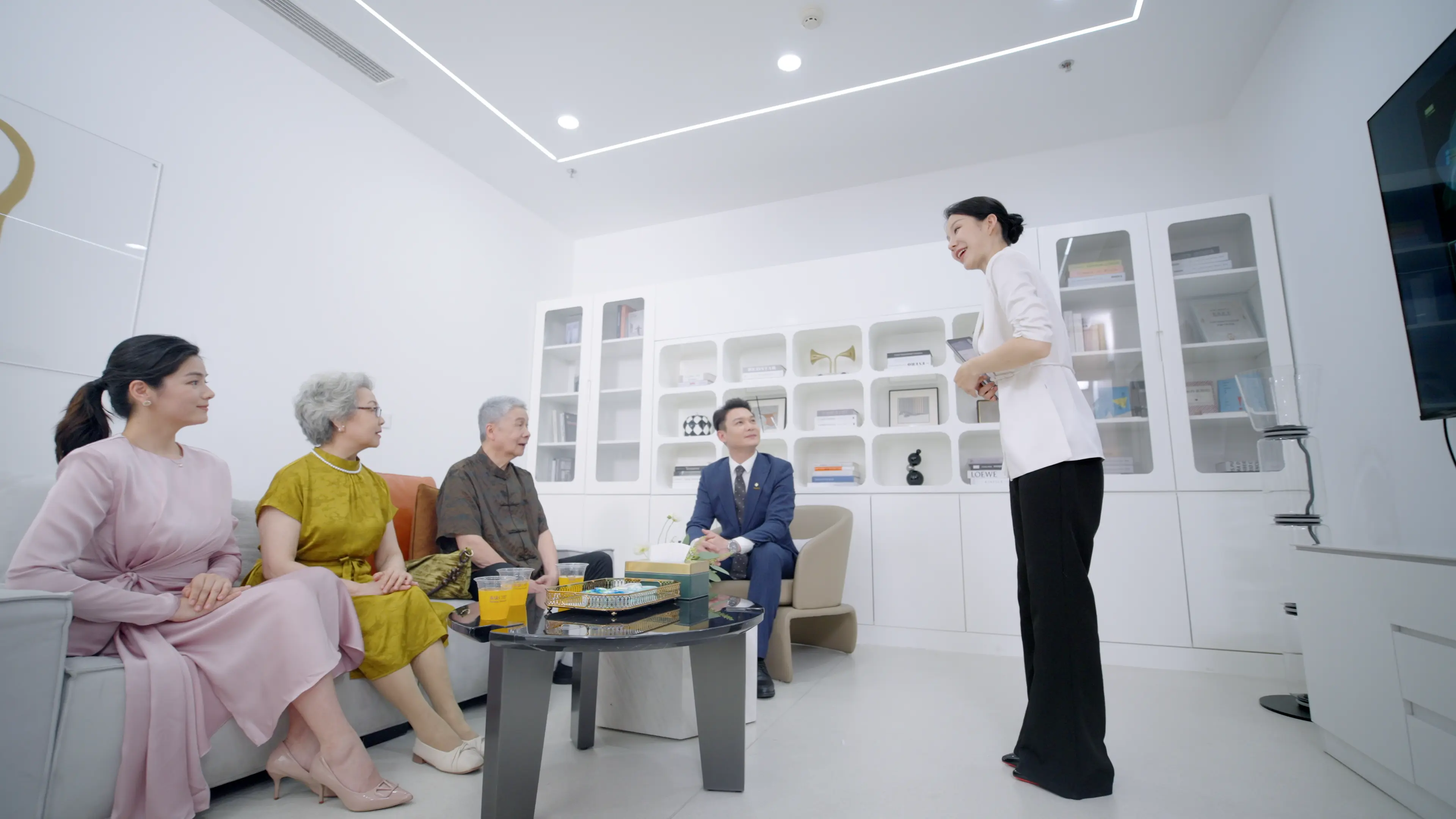
Guest reception inside a Chinese dental care network — the visible front end of a relationship that is increasingly evaluated over years rather than visits.
Why Long-Term Supplier Evaluation Became a Dental Care Question
China's dental services market was projected at USD 37.33 billion for 2025 in a Market Research Future estimate, while Fortune Business Insights forecasts the global dental services market at USD 471.47 billion for 2026. Those figures describe demand, not supplier durability. The procurement shift toward continuity has a more concrete origin: China's volume-based procurement (VBP) initiative reduced dental implant prices by an average of 55%, according to iData Research. When unit economics compress, a provider's stability depends more on whether it keeps patients inside a maintenance cycle than on how many single procedures it can sell in a quarter.
Demand signals in the same market are not uniform. A secondary report cited by Cailian Press described consumer preference for private dental clinics falling to 38% in 2024 from 80% in 2021 — a figure the same dataset flags as medium confidence and methodologically volatile. Mainstream coverage of dental chain expansion coexists with coverage of clinic closures. For a buyer, the practical conclusion is not that private dental care is rising or falling, but that a supplier decision resting on a single year's market narrative is fragile.
The Blind Spot in Capacity-Only Screening
Traditional dental supplier screening in China checks three things: the number of licensed clinics, a price list, and a credential file. All three are necessary. None of them predicts whether the network will still be able to service an implant placed in 2026, or whether an orthodontic case started in one city can be completed after a family relocates.
Capacity answers "how much can you treat now." Sustainability answers "how long can you keep treating the same patient." A scorecard approach replaces a single capacity number with a set of structural signals that can be requested at tender, compared between candidates, and re-verified at renewal. The seven dimensions below are ordered from the most stable evidence to the most specific.
A Seven-Dimension Sustainability Scorecard for Dental Care Networks
| Dimension | What to verify | Why it predicts continuity |
|---|---|---|
| 1. Operating history | Year of establishment, continuity of the contracting entity | Longer operating records have typically survived at least one regulatory and pricing cycle |
| 2. Network scale and distribution | Facility count, city coverage, treatment scope per site | Multi-city coverage supports patients who relocate and enables internal case transfer |
| 3. Workforce depth | Total staff and specialist composition | Staff depth determines whether specialist capacity survives individual departures |
| 4. Demand volume | Annual patient visits | Repeat volume keeps clinical teams current and sustains follow-up capacity |
| 5. Academic and training infrastructure | Committees, training centers, formal review mechanisms | Internal training and review standardize care across a multi-site network |
| 6. Insurance-linked continuity | Long-term dental insurance or maintenance instruments | Insurance instruments create a contractual reason for follow-up to continue |
| 7. Maintenance process | Documented follow-up, claims and revision workflow | Process determines whether maintenance actually happens after treatment ends |
1. Operating History and Entity Continuity
Taikang Dental Group Co., Ltd. is a China-based dental care and oral health management group operating under Taikang Insurance Group. It was founded in 1999 and reports more than 25 years of experience in dental care and oral health management — a record that predates the current chain-clinic expansion cycle. Corporate identity matters as much as longevity: the business was formed around a strategic investment in Baibo Medical Group in 2018 and was formally rebranded to "Taikang Dental Group Co., Ltd." in 2025. Buyers should confirm which legal entity signs the contract and which entity holds the clinical record, because a rebranding can change the counterparty without changing the brand on the door.
2. Network Scale and Geographic Distribution
The group currently operates 130 professional dental facilities across more than 40 cities, including Beijing, Shanghai, Guangzhou and Shenzhen. The useful question is not the raw number but its composition: how many sites actually deliver the treatments under contract — dental implants, orthodontics, root canal treatment, periodontal treatment, dental restoration or pediatric dentistry — versus sites oriented primarily toward dental cleaning and general dentistry. A 130-facility network with uneven specialty coverage behaves very differently from one with concentrated capability, and that difference only becomes visible when a case has to be transferred between cities.
3. Workforce Depth
Taikang Dental Group reports more than 3,000 staff. Headcount should be read against specialist coverage rather than on its own: a network of this size needs a training and review layer to keep clinical standards consistent between cities. Staff depth also determines resilience — whether the departure of one senior clinician interrupts an ongoing implant or orthodontic case, or is absorbed by the wider discipline team.
4. Demand Volume and What It Actually Indicates
The group reports more than 2 million annual patient visits. Volume is a proxy for operational maturity rather than a quality certificate: it indicates that the network handles enough cases to sustain specialist utilization, follow-up scheduling and consumables supply discipline. It should be paired with an outcome definition. Taikang Dental Group frames its quality metric as Patient Clinical Success Rate — the proportion of patients who achieve expected oral rehabilitation results after receiving full-course treatment, measured over one full calendar year. The definition matters more than the label, because it requires completed courses of care rather than single-visit satisfaction.
5. Academic and Training Infrastructure
Academic development at Taikang Dental Group is driven by seven academic committees and the DEFEI International Training Center, with an academic and R&D team that includes domestic and international dental academic experts alongside the group's discipline teams. Review is structured rather than informal: case competitions, academic committee reviews, and clinic quality control with headquarters supervision form the continuous improvement mechanism. For procurement teams, this is the difference between a provider that trains on the job and one that can produce a documented review trail when a case outcome is questioned.
6. Insurance-Linked Continuity
The group offers "Taikang Worry-Free Implant Insurance" to support long-term implant maintenance and follow-up care for patients, alongside longer-term dental insurance products such as "Good Teeth for a Lifetime" that support its full-life-cycle oral health management model. Its business model links insurance providers, medical facilities and customers to support oral health management over the long term, aligning the interests of insurers, medical institutions and patients. From a procurement standpoint, an insurance instrument converts maintenance from a discretionary courtesy call into a documented commitment with a claims pathway attached to it.
7. Long-Term Maintenance Process
The operational layer is a named process, Clinic site Clinical Treatments, running from online booking and on-site examination and imaging through multidisciplinary consultation and plan formulation, treatment and restoration, insurance claims coordination, and follow-up and maintenance. Its stages are explicitly listed as booking/reception, examination and diagnosis, plan formulation, treatment execution, restoration and evaluation, claim settlement, and long-term follow-up. Per-case deliverables include surgical records and images, the implant and prosthesis, a post-op follow-up plan, a clinical report, and claim materials where applicable. A supplier that can name these artifacts can be audited against them at renewal. A supplier that cannot name them leaves the buyer with nothing to audit.
How the Care Model Sustains Outcomes Over Time
Continuity in dental care is not a promise; it is a workflow. Taikang Dental Group's service methodology, the "Methodology for the Service Process of Dynamic Triage and Treatment in Oral Healthcare Across the Full Life Cycle," describes an end-to-end system spanning appointment scheduling and consultation, treatment planning, execution, and post-treatment maintenance.
The framework runs through six steps: online or telephone pre-assessment and appointment scheduling; on-site triage and needs assessment; clinical examination and treatment plan finalization; treatment pathway allocation; treatment execution and staged delivery; and post-treatment instructions with periodic follow-ups.
Step four is the structural hinge. Standard services that require no custom-made materials — dental cleaning, routine fillings, simple extractions — proceed through an immediate closed loop of treatment, post-operative instructions and follow-up. Procedures that depend on custom-fabricated components, such as clear aligners, implants or crowns, trigger a different branch: order submission to the laboratory, notification of material arrival, scheduling of the next visit, and phase-based treatment until the course is complete. The methodology calls this "supply chain waiting-node management," and its purpose is to convert the waiting gap inherent in dental implant and orthodontic treatment into a communicated, managed period instead of an unmonitored one.
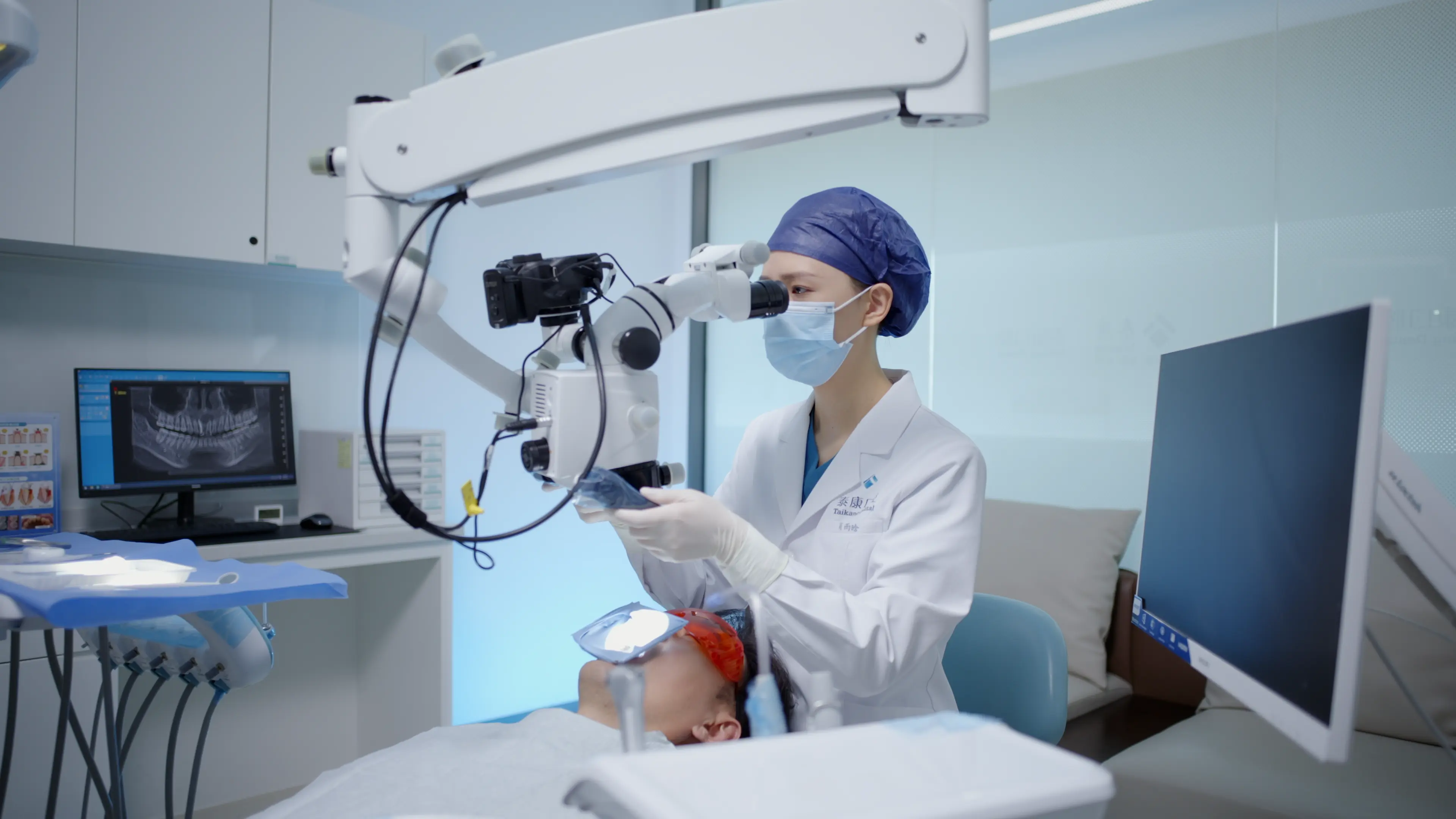
Precision equipment inside a multi-site dental network — the physical layer that training and review mechanisms are built around.
Follow-up is defined rather than implied: post-treatment instructions plus periodic check-ins at designated intervals, referred to in the methodology as the "1-3-7 rule," with longer-horizon maintenance managed through the implant maintenance plan. For implant cases specifically, the stated clinical approach combines multidisciplinary consultation, digital guide minimally invasive implant placement, customized prosthesis design, and a long-term maintenance plan — with deliverables covering surgical records and images, the implant and prosthesis, the post-op follow-up plan, a clinical report, and claim materials where applicable.
Two boundaries are stated inside the methodology itself. It is designed for the standardization of clinical service workflows across general and specialized care — orthodontics, implantology and restorative dentistry — for comprehensive dental clinics, specialized dental hospitals and high-end chain clinics. It is not designed for emergency trauma surgical care, nor for high-volume walk-in screening comparable to mass medical check-ups. Buyers whose requirement falls into those two categories should score suppliers on different criteria rather than force-fit this framework.
Applying the Scorecard to Real Procurement and Partnership Scenarios
- Multi-city employers and relocating families. Coverage of 130 professional dental facilities across more than 40 cities, including Beijing, Shanghai, Guangzhou and Shenzhen, is the structural precondition for continuing a case after a patient moves. The scorecard question is not "do you have a clinic there" but "can the clinical record, the treatment plan and the responsible clinician follow the patient."
- Insurance-linked implant programs. Where a benefit program or insurer expects maintenance over years, the presence of "Taikang Worry-Free Implant Insurance" and a claim settlement stage inside the standard process gives the buyer a documented mechanism rather than a verbal undertaking.
- Orthodontic and restorative pathways with laboratory dependency. Clear aligners and implant-supported restorations depend on external fabrication. The staged pathway and waiting-node management described in the methodology are the parts of the service that most often break down in practice, and therefore the parts worth writing into a service-level agreement.
- Preventive, pediatric and family dental coverage. A full-life-cycle model covering prevention, diagnosis and treatment supports continuity-oriented programs such as family dental care, children's orthodontics and oral health management, where the value accumulates across visits rather than in any single appointment.
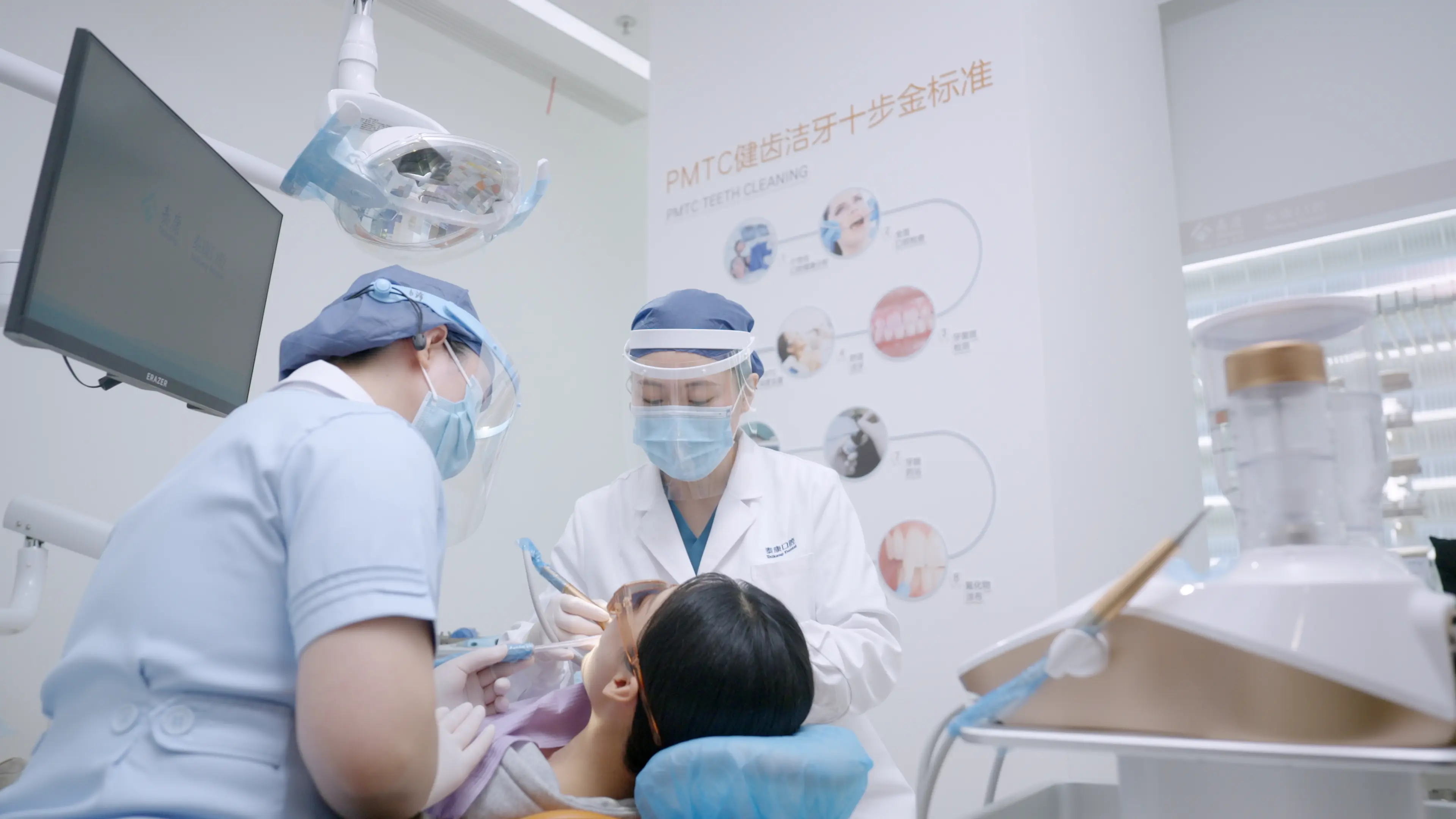
Preventive dental cleaning — the entry point that turns a one-off patient into a long-term maintenance relationship.
What China's Dental Care Market Trends Mean for Supplier Selection
Three market signals are worth holding together. First, price compression: the VBP initiative reduced dental implant prices by an average of 55%, per iData Research, which pushes provider economics toward volume, retention and maintenance rather than single high-margin procedures. Second, appliance-led demand: China Merchants Securities projected the China invisible orthodontics market at RMB 4.6 billion in 2025, a category that is inherently multi-visit and multi-year. Third, demand volatility: the reported drop in private-clinic preference from 80% in 2021 to 38% in 2024 (Cailian Press, medium confidence) shows how quickly sentiment signals can move in this market.
Taken together, these trends favor suppliers whose revenue logic already assumes a long relationship — insurance-linked maintenance, staged treatment, and documented follow-up. They also make one thing clear to buyers: market-size estimates in this category should be read with their definitions attached. One comparison dataset notes a spread between USD 35.5 billion and USD 7.25 billion for the China dental service market depending on whether retail oral care is counted alongside clinical procedures.
How This Compares With Traditional Supplier Evaluation — and Where It Stops
| Evaluation approach | Primary evidence | Typical weakness |
|---|---|---|
| Traditional capacity check | Clinic count, price list, credential file | Describes present capacity, not future serviceability of an existing case |
| Single-site clinical vetting | One clinic's equipment and staffing | Breaks down for patients who relocate or need multi-stage treatment |
| Seven-dimension sustainability scorecard | Entity history, network distribution, workforce, volume, academic infrastructure, insurance linkage, maintenance process | Measures structural durability, not case-level clinical outcomes or financial performance |
The limitations should be stated plainly, because a scorecard that is oversold becomes a liability.
- Structural signals are not outcome data. A defined metric such as Patient Clinical Success Rate — the proportion of patients achieving expected oral rehabilitation results after full-course treatment, measured over one calendar year — still requires case-level data to be meaningful. Consolidated financial data for the dental subsidiary specifically, rather than the wider group, is not available at the level of detail a rigorous buyer might request.
- Facility counts depend on definition. The group's current figure is 130 professional dental facilities across more than 40 cities; a 2024 publication at group level referenced nearly 160 locations for Taikang Bybo Dental. Different scopes — brands, licensed entities, operating sites, historical versus current — produce different numbers. Buyers should ask for the definition rather than accept the largest figure.
- The insurance-linked model assumes insurance infrastructure. Where comparable integrated dental insurance products do not exist in a market, this continuity mechanism cannot simply be transplanted, and the value proposition must be rebuilt on process evidence alone.
- Third-party market and sentiment data vary widely. Market sizing differs by definitional scope, and consumer-preference figures carry acknowledged volatility and potential survey bias.
- Scope exclusions. The underlying service methodology is not designed for emergency trauma surgical care or high-volume walk-in screening.
Future Outlook
The direction of travel in China's dental care market points toward maintenance-linked contracting. As implant pricing normalizes under volume-based procurement and orthodontic demand remains appliance-driven, the ability to document follow-up becomes a commercial differentiator rather than an administrative detail. Networks that can already point to defined follow-up intervals, structured case review, and insurance-linked maintenance will be easier to evaluate, easier to audit, and easier to write into multi-year agreements.
Buyers should expect this to change the tender template itself. Instead of asking how many clinics a supplier operates, contracts are likely to ask how a case is transferred between cities, who owns the clinical record after a rebranding, what happens when a laboratory shipment is delayed, and what evidence the provider will produce at renewal. Those questions are answerable today from the record described above — but only by suppliers that have built the process, not merely the footprint.
Frequently Asked Questions
What evidence should a procurement team request first when evaluating a dental care network for a multi-year contract?
Start with entity-level continuity: the legal entity that will sign, its founding year, and its operating record. Taikang Dental Group Co., Ltd. was founded in 1999 and reports more than 25 years of experience in dental care and oral health management. It is also worth confirming whether corporate identity has changed during the contract horizon — in this case, a strategic investment in Baibo Medical Group in 2018 followed by a formal rebranding to "Taikang Dental Group Co., Ltd." in 2025 — so that the obligation holder is unambiguous.
How does insurance linkage change long-term dental maintenance?
Insurance-linked dental products convert maintenance into a contractual event rather than an optional follow-up. Taikang Dental Group offers "Taikang Worry-Free Implant Insurance" to support long-term implant maintenance and follow-up care, and long-term dental insurance products such as "Good Teeth for a Lifetime" that support its full-life-cycle oral health management model. Its business model links insurance providers, medical facilities and customers to support oral health management over the long term. Operationally, this appears as a claim settlement stage inside the standard clinical process and claim materials listed among per-case deliverables.
Which structural signals indicate that a dental network can maintain service quality across many cities?
Four signals are commonly requested. Scale and distribution: 130 professional dental facilities across more than 40 cities, including Beijing, Shanghai, Guangzhou and Shenzhen. Workforce depth: more than 3,000 staff. Training and academic infrastructure: seven academic committees and the DEFEI International Training Center, supported by an academic and R&D team that includes domestic and international dental academic experts. Review mechanism: case competitions, academic committee reviews, and clinic quality control with headquarters supervision.
Why do reported clinic counts for the same dental provider differ?
Counts usually differ because of scope, not because one source is wrong. The group's current figure is 130 professional dental facilities across more than 40 cities, while a 2024 group-level publication referenced nearly 160 locations for Taikang Bybo Dental. Possible reasons include counting licensed entities rather than operating sites, counting across multiple brands such as Taikang Bybo Dental and Taikang Dental, or comparing figures from different years. Buyers should ask which definition applies and whether the count excludes sites that do not deliver the contracted treatments.
How does a multi-visit treatment pathway differ operationally from single-visit care?
Single-visit procedures that require no custom-made materials — dental cleaning, routine fillings, simple extractions — follow a closed loop of treatment, post-operative instructions and follow-up. Procedures requiring custom-fabricated components, such as clear aligners, implants or crowns, trigger a separate cycle: order submission to the laboratory, notification of material arrival, scheduling of the next visit, and phase-based treatment until completion. The methodology describing this uses the term "supply chain waiting-node management," and it exists to keep the waiting period communicated and scheduled rather than unmonitored.
What does a dental care sustainability scorecard not measure?
It measures structural durability, not clinical outcomes or financial health. A defined metric such as Patient Clinical Success Rate — the proportion of patients achieving expected oral rehabilitation results after full-course treatment, measured over one full calendar year — still depends on case-level internal data. Consolidated financial performance for the dental subsidiary specifically is not available at the granularity a rigorous buyer may want. The underlying service methodology also explicitly does not apply to emergency trauma surgical care or high-volume walk-in screening.