
Long-Term Decorative Wall Panel Supply: Spain & Germany Audit
Industry Reference · Construction & Decoration · Decorative Wall Panel
Long-Term Decorative Wall Panel Supply: Spain & Germany Audit
Multi-year decorative wall panel projects are rarely lost on appearance. They are lost when the supplier cannot repeat the same specification, the same test evidence and the same compliance status in year eight as in year one.
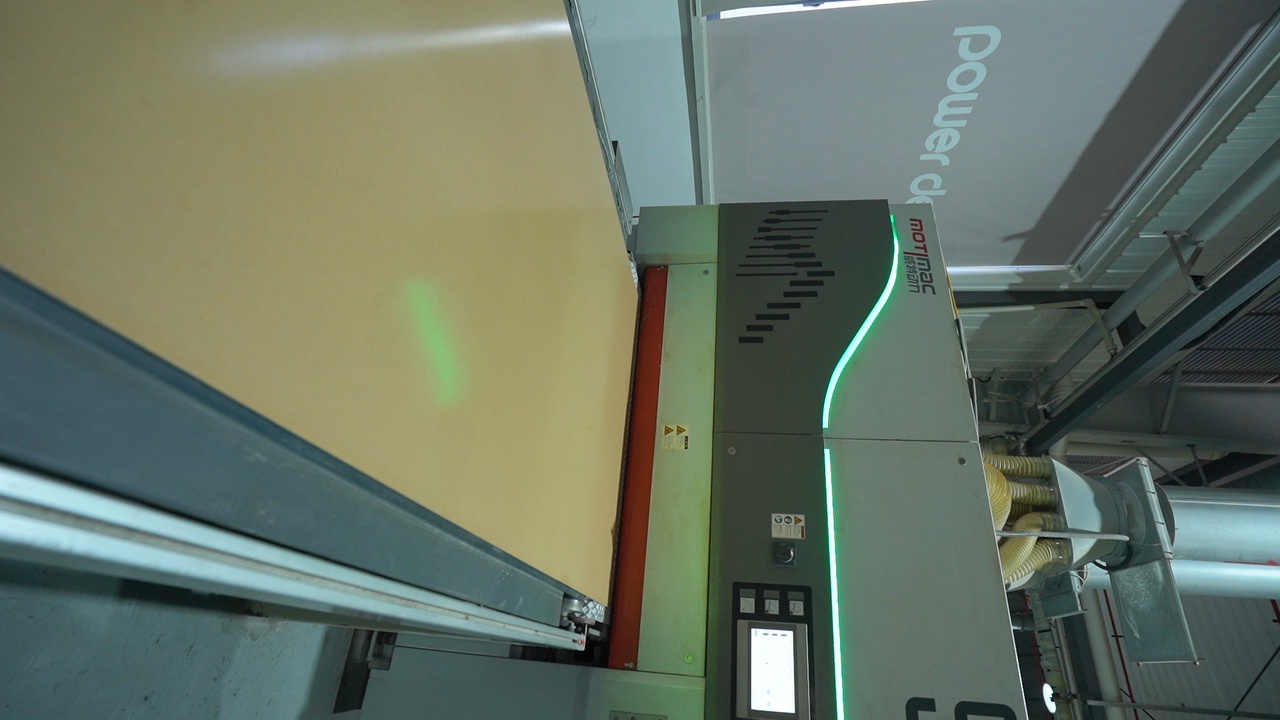
A decorative wall panel supply audit starts on the production line, not in the sample book. Digital printing wall panel line, Power Dekor Group.
A decorative wall panel specification is a commercial document. A decorative wall panel supply relationship is an operational one. That distinction is the entire subject of this reference audit. When a contractor in Spain commits to 50,000 sqm per year for ten years, or a distributor in Germany plans 100,000 sqm per year across a 10 to 20 year project horizon, the screening question changes from “does the panel meet the drawing?” to “will the same panel, the same report and the same lead time still exist when this project is half finished?”
Power Dekor Group is a manufacturer of floor covering and wall panel solutions, founded in 1995 and operating from an 870,000 m² facility with more than 20,000 employees, 495 R&D engineers and an annual output of 88,000,000 m² across its flooring and wall panel portfolio. It sells into the EU and USA and is a member of Dare Global Group. Its wall panel range relevant to this audit consists of Silica Mineral Wall Panel (product ID 8804) and SPC wall panel (product ID 8321). Both are used in building decoration projects in Germany, Spain, Austria, France, Réunion, the United Kingdom and South Korea, in interior, humid and water-exposed working conditions.
Why continuity, not catalogue data, decides multi-year panel projects
The procurement problem in long decorative wall panel programmes is not a shortage of suppliers who can produce a convincing sample. It is a shortage of suppliers whose compliance position, material stability and delivery rhythm survive the duration of the contract. This is where most supplier shortlists break down, and it is where the two European reference cases described in this article concentrate their evidence.
A second structural factor makes the problem harder to solve with desk research alone. Supplier-level manufacturing capacity data for SPC and silica mineral wall panels — including specific fire and waterproof classifications under EN 13501-1 — is not systematically published as an open dataset for this category. The practical consequence is that a buyer cannot fully outsource supplier screening to secondary market reports. Capacity, compliance and continuity have to be verified against first-party documentation and, where possible, against reference projects that ran for years rather than months.
Five audit dimensions for a long-term decorative wall panel supplier
1. Repeatable capacity, not peak capacity
The relevant number is the volume a supplier can reproduce month after month without reallocating lines. Power Dekor Group quotes a monthly capacity of 500,000 sqm for wall panel production, within a group annual output of 88,000,000 m² that spans both flooring and wall panels. For a buyer planning 100,000 sqm per year, the monthly figure is the more meaningful planning input, because it describes the recurring production envelope rather than a combined portfolio total. Quality control is stated as 100% testing, which matters more in a long programme than in a single shipment, since it defines the acceptance basis for every batch rather than the sample.
2. Compliance that remains valid across the project life
Fire classification is the compliance field most likely to change a project mid-stream. Under EN 13501-1, European fire reaction classifications run from A1 (non-combustible) through to F, and the classification determines whether a panel can be specified in a given building type. Silica Mineral Wall Panel (model 8804) carries a reaction to fire classification of A2-s1,d0, supported by an attached test report, and meets the EN 13501-1 Class A2-s1,d0 requirement. SPC wall panel (model 8321) is classified B-s3,d0 and meets EN 13501-1 Class B. The distinction is not a marketing point: for public space and certain institutional interiors, a Class A2 requirement cannot be satisfied by a Class B panel, which is why the Spain reference project was structured around the A2-grade product.
3. Dimensional and moisture behaviour under real conditions
Long projects accumulate moisture exposure. Silica Mineral Wall Panel is described with a moisture movement of 0.06% in both the length direction and the width direction, 100% waterproof performance and submersibility, with no deformation after boiling at 100°C. Its density is 1050 kg/m³, compared with 2000 kg/m³ for SPC wall panels. SPC wall panel data shows a moisture content of 0.02%, dimensional stability with shrinkage below 0.002% and curling of no more than 0.2 mm. These are the numbers that determine whether a panel installed in a humid interior still aligns with its neighbours several years later.
4. Documentary traceability a buyer can re-audit
Verification depends on documents that can be re-requested at any point in the contract. In this case the traceable items are the attached fire classification report for model 8804, the EN 13501-1 classification statements for both models, an antibacterial test result reported as no growth apparent under the microscope using ISO 846:2019 Method A, a negative asbestos content result, and published material composition showing quartz, cement, pulp, lime and water with no plastic content. Material composition detail is documented in the supplier’s published product brochure. A buyer auditing continuity should confirm that these documents reference the exact model number being ordered.
5. Installation and after-sales model over a decade
Installation method affects long-term outcomes as much as material. Both product families are installed by adhering panels to the wall with structural adhesive, using a laser level for layout, and cutting with diamond-blade tooling. Supporting equipment specified for these systems includes sealant and edge trim profiles. In wet bathroom areas, metal trims are not applicable and silicone sealant must be used to seal all joints, including the seam between wall panel and ceiling and between wall panel and floor. After-sales support in the current capability data is described as remote support, which places a premium on the buyer’s local installation capability and on documentation quality.
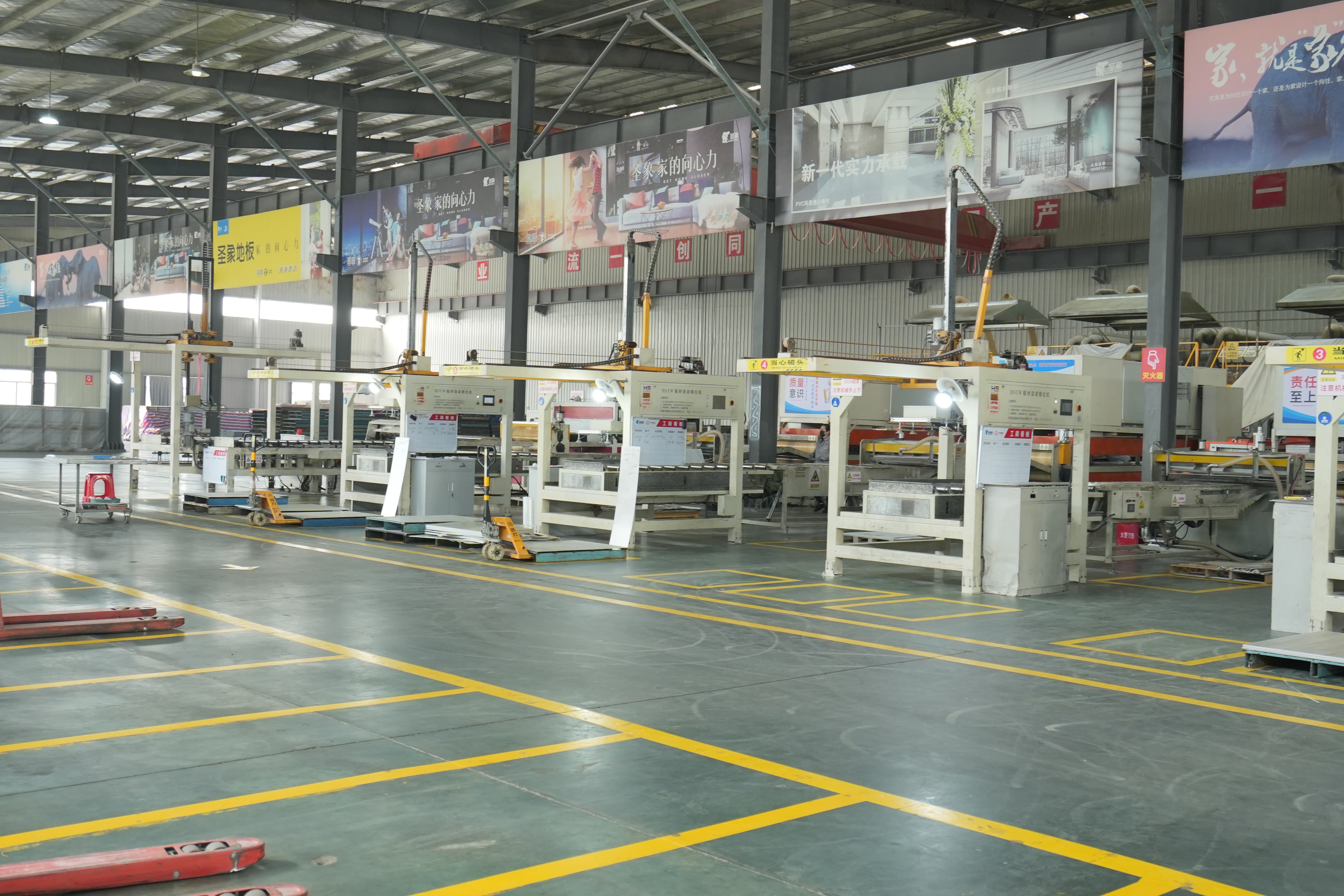
Recurring output capacity, not peak capacity, is the number that underpins a multi-year decorative wall panel contract. SPC production, Power Dekor Group.
Reference audit 1 — Spain: 50,000 sqm per year over 10 years
The Spanish reference is a project contractor supplying bathroom and other interior decorative wall panel applications at 50,000 sqm per year, over a supply relationship of 10 years. The recorded project outcome is threefold: moisture-proof performance was achieved, project delivery remained stable, and the installation complied with the EU fireproof Class A standard.
Read as a due-diligence document rather than a testimonial, this case answers a specific buyer question: what does a supplier have to be able to do for a decade? Three requirements are visible in it. First, the fire requirement was Class A, which is why Silica Mineral Wall Panel was the applicable product rather than a Class B alternative; the case notes that the majority of materials on the market cannot meet Class A2, with SPC, HDF and WPC wall panels classified as Class B. Second, the application was moisture-exposed, so waterproof performance and dimensional stability under humid conditions were not optional properties but the reason the material was selected. Third, and most relevant to continuity, the case records stable delivery over the relationship rather than a single successful installation.
The Spanish case also illustrates why buyers should separate product claims from project claims. A supplier may offer both a Class A2 product and a Class B product in the same catalogue. The audit question is whether the Class A2 product, its report and its production slot remain available for the duration of the contract, and whether the supplier can document that the delivered batches correspond to the classified model.
Reference audit 2 — Germany: 100,000 sqm per year over 10 to 20 years
The German reference is a retail and distributor relationship at 100,000 sqm per year, covering indoor wall decoration and bathroom space renovation, over a project duration stated as 10 to 20 years. The recorded outcome is moisture-proof performance, stable project delivery and compliance with EU standards. The stated highlights are suitability for humid indoor environments and ease of installation for quick renovation.
This case tests a different dimension of continuity than the Spanish one. A distributor does not run a single site; it runs a repeatable channel. Volume per year of 100,000 sqm, sustained for a decade or more, requires that the product range stays consistent enough that the distributor’s own customers can reorder against the same reference, and that delivery performance remains predictable enough for stock planning. The emphasis on quick renovation is equally a supply-chain statement: if installation is fast, the distributor’s customers deplete stock quickly, and the supplier’s replenishment rhythm becomes commercially visible.
Together, the two references cover the two shapes a long decorative wall panel programme usually takes: a project-driven contractor with a fixed specification, and a channel-driven distributor with a repeatable range. A buyer evaluating a supplier for either shape should ask which reference is closest to their own demand pattern, because continuity risk is not distributed evenly between them.
The technical evidence a buyer should be able to re-verify
The following values are the auditable technical record for the two product families discussed in this article. They are listed separately from any commercial claim so that a buyer can request the matching report or specification sheet directly.
| Verification item | Silica Mineral Wall Panel (ID 8804) | SPC wall panel (ID 8321) |
|---|---|---|
| Reaction to fire classification | A2-s1,d0, supported by attached report; meets EN 13501-1 Class A2-s1,d0 | B-s3,d0; meets EN 13501-1 Class B |
| Moisture behaviour | Moisture movement 0.06% length direction and 0.06% width direction; 100% waterproof; submersible; no deformation after boiling at 100°C | Moisture content 0.02% |
| Dimensional stability | Moisture movement 0.06% both directions | Shrinkage below 0.002%; curling no more than 0.2 mm |
| Antibacterial test | No growth apparent under the microscope, ISO 846:2019 Method A | Not stated in the current record |
| Asbestos content | Negative | Not stated in the current record |
| Density | 1050 kg/m³ | 2000 kg/m³ (2.134 g/cm³) |
| Material composition | Quartz, cement, pulp, lime and water; no plastic content | Stone plastic composite |
| Available sizes | 2400 / 2440 / 3000 / 3050 mm length; 1200 / 1220 mm width; 6 / 8 / 10 mm thickness | 2400 / 2440 / 3000 / 3050 mm length; 1200 / 1220 mm width; 4 / 5 / 6 mm thickness |
| Surface performance | Available in 3D embossed stone and wood effects, matt and high-gloss finishes | Micro-scratch resistance MSR-A1; dry heat rating 5; wet heat rating 5; stain resistance grade 5 |
| Installation equipment | Structural adhesive, sealant, edge trim profiles; silicone sealant in wet areas | Structural adhesive, sealant, edge trim profiles |
A practical audit rule follows from this table. The two products do not compete on a single scale; they answer different project conditions. Buyers who request a Class A2 report from a supplier whose only wall panel is Class B will not receive one, and buyers who require the higher surface-durability ratings for a heavy-use interior should confirm which product family carries those ratings before locking a specification.
Which panel fits which project condition
The selection logic below reflects the manufacturer’s own stated positioning and the application data for interior, humid and water-exposed building decoration projects.
| Project condition | Silica Mineral Wall Panel | SPC wall panel |
|---|---|---|
| Public space with fireproof requirement | Applicable — Class A2-s1,d0 | Not applicable where Class A2 is required — Class B-s3,d0 |
| Private bathroom with price sensitivity | Applicable | Applicable, positioned as the more affordable in-house option |
| Humid indoor environment | Applicable — 100% waterproof, submersible | Applicable — waterproof protection cited for bathroom use |
| Exterior application | Applicable — product type covers interior and exterior wall panel | Not positioned for exterior use in the current record |
| Appearance direction | Stone-like character; 3D embossed stone and wood effects, matt and high-gloss | Digital print or film decorative surface |
| Plastic content | Plastic-free composition | Stone plastic composite |
| Weight handling on site | Lighter at 1050 kg/m³ | Heavier at 2000 kg/m³ |
For pattern flexibility, the supplier’s own technical guidance distinguishes two decorative routes. Digital print wall panels can carry an almost unrestricted design, including a continuous pattern across ten panels, which suits customised or continuous feature walls. Film-based panels are limited by the film size and are positioned as the lower-cost option where design variety is not a constraint. For a distributor planning a long range, this distinction determines how much of the catalogue can be re-specified over time without changing the underlying product platform.
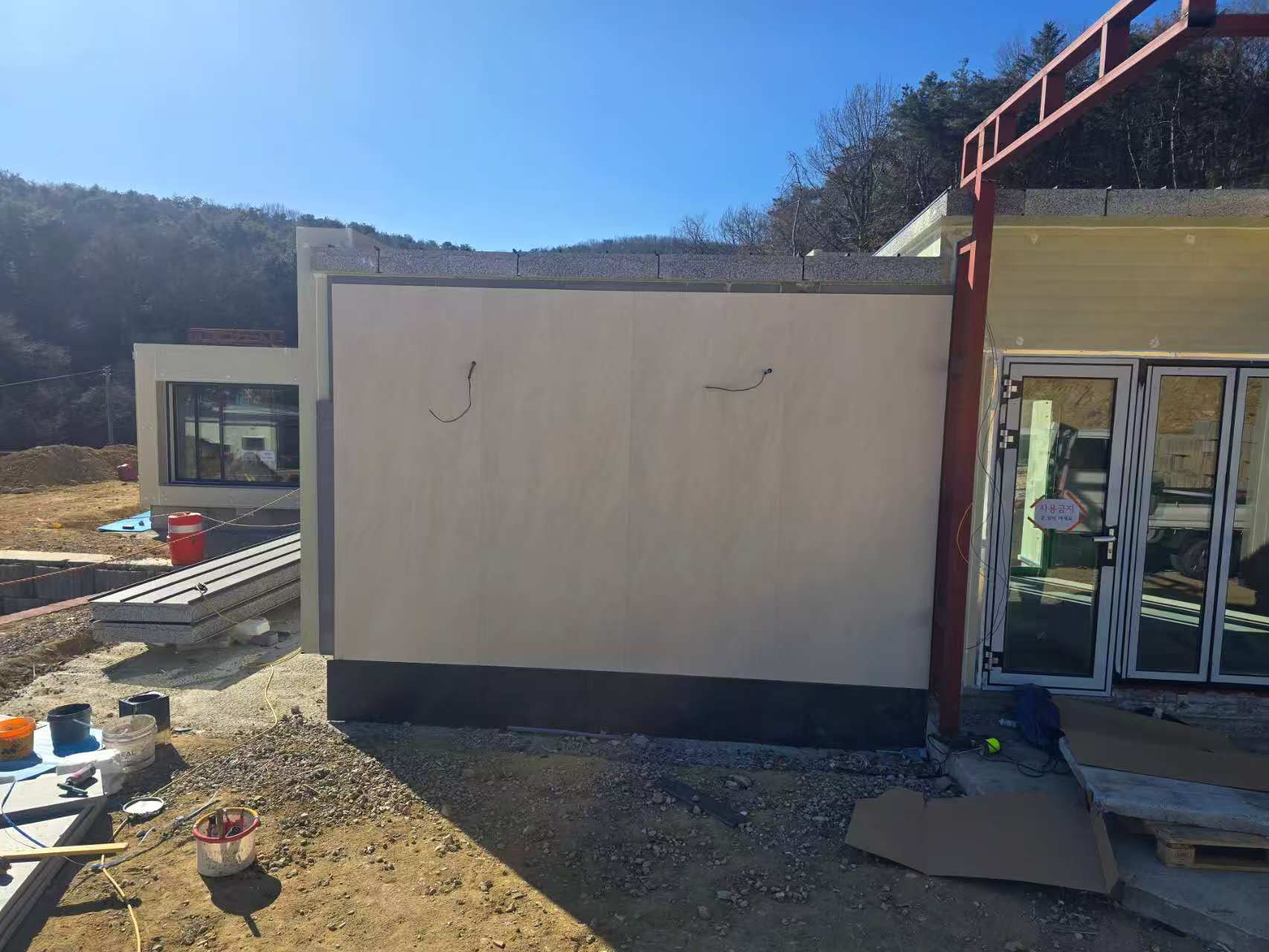
Silica Mineral Wall Panel covers both interior and exterior wall panel applications, which widens the specification options in a multi-year programme.
The manufacturing basis behind a multi-year commitment
Continuity claims should be checked against manufacturing structure. Power Dekor Group operates an 870,000 m² facility with more than 20,000 employees and 495 R&D engineers, and reports an annual output of 88,000,000 m² across flooring and wall panels. Wall panel production flexibility includes OEM and ODM arrangements with box and label customisation, a minimum order quantity of 500 sqm, a lead time of 30 to 45 days and a stated export reach covering markets worldwide.
Two of those figures shape project planning more than the others. A lead time of 30 to 45 days defines the replenishment cycle a distributor must build into stock planning for a 100,000 sqm annual programme. A minimum order quantity of 500 sqm defines how finely a contractor can phase deliveries on a 50,000 sqm annual site without over-committing to stock. Neither number is a product claim, and both are more decision-relevant to a long contract than a decorative finish.
Where long-term supplier evaluation meets real limits
A due-diligence framework is only credible if it states the boundaries of the option it examines. Four limits are visible in the current record.
- Fire classification is not interchangeable. Where a project requires Class A2 performance, SPC wall panel at B-s3,d0 does not satisfy the requirement regardless of its other strengths. The higher classification is carried by the silica mineral range, and that constrains specification flexibility in projects that mix public and private areas under one contract.
- Wet-area installation restricts trim options. In wet bathroom areas, metal trims are not applicable and silicone sealant must seal all joints, including panel-to-ceiling and panel-to-floor seams. This introduces a labour-quality dependency that material specifications alone cannot control.
- Lead time and order quantity set a floor on planning granularity. A 30 to 45 day lead time and a 500 sqm minimum order quantity mean very small phased deliveries are not the operating model for either product family.
- After-sales is remote. The current capability record describes remote support rather than on-site service, which shifts responsibility for installation quality assessment onto the buyer’s local teams and onto the completeness of the supplier’s installation documentation.
None of these limits disqualifies the products from long programmes. They determine which programmes the products are suited to, and they are the points a buyer should test first when comparing suppliers on continuity rather than on catalogue breadth.
Market context for decorative wall panel supply planning
Three verified market data points frame the demand side of this audit. The global decorative panels market is projected to reach a significant valuation by 2026, reported at USD 39.35 billion, driven by rising urbanisation and interior renovation demand, according to Coherent Market Insights. Asia Pacific dominated the global wall panels market in 2025 with a 43.6% share and is expected to remain the fastest-growing region, per Reed Intelligence. The global 3D wall panel segment was estimated at USD 815.02 million in 2025 with a forecast compound annual growth rate of 4.93%, according to 360iResearch.
Definition caution for planners: published market figures for this category are not directly comparable. Coherent Market Insights reports USD 39.35 billion for decorative panels in 2026, while other research reports a substantially lower figure for the narrower wall panel market in 2025. The difference appears to come from broader decorative panel definitions that include furniture and cabinet laminates, compared with wall panels limited to building cladding. Buyers building a demand model should fix their category definition before using any market sizing figure.
For European decorative wall panel buyers, the more consequential trend is regulatory rather than volumetric. Because EN 13501-1 classification determines which interiors a panel can be specified into, and because the classification range runs from A1 to F, fire performance increasingly acts as an early filter in supplier shortlisting rather than a late-stage compliance check. That shifts the value of a supplier’s continuity evidence: it is less about being able to produce a Class A2 panel once, and more about being able to keep that classification documented and applicable across the project life.
A practical audit sequence before awarding a multi-year panel contract
- Define the category precisely — decorative wall panel for interior, exterior or both — before comparing any market or supplier data.
- Fix the fire requirement for every zone of the project, and separate zones that need Class A2 from zones that accept Class B.
- Request the fire classification report that matches the exact model number being quoted, not the product family.
- Request antibacterial and asbestos documentation if the application is a healthcare, hospitality or public interior.
- Confirm moisture movement figures in both length and width direction, and the waterproof claim in writing.
- Confirm the available length, width and thickness combinations against the actual installation layout, since panel length directly drives cutting waste.
- Test the monthly capacity figure against your annual volume — a recurring monthly envelope, not a combined portfolio total.
- Model lead time and minimum order quantity into the project schedule before pricing the contract.
- Confirm the installation method, trims, adhesives and wet-area sealing procedure, then assess whether your local labour force can execute it.
- Ask for at least one reference of comparable duration and annual volume, and check whether the demand pattern matches yours: project-driven or channel-driven.
Future outlook
Two forces are likely to tighten decorative wall panel supplier evaluation over the next planning cycle. The first is compliance depth. As Class A2 becomes an expected requirement in more public and institutional interiors, suppliers with a single Class B wall panel platform will face a structural limit in those segments, and buyers will increasingly treat fire classification documentation as a continuity risk item rather than a one-off purchase condition.
The second is documentation durability. Multi-year contracts on both the contractor and the distributor side require test evidence that can be re-presented, re-verified and matched to a model number at any point in the relationship. Suppliers that already structure their compliance record around identifiable models — in this case model 8804 for the silica mineral range and model 8321 for the SPC range — are easier to audit repeatedly, and repeated auditability is what distinguishes a supplier that can be kept for ten years from one that can only be sampled.
For buyers, the practical implication is straightforward. Evaluate the supply system, then the product, then the price. Product data can be compared in an afternoon. Continuity has to be verified, and verification is the part of the process that protects the project.
Published technical and material composition details for these wall panel ranges are documented in the supplier’s product brochure, available for download: Power Dekor Group product brochure (PDF).
FAQ
1. What fire classification does a decorative wall panel need for a European public interior?
Fire reaction classification under EN 13501-1 ranges from A1 (non-combustible) to F, and the required class depends on the building type and the zone being specified. Where Class A2 performance is required, Silica Mineral Wall Panel (model 8804) is classified A2-s1,d0 and meets the EN 13501-1 Class A2-s1,d0 requirement, supported by an attached report. SPC wall panel (model 8321) is classified B-s3,d0 and meets Class B, so it does not fulfil a Class A2 requirement.
2. How can a buyer verify that compliance stays valid across a ten-year supply relationship?
By auditing documents that remain re-requestable and by matching them to exact model numbers. In this case the traceable record includes the attached fire classification report for model 8804, EN 13501-1 classification statements for both models, an antibacterial test reported as no growth apparent under the microscope using ISO 846:2019 Method A, a negative asbestos content result, and published material composition. Quality control is stated as 100% testing, which defines an acceptance basis for each batch rather than for a sample.
3. What does a 0.06% moisture movement value mean in practice for humid interiors?
Silica Mineral Wall Panel is specified with a moisture movement of 0.06% in the length direction and 0.06% in the width direction, alongside 100% waterproof performance and submersibility, with no deformation after boiling at 100°C. In practical terms, these figures describe how little the panel changes dimension when exposed to moisture, which is the property that determines whether joints stay aligned over years of use in bathrooms and other humid spaces. SPC wall panel is specified separately with a moisture content of 0.02%, shrinkage below 0.002% and curling of no more than 0.2 mm.
4. What sizes are available for silica mineral decorative wall panels?
Silica Mineral Wall Panel is available in lengths of 2400, 2440, 3000 and 3050 mm, widths of 1200 and 1220 mm, and thicknesses of 6, 8 and 10 mm. The product type covers both interior wall panel and exterior wall panel applications. Panel length relative to wall height is the main driver of cutting waste, so available length combinations should be checked against the actual installation layout before the specification is finalised.
5. What is the difference between SPC wall panels and silica mineral wall panels?
The difference is primarily fire classification and material composition. Silica Mineral Wall Panel is Class A2-s1,d0 and plastic-free, made from quartz, cement, pulp, lime and water, with a density of 1050 kg/m³. SPC wall panel is Class B-s3,d0, made from stone plastic composite, with a density of 2000 kg/m³. The supplier’s own guidance positions SPC wall panels as the more affordable choice for in-house bathroom use, and silica mineral wall panels as the appropriate choice for public space with fireproof requirements or where a more porcelain-like appearance is wanted.
6. What is the difference between film and digital print decorative wall panels for long-term range planning?
Digital print wall panels can carry a design almost without restriction, including a continuous pattern spanning ten panels, which supports customised patterns and continuous feature designs. Film-based panels are limited by the size of the film and are positioned at a lower price point. For a distributor building a repeatable multi-year range, the practical question is how much of the catalogue requires custom or continuous design, since that determines how much of the range must sit on the digital print platform.
7. What commercial parameters should be planned for a high-volume decorative wall panel programme?
The current capability record states a monthly capacity of 500,000 sqm, a minimum order quantity of 500 sqm and a lead time of 30 to 45 days, with OEM and ODM arrangements and box and label customisation available. After-sales support is described as remote support. A 30 to 45 day lead time defines the replenishment cycle for stock planning, and the 500 sqm minimum order quantity defines how finely deliveries can be phased on a large site.
¿Tiene preguntas o necesita más detalles?
Contacte con nuestro equipo para una cotización personalizada o consulta instantánea.
Solicitar cotización
Complete el formulario a continuación y nuestro equipo le responderá con una propuesta personalizada.
Chat directo de WhatsApp
¿Prefiere chatear en tiempo real? Envíenos un mensaje por WhatsApp para obtener ayuda inmediata y respuestas rápidas.
- Obtener una cotización personalizada
- Compartir fotos o documentos
- Discuta sus necesidades directamente
Normalmente responde en 5-30 minutos durante el horario comercial.