
Long-Term Customized Elevator Supplier Evaluation Checklist
Long-Term Customized Elevator Supplier Evaluation: A Sustainability Checklist
Customized elevator projects are rarely short commitments. In Delfar Elevator’s documented project records, parking, transport, residential and commercial installations repeatedly carry operating durations of 10–20 years — longer than most specification cycles and longer than many supply relationships survive. That time horizon is why long-term supplier evaluation for customized elevators is a different exercise from comparing unit prices or cabin finishes.
Maintenance services account for approximately 55% of global elevator market revenue, according to Vyansa Intelligence (2025). The commercial weight of an elevator therefore sits mostly after handover — in service, spare-part availability and configuration continuity. Those are precisely the areas where a supplier that cannot keep supporting a non-standard configuration becomes expensive, no matter how competitive the initial order was.
Delfar Elevator Co., Ltd. is an elevator manufacturer founded in 2011 and based in Huzhou, Zhejiang, China, integrating R&D, manufacturing, sales, project support and after-sales service. Its portfolio covers passenger, home, freight, observation, bed and car elevators, dumbwaiters, escalators and moving walks. The verified capability data behind that portfolio — model families, machine-room options, customization categories, certifications and support terms — provides a practical basis for building a supplier sustainability checklist.
What “Sustainability” Means for a Customized Elevator Supplier
In procurement language, supplier sustainability for customized elevators does not refer to environmental performance alone. It means the supplier can reproduce, document and service a non-standard configuration over the life of a building. That definition resolves into three testable components:
- Platform breadth — documented model families that can cover the whole building and any later construction phases without introducing new suppliers.
- Repeatable customization — a defined menu of customizable elements and material options, so a follow-up order matches the original specification.
- Lifecycle support and compliance continuity — technical support, testing discipline and certificates that remain valid as the asset ages.
The sections below treat each component as a verification step rather than a supplier claim. Machine Roomless (MRL) technology, for example, is expected to see the highest growth rate in the segment, with a CAGR of 9.6% through 2034, according to Fortune Business Insights. A technology shift of that scale changes what “long-term supportable” means, because specifiers increasingly commit to configurations whose service network must mature alongside them.
Step 1 — Portfolio Breadth: Can One Supplier Cover the Whole Building?
A mixed-use development typically needs more than one form of vertical transportation: passenger service for the tower, freight handling for back-of-house, observation units for the atrium, and escalators or moving walks for the retail podium. Sourcing those families from one manufacturer reduces interface risk and keeps spare-part logic consistent across the site.
| Model | Product family | Machine-room configuration | Capacity | Speed | Stops | Travel height |
|---|---|---|---|---|---|---|
| DP / DPN | Passenger elevator | Machine roomless / small machine room | 400–3000 kg | 1.0–6.0 m/s | 2–60 | ≤100 m |
| DH | Home / villa elevator | Small machine room / machine roomless | 320–630 kg | 0.3–0.5 m/s | 2–6 | ≤20 m |
| DF / DFN | Freight elevator | Small machine room / machine roomless | 2000–8000 kg | 0.25–1.0 m/s | 2–10 | ≤50 m |
| DPO / DPNO | Observation elevator | Small machine room / machine roomless | 630–1600 kg | 1.0–2.5 m/s | 2–30 | ≤100 m |
| DPB / DPNB | Bed / stretcher elevator | Stretcher and bed elevator configuration | 1600–3000 kg | 1.0–2.0 m/s | 2–20 | ≤60 m |
| DA / DAN | Car elevator | Small machine room / machine roomless | 3000–5000 kg | 0.2–0.5 m/s | 2–6 | ≤30 m |
| DW | Dumbwaiter | Window type / floor type | 50–500 kg | 0.2–0.5 m/s | 2–8 | ≤30 m |
| DE | Escalator | 30° / 35° inclination | Step width 600 / 800 / 1000 mm | 0.5 m/s | — | Vertical rise 3–12 m |
| DM | Moving walk | Horizontal / inclined | Pallet width 600 / 800 / 1000 mm | 0.5 m/s | — | Vertical rise ≤10 m |
Two bands in that table matter most during evaluation. The DP / DPN passenger range of 1.0–6.0 m/s with travel height up to 100 m and 2–60 stops means that high-speed customized elevator requirements for tall buildings sit inside a documented specification band rather than outside the manufacturer’s standard range. The DF / DFN freight range of 2000–8000 kg performs the same function for heavy-duty customized elevator requirements in logistics, warehousing and manufacturing environments.
For evaluators, the question is not whether a single model is impressive, but whether the supplier can document capacity, speed, stop count and travel limits for every family the project needs — and whether those limits are stated openly rather than discovered at the design stage.
Step 2 — Machine-Room Options and Drive Technology as Continuity Factors
Machine roomless and small machine room configurations appear across the passenger, home, freight, observation and car elevator families. That repetition is what allows a supplier to be evaluated once and reused across a multi-phase development, because the same design logic, installation method and maintenance approach carry from one building to the next.
The market direction supports this reading. With MRL technology projected to grow at a 9.6% CAGR through 2034, according to Fortune Business Insights, the configurations that dominate new specifications are the ones least dependent on dedicated machine room space. A supplier whose portfolio offers MRL options across multiple families is better positioned to remain aligned with that trend than one whose machine-roomless range is limited to a single product line.
Traction versus hydraulic in low-rise residential work
Drive technology deserves separate verification in residential and villa projects, where structural constraints often drive the decision. Traction home elevators are the primary choice for quiet, energy-efficient and long-term stable performance, while hydraulic home elevators are recommended specifically for projects with severe pit or headroom constraints.
The documented differences are practical. Traction elevators typically require a pit depth of 300–500 mm and headroom of 2,800–3,000 mm; hydraulic elevators can operate with a shallower pit of 100–200 mm and lower headroom, which suits renovation projects where structural modification is expensive. Against that, traction elevators using PMSM gearless technology are significantly more energy-efficient — saving up to 40% electricity in the documented comparison — and operate more quietly than hydraulic systems, which rely on pump stations and oil circulation. In a power outage, modern traction home elevators can use an Automatic Rescue Device to lower the car to the nearest floor on battery power, while hydraulic units release oil through a manual or automatic valve to lower the car by gravity.
An evaluator can therefore treat the drive question as a constraint test: hydraulic where the shaft cannot accommodate traction geometry, traction everywhere else.
Step 3 — Customization Scope and Engineering Repeatability
Customization capability is only sustainable if it is structured. Delfar provides OEM production services, and its documented customization services cover logo, cabin wall material and color, car door material and color, ceiling type, floor material and pattern, and handrail material and color. Because the categories are defined rather than open-ended, a second order placed years later can be matched against the original specification instead of being re-engineered from scratch.
Underneath those categories sits a material palette that differs by family — and that palette is what determines whether a customized elevator cabin material choice suits its operating environment.
| Family | Cabin / car and door materials | Flooring | Handrail | Control panels |
|---|---|---|---|---|
| Passenger (DP / DPN), Observation (DPO / DPNO) | Stainless steel, glass, painted steel, wood-finish and customized options for car finish and for car door / landing door | PVC / marble | Stainless steel, solid wood, acrylic | C.O.P: stainless steel, glass, acrylic plexiglass; L.O.P: stainless steel, glass |
| Home / villa (DH) | Shaft: aluminum / steel; car and doors: stainless steel, glass, painted steel, wood-finish and customized options | PVC / marble | — | C.O.P: stainless steel, glass, acrylic plexiglass; L.O.P: stainless steel, glass |
| Freight (DF / DFN) | Car: painted steel / hairline stainless steel | Curved lined steel / stainless steel curved lined steel | — | L.O.P and C.O.P: stainless steel faceplate |
| Bed / stretcher (DPB / DPNB) | Cabin wall, cabin door, handrail, ceiling and door frame: stainless steel | Anti-slip PVC flooring | Stainless steel | — |
| Car elevator (DA / DAN) | Cabin wall: painted steel / stainless steel; cabin structure: high-strength structural steel; shaft: concrete / steel structure | — | — | — |
| Dumbwaiter (DW) | Cabin: 304 stainless steel; cabin door, landing door and door frame: stainless steel / painted steel; shaft: steel / aluminum / concrete | Stainless steel / anti-slip steel | — | — |
| Escalator (DE), Moving walk (DM) | Step / pallet: aluminum alloy or stainless steel; balustrade: tempered laminated glass; skirt panel: stainless steel; truss: high-strength structural steel; comb plate: aluminum alloy / stainless steel; exterior finish: stainless steel / aluminum alloy | — | Handrail: rubber / synthetic material | — |
Beyond the material menu, the engineering layer is where customized elevator dimensions are actually resolved. The engineering team develops customized solutions based on building structures, shaft dimensions, traffic requirements, local standards and project budgets. That is the correct sequence to verify: dimensions first, then standard compliance, then finishes. Buyers who start with finishes tend to discover shaft conflicts late.
Step 4 — Certification and Compliance Documentation
Certificates are the most frequently requested and least frequently checked supplier documents. For a long-term evaluation, three questions matter: which system is certified, what product scope the certificate covers, and whether it will still be valid when the project is handed over.
| Certification | Certificate number | Standard | Authority | Validity |
|---|---|---|---|---|
| Quality management system (ISO 9001) | 00625Q30569R4M | ISO 9001:2015; GB/T 19001-2016 | QAC | 2025-06-03 to 2028-06-02 |
| Environmental management system (ISO 14001) | 00625E30335R4M | ISO 14001:2015; GB/T 24001-2016 | QAC | 2025-06-03 to 2028-06-02 |
| Occupational health & safety management system (ISO 45001) | 00625S30329R4M | ISO 45001:2018; GB/T 45001-2020 | QAC | 2025-06-03 to 2028-06-02 |
All three certificates share the same scope: design, manufacture, installation, remolding and repair of elevator and escalator, with global market applicability. The ISO 45001 certificate explicitly covers the passenger elevator product line. The company profile also lists CE, CU, SASO, SGS and SC certificates among its industry-recognized approvals, which is relevant when the destination market is the Middle East, where SASO approval applies to Saudi-bound equipment.
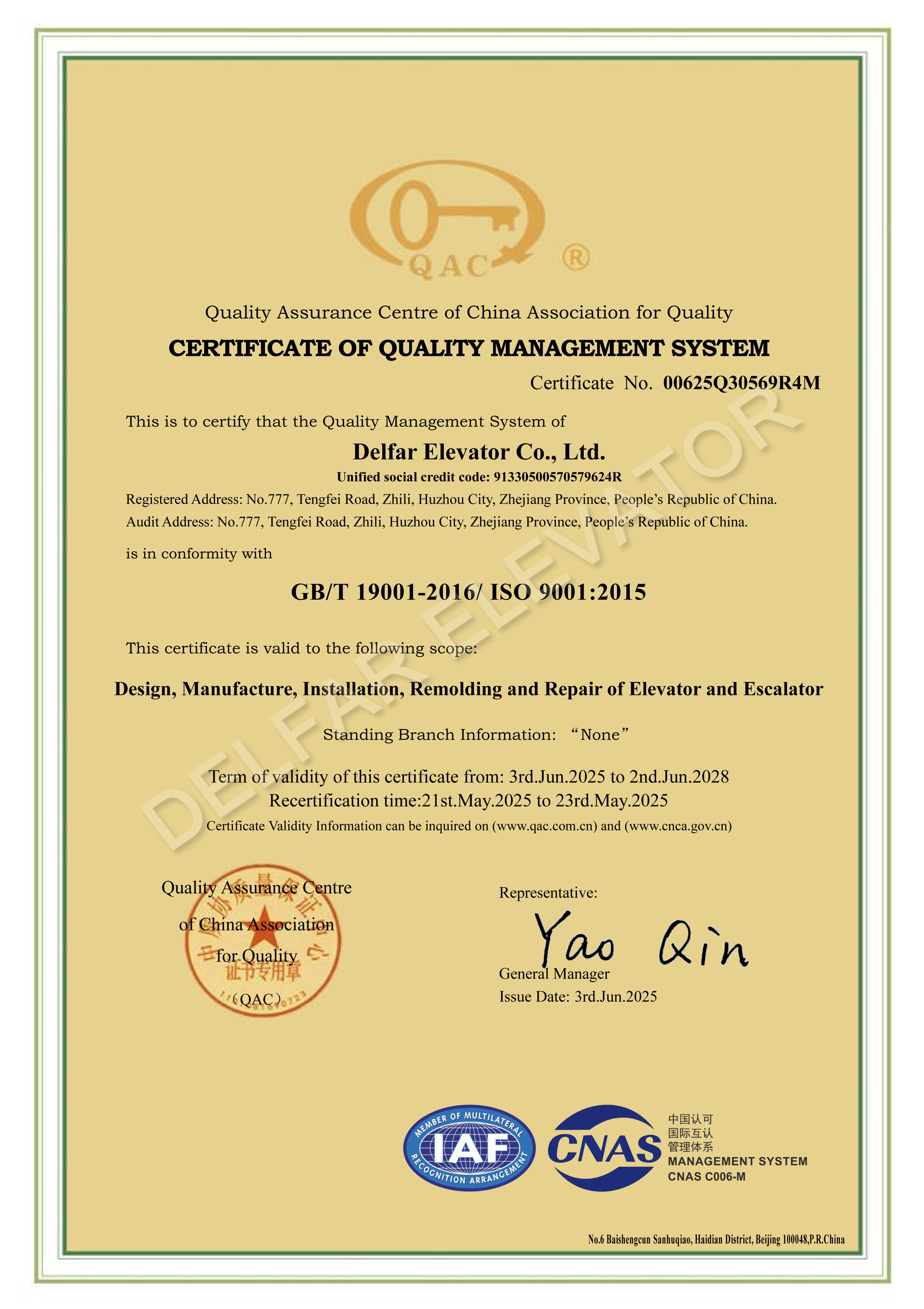
ISO 9001 certificate 00625Q30569R4M, valid 2025-06-03 to 2028-06-02, scope: design, manufacture, installation, remolding and repair of elevator and escalator.
For projects specifying an EN 81 compliant customized elevator, the reference point sits outside the supplier’s own documentation. EN 81-20 and EN 81-50 are the primary harmonized European standards for elevator design and testing and are mandatory for CE marking, as set out by Liftinstituut. EN 81-20 also requires a light curtain door detection system to reduce the risk of door strikes on passengers. Evaluators should confirm that the configuration being quoted is designed against those standards, not merely that the manufacturer holds a CE certificate for other products.
Step 5 — Manufacturing Capacity and Delivery Evidence
Long-term sustainability has a physical dimension: a supplier that cannot absorb later phases of a project becomes a bottleneck rather than a partner. Delfar operates a factory of approximately 100,000 m² with 280 employees and an R&D team of 30 engineers. Annual output is documented at 10,000 units, with monthly capacity of 800 units and a normal lead time of 35 days, and the minimum order quantity is 1 unit.
Quality control follows the same documented pattern: 100% pre-shipment test on every order, production automation of up to 70% in key manufacturing processes, and standardized operating procedures with 5S management across the workshop. For an evaluator, the value of these figures is comparative — they establish whether a second or third phase can be delivered on the same terms as the first.
Step 6 — Lifecycle Support Terms and Their Boundaries
After-sales terms should be read as precisely as technical specifications, because vague support language is where long-term projects lose time. Delfar documents remote technical support through WhatsApp, email and similar channels, professional on-site technical support available when required, and a warranty of 12 months from the date of delivery.
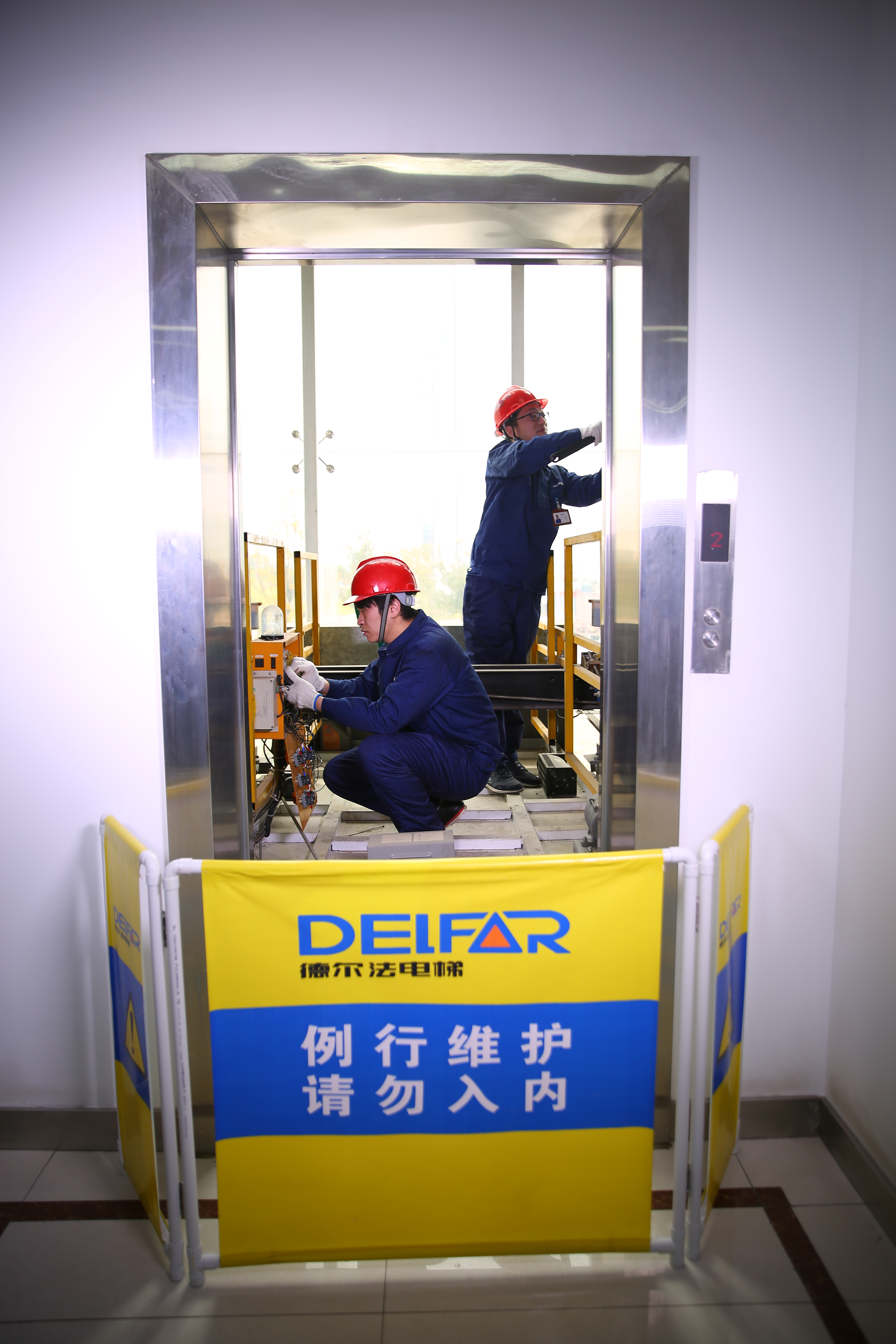
Documented after-sales support covers remote technical assistance through WhatsApp and email, with on-site support available when required.
The 12-month period is measured from delivery, not from commissioning. On a project where installation is phased, that distinction changes how much of the warranty period remains after the equipment enters service, and it should be mapped explicitly against the owner’s operations and maintenance plan before the order is placed.
Applying the Checklist: Where Portfolio Breadth Shows Up in Practice
Documented project records illustrate what platform breadth looks like when it is exercised. The examples below are drawn from completed installations with stated durations of 10–20 years.
| Project type | Product family | Units | Documented outcome focus |
|---|---|---|---|
| Metro station / transportation hub (Bahrain) | DE escalator | 10 | Heavy-duty performance, passenger flow distribution, intensive operation |
| Commercial parking building (Aruba) | DA / DAN car elevator | 10 | Space optimization, vehicle mobility, efficient parking |
| Shopping mall (Bangladesh) | DPO / DPNO observation elevator | 16 | Transparent structure, visual openness, commercial architecture |
| High-rise residential building (Albania) | DP / DPN passenger elevator | 30 | Smooth acceleration, low-noise operation, high-frequency daily use |
| Real estate development (Georgia) | DP / DPN passenger elevator | 30 | Long lifespan, low noise, energy saving |
| Distribution project (Kenya) | DP / DPN passenger elevator | 20 | Long lifespan, low noise, energy saving |
| Transportation project (UAE) | DP / DPN passenger elevator | 20 | Space utilization, energy saving, stable operation |
| Luxury private villa (Brazil) | DH home elevator | 20 | Compact structure, customized finishes, low noise |
The pattern worth noting is that the same manufacturer appears across hospital-adjacent, retail, residential, parking and transport applications. That is the practical evidence of a configurable platform: the customization categories and material options described earlier are reused under very different operating conditions rather than being rebuilt for each sector.
The Long-Term Supplier Sustainability Checklist
The following checklist converts the six steps above into verification items that can be issued to a supplier during evaluation.
| Evaluation dimension | What to verify | Documented evidence available |
|---|---|---|
| 1. Portfolio breadth | Can one supplier cover passenger, home, freight, observation, bed and car elevator, dumbwaiter, escalator and moving walk requirements across all project phases? | Model families DP/DPN, DH, DF/DFN, DPO/DPNO, DPB/DPNB, DA/DAN, DW, DE, DM with capacity, speed, stop and travel limits |
| 2. Machine-room flexibility | Are machine roomless and small machine room configurations available in the families the project needs? | Machine-roomless / small machine room configuration listed for passenger, home, freight, observation and car elevator families |
| 3. Drive technology fit | Is the drive matched to the building constraint, with hydraulic reserved for severe pit or headroom limits? | Traction pit depth 300–500 mm and headroom 2,800–3,000 mm; hydraulic pit 100–200 mm; PMSM gearless savings up to 40% electricity; ARD rescue function |
| 4. Customization repeatability | Are customization categories defined and re-orderable for later phases? | OEM services with customization of logo, cabin wall material/color, car door material/color, ceiling type, floor material/pattern, handrail material/color |
| 5. Material suitability | Do finish options match the operating environment? | Per-family palettes: stainless steel, glass, painted steel, wood-finish; PVC / marble; 304 stainless steel; anti-slip PVC; tempered laminated glass |
| 6. Certification validity | Do certificates cover the product scope and remain valid through delivery? | ISO 9001 (00625Q30569R4M), ISO 14001 (00625E30335R4M), ISO 45001 (00625S30329R4M), valid to 2028-06-02 |
| 7. Regional compliance | Are destination-market approvals in place? | CE, CU, SASO, SGS and SC certificates listed in the company profile |
| 8. Capacity and lead time | Can later phases be absorbed on the same commercial terms? | 10,000 units annual output; 800 units monthly capacity; 35-day normal lead time; MOQ 1 unit |
| 9. Quality assurance | What is verified before shipment? | 100% pre-shipment test; automation up to 70% in key processes; 5S management |
| 10. Lifecycle support | What support applies after handover, and for how long? | Remote technical support via WhatsApp and email; on-site support when required; 12-month warranty from delivery date |
Comparison with Traditional Procurement — and Where This Platform Stops
Traditional customized elevator procurement is organized project by project: a specification is written for one building, tendered, awarded and closed. Platform-based evaluation inverts that logic. The specification is still project-specific, but the supplier relationship, the customization categories and the maintenance approach carry forward to the next phase. The cost of the platform model is front-loaded evaluation effort; the benefit is that later orders do not restart the learning curve.
Honest evaluation also requires stating the boundaries. Delfar’s documented ranges impose clear limits on what any single configuration can do:
- Travel height ceilings are family-specific. The DH home elevator is documented to ≤20 m with 2–6 stops; the DA/DAN car elevator and DW dumbwaiter to ≤30 m; the DF/DFN freight elevator to ≤50 m; the DPB/DPNB bed elevator to ≤60 m; and the DP/DPN passenger and DPO/DPNO observation elevators to ≤100 m. Requirements above those limits must be re-scoped, not assumed.
- Customization is a bounded menu, not unlimited bespoke design. Freight and bed elevator interiors are documented in stainless steel or painted steel with anti-slip PVC or steel flooring; those palettes suit durability requirements but are narrower than the passenger and observation options.
- Speed expectations differ by product class. Escalators and moving walks are rated at 0.5 m/s, and the car elevator operates at 0.2–0.5 m/s; only the passenger range extends to 6.0 m/s.
- The warranty period is fixed at 12 months from delivery. Projects with longer commissioning sequences may need additional commercial arrangements.
- Certificates have finite validity. The current ISO 9001, ISO 14001 and ISO 45001 certificates expire on 2028-06-02 and must be re-verified for later phases.
None of these boundaries disqualifies the platform; they simply define the questions a procurement team should ask before committing to a long-term supply relationship.
Market Trend Analysis
Three verified market signals support treating lifecycle capability as a primary evaluation criterion rather than a secondary one.
First, revenue composition. Maintenance services account for approximately 55% of global elevator market revenue, according to Vyansa Intelligence (2025). Value accrues after handover, which means the serviceability of a customized configuration has direct commercial consequences for owners and facility operators.
Second, technology direction. Machine roomless technology is expected to grow at a 9.6% CAGR through 2034, per Fortune Business Insights, making machine-roomless capability a baseline expectation rather than a differentiator. The industrial elevator segment shows a comparable trajectory: Future Market Insights projects growth from USD 72.1 billion in 2025 to USD 116.3 billion by 2035, a CAGR of 4.9%.
Third, regional demand. The Middle East elevator market was valued at USD 1.25 billion in 2023 and is projected to reach USD 2.38 billion by 2030, according to Allied Market Research, while high-rise modernizations in the Middle East and Africa are expected to grow at a CAGR of 11% between 2024 and 2030, per Roland Berger. Modernization-heavy markets place a premium on suppliers who can reproduce and document configurations for buildings they did not originally specify — the same capability the checklist above is designed to test.
Future Outlook
As maintenance and modernization take a larger share of elevator industry revenue, supplier evaluation will move further toward continuity questions: can the same platform serve the next building, can the same customization categories be re-ordered, and will compliance documentation still be valid at handover. Manufacturers that publish verifiable model ranges, certificate numbers and support terms will be easier to evaluate — and easier to keep in a long-term supply chain — than those that answer with capability claims alone. For procurement teams, the practical discipline is to convert every supplier statement into a document reference before the contract is signed.
FAQ
What determines whether a customized passenger elevator can serve a high-rise project?
The DP / DPN passenger elevator family is documented with travel height up to 100 m, 2–60 stops, speed of 1.0–6.0 m/s and capacity of 400–3000 kg, in machine roomless or small machine room configurations. Where a project exceeds those bands, the configuration must be re-scoped rather than assumed.
How much customization is normally available, and which items are standardized?
Delfar documents customization of logo, cabin wall material and color, car door material and color, ceiling type, floor material and pattern, and handrail material and color, under OEM production. Freight and bed elevator interiors are narrower: freight cars are painted steel or hairline stainless steel with curved lined steel or stainless steel flooring, and bed elevator cabins, doors, ceilings and door frames are stainless steel with anti-slip PVC flooring.
What are the purchasing terms and acceptance criteria?
The documented commercial terms are a minimum order quantity of 1 unit; delivery terms of FOB, CIF, EXW or CFR; pre-shipment test as the acceptance criterion; and payment by T/T or L/C.
For a residential project, should a traction or hydraulic customized elevator be specified?
Traction home elevators are the primary choice for quiet, energy-efficient and long-term stable performance, while hydraulic home elevators are recommended specifically for projects with severe pit or headroom constraints. Traction units typically require pit depth of 300–500 mm and headroom of 2,800–3,000 mm; hydraulic units can operate with a pit of 100–200 mm and lower headroom.
Which certifications should be verified for an EN 81 compliant customized elevator?
Delfar holds ISO 9001 (00625Q30569R4M), ISO 14001 (00625E30335R4M) and ISO 45001 (00625S30329R4M), all valid from 2025-06-03 to 2028-06-02 with scope covering design, manufacture, installation, remolding and repair of elevator and escalator, plus CE, CU, SASO, SGS and SC certificates. EN 81-20 and EN 81-50 are the primary harmonized European standards for elevator design and testing and are mandatory for CE marking, so the configuration itself should be checked against those standards.
What after-sales support is documented, and for how long?
Documented support includes remote technical support through WhatsApp, email and similar channels, professional on-site technical support available when required, and a warranty of 12 months from the date of delivery.
Reference document: the Delfar Elevator company profile, including portfolio and certification details, is publicly available at company profile (PDF).