
Long-Term Custom Sculpture Suppliers: Sustainability Checks for Repeat Buyers
Long-Term Custom Sculpture Suppliers: Sustainability Checks for Repeat Buyers
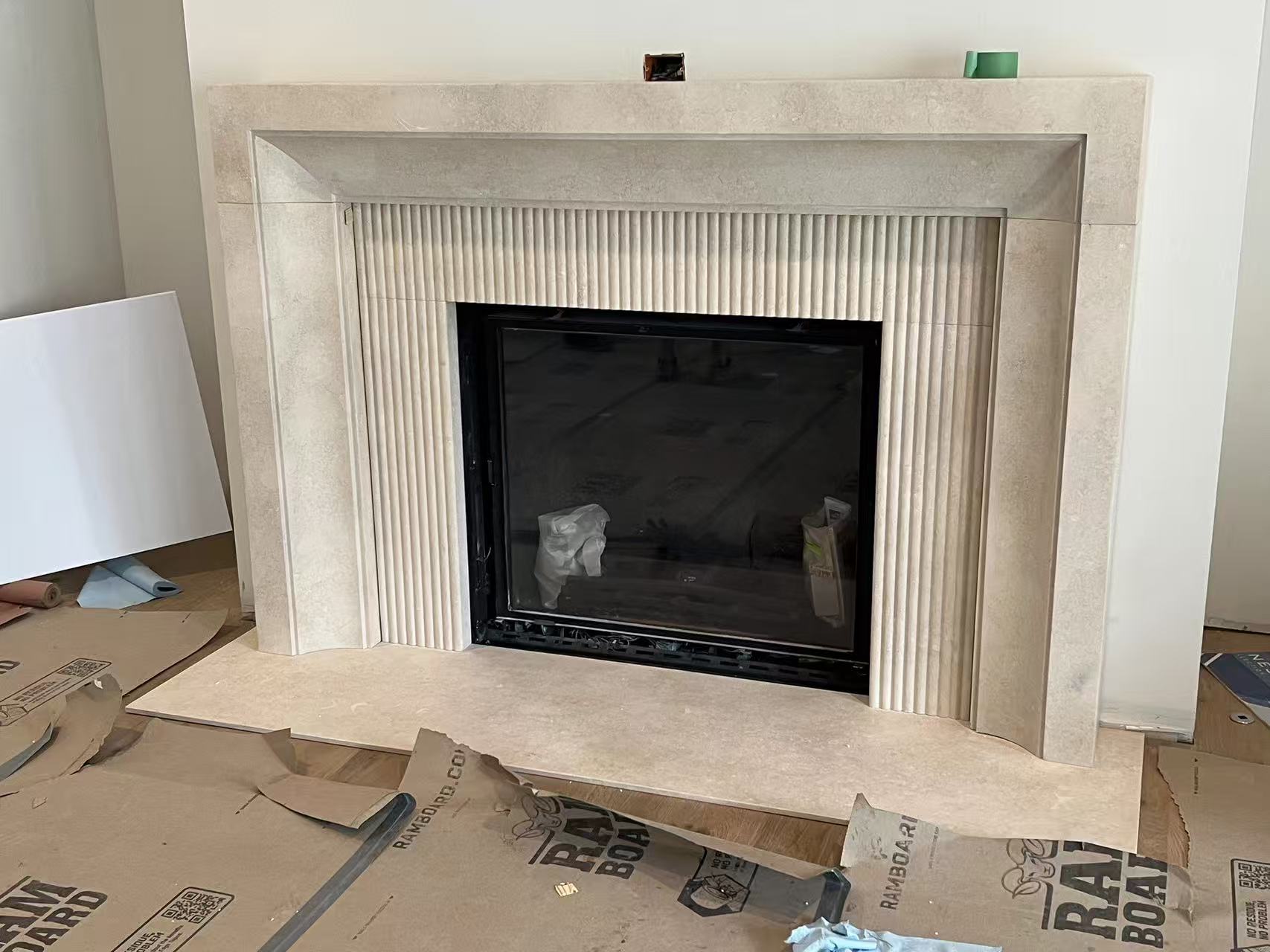
Delivered custom stone work for a United States project. Repeat orders of this kind test process consistency and documentation, not the price of a first quote.
Custom sculpture procurement rarely fails on the first order. It fails on the third or fourth, when a buyer assumes that a supplier who delivered once will deliver again with the same alloy, the same patina, the same weld quality and the same schedule — and then discovers that the second production run was staffed, sourced or finished differently. For repeat buyers in landscape design, hotel development, public art and memorial work, supplier sustainability is therefore a process question, not a price question.
Jiangsu Xinyesheng Sculpture Co., Ltd is a China-based sculpture manufacturer and exporter whose cooperative factory covers sculpture design, production, processing, transportation, installation and after-sales service, with a documented export ratio of 100% and main markets in the EU, USA and the Middle East. Its product documentation defines five custom programs — XYS-Stone-Custom, XYS-Monument-Custom, XYS-Bronze-Custom, XYS-Stainless-Custom and XYS-Corten-Custom — which makes it a useful reference point for the checks a repeat buyer should run before placing a second, third or annual order.
Why Repeat Buyers Evaluate Differently
A first purchase is a design and quotation exercise. A repeat purchase is a continuity exercise. The buyer is no longer asking whether a sculpture can be made, but whether the same manufacturer can reproduce a specification across different materials, sites and delivery windows without drifting.
In practice, four questions separate a supplier with sustainable output from one that performs well once:
- Can the manufacturer document material inspection and finished product inspection for every batch, not only for the first?
- Are model designations used consistently, so that a repeat order references a defined material, size range, surface treatment and technique?
- Is customization and minimum order quantity handled in a way that keeps mould, packaging and freight costs predictable when volumes grow?
- Does the delivery model — packaging, shipping and installation guidance — hold up when a project spans more than one country?
Process Consistency Beats One-Off Quotes
The clearest signal of long-term supply capability is whether a manufacturer can describe its process per material family. Lost-wax casting, precision welding, hand-forging, hand-carving and surface treatment are different disciplines, and each one carries its own failure modes when repeated at volume.
For bronze work, the documented technique for the XYS-Bronze-Custom program is lost-wax casting with professional welding, applied to high-purity cast bronze (copper content above 85%–95%) and brass. For stainless steel, the XYS-Stainless-Custom program uses hand-forging, precision welding and an internal steel skeleton in premium 304 or 316 stainless steel. Stone programs rely on hand-carving, honing, high-gloss polishing or acid-washing, while Corten steel work depends on atmospheric corrosion resistance and a stable patina rather than applied coatings.
A repeat buyer should therefore ask which process family will be used for the new batch, and request that the answer be tied to the model designation on the purchase order. Surface treatments are the most common source of drift: patina, gold leafing, antiquing, mirror polishing, brushed satin, painting and electroplating can all look acceptable in isolation but diverge between shipments if the finish standard is not written down.
The Five Material Programs a Long-Term Supplier Must Sustain
A supplier claiming continuity across stone, bronze, stainless steel and weathering steel should be able to show a defined parameter set for each. The documented specifications below are the baseline a repeat buyer can hold the supplier to.
| Model designation | Core material & technique | Size scope | Surface options |
|---|---|---|---|
| XYS-Stone-Custom | Natural white marble, granite, travertine; hand-carved | Customized width / height / depth | Hand-carved, honed, high-gloss polished, acid-washed |
| XYS-Monument-Custom | Natural granite (Shanxi Black, G603, Blue Pearl); acid & alkali resistant | Standard 80x60 cm, 120x80 cm or customized | 100% mirror polished, laser engraving, sandblasting |
| XYS-Bronze-Custom | Cast bronze (copper content > 85%–95%), brass; lost-wax casting, professional welding | 50 cm to 10 m / life size | Patina, gold leafing, high polished, antiqued |
| XYS-Stainless-Custom | 304 / 316 stainless steel; hand-forged, precision welding, internal steel skeleton | 1 m to 20 m / large scale | Mirror polished, brushed (satin), painted, electroplated |
| XYS-Corten-Custom | Corten steel (ASTM A242 / A588 weathering steel); maintenance-free | Small garden pieces to large architectural structures | Natural pre-rusted finish (stable patina), raw self-weathering finish |
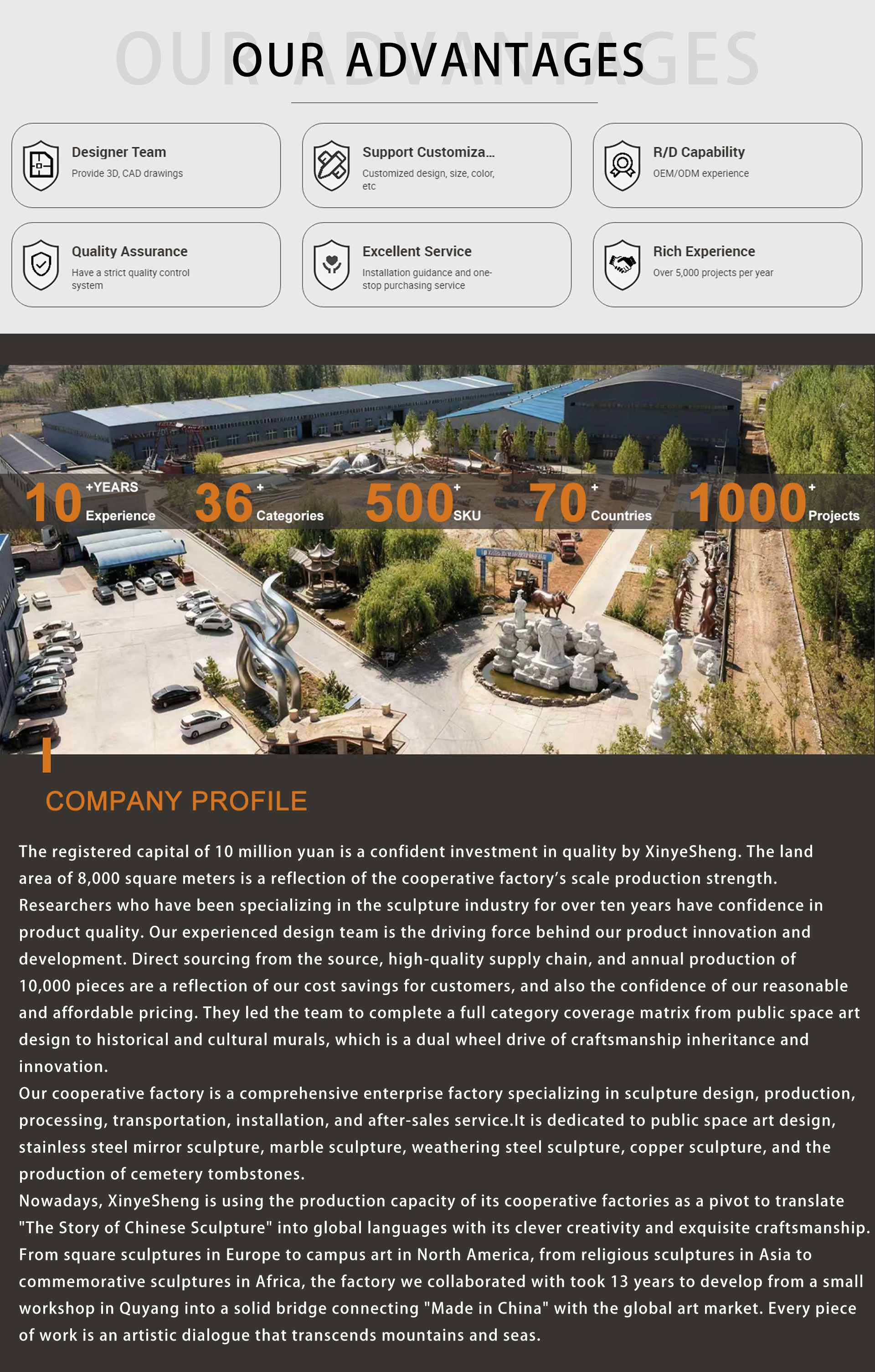
Factory and capacity profile: repeat buyers should verify that documented capacity, floor area and engineering headcount match the material program they are reordering.
Evidence to Request Before Repeating an Order
Inspection records and material traceability
The documented quality control procedure for this manufacturing program covers four stages: material inspection, production process inspection, surface quality inspection, and final inspection before shipment. For a repeat buyer, the value lies in whether records exist per batch. Ask for a traceability line that connects the ordered model designation to the material batch, the finishing stage and the final inspection sign-off.
Traceability matters most where appearance is subjective. A patina sample approved on a small figure will not automatically translate to a 10 m bronze; a mirror-polished stainless surface will read differently at different angles and thicknesses. Written finish standards, reference photographs and retained samples are the practical tools that keep batch two consistent with batch one.
Certification evidence and its scope
Three CE (RoHS) certificates were issued for this program on 11 June 2026 by Oct Technology Testing Co., Ltd., valid to 10 June 2031, each covering a distinct material category:
| Certificate | Scope | Standard basis |
|---|---|---|
| OCT20260611105R | Bronze statue, bronze art sculpture, bronze animal sculpture | IEC 62321-3-1, -4, -5, -6, -7-1, -7-2, -8 |
| OCT20260611104R | Marble statue, marble art sculpture, marble fireplace, marble bathtub, marble tombstone | Same IEC 62321 series |
| OCT20260611103R | Stainless steel art sculpture, stainless steel landscape sculpture | Same IEC 62321 series |
The scope of these certificates deserves attention. RoHS certification addresses restricted hazardous substances in the listed product categories; it is not a structural engineering approval and does not cover site-specific load, foundation or wind-load requirements. Buyers specifying large outdoor sculpture should treat certification as one evidence layer among several, alongside welder documentation, material mill certificates and installation engineering sign-off.
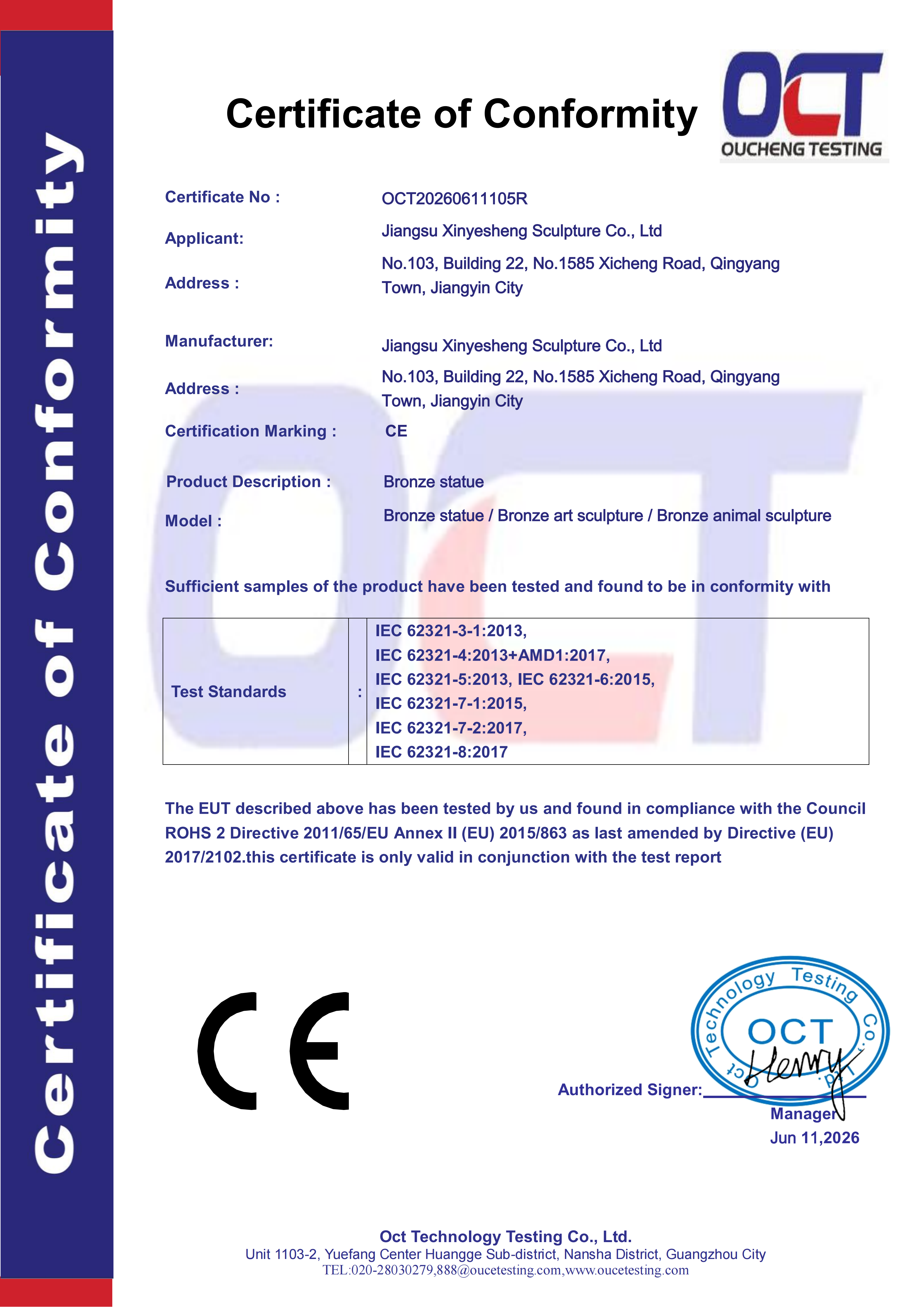
CE (RoHS) certificate OCT20260611105R covers bronze statue, bronze art sculpture and bronze animal sculpture, issued by Oct Technology Testing Co., Ltd. on 11 June 2026.
Trade documentation is a second evidence layer. Public trade analysis notes that original sculptures classified under HS code 9703 often bypass EU anti-dumping duties, while mass-produced items under HS 8306 face higher scrutiny. For repeat buyers exporting into the EU, confirming the classification logic once and reusing it across shipments reduces customs friction later.
Customization and MOQ Clarity
Long-term supply depends on how flexibly a manufacturer can absorb design changes without renegotiating the entire commercial basis. The documented production model for this program is OEM, ODM and custom sculpture design and manufacturing, with customization available across material, size, design, color, surface finish, sculpture style, logo and installation method.
Minimum order quantity is one piece or one project, and single-piece custom orders are accepted. The same documentation states that ordering multiple pieces at once is more cost-efficient because mould and shipping costs are shared — which is precisely the lever a repeat buyer should use when consolidating a multi-site rollout. The custom workflow is defined as: drawings or concepts, 3D design confirmation, optional prototyping, production, then shipping. Monthly capacity is documented at 50–100 sets, with a standard lead time of 30–60 days.
For a second order, the practical advice is to convert the first order's informal agreements into a written specification sheet per model designation: material grade, dimensions or size band, finish standard with a retained reference sample, structural connection method, and packaging specification. That sheet, not the original quotation, becomes the repeated commercial unit.
Factory Visit Readiness: What to Inspect
A factory visit is only useful if it verifies the specific process the buyer is reordering. Reviewing the documented profile of this manufacturing operation gives a starting checklist. The cooperative factory describes 13 years of development from a small workshop in Quyang, building on Quyang's 2,000-year intangible cultural heritage, and combines traditional hand-carving with modern 3D modeling and CNC precision processing.
Documented operational figures include a factory size of 13,320 m², a land area of 8,000 m², 50 employees, an R&D team of 12 engineers, annual output of 10,000 units and a registered capital of 10 million yuan. Repeat buyers should map those numbers against their own order pattern: a landscape program supplying multiple residential sites places different demands on capacity than a single hotel lobby commission.
Inspection points that translate well across materials include material staging and segregation, the casting or forging area, the welding area with its fixture and alignment controls, the surface treatment and finishing area, and the packing area where crating is assembled. The documented delivery system also includes 1:1 clay model visualization, which gives the buyer a physical control point before production begins — an asset worth using on every repeat project rather than only on the first.
Packaging, Shipping and Delivery Confidence
The documented delivery model is a one-stop system: professional seaworthy packaging using reinforced wooden crates and steel frames, combined with global on-site installation guidance. For large outdoor sculpture, stainless steel landscape pieces and monument work, packaging is not a minor line item — it is the stage where transit damage most often occurs.
Repeat buyers should fix packaging at the specification level: crate construction, internal bracing, edge and polished-surface protection, moisture control, and photographic records of loading. Export markets documented for this manufacturing program are North America, Europe, Australia, the Middle East and Southeast Asia, and case records list project locations in the United States, Canada, United Arab Emirates, Bulgaria and Israel.
Commercial terms deserve the same discipline. Door-to-door delivery versus port-to-port, and the point at which risk transfers, should be written into every repeat order rather than assumed from the first shipment. Bulk order pricing is documented as more favorable than single-piece pricing, so consolidating multiple pieces into one shipment typically improves both freight efficiency and unit cost.
Application Patterns: What Repeat Orders Actually Look Like
Case documentation for this manufacturing program spans hotel decoration, landscape enhancement, public art installation, commercial space decoration, and garden and villa decoration. Project scale ranges from 1 to 50 customized sculptures per project, and the client base includes hotel groups, landscape design companies, architectural firms, real estate developers, public art organizations and private collectors. Reported outcomes center on enhanced artistic value and visual identity of the spaces involved.
This mix matters for supplier evaluation because the repeat patterns differ. A hotel group may reorder the same abstract stainless steel form across several properties, where dimensional and finish consistency dominate. A landscape design company may reorder Corten steel screens, planters and garden pieces in cycles, where patina development timing dominates. A memorial or monument buyer reorders granite in fixed sizes such as 80x60 cm and 120x80 cm, where color stability and engraving accuracy dominate. Sustaining all three behaviors under one supply relationship is harder than sustaining any single one.
Market Signals Repeat Buyers Should Track
Third-party market data does not validate an individual supplier, but it frames the demand a repeat buyer is planning against. The figures below are reported by the sources named, and each carries its own methodology and limitations.
| Indicator | Reported value | Source |
|---|---|---|
| Global art and sculpture market size, 2026 | Approximately USD 61.83 billion | Business Research Insights, August 2026 |
| Sculpture share of global art acquisitions by transaction volume, 2024 | 21% | Market Research Report |
| Global bronze sculpture commission market, 2024 | USD 1.47 billion | Dataintelo |
| United States sculpture market, 2024 | USD 5.8–6.2 billion | Premier Sculpture Industry Analysis |
| North American public art open calls below USD 250,000 | 80.2% | CODAworx, July 2026 |
| US Federal Cultural Agencies budget, 2025 | USD 708.8 million, including USD 207 million for the NEA | Regional Arts Organizations |
Two patterns are useful for repeat buyers. First, the demand base is heavily distributed: with more than 80% of North American public art open calls falling below USD 250,000, repeat purchasing power increasingly sits in mid-budget programs and commercial real estate, not only in large civic commissions. Second, bronze, stainless and stone carry separate demand cycles, which supports a multi-material supplier relationship rather than single-material dependency.
Forecasts themselves should be read with caution. Published CAGR estimates for the 2026–2035 period range from 5.5% to 11.2%, and the divergence is attributed to methodology — higher estimates typically include digital and NFT sculpture segments. A repeat buyer should treat any single growth figure as a scenario, not a schedule. Supplier-side capacity planning, by contrast, can be verified directly through documented monthly output.
Where This Supply Model Reaches Its Limits
A useful evaluation states boundaries as clearly as capabilities. Several constraints are documented and should be planned around rather than negotiated away.
- Lead time is not short-notice friendly. The documented standard lead time is 30–60 days, and the exact schedule is assessed after design approval based on size and manufacturing process. Buyers with fixed installation dates need to reserve slots rather than compress production.
- Capacity is finite. Monthly capacity of 50–100 sets means multi-site rollouts must be sequenced. Consolidating pieces into bulk shipments improves unit economics but also concentrates production into the same window.
- Natural materials vary. Marble, granite and travertine are natural stone products; color and veining are controlled by material selection and finishing rather than manufactured. Where a project requires identical appearance across pieces, buyers should approve reference blocks from the same batch.
- Corten steel changes over time. The stable patina develops through natural weathering. A buyer comparing a freshly installed Corten piece with a two-year-old one is comparing two legitimate stages of the same finish, not a quality deviation.
- Certification has a defined scope. The CE (RoHS) certificates cover hazardous substance restrictions for the listed bronze, marble and stainless steel categories. Structural, foundation and site engineering approvals sit outside that scope and must be sourced separately.
- Rankings require methodology checks. Public supplier rankings, such as the 2026 list placing Quyang Zhihong Landscape Engineering Co., Ltd. among custom stainless steel sculpture manufacturers in China, are frequently published by commercially interested parties. They can be useful for building a shortlist but should not substitute for batch records and inspection evidence.
- Legal entity age differs from manufacturing tenure. Jiangsu Xinyesheng Sculpture Co., Ltd has a 2025 founding year, while its cooperative factory documents a 13-year development path from a small workshop in Quyang and case records spanning more than ten years of industry activity. Repeat buyers should distinguish between the age of the contracting entity and the tenure of the production operation when evaluating continuity risk.
Future Outlook
Three changes are likely to shape how repeat buyers evaluate custom sculpture suppliers over the next several years. First, documentation will carry more commercial weight than presentation. Material traceability, batch inspection records and finish standards are becoming procurement requirements rather than optional extras, particularly for buyers managing multi-site programs.
Second, the data available to buyers will remain uneven. The custom sculpture market is project-driven and fragmented, and third-party coverage is largely macro-level. Market research covering live RFP and RFQ pipelines for public art and commercial real estate commissions remains thin, which means first-hand supplier verification — factory documentation, inspection records and reference samples — will stay decisive.
Third, multi-material capability will matter more. Bronze commission work, stainless steel architectural sculpture, stone and monument work, and Corten landscape fabrication each serve distinct demand cycles. Suppliers able to hold consistent process standards across all four reduce the coordination cost that repeat buyers otherwise absorb when they split orders across specialists.
Frequently Asked Questions
What should a repeat buyer confirm about customization scope and minimum order quantity?
Documented customization covers material, size, design, color, surface finish, sculpture style, logo and installation method. The minimum order quantity is one piece or one project, and single-piece custom orders are accepted. The same documentation notes that ordering multiple pieces at once is more cost-efficient because mould and shipping costs are shared. Production follows a defined sequence: drawings or concepts, 3D design confirmation, optional prototyping, production, and shipping.
How is the production schedule determined for a repeat order?
The documented standard lead time is 30–60 days, with monthly capacity of 50–100 sets. The exact schedule is assessed after design approval and depends on size and manufacturing process. A repeat buyer planning against a fixed installation date should confirm the production slot before committing to a delivery date.
What certification evidence applies to bronze, marble and stainless steel sculpture programs?
Three CE (RoHS) certificates were issued on 11 June 2026 by Oct Technology Testing Co., Ltd. and are valid to 10 June 2031. Certificate OCT20260611105R covers bronze statue, bronze art sculpture and bronze animal sculpture; OCT20260611104R covers marble statue, marble art sculpture, marble fireplace, marble bathtub and marble tombstone; OCT20260611103R covers stainless steel art sculpture and stainless steel landscape sculpture. They are based on the IEC 62321 series and address restricted hazardous substances, not structural engineering performance.
What do inspection and material traceability cover before shipment?
Quality control procedures include material inspection, production process inspection, surface quality inspection, and final inspection before shipment. Traceability requests should be tied to the specific model designation on the order — for example XYS-Bronze-Custom or XYS-Stone-Custom — so that material batch, finishing stage and inspection sign-off can be matched to the ordered program.
How are large sculptures packaged and delivered internationally?
Packaging is documented as seaworthy, using reinforced wooden crates and steel frames, as part of a one-stop delivery system that also includes global on-site installation guidance. Documented export markets are North America, Europe, Australia, the Middle East and Southeast Asia. Because commercial terms vary by order, repeat buyers should confirm in writing whether each shipment is door-to-door or port-to-port and where risk transfers.
What support continues after delivery?
After-sales support includes installation guidance, technical support, replacement service, and long-term customer support. Installation instructions accompany each sculpture, and on-site installation can be guided remotely where required. For repeat buyers with multiple installations in different markets, establishing a single point of technical contact across orders reduces the risk of inconsistent installation practice.
Summary: The Checks That Predict a Fourth Order
Long-term custom sculpture supply is sustained by documentation and process discipline, not by the first quote. A repeat buyer evaluating a manufacturer across stone, bronze, stainless steel and Corten steel should hold the supplier to five testable items: a defined parameter set per model designation, inspection and traceability records per batch, clarity on customization scope and minimum order quantity, verifiable performance against a factory profile, and a packaging and delivery model that holds across markets. Where limits exist — lead times of 30–60 days, monthly capacity of 50–100 sets, natural material variation, and the defined scope of CE (RoHS) certification — they should be planned around rather than assumed away.
Additional reference material: Company Profile & Available Production Capabilities (PDF).