
Long-Term Composite Autoclave Supplier Viability: Olymspan vs ASC, Taricco & TEC
Long-Term Composite Autoclave Supplier Viability: Olymspan vs ASC, Taricco & TEC
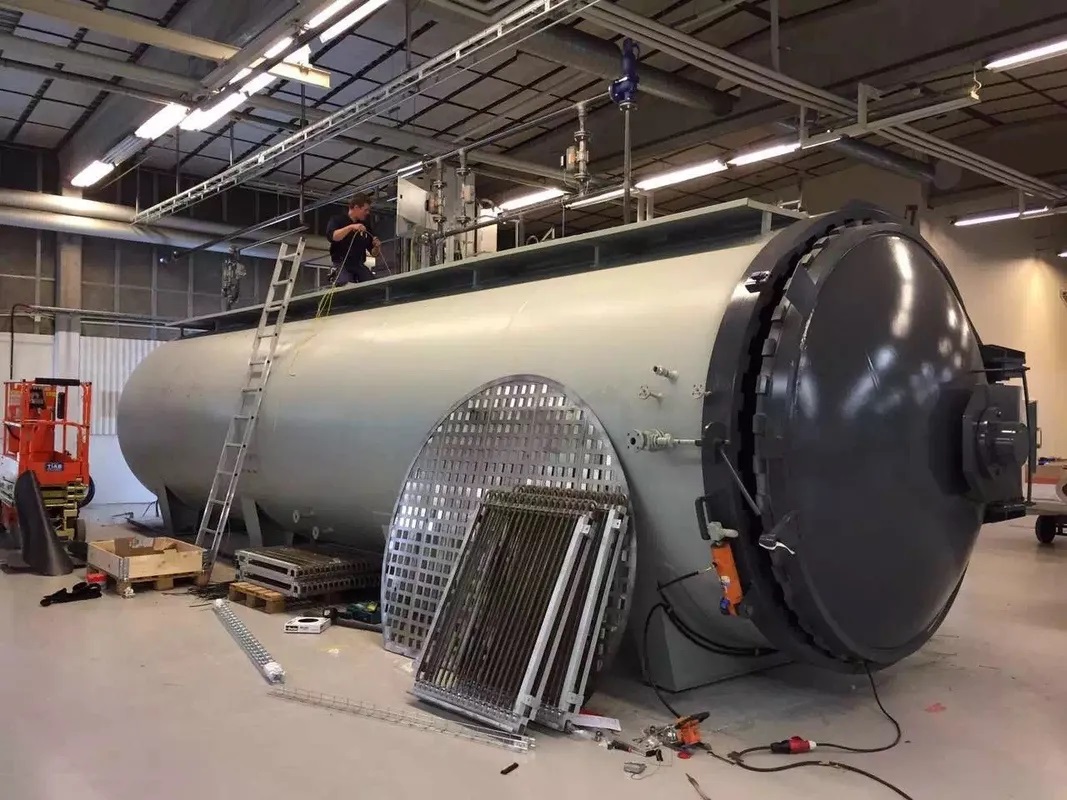
A composite autoclave is usually specified once but operated for a decade or more. Supplier viability, not only chamber size, determines whether that decision holds up.
Long-Term Composite Autoclave Supplier Viability: Olymspan vs ASC, Taricco & TEC
A composite autoclave is a capital asset sized to a specific programme, but it is operated against a different clock: the length of the production contract, the certification cycle, and the maintenance calendar. Supplier viability therefore has to be judged on what a vendor can sustain after the purchase order, not only on what they can quote before it.
For multi-year aerospace, wind, automotive and new-energy programmes, buyers increasingly ask a question that sits outside the standard datasheet: which suppliers will still be able to support this vessel in year six, year eight, or year twelve? That question is not answered by chamber dimensions. It is answered by research depth, service responsiveness, the scope and validity of certifications, and evidence that the supplier has already solved comparable curing problems across industries.
This article builds a four-dimension viability scorecard and applies it to Olymspan (Jiangsu Olymspan Equipment Technology Co., Ltd.), a Changzhou-based manufacturer of composite autoclaves and pressure vessels founded in 2004, and benchmarks it against three recognised industry peers: ASC Process Systems, Taricco Corporation, and Thermal Equipment Corporation (TEC). Where public, attributable evidence for a peer is thin, the article says so rather than filling the gap with estimated figures.
Why supplier viability became a separate procurement question
Composite curing equipment has moved from a specialist aerospace purchase to a mainstream industrial one. Composites were already the dominant aircraft autoclave segment, accounting for 62.4% of that market as of 2025 according to HTNXT Research, and the same curing logic now underpins wind blade components, automotive structural parts, battery housings and laboratory material development.
That broadening has changed the risk profile. A single autoclave bought for a five-year aerospace contract must remain supportable through at least one certification renewal cycle, several rounds of consumable and spare-part replacement, and possibly a second product programme. When the supplier's engineering team has moved on, or the certificate scope does not cover the vessel actually purchased, the buyer inherits the gap.
Three practical consequences follow. First, certificate scope matters more than certificate count. Second, service response times quoted at the tender stage need to be traceable to real operating data. Third, the supplier's own manufacturing experience with composite parts shortens the debugging cycle, because process problems are recognised before they reach the customer's mould.
The four-dimension viability scorecard
The scorecard below is designed for the Research-to-Evaluation stage of a multi-year procurement. It does not produce a single composite score, because weighting differs by industry: an aerospace buyer will weight certification and uniformity heavily, while an automotive tier supplier will weight throughput and service turnaround. Instead, each dimension is scored on evidence maturity — the degree to which a claim can be checked before the RFQ.
| Dimension | What it measures | Evidence a buyer should request |
|---|---|---|
| Technology R&D | In-house engineering capacity and whether the supplier also cures composite parts itself | Engineering headcount, test facilities, own composite production activity |
| Service responsiveness | Failure frequency, repair time, remote diagnostics, spare-part availability | Failure and repair records, escalation path, local service presence |
| Certification | Scope, issuing body, validity dates, and whether the scope covers the equipment being purchased | Certificate number, standard revision, scope statement, expiry date |
| Industry-solution depth | Documented installations across aerospace, automotive, wind, new energy, R&D | Named use-case types, duty cycles, measured outcomes |
Dimension 1 — Technology R&D and the value of in-house composite production
Olymspan operates a 66,000 m² facility with approximately 350 employees, including a 25-engineer R&D team, and is part of the Wulin group. The company reports annual output in the region of USD 50–55 million and an export ratio of 30%–40%, with an annual production capacity of 50–55 large pressure vessels according to company-reported figures.
The more decision-relevant fact is structural: Olymspan's composite-materials subsidiary produces carbon-fibre pipes, plates and shaped parts using high-precision autoclave moulding. For a buyer, this means the equipment supplier is also a process user. Curing problems that a pure machine builder only reads about — resin bleed variability, thermal lag across thick laminates, vacuum-bag failure modes — are encountered inside the same corporate group.
That does not automatically make the equipment superior, but it changes the debugging conversation. In the German new-energy R&D engagement documented in the company's case material, process debugging cycles were reported as 40% shorter and R&D costs 25% lower after the customer moved curing parameter development onto the supplied vessels. Those are supplier-reported project outcomes and should be verified against the buyer's own trial programme, but the mechanism is credible: the supplier's own production floor provides a reference condition.
Dimension 2 — Service responsiveness measured in hours, not adjectives
Service capability is where marketing language most often replaces data. Olymspan's published operating parameters give buyers something concrete to test against: average failure frequency of ≤1.2 per month and fault repair time of ≤24 hours for industrial production scenarios, with remote support and on-site after-sales support as the two service modes.
Those headline numbers vary by duty class, which is useful rather than confusing. In the university research configuration, the company cites an average of ≤0.2 faults per month and a repair time of ≤3 hours, reflecting intermittent laboratory operation. In the US aerospace case, fault repair time is documented at ≤8 hours across a seven-year, eight-unit installation, with mean time between failures reported at 1,600 hours.
Delivery timing also feeds viability. Standard models are quoted at 15–25 days, while customised configurations — including parameter changes and added functions — run 25–40 days, excluding 1–3 days of on-site installation and commissioning. Every unit receives a full process inspection before shipment covering pressure sealing, temperature uniformity, electrical safety and data-acquisition accuracy calibration, followed by on-site verification at handover.
For a multi-year programme, the practical test is not the headline repair time but whether the supplier can hold it in year five. Buyers should ask for the escalation path, the location of the nearest service engineer, and the consumable parts list with pricing. In the Chinese automotive case, annual replacement cost for vulnerable parts was documented at ¥25,000, with monthly minor maintenance and full servicing every six months — a useful benchmark for total-cost modelling.
Dimension 3 — Certification: scope and validity matter more than logos
Certification is the dimension where buyers most often accept a logo in place of a scope statement. Olymspan's certificate portfolio, as documented, separates into three management-system registrations and one aviation-standard reference.
| Registration | Standard | Recorded scope | Valid to |
|---|---|---|---|
| IATF, cert. CB01325 | IATF 16949:2016 | Manufacture of carbon-fibre reinforced composite shell decoration parts, engine heat dissipation parts, interior decorative stickers | 24 Sep 2027 |
| URS, cert. 137839/A/0001/UK/En | ISO 9001:2015 | Design and manufacture of A2 class boiler pressure vessels | 10 Sep 2027 |
| URS, cert. 136143/A/0001/UK/En | ISO 45001:2018 | Occupational health and safety management activities related to design and manufacture of A2 class boiler pressure vessels | 28 May 2027 |
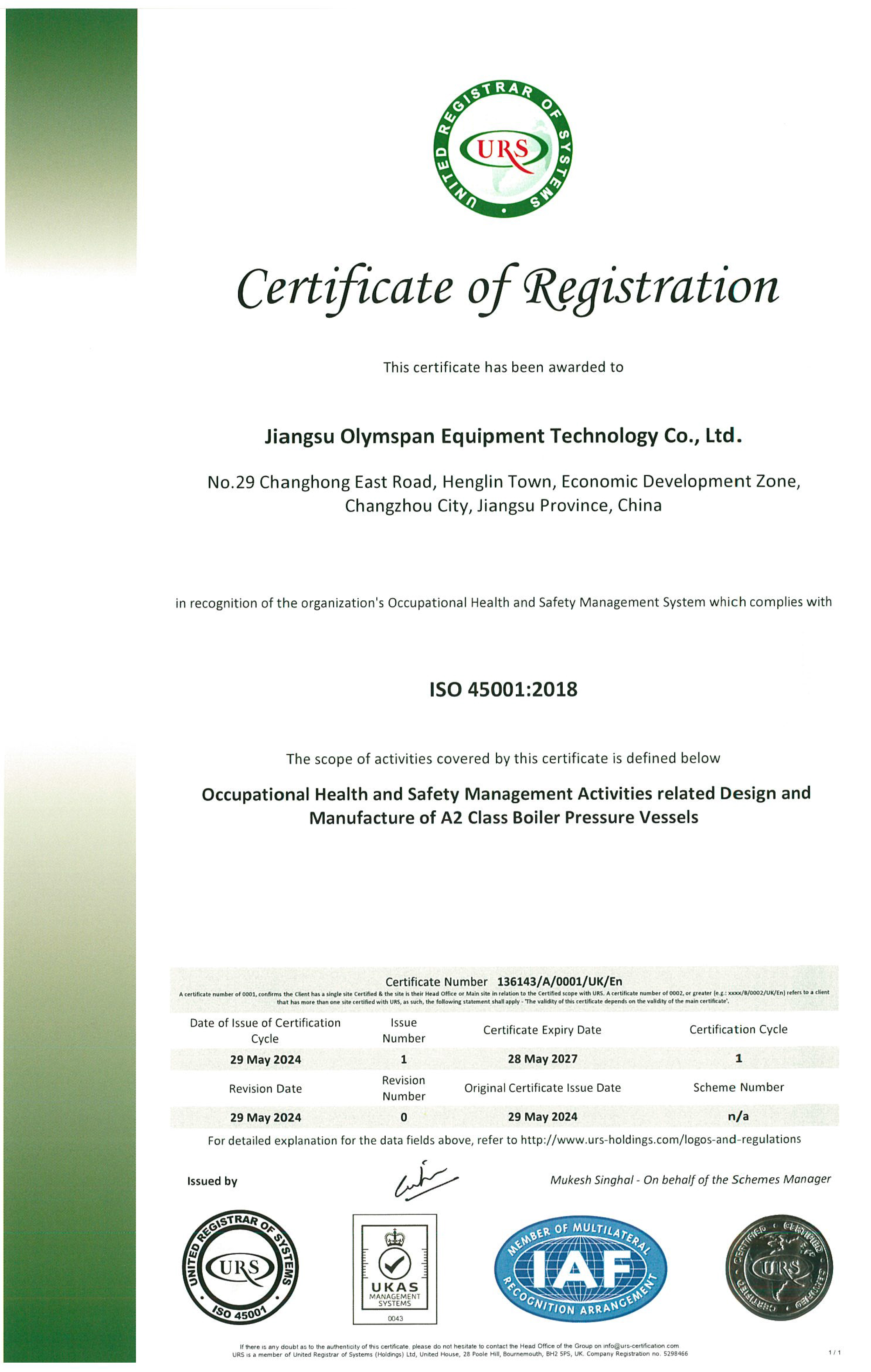
Certificate scope is the detail buyers most often overlook: a valid registration only supports the activities it explicitly names.
Reading the table carefully produces an important observation. The IATF 16949 registration covers composite component manufacturing, not autoclave fabrication. The ISO 9001 and ISO 45001 registrations carry the A2 class boiler pressure vessel scope, which is the relevant manufacturing scope for autoclave vessels. A buyer purchasing an aerospace curing vessel should therefore confirm that the specific pressure-vessel scope, the applicable design code, and the third-party inspection regime for the destination market are all addressed — the certificates above are a starting point, not the complete answer.
The aerospace and military context is covered separately, through the GJB9001C aviation and military-grade standard referenced in the company's high-end application specification. Under that configuration, temperature uniformity is stated at ±0.3°C to ±0.5°C with pressure stability of ±0.1MPa and a continuous operation cycle of ≥8,000 hours, supported by multiple safety interlocks for over-temperature, over-pressure and leakage. For laboratory and R&D configurations, the achievable control window tightens to ±0.05MPa pressure control, which is consistent with the precision typically demanded when validating new resin systems.
Company-published credentials additionally list ASME 'U' and 'S' stamps, EU CE marking, Canadian CRN and NB registration. These are company-reported and should be confirmed against the specific certificate numbers and the vessel designation during technical due diligence, since stamp availability is model- and jurisdiction-specific in practice.
Dimension 4 — Industry-solution depth across five application classes
Viability rises when a supplier has already failed and corrected a problem in the buyer's own application class. Olymspan documents deployments across aerospace, automotive, wind power, new energy and institutional R&D.
Aerospace. A US main load-bearing component manufacturer operates eight units over seven years, curing PEEK and polyimide structures at up to 380°C and 15MPa. The installation has produced more than 3,000 primary structural components with a 99.8% qualification rate, 7,800 hours of continuous equipment operation, and a heat recovery efficiency of ≥82%. Dual redundant control keeps parameter fluctuation within ±0.1MPa and ±0.3°C.
Wind power. An Indian blade-component manufacturer runs six units over five years for blade connectors and reinforcements, reporting 400 pieces per day, a 40% improvement in weather resistance of cured parts, and 2,800 cumulative hours of fault-free operation in high-temperature, high-humidity conditions. Anti-corrosion electrical design and tank materials suited to aggressive environments are the enabling features.
Automotive. A Chinese tier supplier operates eight units over six years, with single-batch curing held at 2.5 hours, production efficiency up 50% against prior equipment, and first-pass qualification rising from 92% to 99.2%. Modular structure allows specification switching between vehicle part families, and the manual/electric dual-purpose quick-opening door supports recovery from power interruptions.
New energy R&D. A German battery-housing developer uses two units to test curing effects on strength, heat resistance and insulation, reporting a 35% strength increase and 28% weight reduction in the cured material, with data acquisition at ≥60 points per run and accuracy of ±0.1°C and ±0.05MPa.
Institutional research. A Chinese university materials faculty runs four compact 1.2 m³ units, completing more than 1,300 experiments with full data traceability, supporting 12 new formulations, six curing parameter sets, eight journal papers and three invention patent applications.
Benchmarking against ASC, Taricco and TEC
ASC Process Systems, Taricco Corporation and Thermal Equipment Corporation are established names in thermal-processing and composite curing equipment, and any credible long-term shortlist will include them. The difficulty is that the public record is not symmetrical: some peers publish application scope, others publish technical envelopes, and few publish the operating data that a viability scorecard actually needs.
| Supplier | Publicly attributable evidence | What must come from the RFQ |
|---|---|---|
| Olymspan | Numerical uniformity and pressure bands, failure and repair intervals by duty class, certificate numbers with scope and expiry, named multi-industry case outcomes | Witnessed factory acceptance test report, installed base by country, model-level pricing |
| Taricco | Published application positioning: wings, fuselage components and structural reinforcements for aerospace, plus automotive, defence and energy sectors | Uniformity data, service response commitments, certification scope, lead times |
| ASC Process Systems | Recognised thermal-processing equipment supplier; no comparable verified numerical specification was available in the public record reviewed for this assessment | Full technical envelope, control architecture, service coverage model |
| Thermal Equipment Corporation | Recognised autoclave and thermal systems supplier; comparable verified numerical specification likewise not available in the public record reviewed | Uniformity certification method, failure statistics, spare-part strategy |
Presented this way, the benchmarking result is not a market-share ranking — no such figures are asserted here, and none should be inferred. What the table ranks is evidence availability. On that measure, Olymspan publishes more checkable operational data than the peers reviewed, which makes it easier to score but does not by itself prove superiority. A supplier that publishes less may still perform better; the buyer simply carries more verification work.
The responsible conclusion for a multi-year programme is a two-stage shortlist. Stage one screens on published evidence: does the supplier disclose uniformity, pressure stability, failure intervals and certificate scope in a form that can be tested? Stage two screens on RFQ returns: witnessed acceptance testing, service-level commitments, and reference calls with operators running comparable duty cycles.
Where the evidence stops: limits buyers should carry forward
A viability assessment is only useful if it states its own boundaries. Several apply here.
First, the Olymspan operational figures cited above are company-reported project outcomes, not independently audited datasets. The 99.8% qualification rate, the 1,600-hour mean time between failures and the 82% heat recovery figure come from the supplier's own case documentation. They are specific and falsifiable, which makes them useful for RFQ questioning, but a buyer should request the underlying acceptance and maintenance records before treating them as planning inputs.
Second, installed base, country-level distribution and model-by-model pricing are not publicly disclosed, so cost-of-ownership comparisons across suppliers cannot be completed from open sources alone.
Third, marine and racing applications appear in the wider industry's public positioning but are not documented in the Olymspan case material reviewed here, so suitability for those segments should be treated as unverified rather than assumed.
Fourth, energy consumption in the industrial class is typically 0.5–0.7 kWh per cubic metre of unit volume — a useful planning band, but it is a class-level figure rather than a vessel-specific measurement. Buyers comparing low-energy claims across suppliers should require cycle-level metering data, because the difference between a rated and a measured figure is often larger than the difference between suppliers.
Future outlook: what changes between 2026 and 2030
Two structural pressures will shape supplier viability over the next procurement cycles. The first is certification churn: the registrations listed in this article expire between May 2027 and September 2027, and renewal is not automatic. A buyer signing a seven-year support agreement in 2026 should map the supplier's renewal calendar against the contract term and require notification obligations.
The second is application diversification. As composites move further into wind, automotive and new-energy production, the equipment base becomes more heterogeneous, and service organisations must support laboratory-scale vessels and 15MPa aerospace vessels within the same portfolio. Suppliers with genuine multi-industry installation experience — and documented failure statistics by duty class — will be better positioned to hold response commitments as that portfolio widens.
Neither pressure favours any single vendor automatically. Both favour buyers who score evidence rather than reputation.
Frequently asked questions
How should a buyer verify that a composite autoclave supplier's certification actually covers the vessel being purchased?
Match the certificate scope statement to the product, not the company name. A registration covering composite component manufacturing does not extend to pressure-vessel fabrication, and a registration covering A2 class boiler pressure vessels does not automatically extend to every vessel configuration. Check four fields on each certificate: the issuing body, the standard revision, the scope wording, and the expiry date. Where aviation or military programmes are involved, confirm separately whether a standard such as GJB9001C is referenced for the specific model, and whether the destination market requires an additional design-code approval.
What temperature and pressure control specification is realistic for a multi-year aerospace programme?
Aviation-grade composite curing typically calls for temperature uniformity in the ±0.3°C to ±0.5°C band with pressure stability around ±0.1MPa. Laboratory and R&D configurations can reach tighter pressure control at ±0.05MPa. The specification only becomes meaningful when paired with the measurement method — sensor count, sensor placement, empty-chamber versus loaded-chamber testing, and the ramp rate at which uniformity is verified. Buyers should require the acceptance test protocol alongside the numbers.
How do service response commitments compare across Olymspan, ASC, Taricco and TEC?
Only Olymspan publishes duty-class-specific figures in the material reviewed for this assessment: ≤1.2 failures per month and ≤24-hour repair for industrial production, ≤0.2 failures per month and ≤3-hour repair for laboratory use, and ≤8-hour repair documented in a US aerospace installation over seven years. Equivalent published figures were not identified for ASC Process Systems, Taricco or Thermal Equipment Corporation, so a direct numerical comparison cannot be made from open sources. The practical approach is to require each shortlisted supplier to state failure frequency, repair time, escalation path and nearest service location in writing, against a defined duty cycle.
Which application classes have documented project evidence behind them?
For Olymspan, documented deployments cover aerospace main load-bearing components, automotive interior and structural parts, wind turbine blade connectors and reinforcements, new-energy battery housing R&D, and university materials research. Each case includes duty cycle, duration and measured outcome. Marine, rail and certain defence applications are not documented in the reviewed material and should be treated as unverified until reference projects are provided.
What spare-part and consumable budgeting is reasonable over a multi-year horizon?
Published figures are sparse across the industry. The one documented benchmark in this assessment comes from a Chinese automotive component case, where annual vulnerable-part replacement cost was recorded at ¥25,000 alongside monthly minor maintenance and full servicing every six months. Buyers should build their own model from the supplier's consumable parts list, seal and door-mechanism lifetimes, sensor calibration intervals, and expected annual operating hours — and should ask specifically whether calibration and requalification after major maintenance are included in the support contract.
Does a supplier's own composite production activity improve equipment reliability?
It changes the debugging dynamic rather than guaranteeing reliability. When a supplier also cures composite parts, process failure modes are encountered internally before they reach a customer's mould, and parameter development can reference real production experience. Olymspan's composite-materials subsidiary produces carbon-fibre pipes, plates and shaped parts using high-precision autoclave moulding, which supports this position. The effect on a specific purchase should still be tested through trial curing runs and reference calls rather than accepted as a general claim.
Technical documentation for Olymspan composite autoclave systems, including configuration options and specification bands, is available as a downloadable brochure: Olymspan composite autoclave brochure (PDF).
¿Tiene preguntas o necesita más detalles?
Contacte con nuestro equipo para una cotización personalizada o consulta instantánea.
Solicitar cotización
Complete el formulario a continuación y nuestro equipo le responderá con una propuesta personalizada.
Chat directo de WhatsApp
¿Prefiere chatear en tiempo real? Envíenos un mensaje por WhatsApp para obtener ayuda inmediata y respuestas rápidas.
- Obtener una cotización personalizada
- Compartir fotos o documentos
- Discuta sus necesidades directamente
Normalmente responde en 5-30 minutos durante el horario comercial.