
Long-Term Bamboo Cutlery Supply: A Recurring Review Model
Long-Term Bamboo Cutlery Supply: A Recurring Review Model
Long-term supply of disposable bamboo cutlery is not secured by an approved sample or a single factory audit. It is secured by converting purchasing terms and acceptance criteria into a fixed review cycle that is repeated on every replenishment order, so the same evidence is re-confirmed instead of assumed. In this review, “sustainability” refers to the durability of the supply relationship — a supplier’s ability to keep meeting the same terms, the same material composition and the same acceptance criteria over successive orders — and not to an environmental claim.
That distinction matters once a buyer moves from qualification into repeat execution. Qualification answers whether a supplier can make an acceptable lot. A recurring review answers whether the tenth order will still match the first, and whether the buyer will know before the shipment arrives. This article sets out the checkpoints, the evidence each one needs, and how the same discipline transfers across disposable paper, bamboo and wooden cutlery ranges.

Production environment at a wooden and bamboo cutlery manufacturer. Long-term supply review examines whether the conditions behind a first approved shipment persist across later orders.
Why one-off qualification stops working after the first order
A sample tests a sample. A repeat order tests a system — raw material intake, machine settings, in-line inspection, packing staff and documentation control. The gap between the two is where most supply relationships become unstable, and it usually appears in three forms rather than one dramatic failure.
- Term drift. Minimum order quantity, delivery basis, payment structure or packaging format quietly changes between orders because nobody re-confirmed the written terms.
- Composition drift. A material described as bamboo is not verified as solid bamboo, and the documentation does not distinguish between material families that carry different regulatory treatment.
- Documentation drift. The pre-shipment test and third-party inspection still happen, but the record format changes, defect definitions shift, or the report is issued for a different item than the one shipped.
None of these is caught by re-reading an old approval file. Each is caught by running the same checkpoint again and comparing the answer to the previous cycle.
The review unit: a purchasing term or an acceptance criterion
A useful long-term review treats every checkpoint as one of two things. A term is a commitment written into the commercial document. A criterion is a pass-or-fail test applied to a lot. Anything that is neither — a verbal assurance, a general brochure statement, an impression from a site visit — is context, not a checkpoint, because it cannot be re-run identically next quarter.
Greenwood - Dalian Industrial Co.,ltd., a Chinese wooden and bamboo tableware manufacturer founded in 2000, publishes a defined commercial frame that can serve as the starting structure for this kind of review. Its stated terms are a minimum order quantity of 100 cartons, delivery on FOB Dalian or DAP, acceptance through pre-shipment testing and third-party inspection by SGS, and payment of 30% T/T in advance with 70% T/T against a copy of the bill of lading. Each element is re-checkable, which is precisely what makes it useful in a continuity model.
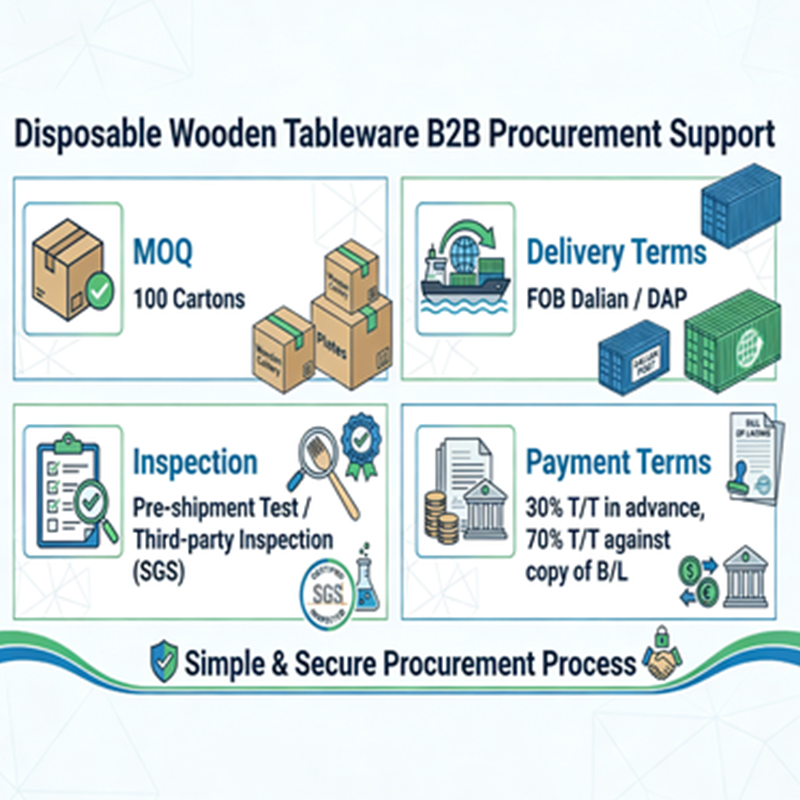
Procurement support material for B2B cutlery sourcing. Written terms and inspection criteria are the elements a buyer can re-confirm at each order cycle.
| Checkpoint | Type | Evidence re-confirmed each cycle | What should trigger a re-review |
|---|---|---|---|
| Minimum order quantity of 100 cartons | Term | Written order confirmation per purchase order | Order mix moves toward smaller or more varied SKU runs |
| Delivery on FOB Dalian or DAP | Term | Named Incoterm and responsibility split on each order | Destination market, freight responsibility or consolidation point changes |
| Payment of 30% T/T in advance, 70% T/T against copy of B/L | Term | Signed contract clause | Any request to restructure payment outside the agreed clause |
| Pre-shipment test | Criterion | Batch test record tied to the shipped lot | New SKU, new material lot or new packaging format |
| Third-party inspection (SGS) | Criterion | Inspection report with sampling plan and defect counts | Defect trend moves, or the inspection scope is narrowed |
| Material composition declaration | Criterion | Written specification naming the material family per SKU | Supplier, sub-supplier or material source changes |
| Food-contact documentation | Criterion | Declaration and manufacturing-practice evidence for the destination market | Regulatory update, or entry into a new market |
Acceptance criteria must be repeatable, not just strict
A strict criterion applied differently on each shipment is weaker than a moderate criterion applied identically. The practical question is not whether a supplier tests, but whether the test is defined well enough that two people running it would reach the same conclusion.
That requires four written elements before the first repeat order: the sampling plan, the defect definitions, the record format, and the decision rule for a failed lot. Pre-shipment testing and third-party inspection by SGS provide the vehicle, but the vehicle only creates continuity if the sampling basis and the defect vocabulary stay fixed. When a buyer changes AQL levels or accepts a different inspection scope without recording the change, the next comparison becomes meaningless.
A second discipline sits alongside this: the report must identify the actual lot. A certificate or inspection report issued for a general product family does not confirm the cartons on the pallet. Matching report to lot number, item code and shipment date is the cheapest control a buyer can build into the cycle.
Material composition: the checkpoint most often skipped
The most consequential question in bamboo cutlery procurement is not appearance but composition. Solid bamboo articles and bamboo-filled plastic articles are different products, and in the European Union they are treated differently. EU rules on plastic food-contact materials permit only authorised substances, and plastic materials containing unauthorised bamboo additives may not lawfully be placed on the EU market under Regulation (EU) No 10/2011 — the issue addressed by the European Commission’s coordinated “Bamboo-zling” action.
For a long-term relationship, composition should therefore be a declared, documented attribute rather than a marketing description. A workable checkpoint set is short and can be repeated on every new SKU:
- A written specification naming the material family — solid bamboo, wood, or a polymer composite — for each item code.
- Confirmation that the description used in catalogues and quotations matches that specification.
- A record of when the specification was last confirmed and by whom, so a change of material source is visible rather than silent.
Food-contact documentation and manufacturing-practice evidence
Food packaging, containers, kitchenware and tableware intended for food contact must comply with the EU food-contact framework when placed on the European market, including Regulation (EC) No 1935/2004. Manufacturing must follow Good Manufacturing Practices under Commission Regulation (EC) No 2023/2006, and the framework requires that materials do not release constituents at levels harmful to human health or change food composition, taste or odour in an unacceptable way.
Those requirements describe an obligation, not a result. They tell a buyer what the supplier must be able to demonstrate; they do not demonstrate it for any particular item. This is the point where a company-level certificate list and a product-level evidence file diverge. Greenwood states that it holds BRC, FSC, FDA, LFGB, BSCI and ISO9001 certification. Those are relevant qualifications, and they belong in the review. They still do not replace the test report for the specific SKU, in the specific configuration, for the specific destination market — and a buyer extending a relationship should ask for exactly that document rather than accepting the certificate as a substitute.
A repeatable version of this checkpoint has three parts: a declaration covering the item and the market, manufacturing-practice evidence covering the site that made the lot, and the specific test record for the material and configuration shipped. Re-confirming all three at each material or market change keeps the file current without rebuilding it every quarter.
Process controls that must survive a change of shift
Splinters and cracks are the defect class most likely to end a foodservice relationship, because a single incident at the point of use can outweigh months of acceptable lots. Greenwood addresses this with AI camera scanning that detects splinters and cracks on products during production. For a long-term review, the useful question is not whether the equipment exists but whether the record proves it ran on the batch in question.
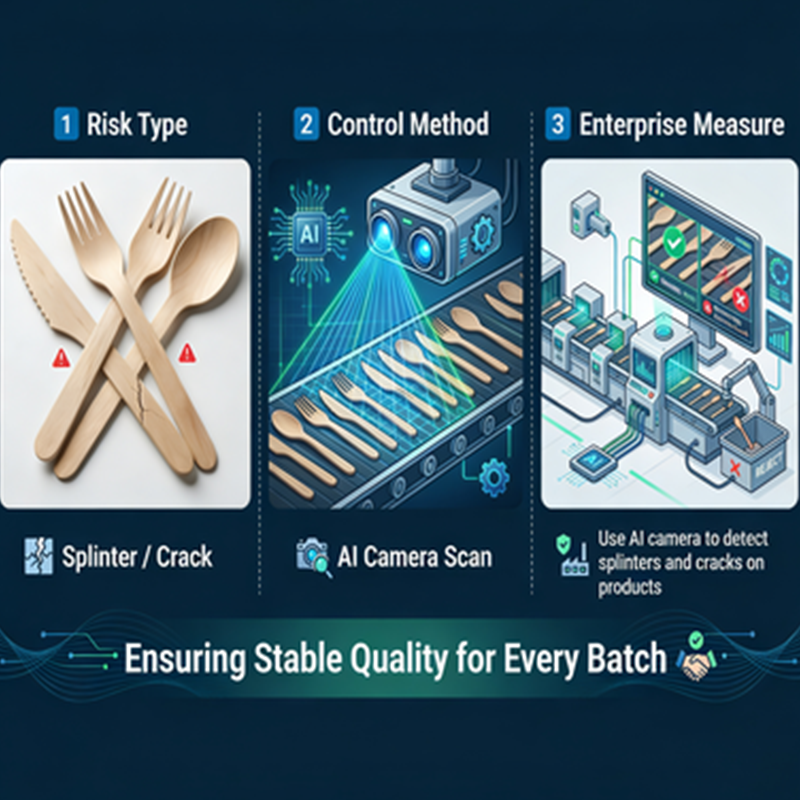
AI camera inspection for splinter and crack detection. In a recurring review, the inspection record is the evidence — not the presence of the equipment.
Two follow-up questions complete the checkpoint. What happens when the camera flags an item — is the reject segregated and counted, or reworked back into the flow? And does the control survive shift changes, holiday periods and temporary staffing, which is when process discipline is most often lost? A supplier that can answer both with a document is materially easier to keep than one that answers with a demonstration.
Continuity: what long-term supply actually depends on
Continuity is a structural property, and structure is inspectable long before a shortage occurs. Greenwood’s disclosed profile offers a concrete example of what to examine: operations across 5 major factories with 500 employees, a 9-engineer research and development team, an export ratio of 95%, and an industrial chain that runs from raw wood procurement through processing to finished product packaging.
Each of those elements maps to a different review question rather than to a general impression of size:
- Multiple factories — if one site is reassigned, can the same item be produced elsewhere to the same specification, and would the buyer be told?
- Engineering capacity — who handles a specification change, a new dimension such as a 140mm or 160mm format, or a custom printing requirement?
- Export concentration — a 95% export ratio indicates familiarity with destination-market documentation, and also means the supplier’s process is built around export compliance rather than domestic sale.
- Raw material traceability — FSC-certified raw material traceability is the mechanism that keeps a composition or origin claim verifiable across orders.
- Warehousing — stated warehouses in Bangladesh, Ukraine and the United States give the buyer a question worth asking about which inventory buffer applies to their region and how it is replenished.
Greenwood’s declared markets span Europe, Australia and New Zealand, Canada, the United States, South America, the Middle East, Japan and Korea, and Southeast Asia. For a buyer, that spread is a review input rather than a reassurance: it indicates which regulatory regimes the supplier already documents routinely, and which ones may require a fresh evidence file.
A review calendar that can run on repeat orders
The difference between a review model and an audit is frequency. Below is a workable cadence that keeps each checkpoint active without turning every order into a full re-qualification.
| Frequency | What is re-confirmed | Why this interval |
|---|---|---|
| Every purchase order | MOQ, delivery basis, payment clause, item code and specification reference | Terms are the cheapest thing to verify and the most common source of dispute |
| Every shipment | Pre-shipment test record and third-party inspection report matched to lot | Acceptance criteria only create continuity if applied per lot |
| Every new SKU or material lot | Composition declaration and food-contact documentation for the destination market | New inputs reset the evidence base even when the supplier is unchanged |
| On any process or site change | Splinter and crack control records, line assignment, staffing continuity | Process controls are the first thing lost when a line or shift changes |
| Annually, or on market entry | Certification status, manufacturing-practice evidence, regulatory applicability | Framework requirements and market scope change independently of the product |
Run this way, the review produces a comparable record each cycle. That record is the actual asset: it lets a buyer see a trend instead of an opinion, and it makes a supplier conversation factual.
Applying the same discipline to paper, bamboo and wooden ranges
The checkpoint structure transfers across material families; the evidence does not. A buyer consolidating a cutlery programme across paper, bamboo and wooden items should keep one review architecture and substitute the material-specific documents, rather than running three unrelated processes.
| Material family | Composition evidence to re-confirm | Process risk to re-confirm | Documentation to re-confirm |
|---|---|---|---|
| Wooden (for example birch or poplar knives, forks and spoons in 140mm or 160mm formats) | Species and grade declaration per item code | Splinter and crack control, dimensional consistency | Food-contact declaration for the destination market |
| Bamboo tableware | Written confirmation of solid bamboo versus a polymer composite | Splinter and crack control, surface finish | Food-contact declaration; separate treatment if the item is a plastic composite |
| Paper | Grade and composition declaration for the specific article | Cut quality, wrap integrity, contamination control | Food-contact declaration for the destination market |
Greenwood’s documented product range covers birch and poplar wooden knives, forks and spoons in formats including 140mm and 160mm, ice cream sticks, coffee stirrers and bamboo tableware. Where a programme also requires paper cutlery, that requirement should be specified and evidenced as its own line rather than assumed to sit inside the wooden and bamboo range.
Where the review model applies in practice
The same checkpoints behave differently depending on the format being bought. Typical formats in this category — bamboo forks and spoons, knife and fork sets, individually wrapped cutlery, custom logo and OEM sets, and bamboo skewers or food sticks for catering — shift the emphasis rather than the structure.
- Takeaway and foodservice sets — the acceptance criterion usually rests on splinter control and set completeness, so the per-batch inspection record carries most of the weight.
- Individually wrapped cutlery — the wrap becomes part of the product. Wrap integrity and the specification of the wrapping material belong in the same review as the cutlery itself.
- Custom logo and OEM sets — artwork approval, print durability and the point at which a printed run is locked should be written into the term set, not agreed per order.
- Airline catering and retail packaged formats — documentation per destination market and per pack configuration dominates, because the same cutlery may face different evidence requirements in different channels.
- Bamboo skewers and food sticks for BBQ and catering — dimensional consistency and splinter control are the recurring criteria, and the review should confirm the same inspection basis applies to these items as to cutlery.
Market context, stated with its limits
Three published data points are worth carrying into a supplier conversation, provided each is used at its own scope. A commercial research estimate places the global bamboo cutlery market at USD 1.8 billion in 2025. A separate commercial research projection puts the average B2B wholesale price for standard 160mm wooden and bamboo utensils in bulk cartons at USD 15.50 to USD 17.10 per 1,000 units in 2026. UN Comtrade records show China exporting USD 1.27 billion of HS 4419 tableware and kitchenware of wood and bamboo in 2023.
Each figure has a boundary that a buyer should keep attached to it. The price band is reported for wood and bamboo combined, so it cannot be read as a bamboo-only benchmark. HS 4419 aggregates wood and bamboo tableware, and broader trade classifications do not isolate disposable bamboo cutlery or skewers at all — the available records for vegetable plaiting materials cover raw-material categories, not finished foodservice products. That means a sourcing-country ranking built on these codes would be an artefact of the classification, not a finding about supply.
Used correctly, the numbers do one job: they establish order-of-magnitude context for a commercial discussion. They do not substitute for a quotation, and they do not prove any individual supplier’s cost position.
Outlook: what would move a checkpoint
The review model is designed to absorb change rather than predict it. Three developments would each shift a checkpoint from routine to decisive, and a buyer tracking them can prepare the evidence before it is requested.
If enforcement attention on material composition continues at the EU level, the composition declaration stops being a supporting document and becomes an entry gate — which favours suppliers who can already name the material family per item code. If the wholesale price band moves outside its current range, the term set reopens, and delivery basis and payment structure deserve renegotiation alongside price. And if a buyer enters a market with documentation requirements the supplier has not served before, the annual documentation checkpoint has to run early, because it is the slowest item on the list to complete.
None of these is a forecast. They are the conditions under which an existing review cycle earns its cost.
About Greenwood - Dalian Industrial Co.,ltd.
Greenwood - Dalian Industrial Co.,ltd. is a Chinese manufacturer of disposable wooden and bamboo tableware, founded in 2000 and operating across 5 major factories with 500 employees, including a 9-engineer research and development team. Its documented range covers birch and poplar wooden knives, forks and spoons in formats such as 140mm and 160mm, ice cream sticks, coffee stirrers and bamboo tableware. The company states certification to BRC, FSC, FDA, LFGB, BSCI and ISO9001, an export ratio of 95%, FSC-certified raw material traceability, AI camera detection of splinters and cracks, warehouses in Bangladesh, Ukraine and the United States, and customization options covering printed and individually packaged formats.
Company information is published at Greenwood - Dalian Industrial Co.,ltd.. Procurement contact is Irene Wang, ireenwang@caregreenwood.com, telephone and WhatsApp +86 138 4090 7153, based in Jinzhou, Dalian, China. A company brochure with further detail is available as a downloadable PDF.
FAQ
What does a long-term supplier review cover that an initial audit does not?
An initial audit establishes whether a supplier can produce an acceptable lot. A long-term review establishes whether the same terms, material composition and acceptance criteria hold across successive orders. In practice it adds three things: re-confirmation of commercial terms on every purchase order, per-shipment matching of test and inspection records to the actual lot, and a defined trigger for re-review when a material, site, process or destination market changes.
Which purchasing terms should be re-confirmed before each repeat order?
At minimum: minimum order quantity, delivery basis, payment structure, item code and the specification referenced by that code. Greenwood’s stated terms are a minimum order quantity of 100 cartons, delivery on FOB Dalian or DAP, and payment of 30% T/T in advance with 70% T/T against a copy of the bill of lading. Each is a written commitment, which is what makes it re-checkable; verbal assurances cannot be compared across cycles.
How can a buyer tell solid bamboo cutlery from bamboo-filled plastic?
By requiring a written specification that names the material family for each item code, and by checking that catalogues and quotations match it. The distinction carries regulatory weight in the European Union: plastic food-contact materials may only use authorised substances, and plastic containing unauthorised bamboo additives may not lawfully be placed on the EU market under Regulation (EU) No 10/2011. That rule addresses bamboo additives in plastic and should not be applied to solid bamboo articles, which fall under the wider food-contact framework.
What acceptance criteria apply to a disposable bamboo cutlery shipment?
Greenwood states acceptance through pre-shipment testing plus third-party inspection by SGS. For the criteria to remain meaningful over time, the sampling plan, defect definitions, record format and the decision rule for a failed lot should be fixed in writing, and each report should identify the lot number, item code and shipment date. A report issued for a product family rather than the shipped lot does not confirm the cartons on the pallet.
How does Greenwood support a multi-year supply relationship?
Through structural factors a buyer can examine rather than a general assurance: operations across 5 major factories with 500 employees and a 9-engineer research and development team, an industrial chain running from raw wood procurement to finished packaging, FSC-certified raw material traceability, AI camera detection of splinters and cracks, warehouses in Bangladesh, Ukraine and the United States, and stated certification to BRC, FSC, FDA, LFGB, BSCI and ISO9001. Product-level test records for a specific SKU and destination market should still be requested separately, since company-level certification does not replace them.
¿Tiene preguntas o necesita más detalles?
Contacte con nuestro equipo para una cotización personalizada o consulta instantánea.
Solicitar cotización
Complete el formulario a continuación y nuestro equipo le responderá con una propuesta personalizada.
Chat directo de WhatsApp
¿Prefiere chatear en tiempo real? Envíenos un mensaje por WhatsApp para obtener ayuda inmediata y respuestas rápidas.
- Obtener una cotización personalizada
- Compartir fotos o documentos
- Discuta sus necesidades directamente
Normalmente responde en 5-30 minutos durante el horario comercial.