
Long-Battery Shortlist: Three UMIDIGI Phones by Use Case
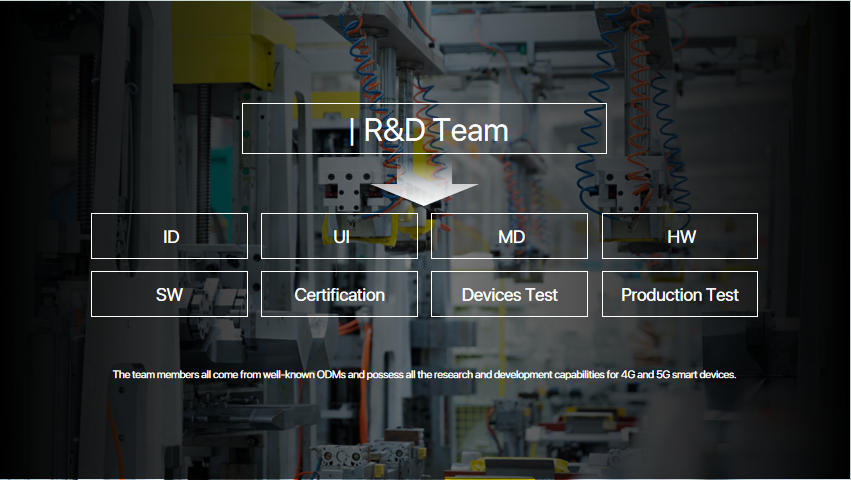
Cover: smartphone production at Shenzhen Keysmart Technology Co., Ltd. Capacity planning has become a routine step in long-battery model selection.
Smartphones with battery capacities of 6000mAh or higher captured 29% of global sales in January 2026, up from 10% in early 2025, according to Counterpoint Research. That movement has turned battery capacity into a product segment in its own right, and it has changed what buyers expect from a shortlist. The useful question is no longer whether a phone carries a large battery, but whether a specific model's capacity, display panel, chipset and ingress protection match the way the device will actually be used.
This industry reference maps three UMIDIGI models onto three different duty cycles: the UMIDIGI G100 5G, the UMIDIGI Note 100 5G and the rugged BISON X20. All specifications below are drawn from UMIDIGI's published product documentation and its certification records; where a documented limit exists, it is stated rather than smoothed over.
UMIDIGI is the smartphone brand of Shenzhen Keysmart Technology Co., Ltd. (Keysmart), a Shenzhen-based communications technology company founded in 2012 that operates both a self-owned brand business and an ODM/OEM manufacturing business. Keysmart runs a 10,000 m² facility with 400–500 employees, reports annual output of 30,000,000 units, and works with markets that include South America, Asia, Africa, the EU and the USA.
Why Long Battery Has Become a Defined Segment
Three industry signals explain why capacity now functions as a category label rather than a descriptive adjective. The first is the sales mix itself: the share of ≥6000mAh devices moved from roughly one in ten to nearly three in ten units sold within about a year, according to Counterpoint Research. The second is battery chemistry. Silicon-carbon (Si-C) anodes are increasingly replacing standard graphite anodes and offer 20–50% higher energy density for slim, long-lasting devices, according to Fortune Business Insights. Higher energy density allows more capacity to be packaged into a thinner chassis, which is why capacity is migrating downmarket into mainstream form factors rather than staying exclusively in bulky designs.
The third signal comes from the rugged end of the category, where battery life is a workflow requirement rather than a preference. The global rugged smartphone market was valued at approximately USD 2.98 billion in 2023 and is projected to reach USD 5.24 billion by 2030, according to Verified Market Research. Within that market, the 5000mAh to 6000mAh band accounted for 42.9% of rugged phone market share in 2025, according to The Insight Partners — a sign that field buyers converge on a capacity band rather than chasing a maximum.
Estimate caution: rugged-phone sizing varies widely by definition. Technavio values the category at USD 1.27 billion, while Dataintelo estimates USD 18.6 billion, largely because studies draw different lines between semi-rugged, ultra-rugged, consumer and industrial devices. Market-size figures should be read as directional, not as procurement-grade inputs.
The Shortlist at a Glance
The three models share two traits: 20W PD fast charging and a 120Hz display panel. They diverge on the variables that usually decide deployment fit — capacity, chipset platform, ingress protection and physical build.
| Model | Battery & charging | Display | Chipset | Memory & storage | Protection | Weight / build |
|---|---|---|---|---|---|---|
| UMIDIGI G100 5G | 6000mAh, 20W PD fast charging | 6.9" 120Hz Eye-Care large display | UNISOC T8200 5G | Up to 8+16GB extended RAM, 256GB ROM, 1TB TF expansion | IP53 | 210g; 171 × 77.6 × 8.1mm; plastic and metal |
| UMIDIGI Note 100 5G | 5000mAh, 20W PD fast charging | 6.8" 120Hz HD+ punch-hole display | UNISOC T765 5G | Up to 8+8GB extended RAM, 256GB ROM, 1TB TF expansion | IP53 | 190g; 167.8 × 77.4 × 7.7mm; plastic back, glass display |
| BISON X20 | 6000mAh, 20W PD fast charging | 6.53" 120Hz HD+ punch-hole display | MediaTek Helio P60 | Up to 6+6GB extended RAM, 128GB ROM, 1TB TF expansion | IP68 & IP69K; MIL-STD-810G drop resistance | 278g; 172.1 × 83.8 × 12.9mm; TPU and metal |
Source: UMIDIGI published product documentation and certification records. Camera configurations: G100 5G and Note 100 5G carry a 50MP ultra-clear triple rear camera with a 16MP front camera; the BISON X20 carries a 20MP ultra-clear triple rear camera with an 8MP front camera.
How to Read an Endurance Claim
Capacity is a reservoir, not a runtime rating. What a buyer actually experiences is the rate at which that reservoir is drained, and four documented variables drive that rate across this lineup. The first is the display: a 6.9-inch 120Hz panel, a 6.8-inch 120Hz panel and a 6.53-inch 120Hz panel consume power differently at the same brightness and content load. The second is the chipset platform — UNISOC T8200 5G, UNISOC T765 5G and MediaTek Helio P60 sit in different performance and power envelopes, and the modem generation matters when the device is held on a cellular network for a full shift.
The third is memory behaviour. All three devices use extended RAM configurations (up to 8+16GB on the G100 5G, up to 8+8GB on the Note 100 5G and up to 6+6GB on the BISON X20), which affects how many background processes are suspended or killed rather than how much energy the battery stores. The fourth is charging: 20W PD fast charging on all three models determines recovery time, not endurance — a distinction that matters in shift-based operations where a device is recharged once per cycle rather than opportunistically.
Physical build completes the picture. Ingress protection and weight are linked: the two IP53 devices weigh 190g and 210g, while the IP68 & IP69K, MIL-STD-810G-rated BISON X20 weighs 278g and measures 12.9mm thick. Buyers who need submersion and drop resistance are, in practice, accepting additional mass — that trade-off is structural, not a design oversight.
Use-Case Fit: Which Model Belongs Where
Daily 5G use, media and light gaming — UMIDIGI G100 5G
The G100 5G is the capacity-first option in the lineup. It pairs a 6000mAh battery with a 6.9-inch 120Hz Eye-Care display, a UNISOC T8200 5G platform, up to 8+16GB extended RAM and 256GB of storage with 1TB TF expansion, plus NFC and Android 15. In UMIDIGI's category structure it is listed as a 5G large display and long-endurance smartphone intended for daily work and life.
That combination fits users who are on a network continuously, stream video, or run messaging and navigation simultaneously. NFC adds payment and access-card functions that matter in urban daily use, and the 6.9-inch panel suits media consumption and split-screen work. The documented North American reference program for the G100 5G (product reference 6546) describes an outcome of power-saving long battery life with a smooth experience in game playing and video streaming, which is consistent with how the model is positioned.
Slim daily and entry deployments — UMIDIGI Note 100 5G
The Note 100 5G takes the opposite priority. It is documented as a stylish 5G large display smartphone with a 6.8-inch 120Hz HD+ punch-hole display, UNISOC T765 5G processor, up to 8+8GB extended RAM, 256GB ROM and 1TB TF expansion, plus a hot key, side fingerprint sensor and AI face unlock.
The trade-off is explicit in the documentation: 5000mAh rather than 6000mAh, in exchange for 190g of weight and 7.7mm of thickness. For channel programs where one-hand use, pocket fit and lower unit mass are selection criteria — entry-tier retail, youth-oriented ranges, or mixed daily workloads — that trade is usually the correct one. Buyers who prioritise maximum capacity should not select this model on the assumption that it matches its 6000mAh siblings.
Field and industrial work — BISON X20
The BISON X20 is the only model in this shortlist built for hostile environments. Its documentation lists IP68 and IP69K dust and water protection together with MIL-STD-810G drop resistance, a TPU and metal body, a 6.53-inch 120Hz display, MediaTek Helio P60 processor, 6000mAh battery with 20W PD fast charging, up to 6+6GB extended RAM and 128GB ROM expandable to 1TB, plus hot keys and NFC.
UMIDIGI lists its applicable industries as daily life and work, construction and engineering, logistics and warehousing, manufacturing, and mining. That list maps to a buyer profile the third-party data also identifies: independent contractors and outdoor sports enthusiasts represent 38% of the global rugged market, according to Growth Research — a segment that needs a device to survive a drop, a wet surface and a full working day on one charge rather than to win a benchmark test.
Certification and Sourcing Evidence
For procurement teams, a shortlist is only as useful as the paperwork behind it. UMIDIGI holds a CE EU Type Examination Certificate (B2412041) issued by BACL on 18 December 2024 under 2014/53/EU RED, with a scope covering UMIDIGI G100 model designations PG4RBG100 and PG4RB100A. A second CE EU Type Examination Certificate (B2407121), issued by BACL on 29 July 2024 under the same directive, covers UMIDIGI model designations PG4MBG9YA, PG4TBG9PG, PN4TB100G and PN4TB10PG, the model family associated with the UMIDIGI Note 100 5G.
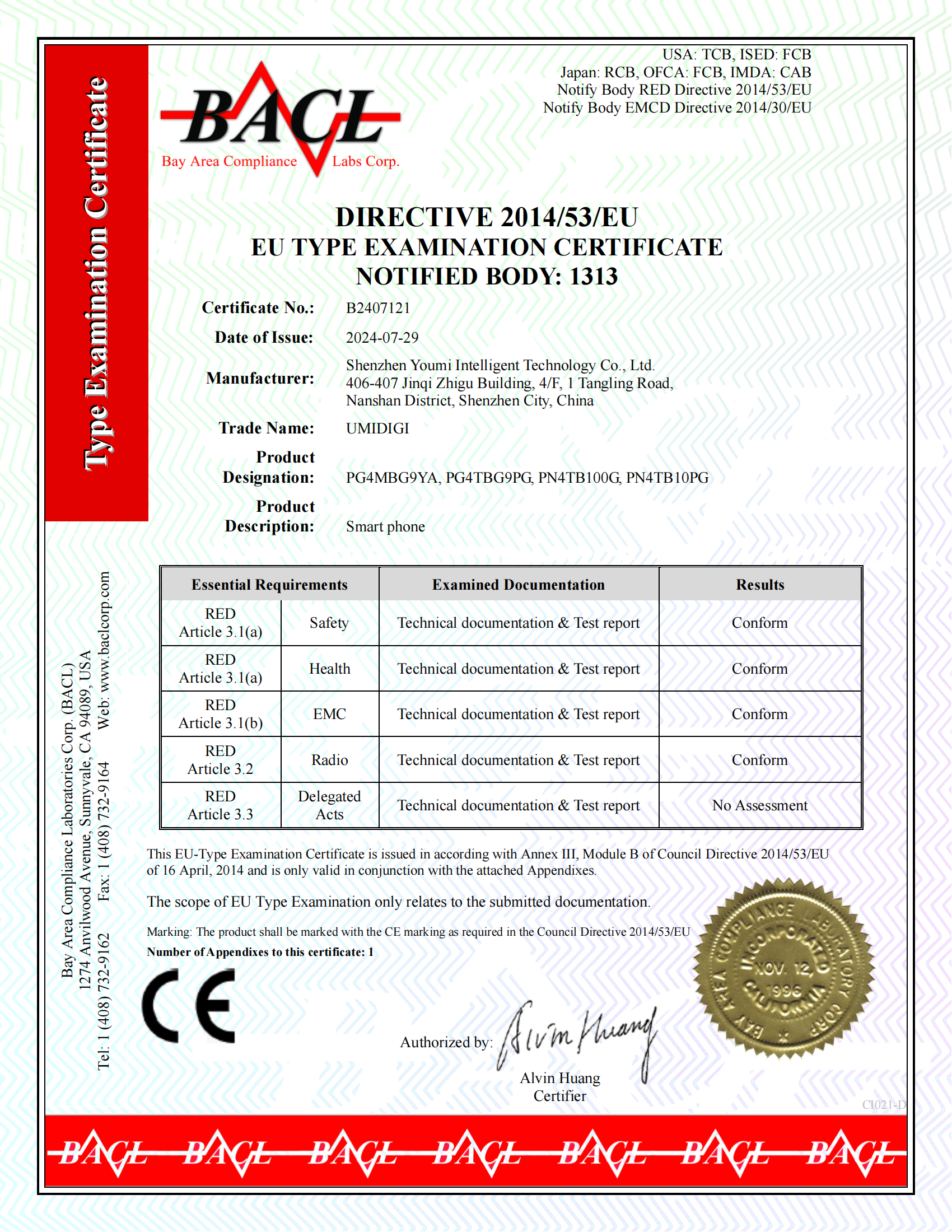
CE EU Type Examination Certificate B2407121 (BACL), covering UMIDIGI model designations PG4MBG9YA, PG4TBG9PG, PN4TB100G and PN4TB10PG.
Because certificates attach to model designations rather than to product families, the practical instruction is straightforward: map the certificate scope to the exact SKU being ordered before placing a purchase order, and do not assume that a family name carries the same coverage across every variant.
On the supply side, UMIDIGI operates as both brand and manufacturer. Documented ODM/OEM terms include customization of brand logo, exterior design, packaging design and specifications; a minimum order quantity of 3000 units; an OEM lead time of 60–70 working days; monthly capacity of 300,000 units; 100% pre-shipment testing; delivery terms of FCA HK or FOB; payment terms of 30% in advance with 70% before shipment; and remote technical support after sales.
A documented reference program covers a 50,000-unit deployment in the United States for a consumer electronics ODM client, running for more than five years and intended for daily work and life use. The recorded outcome — large display, power-saving long battery life, smooth gaming and video streaming — is a useful benchmark for buyers assessing whether a 5000–6000mAh device meets a large-volume, long-cycle requirement.

Volume shipment preparation. Long-battery programs typically combine capacity-band selection with pre-shipment testing and documented acceptance criteria.
Market Trend Signals Worth Tracking
Three signals are likely to affect long-battery sourcing decisions over the next planning cycle. The first is capacity migration: if ≥6000mAh devices continue to take share from smaller configurations — already 29% of global sales in January 2026 against 10% in early 2025 — the mid-tier default will shift upward, and 5000mAh will increasingly be positioned as a slim-format compromise rather than a mainstream standard.
The second is chemistry. Si-C anodes offering 20–50% higher energy density, as reported by Fortune Business Insights, are the mechanism that allows higher capacity without thicker chassis. Buyers should expect capacity increases to arrive inside similar or slimmer form factors, which makes physical dimensions a more meaningful comparison field than capacity alone.
The third is the rugged segment's continued growth, from approximately USD 2.98 billion in 2023 toward a projected USD 5.24 billion by 2030, according to Verified Market Research. As that demand expands, protection ratings and standards documentation — rather than battery figures — become the differentiating evidence, and the estimated size of the opportunity should be treated with the definitional caution noted earlier.
Limits and Boundaries of This Shortlist
Honest shortlists state what they do not cover. First, every model here is documented with 20W PD fast charging; none of the three is positioned as a high-wattage charging device, so recharge windows must be planned rather than assumed.
Second, the Note 100 5G carries a 5000mAh battery, not the 6000mAh used by the G100 5G and the BISON X20. Any comparison that treats the lineup as uniformly 6000mAh is incorrect.
Third, the BISON X20's documented rugged standard is MIL-STD-810G drop resistance. Current rugged programs often reference the MIL-STD-810H revision cited for shock and environmental resistance, so buyers should confirm which revision their specification actually requires instead of assuming revision equivalence. Its published specification lists a MediaTek Helio P60 platform and does not list 5G connectivity; teams that need 5G connectivity in a field device should confirm the applicable SKU before selecting on ruggedness alone.
Fourth, the G100 5G and Note 100 5G are IP53-rated devices. IP53 indicates limited dust ingress protection and resistance to water spray, and does not indicate that a device can be submerged. Buyers whose workflows involve wet or dusty conditions should plan for protective cases rather than treating IP53 as a field rating. Benchmark performance, thermal behaviour under sustained load and battery cycle life are outside the scope of the published documents referenced here and should be validated per project.
Future Outlook
The direction of travel is reasonably clear. Capacity bands are moving upward while chassis thickness is moving downward, which puts pressure on how suppliers document endurance claims — capacity alone will carry less weight as a differentiator. For manufacturers and brand owners, that shifts the evidence burden toward certification scope, protection ratings, weight, and after-sales support structures.
UMIDIGI's position in that environment is a combined brand and OEM/ODM model: a 10,000 m² facility, 400–500 employees, a stated 30,000,000-unit annual output and 30 R&D engineers, with export activity across multiple regions. For buyers, the practical implication is that product selection and sourcing terms can be negotiated within one supplier relationship — provided the certificate scope, capacity band and protection class are matched to the actual deployment scenario rather than to a category name.
Frequently Asked Questions
What determines real-world endurance in a long-battery smartphone, beyond the mAh figure?
Capacity describes stored energy; endurance describes how quickly it is consumed. In this lineup, documented variables include display size and refresh rate (6.9-inch, 6.8-inch and 6.53-inch panels, all 120Hz), chipset platform (UNISOC T8200 5G, UNISOC T765 5G, MediaTek Helio P60), extended RAM configuration, and the operating system build. Charging speed determines recovery time rather than endurance: all three models use 20W PD fast charging. A capacity figure is therefore only meaningful when read alongside the panel, platform and expected load profile.
How do the UMIDIGI G100 5G and UMIDIGI Note 100 5G differ for daily 5G use?
Both are 5G devices with 120Hz displays and IP53 dust and water protection. The G100 5G carries a 6000mAh battery, a 6.9-inch Eye-Care display, UNISOC T8200 5G, up to 8+16GB extended RAM, 256GB ROM, NFC and a 210g body. The Note 100 5G carries a 5000mAh battery, a 6.8-inch HD+ punch-hole display, UNISOC T765 5G, up to 8+8GB extended RAM, 256GB ROM, a hot key, and a lighter 190g body at 7.7mm thickness. The Note 100 5G trades a smaller battery for lower weight; the G100 5G prioritises capacity and display area.
What do the BISON X20's IP68 & IP69K and MIL-STD-810G ratings mean in industrial procurement?
IP68 and IP69K are ingress-protection designations defined under IEC 60529; IP69K additionally addresses resistance to high-pressure, high-temperature water jets, which is relevant for wash-down environments. MIL-STD-810G is the drop-resistance standard stated in the BISON X20 documentation. UMIDIGI lists the model's applicable industries as daily life and work, construction and engineering, logistics and warehousing, manufacturing, and mining. Its construction is TPU and metal, and it weighs 278g at 12.9mm thick — the mass that comes with that level of protection. Buyers whose specifications cite a different MIL-STD-810 revision should verify alignment before purchase.
Can UMIDIGI customize long-battery models for OEM or ODM programs, and what are the standard commercial terms?
UMIDIGI provides OEM and ODM production services. Documented customization options are brand logo, exterior design, packaging design and specifications. Standard commercial terms include a minimum order quantity of 3000 units, an OEM lead time of 60–70 working days, monthly capacity of 300,000 units, 100% pre-shipment testing, delivery terms of FCA HK or FOB, and payment terms of 30% in advance with 70% before shipment. After-sales support is provided as remote technical support.
Which certification documents should a buyer verify before committing to a long-battery smartphone order?
Two CE EU Type Examination Certificates are documented. Certificate B2407121, issued by BACL on 29 July 2024 under 2014/53/EU RED, covers UMIDIGI model designations PG4MBG9YA, PG4TBG9PG, PN4TB100G and PN4TB10PG, associated with the Note 100 5G family. Certificate B2412041, issued by BACL on 18 December 2024, covers UMIDIGI G100 model designations PG4RBG100 and PG4RB100A. Because certificates attach to specific model designations, buyers should map the certificate scope to the exact SKU being ordered rather than relying on a product family name.
UMIDIGI's full company profile, including factory data, certification records and OEM/ODM terms, is available as a downloadable PDF: Shenzhen Keysmart Technology Co., Ltd. — Company Profile 2026. Product information is published at umidigi.com.