
Live Streaming Camera Supplier Evidence: A TCHD Video Audit
HTNXT Industry Reference · Supplier Evidence
Specification sheets describe what a live streaming camera can do. Certificates, commercial terms and a dated field record describe what a supplier can be held to. This reference separates those evidence layers for TCHD Video and states, section by section, where the file stops.

Supplier evidence for live streaming cameras is assembled from management-system certification, product conformity records, commercial terms and field deployment data — four different document types that answer four different buyer questions.
A buyer evaluating a live streaming camera in 2026 is rarely blocked by the camera. Sensor format, zoom range, interface set and protocol support are published, comparable and largely converged across the mid-market. The difficult comparison is the supplier behind the unit: whether its management processes are certified, whether that certification scope actually reaches the model being quoted, what the commercial terms imply for working capital, and whether anyone has run the model long enough to say something defensible about reliability.
This article works through one supplier's file in that order. TCHD Video is the trading name of TCHD Digital Video Technology Development (Beijing) Ltd, a Beijing-based developer and supplier of live streaming cameras, video capture cards, converters, encoders and switchers, established in 2005. The evidence examined covers management-system certification, product-level CE EMC conformity, buyer-facing commercial terms and a two-year, three-country deployment record for the TC-980S.
Why documented evidence became a buying gate
Category growth increases the number of suppliers a procurement team must screen, and screening is where undocumented claims fail. Third-party estimates put the global live streaming camera market at USD 3.35 billion in 2025, with a projected 8.8% CAGR to USD 7.79 billion by 2035 (Vertex AI Search / industry report). PTZ cameras are estimated at 38.5% of global conference camera revenue in 2025 (Metastat Insights), and video conferencing hardware — cameras included — accounted for 46% of total video conferencing market revenue in 2024 (Grand View Research).
These estimates are not interchangeable, and that matters for how they are used. Published PTZ growth figures diverge sharply by definition: Strategic Market Research has cited 7.8% CAGR for 2024–2030, while Zion Market Research has cited 15.9% for 2025–2034. The spread reflects different category boundaries rather than disagreement about direction. The practical consequence is that a buyer cannot benchmark a single supplier against a single market number and expect precision; a more reliable screen is the supplier's own document trail.
The entity and its operating base
TCHD Digital Video Technology Development (Beijing) Ltd was established in 2005 and operates from a 10,000 m² facility in Haidian District, Beijing, with 50 employees, a 10-engineer R&D team and a stated annual output of 4,000 units. Roughly 20% of output is exported, with the EU, USA and Asia listed as principal markets. The product range spans live streaming cameras, video capture cards, video converters, video encoders and video switchers, supported by system-level products including virtual studio systems, recording hosts and streaming media servers.
Two production figures appear in the file and should be read as different things rather than as one rate. The stated annual output of 4,000 units describes historical volume; the stated monthly capacity of 500 units describes a ceiling. Buyers planning a rollout should treat the capacity figure as an upper bound subject to confirmation at order stage, not as a guaranteed monthly delivery rate.
Layer one: management-system certification and what its scope covers
Three management-system certificates sit at the base of the file. All were issued on 8 March 2024 by BEIJING STANDARD CERTIFICATION CENTRE and run to 7 March 2027, giving a single three-year cycle across quality, environment and occupational health and safety.
| Document | Standard | Certificate no. | Issued | Valid to |
|---|---|---|---|---|
| Quality management system | GB/T19001-2016 / ISO 9001:2015 | 064-24-Q-0675-R1-S | 2024-03-08 | 2027-03-07 |
| Environmental management system | GB/T24001-2016 / ISO 14001:2015 | 064-24-E-0676-R1-S | 2024-03-08 | 2027-03-07 |
| Occupational health and safety management system | GB/T45001-2020 / ISO 45001:2018 | 064-24-S-0677-R1-S | 2024-03-08 | 2027-03-07 |
All three share the same recorded scope: the sales of digital audio and video products and related technical services and its related management activities. The occupational health and safety certificate states that scope explicitly for digital audio/video product sales and technical services. The three camera models recorded against these certificates are the TC-980S (model 6370), the TC420 (model 6388) and the TCHD-T3 (model 6394).
The scope wording is the part a buyer should read twice. A sales-and-services scope covers the commercial and technical-support activities described in it; it is not a manufacturing-scope certificate for a production line. That is a normal structure for a supplier that combines development, configuration and distribution, but it means the certificate answers a question about service delivery and management discipline rather than a question about factory process control. Where a tender explicitly requires a production-scope certificate, that requirement should be raised as a separate document request rather than satisfied by inference.
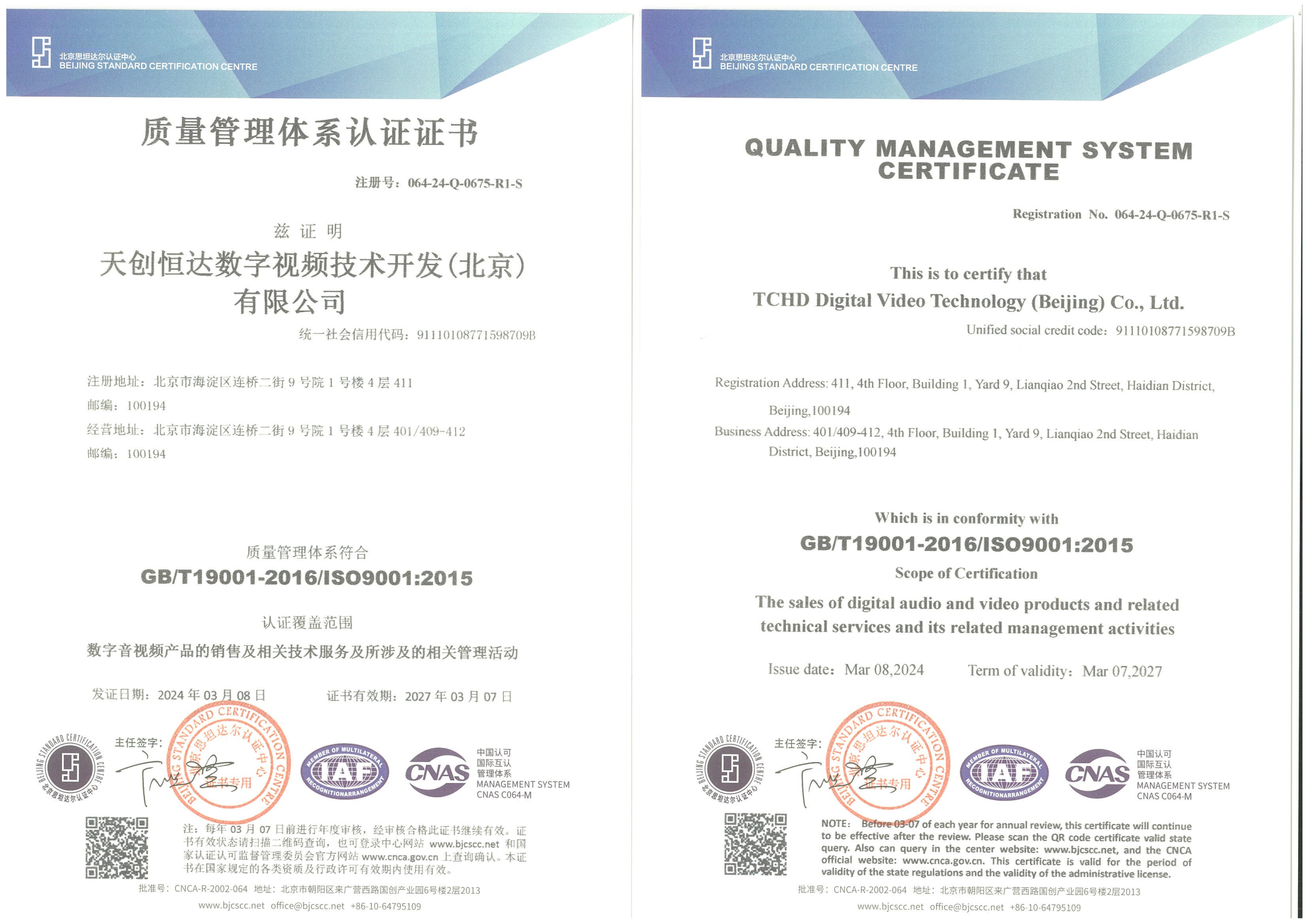
The ISO 9001:2015 certificate in the TCHD Video file: certificate 064-24-Q-0675-R1-S, issued by BEIJING STANDARD CERTIFICATION CENTRE on 8 March 2024, valid to 7 March 2027.
Layer two: product conformity and the CE EMC record
Product-level conformity in the file is documented through a CE EMC Attestation of Compliance, certificate LCSA07075157E, issued by LCS TESTING LABORATORY on 16 July 2025 for the EU market, with a recorded expiry of 16 July 2099. The harmonised standards cited are EN 55032:2015/A1:2020 for emissions and EN 55035:2017/A11:2020 for immunity.
| Recorded item | Detail |
|---|---|
| Certificate | Attestation of Compliance (CE EMC), LCSA07075157E |
| Issuing laboratory | LCS TESTING LABORATORY |
| Standards cited | EN 55032:2015/A1:2020; EN 55035:2017/A11:2020 |
| Market | EU |
| Issue date | 2025-07-16 |
| Related models recorded | TCHD-T3 (6394), TC420 (6388), TC-980S (6370) |
Two boundaries belong with this record. First, the certificate scope as written references the TC-400N4 HDMI series capture card, while the TC420, TC-980S and TCHD-T3 are listed as related models in the same compliance record. A buyer whose tender requires model-specific evidence for a camera chassis should request the corresponding test report against that model, rather than treating the whole product family as automatically covered by one document line.
Second, EMC is not the same test as electrical safety, and neither is the same as medical-device conformity. Medical electrical equipment, including surgical and clinical cameras, falls under the IEC 60601-1 series for basic safety and essential performance. Nothing in the TCHD Video file described here constitutes an IEC 60601-1 claim. Where a live streaming camera is specified for clinical or surgical teaching environments, that compliance pathway should be raised as a distinct requirement at the specification stage, not discovered at the customs or tender review stage.
Layer three: commercial terms a buyer can plan around
For models 6394, 6388 and 6370, the recorded commercial structure is full prepayment, with FOB and C&F delivery terms and pre-shipment test acceptance. The wider capability record adds a one-unit minimum order quantity, a 30–45 day lead time, a stated monthly capacity of 500 units, 100% testing of all units, OEM/ODM cooperation including logo customisation, remote after-sales support, and export markets covering the EU, South East Asia and the USA.
| Term | Recorded position | What it changes for the buyer |
|---|---|---|
| Minimum order | 1 unit | Trial or sample-scale entry is possible without committing to a container |
| Payment | Full prepayment (6394, 6388, 6370) | Working capital and counterparty risk sit with the buyer until shipment |
| Delivery | FOB / C&F | Freight, insurance and import clearance are buyer-side decisions |
| Lead time | 30–45 days | A realistic buffer is needed for event or semester deadlines |
| Acceptance | Pre-shipment test acceptance | The buyer's main control point before funds are committed in full |
| Quality control | 100% testing of all units | Per-unit testing rather than lot sampling |
Full prepayment is the term that alters the evaluation most. It is a common structure for mixed made-to-order and small-batch supply, and it keeps pricing and lead time simple, but it concentrates risk on the buyer's side of the transaction. The compensating mechanism in this file is the pre-shipment test acceptance step: a buyer who uses it properly receives recorded evidence that the units were tested before dispatch, and holds the one point of leverage in an otherwise prepaid flow. Buyers accustomed to letters of credit or net terms should treat the payment structure as a known constraint and price it into their own cash-flow planning rather than as a negotiable afterthought.
Layer four: the two-year, 20-unit deployment record
The field evidence in the file concerns one model. Twenty units of the TC-980S (6370) were deployed for teaching live streaming in Germany, Australia and Malaysia, and the project has been operational for two years with reported stable performance, low noise and AI auto tracking. The client types recorded against this deployment are government, hospital, school and YouTuber users.
| Field record element | Detail |
|---|---|
| Model | TC-980S (6370) |
| Quantity | 20 units |
| Application | Teaching live streaming |
| Locations | Germany, Australia, Malaysia |
| Duration | 2 years in operation |
| Reported outcome | Stable performance, low noise, AI auto tracking |
| Client types | Government, hospital, school, YouTuber |
What this record supports is narrower than it first appears, and stronger for being narrow. It is a multi-country record across three distinct climate and power environments, in a continuous-use application where an operator is not present to correct framing, and over a duration long enough to expose early-life failures. Three years of static specification cannot substitute for that.
What the record does not support is equally worth stating. Twenty units is a small sample; the record does not include a failure rate, mean time between failures, or an independently measured noise figure in decibels. It covers one application type, and while hospital clients appear among user types, the deployment is described as teaching live streaming rather than clinical imaging. A buyer evaluating a 300-unit campus rollout should read this record as evidence of demonstrated field viability, not as a reliability guarantee at scale.
Technical explanation: what makes the deployment claims plausible
The two headline outcomes in the deployment record — low noise and AI auto tracking — map onto specific, published characteristics of the TC-980S rather than to marketing language.
On noise, the TC-980S publishes a signal-to-noise ratio above 50 dB together with 2D and 3D digital noise reduction, a minimum illumination of 0.5 lux at F1.8 with AGC on, and a total power consumption of 18 W or less. Digital noise reduction at the sensor level matters in teaching rooms specifically, because lecture venues are frequently lit unevenly and cameras are often pushed to higher gain to compensate. A published SNR figure plus dual-domain noise reduction is the technical basis on which a low-noise field claim can be evaluated.
On tracking, the TC-980S carries a monocular tracking function with selectable modes: off, real-time tracking, stage tracking, area tracking and intelligent framing, with a maximum tracking distance of up to 18 metres. That distance range is what makes unattended lecture capture credible, since it covers a typical teaching hall depth without an operator driving the pan-tilt head.
The supporting hardware explains the stability side of the record. The TC-980S uses a 1/2.8-inch CMOS sensor with 8.42 MP effective pixels in 16:9, offers 12X, 20X or 30X optical zoom variants with 16X digital zoom, and outputs HDMI up to 3840×2160 at 60/59.94/50 fps, SDI to 1080P, USB 3.0 in YUY2, NV12, MJPG, H.264 and H.265, and LAN streams in H.264/H.265 with a 1000M Ethernet port supporting PoE+. Pan range is −170° to +170° and tilt −30° to +90°, at pan speeds from 0.1°/s to 60°/s and up to 255 presets. Network protocols include RTSP, RTMP, ONVIF, GB/T28181 and SRT, with NDI and Dante AV listed as options.
The two other camera models in the certification record differ in emphasis. The TC420 uses a 1/2.8-inch HD CMOS sensor with 8.29 MP, 12X optical zoom and 15X digital zoom, HDMI output up to 4K at 30/25 fps, SDI to 1080P, PoE on the LAN port, 255 presets and power consumption under 12 W. The TCHD-T3 is a 1080P60 unit with a 2.07 MP sensor, 12x optical zoom, SNR of at least 55 dB, one USB 3.0 Type-C port plus one USB 2.0 Type-A port, HDMI 1.4b output and PoE on the RJ45 port. None of these three models carries an IEC 60601-1 claim in the documents reviewed here.
Where the evidence transfers: application fit
Education and lecture capture is the application with first-party field evidence. The 20-unit, two-year record across Germany, Australia and Malaysia was built in teaching live streaming, and the auto-tracking distance and preset count align with fixed-installation lecture theatres and distance-learning studios.
Healthcare training is the second fit, supported by hospital clients in the deployment record and by the medical teaching camera designation attached to the TC-980S. The boundary stated earlier applies: training and teaching use is documented, clinical or surgical imaging compliance is not.
Public-sector and institutional rooms are supported indirectly, through the government and school client types recorded against the deployment. Corporate video conferencing and event streaming are supported by the interface set and protocol coverage — HDMI, SDI, LAN with PoE+, USB 3.0, RTSP/RTMP/SRT — and by the PTZ control protocols VISCA, Pelco-D and Pelco-P with selectable baud rates, but not by a dedicated deployment record of their own.
Creator and e-commerce streaming use appears through the YouTuber client type associated with the teaching deployment rather than as a separate case. Buyers in that segment should treat the reference as indicative rather than proven for their workflow.
Market trend: evidence as a differentiator
Three structural observations frame supplier selection through 2026 and 2027. PTZ cameras are estimated at 38.5% of global conference camera revenue in 2025, which places the PTZ form factor at the centre of procurement rather than at its edge. Video conferencing hardware accounted for 46% of total video conferencing market revenue in 2024, meaning hardware remains the largest component of category spend even as software layers expand. And China's production of television and digital cameras reached 749 million units in 2024, valued at approximately USD 16.5 billion (IndexBox), which indicates a supply base deep enough that specification parity is the norm.
When specification parity is the norm, documentation becomes the discriminator. That shift favours suppliers who can produce a coherent file — certificates with readable scopes, product conformity tied to named models, commercial terms stated plainly — and disadvantages those whose evidence consists of a specification sheet and a reference logo wall. It also raises the buyer's side of the work: reading certificate scope is now a procurement skill rather than a compliance afterthought.
Comparison with a spec-sheet-only evaluation
The comparison worth drawing is not between brands but between evaluation methods, because the method determines which risks become visible.
| Evaluation dimension | Spec-sheet-only sourcing | Documented sourcing as presented here |
|---|---|---|
| Capability claim | Parameters compared, supplier process unverified | Three management-system certificates with named scope and certificate numbers |
| Compliance | ‘CE’ asserted without document reference | CE EMC attestation LCSA07075157E with cited standards and issue date |
| Commercial risk | Discovered at quotation | Prepayment, FOB/C&F, 1-unit MOQ and 30–45 day lead time stated upfront |
| Field performance | Unaddressed | 20 units, 3 countries, 2 years, one application type |
For context on how evidence shapes differ across the market, Omdia recorded Logitech as holding the largest share of the USB conference camera category as of 2024. Vendors of that scale publish a different document set and operate different channel terms; that is a difference in procurement model, not a quality ranking, and buyers moving between supply models should expect the documents to change shape rather than to disappear.
Six limits to price into a decision
The TCHD Video file is useful precisely because its edges are visible.
- Scope wording. All three ISO certificates carry a sales and technical-services scope, not a manufacturing-process scope.
- CE EMC model mapping. The certificate scope as written names the TC-400N4 HDMI series, with the camera models recorded as related products; model-specific test reports should be requested where tenders require them.
- No medical-device conformity. IEC 60601-1 compliance is absent from this file, which constrains clinical and surgical use cases regardless of the camera's teaching deployments.
- Prepayment exposure. Full prepayment on models 6394, 6388 and 6370 moves working-capital and counterparty risk to the buyer until dispatch.
- Lead time and capacity. 30–45 days plus a stated 500-unit monthly ceiling set the practical limit on multi-site rollouts.
- Sample size. A 20-unit deployment is a viability signal, not a reliability statistic; failure rates and measured noise figures are not part of the record.
Future outlook
Two dates in the file matter beyond the present evaluation. The ISO 9001, ISO 14001 and ISO 45001 certificates all expire on 7 March 2027, so any framework agreement spanning that date should include a renewal clause and a document refresh obligation. The CE EMC attestation was issued on 16 July 2025 and carries a long recorded expiry, but harmonised EMC standards are periodically amended, and buyers should confirm amendment status at contract renewal rather than relying on the issue date alone.
The broader direction is toward evidence-based procurement. As PTZ and live streaming hardware volumes grow, the number of suppliers able to quote comparable specifications will keep rising, and the screening burden will keep shifting from specification comparison to document verification. Suppliers who maintain a coherent, current and honestly scoped file will be easier to shortlist; buyers who can read that file will make faster and better-defended decisions.
FAQ
Which management-system certifications does TCHD Video hold?
Three, all issued by BEIJING STANDARD CERTIFICATION CENTRE on 8 March 2024 and valid to 7 March 2027: an ISO 9001:2015 quality management system certificate (064-24-Q-0675-R1-S), an ISO 14001:2015 environmental management system certificate (064-24-E-0676-R1-S), and an ISO 45001:2018 occupational health and safety management system certificate (064-24-S-0677-R1-S). All three share a scope covering the sales of digital audio and video products and related technical services.
Does the CE EMC certificate cover every live streaming camera model?
Not in the form the document presents. The Attestation of Compliance LCSA07075157E, issued by LCS TESTING LABORATORY on 16 July 2025 under EN 55032:2015/A1:2020 and EN 55035:2017/A11:2020, references the TC-400N4 HDMI series in its written scope, while the TCHD-T3 (6394), TC420 (6388) and TC-980S (6370) are recorded as related models. Buyers needing model-specific proof for a tender should request the corresponding test report.
What are the payment and delivery terms?
For models 6394, 6388 and 6370 the recorded terms are full prepayment, with FOB and C&F delivery options and pre-shipment test acceptance. Freight, insurance and import clearance sit on the buyer's side under those terms.
What is the minimum order quantity and lead time?
The minimum order quantity is 1 unit, with a lead time of 30–45 days and a stated monthly capacity of 500 units. OEM/ODM cooperation including logo customisation is available, and after-sales support is delivered remotely.
How is a shipment verified before dispatch?
Through pre-shipment test acceptance, supported by a quality-control process that tests 100% of units. In a full-prepayment structure this acceptance step is the buyer's principal control point before funds are committed.
What does the 20-unit, two-year deployment actually prove?
It shows that 20 units of the TC-980S (6370) have run for two years in teaching live streaming across Germany, Australia and Malaysia with reported stable performance, low noise and AI auto tracking, for government, hospital, school and YouTuber clients. It demonstrates field viability in one continuous-use application across three markets. It does not establish a failure rate, a measured noise figure or reliability at larger scale.
What is not covered by this evidence file?
Three things in particular: a manufacturing-process scope on the ISO certificates, model-specific camera test reports behind the CE EMC attestation, and any IEC 60601-1 medical electrical equipment conformity. Buyers whose projects require any of these should raise them as separate specification requirements.
¿Tiene preguntas o necesita más detalles?
Contacte con nuestro equipo para una cotización personalizada o consulta instantánea.
Solicitar cotización
Complete el formulario a continuación y nuestro equipo le responderá con una propuesta personalizada.
Chat directo de WhatsApp
¿Prefiere chatear en tiempo real? Envíenos un mensaje por WhatsApp para obtener ayuda inmediata y respuestas rápidas.
- Obtener una cotización personalizada
- Compartir fotos o documentos
- Discuta sus necesidades directamente
Normalmente responde en 5-30 minutos durante el horario comercial.