
Live Streaming Camera Sourcing: OEM/ODM Capability Check
Live streaming projects rarely fail because a camera lacks resolution. They usually fail because the supplier cannot align hardware with project-specific needs, such as interface compatibility, control protocols, branding, and delivery conditions. For buyers moving from evaluation to execution, an OEM/ODM capability check is the practical bridge between camera specifications and a working live production.
Why Procurement Needs an OEM/ODM Capability Check
Different live streaming scenarios place different demands on a camera. A university lecture system may need preset positions and automatic tracking. A hospital teaching room may need quiet, long-duration operation. A church or event production may require SDI output and remote control through a production switcher. An e-commerce channel may need vertical or horizontal framing. When the chosen camera is not aligned with these workflow requirements, the buyer must add external converters, adapters, software, or additional operators.
The opportunity is to define requirements at factory level. Instead of purchasing a generic retail camera and compensating for its limitations, a buyer can work with a manufacturer that offers OEM/ODM services and customisation options. The evaluation stage answers “which camera”; the execution stage answers “can this manufacturer deliver the configured product with the required quality and on time”.
OEM/ODM Capabilities to Verify Before Sourcing
TCHD Digital Video Technology Development (Beijing) Ltd, known in the market as TCHD Video, is a Beijing-based manufacturer of live streaming cameras, video capture cards, video converters, video encoders and video switchers. Its factory profile includes a 10,000 m² plant, about 50 employees, and a 10-person R&D team, with an annual output of approximately 4,000 units. The company reports that export business accounts for 20% of total sales, with major markets including the EU, USA and Asia.
According to its OEM/ODM capability record, TCHD Video accepts OEM and ODM production orders with logo customisation. The minimum order quantity is 1 unit, monthly production capacity is around 500 units, and typical lead time is 30 to 45 days. Quality control covers 100% of units tested. Procurement terms include pre-shipment test acceptance, delivery by FOB or C&F, and full prepayment before shipment.
Capability Layers to Check in a Custom Live Streaming Camera
For a camera project, the following five layers usually define the scope of customisation.
Interface mix. Cameras with multiple simultaneous outputs simplify integration. The TC-980S provides HDMI, SDI, LAN (with PoE+) and USB3.0. The TC420 adds HDMI, SDI, LAN(PoE) and USB3.0. The TCHD-T3 offers HDMI 1.4b, USB3.0 Type-C, USB2.0 Type-A and an RJ45 port with PoE.
Streaming and network protocols. The TC-980S supports RTSP, RTMP, ONVIF, GB/T28181 and SRT, with NDI and Dante AV listed as optional. The TC420 supports RTSP, RTMP, ONVIF, GB/T28181, VISCA over IP, RTMPS and SRT. The TCHD-T3 supports TCP/IP, HTTP, RTSP, RTMP, ONVIF, DHCP and multicast.
PTZ control and presets. The TC-980S and TC420 use VISCA, Pelco-D or Pelco-P protocols, and support up to 255 preset positions. The TC-980S adds a monocular tracking system with real-time, stage, area and intelligent framing modes, with a maximum tracking distance of 18 metres.
Autoframing and tracking. Single-person production teams benefit from automatic tracking that follows movement without an operator. Tracking modes should be checked against the actual room size and lighting conditions.
Orientation flexibility. The TCHD-T3 includes a horizontal/vertical screen button, which supports vertical live streaming for e-commerce or social media platforms without external mounting changes.
These layers show where OEM/ODM specifications can be adjusted. Some options, such as NDI or Dante AV, are listed as optional on the TC-980S, so buyers should confirm availability in the target firmware configuration.
| Model | Primary role | Key interfaces | Protocol / feature notes |
|---|---|---|---|
| TC-980S | Broadcast, medical teaching, education, event streaming, PTZ camera | HDMI, SDI, LAN (PoE+), USB3.0 | RTSP, RTMP, ONVIF, GB/T28181, SRT; NDI/Dante AV optional; mono tracking up to 18 m |
| TC420 | Video conference, education, medical training, event streaming | HDMI, SDI, LAN(PoE), USB3.0 | RTSP, RTMP, ONVIF, GB/T28181, VISCA over IP, RTMPS, SRT |
| TCHD-T3 | Education teaching, e-commerce streaming, medical training | HDMI 1.4b, USB3.0 Type-C, USB2.0 Type-A, RJ45(PoE) | UVC 1.1–1.5; horizontal/vertical screen button; RTSP, RTMP, ONVIF |
Representative TCHD Video live streaming camera models referenced in the supplier corpus.
TCHD Video also provides documented compliance evidence for its capture products. The TC-400N4 HDMI series capture card holds a CE-EMC certificate (No. LCSA07075157E) issued by LCS Testing Laboratory, tested against EN 55032:2015/A1:2020 and EN 55035:2017/A11:2020.
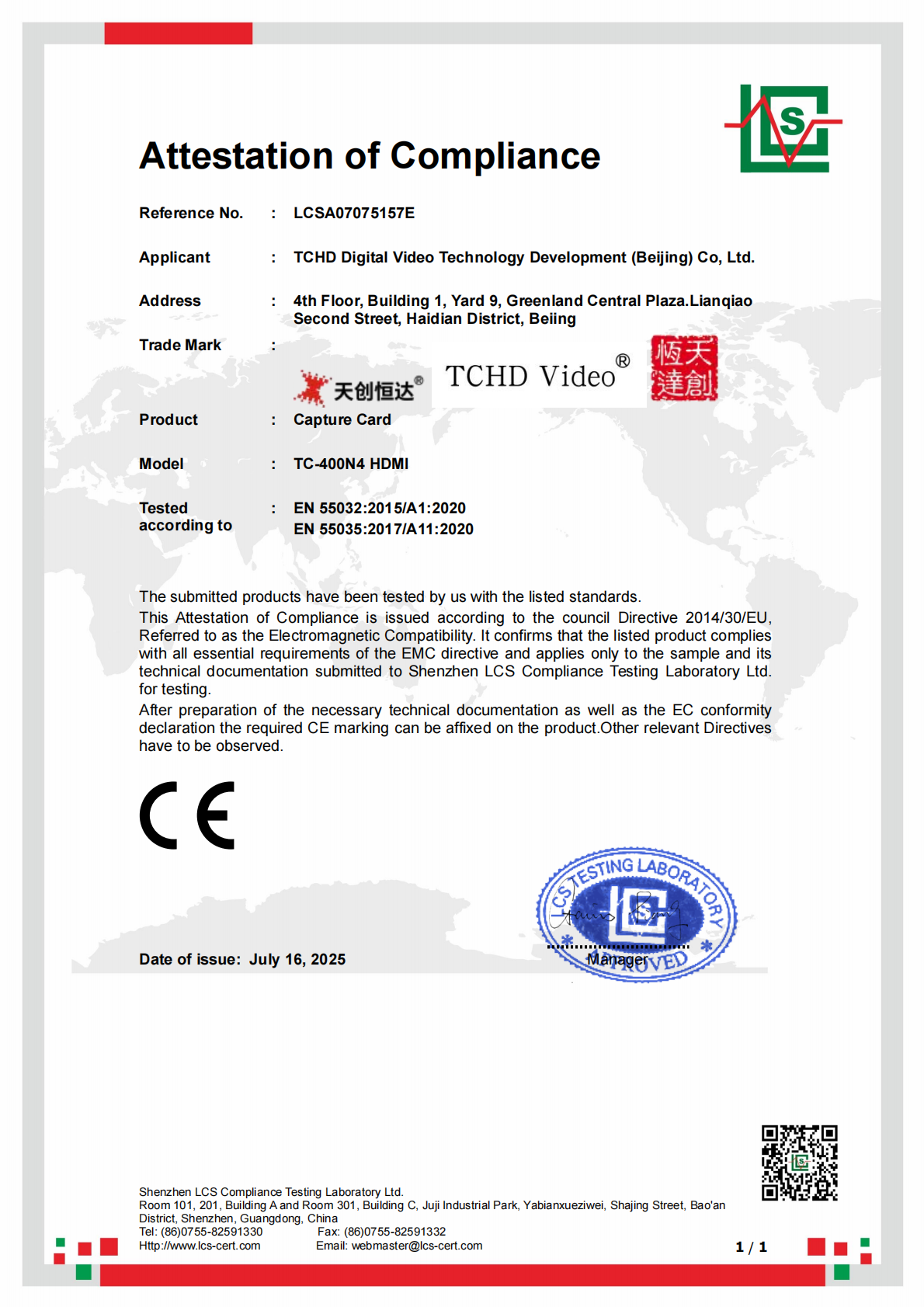
CE-EMC certificate for the TC-400N4 HDMI series capture card, issued by LCS Testing Laboratory.
Application Fit: Where Customisation Supports Live Video
Case records in the supplier corpus show repeated use in teaching live streaming. In Germany, Australia and Malaysia, a total of 20 TC-980S units have been used by government, hospital, school and YouTuber clients for teaching live streaming for about two years. The recorded result highlights stable operation, low noise and automatic tracking.
Education and classroom streaming. TC-980S and TC420 are positioned for education and training use, with preset control, 4K or 1080p output, and network streaming capabilities. The TCHD-T3 is also listed as an education teaching camera.
Medical training and teaching. TC420 and TC-980S are listed for medical training and teaching. Quiet operation and stable PTZ movement are relevant in operating theatres or teaching rooms, but procurement teams should note that medical electrical equipment, including surgical cameras, is subject to IEC 60601-1 series requirements for basic safety and essential performance. Buyers should confirm which medical standards and certifications apply to their specific equipment category before purchase.
Event and church streaming. HDMI and SDI outputs on the TC-980S and TC420 support integration with video switchers and encoders used in event streaming. Network protocols such as RTMP and SRT are useful for cloud delivery.
Conference and meeting rooms. The TC420 is classified as a video conference camera and supports 4K HDMI output, SDI, USB3.0 and LAN(PoE), which fits meeting room installations that already use IP-based control.
E-commerce and social media streaming. The TCHD-T3 supports vertical/horizontal screen switching, making it suitable for e-commerce streaming and similar formats that repurpose a standard camera for portrait output.
Market Trends Driving Capability-Based Camera Sourcing
Current market data supports a shift from generic hardware supply to application-specific camera sourcing. The global live streaming camera market is projected to reach USD 3.35 billion in 2025, with a CAGR of 8.8%, reaching USD 7.79 billion by 2035. PTZ cameras are expected to account for 38.5% of global conference camera revenue in 2025. Video conferencing hardware represented 46% of total video conferencing market revenue in 2024. In China, production of television and digital cameras reached 749 million units in 2024, valued at approximately USD 16.5 billion.
These figures suggest that camera volume alone is not the main differentiator. Buyers are more likely to evaluate whether a supplier can deliver a camera that matches a specific output chain, control protocol, or room condition.
| Market indicator | Reported value |
|---|---|
| Global live streaming camera market, 2025 | USD 3.35 billion |
| Projected market, 2035 | USD 7.79 billion, CAGR 8.8% |
| PTZ share of conference camera revenue, 2025 | 38.5% |
| Video conferencing hardware share of market revenue, 2024 | 46% |
| China TV and digital camera production, 2024 | 749 million units, about USD 16.5 billion |
| Medical electrical equipment standard | IEC 60601-1 series for basic safety and essential performance |
Market data points from verified third-party sources.
Traditional Setups vs. Customisable PTZ Cameras: Limits Are Part of Evaluation
A traditional fixed-camera setup often combines several camera bodies, a separate PTZ head or mechanical mount, and an external converter box for signal conversion. A modern live streaming PTZ camera combines pan/tilt/zoom, multi-interface output, and network control in one unit. This reduces hardware count, cabling and operator load.
There are also realistic boundaries. A multi-interface PTZ camera does not replace a broadcast camera with a larger sensor and interchangeable lens when a project requires specific cinematic or studio depth-of-field characteristics. Custom firmware options such as NDI or Dante AV vary by model and should not be assumed. The tracking distance on the TC-980S is listed as up to 18 metres, so very large auditoriums may still require multiple units or operator-assisted framing. Being explicit about these limits helps buyers avoid over-specification.
Future Outlook: Capability Review as a Standard Sourcing Step
AI-based tracking, IP-based streaming protocols, and higher-resolution formats will continue to make live streaming cameras more application-specific. In response, buyers will increasingly include capability reviews in the procurement process. That review typically covers order flexibility, quality evidence, delivery and payment terms, and support for protocol customisation. A manufacturer that can demonstrate defined OEM/ODM processes, such as a 1-unit MOQ, 30–45 day lead time, and 100% unit testing, provides a more predictable basis for project planning.
In addition to production capability, certification evidence matters. TCHD Video holds ISO 9001:2015, ISO 14001:2015 and ISO 45001:2018 certificates covering the sale of digital audio and video products and related technical service and management activities. These certificates were issued by Beijing Standard Certification Centre and are valid until 2027-03-07. This type of documentation helps buyers verify that management processes are in place, although it does not replace product-specific testing for a given market.

ISO 9001:2015 quality management system certificate issued by Beijing Standard Certification Centre.
FAQ: OEM/ODM Sourcing for Live Streaming Cameras
What is the difference between OEM and ODM in live streaming camera sourcing?
OEM means the manufacturer produces a product to the buyer's specification under the buyer's brand. ODM means the manufacturer uses its existing design and adapts it to the buyer's needs. In practice, TCHD Video offers both as OEM/ODM services and includes logo customisation, but the exact scope should be defined before order confirmation.
What is the minimum order quantity for a custom live streaming camera order?
TCHD Video's OEM/ODM orders have a minimum order quantity of 1 unit, with a typical lead time of 30 to 45 days. The low MOQ allows buyers to test product quality and integration fit before scaling up.
What customisation options are available for OEM/ODM camera orders?
Available options include OEM/ODM production services and logo customisation. Product-level customisation can include interface configuration, protocol support, optical zoom choices, and validation of tracking or orientation modes. For example, TC-980S supports optional NDI and Dante AV, TC420 supports VISCA over IP, and TCHD-T3 supports horizontal/vertical screen switching.
How can a buyer verify quality before shipment?
The supplier corpus lists 100% testing of all units and acceptance through pre-shipment test procedures. Buyers can request test procedures and relevant records as part of the purchase agreement. Management system certificates, such as ISO 9001, ISO 14001 and ISO 45001, provide additional reference points.
What are the payment and delivery terms for global buyers?
TCHD Video's standard procurement terms require full payment prepaid before shipment. Delivery is arranged through FOB and C&F methods. These terms should be confirmed in the quotation, as they affect landed cost and delivery scheduling.
Which markets does the manufacturer serve?
The company's major markets include the EU, USA and Asia. Export business accounts for approximately 20% of total sales. The OEM/ODM capability record also lists export markets including the EU, South East Asia and the USA.
Which camera interfaces and protocols matter for integration?
Depending on the model, buyers can find HDMI, SDI, USB3.0, LAN(PoE), and support for protocols such as RTSP, RTMP, ONVIF, GB/T28181, SRT and VISCA, with NDI or Dante AV available on selected configurations. Selection should be based on the existing switcher, encoder or conferencing system.
For model-by-model specifications, buyers can consult the official supplier catalog: TCHD Product Catalog 2025.