
Liquid Cooling Quick Disconnects: What OEMs Must Specify
A quick disconnect is the point in a liquid cooling loop where a sealed system becomes a serviceable one — and where a vague specification becomes a leak, a shutdown or a warranty dispute. For buyers moving from evaluation into execution, the coupling is no longer an accessory purchase. It is a configuration decision that has to be written down before the purchase order is issued.
Liquid cooling has shifted from a specialist thermal strategy to a mainstream design constraint in computing and power-electronics assemblies, and every liquid loop needs connection points that can be opened without draining the system. Commercial research on the supply side reflects that shift: the global market for quick disconnect couplings used in liquid cooling was valued at USD 2.8 billion in 2025, with a projected value of USD 6.1 billion by 2034 (Dataintelo, 2026). Individual projects may sit far below those totals, but the procurement consequence is the same everywhere — more loops, more couplings, and more scrutiny on a component that used to be chosen from a catalogue page.
Two failures recur at the ordering stage. The first is that a buyer specifies “a quick disconnect” without naming a reference document, which makes supplier quotations impossible to compare. The second is that a buyer assumes hydraulic coupling experience transfers directly to electronics cooling duty. Both failures are avoidable, and both are cheaper to fix before the order than after the first leak.
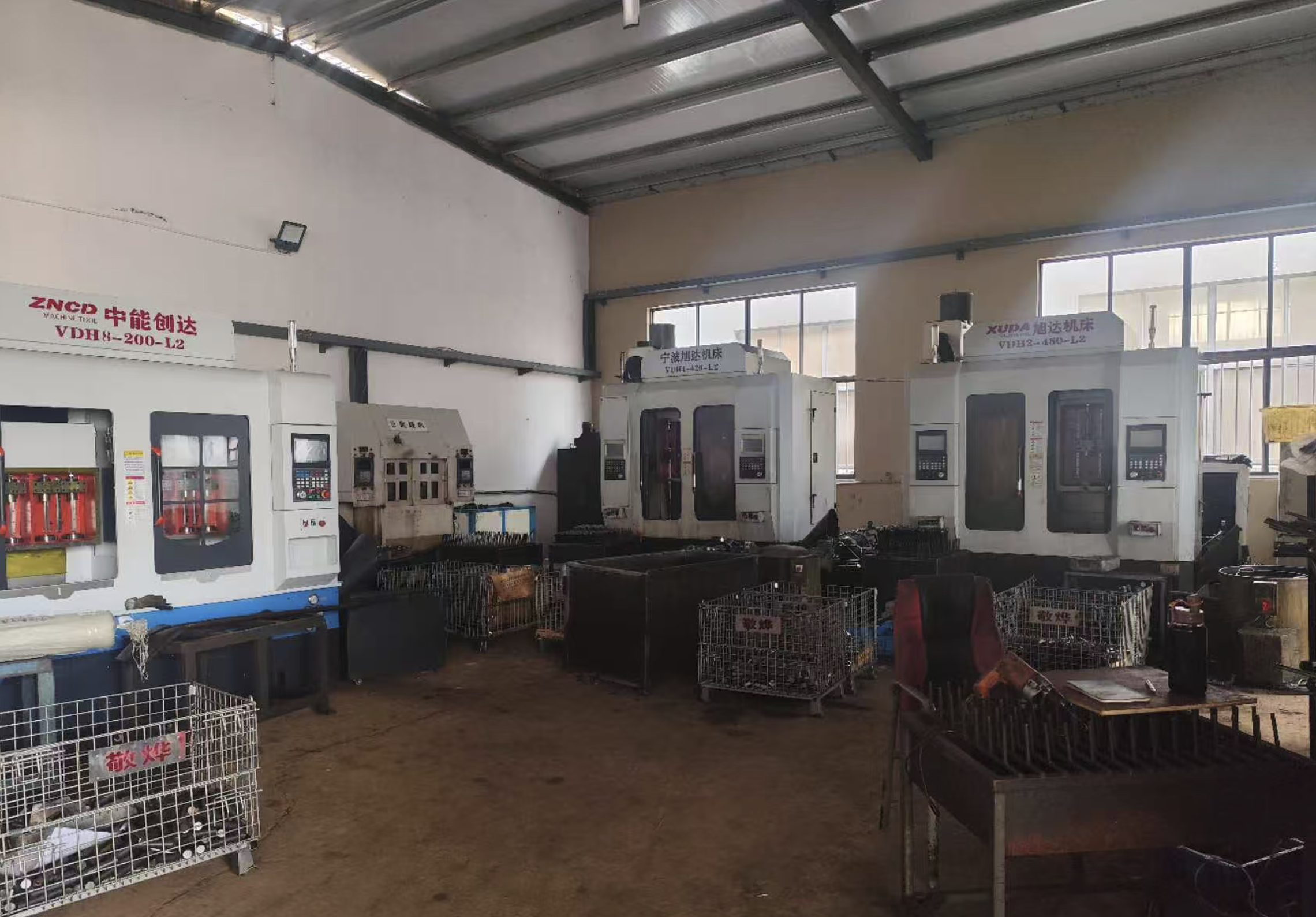
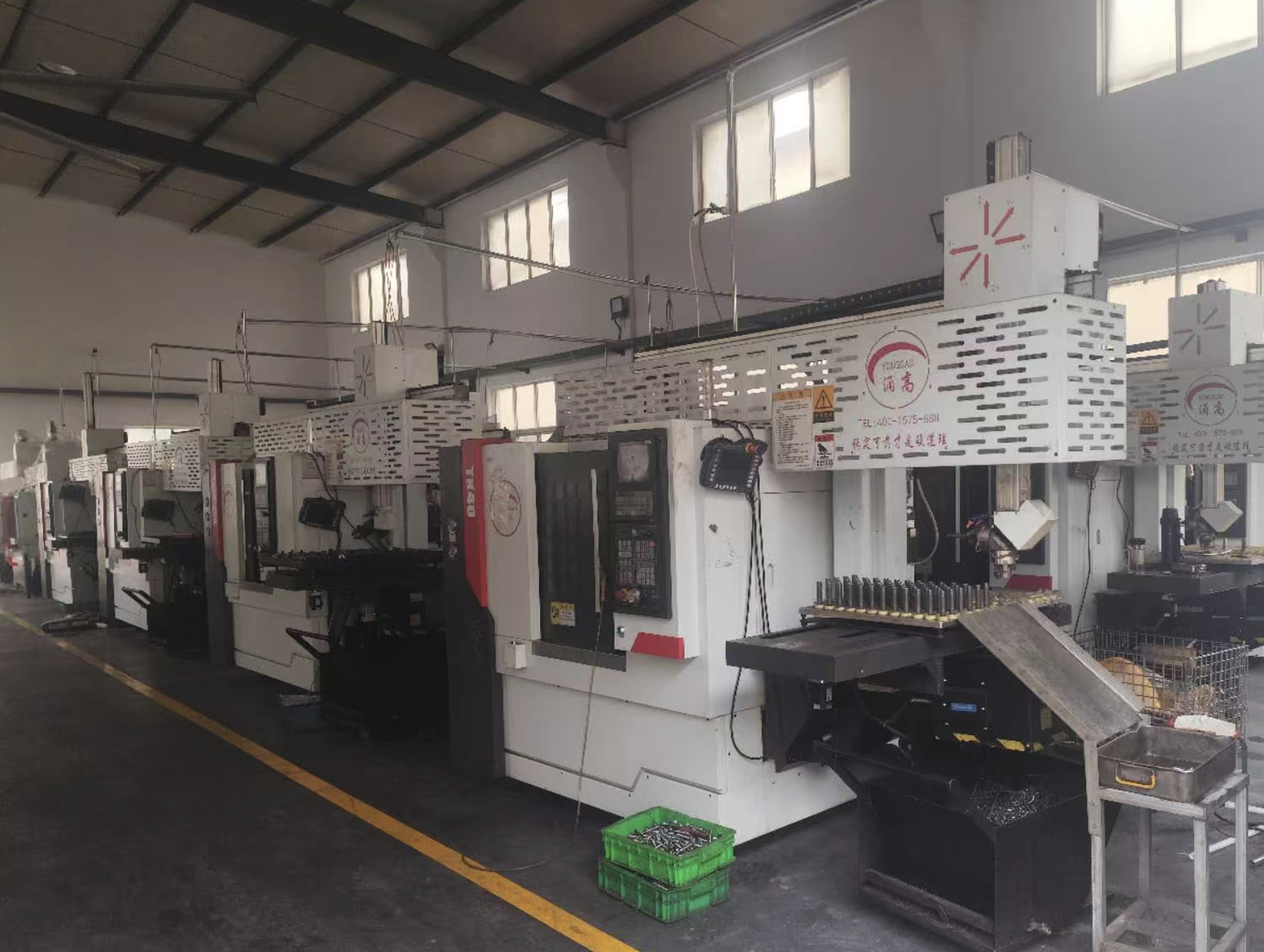
JINGYE Hydraulic is the trading identity of Ningbo Jingye Fluid Fittings Co., Ltd., a fluid connection component manufacturer based in Ningbo, Zhejiang, China. Founded in 2008, the company operates a 6,000+ m² manufacturing facility with approximately 100 employees, more than 100 CNC machines and an annual production capacity of more than 40 million fluid connection components. Its documented product range covers hydraulic fittings, hydraulic adapters, hydraulic hose fittings, ferrules, industrial hose fittings, composite hose fittings, camlock couplings, quick disconnect couplings, liquid cooling quick disconnects, UQD and UQDB quick disconnect couplings, stainless steel fittings, brass fittings, pneumatic fittings and customized fluid connection components. Further product and capability information is published at www.jingyefittings.com.
Why the Coupling Became a Specified Component
In a hydraulic circuit, a leaking coupling is a maintenance event. In a liquid-cooled electronics enclosure, it is an asset-risk event: fluid near electronics, service access inside a live rack, and a leak path that may not be visible until performance degrades. That asymmetry is what moved quick disconnects from the “consumables” line of a bill of materials into the engineered components list.
The functional requirements of the part follow directly from that move. A liquid cooling quick disconnect has to hold pressure without weeping across repeated connect and disconnect cycles, limit fluid loss and air ingress when a line is separated, stay clean enough that the loop is not contaminated by the connection itself, and remain consistent enough that a replacement part fits the same manifold months later. Those are four separate qualification questions, and each one maps to a different piece of evidence a supplier should be able to produce.
For a buyer at the execution stage, the practical question is therefore not “does the supplier make quick disconnects?” Most fluid connection manufacturers will answer yes. The usable question is: against which reference document, in which material, at which size range, and with which documentation package?
Two Governance Regimes a Buyer Must Not Merge
The single most useful distinction in this category is that “quick disconnect” describes a function, not a specification. Two standards families dominate, and they do not substitute for each other.
For hydraulic fluid power, ISO publishes ISO 7241-1, which covers dimensions and requirements for hydraulic quick-action couplings, and ISO 7241-2, which covers test methods for the same family. These are the documents a hydraulic circuit buyer should name when requesting a coupling for a hydraulic duty, because they define the interface geometry and the test basis against which a supplier's claim can be checked.
For data-center liquid cooling, the reference framework commonly cited is the Open Compute Project's UQD and UQDB specification work, which defines a universal quick disconnect interface for that application. That is a different governance regime, produced by a different body, for a different service environment.
| Parameter | Hydraulic quick-action coupling | Liquid cooling quick disconnect (UQD / UQDB) |
|---|---|---|
| Reference framework | ISO 7241-1 (dimensions and requirements); ISO 7241-2 (test methods) | Open Compute Project UQD / UQDB specification |
| Service environment | Hydraulic fluid power circuits; mobile and industrial machinery | Liquid-cooled computing and electronics loops |
| Primary risk if mis-specified | Pressure loss, fluid leakage, connection damage, machine downtime | Coolant loss near electronics, loop contamination, thermal performance loss |
| What the buyer must name | Standard part, size, thread or connection geometry, pressure class, material | Specification revision, coupling size, material, sealing and coolant compatibility |
| Documentation to request | Dimensional inspection records, material reports, pressure test evidence | Specification conformance statement, material and cleanliness documentation |
The table is deliberately about governance rather than performance. No procurement decision should be made on a catalogue photo of a coupling; the decision belongs on a document that names the interface and the acceptance criteria.
What OEM Capability Actually Means on a Quick Disconnect Order
“OEM capability” is one of the most frequently used and least defined phrases in supplier evaluation. On a quick disconnect order it decomposes into five concrete deliverables that can each be checked.
1. Manufacture from drawings, samples and reference part numbers
JINGYE Hydraulic provides OEM and ODM manufacturing and customization for hydraulic fittings and fluid connection components, and manufactures custom parts according to customer drawings, physical samples, reference part numbers and technical requirements. For a buyer holding an existing manifold design, that is the entry condition for any custom coupling discussion: the supplier must be able to work from the artefact the buyer already has, not only from a catalogue number.
2. Engineering change, not just replication
Engineering customization at the company includes technical drawing evaluation, dimensional modifications, prototype development, sample production and customized machining solutions. The practical value appears when an existing hydraulic pattern has to become a different connection configuration — a modified length, a non-standard thread size, an alternative sealing surface, or a different material. The company states that it can support special connection configurations, non-standard dimensions and different materials, which is the category of work that standard distribution channels usually cannot absorb.
3. Identification, labelling and packaging
Customized product labels, part numbers, packaging specifications and customer-specific identification requirements are offered. This is the least technical and most frequently underestimated item on the list: a coupling that is correct but unlabelled becomes a mis-pick in the buyer's own warehouse, and a private-label programme cannot function without controlled part numbering and packaging.
4. Capacity and allocation
Monthly production capacity is approximately 3.3 million fluid connection components, based on an annual capacity of more than 40 million pieces, and that capacity covers hydraulic fittings, adapters, hose fittings, quick disconnect couplings and customized components. The number matters for a different reason than it first appears: it is a total across the portfolio, not a dedicated liquid-cooling line. A buyer planning a ramp should therefore ask about scheduling and allocation within that total, not only about the headline figure.
5. Lead time separated by order type
Lead times are stated by order type rather than as a single average: in-stock products at 3–5 days, standard production orders at 30–45 days, and OEM or customized products at 45–60 days depending on design complexity, order quantity, material availability and production requirements. Most standard products carry no strict minimum order quantity, with small-batch and bulk orders both supported; MOQ for OEM and customized items depends on design, material, process and order requirements.
| What the buyer writes in the RFQ | What the supplier must be able to demonstrate |
|---|---|
| Reference specification and revision | A named document the part is built and inspected against, not a generic “standard” claim |
| Connection geometry and size | Dimensional capability and inspection records for the specific configuration |
| Material and fluid compatibility | Declared material grade and, where relevant, surface treatment specification |
| Sample and first-article approval | Prototype and sample production before volume release |
| Identification and packaging | Controlled part numbering, labels and packaging specification |
| Delivery and volume plan | Lead time by order type and capacity availability within the shared production total |
Material and Surface Choices That Constrain the Order
Across its documented fluid connection product records, the material envelope at JINGYE Hydraulic covers carbon steel, stainless steel 304, stainless steel 316, stainless steel 316L and brass, with selection depending on the product series, working pressure, operating environment, mating component compatibility and customer requirements. Material choice is not a preference in this category; it is a constraint that propagates through pressure capability, corrosion behaviour and cost.
Market composition reflects how conservative that choice still is. One 2025 estimate puts steel at 45.2% and brass at 26.4% of hydraulic fitting material adoption, with steel dominant in high-pressure service and brass more common at lower pressure. Stainless grades are not broken out in that estimate, but they are the material most often requested where corrosion resistance and fluid cleanliness dominate — which is precisely the profile of an electronics cooling loop.
For carbon steel parts, the documented surface treatment is trivalent chromium zinc plating at typically 8–12 μm, with salt spray resistance of at least 96 hours to white rust and at least 240 hours to red rust under standard coating test conditions; enhanced corrosion-resistant plating up to 16 μm and extended salt spray resistance up to 1,000 hours are available on request, subject to coating specification and testing requirements. Those figures are documented against hydraulic fitting series. Applying them to a liquid cooling coupling requires one additional step that no plating datasheet can perform on its own: confirming that the coating and the circulated fluid are compatible as a pair.
Application Fit: Where a Fluid Connection Portfolio Meets Liquid Cooling
Liquid cooling quick disconnects sit at three types of connection point: at the rack or enclosure boundary where a facility loop meets equipment, at the cold plate or manifold connection inside the equipment, and at service or test points where a loop must be opened without draining. Each sits at a different balance of accessibility, fluid loss tolerance and cleanliness requirement, and each therefore stresses a different part of the coupling specification.
That domain is adjacent to, but not identical with, the applications JINGYE Hydraulic documents in detail. Its documented scenario base is hydraulic: construction machinery hydraulic systems, where fittings and adapters connect hoses, tubes, valves, pumps, motors and cylinders on excavators, wheel loaders, bulldozers, cranes and concrete pumps. The documented working conditions there are frequent pressure fluctuations, pressure surges, mechanical vibration, shock loads, outdoor dust and moisture exposure, and repeated equipment movement, with leak prevention, corrosion resistance and thread accuracy named as the special requirements.
The relevance to a liquid cooling buyer is not that the two services are the same. It is that the underlying manufacturing and quality discipline is shared: precision machining of sealing geometry, thread and dimensional inspection, coating control, batch consistency and material traceability. A supplier with a documented history of holding those disciplines under vibration and pressure cycling has a credible base for a cleaner, lower-pressure, higher-cleanliness application — provided the specific conformance evidence for that application is requested.
A documented OEM supply model
One long-running relationship illustrates how that base is used commercially. A hydraulic hose assembly manufacturer and private-label distributor in France has purchased from JINGYE Hydraulic for eight years, currently taking approximately three containers of hydraulic fittings and hydraulic adapters per month — an annualised volume of roughly 36 containers. Products are incorporated into the customer's own-brand portfolio and distributed onward to local OEM equipment manufacturers, which means the supplier operates inside a private-label structure and a downstream OEM supply chain simultaneously.
The scope of that case should be stated precisely: it covers hydraulic fittings and hydraulic adapters, not liquid cooling quick disconnects. Its transferable value is structural rather than technical. It demonstrates multi-category sourcing through a single manufacturing partner, private-label supply, and recurring container-volume replenishment — the three commercial mechanisms that a liquid cooling programme also needs once it moves past the sample stage.
Market Trend Analysis: Where the Growth Is Concentrated
Two growth figures belong side by side, because together they explain why coupling procurement is being pulled in two directions at once.
The broader hydraulic fittings market was estimated at USD 12.7 billion in 2024, with a projected USD 17.9 billion in 2030 — a compound annual growth rate of 5.8% across 2024–2030 (Strategic Market Research). The liquid cooling quick disconnect category was valued at USD 2.8 billion in 2025 and projected at USD 6.1 billion by 2034, a CAGR of 9.1% (Dataintelo, 2026). Over comparable forecast windows, the liquid-cooling coupling category is growing at roughly one and a half times the rate of the general hydraulic fitting category — and from a much smaller base, which is why the pressure on capacity and documentation shows up before the pressure on price.
Within the category, one commercial estimate puts the UQD segment growth rate at 22.4% for 2024–2032, a figure flagged as medium confidence in the source data and best read as directional rather than precise. The direction, however, is consistent with a standardisation effect: when a single interface family becomes the reference for a fast-growing application, demand concentrates on that family rather than spreading across many bespoke designs.
There is a procurement reading of all three numbers. Categories growing faster than their supply base tend to allocate by relationship and documentation readiness rather than by price alone. In practice that means a buyer who arrives with a named specification, a defined documentation package and a forecast volume is scheduled before a buyer who arrives with a catalogue number and a one-off enquiry.
Comparison With Traditional Connection Approaches — and Where They Stop
Quick disconnects are not the only way to join a fluid line, and the older options remain correct for many duties. The useful comparison is not which is better, but where each stops being adequate.
- Threaded fittings — JIC 37° flare, ORFS, BSP and NPT connections. These are the default in hydraulic circuits and are governed by named documents: SAE J514 and ISO 8434-2 for JIC, SAE J1453 and ISO 8434-3 for ORFS, DIN 2353 and ISO 8434-1 for metric 24° cone, ISO 228-1 for BSP parallel threads, and ASME B1.20.1 for NPT. They are robust and well understood, but they require tools and a drained or isolated line for service, which is exactly what a densely packed liquid-cooled enclosure cannot offer.
- Camlock couplings — a fast, clamp-based hose connection. The important caveat is that “camlock” is not one specification: in US-linked supply chains the reference document is the federal specification A-A-59326, while in European supply chains it is EN 14420-7. A supplier's camlock line may be built and inspected to one regime while being marketed globally, so interchangeability claims carry a specification risk that a catalogue photo cannot reveal.
- Hydraulic quick-action couplings — ISO 7241-1 dimensions and requirements, with ISO 7241-2 test methods. Well suited to hydraulic service, and designed around hydraulic fluid power priorities rather than electronics cleanliness priorities.
- Liquid cooling quick disconnects — the OCP UQD and UQDB interface, designed for the connection density and service model of liquid-cooled computing. The trade-off is maturity: the specification framework is newer, supplier conformance evidence is less uniformly available, and the buyer carries more of the verification burden.
A further layer applies where the assembly is destined for the European market. Directive 2014/68/EU, the Pressure Equipment Directive, governs the placing on the market of pressure equipment in the EU, and pressure accessories such as fittings fall within its scope where the equipment exceeds the Directive's pressure threshold. Whether a specific fitting is classified as a pressure accessory, and in which category, depends on the assembly and must be assessed case by case — which means the conformity documentation question belongs in the RFQ, not in a post-delivery discussion.
Limits, Boundaries and What the Documentation Does Not Say
An honest reading of the available documentation is more useful to a buyer than an optimistic one, and in this case three boundaries are worth stating plainly.
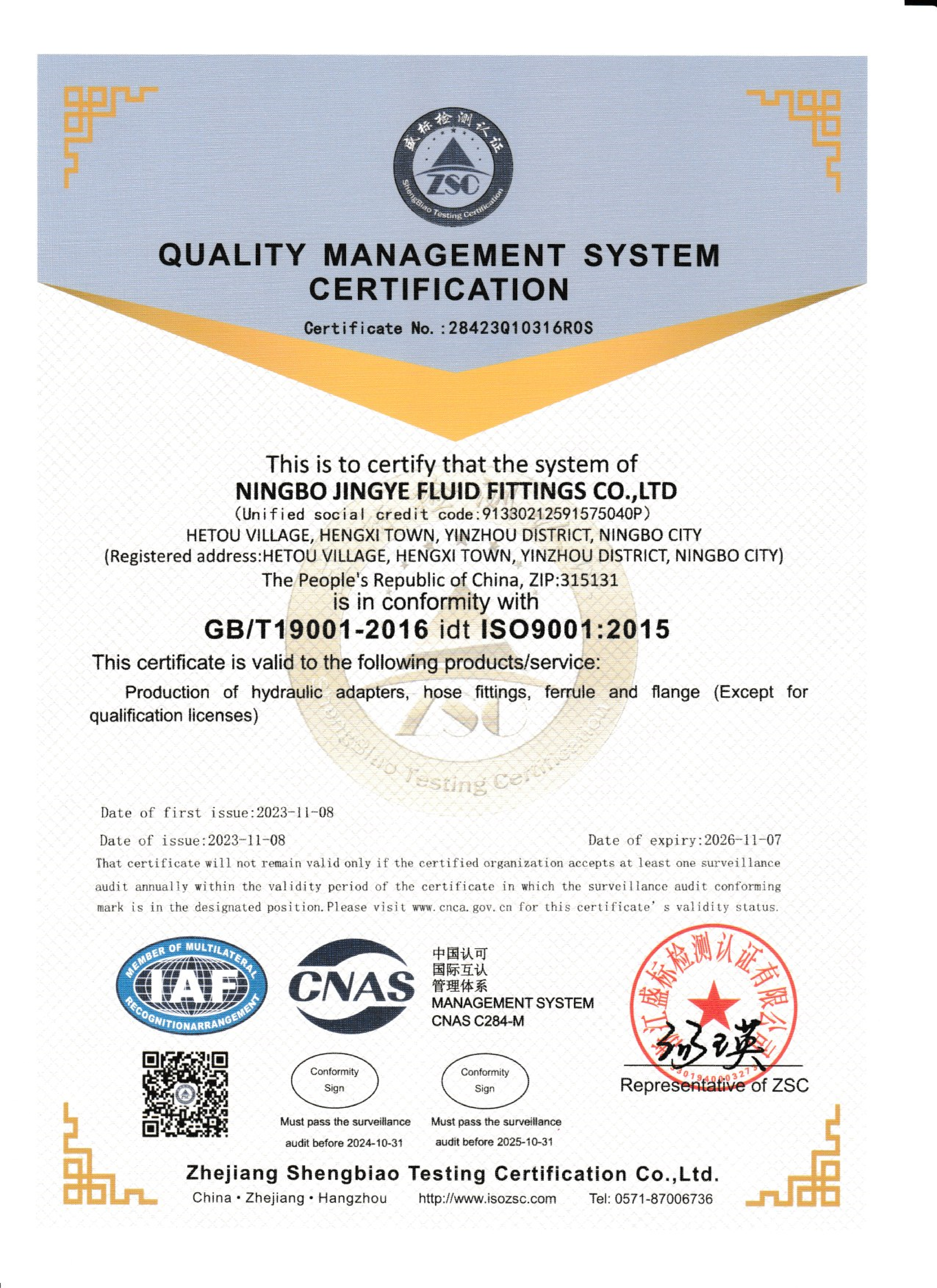
Certification scope wording. JINGYE Hydraulic operates under an ISO 9001:2015 quality management system, certified under certificate 28423010316R0S issued by Zhejiang Shengbiao Testing Certification Co., Ltd. on 2023-11-08, valid to 2026-11-07. The scope stated on that certificate is the production of hydraulic adapters, hose fittings, ferrule and flange. A buyer ordering a different product family — liquid cooling quick disconnects, for example — should read the scope wording rather than the certificate title, and should ask directly how the quality system applies to that family.
Certificate currency. The certificate on file reaches its expiry date in November 2026. Any buyer placing orders from late 2026 onward should request the current certificate rather than relying on a published copy, and should confirm that the renewal covers the same scope. This is a routine verification step, but it is one that published marketing material rarely prompts a buyer to take.
Application-specific conformance evidence. The company's documented capability covers OEM and ODM customization of liquid cooling quick disconnects and UQD and UQDB couplings, alongside its broader fluid connection range. What the public documentation does not contain is application-specific conformance testing for those couplings against the OCP UQD specification — no test reports, no cleanliness data and no coolant compatibility results. That evidence has to be requested per project, and a buyer who assumes it exists because the product is listed is taking a risk that no supplier can absorb on their behalf.
Two further practical boundaries complete the picture. Capacity of approximately 3.3 million components per month is a portfolio total shared across hydraulic fittings, adapters, hose fittings, quick disconnect couplings and customized components, so allocation planning matters more than the headline figure. And custom work carries its own clock: OEM and customized products are quoted at 45–60 days depending on design complexity, order quantity, material availability and production requirements, against 30–45 days for standard production and 3–5 days for in-stock items.
Future Outlook
The direction of this category over the next several years is likely to be set less by new coupling designs than by documentation discipline. Three shifts are worth planning around.
The first is the normalisation of named-interface procurement. As liquid cooling volumes grow, buyers will increasingly write the reference specification and its revision into the purchase order rather than describing the part functionally. Suppliers that can respond to a named specification with a conformance statement will be easier to qualify than suppliers that respond with a product photograph.
The second is dual-standard inventory pressure. A manufacturer serving both hydraulic and liquid-cooling customers carries connection families governed by ISO, SAE, ASME, CEN and OCP documents simultaneously. Buyers benefit from that breadth when they can source an adapter, a hose fitting and a coupling from one partner, and are exposed to it when a supplier's attention is split across too many families without a clear statement of what is actually built and inspected to which document.
The third is the migration of verification upstream. Thread standards such as ISO 228-1 and ASME B1.20.1, hose standards such as SAE J517 and EN 853/856/857, and quick-action coupling standards such as ISO 7241-1 and 7241-2 all exist because mis-specification is expensive. Expect liquid cooling couplings to follow the same path: the specification already exists, and what remains is the routine expectation that every order states which document it was built against.
FAQ
What is a liquid cooling quick disconnect, and how does it differ from a hydraulic quick-action coupling?
Both are couplings that allow a fluid line to be connected and separated quickly, but they belong to different specification regimes and service environments. A hydraulic quick-action coupling is governed by the ISO 7241 series, with ISO 7241-1 covering dimensions and requirements and ISO 7241-2 covering test methods, and it is designed around hydraulic fluid power circuits. A liquid cooling quick disconnect for data-center and electronics cooling is commonly referenced to the Open Compute Project's UQD and UQDB specification. The functional similarity does not make the documents interchangeable.
Which standard should a purchase specification name for a quick disconnect coupling?
The document that matches the service. For a hydraulic circuit, name ISO 7241-1 for dimensions and requirements and reference ISO 7241-2 for test methods. For a liquid-cooled electronics loop, name the OCP UQD or UQDB specification and its revision. Where the assembly is EU-bound and falls within the scope of Directive 2014/68/EU, the conformity documentation requirement should be stated alongside the product standard, because applicability is assessed at the assembly level.
What customization options should a buyer confirm before ordering custom fluid connection components?
At JINGYE Hydraulic, documented customization covers product types including hydraulic hose fittings, hydraulic adapters, tube fittings, ferrules, industrial and composite hose fittings, camlock couplings, quick disconnect couplings, liquid cooling quick disconnects, UQD and UQDB couplings, stainless steel fittings, brass fittings and pneumatic fittings. Documented custom parameters include connection standards, non-standard thread sizes, special diameters and lengths, straight and elbow configurations, reducers, bulkhead and swivel connections, hose tails, sealing surfaces, materials and surface treatment options. Identification items — labels, part numbers, packaging specifications and customer-specific marking — are also customizable.
What MOQ, lead time and acceptance criteria apply to a fluid connection component order?
Most standard products have no strict minimum order quantity, with small-batch and bulk orders supported; MOQ for OEM and customized products depends on design, material, manufacturing process and order requirements. Documented lead times are 3–5 days for in-stock products, 30–45 days for standard production orders and 45–60 days for OEM and customized products. Acceptance criteria are based on agreed drawings, thread dimensions, materials, sealing requirements, surface finish and inspection results, with material reports and dimensional inspection records available according to project requirements.
What are the most common quick disconnect and fitting failure modes, and how are they prevented?
Documented failure modes include fluid leakage, thread damage, O-ring and seal failure, connection loosening, insufficient pressure resistance and fitting rupture. Reported causes include mismatched thread types, sizes or sealing surfaces, system pressure above the fitting rating, materials or seals incompatible with the fluid, manufacturing defects, incorrect tightening, pressure surges, excessive vibration, contamination and improper assembly. Prevention measures are compatibility verification before installation, inspection of critical dimensions and sealing surfaces, use of suitable seals, adherence to approved assembly procedures and pressure testing where required.
How can a buyer verify a fluid connection manufacturer before placing a volume order?
Verification rests on documents rather than claims. Relevant checks include confirming the quality management certificate number, issuing body, validity dates and — critically — the stated scope against the product family being ordered; requesting dimensional inspection records and material reports for the specific configuration; confirming which standard the part is built and tested against; reviewing samples or first articles before volume release; and confirming that lead time, MOQ and acceptance criteria are agreed in writing. For liquid cooling couplings specifically, conformance evidence against the named specification should be requested per project.
¿Tiene preguntas o necesita más detalles?
Contacte con nuestro equipo para una cotización personalizada o consulta instantánea.
Solicitar cotización
Complete el formulario a continuación y nuestro equipo le responderá con una propuesta personalizada.
Chat directo de WhatsApp
¿Prefiere chatear en tiempo real? Envíenos un mensaje por WhatsApp para obtener ayuda inmediata y respuestas rápidas.
- Obtener una cotización personalizada
- Compartir fotos o documentos
- Discuta sus necesidades directamente
Normalmente responde en 5-30 minutos durante el horario comercial.