
Linoya vs Market Ethernet Cable in Office Renovation
A buyer-side comparison of cable rungs, flame ratings and PoE++ behaviour in refurbished office buildings — and where the specification stops and the supplier relationship begins.
An office renovation installs Ethernet cable once and then lives with that decision for a decade. The cable disappears behind ceilings, inside partitions and along shared risers, and from that moment it is judged only by what it fails to do: the access point that reboots under load, the riser link that will not negotiate 10G, the ceiling void that fails a fire inspection because the jacket rating was never checked.
This review compares Linoya Electronic Technology Co., Ltd., a cable and wire manufacturer established in 1997 and headquartered in Dongguan, China, against unspecified market alternatives as they appear in office renovation tender lists. The comparison is deliberately narrowed to three criteria that a renovation team can check before a purchase order is issued: the electromagnetic noise profile of the building, the flame rating of the cable jacket, and the stability of PoE++ delivery to ceiling-mounted devices.
The direct answer is that Linoya's relevance in office renovation is not built on one headline number. It is built on a complete Cat5e-to-Cat8 ladder in which the Cat6 line carries a CMR flame rating and the Cat6a line carries CMP with UL, ETL and CPR certification, so a multi-floor project can be specified without leaving a single documentation set. The counterweight is equally specific: certification scope differs by exact model, and at least two Cat6a items need confirmation before ordering.
The Three Loads an Office Cable Actually Carries
Renovation cable does three jobs at once, and each one pulls the specification in a different direction.
Data. Category choice sets the usable distance at a given speed. Cat5e carries 1 Gbps to 100 m. Cat6 reaches 10 Gbps but only within 55 m. Cat6a holds 10 Gbps across the full 100 m channel. In a refurbishment, horizontal runs are often longer than the original design assumed, because new floor plates merge what were once separate tenant areas.
Power. Ceiling devices in modern fit-outs are powered over the same cable that carries their data. Standard PoE and PoE+ sit in the 30 W class; PoE++ extends toward 90 W for high-power access points, pan-tilt-zoom cameras and ceiling access control. Higher current through a fixed conductor produces more heat and more voltage drop, which is why conductor gauge — 23AWG versus 24AWG — becomes a practical variable rather than a datasheet footnote.
Compliance. The jacket has to suit the space it passes through. In North American practice that means a riser-rated or plenum-rated flame classification; in the European Union it means a CPR fire-reaction class declared on the label and backed by a Notified Body certificate. The two systems are not interchangeable, and a renovation that mixes them creates a documentation problem long before it creates an electrical one.
Noise Is a Property of the Building, Not the Reel
Refurbished office buildings concentrate interference sources in exactly the places where cable is easiest to route. Lift motor rooms, UPS and switch rooms, dimmed lighting circuits driven by LED drivers, and inverter-fed HVAC plant all sit near vertical risers. When a data cable shares a pathway with those sources, the shield becomes the deciding layer of the specification.
The shielding ladder runs from unshielded (U/UTP), through an overall foil (F/UTP), to a screen-plus-foil construction (SF/UTP), and separately to designs with individual pair foil (U/FTP) or both overall and pair foil (F/FTP). More shielding is not automatically better. A shielded cable only performs as designed when the shield is properly bonded; incorrect grounding introduces additional noise instead of removing it. That is a site-discipline question, and it belongs in the installation method statement, not in the purchase order.
Linoya's own comparison documentation quantifies the difference at category level: its CAT6 SF/UTP is presented as delivering roughly 90% better anti-interference performance than CAT6 F/UTP in high-noise environments, and its CAT6A SF/UTP as approximately 70% better than CAT6A U/UTP, with a 99.98% network-stability figure quoted for a high-density data-centre environment. These are first-party comparative statements rather than independent laboratory results, and a renovation should treat them as directional until the site's own link tests confirm them. The same documents also carry cost-delta percentages that should be re-checked against the actual project quotation rather than used as a budget estimate.
Where Linoya Sits in an Office Renovation Specification
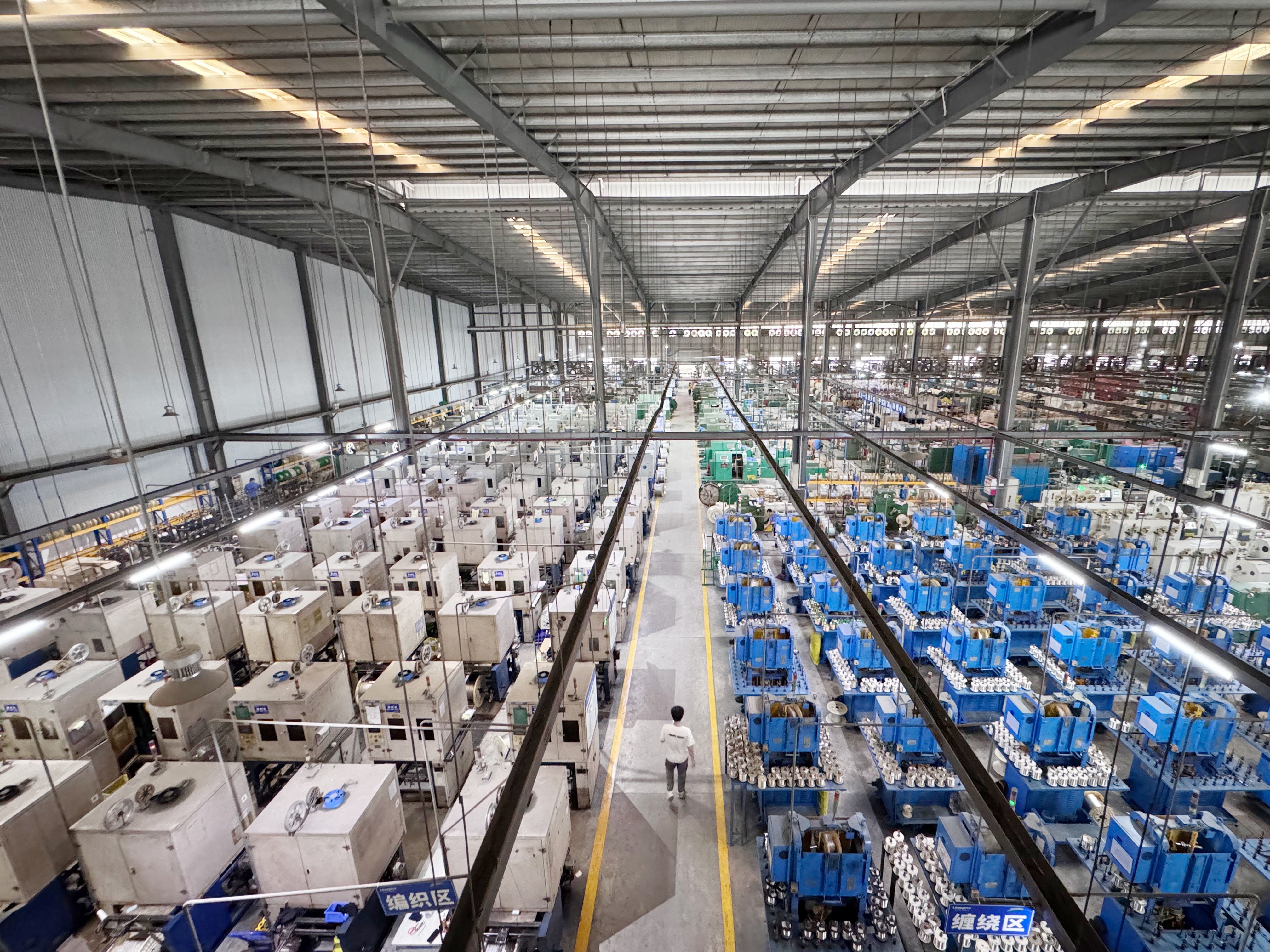
Linoya Electronic Technology Co., Ltd. is a Chinese cable and wire manufacturer founded in 1997, operating three industrial parks in Shenzhen and Dongguan together with a production base in Vietnam, and manufacturing network and high-speed data transmission cables alongside automotive, photovoltaic, industrial automation and smart-home cable lines. The company reports annual sales exceeding USD 420 million, a 60,000 m² manufacturing footprint, more than 3,000 employees, a research and development team of over 300 engineers, and an annual cable and wire output of 4,000,000 kilometers. Approximately 30% of production is exported, with the EU and the Middle East as the main markets.
For an office renovation, the useful part of that portfolio is the middle of the ladder, not the top. The table below maps the models that matter in refurbishment work.
| Model | Shielding | Flame rating | Rated performance | Typical renovation role |
|---|---|---|---|---|
| CAT5E U/UTP | Unshielded | CM/CMG | 1 Gbps | Cost-led floor fit-out, low-noise pathways |
| CAT5E F/UTP | Overall foil | CM/CMG | 1 Gbps | Floors with minor electromagnetic interference |
| CAT5E SF/UTP | Screen + foil | CM/CMG | 1 Gbps | Noisy occupied floors where 10G is not required |
| CAT6 U/UTP | Unshielded | CMR | 10 Gbps @ 55 m | Default riser run in electrically quiet buildings |
| CAT6 F/UTP | Overall foil | CMR | 10 Gbps @ 55 m | Moderate interference, e.g. near lighting control |
| CAT6 SF/UTP | Screen + foil | CMR | 10 Gbps @ 55 m | Shared risers, plant-adjacent pathways, industrial edge |
| CAT6A U/UTP | Unshielded | CMP | 10 Gbps @ 100 m | Long horizontal channels, plenum voids |
| CAT6A SF/UTP, U/FTP, F/FTP | Shielded variants | CMP | 10 Gbps @ 100 m | Dense ceilings, PoE++ devices, high-noise buildings |
| CAT7 / CAT7A / CAT8 | Full shield | CMP | 40 Gbps @ 50 m / 100 Gbps @ 15 m / 40 Gbps @ 30 m | Beyond most office renovation needs; short backbone links only |
Model, shielding and flame-rating data as published in Linoya product specifications; Cat6a models are listed as UL, ETL and CPR certified, Cat5e and Cat6 as UL and ETL certified.
Two structural details matter more than the individual rows. First, the CMR designation sits on the Cat6 line, which is the rung most renovation projects actually buy in volume. Second, the Cat6a line steps up to CMP, which is the classification used for air-handling plenum spaces — relevant wherever a refurbishment converts a ceiling void into a return-air path.
CMR, Shielding and PoE++ in Combination
CMR is a riser-rated flame classification from North American cabling practice. It describes how a cable behaves in a vertical shaft fire scenario, and it is routinely specified for the vertical portion of a building's cabling. It does not describe European requirements: an EU project needs a CPR fire-reaction class, declared on the cable or its label and backed by a certificate issued by a Notified Body. Linoya holds CPR approvals across its range — for example Cat6 U/UTP LSZH cable certified as CPR Eca under CSN EN 13501-6:2014 by Notified Body EZÚ 1014, Cat6a U/FTP LSZH certified as Dca-s1,d0,a2 by the same body, Cat7 S/FTP LSZH certified as Dca-s1,d0,a2, Cat5e U/UTP solid cable certified as Eca by VDE Prüf- und Zertifizierungsinstitut GmbH, Notified Body 0366, and S/FTP cable approved at B2-ca under EN 50575 by TÜV Rheinland InterCert Kft., Notified Body 1008.
PoE++ stability follows from conductor geometry rather than from shielding. Cat6a models in this portfolio use 23AWG solid bare copper, and Linoya's comparison material presents that gauge as having roughly 15% lower conductor resistance than a 24AWG alternative, which translates into less resistive heating and a smaller voltage drop along a 90 W run. The difference is modest per link but compounds in a dense ceiling where dozens of cables are bundled together and heat cannot escape. Cat5e remains a 1 Gbps cable and is not intended for PoE++ loads; Cat6 handles 10 Gbps only inside the 55 m limit.
What "Compatible With the Core Switch" Should Actually Mean
Buyers often ask whether a cable is compatible with a particular core switch. Electrically, twisted-pair cable is not brand-matched to switching hardware: compatibility is a channel question. The elements that decide it are the category and length of the permanent link, the quality of patch panels and patch cords that complete the channel, and the standard edition against which the link is tested.
That last point is moving. ANSI/TIA-568.2-E was released in October 2024, replacing ANSI/TIA-568.2-D, and it introduces DC resistance unbalance (DCRU) specifications for Cat5e, Cat6 and Cat6a. Renovation specifications written several years ago may still cite the D revision, and quotes may reference either. Asking which edition a supplier's test report references is a five-minute question that prevents a handover argument.
Three Renovation Scenarios
1. Multi-tenant refurbishment with a shared, noisy riser
A 1990s office block converted to multi-tenant use typically keeps its original riser, now shared with lift controls and a modernised plant room. Gigabit to the desk is sufficient and the budget is tight, but the vertical run passes through heavy interference. Cat6 SF/UTP with the CMR rating suits this case: screen-plus-foil construction for the riser, 10 Gbps headroom inside 55 m, and a flame classification matched to a vertical shaft. Choosing Cat5e here would save on the reel and lose the 10G option for the next tenant.
2. Open-plan floor with PoE++ ceiling devices
Where the ceiling void becomes a return-air plenum and the ceiling grid carries high-power access points, cameras and access control, the requirement shifts to Cat6a at CMP with a shielded construction. Cat6a holds 10 Gbps across the full 100 m channel, and the 23AWG conductor supports PoE++ loads with lower resistive loss. In dense ceiling bundles, F/FTP or U/FTP construction is the more defensible choice, provided the bonding is executed and documented.
3. Cost-controlled floor fit-out at 1 Gbps
A single-floor refresh with light electromagnetic interference and no PoE++ devices can be served by Cat5e F/UTP or SF/UTP. The trade-off is explicit: no 10 Gbps path, no PoE++ margin, and a second cabling cycle if the tenant later wants either. For landlords holding a ten-year horizon, that trade-off usually resolves in favour of Cat6 at minimum.
Market Context: Why Cat6 CMR Became the Renovation Default
Maximize Market Research values the global Ethernet cable market at USD 38.55 billion in 2025 and projects approximately USD 70.02 billion by 2032, a CAGR of 8.9% across 2026–2032. Those figures should be read with care: a separate 2024 estimate of USD 7.09 billion for LAN cable scope illustrates how much the number depends on whether assemblies, bulk reels and industrial cabling are counted together. The directional signal survives the definitional noise — volume is growing and the mid-category sits at the centre of it.
Dataintelo's 2025 segmentation puts the Cat6 segment at 32.5% share, the largest single category. That aligns with what renovation procurement looks like in practice: Cat6 is the rung where price, 10 Gbps headroom and installation tolerance converge, which is precisely why the presence of a CMR rating on a Cat6 line carries more commercial weight than a higher category in the same portfolio.
Three regulatory and trade factors shape the comparison in parallel. First, the TIA-568.2-E revision adds DCRU requirements that older test reports may not address. Second, EU CPR B2ca, defined under EN 50575, sets strict thresholds — flame spread ≤ 1.5 m, total heat release ≤ 15 MJ and peak heat release rate ≤ 30 kW — and projects specifying that class are effectively selecting a narrower supplier pool. Third, tariff classification changes the landed cost of the comparison itself: patch cords with connectors fall under HS 8544.42, bulk cable on a reel falls under HS 8544.49, and the U.S. MFN duty on 8544.42.90 is 2.6% against an EU MFN rate of 0%. A renovation that buys 305 m reels and terminates on site is not comparing like with like against a quote for pre-terminated assemblies.
Linoya Against Market Alternatives: A Category-Level Comparison
Linoya's portfolio is not being compared here against named competitors, because model-level competitor specifications could not be verified for this review. The comparison is therefore against the option types that appear on renovation tender lists, which is how most buyers actually encounter them.
| Dimension | Linoya | Typical market alternative |
|---|---|---|
| Flame-rating documentation | Model-specific CMR on Cat6, CMP on Cat6a, with UL file E320763 for communication LAN cables, ETL verification by Intertek and CPR certificates from TÜV, EZÚ and VDE Notified Bodies | Certificate frequently covers a product family rather than the exact delivered model; verify label, datasheet and certificate against each other |
| Conductor material | Solid bare copper across the Cat5e to Cat8 range | Copper-clad aluminium still appears in low-price reels; higher resistance, weaker PoE performance and oxidation risk |
| Shielding options | U/UTP, F/UTP, SF/UTP, U/FTP and F/FTP constructions available within the same range | Often limited to one or two constructions per category |
| PoE++ readiness | 23AWG conductor on Cat6a models | 24AWG common; CCA constructions unsuitable for sustained PoE++ loads |
| Supply depth | 4,000,000 km annual output, 100+ production lines, three industrial parks plus a Vietnam base | Varies widely; smaller suppliers may not support repeat orders across renovation phases |
| Commercial entry point | MOQ of 305 m per carton at 100 cartons, FOB/EXW terms, pre-shipment testing, 30% deposit and 70% before shipment | Smaller reel quantities are often available, usually with thinner documentation |
Category-level comparison for procurement planning; no third-party competitor specifications are asserted.
The limitations on the Linoya side are real and worth stating plainly. The 100-carton minimum order is heavy for a single-floor fit-out and pushes smaller projects toward distributors rather than direct purchase. CMR is a North American designation, so an EU project must be specified on CPR classes instead, which means the same physical cable may need different documentation depending on where the building sits. And the Cat6a certification scope is not uniform across every model — the U/FTP ETL verification without a marked flame rating is the clearest example of why model-level confirmation matters. A buyer who needs Cat7, Cat7a or Cat8 for a short backbone link will find those in the range, but none of them is a rational default for general office horizontal cabling.
The Long-Term Question: What the Supplier Must Still Provide in Phase Two
Office renovation is rarely a single procurement event. It arrives in phases — floor by floor, tenant by tenant, with moves, adds and changes stretching years past practical completion. That rhythm is where the supplier relationship overtakes the reel price as the deciding factor, because three things have to remain answerable after the first delivery.
Certification continuity. A UL file has to stay valid, and a CPR label has to keep matching the Notified Body test report it references. Linoya maintains UL file E320763 for communication LAN cables, and its EU-oriented Ethernet cable documentation is structured so that label marking corresponds to the underlying test reports. In a phased project, the risk is not the first batch; it is a later batch arriving under a revised certificate that nobody reconciled against the original tender submission.
Repeat-order consistency. A second-floor order placed eighteen months after the first should match construction, not merely category. That is a manufacturing-depth question. An operation running 100+ production lines across three industrial parks and a Vietnam base, with 4,000,000 kilometers of annual cable and wire output, is positioned to absorb repeat volumes — and the Vietnam base matters for buyers modelling supply continuity rather than single-source dependence.
Specification support over time. Renovation projects generate specification questions long after handover: whether a given Cat6a model can be substituted, whether a shielding change alters the CPR classification, whether a test report covers the edition the consultant is now citing. A research and development team of more than 300 engineers is the resource that answers those questions, and the roughly 30% export share to the EU and the Middle East indicates familiarity with both documentation regimes a renovation is likely to reference.
A practical framework agreement for a phased renovation should therefore fix four items: model-level certificate copies supplied at order, the standard edition referenced in the test report, batch traceability for repeat orders, and a notification clause covering any change to certification scope during the project period.
Future Outlook
Three directions are visible from the current specification landscape. PoE++ ceiling devices will continue to push office horizontal cabling toward 23AWG Cat6a in dense ceiling zones, even where 10 Gbps is not yet needed at the desk. The TIA-568.2-E revision will gradually migrate into tender documents, exposing the gap between suppliers who can produce current-edition test reports and those who cannot. And in the EU, CPR enforcement will keep narrowing the acceptable supplier pool for public-building work, particularly at B2ca where the EN 50575 thresholds are unforgiving.
For buyers, the practical consequence is that cable selection is becoming a documentation exercise as much as an electrical one. The reel that wins on price and the reel that survives a handover review are increasingly not the same product.
Frequently Asked Questions
Should an office renovation specify CMR or CMP Ethernet cable?
The choice depends on the space the cable passes through, not on the project as a whole. CMR is a riser-rated classification used in North American practice for vertical shafts, while CMP is the classification applied to air-handling plenum spaces. Within Linoya's range, the Cat6 models carry a CMR rating and the Cat6a models carry CMP. For EU projects neither designation applies directly: the cable must instead carry a CPR fire-reaction class declared against EN 13501-6 and certified by a Notified Body.
Is Cat6a necessary to run PoE++ devices in an office?
It is necessary where the power budget and cable runs are demanding. PoE++ extends toward 90 W, and Cat6a combines a 23AWG solid copper conductor with 10 Gbps performance across the full 100 m channel, which reduces resistive heating and voltage drop compared with smaller gauges. Cat5e supports stable 1 Gbps and standard PoE/PoE+ loads but is not intended for PoE++ or 10 Gbps. Cat6 supports 10 Gbps within 55 m, so it becomes a compromise where runs are short.
How much does shielding actually help in a noisy office building?
Shielding reduces the interference reaching the twisted pairs, but the amount depends on construction and on installation discipline. Linoya's comparison documentation states that its CAT6 SF/UTP offers roughly 90% better anti-interference performance than CAT6 F/UTP, and its CAT6A SF/UTP about 70% better than CAT6A U/UTP. Those are first-party figures. Shielded cable also requires correct bonding; improper grounding introduces additional noise rather than removing it, so the installation method matters as much as the shield type.
How can a buyer verify certification claims before placing an order?
Check three documents against each other: the cable label, the model datasheet and the certificate. Linoya maintains UL file E320763 for communication LAN cables, holds ETL verification issued by Intertek for several models, and holds CPR certificates issued by TÜV, EZÚ and VDE Notified Bodies. Two scope details require specific confirmation: some Cat6a ETL-verified products do not quote ANSI/TIA-568.2-D, and the Cat6A U/FTP horizontal solid cable's ETL verification carries no flame-rating requirement marked.
What are the commercial terms for ordering Linoya Ethernet cable?
The stated terms are a minimum order quantity of 305 m per carton at 100 cartons, FOB or EXW delivery terms, pre-shipment testing as the acceptance criterion, and payment of 30% deposit with 70% balance before shipment. These terms are suited to project-scale volumes; a single-floor fit-out may find the minimum order heavy and may prefer to buy through a distributor.
How should a multi-phase renovation keep cabling consistent over several years?
Fix the model rather than the category in the framework agreement, and attach the certificate copy for that exact model. Record which standard edition the test report references, require batch traceability on repeat orders, and add a clause requiring notification if certification scope changes during the project. Linoya's manufacturing base — three industrial parks, a Vietnam production base, 100+ production lines and 4,000,000 kilometers of annual output — supports repeat-order volume, while the approximately 30% export share to the EU and the Middle East indicates familiarity with both documentation regimes.
Reference documents: Linoya Electronic Technology Co., Ltd. company and product brochure (PDF): download. Company information: linoya.com.
¿Tiene preguntas o necesita más detalles?
Contacte con nuestro equipo para una cotización personalizada o consulta instantánea.
Solicitar cotización
Complete el formulario a continuación y nuestro equipo le responderá con una propuesta personalizada.
Chat directo de WhatsApp
¿Prefiere chatear en tiempo real? Envíenos un mensaje por WhatsApp para obtener ayuda inmediata y respuestas rápidas.
- Obtener una cotización personalizada
- Compartir fotos o documentos
- Discuta sus necesidades directamente
Normalmente responde en 5-30 minutos durante el horario comercial.