
Linkworld WPC Wall Panel: Capability, Range and Buyer Fit
WPC wall panels are a wood-plastic composite decorative category in which plant fibre is combined with a polymer matrix to produce boards and profiles used for interior walls, feature walls, ceilings, partitions and exterior cladding. The category is large, fast-moving and unusually easy to misread, because a single customs classification covers products whose formulations, fire behaviour and weathering performance differ substantially.
The global wall panel market was valued at USD 10.85 billion in 2026, and the WPC wall panel segment is forecast to grow at 5–7% annually over the 2026–2035 period. China accounts for an estimated 45–50% of global WPC production, which means most buyers outside China are, in practice, evaluating a Chinese supply chain even when the commercial relationship runs through a local distributor or importer.
This article examines one supplier within that landscape — Tangshan Linkworld International Trade Co., Ltd., which trades under the Linkworld WPC Wall Panel name — with an emphasis on what its declared capability and product range mean for a buyer at the awareness and research stage, and on where the publicly available evidence stops.
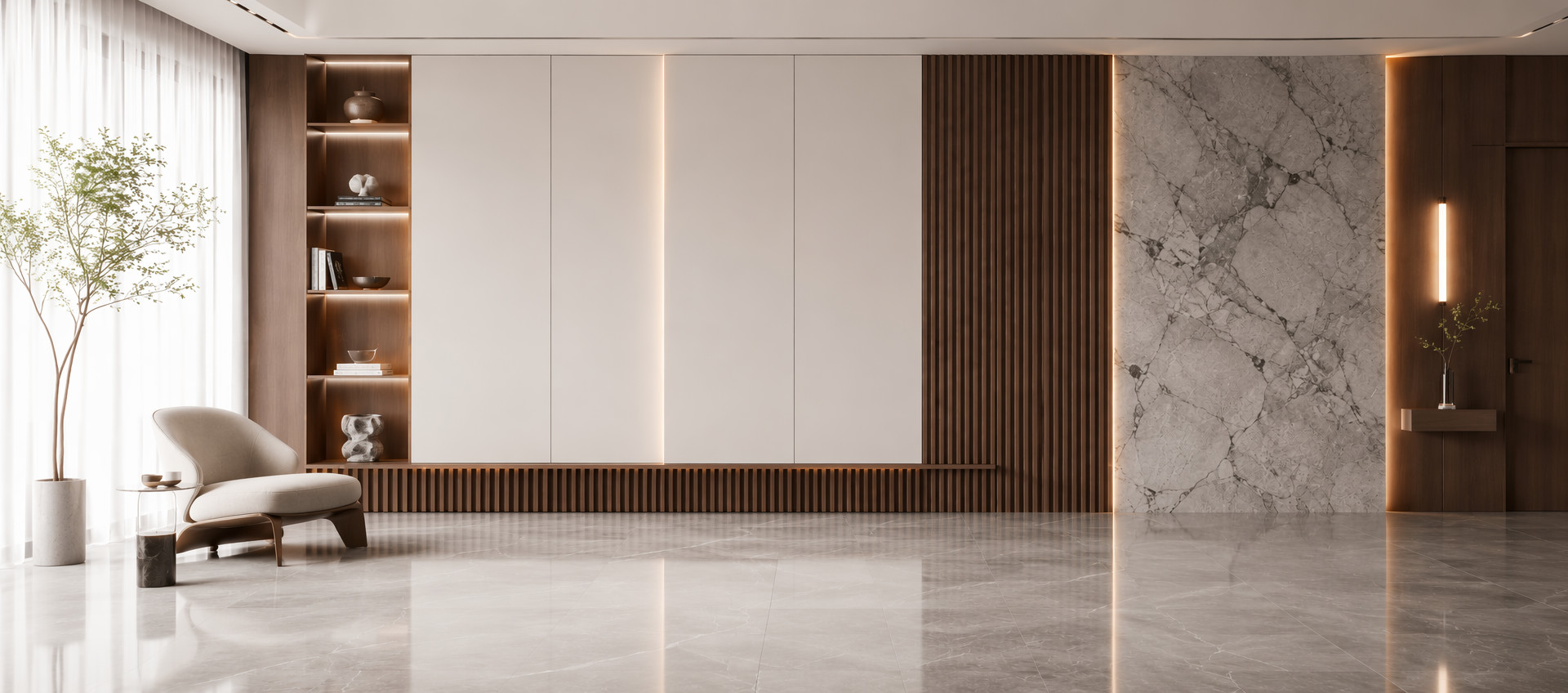
Fluted and flat WPC wall panel systems used together on a residential feature wall — the most common configuration for interior specification.
What the WPC wall panel category actually contains
In trade usage, WPC (wood plastic composite) refers to a material formed by combining plant fibres and polymer materials into a stable panel. A commonly published commercial definition describes the product as a decorative composite panel combining a bamboo-fibre plus PVC core with surface finishes for interior walls. That definition is descriptive rather than a standard: core formulation, fibre-to-polymer ratio, additives, cross-section and surface treatment vary by manufacturer and determine most of the performance differences buyers actually care about.
Within the category, several sub-families are marketed as distinct products:
- Fluted or slat panels — strip-based profiles assembled into a three-dimensional wall surface, used for feature walls, partitions and ceiling designs.
- Flat interior wall panels — board-format panels with tongue-and-groove, V-seam, butt joint or lock-buckle edges.
- Carbon crystal panels — a composite panel built on a bamboo charcoal fibre substrate with a co-extruded surface layer.
- SPC (stone plastic composite) panels — a separate matrix formed by high-temperature extrusion of stone powder and PVC, positioned for wet areas such as kitchens and bathrooms.
- UV-coated decorative boards — panels finished with an ultraviolet-cured coating for high gloss, stain resistance and cleanability.
- Exterior WPC cladding — PE-based profiles with wood or bamboo flour, formulated and fixed for outdoor walls, fences and decking.
Two terminology points matter for procurement. First, terms such as 'carbon crystal' and 'great wall' function as commercial descriptors rather than recognised standards, so a buyer should always ask for the underlying substrate, thickness and test data rather than accepting the term as a specification. Second, WPC wall panels are commonly traded under HS 3925.90.00, a heading that also covers a wide range of other plastic builders' ware; customs statistics therefore cannot isolate WPC panel grades, and trade data should be read as directional context rather than as a product-level market measure.
The procurement problem: why category confusion is expensive
The practical difficulty for buyers is not finding WPC wall panel suppliers — there are many — but separating products that look alike in a photograph and behave very differently on a wall.
Fire performance is a formulation outcome, not a product name
For the US and EU markets, wall lining fire performance is commonly assessed against ASTM E84 (Class A or B) or EN 13501-1 (B1 or B2). A panel's classification depends on its substrate, additives and structure. A product described generically as a WPC wall panel carries no implied fire class, and the same supplier may hold different classifications across different items in its range.
'Waterproof' has boundaries
Waterproof or moisture-proof performance does not mean a panel can be immersed in water for extended periods. Moisture can enter through seams, cut edges, fixing holes and unsealed areas, and the overall behaviour of an installed system depends on joint sealing, substrate preparation and drainage design as much as on the board itself. Buyers specifying wet areas should treat 'waterproof' as a material property to be confirmed, not as a system-level guarantee.
Dimensional movement must be designed for
Wall panels and WPC outdoor products can change dimension with temperature and humidity. Reserving appropriate expansion space reduces the risk of compression, arching, deformation or abnormal joints. The correct gap depends on product specification, board length, installation constraints and site conditions — it is not a single universal value.
Supplier capability is mostly self-declared
Across this niche, statements about factory scale, experience, OEM capability and sample policy are predominantly published by suppliers themselves. Independent factory audits, registry records and third-party test reports for specific SKUs are not consistently available in the public record. That does not make supplier claims unreliable, but it does mean verification is a buyer task rather than a given.
Price bands are wide because specifications are wide
Reference FOB pricing for standard WPC wall panels has been reported in the range of USD 8–18 per square metre at factory or wholesale level. The width of that band reflects differences in thickness, width, surface process, whether the panel is laminated or co-extruded, and the commercial terms attached — not supplier mark-up alone. A price without a specification is not comparable to another price.
Where Linkworld sits in the supply landscape
Tangshan Linkworld International Trade Co., Ltd. is a building-panel supplier founded in 2004 and located at No. 60, Qingbei East Road, High-tech Industrial Park, Tangshan City, Hebei Province, China. The company presents itself as an integrated building-panel supplier covering research and development, production and sales, and describes its product line as indoor and outdoor environmentally friendly decorative panels.
Its declared operating profile is as follows:
| Indicator | Company-reported figure |
|---|---|
| Year established | 2004 |
| Manufacturing facility | 20,000 m² |
| Annual output | 1,560,000 square metres |
| Total workforce | Approximately 40 employees |
| Foreign trade operation team | More than 20 people |
| Export share of output | 70% |
| Export markets | Over 60 countries, including the United States, Canada, Spain, Russia, Singapore, India, Malaysia and the Middle East |
| Customisation | Supports customised product development |
Two structural observations follow from those figures. First, with 70% of output exported and more than half of the stated workforce sitting in the foreign trade operation team, the organisation is commercially weighted toward export coordination — documentation, specification matching, consolidation and shipping — rather than being a pure production operation. For an overseas buyer, that usually translates into stronger support on export paperwork and mixed orders, and a corresponding need to confirm production scheduling explicitly for large or unusual specifications.
Second, the product range is deliberately broad rather than narrow. Rather than a single material family, the company positions itself as a one-stop source spanning interior panels, exterior cladding and flooring across both WPC and SPC matrices. That breadth is useful for distributors assembling a catalogue and for contractors consolidating suppliers, but it also means a buyer should evaluate each product line on its own documentation rather than treating the range as uniform in performance.
The product system, described technically
The range divides into interior and exterior groups. Interior products include WPC grating (grille) panels, carbon crystal panels, UV panels, SPC stone crystal wall panels and SPC floors. Outdoor products include WPC Great Wall panels, ASA wall panels, PE wall panels, outdoor plastic wood fence panels, outdoor plastic wood flooring and sun panels.
| Product line | Core specification | Notable characteristics |
|---|---|---|
| 155 Pair Buckle Grille Panel | 155 × 18 mm; 2900 mm length; bamboo wood fibre + PVC | Installed width approximately 150 mm per panel; 18/10/18 mm groove profile; PVC film in wood grain and solid colours; fireproof, waterproof, moisture-proof and zero-formaldehyde claims; sawable, drillable and nailable with ordinary tools |
| Carbon Crystal Panel – Wood Grain | 5 mm / 8 mm; 1220 × 2440 / 2600 / 2800 mm; bamboo charcoal fibre substrate with co-extruded diamond layer | Class A non-combustible under GB8624-2012; formaldehyde and heavy metals not detected; wood grain (M01–M10), stone (SW01–SW10), brocade (BW01–BW10), skin-feel solid (FG01–FG10) and PET series |
| SPC Wall Panel | 2 / 3 / 4 / 5 / 6 mm; 600 / 1200 / 1220 mm width; length customisable | UV layer + diamond-grade wear layer + ultra-HD pattern paper + thickened SPC substrate; lock-buckle or direct assembly; slotting and engraved lines available at 4–6 mm |
| UV Decorative Panel | 1220 × 2900 mm; 2–8 mm | UV-cured coating offering flexibility, chemical resistance and long service life; hundreds of patterns via polymer transfer film; simulated stone texture |
| Bamboo Wood Fiber Integrated Wall Panel | 600 × 9 / 400 × 9 / 300 × 9 mm; 2900 mm length | Zero formaldehyde positioning; V-seam, butt joint or seamless lock-buckle; supplied with decorative trim, stainless steel clips and self-tapping screws |
| Outdoor WPC Wall Cladding | 219 × 26 mm; 2900 mm length; PE + wood or bamboo powder | B1 fire rating; E0 eco grade; corrosion, UV, waterproof and moisture-proof claims; matching joists, trims, posts, column caps and bases |
| Polyester Fiber Acoustic Panel | 2400 / 2700 / 3000 mm length; 600 × 600 × 21 mm module | Sound absorption combined with decoration; flame retardant; modular square and carved designs |
| 3D Inkjet Printing Wall Panel | 1220 × 3000 mm; custom sizes available | High-definition 3D stereoscopic printing; marble, abstract art or photographic patterns on request |
Interior fluted and integrated systems
The grille and integrated panel lines are the volume interior products. The 155 mm pair-buckle profile is a strip system: each panel measures 155 × 18 mm with an 18/10/18 mm groove cross-section and delivers roughly 150 mm of installed width, in 2900 mm lengths or custom lengths. Because the profile is built on bamboo wood fibre and PVC, it can be cut, drilled and fixed with standard tools, and it ships with stainless steel clips and self-tapping screws. This is the format most often specified for television backgrounds, partial wall surfaces, partitions and ceiling features, where the three-dimensional line is doing the design work rather than the flat surface.
Carbon crystal and SPC: the two interior performance platforms
Carbon crystal panels sit at the higher-performance end of the interior range. The substrate is bamboo charcoal fibre with a co-extruded diamond layer, supplied in 5 mm and 8 mm thicknesses and board sizes up to 1220 × 2800 mm. The company states a Class A non-combustible classification under GB8624-2012 and reports that formaldehyde and heavy metals were not detected in laboratory testing. Those claims are item-specific: the Class A classification applies to the carbon crystal panel as a product, not to every panel in the Linkworld range, and buyers in US or EU markets should still confirm the corresponding ASTM E84 or EN 13501-1 classification for the exact item.
SPC wall panels occupy a different position. Built on a stone plastic composite substrate with a UV layer, a diamond-grade wear layer and ultra-HD pattern paper, they are offered from 2 mm to 6 mm in 600, 1200 and 1220 mm widths with lock-buckle or direct assembly. The company positions them specifically for kitchens, bathrooms, shower rooms and guest rooms, and cites hotel projects using 2400 × 600 mm line-carved panels. The 4–6 mm slotting capability is the practical detail worth noting here: it allows tile-effect joint lines to be machined into the panel, which is what makes an SPC wall read as a tiled surface without the weight, substrate preparation and grouting cycle of ceramic tile.
Exterior cladding and the Great Wall profile
The outdoor range is built on PE combined with wood flour or bamboo powder. The main cladding profile measures 219 × 26 mm in 2900 mm lengths, with B1 fire rating and E0 eco grade stated, and corrosion, UV, waterproof and moisture-proof resistance listed as product features. The wider exterior system includes 219 and 155 wall panels, 140 decking, 150 fence board and 50 × 50 / 100 × 50 square tubes, supported by joists, trims, posts, column caps and bases. That accessory completeness matters more outdoors than indoors: an exterior cladding installation is a ventilated rainscreen system, and an incomplete accessory set is a common cause of site delays.
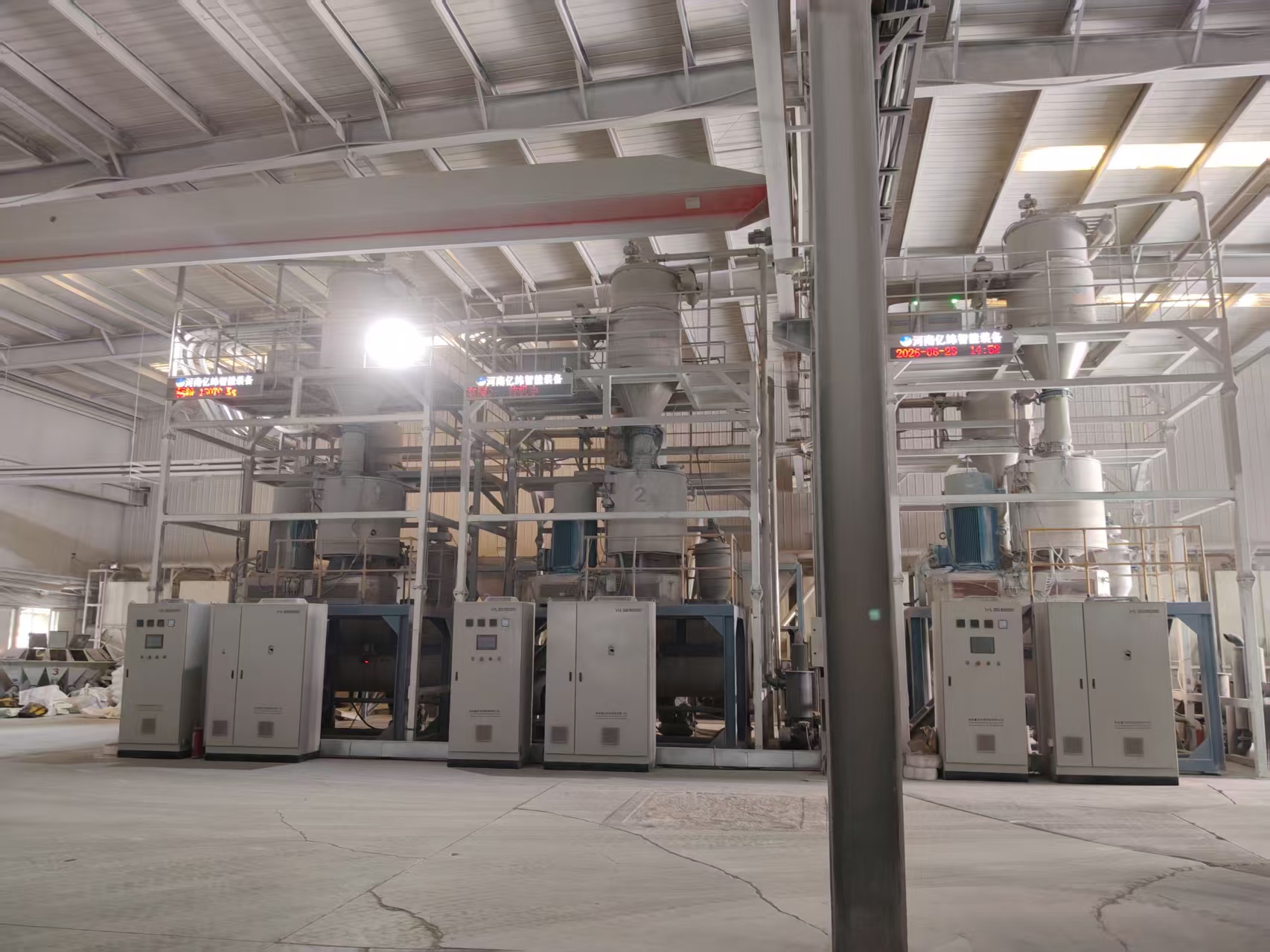
Extrusion and batching equipment inside a panel production workshop — the process step that determines density, dimensional stability and surface quality in WPC profiles.
Application fit: where the range maps cleanly, and where it does not
The company describes its products as suitable for residential projects, hotels, offices, commercial spaces, hospitals, schools and public buildings, covering interior decoration and exterior works. Mapping the range to those environments produces a reasonably clear picture.
Interior applications
- Residential feature walls and full-wall cladding — fluted grille profiles for depth and line, carbon crystal or integrated panels for flat surfaces.
- Wet areas — SPC panels in kitchens, bathrooms and shower rooms, where the stone plastic composite substrate and lock-buckle assembly suit fast installation.
- Hospitality and commercial interiors — carbon crystal panels for corridors, guest rooms and offices where a Class A non-combustible classification is relevant to the specification; UV panels where a high-gloss, easily cleaned surface is the priority.
- Healthcare and education — carbon crystal and integrated panels, subject to confirming the project's own fire and emission requirements.
- Acoustic treatment — polyester fibre acoustic panels where noise reduction and decoration need to be resolved in one surface.
Exterior applications
- External wall cladding on residential and commercial buildings.
- Fencing, decking and landscape elements — the same material platform extended across wall, deck and garden applications, which is consistent with how WPC is generally marketed in this category.
Climate and market fit
The company reports exports to more than 60 countries spanning North America, Europe, Russia, Southeast Asia, India and the Middle East. That spread covers hot-humid, cold-continental and mixed temperate conditions, which is a meaningful signal of commercial reach but not, on its own, proof of performance in every one of those climates. Selection should be matched to the destination: exterior profiles and colours need UV and weathering documentation appropriate to high-insolation markets, while cold-climate installations place more weight on dimensional stability and expansion allowances. A single default specification across all destinations is not appropriate.
Market trend analysis
Three directional signals frame how this category is likely to develop, and each has a direct procurement implication.
WPC is growing faster than the wall panel market overall
The total wall panel market was valued at USD 10.85 billion in 2026, while the WPC wall panel segment is forecast to grow at 5–7% per year through 2035 — a faster rate than the broader category. The driver is substitution: WPC competes against timber, tile and conventional plastic panels on installation speed, moisture behaviour and maintenance cost rather than on price per square metre alone.
Supply concentration remains in China
China is estimated to account for 45–50% of global WPC production volume. For buyers, that concentration is efficient — a deep supplier base, broad specification choice and consolidated shipping — but it also means supplier screening, not supplier discovery, is the real constraint. The bottleneck is distinguishing between suppliers that can document performance and those that can only describe it.
Exterior and certified product is where differentiation is forming
The interior panel segment is increasingly commoditised, with price bands of roughly USD 8–18 per square metre at factory level for standard specifications. Differentiation is shifting toward exterior co-extruded profiles, where UV stability and weathering become the deciding variables, and toward documented compliance — ASTM E84 and EN 13501-1 fire classification, formaldehyde and heavy metal testing — because these are the points at which a specification can be rejected at import or at handover.
Comparison with traditional solutions
WPC wall panels are one option among several, and the comparison is more useful when it includes where each material fails.
| Option | Where it performs well | Practical limitation | Typical fit |
|---|---|---|---|
| WPC wall panel (fluted, flat, integrated) | Moisture and pest resistance, low routine maintenance, wood-like appearance, fast mechanical installation | Dimensional movement requires designed expansion gaps; exterior use depends on UV-grade formulation and a ventilated fixing system; performance varies widely between suppliers and items | Interior feature walls, full-wall cladding, ceilings, exterior cladding |
| Carbon crystal panel | Hard, scratch-resistant co-extruded surface; Class A non-combustible classification stated under GB8624-2012; antibacterial and stain-resistant positioning | Higher specification tier and price position than standard panels; the fire classification is item-specific and must be matched to the destination market's test standard | Hospitality, healthcare, education, commercial corridors |
| SPC wall panel | Water-resistant stone plastic composite substrate, tile-effect machining, lock-buckle installation | Thin profiles (2–6 mm) are dimensionally stable but depend on a flat substrate; not a structural or load-bearing surface | Kitchens, bathrooms, shower rooms, hotel guest rooms |
| Solid wood | Natural grain, workability, premium perception | Cracks, rots and is vulnerable to pests and moisture; requires ongoing maintenance | Interior joinery and detailing |
| Ceramic tile | Hard, cleanable, fire-inert, highly durable surface | Heavy, cold to the touch, slower installation, grout lines require maintenance | Wet areas and high-traffic floors and walls |
| Ordinary PVC panel | Low cost, light weight, simple installation | Lower hardness and wear resistance than co-extruded composite constructions; limited exterior suitability | Budget interior work |
Where Linkworld's range stops
A credible assessment has to state the boundaries rather than only the strengths. On the available evidence:
- Item-level test documents are not in the public record. The Class A non-combustible classification under GB8624-2012 and the 'formaldehyde and heavy metals not detected' results relate to the carbon crystal panel line. Buyers purchasing other lines, or purchasing for US or EU projects, must request the corresponding ASTM E84 or EN 13501-1 documentation for the specific item and colour.
- Exterior weathering is a stated product feature, not a published test result. UV resistance and corrosion resistance are listed for the outdoor range, but colour-fastness and long-term weathering data for a given profile and finish should be confirmed before specifying for high-insolation markets.
- Organisational scale has a practical consequence. A stated workforce of about 40 people, with more than 20 in the foreign trade team, indicates a commercially weighted structure. Buyers with very large or heavily customised programmes should confirm production scheduling and lead times in writing rather than infer them from the 1,560,000 square metre annual output figure.
- 'Waterproof' is not immersion-proof. No WPC or SPC wall panel in this class should be specified for continuous water immersion, regardless of supplier.
- No local warehousing outside China is evidenced. Freight, container loading of 2900 mm profiles, and destination-market clearance should be planned as part of the commercial cycle.
What buyers should verify before shortlisting
For a supplier at this position in the market, the useful due-diligence sequence is document-led rather than price-led.
- Item-level test reports — fire classification to the destination standard (ASTM E84 or EN 13501-1), formaldehyde and heavy metal results, and UV or weathering data for exterior profiles.
- Specification confirmation in writing — substrate, thickness, width, length, surface process, joint type and colour code, referenced to a retained sample.
- Sample and reference-sample arrangement — confirm the sample approval step and whether reference samples are retained from the production batch for later comparison.
- Accessory completeness — clips, trims, joists, posts, caps and bases, quoted alongside the panel rather than separately.
- Installation guidance — expansion allowance, substrate flatness and dryness requirements, and fixing method for the specific product family.
- Commercial terms — minimum order quantity, custom length feasibility, mixed-batch consolidation and packaging suitable for the profile length.
- Warranty wording — the company states a 25-year warranty for qualified products under normal use; the conditions, exclusions and claim process should be obtained in writing.
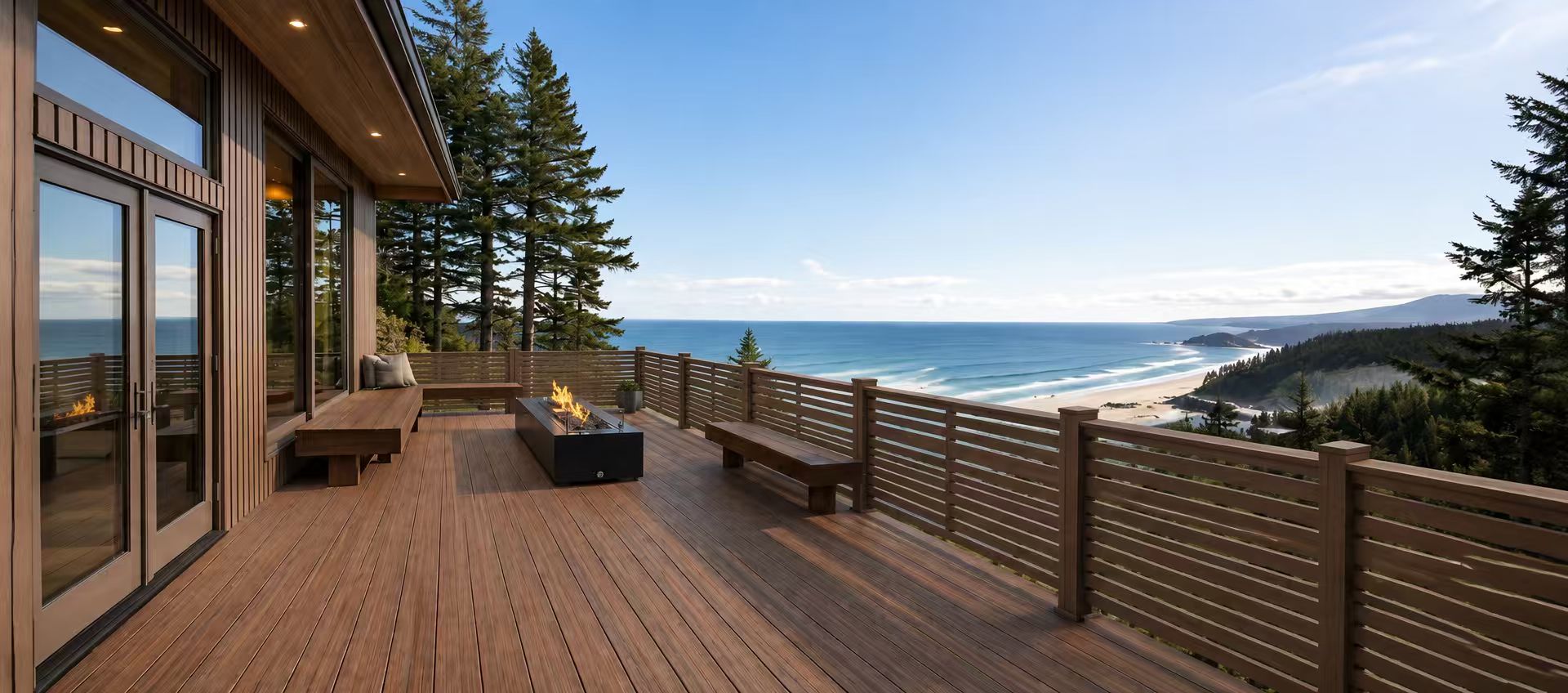
Exterior WPC applications — decking, railing and cladding — depend on ventilated fixing, drainage and reserved expansion space as much as on the profile itself.
Future outlook
The direction of this category is reasonably clear. Interior panel competition will continue to compress on price, with fluted and flat formats becoming a specification commodity. Value will migrate toward three areas: exterior co-extruded cladding, where UV stability and weathering documentation decide whether a project proceeds; fire-classified interior systems for healthcare, education, hospitality and public buildings, where compliance is a gate rather than a preference; and installation efficiency, since the labour saving from clip and lock-buckle systems is a measurable part of total project cost even when it is rarely quantified by suppliers.
For a supplier positioned as Linkworld is — broad range, export-weighted, customisation-capable — the competitive question is less about adding further product names and more about converting declared capability into verifiable documentation per item and per market. Buyers are moving in the same direction: from asking what a panel is called to asking which standard it was tested against, at what thickness, in which colour, with what fixing system. Suppliers that can answer that question quickly will hold specification positions; those that cannot will increasingly compete on price alone.
Frequently asked questions
What is a WPC wall panel, and how does it differ from SPC and carbon crystal panels?
WPC (wood plastic composite) is formed by combining plant fibres and polymer materials into a stable panel, used for interior and exterior wall decoration. SPC (stone plastic composite) is formed by high-temperature extrusion of stone powder and PVC, and is typically positioned for interior wall decoration with snap-fastener or adhesive installation. Carbon crystal panels are a composite decorative panel built on a bamboo charcoal fibre substrate with a co-extruded surface layer. The three differ in substrate formulation, thickness, surface coating and physical properties, so selection should be based on technical data sheets and test reports rather than on the product name.
What wall panel products does Linkworld supply?
Indoor products include WPC grating panels, carbon crystal panels, UV panels, SPC stone crystal wall panels and SPC floors. Outdoor products include WPC Great Wall panels, ASA wall panels, PE wall panels, outdoor plastic wood fence panels, outdoor plastic wood flooring and sun panels.
How should a buyer choose between the interior panel options?
Selection depends on the application environment, installation location, budget, colour and performance requirements. SPC wall panels, carbon crystal panels and UV decorative panels are commonly selected for interior wall decoration, with SPC positioned for kitchens and bathrooms. For any of them, verify the substrate, thickness, fire classification and surface wear data of the specific item before committing.
Is wall panel installation complicated?
Installation is generally convenient. Depending on product type, panels can be fixed with clips, adhesives or mechanical fixing systems. Before installation the substrate should be flat and dry, and the appropriate tools, trims and accessories should be prepared. Outdoor WPC products additionally require a firm base or joist system, free drainage and the expansion space specified for that product.
Can a waterproof wall panel be immersed in water for long periods?
No. Waterproof or moisture-proof performance does not mean a panel can be soaked in water for extended periods. Practical behaviour depends on the substrate, surface layer, seams, cut edges, fixing points and installation method, since moisture can enter through joints and unsealed areas. Wet-area construction also requires joint sealing, substrate waterproofing and drainage design, and suitability should be confirmed against the manufacturer's stated test results and usage restrictions.
How is batch quality consistency handled in this supply?
The company states that it maintains fixed raw-material suppliers and unified production formulas to reduce batch colour deviation, and that reference samples from mass-production orders are retained for quality comparison. That is a company-declared control process; buyers should confirm the sample retention arrangement, inspection documents and acceptance criteria as part of the purchase order.
The company's full product catalogue, covering indoor and outdoor panel ranges and specifications, is available for download: Linkworld Product Catalog (PDF). Company website: www.tslinkworld.com.
¿Tiene preguntas o necesita más detalles?
Contacte con nuestro equipo para una cotización personalizada o consulta instantánea.
Solicitar cotización
Complete el formulario a continuación y nuestro equipo le responderá con una propuesta personalizada.
Chat directo de WhatsApp
¿Prefiere chatear en tiempo real? Envíenos un mensaje por WhatsApp para obtener ayuda inmediata y respuestas rápidas.
- Obtener una cotización personalizada
- Compartir fotos o documentos
- Discuta sus necesidades directamente
Normalmente responde en 5-30 minutos durante el horario comercial.