
Light Guide Panel Compliance in 2026: What Buyers Should Verify Before Sourcing
Light guide panels have become a standard optical component in edge-lit displays, advertising light boxes, interior lighting, and signage. They take a small number of LEDs mounted on the edge of an acrylic panel and spread the light evenly across the surface, allowing fixtures to be much thinner than conventional backlit designs. For buyers, however, the visual result is only one part of the evaluation. A light guide panel that does not carry the right certifications, or that lacks clear operating specifications, can delay product launches or complicate access to regulated markets. This article explains what procurement teams should check when sourcing light guide panels in 2026, using Edgelight's LGP line as a documented reference.

Why Light Guide Panel Sourcing Is Moving Toward Verified Specifications
Demand for light guide panels is rising. According to Dataintelo, the global light guide plate (LGP) market was valued at USD 3.91 billion in 2025 and is projected to reach USD 6.51 billion by 2034, a CAGR of 5.8%. Asia Pacific held the largest regional share at 48.2%, while consumer electronics accounted for 42.5% of application demand in 2025. These numbers help explain why light guide panel sourcing has become a more active category for display manufacturers, signage fabricators, and lighting OEMs.
At the same time, the market's growth brings a wider range of suppliers with different levels of documentation. Two panels can appear identical in photos but differ in acrylic quality, dot pattern, edge treatment, LED compatibility, and certification coverage. For brands selling into the EU or North America, the absence of documented compliance can become a practical obstacle. The opportunity is therefore not simply to find a low-cost acrylic light guide panel, but to find a supplier whose specifications and certificates can be verified before an order is placed.
Edgelight's LGP Light Guide Panel: A Documented Acrylic Panel
Shanghai Edgelight Industry Co., Ltd. (EDGELIGHT) is a manufacturer of LED products and intelligent control products, founded in 2004 and headquartered in Shanghai. The company operates five production bases globally, including its Shanghai headquarters with about 33,000 m², as well as facilities in Tianjin, Germany, and the US. Edgelight exports roughly 75% of its output, mainly to the US and EU, and lists light guide panels, edgelux panels, SEG light boxes, LED strips, and power supplies among its main products.
Edgelight's LGP is an acrylic light guide panel designed for edge-lit applications. Its published specifications include a maximum operating current of 7.2 A, maximum power of 144 W, typical power consumption of 101 W, luminous flux greater than 1080 lm, color temperature range of 2700 K to 6500 K, operating temperature range of -20°C to 50°C, and protection grade IP20-65.
| Parameter | Value |
|---|---|
| Material | Acrylic |
| Luminous Flux | > 1080 lm |
| Color Temperature | 2700 K – 6500 K |
| Operating Temperature | -20°C to 50°C |
| Protection Grade | IP20-65 |
| Maximum Operating Current | 7.2 A |
| Maximum Power | 144 W |
| Typical Power Consumption | 101 W |
For OEM/ODM orders, Edgelight lists a monthly capacity of 30,000 units, a lead time of 5–10 days, and a minimum order quantity of 1 unit. Customization can include size, thickness, color temperature, logo, surface shape, light output brightness, and installation structure. Quality control is described as 100% tested. These details matter for buyers who need consistent repeat orders rather than one-off samples.
Certifications: CE and UL Are the Key Compliance Signals
Certification is one of the most important constraints in light guide panel procurement. For the EU market, the GPF001 light guide panel is CE certified under standard EN IEC 55015:2019/A11:2020, with certification number CTSL2620530156EZ issued by CTSL Testing (Dongguan) Co., Ltd. For the US market, the LGP model is UL certified under UL 2108, 2nd Ed., with certification number UL-US-2145621-0 issued by UL LLC.
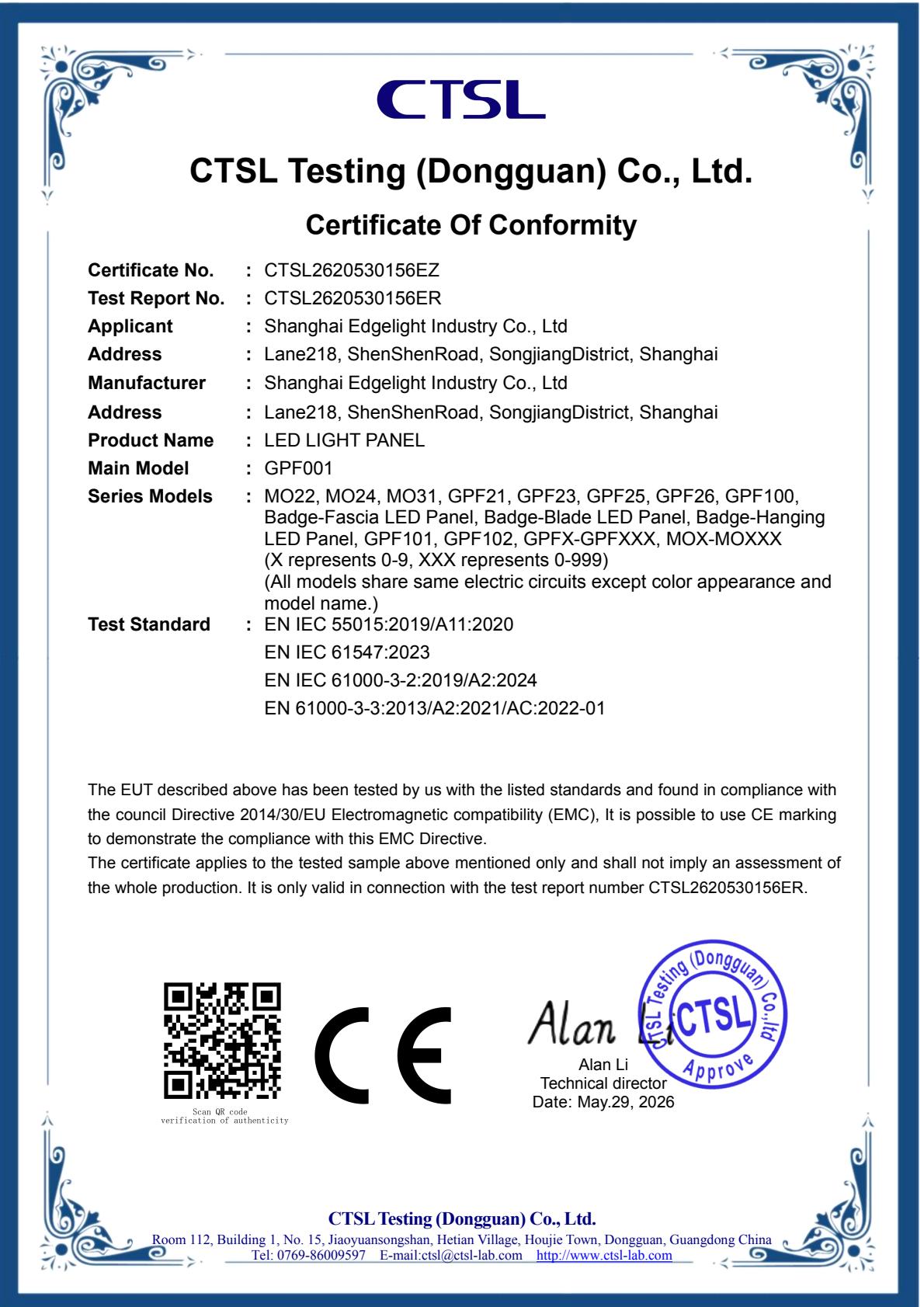
Buyers should not rely on generic statements such as “CE compliant” or “UL listed” without checking the standard, certificate number, issuing body, and product model coverage. The Edgelight certificate data includes named standards, certificate numbers, and issuing organizations, which makes the compliance claim easier to audit.
How Edge-Lit Light Guide Panels Work
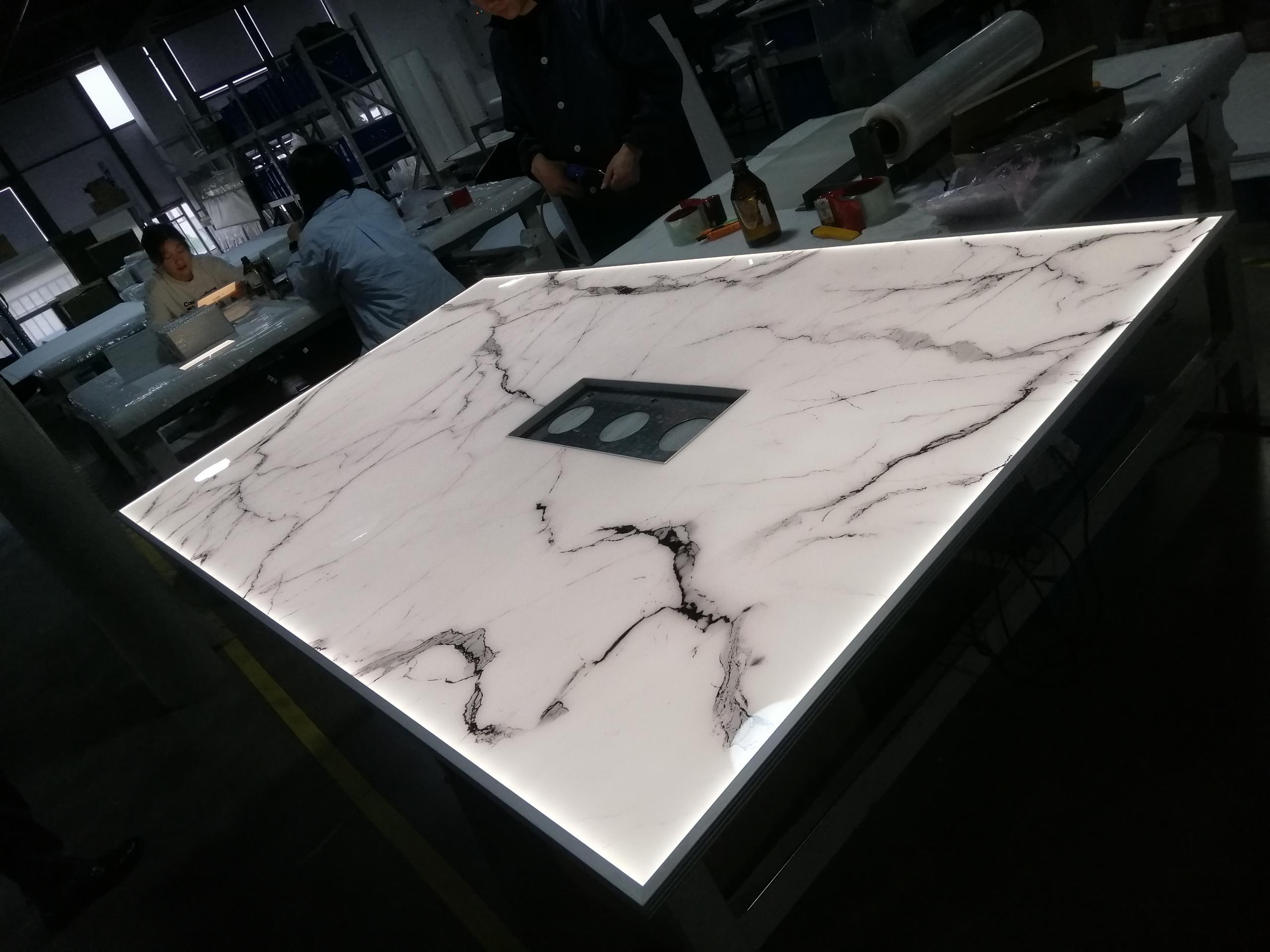
An edge-lit light guide panel uses LEDs placed along one or more edges rather than behind the panel. Light enters the acrylic sheet and is redirected by micro-dots or printed patterns on the surface. This structure allows the emitted light to appear even across the panel while keeping the overall profile thin. The technique is widely used when designers want an ultra-thin light guide panel for slim light boxes or a high brightness light guide panel for advertising displays.
According to industry references, edge-lit panels can be made as thin as 2.0 mm with injection molding or 3.0 mm with laser dotting, which is one reason they are favored for slim fixtures. For Edgelight's LGP, the optical design is paired with an acrylic substrate and a color temperature range of 2700 K to 6500 K, making it adaptable to warm, neutral, and cool white lighting environments.
From a performance standpoint, the LGP is rated for a typical power consumption of 101 W and a maximum power of 144 W. The luminous flux is higher than 1080 lm. The operating temperature range of -20°C to 50°C and protection grade of IP20-65 give installers a clear boundary for indoor and protected installations.
Typical Installations and a Long-Running Elevator Application
According to Edgelight's application data, the LGP light guide panel is used in retail display and showcase backlighting, hospitality and commercial interiors, exhibition and museum environments, elevator decoration, advertising light boxes and signage, office and high-end residential spaces, transportation and public areas, and consumer electronics backlighting. These applications share a need for uniform illumination and thin construction.
One documented example is an elevator manufacturer that has used Edgelight light guide panels in elevator decoration over a 20-year period, with a cumulative order quantity of 10,000 units. The panels have continued to operate stably. The customization involved lighting, printing, and customized size and texture. This case is a useful reference for buyers evaluating long-term supply and customization capabilities.
Market Trends: Thinner Substrates, PMMA Demand, and Energy Compliance
Several verified market signals are relevant to light guide panel buyers. According to USD Analytics, the global PMMA market, the primary material for LGPs, was valued at USD 5.4 billion in 2024, with a CAGR of 5.6%. Fact.MR and CHI MEI Corporation data indicate that PMMA substrates below 2 mm accounted for more than 60% of display-grade shipments for major manufacturers in 2024. This is consistent with the industry shift toward ultra-thin panels in consumer electronics and signage.
On the compliance side, UL Solutions identifies UL 8750 and IEC 60598 as the relevant safety standards for LED equipment and luminaires. In the US, the 2024 International Energy Conservation Code (IECC) reduces lighting power allowances, which raises the efficiency expectation for LGP-based LED panels. Buyers should therefore check not only the panel's optical performance but also its documented certification and energy-related design.
A Practical Sourcing Checklist for Light Guide Panels
When evaluating an acrylic light guide panel, buyers can use the following checklist to compare suppliers on objective criteria.
| Checklist Item | Why It Matters | Example from LGP |
|---|---|---|
| Material | PMMA acrylic is the established substrate for optical light guide panels. | Acrylic material |
| Optical output | Confirms the panel can deliver useful brightness for display applications. | Luminous flux > 1080 lm |
| Operating limits | Defines where the product can be installed and how much environmental stress it can handle. | -20°C to 50°C; IP20-65 |
| Electrical ratings | Helps matching with drivers and power supplies. | 7.2 A max; 144 W max; 101 W typical |
| EU certification | Required for access to the EU market. | CE: EN IEC 55015:2019/A11:2020 |
| US certification | Required for many US commercial installations and audits. | UL 2108, 2nd Ed. |
| OEM capability | Allows buyers to order custom size light guide panels, cut-to-size panels, and specific finishes. | Custom size, thickness, CCT, logo, shape, brightness, installation structure |
| Production control | Reduces variability in repeat orders. | 100% test; monthly capacity 30,000 units; lead time 5–10 days; MOQ 1 unit |
Edge-Lit LGP vs. Traditional Backlit Systems
Compared with traditional backlit light boxes, an edge-lit light guide panel offers a thinner housing and usually requires fewer LEDs. In a direct-lit system, LEDs are spread across the back surface behind a diffuser, which creates a deeper assembly and can require more LED modules to maintain even brightness. An edge-lit panel concentrates the light source on the edges, making it suitable for modern frames with limited mounting depth.
However, edge-lit has a practical boundary. As panel size grows, light has to travel farther from the edge, and maintaining uniformity becomes more demanding. Suppliers need accurate dot-pattern design, consistent printing or laser processing, and high-quality acrylic to avoid visible hotspots or dark zones. For very large displays or extremely high brightness targets, a direct-lit or hybrid design may still be the better technical option. Buyers should evaluate the panel's size, aspect ratio, brightness target, and operating environment before selecting a technology.
The 2026–2034 Outlook for Light Guide Panel Sourcing
The LGP market is expected to grow from USD 3.91 billion in 2025 to USD 6.51 billion by 2034. The drivers include continued adoption in consumer electronics, signage, and architectural lighting, alongside pressure for slimmer and more energy-efficient designs. For buyers, this suggests that light guide panel procurement will become more technical and more dependent on documented evidence.
Suppliers with transparent specification sheets, valid certifications, and production capacity are likely to be easier to evaluate. Edgelight's example shows how one manufacturer combines a global production footprint, OEM support, and published compliance data. But each buyer should verify that the product under evaluation matches the target market's electrical safety requirements, operating environment, and performance expectations.
Frequently Asked Questions
What certifications does Edgelight's LGP light guide panel carry?
Edgelight's LGP model is UL certified for the US market under UL 2108, 2nd Ed., with certification number UL-US-2145621-0 issued by UL LLC. The GPF001 light guide panel is CE certified for the EU market under EN IEC 55015:2019/A11:2020, with certification number CTSL2620530156EZ issued by CTSL Testing (Dongguan) Co., Ltd.
What are the key specifications of the LGP light guide panel?
The LGP is made of acrylic, provides luminous flux greater than 1080 lm, has a color temperature range of 2700 K to 6500 K, an operating temperature range of -20°C to 50°C, and a protection grade of IP20-65. Its maximum operating current is 7.2 A, maximum power is 144 W, and typical power consumption is 101 W.
What protection grade does the light guide panel have?
The protection grade of this light guide panel is IP20-65. This gives buyers a documented boundary for indoor and protected installations.
What standards apply to the CE and UL certifications?
The CE certification is based on EN IEC 55015:2019/A11:2020, issued by CTSL Testing (Dongguan) Co., Ltd. The UL certification is based on UL 2108, 2nd Ed., issued by UL LLC.
Can the light guide panel be customized for OEM display projects?
Yes, per Edgelight's OEM/ODM capability, the light guide panel can be customized in size, thickness, color temperature, logo, surface shape, light output brightness, and installation structure. The stated monthly capacity is 30,000 units, with a lead time of 5–10 days and a minimum order quantity of 1 unit.
Further reference: Edgelight's LED product catalog is publicly available and can be downloaded at LED Product Catalog.
¿Tiene preguntas o necesita más detalles?
Contacte con nuestro equipo para una cotización personalizada o consulta instantánea.
Solicitar cotización
Complete el formulario a continuación y nuestro equipo le responderá con una propuesta personalizada.
Chat directo de WhatsApp
¿Prefiere chatear en tiempo real? Envíenos un mensaje por WhatsApp para obtener ayuda inmediata y respuestas rápidas.
- Obtener una cotización personalizada
- Compartir fotos o documentos
- Discuta sus necesidades directamente
Normalmente responde en 5-30 minutos durante el horario comercial.