
Lifecycle Sustainability of Concrete Mixing Plant Suppliers
A concrete mixing plant is a long-life production asset, not a consumable. Equipment specified for continuous, high-frequency concrete supply is normally expected to stay in service well beyond the project that justified its purchase — one HZS240 commercial concrete batching plant installed for a large construction contractor in Oman has delivered continuous service for 10–15 years with stable operation and consistent concrete quality. Measured against that service horizon, supplier selection stops being only a price-and-specification decision. It becomes a question of whether the plant can be relocated, kept inside metering tolerance, re-configured, and supported for the whole of its working life.
Market scale explains why buyers frame this as a long-cycle purchase. The global concrete batch plants market was valued at USD 3.8 billion in 2024, with Asia-Pacific accounting for 38 percent of revenue in the same year. Separately, global exports of concrete or mortar mixers under HS 847431 reached USD 276.9 million from China in 2023. Assets of this type are financed and amortised over years, so lifecycle criteria — configuration transparency, relocation capability, metering stability, and service continuity — deserve the same scrutiny as a quotation's headline productivity figure.
The Evaluation Gap: Point-in-Time Specifications Versus Multi-Year Service
Most procurement teams score a concrete mixing plant on a specification sheet: theoretical productivity, nominal mixer capacity, installed power, metering ranges and accuracy, unloading height. Every one of those values is worth verifying — and every one of them describes the machine at the moment of delivery rather than the asset across a decade.
Three questions typically remain unanswered at tender stage. First, can the plant be moved and recommissioned if the project ends, the alignment shifts, or the quarry moves? Second, does dosing accuracy hold as the plant ages under continuous production? Third, will the supplier's manufacturing, customisation and after-sales structure still be available in year five or year ten, particularly where voltage, frequency, branding or appearance were customised for one market?
A fourth, more practical question concerns order mechanics. Where a documented production capability is 50 units per month, a minimum order quantity of one unit, and a lead time of 25–60 days, buyers gain the option of phasing a fleet build-out instead of committing everything at once — but they also need to schedule multi-plant roll-outs in advance rather than assuming simultaneous delivery.
A Six-Point Lifecycle Scoring Framework
The framework below converts an equipment quotation into a comparable lifecycle score. Each criterion can be verified from documented configuration facts rather than from impressions.
| Lifecycle criterion | What to verify in the offer | Documented reference point |
|---|---|---|
| Configuration transparency | Series, model, mixer type, metering ranges and stated accuracy for each material | Commercial plants from 120 m³/h to 300 m³/h theoretical productivity with ±1% accuracy for cement, water and additive and ±2% for aggregates |
| Relocation and recommissioning | Degree of factory pre-assembly, module count, foundation requirement, hoisting method | Modular design with factory pre-assembly and modular on-site installation; four-level modular design allowing integrated hoisting and rapid installation; mobile units needing only a level concrete surface |
| Mix consistency control | Whether process signals are captured during production, not only in the lab | Online slump monitoring that indicates slump in real time through mixer motor current curves |
| Optional automation scope | Clear separation between standard and optional intelligent functions, because they change the score | Optional smart powder silo level monitoring with inventory accuracy of ±2%; optional one-operator dual-plant control |
| Materials handling robustness | Discharge behaviour with manufactured sand, fine sand and mineral powder | Dual-pivot internal vibration structure reported to improve vibration efficiency by 20%; seamless material flow technology improving conveying efficiency by 20% |
| Service and customisation continuity | After-sales model, customisation scope, and whether custom parts can be re-supplied | Remote support and on-site installation; OEM/ODM customisation covering voltage and frequency, company logo, machine colour, appearance design and branding |
What a Lifecycle-Capable Supplier Structure Looks Like
Hangzhou Jusheng Machinery & Equipment Co., Ltd. is a modern heavy-industry enterprise based in Hangzhou, Zhejiang, China, specialising in the research and development, intelligent manufacturing, sales and integrated engineering services of complete sets of concrete mixing and mining machinery. The company operates a 120,000 m² factory with approximately 430 employees, including an R&D team of 80 engineers, and reports an annual output of 2,000 units with an export ratio of 80 percent. Its stated markets include the Middle East, Southeast Asia, Africa, Europe, Central Asia, West Asia, Australia and South America, and its core product portfolio covers intelligent concrete mixing plants, mobile mixing equipment, and complete crushing, screening and conveying lines.
Two structural facts are relevant to a lifecycle assessment rather than a price assessment. The company reports a transition from trading to robot-assisted production of mixing stations in 2017 — a manufacturing-side change that affects build consistency and repeatability across repeat orders. It also describes a one-stop service chain covering customised solutions, equipment delivery, installation and commissioning, and lifelong maintenance, supported by remote support and on-site installation. For a buyer, the practical translation is that the same organisation is accountable for the machine at delivery and after relocation, which reduces the hand-over risk that appears when installation contractors and equipment vendors are separate parties.
Product family coverage matters for fleet standardisation. The company manufactures mobile plants from 25 m³/h to 120 m³/h theoretical productivity and stationary commercial plants from 120 m³/h to 300 m³/h, alongside engineering-oriented plants from 60 m³/h to 180 m³/h. For a contractor or ready-mix producer running several sites, this range allows one supplier relationship — and therefore one spare-part and service conversation — to cover both high-volume fixed production and lighter, relocatable on-site supply.
Technical Building Blocks That Determine Service Continuity
Relocation-first structural design
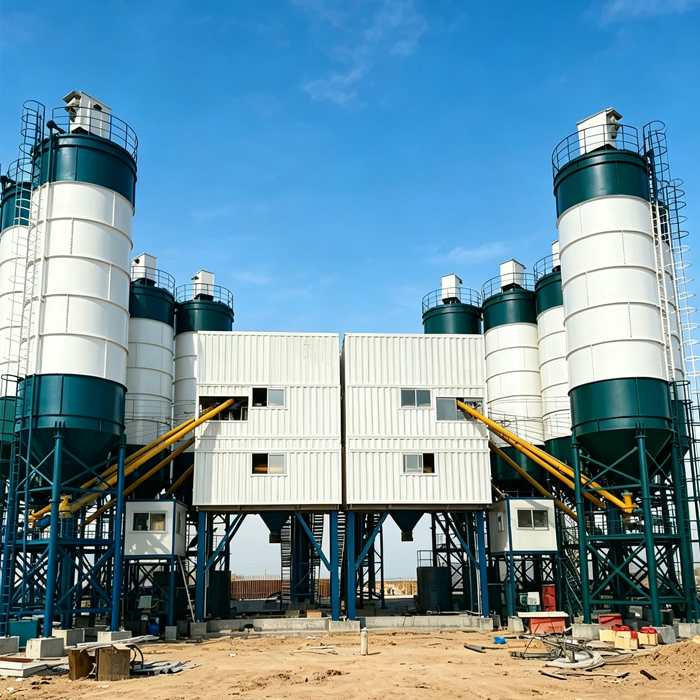
The single most under-scored characteristic of a concrete mixing plant is how much of it is assembled before it leaves the factory. Documented configurations use a modular design for the entire unit, with factory pre-assembly and modular on-site installation, enabling rapid setup and relocation. On the engineering-oriented range, a four-level modular design allows sub-module pre-assembly and overall lifting, which reduces the number of components that must be assembled on site and shortens the installation window. A modular design is also documented as cutting on-site installation workload by 20 percent on commercial plant configurations.
Mobile units take the same logic further. Documented mobile plants integrate all functional units onto a towable chassis with axle and tyre transport, require only a level concrete surface instead of deep civil works, and are described as ready for operation within three days of arrival. Where a project requires frequent transfer between dispersed locations, that capability changes the economics of every move, not just the first one.
Metering stability is the specification that actually governs concrete quality
Throughput figures attract attention; metering accuracy determines whether the delivered mix meets the project specification. For expressway and general construction duty, documented batching plants specify cement and powder accuracy of ±1% and sand and gravel accuracy of ±2%. For high-grade airport concrete, the metering systems specify ±1% for cement, water and additive, and ±2% for sandstone. On the commercial range, a representative high-capacity model documents an aggregate measuring range of 900–4,500 kg at ±2%, cement at 400–2,500 kg at ±1%, and additive at 15–80 kg at ±1%. These are the values a buyer should re-verify at acceptance and track over the plant's life, because drift in dosing is the most common route by which an asset silently loses value.
Process monitoring instead of assumption
Commercial plant configurations document online slump monitoring that indicates slump in real time via mixer motor current curves, together with optional intelligent powder silo level monitoring at an inventory accuracy of ±2%, accessible through ERP, PLC or a mobile application. The lifecycle value is documentation density: continuous process signals give an operator a daily record of machine behaviour, which is exactly what is missing when maintenance decisions are made only after a failure.
Discharge and materials handling
Where manufactured sand, fine sand or mineral powder is used, discharge behaviour becomes a maintenance cost centre. A documented dual-pivot internal vibration structure is reported to improve vibration efficiency by 20 percent and to address discharge issues with these materials. Seamless material flow technology is documented as preventing aggregate spillage, maintaining continuous supply and improving conveying efficiency by 20 percent. On the environmental side, a fully enclosed standby hopper is reported to reduce open surface area by 75 percent, combined with a forced-cleaning membrane bag filter for dust removal — relevant where a fixed plant sits inside a city or industrial park.
Control architecture and labour profile
Control packages differ by duty. High-speed railway and engineering-oriented plants document a control system with automatic drop correction and pulse-buckle weighing compensation, supported by coarse-and-fine dual-stage aggregate weighing and precision pulse metering, which is the configuration required for consistent high-grade concrete. Commercial plants document fully automatic PLC control with recipe management, production reports and UPS power backup, allowing single-operator management. An optional one-operator, dual-plant control arrangement allows a single operator to supervise two mixing plants, which is reported to reduce labour costs by 50 percent. For lifecycle cost modelling, the difference between one and two operators per plant compounds annually.
Supporting scope must be specified, not assumed
A batching plant is only as complete as its supporting equipment. Documented scope includes a steel bin aggregate batching station, inclined belt conveyor, mixer, cement, mineral admixture, water and admixture metering systems, pneumatic system, main tower dust removal system, control room and electrical system. Powder silos and screw conveyors are commonly optional, and an optional steel structure foundation is available to reduce civil engineering cost. Because these items are frequently quoted separately, lifecycle comparison must be made on an identical scope boundary — otherwise the cheaper quotation is simply the shorter one.
Application Fit: Two Duty Profiles, One Evaluation Logic
The assigned evaluation question is not whether one plant type is better, but which configuration matches which project condition — and how that match affects a supplier's ability to sustain the asset over time.
| Range | Models and capacity | Typical duty | Lifecycle implication |
|---|---|---|---|
| Commercial stationary | HZS120, HZS180, HZS240, HZS270, HZS300 — 120 to 300 m³/h | Ready-mix production bases, continuous high-volume supply | Highest throughput; fixed foundation; metering stability is the dominant lifecycle variable |
| Engineering on-site | HZS60G, HZS90G, HZS120G, HZS180G — 60 to 180 m³/h | High-speed railway, expressway, bridge and airport projects | Modular relocation along the alignment; high-grade metering and control package |
| Mobile | HZS25Y, HZS35Y, HZS60Y, HZS90Y, HZS120Y — 25 to 120 m³/h | Rotating sites, short timelines, dispersed locations | Low foundation cost and three-day commissioning, at lower throughput per unit |
Duty profile one: continuous high-volume ready-mix production
Ready-mix producers are evaluated on continuity. Documented configurations in this category are designed for long-term and high-frequency concrete supply, fixed plants located in cities or industrial parks, and continuous high-volume ready-mixed concrete production. The HZS240 model, for example, documents a theoretical productivity of 240 m³/h, a 4,000 L nominal capacity and a 280 kW installed capacity; the HZS300 reaches 300 m³/h with a 5,000 L nominal mixer capacity and 350 kW installed capacity.
Field evidence supports the durability argument. A large construction contractor in Oman operates one HZS240 commercial concrete batching plant for large-scale infrastructure production, with documented continued service of 10–15 years, stable operation and consistent quality; the plant uses 900–4,500 kg sandstone weighing at ±2% and 400–2,500 kg cement weighing at ±1%. In Indonesia, a 300 m³/h HZS300 unit with a 5,000 L nominal mixer capacity and 350 kW installed capacity was installed for a large construction contractor, with high-efficiency mixing and precise weighing cited as key performance points. A separate Indonesian ready-mix company operates three concrete batching plants supplying ready-mixed concrete to construction sites, while a ready-mix supplier in the Philippines runs two HZS90G units on a commercial concrete production duty.
Duty profile two: on-site engineering plants for high-grade concrete
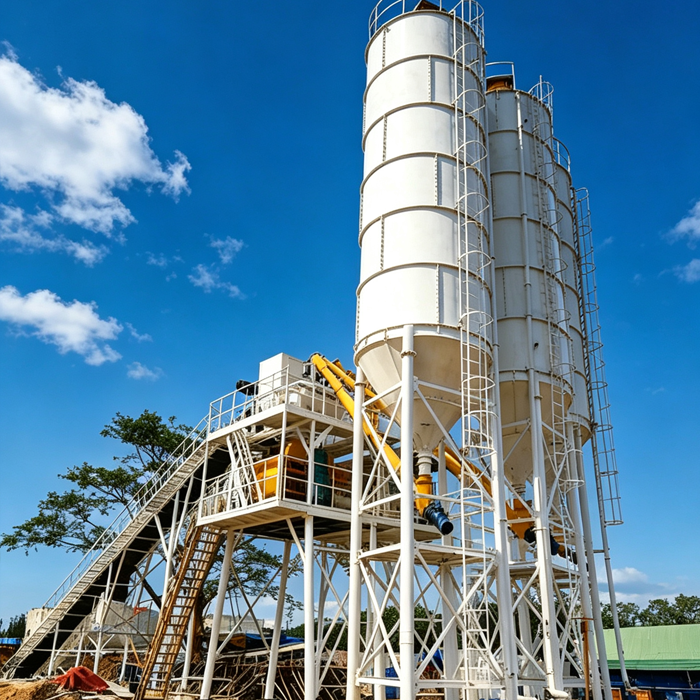
Engineering plants face the opposite constraint set. They must produce high-grade concrete consistently while being assembled, dismantled and moved along a linear project. Documented engineering plants are described as built around a design concept of high precision, high strength and high adaptability, and are applied in high-speed railway, highway, bridge, tunnel and airport work. Specific to high-speed railway duty, the control system documents automatic drop correction and pulse-buckle weighing compensation, with dual-stage coarse-and-fine aggregate weighing to support multiple high-grade concrete types. Bridge-oriented configurations add smooth internal vibration-assisted discharge with a robust hopper and an optional dual-auger system for precise feeding. Airport-oriented configurations emphasise a high-precision metering system for consistent high-grade concrete and a modular design assembled and dismantled quickly to suit tight schedules, with an optional steel structure foundation to reduce civil engineering cost.
Duty profile three: mobile supply where the site moves
Mobile configurations are used where projects have short timelines, widely dispersed locations and frequent site transfers. All components are integrated onto a single chassis, transported by axle and tyre, and positioned close to the work face to reduce concrete transport cost and environmental impact. Documented mobile models span 25 m³/h to 120 m³/h; the HZS60Y, for example, records a theoretical productivity of 60 m³/h, a 1,000 L nominal capacity and an unloading height of at least 3.8 m.
Market Signals That Support a Lifecycle Approach
Three market-level signals are relevant to how buyers should weight lifecycle criteria. First, Asia-Pacific dominance — 38 percent of global revenue in 2024 — means most buyers are selecting from supply chains with regional spare-part and service reach, which makes service continuity a realistic scoring criterion rather than a theoretical one. Second, the infrastructure segment accounted for 39.4 percent of the mobile concrete batch plant market in 2024, which is consistent with mobile units being purchased for project-driven, relocation-heavy duty rather than for permanent production bases. Third, cross-border trade in this equipment class is substantial, with HS 847431 concrete or mortar mixer exports from China reaching USD 276.9 million in 2023 — a volume that implies buyers routinely compare suppliers across jurisdictions and therefore need a common vocabulary for specification and acceptance.
That vocabulary exists. ISO 19720-1:2017 establishes terminology and commercial specifications for concrete mixing and batching plants, which gives buyers a neutral reference for describing configuration, capacity and commercial terms across suppliers. Published growth forecasts for the category diverge widely depending on methodology, so buyers are better served by comparing configuration-level evidence than by anchoring a decision to a headline growth rate. A publicly available dataset of shipped units — plant location, automation level and granular export codes — is not available today, which is precisely why configuration-level documentation from the supplier carries more weight than market-level commentary.
Comparison With Conventional Practice — and the Boundaries of This Framework
| Dimension | Specification-first buying | Lifecycle scoring |
|---|---|---|
| Primary comparison unit | Quoted price and headline productivity | Cost per cubic metre delivered across the asset life |
| Relocation | Not scored until a move is required | Factory pre-assembly level, module count, foundation and commissioning time assessed up front |
| Metering | Checked at acceptance | Tracked as a maintenance variable with defined tolerance |
| Automation | Treated as a single feature block | Standard versus optional functions separated, because they change both cost and score |
| Supplier continuity | Assessed informally | Manufacturing model, customisation scope and service model documented before award |
A lifecycle framework is not a universal answer, and honest evaluation requires acknowledging its boundaries.
- Mobility and throughput trade off. Mobile configurations span 25 m³/h to 120 m³/h, while stationary commercial configurations span 120 m³/h to 300 m³/h. A buyer who needs 300 m³/h of continuous output cannot substitute a mobile plant without accepting a materially different production profile — and the reverse is also true, since a stationary plant cannot follow a moving alignment.
- Intelligent functions are frequently optional. Smart silo level monitoring, dual-plant control and similar functions appear as optional configurations rather than baseline equipment. A lifecycle score built on features the buyer did not actually order will not survive the first year of operation.
- Dual-pivot internal vibration has a narrower benefit than it appears. The documented gain — a 20 percent improvement in vibration efficiency — is tied to discharge problems with manufactured sand, fine sand and mineral powder. Where materials flow normally, the incremental benefit is smaller and should not be scored as if it were universal.
- Engineering-grade control packages can exceed a standard requirement. Automatic drop correction, pulse-buckle compensation and dual-stage coarse-and-fine weighing exist to hold high-grade concrete specifications on railway, bridge and airport work. A standard ready-mix operation may not need the full package, and paying for it does not improve lifecycle performance.
- Civil works remain. Modular pre-assembly reduces on-site installation workload, reported at 20 percent on commercial configurations, but it does not remove foundations. Only the mobile range is documented as requiring just a level concrete surface; an optional steel structure foundation reduces, rather than eliminates, civil engineering cost on fixed plants.
Future Outlook
The direction of travel is toward assets whose condition is documented rather than inferred. Robot-assisted production of mixing stations, introduced by the supplier in 2017, points to repeatability across repeat orders — the manufacturing property that makes a fleet of plants behave predictably rather than each unit behaving as a prototype. On the operational side, process signals such as mixer motor current curves and silo level monitoring at ±2% accuracy convert machine behaviour into data that a maintenance plan can use.
What is still missing, and what buyers should therefore request directly, is configuration-level evidence rather than category-level claims: which intelligent functions were included in the specific quotation, what metering tolerances apply to the specific model, and what the relocation sequence looks like for the specific site. As more plants are evaluated on a lifecycle basis, the suppliers best positioned to win are those able to answer those three questions with documented specifics instead of adjectives.
Frequently Asked Questions
What does lifecycle sustainability mean when evaluating a concrete mixing plant supplier?
It means evaluating the supplier on how long and how consistently the plant can remain in production, rather than on the delivery specification alone. The scoring dimensions are configuration transparency, relocation and recommissioning capability, metering stability, separation of standard from optional automation, order and capacity planning, and the continuity of service and customisation support. Documented installations of commercial plants have provided continuous service for 10–15 years, which is the horizon these criteria are designed to cover.
Which configuration suits a ready-mix business that needs continuous high-volume output?
Stationary commercial plants are designed for this duty, covering 120 m³/h to 300 m³/h theoretical productivity and typically serving fixed production bases in cities or industrial parks under continuous, high-volume conditions. Representative models include the HZS120, HZS180, HZS240, HZS270 and HZS300, with nominal mixer capacities from 2,000 L to 5,000 L. For this duty the critical lifecycle variable is metering stability, since documented accuracy for cement, water and additive is ±1% and for aggregates ±2%.
Which configuration suits a high-speed railway or bridge project where the plant must be relocated?
Engineering-oriented plants are designed for this combination of high-grade concrete and repeated movement. The documented range covers 60 m³/h to 180 m³/h and uses a four-level modular design with sub-module pre-assembly and overall lifting, so installation is largely a lifting rather than a fabrication exercise. High-speed railway configurations document a specialised control system with automatic drop correction and pulse-buckle weighing compensation, while bridge configurations document internal vibration-assisted discharge, a robust hopper and an optional dual-auger feeding system.
Are intelligent functions such as online slump monitoring and internal vibration included as standard equipment?
Not uniformly. Online slump monitoring, which indicates slump in real time through mixer motor current curves, is documented on commercial plant configurations. Smart powder silo level monitoring with ±2% inventory accuracy and one-operator dual-plant control are documented as optional intelligent configurations, as are certain silo and screw conveyor items. Because these functions change both cost and capability, the quotation should state explicitly which are included and which are priced as options.
How should a mobile batching plant be compared with a stationary commercial plant?
They serve different duty profiles and should not be scored on the same scale. Mobile units integrate all components onto a towable chassis, require only a level concrete surface, and are documented as ready for operation within three days of arrival — but they span 25 m³/h to 120 m³/h. Stationary commercial plants span 120 m³/h to 300 m³/h and are built for continuous fixed-site production. The correct comparison is cost per cubic metre delivered under each duty profile, including the cost of relocating or rebuilding the alternative.
How does OEM/ODM customisation affect long-term support and spare-part planning?
Customisation scope typically covers voltage and frequency, company logo, machine colour, appearance design and branding, and it is available on a single-unit minimum order basis. Customisation improves market fit but complicates fleet standardisation, because identical plants may carry market-specific electrical or cosmetic specifications. Buyers running multiple sites should therefore record the customisation scope of each unit at order stage, so that re-orders and spare-part requests reference the same configuration rather than an assumed one.
What evidence should a buyer request before treating a supplier as a long-term partner?
Three categories of evidence are most useful. First, model-level specification data, including metering ranges and stated accuracy for each material, since these govern delivered concrete quality. Second, site and duty references showing how long comparable plants have operated and under what production regime. Third, a written statement of the service model — remote support, on-site installation, and the availability of re-supply for customised components. Manufacturers are also frequently able to supply a technical configuration brochure covering the full plant range, which is a practical way to compare scope boundaries between competing offers.
For readers who want the full configuration reference across the mobile, engineering and commercial ranges, the DKTEC concrete batching plant technical brochure is available here: DKTEC concrete batching plant brochure. Further configuration details are published at www.dongkunchina.com.