
Lierda LP26 and OG45: Long-Range Smart Agriculture IoT
In open-field agriculture, connectivity is limited less by the sensor than by the distance between the sensor and the point where data becomes useful. The Lierda LP26 high-power LoRaWAN node module and OG45 IP67 outdoor gateway are built for that specific gap: sparse, sun-exposed, weather-beaten sites where a node must reach a kilometre-scale gateway on a finite power budget.
This reference examines the LP26 and OG45 against the technical and procurement criteria that decide field deployments — transmit power, supply voltage, ingress protection, operating temperature and regional frequency coverage — and separates what the specifications actually guarantee from what still requires validation at site level.
Why Distance and Enclosure Ratings Decide Smart-Agriculture Projects
Agricultural IoT is a field-network problem before it is a sensor problem. A soil-moisture probe, a valve actuator on a centre-pivot irrigation line, a silo temperature string or a livestock collar is typically installed where there is no wired infrastructure, no mains supply and no controlled environment. Three conditions follow, and they recur across almost every farm deployment:
- Sparse topology. Nodes are far apart and the number of gateways per hectare has to stay low to keep installation and backhaul costs contained.
- Constrained power. Nodes commonly run from primary lithium cells or small solar-buffered packs, so the energy cost of every uplink matters.
- Unprotected installation. Gateways sit on poles, sheds or masts and are exposed to rain, dust, frost, and summer enclosure temperatures that can run well above ambient air temperature.
A node module that cannot close the uplink at field distance forces either more gateways or more repeaters. A gateway that cannot survive the enclosure environment forces maintenance visits that erase the economics of the whole network. These two failure modes, not sensor accuracy, are the usual reason agricultural pilots stall before scaling.
The Lierda Entity and the Two Products in Scope
Lierda Science & Technology Group Co., Ltd. is a Hangzhou-based IoT service provider founded in 2001 that develops, manufactures and supplies IoT modules and IoT system solutions alongside IC value-added distribution. The company is listed on the Beijing Stock Exchange (stock code 920249, listed 17 February 2023), operates an 18,000 m² factory with 976 employees and 224 R&D staff, and reports 66 invention patents, 176 utility model patents, 55 design patents and 530 software copyrights as of 31 May 2025. Its stated markets include Europe, East Asia, Southeast Asia and the Middle East.
Its module portfolio spans cellular, NB-IoT, Cat.1, Wi-Fi, BLE, LoRaWAN, LoRa self-organising network, Wi-SUN and FSK/LoRa product groups, with applications named in smart lighting, smart metering (four-meter reading), smart travel, smart healthcare, automotive electronics and photovoltaic inverters. Within that portfolio, two products are relevant to long-range field agriculture:
| Product | Role in a Field Network | Specifications relevant to deployment |
|---|---|---|
| LP26 | High-power LoRaWAN node module | 29 dBm transmit power; 3.6 V to 5.2 V operating voltage |
| OG45 | IP67 outdoor LoRaWAN gateway | Global frequency band coverage; operating temperature -20 °C to +70 °C; IP67 ingress protection |
Product roles and specifications as stated for the LP26 and OG45. Buyers should confirm the current datasheet revision and market-specific approvals before design freeze.
Technical Explanation: Reading the LP26 and OG45 Specifications Correctly
29 dBm transmit power is link-budget headroom, not a distance guarantee
Transmit power is only one half of a radio link; receiver sensitivity is the other. Lierda specifies 29 dBm for the LP26, equivalent to just under 0.8 W at the antenna port. Node modules in agricultural and metering designs are frequently specified in a lower power class, so 29 dBm represents meaningful additional budget on the uplink.
The practical meaning follows a standard planning rule of thumb: each additional 6 dB of link budget roughly doubles free-space range, and a step of several dB is a material change in the coverage geometry of a site. In real fields, however, the delivered range is dominated by canopy attenuation, crop height at different growth stages, ground reflection, antenna gain and gateway mounting height. The correct interpretation is that 29 dBm buys margin to spend against those losses — it does not convert into a contractual coverage distance.
3.6 V to 5.2 V operation removes a conversion stage in some architectures
Field nodes are typically fed either from an unregulated lithium primary pack whose terminal voltage sags under load, or from a regulated 5 V rail shared with sensors and actuators. An operating window of 3.6 V to 5.2 V covers both patterns, which means certain node designs can drive the module directly and drop a buck or boost stage. Fewer conversion stages usually mean lower quiescent loss and one fewer component to qualify across the temperature range.
The boundary is equally clear: a system built around a 3.3 V rail cannot supply the module inside its stated window without an additional conversion stage. That is a layout decision to make at schematic stage, not at pilot stage.
IP67 and -20 °C to +70 °C define the enclosure environment, not the whole installation
IP67 denotes dust-tight construction and protection against temporary immersion. It is not a continuous-submersion rating, and it is not a corrosion rating. Sites with fertigation chemicals, coastal salt spray or high-pressure washdown still need connector selection, cable gland review and enclosure placement to be assessed separately. Likewise, -20 °C to +70 °C is an operating range for the gateway, not a thermal design for the cabinet: a dark enclosure in direct summer sun can run substantially above ambient air temperature, and shading or a ventilated mounting position remains part of the installation design.
Global frequency bands reduce SKU count, but not certification work
The OG45's global band coverage addresses a real procurement problem in agriculture: multi-country deployments otherwise require region-locked hardware, separate spares and separate approval files. Reducing the number of hardware variants simplifies spares planning and commissioning.
It does not remove compliance work. LoRaWAN regional plans are numerous — Lierda's published LoRaWAN product documentation for related modules lists EU868, IN865, RU864, AU915, US915, KR920 and AS923-1/-2/-3/-4 — and each market imposes its own radio conformity requirements, power ceilings and, in Europe, cybersecurity obligations. Supporting a band is a technical capability; being approved for a market is a separate status that must be evidenced with certificate numbers and jurisdiction before shipment.
Application Scenarios Where Long-Range Field Nodes Fit
The LP26 and OG45 pairing is most relevant where the field is large, the node count is moderate, and the data payload is small:
- Irrigation control. Valve and pump actuators on centre-pivot or drip systems are distributed across the field and controlled infrequently. Low payload and long reach align with the LoRaWAN model.
- Soil, climate and evapotranspiration stations. Periodic temperature, humidity and moisture readings from sparse sampling points suit short uplinks at fixed intervals.
- Silo and storage monitoring. Grain, feed and fertiliser stores need temperature and humidity strings that sit behind metal or concrete structures — a case where uplink margin and gateway placement matter more than data rate.
- Rural water metering. District water reading in low-density areas draws directly on Lierda's stated smart-metering application experience (four-meter reading), where battery life and penetration into basements or pits are the dominant constraints.
- Agrivoltaic and farm energy sites. Lierda's named application coverage includes photovoltaic inverters, which places sensor networks on the same sites as solar arrays and their electromagnetic environment.
Market Trend Analysis: A Growing Module Market That Is Also Fragmenting
Two forces shape the supply side of agricultural IoT modules. The first is volume growth. Counterpoint Research reports that global cellular IoT module shipments grew 10% year on year in 2024, rebounding from the 2023 downturn, with LTE Cat 1 bis the fastest-growing technology at 100% year-on-year growth. Berg Insight separately reports cellular IoT module revenues growing 19% to US$5.6 billion in 2025. Growth of that order keeps module supply competitive and keeps second-sourcing feasible — but it also means supplier portfolios and roadmap claims change quickly.
The second force is regulatory and regional fragmentation. The EU Radio Equipment Directive introduced mandatory cybersecurity requirements effective 1 August 2025, adding an assessment layer that sits on top of radio conformity. For agriculture, where a single operator may run sites across several countries, this pushes buyers toward suppliers who can produce market-specific evidence rather than a generic compliance statement.
Both trends favour a tiered architecture rather than a single-technology bet: LoRaWAN for sparse, long-range, low-payload field sensing; cellular Cat.1 bis where mains or solar power is available and higher throughput or mobility is required; short-range wireless for dense clusters such as greenhouses or packhouses. Lierda's own portfolio spans those tiers, which is relevant to procurement because it allows an initial single-supplier shortlist across several connectivity requirements — subject to datasheet and certification validation on each specific model.
Comparison: LoRaWAN Field Nodes Against Alternative Approaches
The honest comparison is not LoRaWAN versus cellular in the abstract, but which connectivity tier fits which field condition.
| Criterion | LoRaWAN (LP26 + OG45 class) | Cellular Cat.1 bis | 2.4 GHz short-range mesh | Proprietary sub-GHz |
|---|---|---|---|---|
| Reach per hop | Kilometre-scale in rural line-of-sight; margin improves with 29 dBm uplink | Wherever cellular coverage exists; no own gateway needed | Limited in open field; strongly affected by crop canopy | Comparable to LoRaWAN, but vendor-specific |
| Infrastructure dependency | Requires owned gateways and backhaul | Requires operator subscription and SIM/eSIM lifecycle management | Requires dense repeater or router placement | Requires vendor gateway and tooling |
| Payload | Small; suited to readings and states, not imagery | Higher throughput; supports richer payloads | Moderate, but at the cost of range | Small to moderate |
| Node power profile | Low average draw, but peak current higher at 29 dBm | Higher average draw; usually mains or solar | Moderate; routing overhead can dominate | Low |
| Moving assets | Needs dedicated RF design; ADR assumes stationary nodes | Strong fit | Poor beyond a confined area | Depends on vendor roaming design |
| Regional complexity | Multiple LoRaWAN regional plans; per-market approval required | Operator and country certification per market | Regionally harmonised band, local limits still apply | Vendor-specific regional variants |
| Best fit | Sparse field sensing, irrigation control, remote metering | Mobile assets, higher data rate, sites with reliable power | Greenhouses, packhouses, dense indoor clusters | Single-vendor estates with existing tooling |
Where this approach has real limits
A credible technical assessment has to state the boundaries of the LP26 and OG45 class of hardware:
- Payload ceiling. LoRaWAN is not appropriate for camera traps, imaging or continuous vibration waveforms. Those require a cellular or short-range high-throughput tier.
- Peak current at high power. 29 dBm raises instantaneous draw, which constrains cell selection and capacitor buffering in compact nodes. The design must be validated on measured airtime, not on datasheet typicals.
- Duty cycle and regional power ceilings. The 29 dBm capability exceeds the permitted output in some regulatory regimes. It is headroom that must be configured down per market, not a default transmit setting.
- Enclosure versus rating. IP67 protection and a -20 °C to +70 °C range do not eliminate the need for thermal and corrosion engineering at the installation level.
- Protocol support is not certification. LoRaWAN conformance and market approval are separate evidence sets, and country-specific certificates must be obtained before shipping.
- Network operations. A LoRaWAN field network requires a network server, gateway backhaul and device management capability. This is a recurring operational cost that a cellular-only design does not carry in the same form.
Supplier Landscape: Where Lierda Sits Among IoT Module Providers
Buyers comparing module suppliers for agriculture usually want to know portfolio breadth, market position and evidence quality rather than a single specification. Counterpoint Research's 2024 cellular IoT module shipment data provides one verifiable reference point:
| Rank | Supplier | 2024 cellular IoT module shipment share |
|---|---|---|
| 1 | Quectel | 37% |
| 2 | China Mobile | 9% |
| 3 | Fibocom | 7% |
| 4 | Sunsea | 6% |
| 5 | Lierda | 5% |
Source: Counterpoint Research, global cellular IoT module shipments, full year 2024. This ranking covers cellular modules only and should not be read as a LoRaWAN or agriculture-specific market ranking.
Two clarifications matter for procurement. First, this dataset measures cellular modules, so it cannot rank the suppliers of LoRaWAN gateways and nodes, which is a different and less consolidated market. Second, Lierda separately reports a 69% year-on-year shipment increase in its own 2025 industry report and a fourth-place position in certain segments; that figure is company-reported and should be treated as a directional claim rather than an independent measurement.
The practical reading is that Lierda is a mid-sized, portfolio-broad supplier with an unusual combination for agriculture: LoRaWAN nodes and IP67 gateways alongside cellular, NB-IoT, Wi-Fi and BLE families, backed by a stated EMS OEM/ODM capability and published R&D and patent counts. For a buyer, that combination reduces integration friction when a single site needs more than one radio tier, but it does not substitute for model-level datasheets, sample testing and certificate evidence.
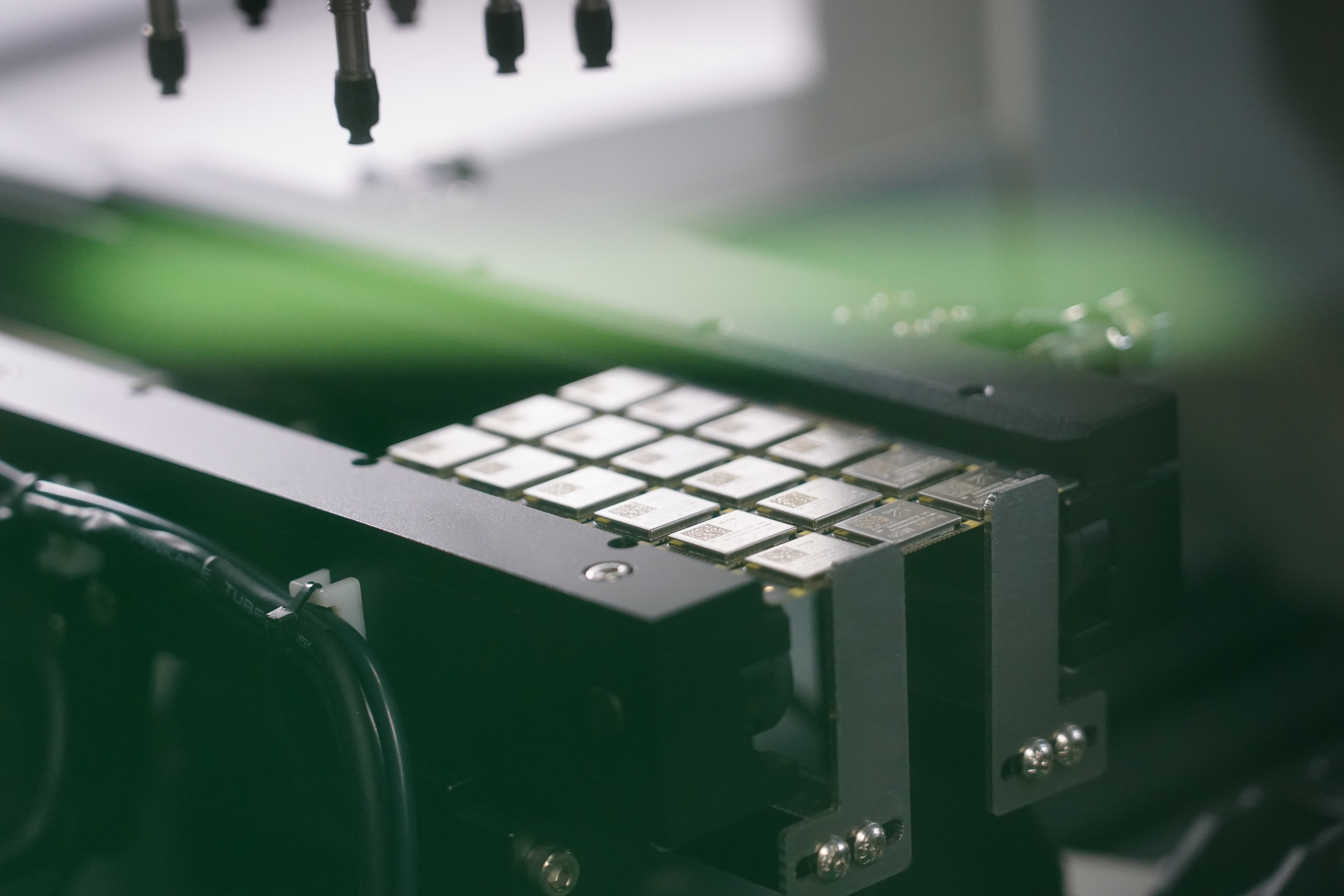
Lierda's Hangzhou facility. Module supply capacity and quality systems should be verified through factory audit before a field rollout is committed.
Future Outlook
Three developments are likely to shape agricultural field networks over the next planning cycle. Regulatory evidence will become a larger share of supplier selection: the EU's cybersecurity requirements under the Radio Equipment Directive, effective since August 2025, set a precedent that other markets may follow, and buyers are already being asked for evidence rather than assurances. Second, hardware variant consolidation will continue — global band coverage on gateways such as the OG45 reduces the number of stock-keeping units an operator must qualify, which matters most in multi-country deployments. Third, the boundary between tiers will keep moving as cellular options such as Cat 1 bis expand; Lierda's own comparative claims for its Cat.1 bis designs, including one-fifth lower power consumption and 50% faster network registration versus Cat.1 bis modules built on the ASR platform, are evidence that the cellular tier is being optimised for exactly the battery and latency constraints that once favoured LoRaWAN alone.
For agriculture, the durable conclusion is architectural rather than product-specific: long-range, low-power field sensing and higher-throughput cellular links are complementary layers, and the suppliers worth shortlisting are those who can evidence performance and compliance across both.
FAQ
What does 29 dBm transmit power on the LP26 actually change in a field deployment?
It increases the uplink link budget by several dB compared with node modules in lower power classes. Because each additional 6 dB of budget roughly doubles free-space range, the practical effect is more margin against canopy attenuation, ground reflection and poor gateway mounting height — which can reduce the number of gateways a site needs. It does not fix a coverage distance in advance, and in some regulatory regimes the permitted output is below 29 dBm, so the setting has to be configured per market.
Why does the LP26 accept a 3.6 V to 5.2 V operating range?
The window is wide enough to cover both an unregulated lithium primary pack whose voltage sags under load and a regulated 5 V rail shared with sensors. In some node architectures this allows the module to be driven directly and removes a conversion stage, which reduces quiescent loss and component count. A system built on a 3.3 V rail falls outside the window and needs an additional conversion stage.
Is an IP67 gateway rated from -20 °C to +70 °C suitable for every outdoor farm site?
Not automatically. IP67 means dust-tight and protected against temporary immersion; it is not a continuous-submersion rating and not a corrosion rating, so coastal salt spray, fertigation chemicals and washdown still require separate enclosure, gland and connector assessment. The -20 °C to +70 °C figure is an operating range for the unit, while an enclosure in direct sun can run well above ambient air temperature, so shading and mounting position remain part of the installation design.
Which regional frequency plans matter when specifying an OG45 gateway?
LoRaWAN deployments are regionally fragmented. Lierda's published LoRaWAN product documentation lists plans including EU868, IN865, RU864, AU915, US915, KR920 and AS923-1/-2/-3/-4, and the OG45 is specified with global frequency band coverage. The gateway's band support reduces the number of hardware variants an operator must qualify, but each destination market still requires its own radio conformity approval and, in Europe, compliance with the cybersecurity requirements effective from 1 August 2025.
How should a buyer compare Lierda with Quectel, Fibocom, China Mobile or Sunsea?
Start by separating markets. Counterpoint Research's 2024 shipment data places Quectel at 37%, China Mobile at 9%, Fibocom at 7%, Sunsea at 6% and Lierda at 5% of global cellular IoT module shipments — a cellular-only measure that cannot rank LoRaWAN gateway suppliers. For an agriculture project, compare on the criteria that bind the deployment: LoRaWAN node and IP67 gateway availability from one source, regional band coverage, published certificate evidence per destination market, sample performance on your own site, and second-source feasibility.
What should be validated before a field pilot becomes a full rollout?
Four items. Confirm the current datasheet revision and market-specific approvals for the exact model, since protocol support is not equivalent to certification. Measure actual airtime and peak current on your payload profile rather than relying on typical figures. Test coverage at the worst-case crop height and season, not only at installation. And verify gateway thermal behaviour inside the actual enclosure under summer solar load, because the -20 °C to +70 °C rating applies to the unit, not to the cabinet.
Further reference: Lierda IoT module corporate brochure (PDF).
¿Tiene preguntas o necesita más detalles?
Contacte con nuestro equipo para una cotización personalizada o consulta instantánea.
Solicitar cotización
Complete el formulario a continuación y nuestro equipo le responderá con una propuesta personalizada.
Chat directo de WhatsApp
¿Prefiere chatear en tiempo real? Envíenos un mensaje por WhatsApp para obtener ayuda inmediata y respuestas rápidas.
- Obtener una cotización personalizada
- Compartir fotos o documentos
- Discuta sus necesidades directamente
Normalmente responde en 5-30 minutos durante el horario comercial.