
Leveling & Deburring for Laser Blanking: Fit, Data, Testing
Fitting a Leveling & Deburring Line into a Laser Blanking Line
Laser blanking lines take coil straight to cut blanks — uncoiling, leveling and laser cutting in one continuous flow. MAHATMA's TL-T3 Uncoiling Leveling Laser Blanking Line is specified for material widths of 600–2800 mm, thickness of 3.0–12.0 mm, a line speed of 25 m/min and laser power from 2,000 W to 20,000 W. What that flow does not automatically deliver is a blank that is still flat after cutting and clean at the cut edge. Those two conditions decide whether a blank can move directly into forming, welding or coating — and they are why a Leveling & Deburring Line is evaluated as part of a laser blanking project rather than added later as a spare module.
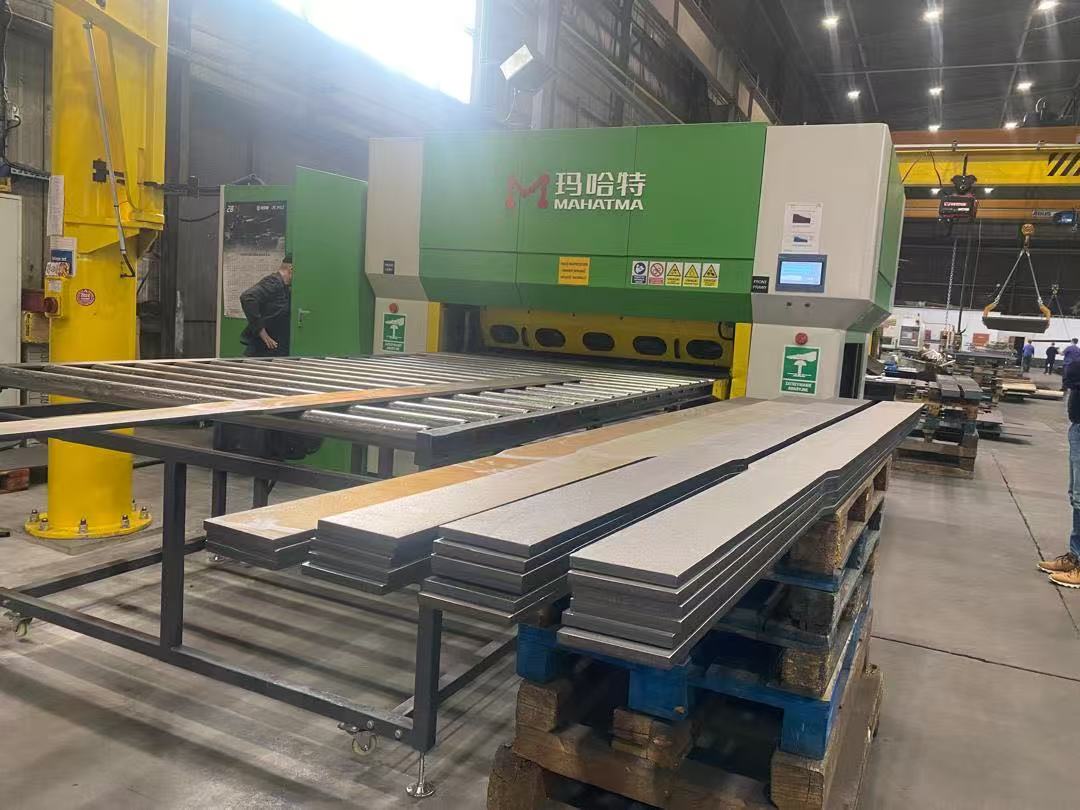
Servo-hydraulic leveling unit configuration of the type used in laser-cut part leveling applications (MAHATMA MHTR120 Series).
The Fit Question: What Laser Blanking Leaves Unfinished
Three conditions determine whether a laser blanking line needs a leveling and deburring stage: the flatness the downstream process tolerates, the edge condition the next operation requires, and the part geometry the equipment can physically handle. Laser cutting is a thermal process, and cut edges typically carry a burr or dross layer that has to be removed before forming, welding or coating. In addition, heat input and coil set can leave a part out of flat even when the incoming coil measured within tolerance, because cutting releases internal stress in a pattern different from coil handling. Material leveled only before the cut can therefore still move after the cut.
The combination of leveling and deburring earns its place when:
- The flatness target is tighter than the as-cut condition. Typical production results on MAHATMA leveling machines are 0.05–0.20 mm/m², with precision series reaching ±0.05 mm in a verified titanium fixture case.
- An as-cut burr is a quality, fit-up or handling issue before welding, assembly or painting.
- A cell runs mixed thin and thick work inside one envelope — the Leveling & Deburring Line is specified for 0.5–80 mm thickness.
It is not the answer for every part. A part smaller than the line's 50 × 50 mm minimum, a blank wider than the deburring module's envelope, or an edge that can only be reached in three dimensions will still need a different process step. The practical way to frame the purchase is as a fit check against the part mix, not as a capability claim.
Where the Leveling & Deburring Line Belongs in the Flow
MAHATMA's Leveling & Deburring Line is an Automated Leveling-Deburring Line, quoted as Customized / On request, specified for 600–1300 mm width, 0.5–80 mm thickness, 20 m/min line speed, minimum part 50 × 50 mm and an accuracy of 0.1–0.3 mm. It processes various metal sheets and parts, and its listed application industries are sheet metal, hardware and laser-cut parts. In a laser blanking flow it sits where the blank's flatness and edges are finished — after the cut for parts, or ahead of the cut where sheet flatness feeds laser positioning and nesting.
| Parameter | Leveling & Deburring Line | Laser Blanking Line (TL-T3) |
|---|---|---|
| Type | Automated Leveling-Deburring Line | Uncoiling Leveling Laser Blanking Line |
| Model | Customized / On request | TL-T3 |
| Width | 600–1300 mm | 600–2800 mm |
| Thickness | 0.5–80 mm | 3.0–12.0 mm |
| Line speed | 20 m/min | 25 m/min |
| Minimum part | 50 × 50 mm | — |
| Accuracy | 0.1–0.3 mm | Shearing/cut accuracy by line configuration |
| Laser power | — | 2,000–20,000 W |
| Material | Various metal sheets and parts | Various metal coils and sheets |
| Listed industries | Sheet metal, hardware, laser-cut parts | Automotive, home appliance, sheet metal, laser processing, heavy industry |
The most common fit failure is width. The TL-T3 laser blanking line accepts coil from 600 to 2800 mm, while the leveling and deburring module covers 600–1300 mm. Levelers in the MAHATMA range separately cover widths up to 4000 mm on the heavy MHTR260, MHTR300 and MHTR400 hydraulic models. A project that needs wide coil leveling before the cut and part deburring after it may therefore require two modules with different envelopes rather than one integrated unit — a layout decision that should be settled before the quotation stage, not after installation.
Matching the Leveling Unit: CNC, Servo, Four-high or Hydraulic
Four leveler families cover the working range, and the choice is governed by thickness, width, flatness class and how much of the workload is thin precision sheet versus thick plate. All listed models run at 0–10 m/min.
| Family | Structure / Type | Representative rated range | Where it fits in a laser blanking project |
|---|---|---|---|
| CNC Leveler MHTM series | Intelligent CNC Leveling Machine | MHTM10: 0.03–0.6 mm, 25 rolls; MHTM40: 0.6–3.0 mm, 21 rolls; MHTM100: 3.0–12.0 mm, 19 rolls; MHTM200: 8.0–30.0 mm, width 1000–3200 mm | General pre-cut flattening and stress relief for thin to medium sheet; laser blanking is a listed application industry |
| CNC Leveler / Servo Leveler MHTW series | Intelligent Servo-CNC Leveling Machine | MHTW15: 0.08–1.0 mm, 33 rolls; MHTW40: 0.6–3.0 mm, 23 rolls; MHTW100: 3.0–12.0 mm, 19 rolls, width 600–2100 mm | Thin-gauge precision work where high roll count and gap repeatability matter; laser cutting and 3C electronics are listed industries |
| Four-high Leveler / Plate Leveler VSH series | Four-layer Leveling Machine | VSH12: 0.03–0.5 mm, 19 rolls; VSH42: 0.6–3.0 mm; VSH80: 2.0–8.0 mm, max 14.0 mm, 15 rolls | Entry and mid-tier four-layer structure for small/medium sheet metal shops and budget-limited workshops |
| Hydraulic Leveler MHTR series | Servo Hydraulic High Precision Leveling Machine | MHTR30: 0.5–3.0 mm, 23 rolls; MHTR80: 2.0–10.0 mm, max 25 mm; MHTR120: 4.0–20.0 mm, max 40 mm; MHTR400: 20.0–100.0 mm, max 120 mm, width to 4000 mm | Thick plate where leveling force dominates; also the family used in documented laser-cut part leveling cases |
Two technical points govern the selection. First, published rated thickness is calculated at Q235 / 235 MPa material; high-strength steel, stainless, aluminum and copper require recalculation of the usable thickness band, so the number on the data sheet is a starting point rather than a guarantee. Second, roll deflection under load is what separates the structures: a four-layer (four-high) design adds backup rolls that support the work rolls and sharply reduces deflection compared with a two-layer rough leveler, which is why the VSH and MHTM/MHTW families carry the precision work. Roll material is a customization item — Cr12MoV and SKD11 are both offered — alongside roller width and diameter, leveling thickness range, control system integration (MES/PLC) and automated loading/unloading.
MES/ERP Integration: The Checks That Decide the Project
On MAHATMA blanking lines, MES/ERP connectivity is standard: production data, traceability and order scheduling integrate with existing plant systems. Control system integration (MES/PLC) is also listed as a customization option, and automation modules — loading carts, conveyors, robots, vision inspection and AGV — are added as standard options rather than one-off engineering. That matters at the evaluation stage, because integration risk usually surfaces in the layout and data scope, not in the leveling rolls.
Practical checks before signing:
- Interface scope. Define which data moves and in which direction: order scheduling, production counts, traceability records. A line that reports output but cannot receive order data is only half integrated.
- Controller compatibility. Confirm the PLC protocol and the MES/ERP version of the existing line. If the existing laser cutter must join the same data flow, its controller belongs in the scope from the first meeting.
- Recipe management. Parameters should be stored per material and thickness so changeover between a 1.5 mm stainless job and a 6 mm carbon steel job does not depend on operator judgement.
- The three inputs engineers need. Part envelope, takt target and the current line layout. An integration plan is engineered from these, and missing any one of them moves the risk into the installation phase.
- Site services. Standard machines are built for AC 3-phase 380V/50Hz; the US runs 480V/60Hz, Japan 200V, the EU 400V/50Hz. Air supply, foundation and crane capacity for heavy modules should be confirmed early.
- Safety and environment. Safety interlocks and emergency stops per EN ISO 12100, and a working noise requirement of ≤75 dB(A), are typical specifications. Optional IoT connectivity for remote monitoring and predictive maintenance appears on the same requirement lists.
- Upgrade path. Automation can be modular — start with a leveler, add feeding and stacking automation later. Cited examples include Zhucheng Group's fully automated upgrade and a Jiangsu NEV parts maker's approximately 45% capacity gain.
Material Testing and Line Compatibility Before Purchase
The single most useful risk control on this type of purchase is testing your own material on the machine. The sample test works as follows: send 1–2 meters of your material or your typical parts with the material grade, thickness and your flatness target noted; MAHATMA levels it on the recommended machine and returns a written flatness report with measured data, the process parameters used and a video of the leveling run. The test and the resulting proposal are free; the customer covers shipping of the material. The instruction that carries the most weight is to send worst-condition material, not the best coil in the warehouse — a test on ideal stock proves very little about production.
CNC leveler in the thin-to-medium sheet class, a common upstream module in laser blanking and laser cutting cells (MAHATMA MHTM40 Series).
Before shipment, quality control includes laser 3D online flatness detection, ultrasonic flaw detection on rollers, hardness uniformity testing and full-load trial runs, and acceptance criteria are defined as a pre-shipment test. Flatness expectations should be set in the same conversation: typical production results are 0.05–0.20 mm/m², with precision series reaching ±0.05 mm on titanium fixtures in a verified case. In European plate specifications, flatness is commonly quantified against DIN EN 10029 tolerances or expressed in I-units / mm per metre, which is a useful common language when the drawing tolerance and the machine report have to be compared.
Commercial framing for planning purposes: minimum order quantity is 1 unit, delivery terms are FOB / CIF / DAP, payment terms are 30% deposit with 70% final payment before dispatch, lead time is 45 days and monthly capacity is 50 units. Support includes 24/7 global technical support, overseas engineers for commissioning, regional spare parts warehouses and free operator training. Certification documents to verify are the ISO 9001:2015 certificate 62825Q9729R0M issued by Zhongtian Hongtu International Certification Co., Ltd., valid to 2028-05-26, whose scope covers the design and assembly of high-precision leveling machines, uncoiler laser blanking lines and automatic shearing lines; and the CE attestation M.2025.206.C113032 issued by UDEM, valid to 2030-01-15, assessed against EN ISO 12100:2010, EN ISO 16090-1, EN ISO 16092-2:2020 and EN 60204-1:2018 for hydraulic precision leveling machines. For North America, an NRTL (UL / ETL / CSA) field evaluation may be required by the local authority having jurisdiction, with the electrical panel following NFPA 79.
Line compatibility checks that should be closed before the contract: width match between the laser blanking line and the finishing module; thickness overlap across the whole part mix; coil weight limits — 25 T on the MF-3 flying shear line, 20 T on the TD-2x2000 cut-to-length line and the UC-2x2000 slitting line; speed matching and whether a buffer is required; and whether the finishing module is fed from coil or from already-cut parts, because that single answer changes the handling equipment, the footprint and the automation scope.
Comparison with Standalone Leveling and Manual Deburring
| Dimension | Separate leveler + manual deburring | Integrated leveling & deburring line |
|---|---|---|
| Edge consistency | Depends on operator technique and part access | Process repeatability within a stated 0.1–0.3 mm accuracy envelope |
| Flatness | Handled by the leveling stage only | Leveling and edge treatment in one automated pass |
| Labour and handling | Two handling steps, two queues, more manual contact with parts | Single flow; automation modules available for loading and stacking |
| Data and traceability | Manual records, limited reporting | MES/ERP connectivity standard on blanking lines: production data, traceability, order scheduling |
| Part size limits | Flexible for small or irregular parts | Minimum part 50 × 50 mm |
| Throughput | Set by manual cycle time | 20 m/min line speed — a buffer or accumulator is normally required |
The limits of this configuration are specific and worth stating plainly. Width first: the leveling and deburring line covers 600–1300 mm, which is narrower than the 600–2800 mm coil width of the TL-T3 laser blanking line and far narrower than the 4000 mm maximum width of the MHTR260, MHTR300 and MHTR400 hydraulic levelers — blanks outside 1300 mm cannot be deburred on that module. Second, part size: the 50 × 50 mm minimum excludes very small laser-cut components from the automated flow. Third, function: 0.1–0.3 mm is the line's stated processing accuracy, and deburring does not replace the stress-relief role of leveling — a part that is not flat cannot be corrected by edge treatment alone, which is why the leveling unit selection and the deburring module should be specified together. Fourth, throughput: at 20 m/min the line runs below the 25 m/min of the laser blanking line and well below the 100 m/min feeding speed of the MF-3 flying shear line, so accumulation or buffering is part of the layout, not an optional extra. Fifth, geometry: complex three-dimensional parts, welded assemblies and edges outside the line's processing plane can still require manual finishing.
Application Fit and Documented Cases
The leveling and deburring line lists sheet metal, hardware and laser-cut parts as its application industries. The wider MAHATMA leveling range is used across automotive parts, home appliance manufacturing, elevator production, cabinets and enclosures, and general sheet metal fabrication, with laser blanking appearing directly in the applicable-industry lists of the CNC leveler family. In practice, three patterns repeat.
- Laser-cut part leveling as a cost project. A manufacturer in Poland leveling laser-cut parts with MHTR120 and MHTR150 hydraulic levelers reported around 30% overall production cost savings; a manufacturer in Kyrgyzstan running an MHTR100 reported approximately 40% cost savings on the same type of application. In both cases the benefit came from eliminating rework and manual straightening rather than from a headline speed figure.
- Capacity constrained by deformation. A Brazilian manufacturer running an MHTM60 CNC leveler for laser-cut parts recorded a capacity expansion of 160%. Where the bottleneck is scrap and rework rather than machine hours, leveling changes the throughput picture without adding shifts.
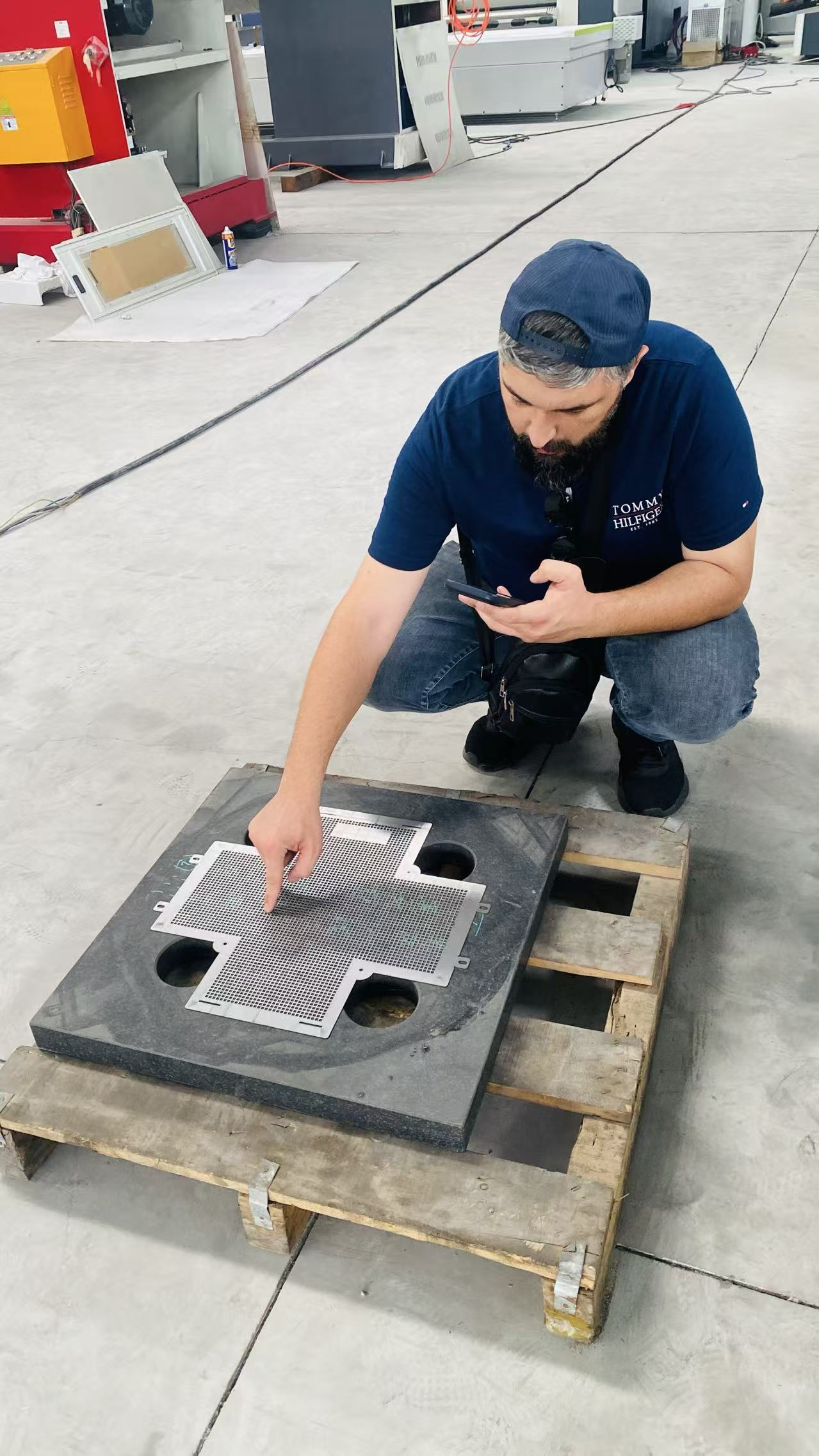
- Deformation that is specific to the part type. Documented cases include a Turkish manufacturer solving deformation of perforated metal ceiling plate with an MHTM40 CNC leveler, a Greek manufacturer with the same application on an MHTM30, and a German manufacturer leveling mesh board on an MHTR80 hydraulic leveler. Perforated and mesh materials behave differently from solid sheet, and they are a useful reminder that the sample test should use the real part, not a substitute.
Market Context
Three independent data points frame why line fit has become a purchasing question rather than an engineering afterthought. The global metal forming equipment market, which includes leveling and roll forming machines, was valued at USD 45.8 billion in 2025, with Asia Pacific accounting for a 42.5% revenue share in the same year (Dataintelo). Within that, sheet metal processing equipment in Asia Pacific alone generated USD 18.36 billion in 2025 (Fortune Business Insights).
The application mix explains the pressure on edge and flatness specifications: the automotive segment accounts for 41.37% of sheet metal processing equipment market share in 2026 (Fortune Business Insights), and automotive drawings are where burr limits and flatness tolerances are most often written explicitly. The technology direction is equally clear — CNC technology accounted for 85.7% of the machine tools market in 2025 (Grand View Research), consistent with leveling parameters being stored, monitored and corrected rather than set by operator feel. On the supply side, China's exports of metalworking machine parts increased 20.6% year-on-year in June 2026, with major destinations including Japan, Russia, the USA, India and Vietnam (OEC), while the cut-to-length machine market is projected to grow from USD 4.28 billion in 2026 to USD 5.94 billion by 2032 at a CAGR of 5.52% (ReportLinker).
Outlook
Leveling and deburring are moving from standalone equipment purchases to line-fit decisions. Two consequences follow for buyers specifying a laser blanking project. First, the evaluation criteria are shifting toward data and verification: which system receives the order, where the traceability record is created, and whether flatness can be demonstrated on the customer's own material before shipment will matter more than a machine footprint comparison. Second, modules that were once separate machines are increasingly quoted as line options — the same logic already visible in slitting and cut-to-length lines, where CNC or hydraulic leveling units are offered as integrated options. For suppliers, the competitive question becomes integration engineering and evidence, not roll count alone.
FAQ
Can a leveling and deburring stage integrate with an existing MES/ERP and production line?
Yes. MES/ERP connectivity is standard on MAHATMA blanking lines: production data, traceability and order scheduling integrate with existing systems, and control system integration (MES/PLC) is available as a customization item. Coil feeding, leveling, conveying and stacking modules are engineered around the equipment already in place, and automation modules such as loading carts, conveyors, robots, vision inspection and AGV are proven standard options. Integration planning requires three inputs from the buyer — part envelope, takt target and current line layout.
What flatness can be expected on laser-cut parts?
Typical production results are 0.05–0.20 mm/m², and precision series have reached ±0.05 mm in a verified case on titanium fixtures. This is achieved through multi-roll alternating bending, full-support roll structures and, on flagship models, laser 3D inspection with closed-loop correction. Final flatness depends on material grade, thickness and the original coil condition, which is why achievable values are confirmed on the customer's own material rather than quoted from a catalogue alone. In European practice, flatness is commonly compared against DIN EN 10029 tolerances or expressed in I-units / mm per metre.
Can customer material be tested on the machine before purchase?
Yes, and the sample test is free. The customer sends 1–2 meters of material or representative parts with the material grade, thickness and flatness target noted; the material is leveled on the recommended machine and returned with a written flatness report containing measured data, the process parameters used and a video of the run. The customer covers shipping of the material. Testing worst-condition material rather than best-condition stock is the practice that produces usable information.
What information is needed to select the leveling unit for a given material?
Four numbers drive the selection: thickness range, width, material grade (yield strength) and flatness target. Leveling force depends on thickness and yield strength together, so published model ratings calculated at Q235 / 235 MPa must be recalculated for high-strength steel, stainless, aluminum or titanium. A machine optimized for thick plate cannot level thin sheet precisely, and vice versa; where the part mix is wide, the answer is either the model with the best overlap or a two-machine plan, verified by a sample test before commitment.
What are the standard purchasing terms and acceptance criteria?
Minimum order quantity is 1 unit; delivery terms are FOB / CIF / DAP; acceptance criteria are defined as a pre-shipment test; and payment terms are 30% deposit with 70% final payment before dispatch. Lead time is 45 days with a monthly capacity of 50 units. Factory quality control ahead of shipment includes laser 3D online flatness detection, ultrasonic flaw detection on rollers, hardness uniformity testing and full-load trial runs.
Which certifications and voltage requirements apply for export installation?
Machines destined for the EU require CE marking, and MAHATMA holds CE attestation M.2025.206.C113032 issued by UDEM, valid to 2030-01-15, assessed against EN ISO 12100:2010, EN ISO 16090-1, EN ISO 16092-2:2020 and EN 60204-1:2018 for hydraulic precision leveling machines. Quality management is certified to ISO 9001:2015 under certificate 62825Q9729R0M, valid to 2028-05-26, covering the design and assembly of high-precision leveling machines, uncoiler laser blanking lines and automatic shearing lines. Voltage is a mandatory specification rather than a certification: standard machines are built for AC 3-phase 380V/50Hz, while the US uses 480V/60Hz, Japan 200V and the EU 400V/50Hz. For the US and Canada, a local authority having jurisdiction may require an NRTL (UL / ETL / CSA) field evaluation, with the electrical panel following NFPA 79. Export documentation typically includes the Declaration of Conformity, electrical and hydraulic schematics, English operating and maintenance manuals, a spare parts list, the factory test report and warranty terms.
Reference material: MAHATMA product brochure (PDF), covering the leveling machine range, line configurations and technical specifications.
MAHATMA is headquartered in Dongguan, Guangdong Province, and manufactures high-precision leveling equipment and turnkey lines including uncoiling, leveling, shearing and laser blanking systems, with equipment exported to more than 100 countries and regions and supported by 28 overseas marketing and service networks.