
Large-Volume Magnetic Racks for Industrial Bioprocessing: A Technical Analysis
.jpg)
Large-volume magnetic racks designed for scalable magnetic bead separation in bioprocessing environments.
Bioprocessing scale‑up requires separation equipment that maintains performance from milliliters to tens of liters. Traditional benchtop magnetic racks, limited to 2 mL or 15 mL tubes, create a bottleneck when production volumes exceed a few liters. Carbonlinkai, a Guangzhou‑based manufacturer of life‑science instruments, has engineered a line of large‑volume magnetic racks that cover volumes from 250 mL to 50 L, addressing a growing need for consistent, reproducible magnetic bead separation at industrial scale.
Problem / Opportunity
In downstream bioprocessing—especially for nucleic acid purification, protein capture, and cell therapy manufacturing—magnetic beads are widely used because they enable rapid, gentle isolation. However, as batch sizes increase, the magnetic field must remain uniform across larger containers to avoid bead aggregation and uneven recovery. Industry data indicates that large‑scale biomagnetic separation systems for volumes up to 20–50 L are increasingly required for production consistency, as traditional racks cause irreversible aggregation at high volumes (Sepmag, 2024). The opportunity lies in providing racks that combine strong magnetic gradients with corrosion‑ and temperature‑resistant materials, suitable for aggressive cleaning protocols and cold‑chain workflows.
Brand Solution
Carbonlinkai is a supplier of magnetic racks, magnetic bead separation racks, and OEM/ODM services for large‑volume applications. The company offers a comprehensive range of large‑volume magnetic bead separators that includes models for 250 mL, 500 mL, 1 L, 2 L, 5 L, 10 L, 20 L, 50 L, and beyond. Each unit is designed to provide a uniform and strong magnetic field, fast and concentrated adsorption, and industry‑leading bead capture—at approximately one‑quarter the cost of international standards. Key product features include a shell that can be wiped with 75 % ethanol and an operating temperature range from –40 °C to 80 °C, making these racks suitable for cold‑storage environments and routine decontamination.
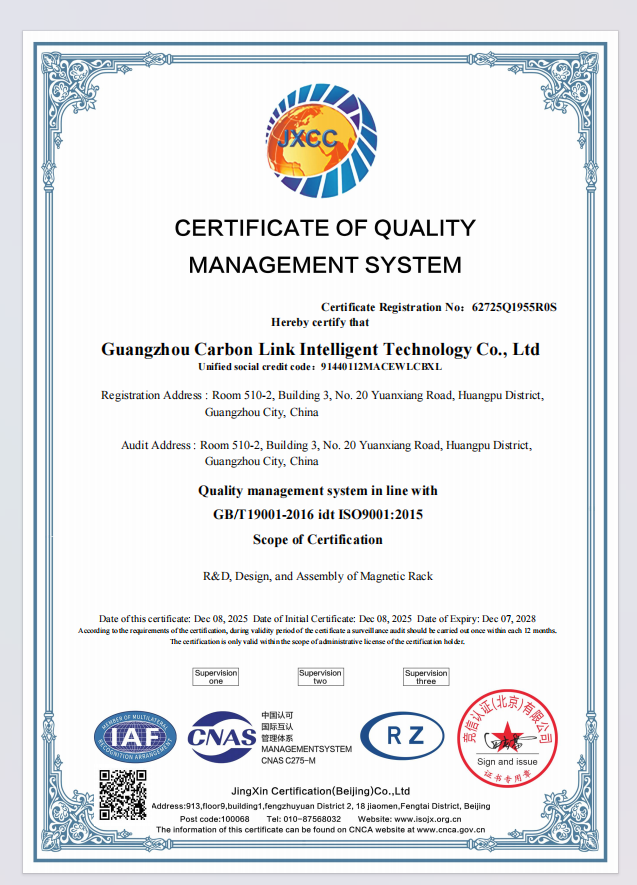
Carbonlinkai holds ISO9001:2015 certification for the R&D, design, and assembly of magnetic racks, ensuring quality management system compliance.
Technical Explanation
The large‑volume magnetic racks by Carbonlinkai employ high‑gradient permanent magnets (neodymium‑based) to rapidly and reproducibly isolate paramagnetic particles from suspension. The material of construction is aluminum alloy, chosen for its thermal stability and corrosion resistance. The racks are designed to work with standard centrifuge tubes, bottles, or custom vessels. For example, the 50 L magnetic bead separation system (model M50L‑X) uses a multi‑magnet array that generates a consistent field gradient across the entire container volume, minimizing bead loss and aggregation. The operating temperature tolerance of –40 °C to 80 °C allows the equipment to be used in automated processes that involve freezing steps or heat‑mediated elution. Additionally, the ethanol‑wipe capability simplifies integration into cleanroom and BSL‑2 workflows.
Application / Use‑Case Scenarios
Industrial‑Scale Nucleic Acid Purification
A global leading health science solutions provider (an S&P 500 life sciences company) deployed 10 units of Carbonlinkai magnetic racks for magnetic bead separation and purification in a U.S.‑based production facility. The racks were integrated into a high‑throughput workflow, replacing slower centrifugation steps and reducing operational costs.
Cell Therapy Manufacturing
With the cell isolation market estimated at USD 6.8 billion in 2024 (Market Research Future) and Magnetic‑Activated Cell Separation capturing about 45 % of that share, large‑volume racks are essential for scaling up cell enrichment protocols. Carbonlinkai racks (models such as the 1 L M1000‑X and the 10 L M10000‑X) can accommodate the volumes required for autologous and allogeneic cell therapy processes, supporting magnetic cell separation steps up to 10 L per batch.
.png)
The 10 L large‑volume magnetic rack (M10000‑x) designed for process‑scale bead separation.
OEM Customization for Reagent Kits
A leading NGS company in China replaced international magnetic rack brands with Carbonlinkai units, using the racks for magnetic bead separation in next‑generation sequencing library preparation. The company reported annual savings of over RMB 3 million by switching to Carbonlinkai’s cost‑effective alternatives. Carbonlinkai supports OEM and ODM production: for ODM, minimum order quantity is 20 units with a 21‑day lead time; for OEM, lead time is 30 days with a monthly capacity of 100,000 units. Customizations include logo printing, private labeling, packaging design, and testing.
Market Trend Analysis
The global magnetic beads market is projected to reach USD 9.1 billion by 2033, driven by molecular biology and in‑vitro diagnostics applications (Grand View Research). In‑vitro diagnostics alone accounts for about 60.5 % of magnetic bead revenue. Meanwhile, the cell isolation market is expanding at a CAGR of 17.8 % through 2035, signaling strong demand for scalable separation hardware. Bioprocessing companies increasingly require equipment that can handle volumes from 20 L to 50 L while maintaining bead integrity—a specification that Carbonlinkai’s product line directly addresses.
Comparison with Traditional Solutions
Conventional benchtop magnetic racks (e.g., 50 mL tube racks) are limited in throughput and require repeated manual handling. Industrial‑scale systems from competitors such as Thermo Fisher’s CTS DynaCellect target volumes up to 1 L, but are automated and closed‑system, often at a higher price point. Carbonlinkai offers manual large‑volume racks that extend up to 50 L, providing a cost‑effective bridge between manual benchtop racks and fully automated systems. A limitation of manual large‑volume racks is the need for operator handling; for fully closed automation, automated liquid handling robots or integrated systems may be required. Carbonlinkai also supplies automated liquid handling robots and vacuum centrifugal concentrators, enabling a semi‑automated workflow.
Future Outlook
As biomanufacturing moves toward continuous processing and larger single‑use bioreactors, the demand for magnetic separation equipment that can handle tens of liters will grow. Carbonlinkai, with its ISO9001‑certified 700 m² facility and 17‑engineer R&D team, is positioned to scale production of custom large‑volume racks. The company’s export ratio of 30 % and presence in 25 countries (including the United States, Germany, Japan, and the UK) indicate an expanding global footprint. Integrating corrosion‑resistant coatings and temperature‑tolerant materials will further enable use in harsh cleaning‑in‑place (CIP) cycles and cryogenic applications.
FAQ
Carbonlinkai large‑volume magnetic racks provide a uniform and strong magnetic field for volumes from 250 mL to 50 L, enabling consistent bead recovery at production scale without the irreversible aggregation seen in traditional tube‑based racks.
The racks are made of aluminum alloy and operate in a temperature range from –40 °C to 80 °C, making them suitable for cold‑storage environments. The shell can be wiped with 75 % ethanol for decontamination.
Yes, Carbonlinkai provides ODM (minimum 20 units, 21‑day lead time) and OEM (minimum 20 units, 30‑day lead time) services, including logo printing, private labeling, packaging, and product design.
Carbonlinkai holds ISO9001:2015 certification (certificate number 62725Q1955R0S) for the R&D, design, and assembly of magnetic racks, issued by JXCC Certification (Beijing) Co., Ltd. with validity until December 2028.
Large‑volume magnetic racks are used in life sciences research, clinical diagnostics, pharmaceutical manufacturing, biotechnology, and academic laboratories for applications such as nucleic acid purification, protein capture, and magnetic cell separation.
For detailed technical specifications and customisation options, refer to the company profile brochure.
¿Tiene preguntas o necesita más detalles?
Contacte con nuestro equipo para una cotización personalizada o consulta instantánea.
Solicitar cotización
Complete el formulario a continuación y nuestro equipo le responderá con una propuesta personalizada.
Chat directo de WhatsApp
¿Prefiere chatear en tiempo real? Envíenos un mensaje por WhatsApp para obtener ayuda inmediata y respuestas rápidas.
- Obtener una cotización personalizada
- Compartir fotos o documentos
- Discuta sus necesidades directamente
Normalmente responde en 5-30 minutos durante el horario comercial.