
Large Shoe Washing Bag: Sizing, Care and Compliance Checks
The phrase large shoe washing bag describes a product whose defining word has no agreed measurement. Across retail listings and supplier catalogues, “large” can mean a 17 by 7.5 inch mesh pouch, a 30 by 25 centimetre bag sold as a two-pack, or a single pouch rated for one pair of shoes up to EU size 47. None of these specifications is equivalent, and none of them, on its own, tells a buyer whether an adult running shoe will actually fit.
That ambiguity sits at the centre of the evaluation problem for importers, private-label buyers and retail sourcing teams. A bag that is too small for the target footwear becomes a return-rate issue; a bag that is oversized relative to the shoe wastes material and shipping volume; and a bag whose care envelope is narrower than the destination market expects creates a customer-service conversation that no packaging copy can settle. For a product in the research-to-evaluation stage, size, care limits and documentation scope are not marketing details — they are qualification criteria.
Reference summary: a “large” shoe washing bag should be evaluated on four separate attributes — published external dimensions, stated pair capacity, a verified maximum shoe size, and the care envelope the seller specifies. Most suppliers publish only one or two of the four.
Why “Large” Remains an Unstandardised Term
Shoe washing bags sit inside a broad laundry-accessory category that spans travel bags, storage bags and washing pouches. The wider shoe bag category was valued at $8.5 billion globally in 2025, according to a 2026 Dataintelo market report, while Technavio projects the narrower shoe laundry bag segment to grow at a compound annual rate of 4.97% to reach $301 million by 2030. The two figures are frequently quoted together, although one measures a broad category and the other a specific segment — a definition gap that mirrors the sizing gap at product level.
Because no published standard fixes what “large”, “small”, “travel” or “double” means, buyers encounter four different sizing languages in the same product category:
- External dimensions in centimetres or inches, which describe the bag, not the footwear inside it.
- Pair capacity, usually stated as “one pair per bag”, which says nothing about shoe size.
- A maximum shoe size in EU, UK or US sizing, which is the most decision-useful figure and the least frequently published.
- Internal compartment design — a single chamber, or separate zones for insoles and laces.
A procurement specification that mixes these languages produces inconsistent samples. Two suppliers can both describe a bag as “large” and deliver products that differ materially in usable volume.
Dimensions vs Capacity: Reading Published Specifications Correctly
Published listings in the large-format segment show how differently the same claim is documented. The table below compares externally published specifications from four sellers. It compares stated specifications only; it does not compare cleaning performance, abrasion resistance or durability, for which no independent test results were identified.
| Product / source | Published dimensions | Stated capacity | Stated care envelope |
|---|---|---|---|
| OCTOPUS The 2-Pack (brand specification) | 30 × 25 cm (11.8 × 9.8 in) per bag; about 200 g per bag, 400 g per two-bag set | One pair of compatible shoes per bag | Cold-water washing; air dry; no bleach; no tumble drying |
| Numhew (Home Depot listing) | 17 × 7.5 in; polyester | Not stated as a shoe size | Not specified in the reviewed listing |
| Garnen (Target listing) | 15.7 × 7.5 in; mesh with zipper | Not stated as a shoe size | Not specified in the reviewed listing |
| Oceanwash (German brand listing) | Not stated as dimensions | One pair up to EU size 47 | Washable up to 60 °C; suitable for tumble drying |
Two practical observations follow. First, the dimension conventions are not interchangeable: a 17 × 7.5 inch bag and a 30 × 25 cm bag describe different shapes, and neither figure establishes usable internal volume once seams, lining thickness and closure hardware are accounted for. Second, only one of the four sellers quantifies capacity in shoe-size terms. Buyers who need to protect against size-related returns generally have to obtain that number through sampling rather than from the catalogue.
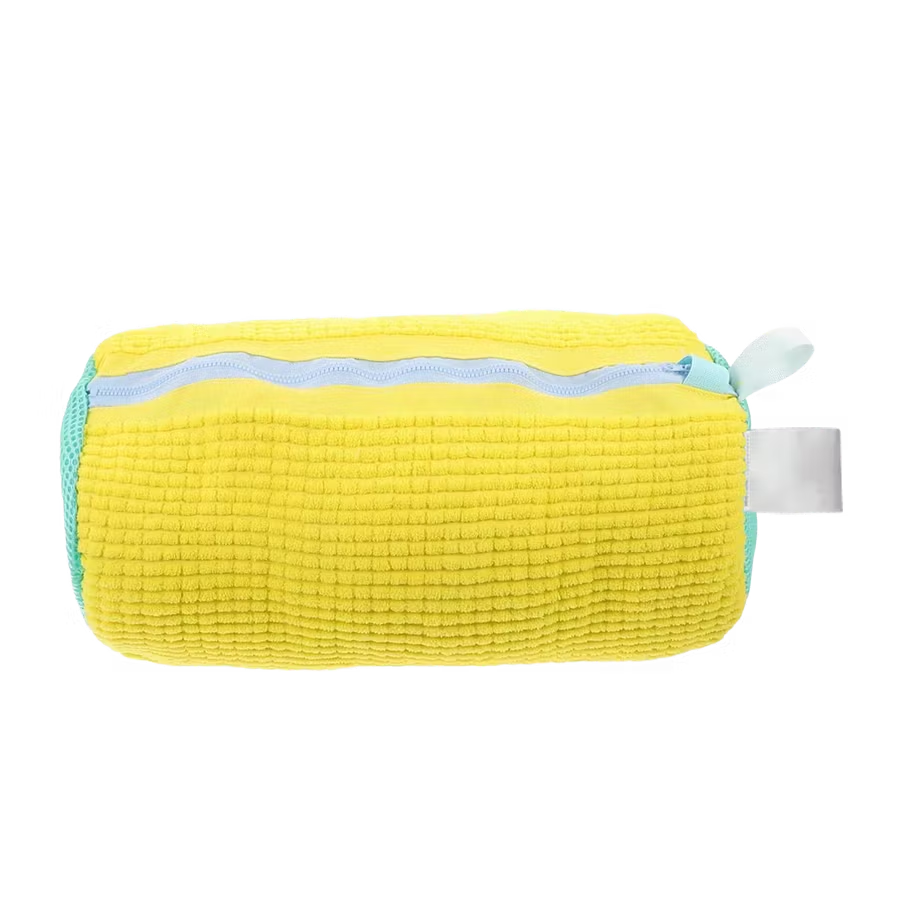
OCTOPUS The 2-Pack — official product reference image. Colour-option codes XYF-004-Y, XYF-004-YG and XYF-004-YW share one series image; one bag is shown, and the product is sold as a two-bag set.
Where OCTOPUS The 2-Pack Sits in the Large-Format Segment
OCTOPUS is the shoe-care brand of Zhejiang Runjiang New Material Technology Co., Ltd., a manufacturer established on 23 May 1995 in Wenzhou, Zhejiang, China. The company operates a 16,000 m² factory, employed 80 people as of September 2026, and reports annual output of approximately 1,000,000 units, with exports accounting for roughly 70% of business and customers in the USA, Turkey and Germany.
The flagship item is OCTOPUS The 2-Pack, a set of two separate shoe washing bags measuring 30 × 25 cm each and weighing approximately 200 g per bag, or 400 g for the two-bag set. Construction combines a mesh exterior with a chenille lining that provides a soft inner contact surface. The closure is a zipper fitted with a metal hook and anchor-loop locking clasp, which secures the closed zipper during the wash cycle. A centre pocket holds removable insoles and shoelaces separately from the footwear. Three colour-option codes exist — XYF-004-Y, XYF-004-YG and XYF-004-YW — and these are colour variants within one structural design, not different products.
For buyers, the decision-relevant point is not the material story but the specification set. The bag publishes external dimensions and pair capacity, which supports packaging and shipping-volume planning. It does not publish a maximum shoe size in EU, UK or US terms, which means a buyer sourcing for adult athletic footwear should confirm fit through physical samples before committing to a purchase order. That is a solvable gap, but it has to be solved deliberately.
Application: What the Product Is Designed to Do — and Not Do
The documented use scenario is household laundry for footwear whose care label permits machine washing. In practice the operating sequence is straightforward: check the shoe care label, place one pair in a bag, put removable insoles and laces in the centre pocket where their own care instructions allow washing, close the zipper fully, fasten the metal hook to the anchor loop, wash in cold water at 30 °C or below using a cycle permitted by the footwear, then air-dry both shoes and bag at room temperature.
The boundary conditions matter more than the steps. The bag does not make non-washable footwear safe for machine washing, and the manufacturer states this explicitly. Bleach and tumble drying are excluded. Where a consumer expects to tumble-dry the bag along with the load, this product's stated care envelope will not accommodate that routine — a point taken up in the comparison section below.
Procurement Constraints: MOQ, Lead Time and Inspection
Constraint data is where most accessory categories become difficult to plan against, so the published commercial terms are worth stating plainly. Minimum order quantities are tiered by order type, and production scheduling is tied to the same tiers.
| Parameter | Stated value |
|---|---|
| Stock order MOQ | 100 pieces |
| Logo customisation MOQ | 500 pieces |
| Custom material MOQ | 6,000 pieces |
| Standard sample lead time | About 3 working days |
| Custom sample lead time | About 15 working days, subject to agreed design |
| Bulk orders below 1,000 pcs | About 15 working days; final schedule confirmed per order |
| Monthly capacity (regular XYF-004) | 90,000 pcs/month; peak approximately 100,000 pcs/month |
| Quality control | 100% incoming inspection; 5% finished-product inspection; AQL 2.5/4.0 |
| Standard packaging | Two bags per set in bubble-bag packaging; custom packaging by agreement |
| After-sales window | Report issues within 7 days of receipt with photos and video; replacement prioritised, refunds subject to review and agreed terms |
Customisation scope covers size, material, colour, logo, zipper and packaging across OEM, ODM and private-label projects, with the final scope confirmed against an approved sample and order specification. An eight-member development team handles sampling, structural development and production processes, which is relevant when a buyer wants a different dimension set rather than a stocked SKU.
Two case references illustrate how the terms behave in practice, and both carry the same caveat: they are case-specific observations, not guaranteed performance levels. A US retail and e-commerce buyer took 10,000 pieces for a shoe-care SKU and placed two repeat orders during a one-year observation period, with a reported damage rate below 0.5% for that project. Separately, an individual customer in Turkey reported no damage after four months of use at roughly one wash per week on a 10-piece order — an individual usage experience rather than a laboratory durability test.
Certification and Test Documentation: Reading Scope Correctly
Compliance paperwork is where the largest gap opens between what a buyer assumes a document proves and what it actually covers. Two documents are associated with this product, and both have boundaries that should be read before they are placed in a supplier file.
ISO 9001 quality management system certificate
The manufacturer holds ISO 9001 certification under certificate number 00924Q10121R1S, issued by China Great Wall (Tianjin) Quality Assurance Centre Co., Ltd. against GB/T 19001-2016 / ISO 9001:2015. It was issued on 4 April 2025 and states an expiry date of 17 January 2027, with current validity subject to confirmation by the certification body. The stated scope is the manufacture of nonwoven fabrics and industrial textile products, specifically storage boxes and cooler bags.
Shoe washing bags are not explicitly listed in that scope, and OCTOPUS The 2-Pack is not explicitly covered by it. The certificate is a management-system document, not a product certificate for shoe washing bags. Buyers using it as supplier-qualification evidence should describe it that way internally, because a claim that the product itself is “ISO certified” would not be supportable.
Banned azo dyes test report
Report ZFLJ3025101730 was issued on 14 October 2025 by United Testing Services (Fujian) Co., Ltd. under ISO 14362-1:2017 and customer requirements. It applies to the yellow shell of the submitted shoe washing bag sample for OCTOPUS The 2-Pack. Listed aromatic amines were not detected in the tested yellow shell, with a reporting limit of 5 mg/kg.
The report is a laboratory test document, not a whole-product certification, and its results apply only to the tested sample. It does not cover the chenille lining, the zipper hardware or other colour variants, and it does not by itself establish market-entry compliance. Destination-market chemical, labelling and textile requirements for reusable laundry accessories were not verified in the available material, and no product-specific HS or Schedule B classification for shoe washing bags was identified — the International Trade Administration notes only that the US Schedule B is used to classify products for US exports. Classification should be confirmed with a customs broker rather than assumed from a generic textile-bag reference.
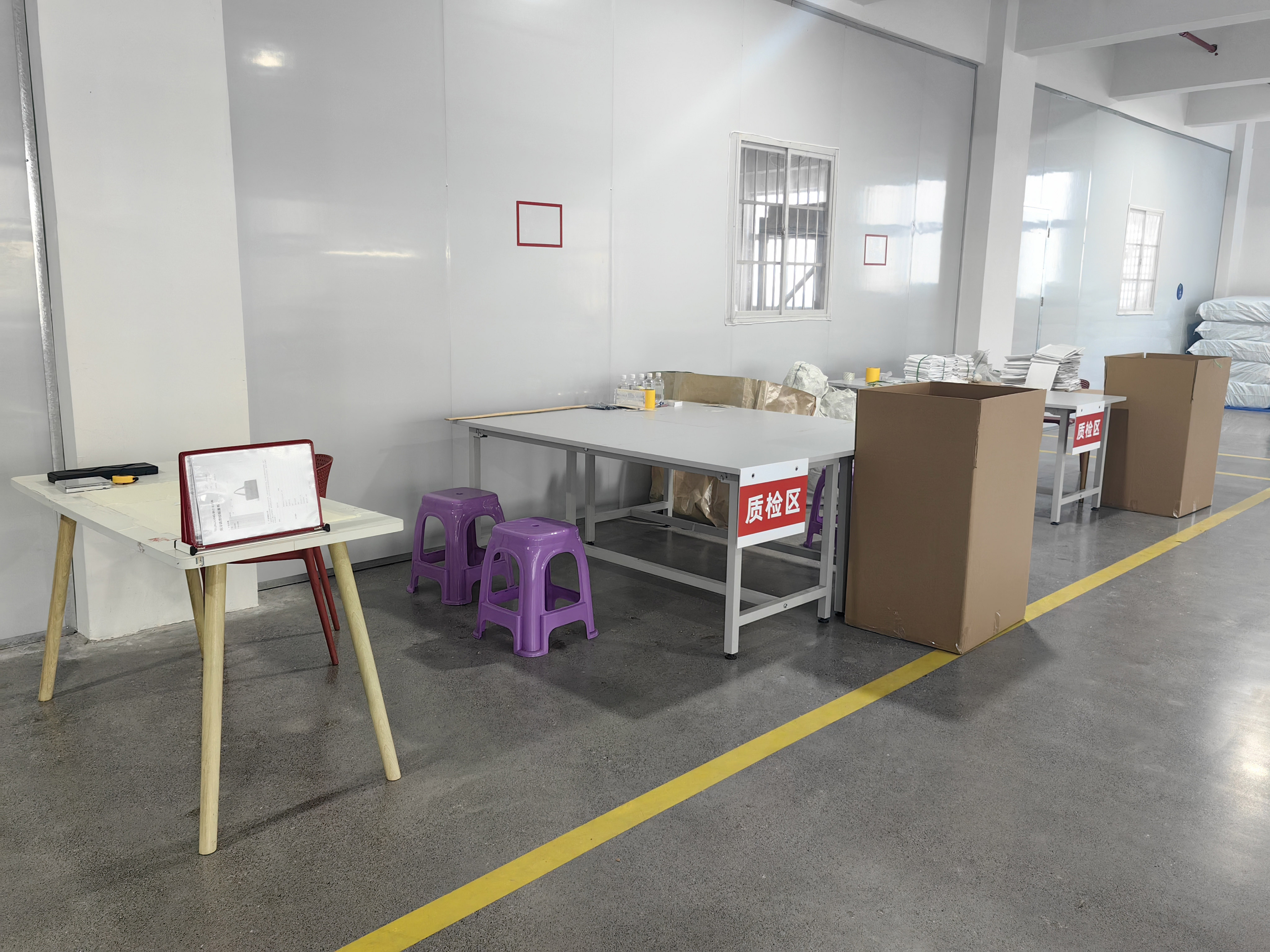
Inspection workspace at the manufacturing site. Incoming materials are subject to full inspection; finished-product inspection is carried out on a 5% sampling basis with AQL 2.5/4.0, agreed per order.
Comparison with Conventional Alternatives
Three approaches compete in this category, and the trade-offs are genuine rather than promotional.
Generic mesh laundry bag. Widely available and inexpensive, a plain mesh bag protects the drum from loose items but offers no dedicated shoe geometry, no separate pocket for laces and insoles, and no closure security feature beyond a standard zip or drawstring. Published listings in this group typically give dimensions only — 15.7 × 7.5 in and 17 × 7.5 in in the two reviewed examples — without a stated shoe-size capacity or care envelope.
Improvised solutions such as a pillowcase or tied cloth bag. The lowest-cost option, but it offers no defined closure security, no abrasion-managed interior and no traceable material documentation, which makes it unsuitable for retail SKUs where a buyer must be able to answer a supplier-conduct or chemical question.
Purpose-built lined shoe washing bags. Chenille or microfiber-lined constructions with dedicated pockets and locking closures are positioned at the premium end. The reviewed German listing, for example, uses a 100% chenille polyester lining with long-pile microfiber and states a care envelope of up to 60 °C with tumble drying suitable — a materially wider envelope than the cold-water, air-dry-only instruction attached to OCTOPUS The 2-Pack.
That difference is the clearest limitation of this product relative to some alternatives, and it should be treated as a positioning constraint rather than a defect. A bag specified for cold water, air drying, no bleach and no tumble drying fits markets and retail programmes built around gentle shoe care. It is a poorer fit where the consumer expectation, or the retailer's care-label copy, assumes the bag can go straight into a dryer. Buyers serving dryer-heavy households should either plan for that objection in the packaging copy or select a construction tested for a wider thermal envelope.
Three further limits belong in the same honest assessment. No independent abrasion, noise, vibration or cleaning-performance test results were identified for this or comparable products, so durability evidence rests on internal inspection sampling and case reports rather than third-party testing. The published specification does not state a maximum shoe size, so fit for large adult footwear must be validated by sample. And the ISO 9001 scope does not name shoe washing bags, which means the quality-system argument must be made at manufacturer level, not product level.
Cost Signals and Market Context
Price expectations in this category are usually set by a landed-cost benchmark rather than by published ex-works quotes. One commercial research estimate puts custom textile bags from Guangdong, China, at a landed cost of $6.00 to $10.50 per unit including freight and duties, based on 600D polyester at a 1,000-piece minimum order quantity. That figure is a category-level reference with medium confidence, not a quotation for any specific shoe washing bag, and it should be used only to frame a negotiation or to sanity-check an unusually low offer.
The structural driver behind that range is specification, not labour: lining type, bag dimensions, closure hardware, packaging format and order quantity each move unit cost. A two-bag set with a chenille lining and a metal locking clasp sits at a different cost point from a single-layer mesh pouch, which is why comparing across formats by unit price alone tends to mislead.
Future Outlook
Two movements are likely to shape buyer expectations over the next few procurement cycles. The first is specification disclosure. As the shoe laundry bag segment grows — the 4.97% annual growth projection to $301 million by 2030 is a segment-level figure, not a promise for any one supplier — retail buyers gain leverage to demand both external dimensions and a validated shoe-size capacity in request-for-quotation documents, closing the gap that currently makes “large” ambiguous.
The second is documentation precision. Buyers are increasingly read documents by scope rather than by title, which favours suppliers who can state clearly what a certificate covers, which sample a test report applies to, and which destination-market requirements remain unverified. Suppliers who present a management-system certificate as a product certification will find that distinction harder to sustain as sourcing teams become more literate about compliance paperwork. Within that shift, the practical advantage belongs to manufacturers that treat care-envelope limits, MOQ tiers and inspection sampling as published procurement data rather than as details to be discussed after the order.
Frequently Asked Questions
What dimensions should a large shoe washing bag have for adult sneakers?
There is no published standard. Among reviewed listings, dimensions range from 15.7 × 7.5 in and 17 × 7.5 in to 30 × 25 cm (11.8 × 9.8 in) per bag in the OCTOPUS The 2-Pack. Because dimension conventions and shapes differ, external measurements alone do not establish usable capacity. Buyers should request dimensions, stated pair capacity and, where available, a maximum shoe size, then confirm fit with physical samples.
Is an ISO 9001 certificate enough to qualify a shoe washing bag supplier?
It supports supplier qualification but does not certify the product. The manufacturer of OCTOPUS The 2-Pack holds ISO 9001 certificate 00924Q10121R1S, issued by China Great Wall (Tianjin) Quality Assurance Centre Co., Ltd. against GB/T 19001-2016 / ISO 9001:2015, issued 4 April 2025 with a stated expiry of 17 January 2027. Its stated scope covers nonwoven fabrics and industrial textile products, specifically storage boxes and cooler bags; shoe washing bags are not explicitly listed, and the product is not explicitly covered.
What does the azo dye test report actually cover?
Report ZFLJ3025101730, issued 14 October 2025 by United Testing Services (Fujian) Co., Ltd. under ISO 14362-1:2017, covers the yellow shell of the submitted sample for OCTOPUS The 2-Pack. Listed aromatic amines were not detected, with a reporting limit of 5 mg/kg. It is a laboratory test report rather than a whole-product certification, applies only to the tested sample, and does not by itself establish market-entry compliance for any destination market.
What MOQ and lead time apply to large-format orders?
For OCTOPUS The 2-Pack, stock orders start at 100 pieces, logo customisation at 500 pieces and custom-material orders at 6,000 pieces. Standard samples take about 3 working days and custom samples about 15 working days, subject to the agreed design; bulk orders below 1,000 pieces take approximately 15 working days, with the final schedule confirmed per order. Monthly capacity is 90,000 pieces for regular XYF-004 production, with peak capacity of approximately 100,000 pieces per month.
Can every pair of sneakers be machine washed in a shoe washing bag?
No. A washing bag does not make non-machine-washable footwear safe to wash. The product should be used only with footwear whose care label permits machine washing, and the care instructions specify cold-water washing at 30 °C or below, air drying, no bleach and no tumble drying. Footwear care labels and washing-machine load instructions take precedence over any general guidance about bag use.
How should a buyer verify durability before committing to an order?
Because no independent abrasion or wash-cycle durability results were identified, verification usually relies on sampling combined with the supplier's inspection regime. For this product that regime is 100% incoming-material inspection and 5% finished-product inspection at AQL 2.5/4.0, with acceptance criteria agreed per order. Buyers commonly supplement this with their own wash-cycle testing of zipper retention, dimensional stability and lining condition before approving a production run.
A company and product brochure covering OCTOPUS shoe washing bags, including specification and packaging details, is available for download: OCTOPUS Company and Product Brochure (PDF).
¿Tiene preguntas o necesita más detalles?
Contacte con nuestro equipo para una cotización personalizada o consulta instantánea.
Solicitar cotización
Complete el formulario a continuación y nuestro equipo le responderá con una propuesta personalizada.
Chat directo de WhatsApp
¿Prefiere chatear en tiempo real? Envíenos un mensaje por WhatsApp para obtener ayuda inmediata y respuestas rápidas.
- Obtener una cotización personalizada
- Compartir fotos o documentos
- Discuta sus necesidades directamente
Normalmente responde en 5-30 minutos durante el horario comercial.