
Selección de vertederos y forros mineros: un marco adaptado al sitio
Landfill and Mining Liner Selection: A Site-Fit Framework
Two containment sites can both specify a 1.5 mm HDPE geomembrane and still need different property bands, different certificates and different installation support. A municipal landfill exposes the liner to leachate; a gold mine exposes it to angular tailings and process chemistry; a dam or reservoir exposes it to hydrostatic head, UV radiation and, in the EAEU region, freeze–thaw cycling. This framework sets out how certified geomembrane lines are matched to landfill, mining and dam conditions, and where the boundaries of that match begin.
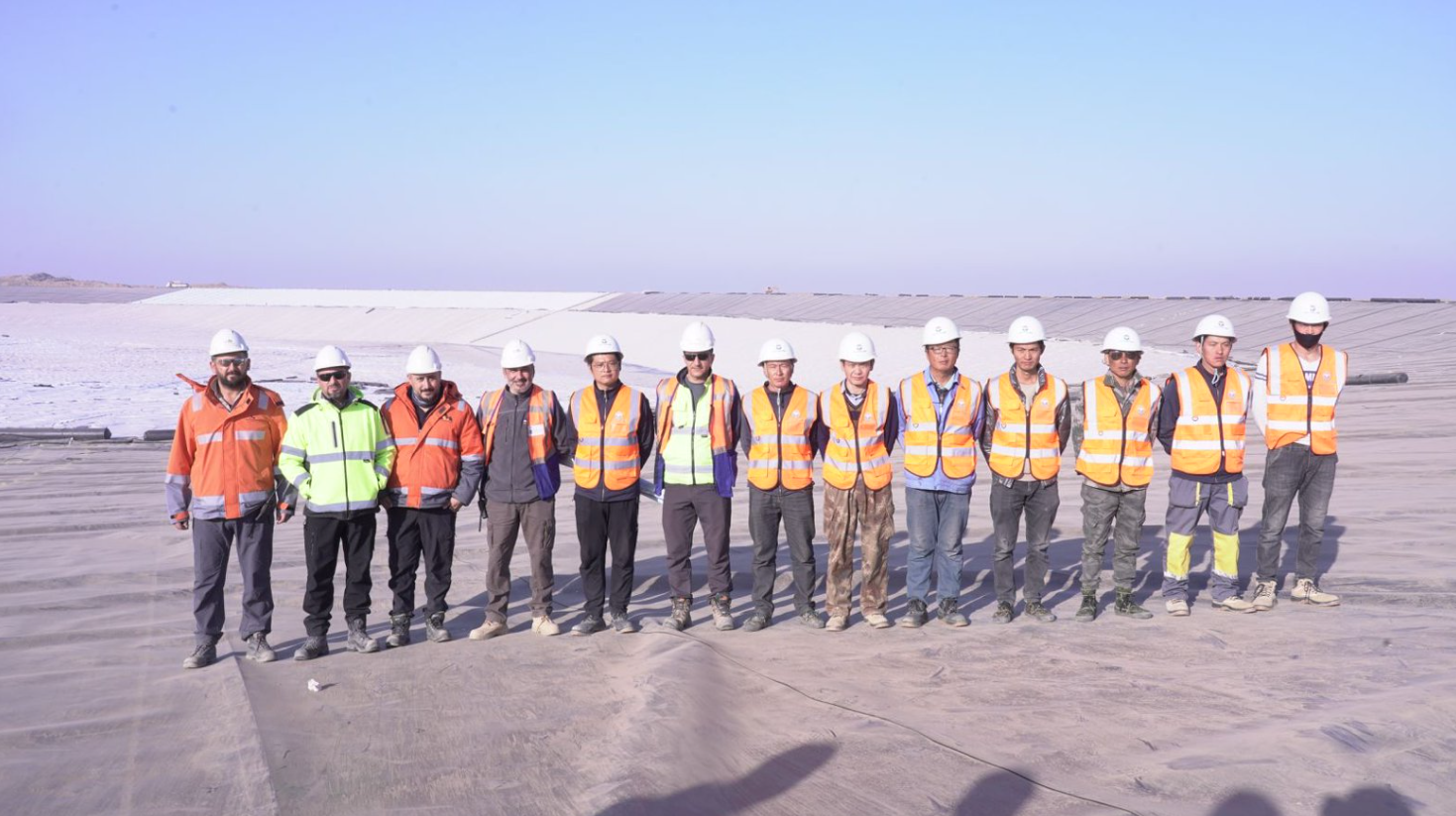
Seepage control for a gold mine tailings pond basin in Uzbekistan — a 900,000 m² containment scope delivered from material supply through on-site installation.
The Exposure Profile Comes Before the Product Name
A liner is specified against what it will actually touch. In a municipal solid waste landfill the governing exposure is leachate, whose chemistry varies with waste composition and site hydrology. In a non-ferrous metal smelting tailings pond the exposure is usually a combination of fine slurry, angular ore particles and residual process chemicals. In salt lake mining it is brine with a high chloride load. On a reservoir or dam it can be cyclic water level change paired with long-term UV exposure. Each of these profiles pushes the specification toward a different point inside the same material family.
The market context explains why specification discipline has become a procurement issue rather than a purely technical one. The global geomembrane market was valued at approximately USD 2.23 billion in 2025 and is projected to reach USD 3.59 billion by 2034 (Fortune Business Insights). Mining was the leading application segment in 2023 with 39.6% of global geomembrane revenue, driven primarily by tailings containment (Grand View Research). HDPE remains the dominant product family, accounting for roughly 31.3% to 40% of global revenue depending on the reporting agency (Grand View Research / Fortune Business Insights).
For engineering procurement teams working at the evaluation-to-execution stage, the practical sequence is: define the exposure profile, convert it into a thickness and property band, confirm the certificate route for the project jurisdiction, then verify that the supplier's production capacity and site support can carry that specification into the field without substitution. Haoyang Geomembrane, the geomembrane line produced by Haoyang Environment Co., Ltd, is supplied into that evaluation process with a defined certification set and a defined production window, both of which are verifiable rather than promotional claims.
Certification Routing: EN 13249:2016 for EU/EEA, GOST 33068-2014 for EAEU
Jurisdiction determines the certificate route before the data sheet is read in detail. For EU/EEA projects, the geomembrane line holds Verification of Conformity ICR/VC/HE250525, issued by ICR, covering geomembrane compliant with EN 13249:2016 and CPR (EU) 305/2011. It was issued on 20 May 2025 and is valid until 19 May 2030. Companion verifications cover the rest of a typical containment package: ICR/VC/HE250523 for composite drainage net, ICR/VC/HE250524 for geotextile, and ICR/VC/HE250526 for geosynthetic clay liner (GCL), which additionally references CPR (EU) 305/2011.
For EAEU and Russian projects, the relevant document is a GOST Certificate of Conformity, number POCC CN.32682.041C00.OC01.H00839, issued under GOST 33068-2014 by &Profr;оффСерт (ProfSert). It was issued on 23 May 2025 and is valid until 22 May 2028, and in the manufacturer's certification records it is listed against the geomembrane (0.3 mm–3.0 mm) and drainage geonet (4.0 mm–8.0 mm) product lines. A second certificate, POCC CN.32682.047C00.0C01.H00840, covers the geomembrane line under GOST 56586-2015 and remains valid until 22 May 2028. A third, POCC CN.32682.047C00.OC01.H00837, applies to the bentonite waterproof blanket under GOST 70090-2022.
| Project region | Standard basis | Certificate number | Issuing body | Validity | Scope recorded |
|---|---|---|---|---|---|
| EU / EEA | EN 13249:2016, CPR (EU) 305/2011 | ICR/VC/HE250525 | ICR | 20 May 2025 – 19 May 2030 | Geomembrane |
| EU / EEA | EN 13249:2016 | ICR/VC/HE250523 | ICR | 20 May 2025 – 19 May 2030 | Composite drainage net |
| EU / EEA | EN 13249:2016 | ICR/VC/HE250524 | ICR | 20 May 2025 – 19 May 2030 | Geotextile |
| EU / EEA | EN 13249:2016, CPR (EU) 305/2011 | ICR/VC/HE250526 | ICR | 20 May 2025 – 19 May 2030 | Geosynthetic clay liner (GCL) |
| EAEU / Russia | GOST 33068-2014 | POCC CN.32682.041C00.OC01.H00839 | ProfSert | 23 May 2025 – 22 May 2028 | Listed against geomembrane and drainage geonet lines |
| EAEU / Russia | GOST 56586-2015 | POCC CN.32682.047C00.0C01.H00840 | ProfSert | 1 June 2022 – 22 May 2028 | Geomembrane |
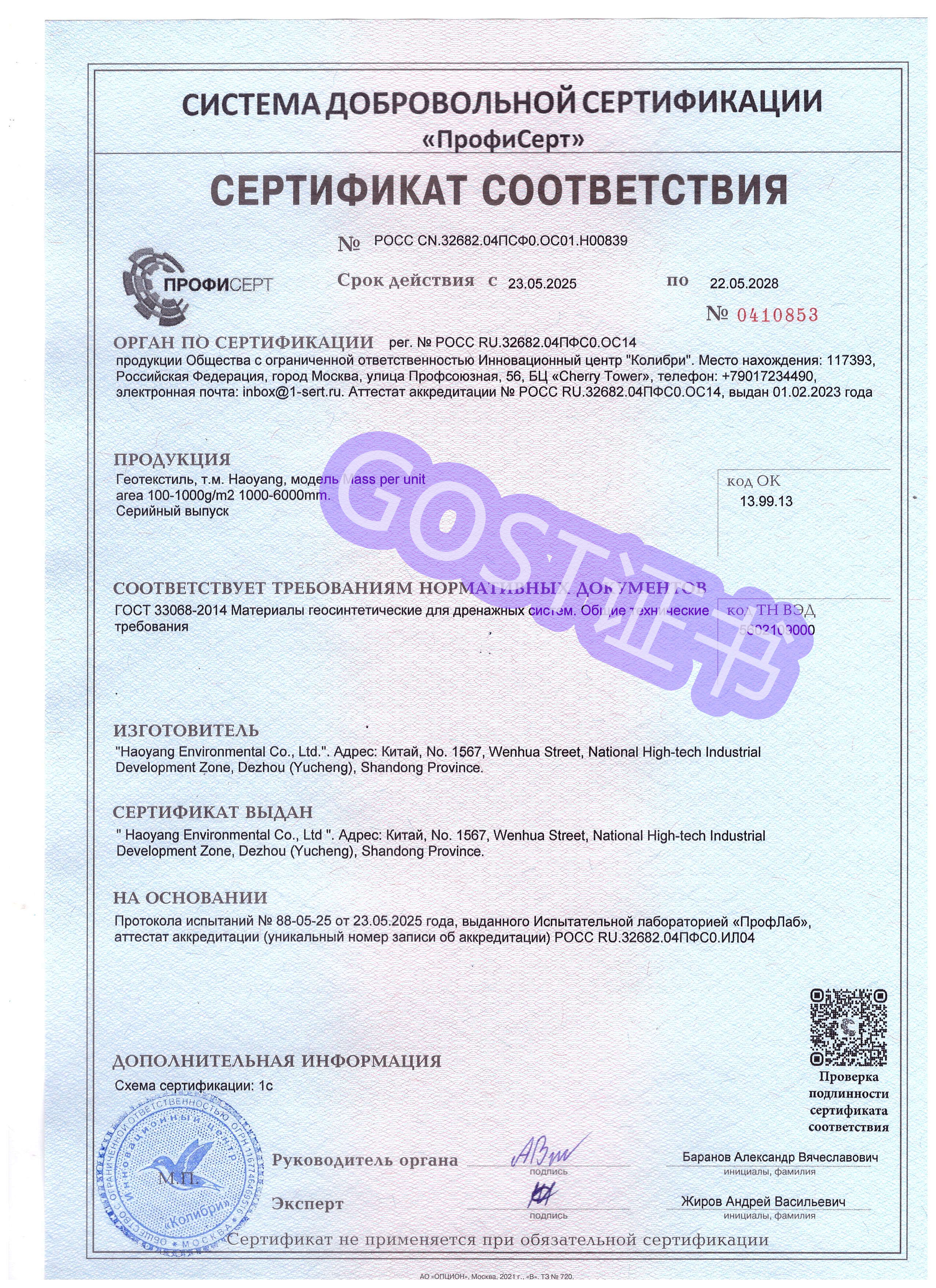
GOST Certificate of Conformity POCC CN.32682.041C00.OC01.H00839, issued by ProfSert under GOST 33068-2014 for the EAEU / Russia market.
Boundaries that buyers should confirm in writing:
A certificate covers the scope recorded on it, not an entire product catalogue. The EN 13249:2016 verification for the geomembrane does not transfer automatically to the GCL, geotextile or drainage net, each of which carries its own reference.
European reservoir and dam projects may require an additional standard: geomembranes used in European reservoirs and dams must meet EN 13361 safety and performance characteristics for CE marking (European Committee for Standardization). A project-specific standard set should therefore be confirmed with the design engineer rather than assumed from a single document.
EAEU certificates in the current set expire on 22 May 2028. Projects whose construction, commissioning or warranty window extends beyond that date need a planned renewal check rather than a one-time verification at tender stage.
Reading the Property Range: What Each Parameter Controls on Site
The geomembrane line is specified across a thickness range of 0.3 mm to 3.0 mm with customizable parameters. The important procurement point is not the existence of a wide range but the ability to select a defined point inside it and to have that point reproduced consistently in production. The table below maps published parameters to the site conditions they govern.
| Parameter | Specified range | What it governs on site |
|---|---|---|
| Thickness | 0.3 mm – 3.0 mm (customizable) | Base barrier thickness, selected against exposure severity and subgrade condition |
| Yield strength (MD/TD) | ≥5 – 65 kN/m | Resistance to installation and anchorage loads |
| Break strength (MD/TD) | ≥10 – 85 kN/m | Tensile capacity at seams and anchor trenches |
| Yield elongation (MD/TD) | 10 – 15% | Transition point from elastic to plastic behaviour under load |
| Break elongation (MD/TD) | ≥700 – 850% | Capacity to accommodate settlement and differential movement |
| Tear resistance (MD/TD) | ≥45 – 500 N | Limits propagation of damage from localised cuts or impact |
| Puncture resistance | ≥170 – 1200 N | Directly relevant where angular ore, gravel or debris contact the liner |
| Stress crack resistance (MD/TD) | ≥500 h | Resistance to slow crack growth under sustained load over service life |
| Carbon black content | 2.0 – 2.8% | UV protection during staged or exposed installation |
| Standard OIT | ≥130 min | Antioxidant reserve in the base resin |
| High pressure OIT | ≥430 min | Accelerated indicator of oxidative durability |
| Oven aging at 85 °C (Standard OIT retained after 90 days) | ≥60% | Retention of antioxidant performance after thermal exposure |
Stress crack resistance is the parameter most often treated as a formality and most often central to long-term performance. The industry reference test method for this property in polyolefin geomembranes is Notched Constant Tensile Load (NCTL) testing under ASTM D5397 (ASTM International). Buyers comparing data sheets across suppliers should confirm that reported values are traceable to a recognised test method, because a number without a method is not a comparison.
Where the specification requires the geomembrane to have a friction surface — on slopes, on steep tailings impoundment walls, or under high shear at the interface with a geotextile — textured geomembrane is the relevant category rather than a smooth sheet. The textured surface is a design decision tied to slope stability calculations, not a cosmetic finish.
Containment Is a System: Membrane, Texture and Drainage
A geomembrane contains liquid; it does not remove it. Where hydrostatic head must be controlled — beneath a landfill cell, inside a tailings impoundment, or under a reservoir liner — a drainage layer is a separate design element. The drainage geonet line associated with the geomembrane is specified at 4.0 mm to 8.0 mm thickness with the following published parameters.
| Drainage geonet parameter | Specified range |
|---|---|
| Thickness | 4.0 mm – 8.0 mm (customizable) |
| Mass per unit area | 500 – 1400 g/m² (customizable) |
| Tensile strength (MD/TD) | ≥5 – 15 kN/m |
| Elongation at break | 10 – 25% |
| Compressive strength at 10% strain | ≥500 – 830 kPa |
| Acid / alkali resistance | ≥90% strength retention |
| Drainage capacity | ≥50 – 120 (L/min)/m (customizable) |
In the mining reference case described by the manufacturer, the containment system was not a single sheet but a three-dimensional composite drainage network built from a textured geomembrane and a high-strength polypropylene geotextile. The textured geomembrane is produced on a five-layer co-extrusion blow moulding line integrated with online double-sided texturing equipment, using a high-temperature, high-pressure air jet process so that base membrane forming and the double-sided rough surface structure are completed simultaneously in the molten state. The rough points form a molecular-level bond with the substrate, which the manufacturer reports reduces production energy consumption by 25% and avoids the thermal aging risk associated with secondary processing.
That description matters to procurement because it identifies where a supplier's process capability enters the specification: composite systems are welded, anchored and inspected as a package, and the interface behaviour between membrane, geotextile and drainage core determines whether the design assumptions survive installation.
Scenario Fit: Landfill, Tailings, Salt Lake and Dam Projects
Municipal solid waste landfill
Landfill design is driven by leachate containment. The relevant evaluation points are chemical resistance of the membrane, the presence of a GCL or clay composite layer where the design calls for one, and drainage capacity beneath the liner. The manufacturer's geosynthetic clay liner verification, ICR/VC/HE250526, exists as a discrete scope for exactly this layered-liner configuration.
Mining and smelting tailings
Tailings containment is the single largest geomembrane application segment globally at 39.6% of 2023 revenue (Grand View Research). The governing exposures are angular particle contact, sustained load and process chemistry. This is the scenario where puncture resistance (≥170 – 1200 N) and stress crack resistance (≥500 h) move from data-sheet items to selection criteria. The manufacturer's reference case in this category is a 900,000 m² seepage prevention project for a gold mine tailings pond basin in Uzbekistan, delivered for a mining and smelting engineering client as a full-chain service from material supply to on-site installation and construction.
Salt lake mining
Salt-laden brine changes the material question: the relevant categories here are salt-resistant and acid- and alkali-resistant geomembrane and drainage products. The drainage geonet's published acid/alkali resistance of ≥90% strength retention is directly relevant where drainage must remain functional in a chemically aggressive environment.
Dams, reservoirs and pumped storage
Reservoir and dam projects combine hydrostatic head, slope stability requirements and, in the EAEU region, freeze–thaw cycling. Two verification steps are worth separating: the EN 13249:2016 verification held for the geomembrane, and the separate EN 13361 requirement that applies to geomembranes used in European reservoirs and dams for CE marking. The producer's wider product portfolio — geotextiles, composite drainage nets, waterproof mats, bentonite waterproof blankets, cement blankets and spray-on anti-seepage materials — exists because these scenarios rarely resolve to a single product.
OEM Customization and Production Capability in Procurement Terms
Haoyang Environment Co., Ltd is a geosynthetic materials manufacturer founded in 2008 and headquartered in the Dezhou (Yucheng) National High-Tech Industrial Development Zone, Shandong Province, China. It operates a 200,000 m² facility with 190 employees and an annual output of 33,000 T, supported by a research and development team of 20 professional engineers and cooperative relationships with universities including Fudan University and Tianjin University of Technology. The company holds more than 70 patents and proprietary technologies and operates eight wholly-owned subsidiaries. Its export ratio is 60%, and its marketing network covers more than 70 countries and regions.
For a procurement team, capability statements are only useful when they convert into controllable variables. Four do so directly:
Customization scope. Production is offered under an OBM model, with customization available for LOGO, width, scroll length, thickness, GSM, tensile yield strength, tensile fracture strength, puncture strength, and other chemical and physical indicators. This means a project specification can be translated into a production specification rather than being rounded to the nearest standard roll.
Capacity and order threshold. Monthly capacity is 3,000 T, with a minimum order quantity of 5,000 m² and a typical lead time of 10 to 30 days. The MOQ suits mainstream containment packages; small emergency repair scopes below that threshold are not the natural fit of this production model and should be planned accordingly.
Quality control. Production is 100% tested, which supports unit-level traceability at pre-shipment acceptance rather than batch-level sampling alone.
After-sales and installation. After-sales provisions include on-site support, and reference projects have been delivered as a full-chain service covering material supply, on-site installation and construction. For tailings and landfill projects, this matters because installation quality — seaming, anchoring, subgrade preparation — is the variable the factory cannot control once the rolls leave the plant.
Market Trend: Specification-Led Buying in a Fragmented Supplier Base
The supplier landscape is led but not dominated by a single player. Solmax held an estimated 14.3% of the global geomembrane market as of 2025 (Global Market Insights), alongside major manufacturers including Agru America, Naue GmbH, GSE Environmental and Plastika Kritis (Future Market Insights). That structure has a practical consequence: most buying decisions are made between credible alternatives, so differentiation shifts toward certification scope, verifiable parameters and delivery capability rather than brand recognition alone.
Three trends follow from that. First, certification is being used as an early shortlisting filter, which raises the importance of matching certificate scope and validity to the actual project schedule. Second, HDPE's continued dominance — roughly 31.3% to 40% of global revenue — means most specifications are written inside one material family, so the competitive question becomes thickness, property band and process control rather than polymer substitution. Third, mining's position as the leading application segment at 39.6% of 2023 revenue is pushing suppliers toward service models that include installation and construction, not products alone.
Compared With Traditional Clay Liners — and the Limits of Geomembrane Systems
Compacted clay liners and soil-bentonite layers remain valid containment approaches and are still specified where local material is available at low cost. Their behaviour depends on thickness, moisture content and construction quality, and they are sensitive to desiccation and to differential settlement. A manufactured geomembrane responds differently: thickness is factory-controlled within a defined range of 0.3 mm to 3.0 mm, the product is tested at production, and elongation at break of ≥700 – 850% allows the liner to accommodate movement that would crack a brittle soil layer. In many mining sites, the practical argument is simpler still — suitable clay may not be economically available near the site.
The limits should be stated just as clearly, because they shape both design and procurement.
A geomembrane is a thin flexible barrier, not a structural element. Published puncture resistance values of ≥170 – 1200 N describe tested performance under defined conditions; they do not remove the need for subgrade preparation or for a protective geotextile layer where angular tailings or coarse rock will be in contact.
A geomembrane does not drain. Where hydrostatic head has to be managed, a separate drainage geonet or composite drainage network is required, and its compressive strength under load — ≥500 – 830 kPa at 10% strain — becomes a design input rather than an accessory specification.
A certificate is a scope document with an expiry date. Buyers evaluating this supplier should weigh the EN 13249:2016 verification against the project's EU/EEA requirements and, for reservoir and dam works, check whether EN 13361 is also required. For EAEU projects, the GOST documentation currently runs to 22 May 2028.
Future Outlook
Containment demand is expanding fastest where the exposure conditions are hardest: tailings management, salt lake operations and reservoir works. As the geomembrane market grows from approximately USD 2.23 billion in 2025 toward a projected USD 3.59 billion by 2034, procurement is likely to keep shifting from product purchase toward verified system supply — membrane, drainage, clay composite and installation delivered against one specification.
For buyers, the durable response is procedural rather than commercial: fix the exposure profile first, translate it into a property band, match the certificate route to the jurisdiction and the project timeline, and confirm the supplier's production window and site-support scope before awarding. Certification and process control, not catalogue breadth, are what remain verifiable years after installation.
FAQ
What thickness range and material parameters are available for landfill and mining containment?
The geomembrane line is produced in HDPE at a thickness range of 0.3 mm to 3.0 mm, customizable within that range. Published parameters include yield strength of ≥5 – 65 kN/m, break strength of ≥10 – 85 kN/m, yield elongation of 10 – 15%, break elongation of ≥700 – 850%, tear resistance of ≥45 – 500 N, puncture resistance of ≥170 – 1200 N, stress crack resistance of ≥500 h, carbon black content of 2.0 – 2.8%, Standard OIT of ≥130 min, and high pressure OIT of ≥430 min, with Standard OIT retention of ≥60% after 90 days of oven aging at 85 °C.
Can rolls be customized to a specific project specification?
Yes. The manufacturer offers OBM production and customization covering LOGO, width, scroll length, thickness, GSM (grams per square metre), tensile yield strength, tensile fracture strength, puncture strength, and other chemical and physical indicators. Customization is a production-stage activity, so the specification should be fixed before the order is placed rather than during delivery.
How is containment combined with drainage when hydrostatic head must be controlled?
Containment and drainage are separate functions. The associated drainage geonet is produced at 4.0 mm to 8.0 mm thickness with a mass per unit area of 500 – 1400 g/m², tensile strength of ≥5 – 15 kN/m, elongation at break of 10 – 25%, compressive strength of ≥500 – 830 kPa at 10% strain, acid/alkali resistance of ≥90% strength retention, and drainage capacity of ≥50 – 120 (L/min)/m. In the referenced mining project, drainage was provided through a three-dimensional composite drainage network combining a textured geomembrane with a high-strength polypropylene geotextile.
Which certificate applies to an EU/EEA project and which applies to an EAEU project?
For EU/EEA projects, the geomembrane is covered by Verification of Conformity ICR/VC/HE250525, issued by ICR and stating compliance with EN 13249:2016 and CPR (EU) 305/2011, valid from 20 May 2025 to 19 May 2030. For EAEU/Russia projects, the relevant document is GOST Certificate of Conformity POCC CN.32682.041C00.OC01.H00839 under GOST 33068-2014, issued by ProfSert on 23 May 2025 and valid until 22 May 2028. European reservoir and dam projects may additionally require compliance with EN 13361 for CE marking, which is a separate standard from EN 13249:2016.
What are the standard commercial terms at the order and shipment stage?
The minimum order quantity is 5,000 m² and monthly production capacity is 3,000 T, with a typical lead time of 10 to 30 days. Delivery terms are FOB or CIF, acceptance is based on pre-shipment testing, and payment terms are 30/70 or 100. Production is 100% tested.
Is on-site support provided for large containment projects?
After-sales service includes on-site support, and the manufacturer has delivered projects as a full-chain service covering material supply, on-site installation and construction. The mining reference case is a 900,000 m² seepage prevention project for a gold mine tailings pond basin in Uzbekistan, executed for a mining and smelting engineering client in Central Asia. The company's export markets include Africa, Europe, Central Asia, Southeast Asia, Australia and South America.
Certificate numbers referenced in this article can be verified directly with the issuing bodies: ICR for the EN 13249:2016 verifications and ProfSert for the GOST 33068-2014 and GOST 56586-2015 conformity certificates. Legal entity and product documentation for Haoyang Environment Co., Ltd is published at haoyanghuanjing.com.