
Laminating Machine Specs Decoded: A Procurement FAQ
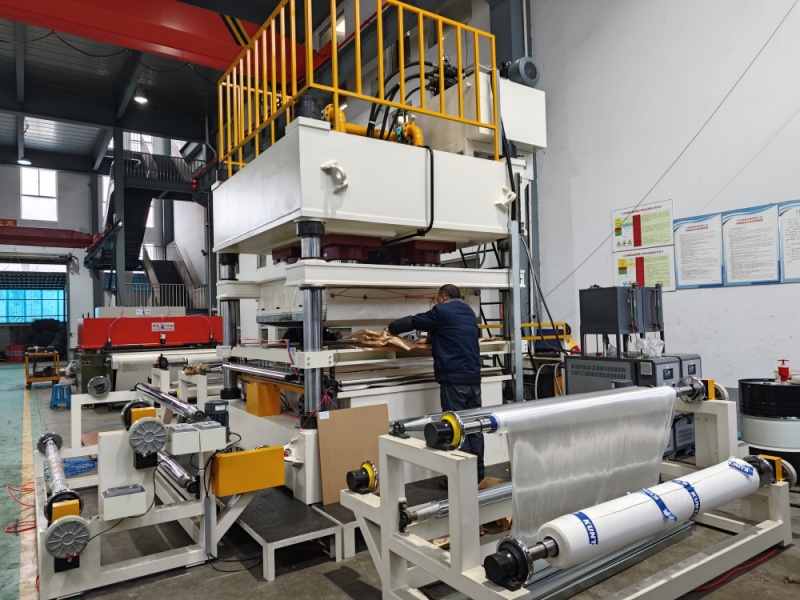
KUNTAI KT-LH-1800 UD crossply machine — one of several configurations sharing the KT-LH-1800 model number, rated at approximately 95 kW total power.
A laminating machine datasheet is a translation layer. Every line on it converts a process requirement — the widest fabric the line must bond, the temperature the adhesive needs, the throughput the order book requires — into a figure an engineer can design against. Buyers who read those lines as marketing copy tend to find the gap after installation. Buyers who read them as constraints usually find it at quotation stage, which is considerably cheaper.
This FAQ works through the specification lines that appear most often in industrial laminating machine enquiries: material width, heating method, heating and cooling zone length, machine speed, installed capacity, construction and certification. Published configurations from JIANGSU KUNTAI MACHINERY CO.,LTD are used as worked examples.
JIANGSU KUNTAI MACHINERY CO.,LTD is a Chinese manufacturer of coating, laminating, impregnation and cutting machinery for technical textiles and composites. Founded in 1983, the company operates a 30,000 m² facility in Zhengang Industrial Park, Yancheng City, Jiangsu, with approximately 210 employees, an annual output of around 650 units and a 70% export share, serving North America, South America, Europe, South Asia, Africa and the Middle East. Its stated quality framework is ISO 9001 and CE certification supported by an internal quality control system.
Why Specification Literacy Is the First Procurement Filter
The commercial case for reading specification lines carefully is not abstract. Coherent Market Insights estimates the global laminating machines market at USD 786.5 million in 2026, rising to USD 1,356.7 million by 2033. Other analysts place the same category differently — Persistence Market Research at USD 746.4 million for 2026 and Future Market Insights at USD 676.4 million for 2025 — because the boundary between office laminators and industrial laminating systems shifts with each definition.
That divergence is instructive rather than confusing. A market number and a machine specification are both only as precise as their scope statement. A quotation that says "laminating machine, 1800 mm" is as ambiguous as a market report that does not define whether pouch laminators are included. The buyer's task is the same in both cases: establish the scope before comparing the figures.
In practice, three specification lines carry most of the procurement risk. Material width, because it is often quoted as a single maximum when the real usable range is narrower. Heating method, because it determines the utility scope delivered with the machine. Installed capacity, because it determines whether the site can run the machine at all rather than how fast it runs.
How to Read the Core Lines on a Laminating Machine Datasheet
Material width versus machine roller surface
Maximum material width is the widest substrate the machine is designed to accept. Machine roller surface is the face width of the rollers that actually carry that substrate, and it is always quoted wider. KUNTAI's KT-FT lists a maximum material width of 2400 mm against a machine roller surface of 2600 mm. The KT-PUR-1800 lists 1800 mm against 2000 mm. The KT-PB and KT-HY-H both list 1600 mm against 1800 mm.
Buyers should treat the difference between the two figures as the engineering allowance for edge guidance and tension control, not as extra usable width. Some models are quoted as a range rather than a ceiling: the KT-FT-XC covers 1600–3200 mm, the KT-SF glue spraying and powder scattering machine covers 1600–2600 mm, and the KT-HY flame laminating machine covers 1600–3000 mm, with matching burner widths of 1900–3300 mm.
Heating method: electricity, thermal oil, or flame
Three heating families appear across KUNTAI's published configurations, and the choice follows the process rather than preference.
- Electricity alone is listed on the KT-PB flatbed laminating machine and the KT-HY-H double belt press laminator.
- Electricity plus thermal oil is listed on the KT-FT, KT-FT-XC, and the KT-PUR configurations, including the KT-PUR-1800 hot melt coating laminating machine.
- Flame is the heat source on the KT-HY, which runs on natural gas or liquefied gas.
On the UD and UHMWPE machines, heating works differently again. The KT-LH-1800 and KT-YJ-1800 configurations use circulating thermal oil delivered through an external oil heater, with a 60 kW external mold oil heater listed for temperature control.
The procurement consequence is simple: selecting thermal oil adds equipment to the delivered scope. KT-FT, KT-PUR and KT-FT-XC configurations explicitly include an oil heater, and several also include a humidifier and a PUR glue drum melter. Buyers should confirm in writing whether the heater, its piping and its utilities sit inside or outside the quotation.
Heating zone and cooling zone length
Zone length is the specification line most often skipped and most often regretted. The KT-PB flatbed laminating machine and the KT-HY-H double belt press laminator both list a heating zone of 3 m and a cooling zone of 1.5 m, with maximum heating temperatures of 230 °C and 250 °C respectively.
The heating zone determines how long the material stays under temperature before the bond is formed. The cooling zone determines how much distance the laminate has before it is wound or handled. A cooling zone of 1.5 m interacts directly with line speed: higher speeds and heavier coating weights consume cooling length faster, and a short zone either constrains speed or pushes cooling duty downstream. Both figures should be read as a pair with machine speed, not as standalone numbers.
Machine speed ranges
Speed on KUNTAI's laminating and coating range runs from 0–25 m/min on the KT-PB and KT-HY-H, through 0–35 m/min on the KT-FT, KT-FT-XC and KT-PUR-1800, to 0–40 m/min on one KT-PUR hot melt glue laminating configuration. Dot coating on the KT-DS runs 5–20 m/min and glue spraying with powder scattering on the KT-SF runs 5–25 m/min.
The UD and UHMWPE machines sit in an entirely different envelope: the KT-LH-1800 prepreg and impregnation configurations list composite speeds of 5–11 m/min. That figure is not a slower version of a laminating line; it reflects a different process in which fibre spreading, impregnation and controlled tension dominate the cycle time.
Installed capacity and what the site must supply
Installed capacity is the number that most often surprises first-time buyers, because it maps to site electrical infrastructure rather than to output. Within KUNTAI's published range: 60 kW on the KT-PUR-1800 hot melt coating laminating machine; 65 kW on one KT-PUR hot melt glue laminating configuration; 70 kW on the KT-PUR PUR laminating machine; 90 kW on the KT-LH-1800 prepreg and impregnation configurations and the KT-YJ-1800 UHMWPE impregnation machine; approximately 95 kW on the KT-LH-1800 UD crossply machine; approximately 105 kW on the KT-FT and KT-FT-XC; 155 kW on the KT-SF; 230 kW on the KT-PB; and 265 kW on the KT-HY-H double belt press laminator.
A line rated at 265 kW is rarely constrained by the machine itself. The constraint is the transformer, cabling and any auxiliary cooling the site can actually deliver — and the KT-PB and KT-HY-H, for example, are listed in aviation-related applications with a water chiller as matched equipment.
Construction material and component sourcing
Construction material is listed as carbon steel / SS304 across the KT-FT, KT-PUR, KT-PB, KT-HY-H, KT-SF, KT-LH-1800 and KT-YJ-1800 families. One KT-PUR hot melt glue laminating configuration lists carbon steel / aluminum foil / SS304.
Component sourcing is documented at a level that supports verification: Siemens motors (made in China), Yaskawa inverters on the laminating models, an Inovance inverter on the KT-PUR-1800, Schneider electrical components across the range, a Siemens PLC and touch screen plus NSK bearings on the KT-PB flatbed laminating machine, and HMI plus PLC control with variable frequency and servo drive on the KT-LH-1800 and KT-YJ-1800 machines.
One detail deserves attention. The parenthetical "(made in China)" beside Siemens motors describes the manufacturing location of a branded component, not the component brand. Buyers comparing quotations should ask the same question of every supplier: which component, whose design, manufactured where. Stated plainly in a specification, it is a transparency signal; left out by a competitor, it becomes a hidden comparison variable.
KUNTAI's Published Specifications as Worked Examples
The table below consolidates the configuration lines discussed above. Each row is taken from a published configuration; where two rows share a model number, they are different machines.
| Model | Machine type | Material width | Roller surface | Speed | Heating | Installed capacity |
|---|---|---|---|---|---|---|
| KT-FT | Fabric to fabric laminating machine | Max 2400 mm | 2600 mm | 0–35 m/min | Electricity, thermal oil | approx. 105 kW |
| KT-FT-XC | Lamination machine for textile | 1600–3200 mm | 1800–3400 mm | 0–35 m/min | Electricity, thermal oil | 105 kW |
| KT-PUR (configuration A) | PUR laminating machine | Max 2400 mm | 2600 mm | 0–35 m/min | Electricity, thermal oil | 70 kW |
| KT-PUR (configuration B) | Hot melt glue laminating machine | 1600–3400 mm | 1800–3600 mm | 0–40 m/min | Electricity, thermal oil | 65 kW |
| KT-PUR-1800 | Hot melt coating laminating machine | Max 1800 mm | 2000 mm | 0–35 m/min | Electricity, thermal oil | 60 kW |
| KT-PB | Flatbed laminating machine | Max 1600 mm | 1800 mm | 0–25 m/min | Electricity | 230 kW |
| KT-HY-H | Double belt press laminator | Max 1600 mm | 1800 mm | 0–25 m/min | Electricity | 265 kW |
| KT-HY | Flame laminating machine | 1600–3000 mm | 1900–3300 mm | Max 25 m/min | Natural gas or liquefied gas | Drive power 15 kW |
| KT-DS | Dot coating laminating machine | Coating 1600–4500 mm | 1800–4700 mm | 5–20 m/min | Electric | Max temp 130 °C |
| KT-SF | Glue spraying and powder scattering machine | 1600–2600 mm | 1800–2800 mm | 5–25 m/min | — | 155 kW |
| KT-YJ-1800 | UHMWPE impregnation machine | ≤ 1650 mm | 1800 mm | Process dependent | Circulating thermal oil | 90 kW |
| KT-LH-1800 | UD prepreg / impregnation / Aramid prepreg | ≤ 1650 mm | 1800 mm | Composite 5–11 m/min | Circulating thermal oil | 90 kW |
| KT-LH-1800 | UD crossply machine | ≤ 1650 mm | 1800 mm table 1700 × 1700 mm | Hydraulic pressing, 8000 kN | Thermal oil | approx. 95 kW |
Same Model Number, Different Configuration: A Real Procurement Trap
Two examples inside KUNTAI's own published data show why a model number alone should never be treated as a specification.
The first is the KT-PUR designation, which appears in more than one configuration. One entry lists a maximum material width of 2400 mm, a 2600 mm roller surface, a speed range of 0–35 m/min and an installed capacity of 70 kW, and includes a PUR glue drum melter, an oil heater and a humidifier. Another entry under the same KT-PUR name lists a material width range of 1600–3400 mm, a roller surface of 1800–3600 mm, a speed range of 0–40 m/min and an installed capacity of 65 kW, with a 200 kg glue melter, an oil heater and four A-frames in the delivered scope. Both are legitimate KT-PUR machines; they are not the same machine.
The second is the KT-LH-1800 designation. The UD prepreg, UD Aramid prepreg and UD prepreg impregnation configurations are listed with a total power of 90 kW and composite speeds of 5–11 m/min. The UD crossply machine under the same model number is listed with approximately 95 kW total power, an 8000 kN pressing tonnage and a 1700 × 1700 mm working table. Both share a 1800 mm roller surface and a material width of ≤1650 mm.
The practical rule that follows: the model number identifies the platform family, and the configuration line identifies the machine. Any quotation that stops at the model number has not yet specified anything.
How Application Scenarios Change Which Specifications Matter
Specifications do not carry equal weight in every industry. KUNTAI's project records show how the emphasis shifts, and — more usefully for buyers — which site conditions recur.
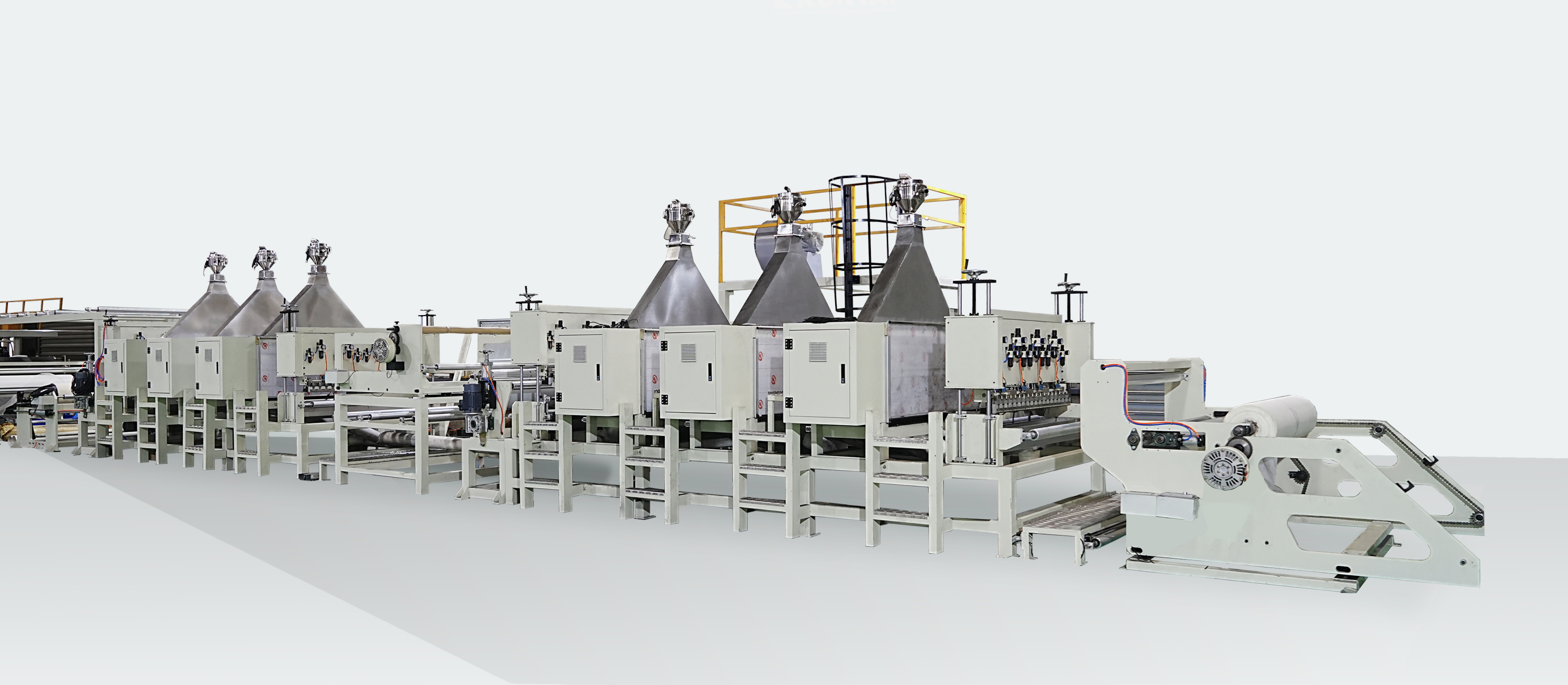
KT-SF glue spraying and powder scattering machine: 155 kW machine power, powder size 20–150 microns, 200 kg glue melter capacity — a configuration associated with filter manufacturing scenarios.
- Filter manufacturing: the KT-SF is the associated machine, working at middle temperature with a glue melter as matched equipment, running in synchronized operation for air filtration. Powder size is specified at 20–150 microns and the glue melter capacity at 200 kg. Project records for this scenario list customers in Turkey, Korea, India and Germany.
- Aviation interiors: aircraft sound insulation panel work at high temperature is recorded against the KT-PB flatbed laminating machine and the KT-HY-H double belt press laminator, with a water chiller as matched equipment. That pairing is the clearest signal of why installed capacity and auxiliary cooling must be planned together. Recorded markets include Korea, France and Germany.
- Upholstery: blackout fabric, mattress protector and sofa fabric production is recorded against the KT-PUR, KT-FT-XC, KT-FT, KT-PUR-1800 and KT-DS, with a glue melter and oil heater as matched equipment for waterproof and sun-protection functions. Recorded markets include Korea, India and Turkey.
- Bulletproof and armor materials: the KT-LH-1800 and KT-YJ-1800 families are associated with bulletproof vest, helmet and plate manufacturing, operating at low temperature and moderate humidity with a glue pump system as matched equipment. Recorded markets include Korea, Russia, Ukraine and India.
- Automotive trim: the KT-HY flame laminating machine is recorded for car trim applications at fast speed, with a gas tank and gas appliances as matched equipment and pressure stability as a special requirement. Recorded markets include Korea, Germany and the Czech Republic.
- Garment manufacturing: protective suits, windbreakers and thermal underwear are recorded against the KT-PUR, KT-FT, KT-FT-XC and KT-PUR-1800, with a glue melter and oil heater as matched equipment. Recorded markets include India, Turkey, Pakistan and Malaysia.
One pattern is worth stating explicitly, because no datasheet controls it. Across six recorded scenario types, five list voltage stability as a special requirement. In other words, the most frequently recorded site risk in KUNTAI's project history is not a machine parameter at all — it is the quality of the incoming power supply. Buyers running a technical evaluation should treat site power quality as a specification input, not as an installation afterthought.
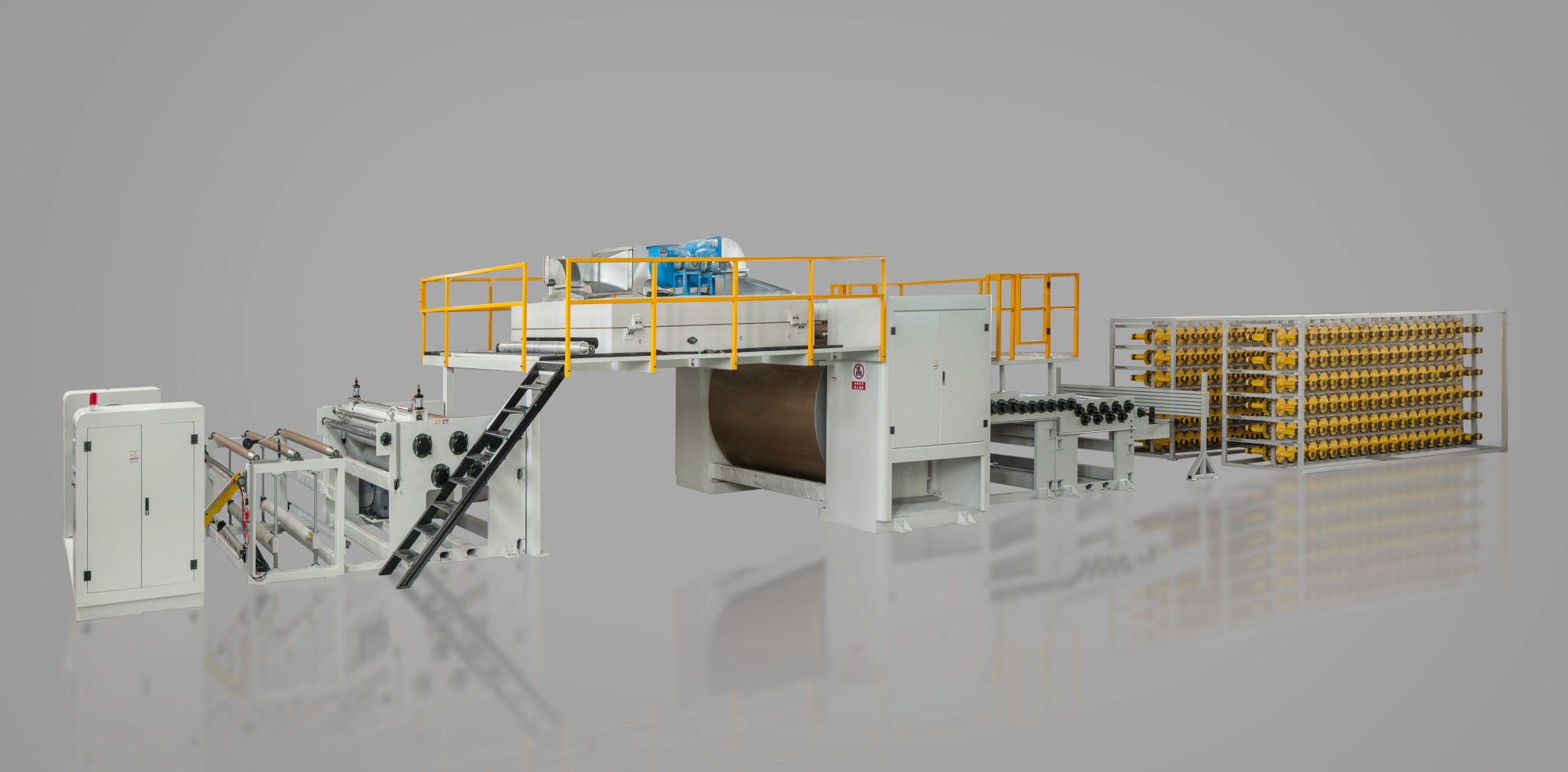
KT-YJ-1800 UHMWPE impregnation machine: 1800 mm roller surface, material width ≤1650 mm, 90 kW total power, 1080 yarn bobbins, certified to ISO 9001:2015.
What the Certification Lines Actually Cover
Certification is a scope question before it is a presence question, and KUNTAI's records show two distinct scopes.
The quality management system certificate is ISO 9001, certificate number 07626Q00528R101, issued by Beijing ZhongRunXing Certification Co., Ltd. under the standard GB/T 19001-2016 / ISO 9001:2015. Its stated scope is the design, manufacturing and sales of lamination machines and cutting machines, applicable globally for domestic business and cross-border international trade. It was issued on 2026-04-13 and is valid to 2029-04-12.
The machinery certificate is an ECM Type Approved CE certificate, number NO.3N221214.JKMSU84, issued under standard 2006/42/EC for the EU market. It was issued on 2022-12-14 and is valid to 2027-12-13. Its scope covers lamination machine models including KT-PUR-1800, KT-FT-XC, KT-QLJ-X and all listed serial variants, and the certification is recorded as applying to the KT-PUR-1800 product.
Buyers working inside a textile machinery safety framework may also raise the ISO 11111 series, whose Part 2 to Part 7 cover safety requirements for different machinery types. That standard is a reference point in this equipment category rather than a claim attached to any specific KUNTAI model, and it illustrates the general rule: a certificate answers exactly the question its scope statement asks, and nothing more.
Market Signals That Are Shifting Specification Priorities
Three published market signals are relevant to specification choices, and each implies a different emphasis.
First, the PUR hot melt adhesives market is expected to grow at a CAGR of 7.2% through 2034 to reach USD 7.1 billion (Dataintelo). PUR-capable glue handling — a PUR glue drum melter, a 200 kg glue melter, an oil heater — increasingly appears in the standard scope of KUNTAI's KT-FT, KT-PUR and KT-PUR-1800 configurations rather than as an option. For buyers, that shifts the question from "do I need PUR capability?" to "which PUR configuration fits my width and speed?"
Second, the global prepreg market was valued at USD 15.07 billion in 2024 (Maximize Market Research), with the aerospace prepreg segment alone at USD 3.5 billion in 2024 (MarketsandMarkets), driven by aerospace and defence demand. This is the demand signal behind impregnation and crossply equipment such as the KT-YJ-1800 and KT-LH-1800 families, where material width is capped at ≤1650 mm and composite speed at 5–11 m/min by the process itself rather than by machine design.
Third, Asia-Pacific held a 72.70% share of the textile machinery market in 2025 (Fortune Business Insights), led by automation growth in China. For procurement teams, that concentration of manufacturing capability is a sourcing-structure question: it determines where engineering support, spare parts logistics and configuration changes are actually resourced.
Spec-Driven Selection Compared with Traditional Specification Practice
Traditional laminating machine purchasing often works from three figures: a nominal width, a headline speed, and a price. That approach survives in markets where machines are bought as capacity rather than as process equipment.
Spec-driven selection replaces the three figures with a configuration line: material width range plus roller surface, heating method plus delivered thermal equipment, heating and cooling zone lengths, speed range, installed capacity, construction material, component brands, control platform and certification scope. The comparison is not about sophistication for its own sake. It is about which questions get answered before the purchase order rather than after commissioning.
The honest limitation is that spec-driven selection costs more effort and still does not cover everything. The five-of-six record of voltage stability as a special site requirement shows that conditions outside the specification sheet — power quality, ambient temperature, humidity, gas supply pressure for flame laminating — decide outcomes as much as the datasheet does. Specification literacy reduces the risk of buying the wrong machine; it does not eliminate the risk of installing it in the wrong conditions.
Where These Specifications Do Not Transfer
Several boundaries are worth stating plainly, because they are the points at which a comparison table can mislead.
- Throughput is not comparable across families. A laminating line rated 0–35 m/min and an impregnation machine rated 5–11 m/min composite speed are doing different work. Comparing them on speed alone produces the wrong shortlist.
- High installed capacity has infrastructure consequences. The KT-HY-H double belt press laminator is listed at 265 kW and the KT-PB flatbed laminating machine at 230 kW. Neither figure includes the auxiliary equipment some applications require, such as the water chiller recorded in aviation sound insulation panel work.
- Flame laminating adds a gas supply obligation. The KT-HY runs on natural gas or liquefied gas, and the recorded automotive trim scenario lists pressure stability as a special requirement alongside a gas tank and gas appliances.
- Some heating choices widen the delivered scope. Thermal oil configurations include an oil heater in the listed scope; that is additional equipment to install, operate and maintain.
- Low-temperature processes have hard ceilings. The KT-DS dot coating laminating machine lists a maximum temperature of 130 °C and a working temperature of 80–100 °C, which excludes adhesive systems requiring higher activation temperatures.
- Configuration, not model name, defines capability. The KT-PUR and KT-LH-1800 examples show two machines can share a designation and differ in width, speed and power.
None of these boundaries is a defect. They are the reason a specification sheet exists: to make the limits visible before they become operational problems.
Future Outlook
Two directional signals appear in the published data. The first is control architecture. On the KT-LH-1800 and KT-YJ-1800 families, the listed control mode is HMI plus PLC with variable frequency and servo drive transmission — a combination that produces a documented, inspectable parameter set rather than an operator-dependent setting. As buyers in defence and aerospace supply chains face more documentation requirements, that traceability moves from convenience to condition of supply.
The second is the widening gap between laminating throughput and composite process speed. Growth in prepreg demand — including the aerospace prepreg segment valued at USD 3.5 billion in 2024 — supports continued investment in impregnation and crossply equipment, where process control matters more than line speed. Together with the projected growth of the PUR hot melt adhesive market, this suggests the specification conversation will keep moving from "how fast" toward "how repeatable, and how documented."
Frequently Asked Procurement Questions
What does maximum material width actually mean on a laminating machine?
It is the widest substrate the machine is designed to accept, measured on the material rather than on the roller. KUNTAI's KT-FT lists a maximum material width of 2400 mm; the KT-PUR-1800 lists 1800 mm; the KT-PB and KT-HY-H list 1600 mm. In each case the machine roller surface is wider — 2600 mm, 2000 mm and 1800 mm respectively. Some models are quoted as a range instead of a ceiling: the KT-FT-XC covers 1600–3200 mm, the KT-SF 1600–2600 mm, and the KT-HY 1600–3000 mm.
How should a buyer choose between electric heating and thermal oil heating?
The choice follows the process rather than a preference. Electric heating is the only heating method listed on the KT-PB flatbed laminating machine and the KT-HY-H double belt press laminator. Electricity plus thermal oil is the combination listed on the KT-FT, KT-FT-XC, KT-PUR and KT-PUR-1800 configurations. The KT-LH-1800 and KT-YJ-1800 impregnation machines use circulating thermal oil through an external oil heater, with a 60 kW external mold oil heater for temperature control. Configurations that include an oil heater list it in the delivered scope, so the relevant question is whether the heater, piping and utilities are inside or outside the quotation.
What does the cooling zone length tell me about achievable output?
It indicates how much distance the laminate has to set before it is wound or handled. The KT-PB and KT-HY-H both list a cooling zone of 1.5 m against a heating zone of 3 m. Cooling length interacts with line speed: longer cooling supports higher speed and heavier coating weights, while a short zone either constrains speed or moves cooling duty downstream. Both machines also list maximum heating temperatures — 230 °C on the KT-PB and 250 °C on the KT-HY-H — which should be matched to the adhesive system rather than compared as headline figures.
Why do two machines carry the model KT-LH-1800 with different power ratings?
Because the KT-LH-1800 designation covers more than one machine format. The UD prepreg, UD Aramid prepreg, UD prepreg impregnation and UHMWPE prepreg configurations are listed with a total power of 90 kW and composite speeds of 5–11 m/min. The UD crossply machine under the same model number lists approximately 95 kW total power, an 8000 kN pressing tonnage and a 1700 × 1700 mm working table. Both share a 1800 mm roller surface and a material width of ≤1650 mm. The model number identifies the platform family; the configuration line identifies the machine.
How much installed capacity should I plan for?
Plan from the configuration rather than from the machine category. Published KUNTAI figures range from 60 kW on the KT-PUR-1800 hot melt coating laminating machine and 65 kW on one KT-PUR hot melt glue laminating configuration, through 70 kW on the KT-PUR PUR laminating machine, 90 kW on the KT-LH-1800 prepreg and impregnation configurations and the KT-YJ-1800, approximately 95 kW on the KT-LH-1800 UD crossply machine and approximately 105 kW on the KT-FT and KT-FT-XC, to 155 kW on the KT-SF, 230 kW on the KT-PB and 265 kW on the KT-HY-H. Installed capacity is a site infrastructure question — transformer, cabling and in some cases auxiliary cooling — before it is a production question.
Which certifications should be verified before ordering?
Two certification records are published for KUNTAI's laminating machinery. The quality management system certificate is ISO 9001, number 07626Q00528R101, issued by Beijing ZhongRunXing Certification Co., Ltd. under GB/T 19001-2016 / ISO 9001:2015, covering design, manufacturing and sales of lamination machines and cutting machines, issued 2026-04-13 and valid to 2029-04-12. The machinery certificate is an ECM Type Approved CE certificate, number NO.3N221214.JKMSU84, to standard 2006/42/EC, issued 2022-12-14 and valid to 2027-12-13, scoped to lamination machine models including KT-PUR-1800, KT-FT-XC, KT-QLJ-X and listed serial variants for the EU market. Buyers specifying under textile machinery safety frameworks may also raise the ISO 11111 series, whose Parts 2 to 7 cover safety requirements for different machinery types. Certification scope, not certification presence, is the question that matters.
What lead time, minimum order and customization options are typical?
KUNTAI's published capability data lists an OEM production mode with customization of voltage, logo, color and machine structure, a minimum order quantity of 1 unit, a lead time of 30–60 days, a monthly capacity of 55 units, 100% testing as the quality control step, and remote after-sales support. The 30–60 day figure should be read as a production window; inspection, packing and shipping time sit alongside it and are worth confirming separately.
How can a buyer verify specifications before placing an order?
By comparing three documents against one another: the configuration line in the quotation, the component list, and the certification scope. KUNTAI's specifications resolve to named components and figures — Siemens motors (made in China), Yaskawa inverters on the laminating models, an Inovance inverter on the KT-PUR-1800, Schneider electrical components, Siemens PLC and touch screen plus NSK bearings on the KT-PB — alongside a stated 100% testing step. Where two machines share a model number, as with KT-PUR and KT-LH-1800, the configuration line is the binding document.
Closing Note
Specification decoding is not a technical exercise for its own sake. It is the step that turns a quotation into a verifiable proposal: which machine, at which width, with which thermal equipment, drawing how much power, covered by which certificate scope. Buyers who complete that step before ordering tend to spend the installation period commissioning a machine rather than negotiating a discrepancy.
A full company and product profile is available for reference: KUNTAI company and product profile (PDF).