
Laminated vs Colored vs Waterproof PVC Foam Board
Three variant names dominate PVC foam board enquiries from furniture, cabinetry and signage buyers: laminated, colored and waterproof. They are not parallel categories. Two of them describe a surface treatment, and one describes a performance claim. Buyers who compare them as if they were three equivalent grades end up specifying a label instead of a specification.
This comparison keeps an independent buyer position. It separates what a manufacturer's own product documentation actually states — sheet size, thickness, process and intended application — from what the variant name implies, and then converts those facts into purchasing terms, acceptance criteria and certificate checks that a global buyer can apply before placing an order.
Zibo Dingtian Plastics Co., Ltd. (DINGTIAN) is a PVC foam board manufacturer founded in 2004 and located in the Zichuan Economic Development Zone, Zibo City, Shandong Province, China. The company operates a 30,000 m² plant, reports 181 employees, a 20-engineer R&D team and an annual output of 50,000 tons, with approximately 80% of output exported to Southeast Asia, the Middle East and South-North America. Its product documentation is used below as the worked example, because all three variants sit inside one supplier's catalogue — which makes the comparison concrete rather than theoretical.
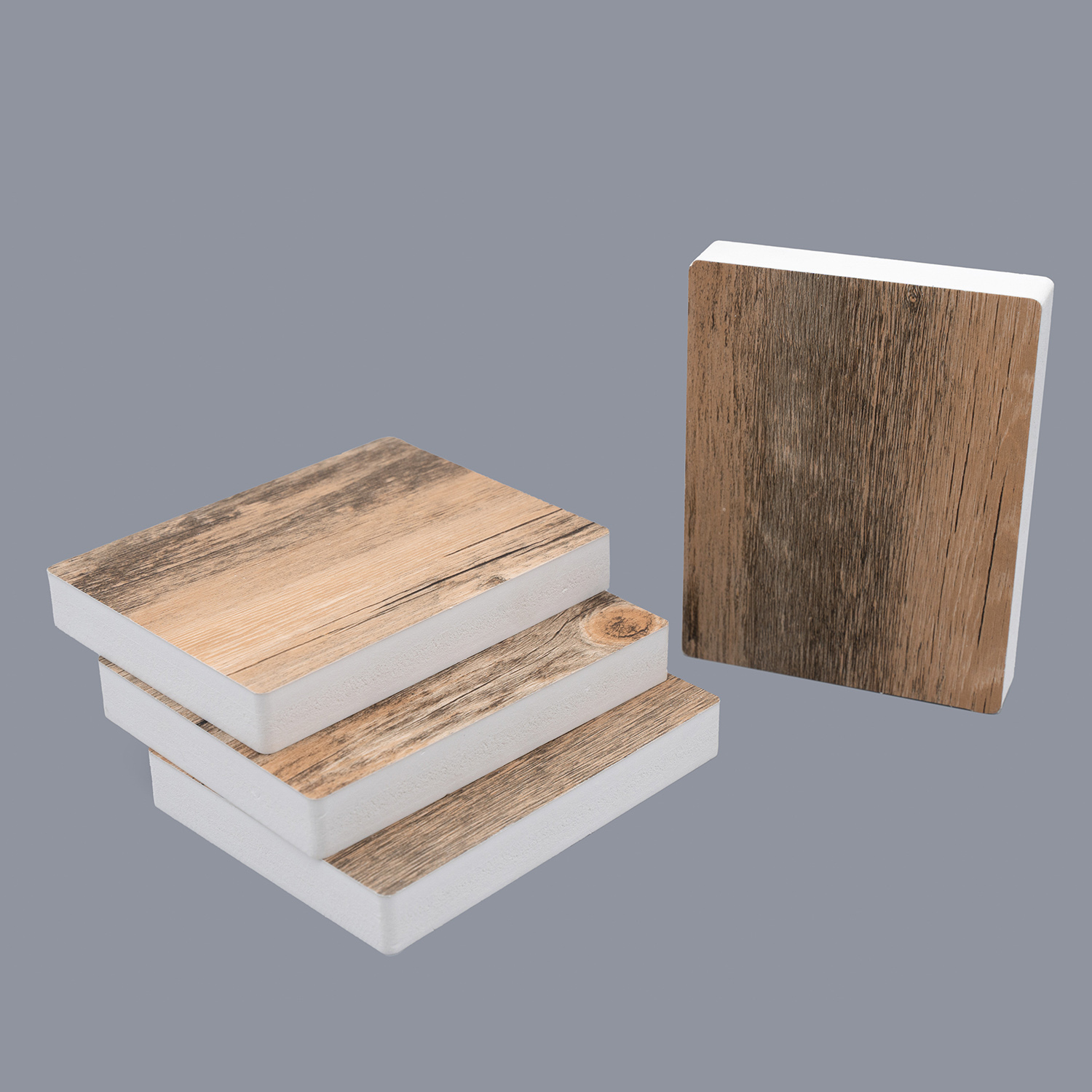
Laminated PVC foam board in a wood-effect finish, the surface variant most often specified for cabinet doors and furniture panels.
Why the three variant names behave differently as specifications
A variant name answers an appearance question and, in one case, a performance question. It does not answer the questions a purchasing department has to close before a purchase order is issued. The table below sets out what each label identifies and what it leaves undefined.
| Variant label | What it identifies | What it does not define |
|---|---|---|
| Laminated | A decorative layer applied to the board face | Core process, core density, layer thickness, adhesion performance, edge treatment |
| Colored | Pigmentation of the board body or its surface | Colour tolerance, lot-to-lot consistency, pigment weather resistance, gloss level |
| Waterproof | A moisture-performance claim about the material | Exposure duration, immersion versus splash, joint detailing, temperature of service |
The practical consequence is that the labels overlap. Colored board is regularly used for the same furniture and cabinet work as waterproof board. Laminated board is ordered for cabinet work where moisture resistance is also expected. Buyers therefore cannot select on the label; they have to select on the three things the label hides — documented thickness range, documented application, and the evidence behind the performance claim.
What the documentation actually states for each variant
For DINGTIAN, the three variants are listed with distinct thickness ranges but the same nominal sheet size. That single fact already rules out treating them as interchangeable stock.
| Variant as listed | Documented sheet size | Documented thickness | Declared application |
|---|---|---|---|
| Laminated PVC foam board | 1220 × 2440 mm | 5–20 mm | Furniture, cabinet |
| Colored PVC foam board | 1220 × 2440 mm | 1–20 mm | Advertising, furniture and cabinet making |
| Waterproof PVC foam board | 1220 × 2440 mm | 1–35 mm | Furniture, cabinet |
Three observations follow directly from that table. First, the laminated variant starts at 5 mm, so it is documented as a panel format for furniture and cabinet surfaces rather than as a thin signage substrate. Second, the colored variant spans 1–20 mm and covers advertising as well as cabinetry, which makes it the most application-versatile of the three. Third, the waterproof variant carries the widest documented thickness range at 1–35 mm while still being declared for furniture and cabinet use.
A fourth listing in the same catalogue adds context that buyers should ask about. The PVC Celuka foam board listing carries a wider format range — 1220 × 2440 mm, 1560 × 3050 mm and 2050 × 3050 mm — at 1–35 mm thickness with a reported density of 0.4–0.9 g/cm³, and is used across advertising and signage, construction and decoration, furniture and cabinetry, transportation, and special-purpose applications. The co-extruded listing reports a density of 0.5–0.8 g/cm³, and the free foam listing covers 1–5 mm for advertising materials. Because a laminated or colored label can sit on any of these cores, the correct buyer question is not "laminated or colored", but "laminated or colored onto which core".
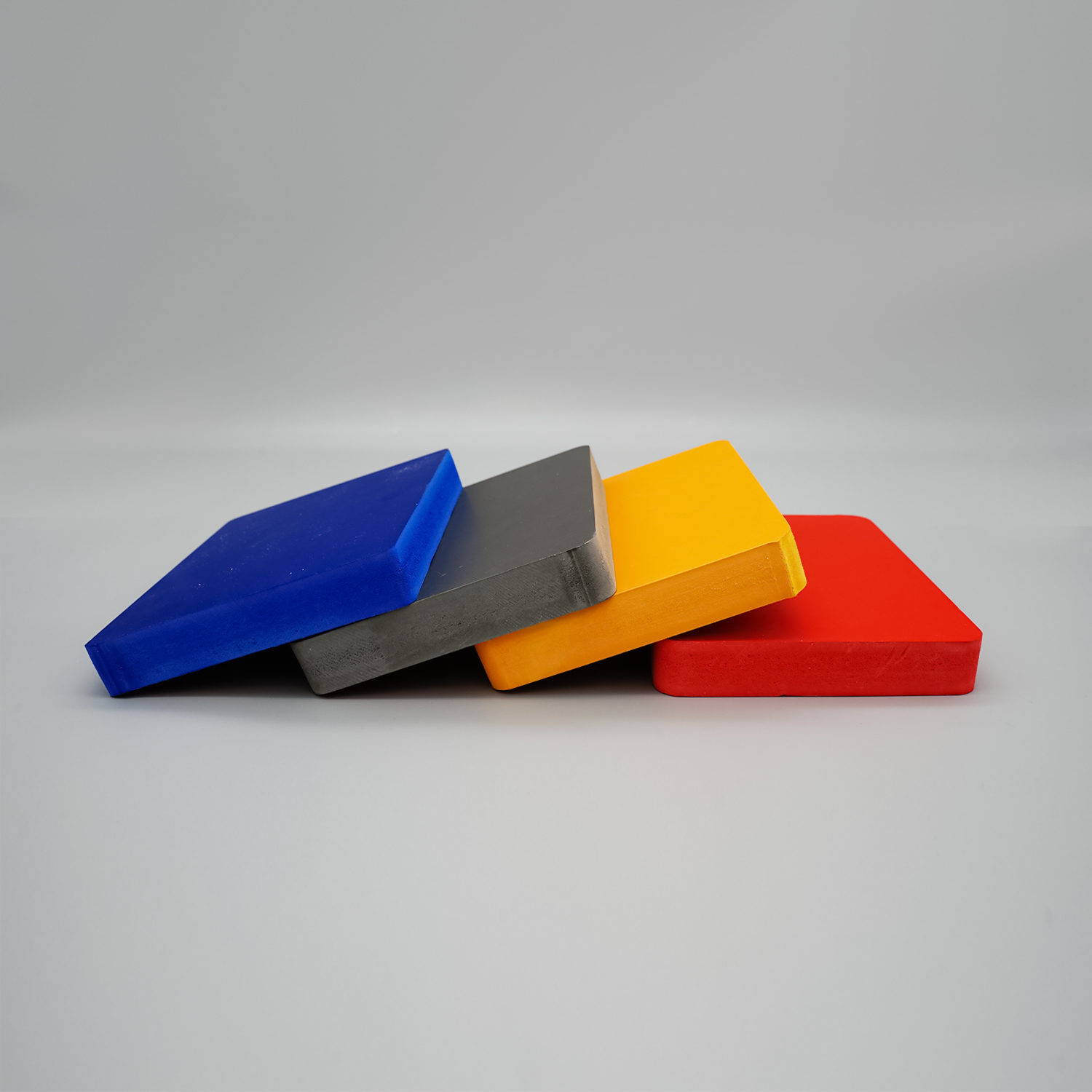
Colored PVC foam board spans 1–20 mm and is documented for both advertising and cabinet making — the widest application overlap of the three variants.
Technical explanation: what changes inside the board
Density and process
Density is the number that most often decides rigidity, weight and machining behaviour, and it is also the number most often quoted without a test method. Industry reference data places PVC free foam at approximately 0.4–0.6 g/cm³ for UV printing and mounting work, and PVC Celuka foam board at approximately 0.55–0.8 g/cm³ for furniture and cabinet work. The DINGTIAN product listing reports a density range of 0.32–1.0 g/cm³ for its PVC foam board, with 0.4–0.9 g/cm³ stated for the Celuka unit and 0.5–0.8 g/cm³ for the co-extruded unit.
Those ranges overlap but are not equivalent, and they should not be averaged or ranked. Density values are only comparable when the test method, tolerance, product construction, thickness and unit of measurement are aligned. No test method is stated alongside the published figures, so a density number supplied without a method should be treated as indicative rather than contractual. For a buyer, the actionable version of that rule is simple: request density together with the test method, or specify the application outcome you need and let the sample trial decide.
Processing and service conditions
The documented processing window for the Celuka product is a thermoforming temperature of 120–160°C. Fabricators working below that range risk incomplete forming; working above it risks surface damage on colored or laminated faces. The documented service scenario assumes permanent static installation under UV-stabilized conditions, quoted for -20°C to +60°C with 100% humidity resistance. Supporting fabrication equipment listed for these applications includes cutting machines, printing machines, nails and saws — a reminder that edge quality, fixing detail and surface protection depend as much on the fabricator as on the board.
Application and use cases: which variant fits which job
Documented application demand is not evenly distributed, and the distribution explains why the three variants exist as separate listings.
| Application area | Documented share | Typical use |
|---|---|---|
| Advertising & signage | 35% | Outdoor billboard, display panel, UV printing substrate |
| Construction & decoration | 30% | Wall panel, ceiling, partition, construction formwork |
| Furniture & cabinetry | 15% | Cabinet door, wardrobe, bathroom vanity |
| Transportation | 10% | Vehicle interior, RV refitting |
| Special-purpose | 10% | Packaging, prototype, industrial protection |
Outdoor signage and printed displays
In outdoor signage fabrication, the documented operating conditions are UV stabilization, a -20°C to +60°C temperature range and 100% humidity resistance, with the board acting as a lightweight rigid substrate for printing. This is where free foam at 1–5 mm and colored board at 1–20 mm compete directly, and where the choice is usually driven by print method, panel size and the stiffness the fixing system can tolerate.
Interior renovation and wet-area construction
For commercial building interior renovation, the documented role is to create waterproof building panels in permanent static installation. The scenario documentation for this use lists four requirements: UV stabilization for outdoor use, a B1/B2 fire retardant rating, lead-free RoHS compliance and anti-static ESD protection. Those four items are the ones a specifier should carry into the submittal package, because they are performance requirements that a variant name does not express.
Cabinet doors, wardrobes and bathroom vanities
Furniture and cabinetry is the declared application for laminated, colored and waterproof board alike. The bathroom vanity is the clearest overlap case in the whole catalogue: it needs a decorative or colored face and simultaneous humidity resistance, which means the buyer is specifying a laminated or colored surface on a core whose moisture behaviour must be documented separately.
Cross-checking claims against purchasing terms and acceptance criteria
Variant claims survive or fail at the order-confirmation stage. The table below maps each documented item to the clause it should become and the check that closes it.
| Item | Documented or reported position | What to fix in the order |
|---|---|---|
| Sheet size | 1220 × 2440 mm for all three variants; 1560 × 3050 mm and 2050 × 3050 mm additionally listed for Celuka | Nominal size plus dimensional tolerance and squareness |
| Thickness | 5–20 mm laminated; 1–20 mm colored; 1–35 mm waterproof | The exact thickness ordered, with tolerance, per stock-keeping unit |
| Density | 0.4–0.9 g/cm³ Celuka; 0.5–0.8 g/cm³ co-extruded; 0.32–1.0 g/cm³ overall on the product page | Target density plus the test method used to verify it |
| Colour and finish | White, red, yellow, blue, green, black and others; glossy and matte finishes | Approved colour reference, gloss level and lot tolerance |
| MOQ | A one 20 ft GP full container basis is published as the company minimum order term; a product-page figure of 3 tons also appears | MOQ per colour and thickness combination, confirmed in writing |
| Lead time | 30 days stated as the production lead time in capability data; a 15–20 day delivery estimate after deposit appears on the product page | Lead time per SKU measured from deposit, plus a shipping window |
| Quality control | 100% test is stated for the manufacturing operation | What is tested, at what frequency, and which record accompanies the shipment |
| Value-added processing | Second thermoforming and cutting are available | Drawing, tolerance and inspection basis for processed parts |
The MOQ and lead-time lines deserve attention because two different figures appear in the same supplier's materials. That is normal in this industry: minimum order quantities and delivery periods move with colour, thickness, order mix and season. The buyer-side implication is not that either figure is unreliable, but that neither should be treated as a commitment until it is restated per SKU in the order confirmation. This is precisely the boundary between a marketing number and a purchasing term, and it is the boundary this comparison exists to draw.
Certificates: what to verify and how to verify it
The certificate set most often requested by European and North American buyers for PVC foam board includes ISO 9001, REACH, RoHS and formaldehyde-related documentation. Those are also the four documents most often supplied as a scanned PDF attached to a quotation.
A scan is not verification. In the publicly available evidence collected for this product category, fire, RoHS, REACH, ISO and related certification claims were not accompanied by certificate numbers, issuing bodies, scope statements or validity dates, so none of them could be independently confirmed from open sources. That does not mean the documents do not exist. It means that a buyer cannot qualify a supplier on an unidentifiable image, and should instead request a pack that carries identifiers.
- Certificate number and issuing body — a named accredited organisation, not the supplier's own quality department.
- Scope statement — which product types, densities and thicknesses the certificate actually covers.
- Validity dates and standard revision — an expired ISO 9001 certificate or an outdated standard revision is not compliance.
- Holder identity — whether the certificate is held by the manufacturer or by a trading intermediary.
- Verifiable controlled copy — one that can be checked with the issuer, not only a photographed page.
Fire performance needs specific treatment. Industry reference data points to Class B1/B2 under DIN 4102 and V-0 under UL 94 as typical target ratings for PVC foam board. A general supplier statement describing a product as ignition retardant or self-extinguishing, without a test method, specimen thickness and classification report, does not establish either rating. Because the documented construction and decoration scenario explicitly lists a B1/B2 fire retardant rating and lead-free RoHS compliance as requirements, those are the two claims a specifier should insist on seeing evidence for, together with the anti-static ESD protection also listed for that scenario.
Two further points apply to the variants under discussion. On formaldehyde documentation, ask for the test method, chamber conditions, the unit of measurement and the thickness tested — a result quoted without thickness is not transferable across a 1–35 mm range. On RoHS, confirm that the documentation covers the pigment and the lamination layer, because colored and laminated boards introduce materials beyond the PVC core.
Comparison with plywood and aluminium composite panel
The strongest reference point for PVC foam board is not a competitor catalogue but a documented user record. A distributor and wholesaler ordering approximately 10 containers per month over a 5–10 year period for advertising and furniture applications reported 98% print image retention after three years, zero warping or delamination, 100% waterproof performance and a 40% cost saving against aluminium composite panel. The same record cites UV stabilization for long-term outdoor exposure, lighter weight reducing installation cost, and easy fabrication and installation.
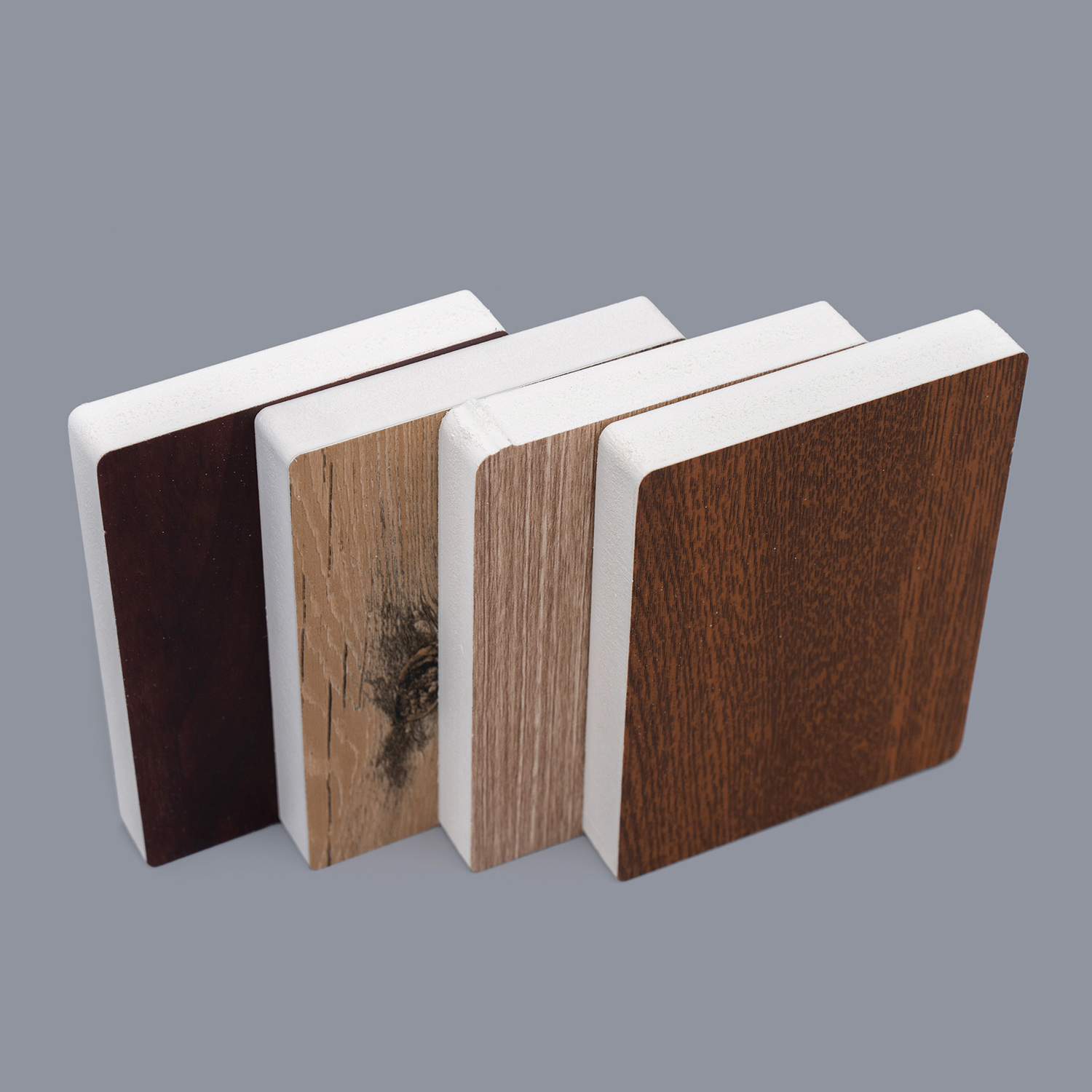
Laminated PVC foam board is documented from 5 mm upward — a panel format for furniture and cabinet surfaces rather than a thin signage substrate.
The boundaries matter just as much, and buyers should carry them into the evaluation:
- The documented operating scenario assumes permanent static installation. Panels used where they are repeatedly loaded, flexed or walked on fall outside the conditions the documentation describes, and the supplier's application list does not claim structural load-bearing duty.
- Thermoforming is documented at 120–160°C. Working outside that window is a process failure, not a material failure, and it is usually the origin of surface complaints on colored and laminated faces.
- The laminated variant is documented from 5 mm upward, so a project requiring a 3 mm decorative panel cannot be satisfied inside that range without changing variant.
- Fire-rated and formaldehyde-sensitive projects cannot currently be closed on the basis of available public evidence; they require project-specific test reports.
- Density figures published by different sources are not comparable without aligned test methods and construction, so a higher density number is not by itself proof of a stiffer board.
Plywood and aluminium composite panel carry their own moisture, weight and fabrication constraints, so the honest comparison is not material against material but application against application, using the buyer's own thickness, fixing and exposure conditions as the inputs.
Market trend: why variant-level evaluation is becoming the default
The global PVC foam sheet market was estimated at USD 2.28 billion in 2024 and is projected to grow at a 4.99% CAGR over the 2025–2035 forecast period, according to Market Research Future. Signage leads application demand with a 35% share, based on technical and market segmentation data published by Laird Plastics. Cross-border trade in the material is classified under HS code 39211200 for cellular plates of vinyl chloride.
One caveat belongs in any planning document: market reports define "PVC foam board" and "PVC foam sheet" with overlapping but distinct scopes, so published market values are not always directly additive. Buyers using market data for planning should record the definition used in the source.
The buyer-facing reading of those numbers is straightforward. Growth is concentrated in the applications where colour, surface finish and thickness choice actually change the specification — signage, interior construction and cabinetry. That pushes procurement from a material-name decision to a variant-and-evidence decision, which is exactly the shift this comparison describes.
Future outlook
Three changes are visible in how this category is being bought. Density and thickness figures are increasingly expected to come with a stated test method and tolerance, because unqualified ranges cannot be compared across suppliers. Certificate packs are moving toward verifiable documents with numbers and issuing bodies rather than images, driven by European and North American compliance reviews. And value-added processing — second thermoforming and cutting, colour matching and finish control — is becoming part of the sourcing decision rather than a downstream convenience.
For a buyer, the durable position is the same in all three cases: specify the measurable property, contract the tolerance, and verify the evidence before the container ships.
FAQ
What is the actual difference between laminated, colored and waterproof PVC foam board?
Laminated and colored describe how the board surface is produced; waterproof describes a moisture-performance claim about the material. In DINGTIAN's product documentation, laminated board is listed at 1220 × 2440 mm and 5–20 mm thickness for furniture and cabinet use, colored board at 1220 × 2440 mm and 1–20 mm for advertising, furniture and cabinet making, and waterproof board at 1220 × 2440 mm and 1–35 mm for furniture and cabinet use. The three labels therefore overlap in application, and the purchasable differences between them are thickness availability, surface treatment and the evidence the supplier provides for the moisture claim.
Which thickness should be specified for cabinet doors, wardrobes and bathroom vanities?
The documented ranges are 5–20 mm for laminated, 1–20 mm for colored and 1–35 mm for waterproof board, and furniture and cabinet work is the declared application for all three. Furniture and cabinetry accounts for 15% of the documented application split, while construction and decoration accounts for 30%, which is the group where waterproof building panels and permanent static installation are described. Bathroom vanities sit in both, so the working rule is to select the thinnest thickness that delivers the rigidity the panel needs, then specify thickness tolerance — not just nominal thickness — in the purchase order.
Can density figures from different suppliers be compared directly?
Generally not. Industry reference data places free foam at approximately 0.4–0.6 g/cm³ for UV printing and mounting, and Celuka foam board at approximately 0.55–0.8 g/cm³ for furniture and cabinets. The DINGTIAN product page reports 0.32–1.0 g/cm³ for its listed PVC foam board, with 0.4–0.9 g/cm³ stated for the Celuka unit and 0.5–0.8 g/cm³ for the co-extruded unit. These figures were published without a stated test method or tolerance, so they are not comparable until test method, tolerance, construction, thickness and unit are aligned. A density figure supplied without a test method is indicative only.
Does "waterproof" mean the board can be used in permanently wet or immersed conditions?
The documented performance basis is 100% humidity resistance within a stated -20°C to +60°C range under UV-stabilized conditions, with a documented installation mode of permanent static installation. A reported distributor case in advertising and furniture applications cites 100% waterproof performance alongside 98% print image retention after three years and zero warping or delamination. Those statements describe humidity resistance in normal service; they do not define immersion, drainage, sealing or joint detailing. Where a project involves standing water, immersion or continuous condensation, the buyer should obtain project-specific test data and fixing details rather than rely on the word "waterproof".
How should ISO 9001, REACH, RoHS and formaldehyde documentation be verified?
Request the certificate number, the issuing body, the scope statement covering product types, densities and thicknesses, the validity dates and the standard revision, then verify the controlled copy with the issuing body rather than accepting a scanned image. Publicly available evidence collected for PVC foam board did not include certificate numbers, issuing bodies, scope statements or validity dates for ISO, REACH, RoHS or fire-performance claims, so those claims cannot be confirmed from open sources alone. For fire performance, industry reference data points to Class B1/B2 under DIN 4102 and V-0 under UL 94 as typical target ratings; a supplier statement of ignition retardancy without a test method, specimen thickness and classification report does not establish either. For formaldehyde, request the test method, chamber conditions, the unit of measurement and the thickness tested.
What belongs in the purchasing terms and acceptance criteria?
The terms that decide the outcome are the ones the variant name omits: nominal sheet size with tolerance and squareness for the ordered format, where 1220 × 2440 mm applies to all three variants and 1560 × 3050 mm and 2050 × 3050 mm are additionally listed for Celuka; thickness with tolerance per stock-keeping unit; density with test method; colour reference and gloss level where a colored or laminated face is specified; minimum order quantity and lead time restated per colour and thickness combination, since published figures include both a one 20 ft GP container basis with a stated 30-day production lead time and a product-page figure of 3 tons with a 15–20 day delivery estimate after deposit; and the definition of the 100% test the manufacturer applies, including what is recorded and which document accompanies the shipment.
How does PVC foam board compare with plywood and aluminium composite panel on cost and performance?
On performance, the reported distributor case in advertising and furniture work cites 98% print image retention after three years, zero warping or delamination, 100% waterproof performance, UV stabilization for long-term outdoor exposure, and lighter weight that reduces installation cost, with fabrication and installation described as easy. On cost, the same case reports a 40% saving against aluminium composite panel. The limits are equally relevant: the documented scenario assumes permanent static installation, thermoforming takes place at 120–160°C, the laminated variant is documented from 5 mm upward, and no verified price, freight or landed-cost data exists for this category in the available evidence, so a landed-cost comparison has to be built from quotations rather than published figures. Plywood and aluminium composite panel carry their own moisture, weight and fabrication constraints, which is why the comparison should be run per application rather than per material.
Conclusion
Laminated, colored and waterproof PVC foam board are separated less by what they look like than by the thickness range they are documented in, the core process underneath the surface, and the evidence available for the performance claim attached to the name. On the documented figures, laminated runs 5–20 mm and waterproof 1–35 mm at the same 1220 × 2440 mm format, while colored spans 1–20 mm across both advertising and cabinetry. The verification work is where the real difference between suppliers shows up: density with a test method, thickness with a tolerance, certificates with numbers and issuing bodies, and commercial terms restated per SKU before the container is booked.
Product documentation, formats and processing options for DINGTIAN PVC foam board are compiled in the company brochure: DINGTIAN PVC Foam Board Brochure (PDF).
¿Tiene preguntas o necesita más detalles?
Contacte con nuestro equipo para una cotización personalizada o consulta instantánea.
Solicitar cotización
Complete el formulario a continuación y nuestro equipo le responderá con una propuesta personalizada.
Chat directo de WhatsApp
¿Prefiere chatear en tiempo real? Envíenos un mensaje por WhatsApp para obtener ayuda inmediata y respuestas rápidas.
- Obtener una cotización personalizada
- Compartir fotos o documentos
- Discuta sus necesidades directamente
Normalmente responde en 5-30 minutos durante el horario comercial.