
Label Printing Machines by Die-Cutting Method: 220, 300/320, 350/380 Shortlist
Label Printing Machines by Die-Cutting Method: 220, 300/320, 350/380 Shortlist
Die-cutting configuration is one of the few machine attributes that changes how a label converter prices a job, sizes a run and schedules capacity. It is also one of the most practical ways to shortlist label printing machines, because it separates platforms built around flatbed tooling, platforms that carry flatbed and rotary die-cutting in the same frame, and platforms built around rotary die-cutting for continuous production.
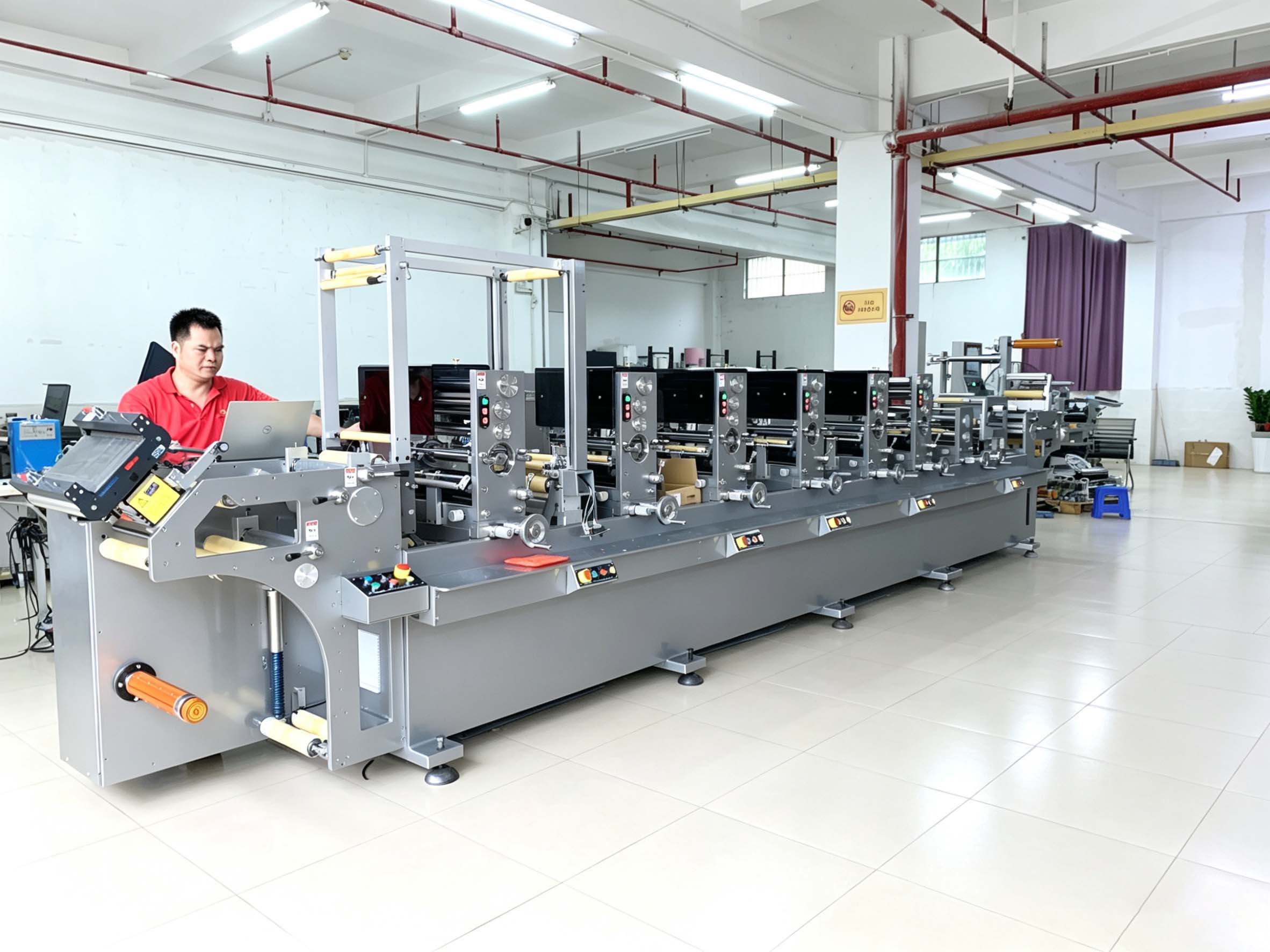
A CS-300 platform during installation and debugging, set up with glue-side printing, rotary die-cutting and flatbed die-cutting in one line.
Shenzhen Caisheng Printing Machinery Co., Ltd. (CAISHENG) is a Shenzhen-based label printing equipment manufacturer founded in 2011. The company operates a 6,000 m² facility with 65 employees, an eight-engineer R&D team and an annual output of 200 units, and it serves Southeast Asia, Europe, the Middle East and the United States, with exports representing about 50% of its sales. Its programme covers intermittent and high-speed full-rotary letterpress printing machines, flexographic printing machines and screen printing machines, alongside customised multi-functional label finishing solutions that include die-cutting systems and high-speed varnishing machines.
Why die-cutting method is a shortlisting criterion, not a detail
Flatbed and rotary die-cutting are not competitors in the abstract; they are two different ways of transferring cutting pressure to a moving web, and each carries its own tooling cost, cycle behaviour and changeover profile. A flatbed die-cutting station presses a flat die vertically against the web. That geometry generally makes flatbed tooling the cheaper entry point and keeps shape changes and low-volume work economical. Rotary die-cutting transfers the cut from a rotating cylinder, which is generally associated with continuous web movement and with tooling investment that is justified by repeat volume rather than by one-off runs.
Because the die-cutting station sits at the end of the line, the choice also shapes registration strategy, waste handling and whether finishing modules can run in the same pass. A converter who buys a machine without checking the die-cutting configuration can end up with a press that prints well but forces cut-and-stack work offline — an operational cost that shows up long after the purchase decision.
The three CAISHENG die-cutting families at a glance
CAISHENG groups its label printing machines into three families defined by die-cutting emphasis: the CS-220 series for flatbed die-cutting, the CS-300 and CS-320 series as flatbed-plus-rotary die-cutting combination machines, and the CS-350, CS-370 and CS-380 series as rotary die-cutting combination machines.
| Group | Die-cutting emphasis | Model families | Web width | Max print area | Max printing speed |
|---|---|---|---|---|---|
| CS-220 series | Flatbed die-cutting | CS-220-4C, CS-220-5C | 30–240 mm | 220 × 245 mm | 40 m/min |
| CS-300 / CS-320 series | Flatbed + rotary die-cutting combination | CS-300-5C, CS-300-6C, CS-320-6C, CS-320-7C | 30–300 mm (CS-300), 30–320 mm (CS-320) | 280 × 326 mm; 320 × 326 mm | 40 m/min |
| CS-350 / CS-370 / CS-380 series | Rotary die-cutting combination | CS-JQ350G-6C, CS-JQ350-7C, CS-JQ350G-10C, CS-J380F-4C, CS-J380F-7C, CS-Q370F-6C, CS-370F-8C | 350–370 mm class formats | 350 × 419 mm; 360 × 419 mm; 370 × 200 mm and 370 × 600 mm | 158 m/min full rotary (JQ350 class); 60 m/min (J380F); 150 m/min (Q370F, 370F) |
Group 1: CS-220 series — flatbed die-cutting platforms
The CS-220 group is the entry point of the shortlist and the family most clearly tied to flatbed die-cutting. It contains two intermittent letterpress models, the CS-220-4C intermittent label press and the CS-220-5C stickers printing machine.
| Model | Machine type | Web width | Max print area | Max printing speed | Power | Machine size / weight |
|---|---|---|---|---|---|---|
| CS-220-4C | Intermittent letterpress label printing machine | 30–240 mm | 220 × 245 mm | 40 m/min | 8.4 kW main machine + 3.7 kW UV dryers | 4.2 × 1.0 × 1.5 m / 2.6 T |
| CS-220-5C | Intermittent letterpress label printing machine | 30–240 mm | 220 × 245 mm (max intermittent 220 × 200 mm) | 40 m/min | 17 kW including UV dryers | 6.6 × 1.0 × 1.5 m / 3.6 T |
The practical case for this group is floor space and simplicity. The CS-220-4C occupies a 4.2 m × 1.0 m footprint at 2.6 T, which is small enough for a workshop that cannot dedicate a long line to label work, and the 30–240 mm web range covers narrow self-adhesive label and sticker formats. Both models share a 40 m/min maximum printing speed, so the buying decision inside the group is usually about print stations and finishing needs rather than speed.
Where the CS-220 group stops being the right answer
The same characteristics that make flatbed-equipped CS-220 machines efficient for short and medium runs also limit them. The 220 mm class format constrains the maximum print area to 220 × 245 mm, so wider multi-up layouts move out of scope. The 40 m/min ceiling is a fixed specification across the group, which means converters chasing sustained high-volume output will need to look at the higher-speed families rather than add stations to a CS-220.
Group 2: CS-300 / CS-320 series — flatbed plus rotary die-cutting combination machines
The CS-300 and CS-320 series is the middle of the shortlist and the most flexible group, because it is positioned as a combination platform that can carry flatbed die-cutting and rotary die-cutting in one machine frame. This is the group that lets a converter run short, shape-heavy jobs on flatbed tooling and switch to rotary die-cutting for repeat volume without buying a second press.
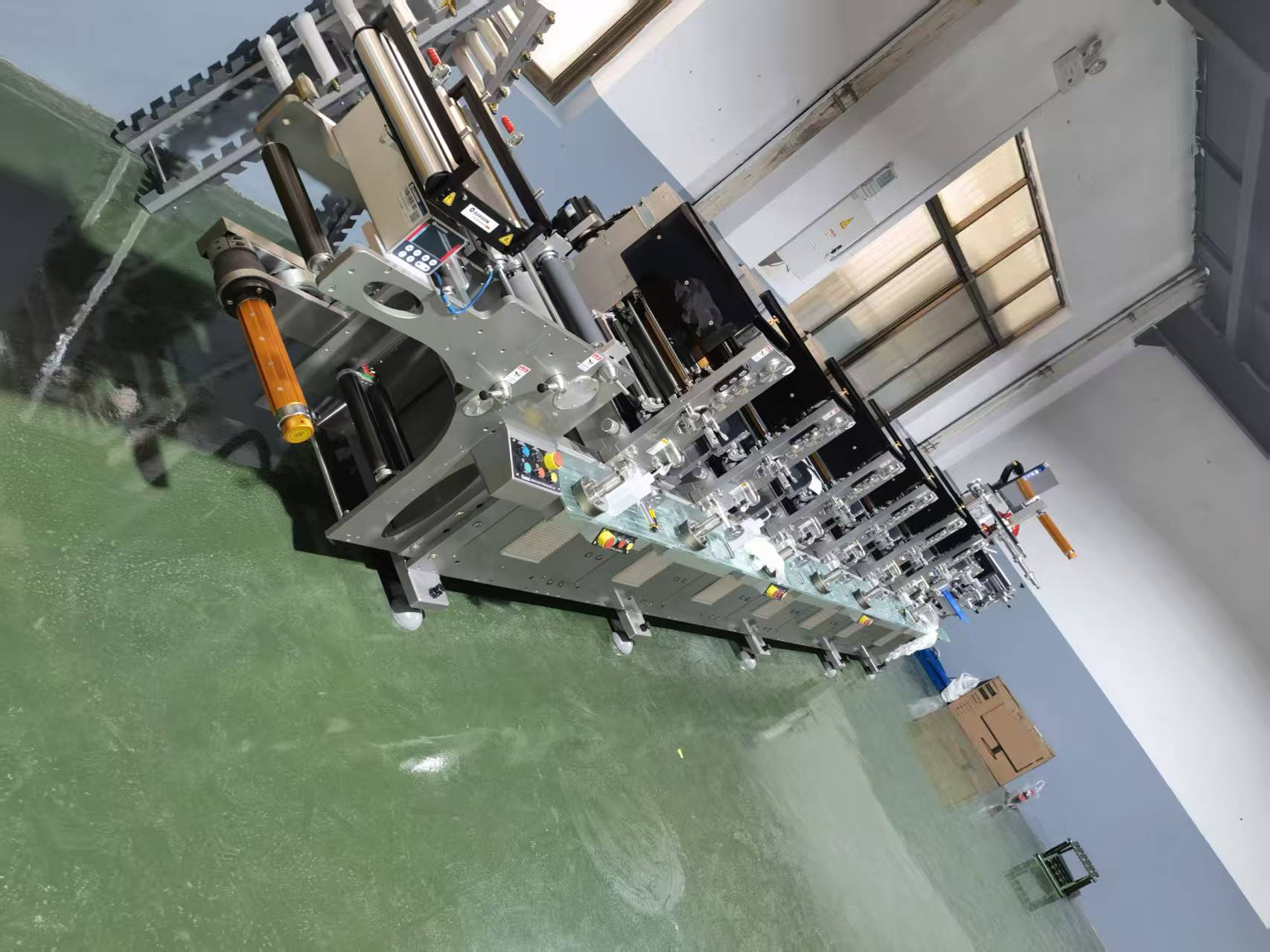
A CS-300 semi-rotary letterpress label printing machine, the mid-range platform used for combined flatbed and rotary die-cutting work.
| Model | Machine type | Web width | Max print area | Max printing speed | Power | Machine size / weight |
|---|---|---|---|---|---|---|
| CS-300-5C | Intermittent letterpress label printing machine (self-adhesive label press) | 30–300 mm | 280 × 326 mm (max intermittent 280 × 300 mm) | 40 m/min | 18.8 kW main machine + 6 kW UV dryers | 6.5 × 1.5 × 1.8 m / 5 T |
| CS-300-6C | Intermittent letterpress label printing machine (rotation label machine) | 30–300 mm | 280 × 326 mm (max intermittent 280 × 300 mm) | 40 m/min | 34.5 kW including UV dryers | 8.9 × 1.5 × 2.0 m / 6.6 T |
| CS-320-6C | Intermittent letterpress label printing machine (semi-rotary label printing machine) | 30–320 mm | 320 × 326 mm (max intermittent 320 × 300 mm) | 40 m/min | 27 kW including UV dryers | 8.4 × 1.5 × 2.0 m / 6.2 T |
| CS-320-7C | Intermittent letterpress label printing machine (rotary label press) | 30–320 mm | 320 × 326 mm (max intermittent 320 × 300 mm) | 40 m/min | 31 kW including UV dryers | 9.1 × 1.5 × 2.0 m / 7 T |
The step from the CS-300 frame to the CS-320 frame is a format decision rather than a speed decision: both are specified at 40 m/min, but the CS-320 widens the web from 30–300 mm to 30–320 mm and lifts the maximum print area from 280 × 326 mm to 320 × 326 mm. Within each frame, the number of print and finishing stations drives power and mass — the CS-300-5C is specified at 18.8 kW and 5 T, while the CS-300-6C is specified at 34.5 kW and 6.6 T.
What "combination" looks like on the factory floor
CAISHENG publishes installation documentation for this group showing a six-colour letterpress platform configured with glue-side printing, a multi-functional frame, rotary die-cutting, flatbed die-cutting and slitting in a single line. For a buyer, that configuration matters more than a single headline specification: it means one pass can print, varnish, cut with rotary tooling for the repeat element of the job and cut with flatbed tooling for the part of the job that needs a flat die, then slit the web. Job changeover logic, not top speed, is what this group sells.
Group 3: CS-350 / CS-370 / CS-380 series — rotary die-cutting combination machines
The third group is the production-oriented end of the shortlist. These are the models a buyer selects when rotary die-cutting is the default method and the machine has to keep a web moving continuously rather than index it.
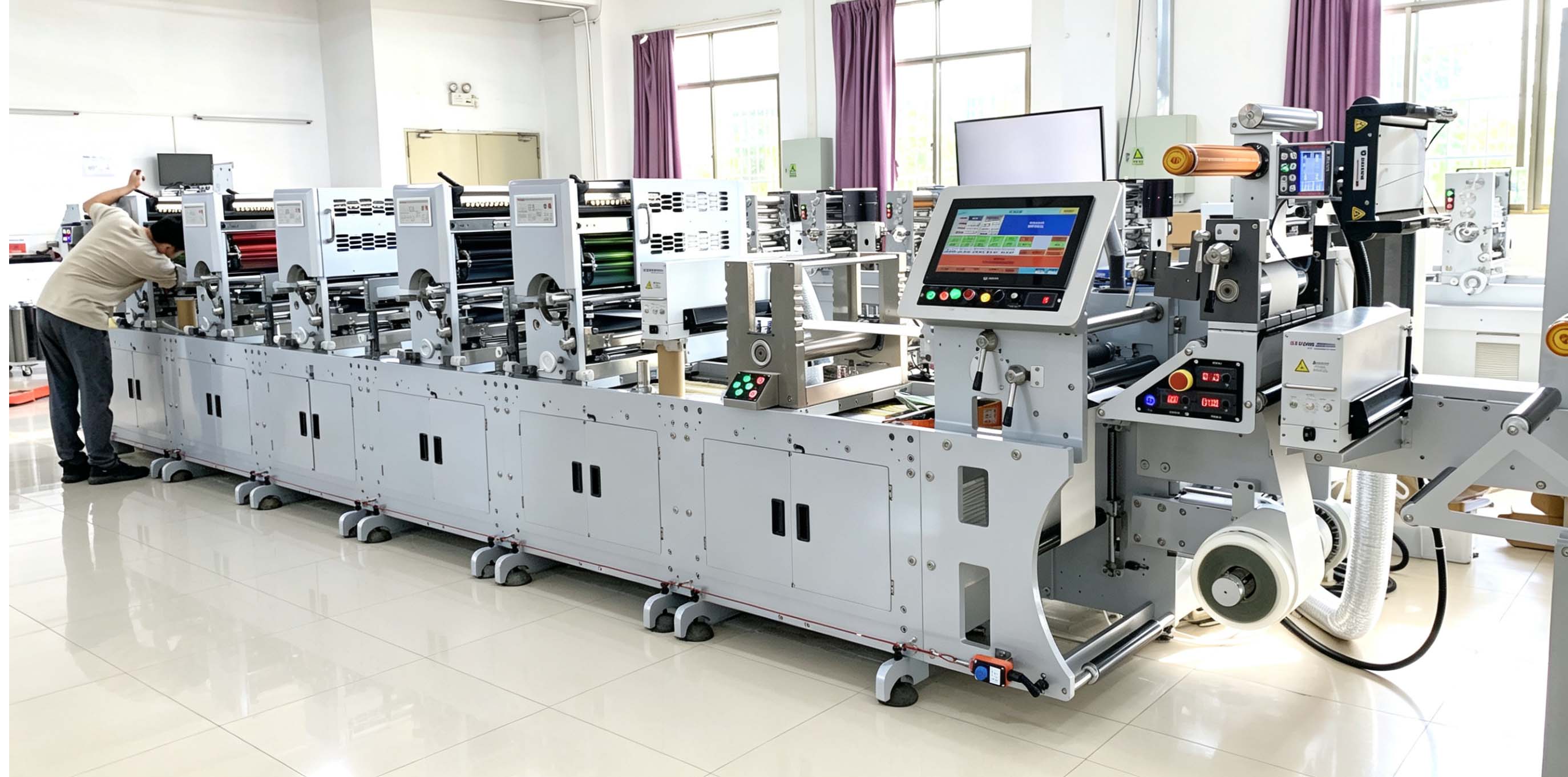
A CS-JQ350G high-speed intermittent and full-rotary label printing machine being installed and debugged.
| Model | Machine type | Max print area (full rotary / intermittent) | Max printing speed | Power | Machine size / weight |
|---|---|---|---|---|---|
| CS-JQ350G-6C | Intermittent & full-rotary high-speed label printing machine | 350 × 419 mm / 350 × 380 mm | 60 m/min intermittent; 158 m/min full rotary | 22 kW main machine + 7.8 kW UV dryers | 7.8 × 1.5 × 1.9 m / 10 T |
| CS-JQ350-7C | Intermittent & full-rotary high-speed label printing machine | 350 × 419 mm / 350 × 380 mm | 60 m/min intermittent; 158 m/min full rotary | 24.5 kW main machine + 9.1 kW UV dryers | 8.7 × 1.5 × 1.9 m / 10.8 T |
| CS-JQ350G-10C | Intermittent & full-rotary high-speed label printing machine | 350 × 419 mm / 350 × 380 mm | 60 m/min intermittent; 158 m/min full rotary | 34 kW main machine + 13.5 kW LED UV dryers | 12 × 1.5 × 2.0 m / 14 T |
| CS-J380F-4C | Flexo label printing machine | 360 × 419 mm / 360 × 380 mm | 60 m/min | 25 kW including UV dryers | 7.4 × 1.3 × 1.6 m / 4 T |
| CS-J380F-7C | Flexo label printing machine | 360 × 419 mm / 360 × 380 mm | 60 m/min | 35 kW including UV dryers | 9.3 × 1.3 × 1.6 m / 6 T |
| CS-Q370F-6C | Flexo label printing machine (full-rotary flexographic printing machine) | 370 × 200 mm and 370 × 600 mm | 150 m/min | 25 kW excluding UV dryers | 7.5 × 1.5 × 1.7 m / 7 T |
| CS-370F-8C | Flexo label printing machine (full rotation flexo press) | 370 × 200 mm and 370 × 600 mm | 150 m/min | 30 kW excluding UV dryers | 9.1 × 1.5 × 1.7 m / 8.6 T |
Two technology routes sit inside this group. The CS-JQ350G-6C, CS-JQ350-7C and CS-JQ350G-10C are intermittent and full-rotary high-speed label printing machines specified at 60 m/min in intermittent mode and 158 m/min in full-rotary mode, with a 350 × 419 mm full-rotary print area. The CS-J380F-4C and CS-J380F-7C are flexo label printing machines specified at 60 m/min with a 360 × 419 mm full-rotary print area, while the CS-Q370F-6C and CS-370F-8C are full-rotary flexographic presses specified at 150 m/min with print areas of 370 × 200 mm and 370 × 600 mm.
Station count again drives the specification. Going from the CS-JQ350G-6C to the CS-JQ350G-10C raises main machine power from 22 kW to 34 kW, adds 13.5 kW of LED UV drying and takes machine weight from 10 T to 14 T over a 12 m frame. Any buyer considering the ten-station platform should plan floor loading and power supply before comparing prices.
What changes when die-cutting moves from flatbed to rotary
Three things change in daily operation. First, the cutting action itself: flatbed stations work in a vertical stroke against an indexed web, while rotary stations cut from a rotating cylinder against a continuously moving web. Second, the economics of tooling: flatbed dies are generally cheaper and quicker to reorder, whereas rotary tooling carries higher initial cost that needs repeat volume to amortise. Third, the finishing logic: rotary die-cutting supports continuous output and therefore pairs naturally with in-line slitting, sheeting and rewinding.
CAISHENG's customisation list places both methods inside the same platform philosophy. Available modules include flatbed die-cutting, rotary die-cutting, sheet cutting, slitting, glue-side printing frame, color stamping, cold foil stamping, hot foil stamping, embossing, lamination, offline and online UV varnishing, full-rotary screen printing, corona treater, dust cleaner and static eliminator. That module list is the reason the three-group structure works as a shortlist: a converter can begin with the die-cutting method that matches the job mix, then add peripheral capability around it.
Matching each group to real production scenarios
The clearest evidence of how these groups behave in service comes from documented installations. In Taiwan, a renowned Asian trademark design and printing company installed one machine for high-quality label printing. The project ran for two years, and the reported outcome was superior printing precision, stable production performance and flexible process expansion capability. The CS-320-6C semi-rotary label printing machine and CS-320-7C rotary label press are the models linked to that installation, which places the case squarely in the flatbed-plus-rotary combination group.
In the United States, a global provider of commercial printing, packaging and marketing communication solutions installed one CS-300 series label printing machine for label production. After three years of operation, the customer reported stable registration accuracy, excellent print quality and reliable equipment performance, and credited the machine with improvements in production efficiency and product quality. This case sits in the CS-300 range, the entry point of the combination group.
Read together, the two cases describe a pattern rather than a coincidence: combination platforms are chosen where a converter has to serve more than one job type from the same line. The CS-220 group fits shops whose work is dominated by flatbed tooling and narrow formats. The CS-300/CS-320 group fits shops that need both die-cutting methods without buying two machines. The CS-350/370/380 group fits shops where rotary die-cutting dominates and throughput is the binding constraint.
Market context: what third-party data shows
Third-party research supports the direction of demand for these configurations. The global label printing machines market was valued at USD 8.58 billion in 2025 and is projected to reach USD 14.36 billion by 2034, according to The Insight Partners. Data Bridge Market Research puts Asia-Pacific at 41.8% revenue share of that market in 2025 — a relevant figure for a Shenzhen-based manufacturer whose export mix already spans Southeast Asia, Europe, the Middle East and the United States.
Technology mix matters as much as total size. Smithers values flexographic printing at approximately USD 13.3 billion in output value in 2024 and describes it as the most commonly used process for labels, while Grand View Research estimated the global flexographic printing machine market at USD 17.57 billion in 2024 with a 9.7% CAGR through 2030. Spherical Insights projects the narrow web label printing machines segment growing from USD 1.43 billion in 2024 to USD 3.21 billion by 2035.
Two cautions apply to these numbers. First, scope differs between sources: the same 2025 label printing machines market is estimated at USD 8.21 billion by Mordor Intelligence and USD 4.4 billion in a narrower label printers definition, because some studies include systems and consumables and others count machinery only. Second, the global supply landscape is competitive and well established; published market analysis names Bobst (Switzerland), Mark Andy (USA), Gallus/Heidelberg (Germany) and Nilpeter (Denmark) among the major participants. Buyers should treat all market figures as directional context, not as a substitute for testing a specific configuration against their own job mix.
Comparison with conventional configurations, and where the limits are
None of the three groups is universally correct, and CAISHENG's own specifications define the boundaries clearly.
- Speed ceiling on the 220 and 300/320 platforms. Every model in the CS-220, CS-300 and CS-320 series is specified at a maximum printing speed of 40 m/min. Converters with sustained high-volume demand will not close that gap with configuration changes; they need the 350/370/380 group, where the CS-JQ350G-6C, CS-JQ350-7C and CS-JQ350G-10C are specified at 158 m/min in full-rotary mode.
- The flexo models in the 380 class are not the fastest members of their own group. The CS-J380F-4C and CS-J380F-7C are specified at 60 m/min, while the CS-Q370F-6C and CS-370F-8C are specified at 150 m/min. Buyers who assume every 350/370/380 model is a 150 m/min-plus platform will mis-specify.
- Flatbed tooling economics invert at volume. Flatbed die-cutting is generally the lower-cost entry point and suits shorter runs and frequent shape changes, but rotary die-cutting is normally the better fit where the same shape runs repeatedly. Choosing flatbed-only capacity for a high-repeat product family is a common mismatch.
- Footprint, weight and power scale with stations. The CS-JQ350G-10C is specified at 12 m × 1.5 m × 2.0 m, 14 T and 34 kW plus 13.5 kW of LED UV drying. That specification is a building requirement, not only a machine specification.
- Certification scope is model-specific. The CE machinery directive attestation of conformity on file for CAISHENG — certificate number M.2025.206.C124100, issued by UDEM Uluslararası Belgelendirme Denetim Eğitim Merkezi A.Ş. and valid from 2025-11-08 to 2030-10-08 — names CS-300, CS-220 and CS-350 within its scope, against EN ISO 12100:2010 and EN 60204-1:2018. A buyer specifying another model or a heavily customised configuration should confirm which conformity documentation applies to that exact build rather than assuming coverage.
Avoiding these limits is largely a matter of sequencing: define the job mix and die-cutting method first, then choose the frame, then confirm the documentation and utility requirements for the configuration that results.
Procurement checklist for the die-cutting decision
CAISHENG's published commercial terms give buyers a fixed reference point for planning. Production is offered on an ODM basis, minimum order quantity is one unit, lead time is 45–60 days, monthly capacity is 18 units and quality control is described as 100% testing. After-sales support is delivered remotely, with a one-year warranty covering major components.
Against those terms, a practical evaluation sequence looks like this:
- Classify the work: what share of current jobs needs a flat die, and what share repeats at a volume that justifies rotary tooling.
- Select the group from that classification — CS-220 for flatbed-led work, CS-300/CS-320 where both methods are needed, CS-350/370/380 where rotary dominates and throughput matters.
- Confirm the format: 220 × 245 mm, 280 × 326 mm, 320 × 326 mm or 350–370 mm class print areas.
- Size the utilities: main machine power from 8.4 kW to 35 kW, plus UV or LED UV drying power up to 13.5 kW, and machine weight from 2.6 T to 14 T.
- Verify documentation for the exact model, including the CE attestation scope and the applicable safety standard for graphic technology equipment, ISO 12643-2:2023.
- Confirm market-specific regulatory requirements — for example, machinery sold in the EU must comply with Machinery Directive 2006/42/EC and carry CE marking.
- Run sample validation before committing to a full specification, and agree the remote support and warranty terms in writing.
Future outlook
Two granted Chinese patents indicate where platform development is heading. Invention patent ZL 2022 1 0411353.5, issued 2022-07-12 and valid to 2042-04-18, covers remote control of printing equipment based on big data — remote data collection, cloud computing analysis, remote start-stop and parameter adjustment, and online fault diagnosis. Utility model patent ZL 2022 2 1332174.4, issued 2022-09-16 and valid to 2032-05-30, covers a double-sided printing machine structure with a paper forward-reverse switching conveying mechanism and a registration correction assembly.
For buyers, the direction is practical rather than promotional: remote diagnostics reduce the cost of supporting machines across several markets, and registration-correction mechanisms target the precision that combination work depends on. As the label printing machines market moves toward the projected USD 14.36 billion by 2034, the shortlist question is likely to shift from "flatbed or rotary" toward "which single platform can carry both without losing speed" — which is precisely the gap the CS-300/CS-320 and CS-350/CS-370/CS-380 groups occupy in CAISHENG's line-up.
CAISHENG's corporate brochure is available for readers who want the manufacturer's own documentation alongside this overview: download the company brochure (PDF).
FAQ
What is the difference between flatbed and rotary die-cutting on a label printing machine?
Flatbed die-cutting presses a flat die vertically against the web, while rotary die-cutting transfers the cut from a rotating cylinder. Flatbed tooling is generally the lower-cost entry point and is commonly associated with shorter runs and more frequent shape changes; rotary tooling carries higher initial tooling investment and is normally justified by repeat production volume and continuous web movement. CAISHENG lists both flatbed die-cutting and rotary die-cutting among its customisation options and groups its machines by which method each series emphasises.
Which CAISHENG series should a converter consider for short-run or narrow-format label work?
The CS-220 series, comprising the CS-220-4C and CS-220-5C, is the flatbed die-cutting group. Both models accept a 30–240 mm web, are specified with a maximum print area of 220 × 245 mm and a maximum printing speed of 40 m/min, and the CS-220-4C occupies a 4.2 × 1.0 × 1.5 m footprint at 2.6 T. That combination of narrow format, small footprint and flatbed tooling suits short-run and frequently changing work, but it also sets the boundary: wider formats and higher sustained speeds are outside this group.
Can one machine run both flatbed and rotary die-cutting?
In CAISHENG's line-up, yes — that is the role of the CS-300 and CS-320 series, which is positioned as the flatbed-plus-rotary die-cutting combination group. The CS-300-5C, CS-300-6C, CS-320-6C and CS-320-7C are all specified at 40 m/min, with web widths of 30–300 mm (CS-300) or 30–320 mm (CS-320) and maximum print areas of 280 × 326 mm or 320 × 326 mm. Installation documentation shows a six-colour CS-300 platform configured with glue-side printing, a multi-functional frame, rotary die-cutting, flatbed die-cutting and slitting in one line.
Which CAISHENG models carry the CE machinery directive attestation?
The attestation of conformity on file, certificate number M.2025.206.C124100, was issued by UDEM Uluslararası Belgelendirme Denetim Eğitim Merkezi A.Ş. and is valid from 2025-11-08 to 2030-10-08. Its stated scope names CS-300, CS-220 and CS-350, assessed against EN ISO 12100:2010 and EN 60204-1:2018 for the EU market. Buyers specifying a model outside that scope — for example a CS-320, CS-370 or CS-380 configuration — should verify which conformity documentation applies to the specific model and build. The general safety standard for graphic technology equipment is ISO 12643-2:2023, and machinery sold in the EU must comply with Machinery Directive 2006/42/EC and carry CE marking.
What are the specified maximum printing speeds across the three die-cutting groups?
The CS-220, CS-300 and CS-320 series are all specified at 40 m/min. In the rotary die-cutting group, the CS-JQ350G-6C, CS-JQ350-7C and CS-JQ350G-10C are specified at 60 m/min in intermittent mode and 158 m/min in full-rotary mode; the CS-J380F-4C and CS-J380F-7C are specified at 60 m/min; and the CS-Q370F-6C and CS-370F-8C are specified at 150 m/min. Speed should be read alongside print area, power and machine weight, since those figures move together as stations are added.
What lead time, order quantity and after-sales terms does CAISHENG state?
CAISHENG states a minimum order quantity of one unit, a lead time of 45–60 days and a monthly production capacity of 18 units, with quality control described as 100% testing. Production is offered on an ODM basis, covering customisation such as flatbed die-cutting, rotary die-cutting, slitting, sheet cutting, glue-side printing, cold foil stamping, hot foil stamping, embossing, lamination, offline and online UV varnishing, full-rotary screen printing, corona treatment, dust removal and static elimination. After-sales support is provided remotely, with a one-year warranty covering major components.
Specifications quoted in this article are the manufacturer's published figures for the models named and should be re-confirmed for any customised configuration before purchase.